ESP MITSUBISHI MIRAGE G4 2019 (in English) User Guide
[x] Cancel search | Manufacturer: MITSUBISHI, Model Year: 2019, Model line: MIRAGE G4, Model: MITSUBISHI MIRAGE G4 2019Pages: 267, PDF Size: 38.31 MB
Page 90 of 267
Door locks
Features and controls 5-25
5
N00509201599
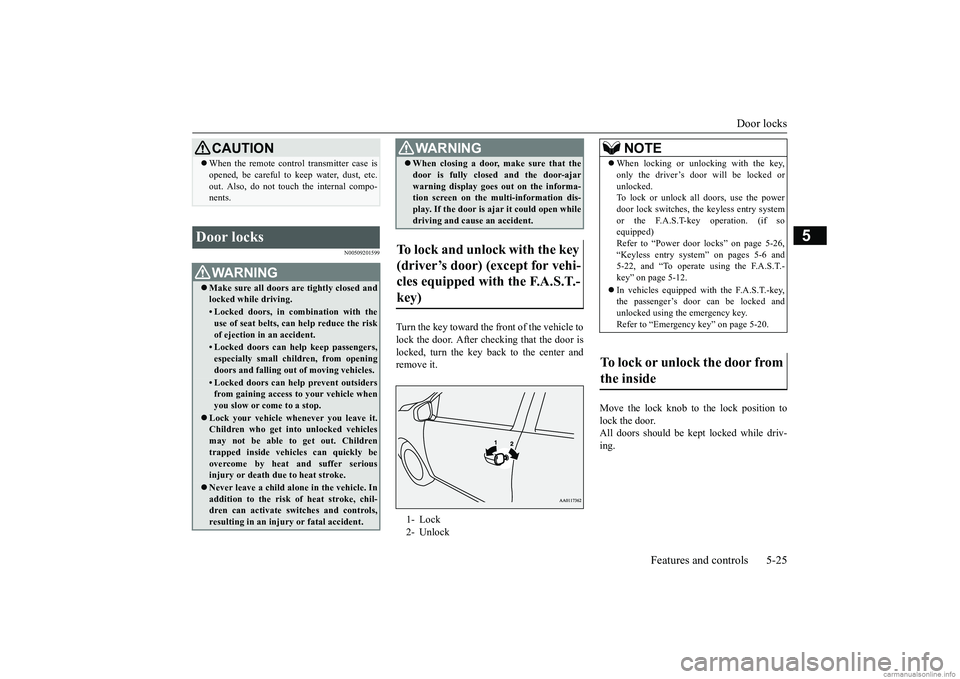
Turn the key toward the front of the vehicle to lock the door. After checking that the door is locked, turn the key back to the center and remove it.
Move the lock knob to the lock position to lock the door. All doors should be kept locked while driv-ing.
CAUTION When the remote control transmitter case is opened, be careful to keep water, dust, etc.out. Also, do not touch the internal compo-nents.
Door locks
WA R N I N G Make sure all doors are tightly closed and locked while driving.• Locked doors, in co
mbination with the
use of seat belts, can help reduce the risk of ejection in
an accident.
• Locked doors can help keep passengers, especially small children, from openingdoors and falling out
of moving vehicles.
• Locked doors can help
prevent outsiders
from gaining access to your vehicle when you slow or come to a stop.
Lock your vehicle when
ever you leave it.
Children who get into unlocked vehicles may not be able to get out. Childrentrapped inside vehicles can quickly beovercome by heat
and suffer serious
injury or death due to heat stroke. Never leave a ch
ild alone in the vehicle. In
addition to the risk
of heat stroke, chil-
dren can activate switches and controls,resulting in an injury
or fatal accident.
When closing a door,
make sure that the
door is fully closed and the door-ajarwarning display goes out on the informa-tion screen on the multi-information dis- play. If the door is aj
ar it could
open while
driving and caus
e an accident.
To lock and unlock with the key (driver’s door) (except for vehi- cles equipped with the F.A.S.T.-key) 1- Lock 2- UnlockWA R N I N G
NOTE
When locking or unlocking with the key, only the driver’s door will be locked orunlocked.To lock or unlock all doors, use the power door lock switches, the keyless entry system or the F.A.S.T-key operation. (if soequipped) Refer to “Power door locks” on page 5-26, “Keyless entry system” on pages 5-6 and5-22, and “To operate using the F.A.S.T.- key” on page 5-12. In vehicles equipped wi
th the F.A.S.T.-key,
the passenger’s door can be locked and unlocked using the emergency key.Refer to “Emergency key” on page 5-20.
To lock or unlock the door from the inside
BK0267800US.book 25 ページ 2018年5月30日 水曜日 午後4時24分
Page 92 of 267
Child safety locks for rear door Features and controls 5-27
5
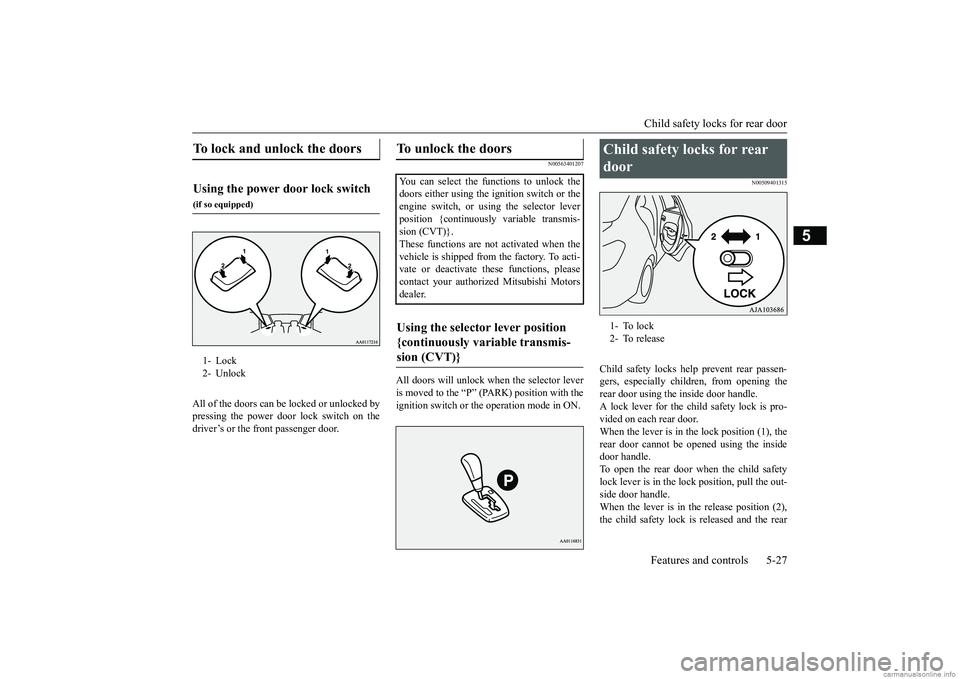
All of the doors can be locked or unlocked by pressing the power door lock switch on the driver’s or the front passenger door.
N00563401207
All doors will unlock when the selector leveris moved to the “P” (PARK) position with the ignition switch or the operation mode in ON.
N00509401315
Child safety locks help prevent rear passen-gers, especially children, from opening therear door using the inside door handle. A lock lever for the child safety lock is pro- vided on each rear door.When the lever is in the lock position (1), the rear door cannot be opened using the inside door handle.To open the rear door when the child safety lock lever is in the lock position, pull the out- side door handle.When the lever is in the release position (2), the child safety lock is released and the rear
To lock and unlock the doors Using the power door lock switch
(if so equipped)1- Lock 2- Unlock
To unlock the doors You can select the functions to unlock thedoors either using the ignition switch or theengine switch, or usi
ng the selector lever
position {continuously variable transmis- sion (CVT)}.These functions are not
activated when the
vehicle is shipped from the factory. To acti- vate or deactivate
these functions, please
contact your authorized Mitsubishi Motors dealer.Using the selector lever position {continuously variable transmis-sion (CVT)}
Child safety locks for rear door 1- To lock 2- To release
BK0267800US.book 27 ページ 2018年5月30日 水曜日 午後4時24分
Page 93 of 267
Trunk lid 5-28 Features and controls
5
door can be opened using the inside door han- dle.
N00509501215
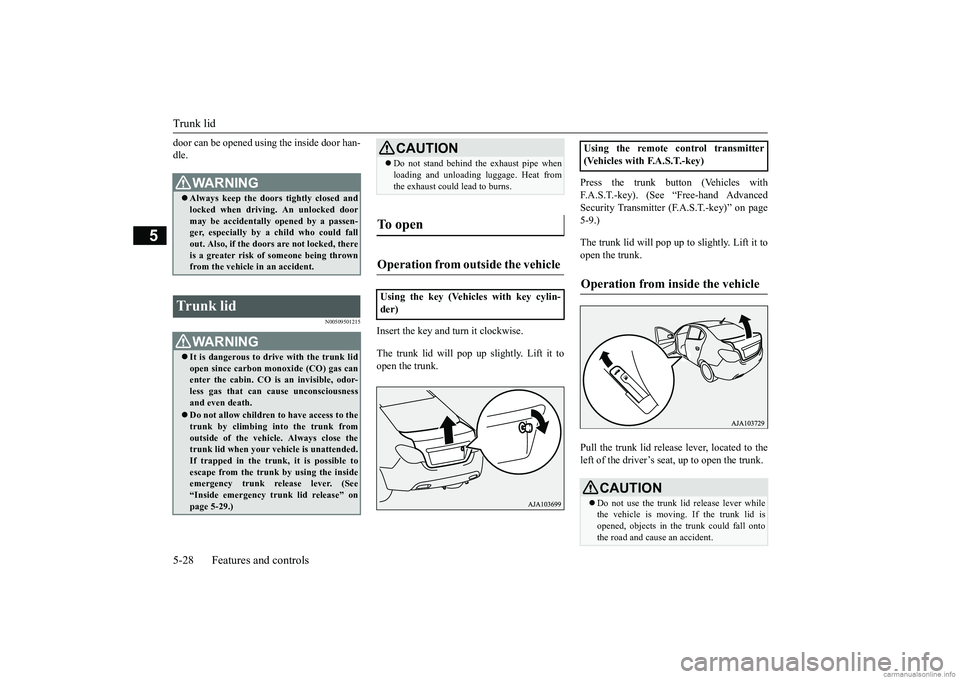
Insert the key and turn it clockwise. The trunk lid will pop up
slightly. Lift it to
open the trunk.
Press the trunk button (Vehicles with F.A.S.T.-key). (See “Free-hand Advanced Security Transmitter (F.A.S.T.-key)” on page 5-9.) The trunk lid will pop up to slightly. Lift it to open the trunk. Pull the trunk lid release lever, located to the left of the driver’s seat, up to open the trunk.
WA R N I N G Always keep the door
s tightly closed and
locked when driving. An unlocked door may be accidentally
opened by a passen-
ger, especially by
a child who could fall
out. Also, if the doors are not locked, there is a greater risk of someone being thrown from the vehicle
in an accident.
Trunk lid
WA R N I N GIt is dangerous to drive with the trunk lid open since carbon mo
noxide (CO) gas can
enter the cabin. CO is an invisible, odor- less gas that can cause unconsciousnessand even death. Do not allow children
to have access to the
trunk by climbing into the trunk from outside of the vehicl
e. Always close the
trunk lid when your vehicle is unattended.If trapped in the trunk, it is possible toescape from the trunk by using the inside emergency trunk re
lease lever. (See
“Inside emergency trunk lid release” onpage 5-29.)
CAUTION Do not stand behind the exhaust pipe when loading and unloading
luggage. Heat from
the exhaust could lead to burns.
To open Operation from outside the vehicle Using the key (Vehicles with key cylin- der)
Using the remote control transmitter (Vehicles with F.A.S.T.-key)Operation from inside the vehicle
CAUTION Do not use the trunk lid release lever while the vehicle is moving. If the trunk lid is opened, objects in th
e trunk could fall onto
the road and cause an accident.
BK0267800US.book 28 ページ 2018年5月30日 水曜日 午後4時24分
Page 94 of 267
Inside emergency trunk lid release
Features and controls 5-29
5
Pull the trunk lid downward as illustrated. Gently slam the trunk
lid from the outside so
that it is completely closed. Always ensurethe trunk lid is securely closed.
N00509801188
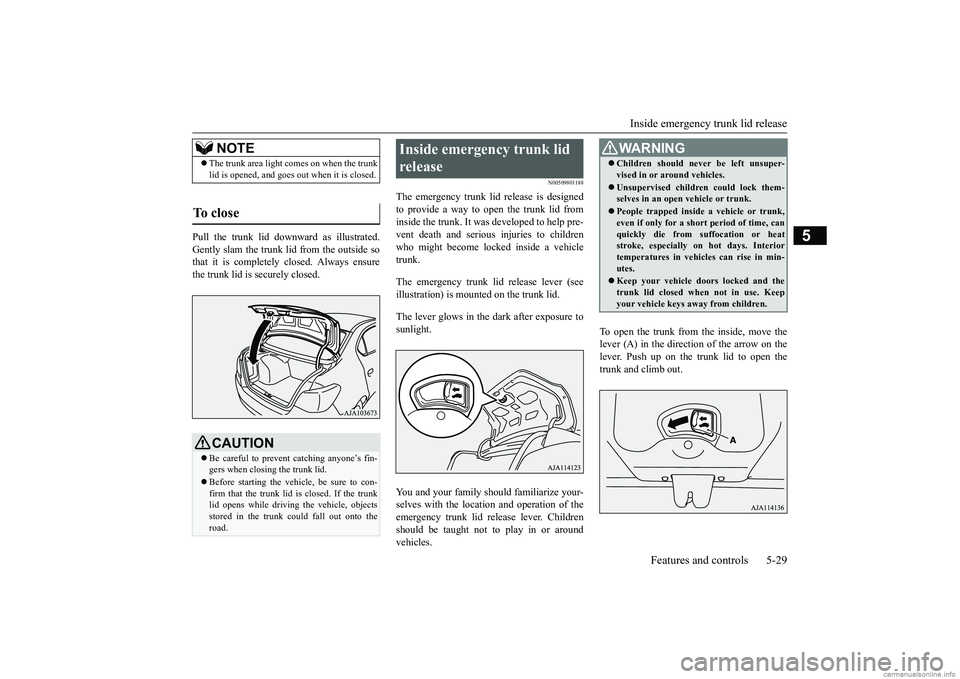
The emergency trunk lid
release is designed
to provide a way to open the trunk lid from inside the trunk. It was developed to help pre-vent death and serious injuries to children who might become locked inside a vehicle trunk. The emergency trunk lid release lever (see illustration) is mounted on the trunk lid. The lever glows in the dark after exposure to sunlight. You and your family should familiarize your- selves with the location and operation of theemergency trunk lid re
lease lever. Children
should be taught not to play in or around vehicles.
To open the trunk from the inside, move the lever (A) in the direction of the arrow on thelever. Push up on the trunk lid to open the trunk and climb out.
NOTE
The trunk area light comes on when the trunk lid is opened, and goes out
when it is closed.
To close
CAUTIONBe careful to prevent catching anyone’s fin- gers when closing the trunk lid. Before starting the vehi
cle, be sure to con-
firm that the trunk lid is closed. If the trunk lid opens while driving the vehicle, objects stored in the trunk could fall out onto theroad.
Inside emergency trunk lid release
WA R N I N G Children should never be left unsuper- vised in or ar
ound vehicles.
Unsupervised children could lock them- selves in an open vehicle or trunk. People trapped inside
a vehicle or trunk,
even if only for a short period of time, can quickly die from su
ffocation or heat
stroke, especially on hot days. Interior temperatures in vehicles can rise in min- utes. Keep your vehicle d
oors locked and the
trunk lid closed when not in use. Keepyour vehicle keys aw
ay from children.
BK0267800US.book 29 ページ 2018年5月30日 水曜日 午後4時24分
Page 95 of 267
Manual window control (if so equipped) 5-30 Features and controls
5
N00510700021
N00510800370
N00548700130
The main switch located on the driver’s door can be used to operate all the windows. A window can be opened or closed by operat-ing the corresponding switch. Press the switch down to open the window, and pull up the switch to close it.If the driver’s door window switch is fully pressed down/pulled up, the driver’s door window automatically opens/closes com-pletely. (Type 1) If the driver’s door window switch is fully pressed down, the driver’s door window auto-matically opens completely. (Type 2) If you want to stop the window movement, operate the switch lightly in the reverse direc-tion.
CAUTION When loading the trunk, place your things so that they will not touch the emergency trunklid release lever when you close the trunk.Otherwise you could damage the lever and make it unusable.
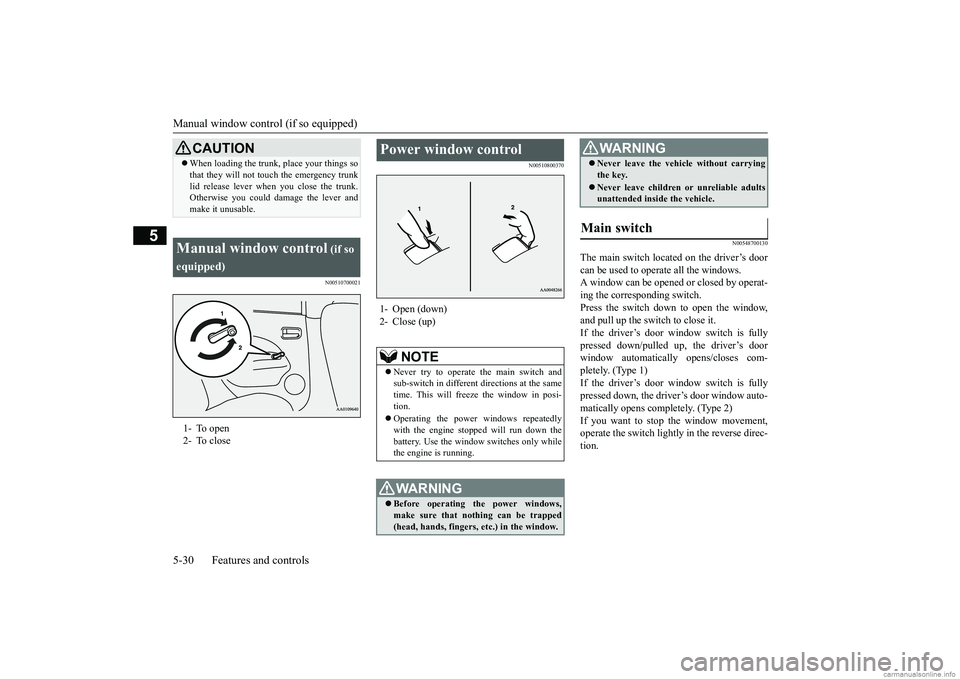
Manual window control
(if so
equipped)1- To open 2- To close
Power window control 1- Open (down)2- Close (up)
NOTE
Never try to operate the main switch and sub-switch in different directions at the same time. This will free
ze the window in posi-
tion. Operating the power
windows repeatedly
with the engine stopped will run down thebattery. Use the window
switches only while
the engine is running.WA R N I N G Before operating the power windows, make sure that nothing can be trapped (head, hands, fingers, etc.) in the window.
Never leave the vehi
cle without carrying
the key. Never leave children
or unreliable adults
unattended inside the vehicle.
Main switch
WA R N I N G
BK0267800US.book 30 ページ 2018年5月30日 水曜日 午後4時24分
Page 97 of 267
Power window control 5-32 Features and controls
5
N00528801161
If a hand or head is trapped, for safety the door window is automati
cally lowered a little.
After the door window is lowered, clear the obstruction, then pull up the switch again toclose the door window.
N00551400043
Wind buffeting can be de
scribed as the per-
ception of pressure on the ears or a booming or rumbling sound. Your
vehicle may exhibit
wind buffeting when driving with one or bothrear door windows down or partially opened. This is a normal occurrence that can be mini- mized. If the buffeting
occurs with the rear
door windows open, open the front door win- dows as well as the rear door windows to minimize the condition.
WA R N I N G Before driving with a child in the vehicle, be sure to lock the window switch to makeit inoperative. Children tampering withthe switch could easily trap their hands or heads in the window.
Safety mechanism (Driver’s door window of Type 1 only)
WA R N I N G If the battery terminals are disconnected or the fuse for electric window is replaced, the safety mechanism will be cancelled. If a hand or head got
trapped, a serious
injury could result.CAUTION The safety mechanism is deactivated just before the door window closes. This allows the door window to close completely. There- fore be especially careful that fingers are nottrapped in the door window opening.
The safety mechanism is deactivated while the switch is pulled up.
Therefore be espe-
cially careful that fi
ngers are not trapped in
the door window opening. Do not deliberately tr
ap your hands or head
in order to activate the safety mechanism. Your hand or head coul
d be trapped and per-
sonal injury could result.NOTE
The safety mechanism can be activated if the driving conditions or
other circumstances
cause the door window to be subjected to a physical shock similar to that caused by trapped hand or head. If the safety mechanism is activated 5 or more times in a row, the safety mechanismwill be cancelled a
nd the door window will
not close correctly. In such a case, the following procedureshould be implemented to rectify this situa- tion. If the window is open,
repeatedly raise the
driver’s door window sw
itch until that win-
dow has been fully cl
osed. Following this,
release the switch, raise the switch once again and hold it in this condition for atleast1 second, then release it. You should now be able to operate
in the normal fashion.
CAUTION
If the battery terminals are disconnected or the fuse for electric
window is replaced, the
safety mechanism will
be cancelled and the
door window will not automatically open/close completely. If the window is open,
repeatedly raise the
driver’s door window switch until the win- dow has been fully cl
osed. Following this,
release the switch, raise the switch onceagain and hold it in this
condition for at least
1 second, then release it. You should now be able to operate the driver’s door window inthe normal fashion.
What to do if you hear wind buffeting when driving
NOTE
BK0267800US.book 32 ページ 2018年5月30日 水曜日 午後4時24分
Page 111 of 267
Continuously variable transmission (CVT) (if so equipped) 5-46 Features and controls
5
N00560801095
To gain extra acceleration in “D” (DRIVE) position (when passing another vehicle) push the accelerator to the floor. The CVT will automatically downshift.
For short waiting periods, such as at traffic lights, the vehicle can be
left in selector lever
position and held stationary with the servicebrake. For longer waiting periods with the engine running, place th
e selector lever in the “N”
(NEUTRAL) position a
nd apply the parking
brake, while holding the vehicle stationary with the service brake. Prior to moving off after having stopped the vehicle, make sure that
the selector lever is in
“D” (DRIVE) position. To park the vehicle, first bring it to a com- plete stop, fully engage the parking brake,
Operation of the CVT
CAUTION Before selecting a pos
ition with the engine
running and the vehicl
e stationary, firmly
depress the brake pedal to prevent the vehi- cle from creeping. The vehicle will begin to
move as soon as the
CVT is engaged, especi
ally when the engine
speed or idle speed is
high, or with the air
conditioning operating.Do not release the br
ake pedal until you are
ready to drive away. Depress the brake pedal with the right foot at all times. Using the left foot c
ould cause driver move-
ment delay in case of an emergency. To prevent sudden acceleration, never run the engine at high rpms when shifting from the “P” (PARK) or “N” (NEUTRAL). Operating the accelerator pedal while the other foot is resting
on the brake pedal will
affect braking efficien
cy and may cause pre-
mature wear of brake pads.
Use the selector lever in the correct shift position in accordance with driving condi-tions.Never coast downhill backward in the driv- ing shift position “D” (DRIVE), “Ds” (DOWNSHIFT & SPORTY DRIVING), “L”(LOW) or coast forward in the “R” (REVERSE) position. Engine stopping and increased brake pedaland steering effort could
lead to an accident.
Do not rev the engine
with the brake pedal
pressed when the vehicle is stationary. This can damage the CVT. Also, when you depress
the accelerator pedal
while holding down the brake pedal with the selector lever in th
e “D” (DRIVE) position,
the engine revolutions
may not rise as high
as when performing the same operation with the selector lever in the “N” (NEUTRAL) position.
Passing acceleration
CAUTION
Waiting
CAUTION To avoid transmission
overheating, never try
to keep your vehicle st
ationary on a hill by
using the accelerator
pedal. Always apply
the parking brake and/or service brake. Do not rev the engine unnecessarily while the vehicle is stationary. Unexpected acceler-ation may occur if the selector lever is in a position other than “P” (PARK) or “N” (NEUTRAL).
Parking
BK0267800US.book 46 ページ 2018年5月30日 水曜日 午後4時24分
Page 112 of 267
Service brake
Features and controls 5-47
5
and then move the sele
ctor lever to the “P”
(PARK) position. If the CVT does not shift while driving, or your vehicle does not pick up enough speed when starting on an uphill slope, it may bethat there is something unusual happening in the transmission. Have your vehicle checked at an authorized Mitsubishi Motors dealer or a repair facility of
your choice immediately.
N00517501328
Overuse of the brake can cause weakening, resulting in poor brake response and prema- ture wear of the brake pads.When driving down a long or steep hill, use engine braking by movi
ng the selector lever
to “Ds” (DOWNSHIFT & SPORTY DRIV-ING) or “L” (LOW) position.
N00517600436
Your vehicle is equipped with power brakesfor more braking force with less brake pedaleffort. Your brakes are designed to operate at full capacity, even if the power assist is not beingused. If the power assist is not being used, the effort needed to press the br
ake pedal is greater.
If you should lose the power assist for some reason, the brakes will still work.
If the power brake unit or either of the two brake hydraulic systems stops working prop-erly, the rest of the brake system will still work, but the vehicle will not slow down as quickly.You will know this has happened if you find you need to press the brake down farther, or harder when slowing down or stopping, or ifthe brake warning light and the warning dis- play in the multi-information display come on. Have the brake system repaired at an authorized Mitsubishi Motors dealer or a repair facility of your
choice immediately.
When the CVT makes no speed change
Service brake Brake pedal
WA R N I N G Do not leave any obje
cts near the brake
pedal or let a floor
mat slide under it;
doing so could prevent the full pedalstroke that would be necessary in an emergency. Make sure that the pedal can be operated freely at
all times. Make sure
the floor mat is securely held in place.CAUTION It is important not to
drive the vehicle with
your foot resting on the brake pedal when braking is not required.
This practice can
result in very high brake temperatures, pre- mature lining wear, a
nd possible damage to
the brakes.
Power brakes
WA R N I N G Never coast downhill
with the engine OFF.
Keep the engine running whenever your vehicle is in motion. If you turn off theengine while driving, the power brake booster will stop wo
rking and your brakes
will not work as well. If the power assist is lost or if either brake hydraulic system stop
s working properly,
take your vehicle
to an authorized
Mitsubishi Motors dealer
or a repair facil-
ity of your choice immediately.
BK0267800US.book 47 ページ 2018年5月30日 水曜日 午後4時24分
Page 115 of 267
Anti-lock braking system 5-50 Features and controls
5
N00517900338
The anti-lock braking system helps prevent the wheels from locking up when braking. This helps maintain ve
hicle drivability and
steering wheel handling. When using the anti-lock brakes (sudden braking), steering is
slightly different
from normal driving conditions. Use the steering wheel carefully. Always keep a safe distance from the vehicle in front of you. Even if your vehi- cle is equipped with
the anti-lock braking
system, leave a greater braking distance when: • Driving on gravel or snow-coveredroads. • Driving on uneven road surfaces. Operation of anti-lock braking system is not restricted situati
ons where brakes are
applied suddenly. This system may also prevent the wheels from locking whenyou drive over manholes, steel roadwork plates, road markings
, or any uneven road
surface.
When the anti-lock braking system is in use, you may feel the brake pedal vibrat-ing and hear a unique sound. It may also feel as if the pedal
resists being pressed.
In this situation, si
mply hold the brake
pedal down firmly. Do not pump the brake, which will result in reduced braking performance.
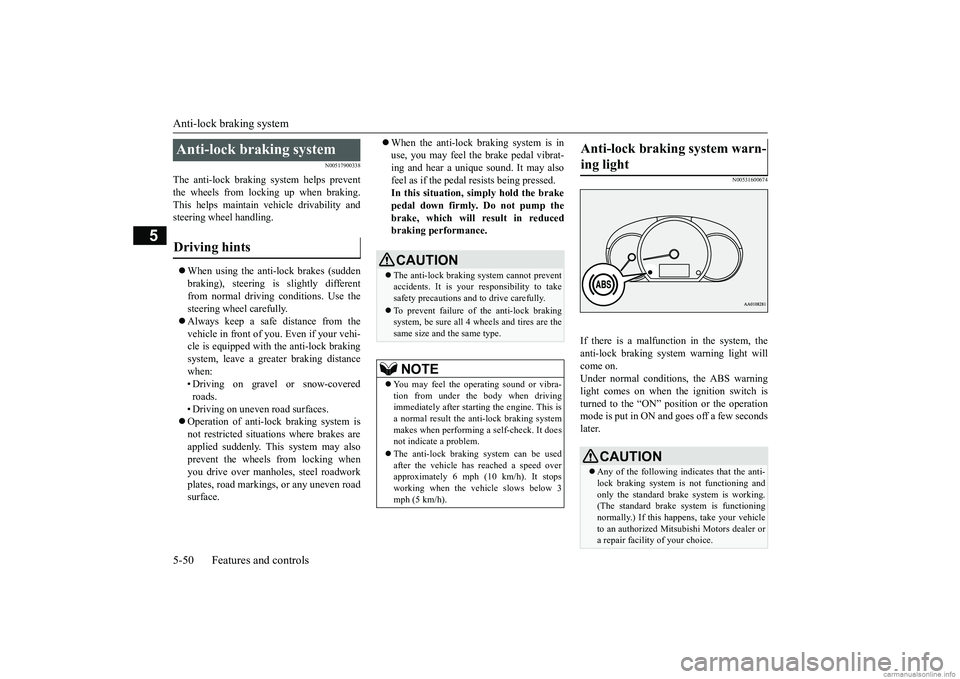
N00531600674
If there is a malfunction in the system, the anti-lock braking system warning light will come on.Under normal conditions, the ABS warning light comes on when the ignition switch is turned to the “ON” position or the operationmode is put in ON and goes off a few seconds later.
Anti-lock braking system Driving hints
CAUTION The anti-lock braking system cannot prevent accidents. It is your
responsibility to take
safety precautions and to drive carefully. To prevent failure of the anti-lock braking system, be sure all 4 wheels and tires are the same size and the same type.NOTE
You may feel the operating sound or vibra- tion from under the body when driving immediately after starti
ng the engine. This is
a normal result the anti-lock braking systemmakes when performing a self-check. It does not indicate a problem. The anti-lock braking system can be used after the vehicle has
reached a speed over
approximately 6 mph (10 km/h). It stops working when the vehicle slows below 3mph (5 km/h).
Anti-lock braking system warn- ing light
CAUTION Any of the following indicates that the anti- lock braking system is not functioning andonly the standard brake system is working. (The standard brake system is functioning normally.) If this happe
ns, take your vehicle
to an authorized Mits
ubishi Motors dealer or
a repair facility of your choice.
BK0267800US.book 50 ページ 2018年5月30日 水曜日 午後4時24分
Page 117 of 267
Active stability control (ASC) 5-52 Features and controls
5
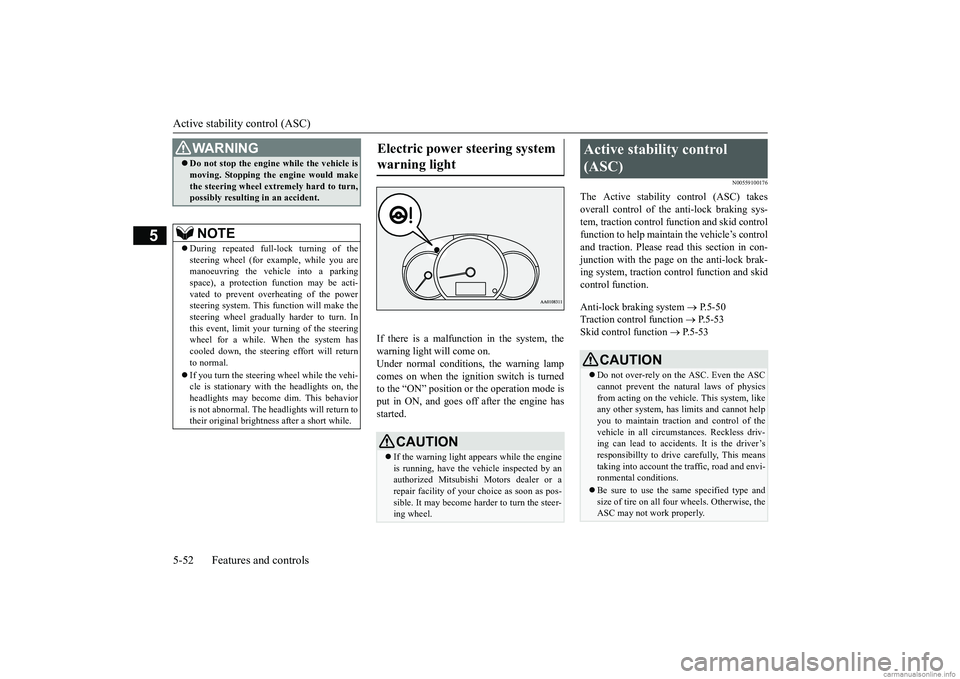
If there is a malfunction in the system, the warning light will come on. Under normal conditions
, the warning lamp
comes on when the ignition switch is turnedto the “ON” position or the operation mode is put in ON, and goes off after the engine has started.
N00559100176
The Active stability
control (ASC) takes
overall control of the
anti-lock braking sys-
tem, traction control function and skid controlfunction to help maintain the vehicle’s control and traction. Please read
this section in con-
junction with the page on the anti-lock brak-ing system, traction control function and skid control function. Anti-lock braking system
P.5-50
Traction control function
P.5-53
Skid control function
P.5-53
WA R N I N GDo not stop the engine while the vehicle is moving. Stopping the engine would makethe steering wheel extremely hard to turn,possibly resulting
in an ac
cident.
NOTE
During repeated full-lock turning of the steering wheel (for example, while you are manoeuvring the vehicl
e into a parking
space), a protection
function may be acti-
vated to prevent overheating of the power steering system. This f
unction will make the
steering wheel gradually harder to turn. In this event, limit your turning of the steering wheel for a while. When the system hascooled down, the steering effort will return to normal. If you turn the steering wheel while the vehi- cle is stationary with
the headlights on, the
headlights may become
dim. This behavior
is not abnormal. The headlights will return to their original brightne
ss after a short while.
Electric power steering system warning light
CAUTION If the warning light a
ppears while the engine
is running, have the vehicle inspected by an authorized Mitsubishi Motors dealer or arepair facility of your choice as soon as pos- sible. It may become ha
rder to turn the steer-
ing wheel.
Active stability control (ASC)
CAUTION Do not over-rely on the ASC. Even the ASC cannot prevent the natural laws of physicsfrom acting on the vehicle. This system, like any other system, has li
mits and cannot help
you to maintain traction and control of thevehicle in all circumstances. Reckless driv- ing can lead to accident
s. It is the driver’s
responsibillty to drive carefully, This meanstaking into account the tr
affic, road and envi-
ronmental conditions. Be sure to use the same specified type and size of tire on all four wheels. Otherwise, the ASC may not work properly.
BK0267800US.book 52 ページ 2018年5月30日 水曜日 午後4時24分