battery MITSUBISHI MONTERO 1991 Owner's Manual
[x] Cancel search | Manufacturer: MITSUBISHI, Model Year: 1991, Model line: MONTERO, Model: MITSUBISHI MONTERO 1991Pages: 1333, PDF Size: 24.61 MB
Page 229 of 1333

CRUISE CONTROL SWITCH FUNCTION TEST
NOTE: If vehicle speed decreases approximately 9 MPH below set
speed, set speed will be cancelled.
1) Cruise control switch is part of multifunction switch
mounted on steering column. To operate cruise control system, turn
ignition on. Turn cruise control switch to ON position. Ensure switch
indicator light comes on.
NOTE: Speed will not set beyond system limit of 90 MPH.
2) With cruise control switch in ON position, drive vehicle
between 25 and 90 MPH. Press and release SET button. Vehicle speed
should stay at set speed. Instrument cluster cruise indicator light
should come on. To increase set speed, turn control switch to RESUME
position and hold until new set speed is reached.
3) To lower set speed, press SET button and hold until new
set speed is reached. To return to set speed after cancellation, move
resume switch from ON to OFF position. Vehicle speed should return to
previous setting before cancellation. Set speed should cancel when any
of the following occurs:
* Brake pedal is pressed.
* Clutch pedal is pressed.
* Transmission is shifted to Neutral or Park.
* Cruise control main switch is turned off.
* Ignition switch is turned off.
SELF-DIAGNOSTICS
1) Self-diagnostics should be performed when cruise control
cancels without the driver using normal cancel modes. Diagnosis
connector is located on right side of fuse box. Use analog voltmeter
or Multi-Use Tester (MB991341) for code retrieval.
2) Use multi-use tester according to operating instructions
provided with tester. Connect leads of analog voltmeter between cruise
control terminal and ground terminal of self-diagnostic connector. See
Fig. 6 . Read voltmeter needle sweeps to determine trouble code.
NOTE: On 1991 models, codes No. 13, 14, 15, 16 and 17 will be
displayed whether malfunction is present or not.
3) Once trouble codes have been displayed, see SELF-
DIAGNOSTIC CODE CHART to determine appropriate CIRCUIT TEST. See
Fig. 7 or 8.
4) To clear trouble codes, either disconnect battery cable or
turn ignition on. Turn main cruise control switch and set switch to ON
position. Within one second turn resume switch to ON position.
5) Hold stoplight switch and cruise control switch in ON
position for more than 5 seconds. Verify codes are cleared.
Fig. 6: Identifying Self-Diagnostic Connector Terminals
Courtesy of Mitsubishi Motor Co.
Page 239 of 1333

Test No. 1 (Power & Ground Circuit)
1) Turn ignition on. When cruise control main switch is
turned to ON position, battery voltage should be present on terminal
No. 7 of cruise control unit connector.
2) If voltage is not present, check fuse No. 3 and replace as
necessary. If fuse is okay, check and repair harness as necessary.
Terminal No. 10 should be grounded at all times. If terminal No. 10 is
not grounded, repair harness.
Test No. 2 (Set Switch Circuits)
When set switch is turned to ON position, voltage should not
be present on terminal No. 5 of cruise control unit. When set switch
is turned to OFF position, battery voltage should be present on
terminal No. 5 of cruise control unit. If circuit does not test
correctly, replace switch as necessary or repair harness.
Test No. 3 (Resume Switch Circuit)
When resume switch is turned to ON position, voltage should
not be present on terminal No. 4 of cruise control unit. When resume
switch is turned to OFF position, battery voltage should be present on
terminal No. 4 of cruise control unit. If circuit does not test
correctly, replace switch as necessary or repair harness.
Test No. 4 (Vehicle Speed Sensor Circuit)
When vehicle moves slowly, voltage should alternate from zero
volts to 3-5 volts at terminal No. 15 of cruise control unit. If
circuit does not test correctly, replace sensor as necessary or repair
harness.
Test No. 5 (Actuator Circuit)
1) When cruise control main switch is in On position, voltage
should not be present on terminal No. 8 of cruise control unit.
2) When vehicle is accelerated using resume switch, voltage
should not be present on terminal No. 9 of cruise control unit. When
vehicle is coasting by using set switch, battery voltage should be
present on terminal No. 9.
3) When vehicle is accelerated using resume switch, battery
voltage should be present on terminal No. 20 of cruise control unit.
When vehicle is coasting by using set switch, voltage should not be
present on terminal No. 20 of cruise control unit. If circuit does not
test correctly, replace actuator as necessary or repair harness.
Test No. 6 (Stoplight Switch Circuit)
1) When brake pedal is pressed, battery voltage should be
present on terminal No. 3 of cruise control unit. If voltage is not
present, adjust or replace brake switch.
2) Battery voltage should be present at all times on terminal
No. 11 of cruise control unit. If voltage is not present, check fuse
no. 7. If fuse is okay, repair harness.
Test No. 7 (Inhibitor Switch Circuit)
1) When gear shift lever is moved to Neutral or Park
position, voltage should not be present on terminal No. 2 of cruise
control unit.
2) When gear shift lever is moved to any other position,
battery voltage should be present on terminal No. 2 of cruise control
unit. If circuit does not test correctly, replace switch as necessary
or repair harness.
Test No. 8 (Clutch Switch Circuit)
When clutch pedal is pressed, battery voltage should be
present at terminal No. 1 of cruise control unit. If circuit does not
Page 240 of 1333
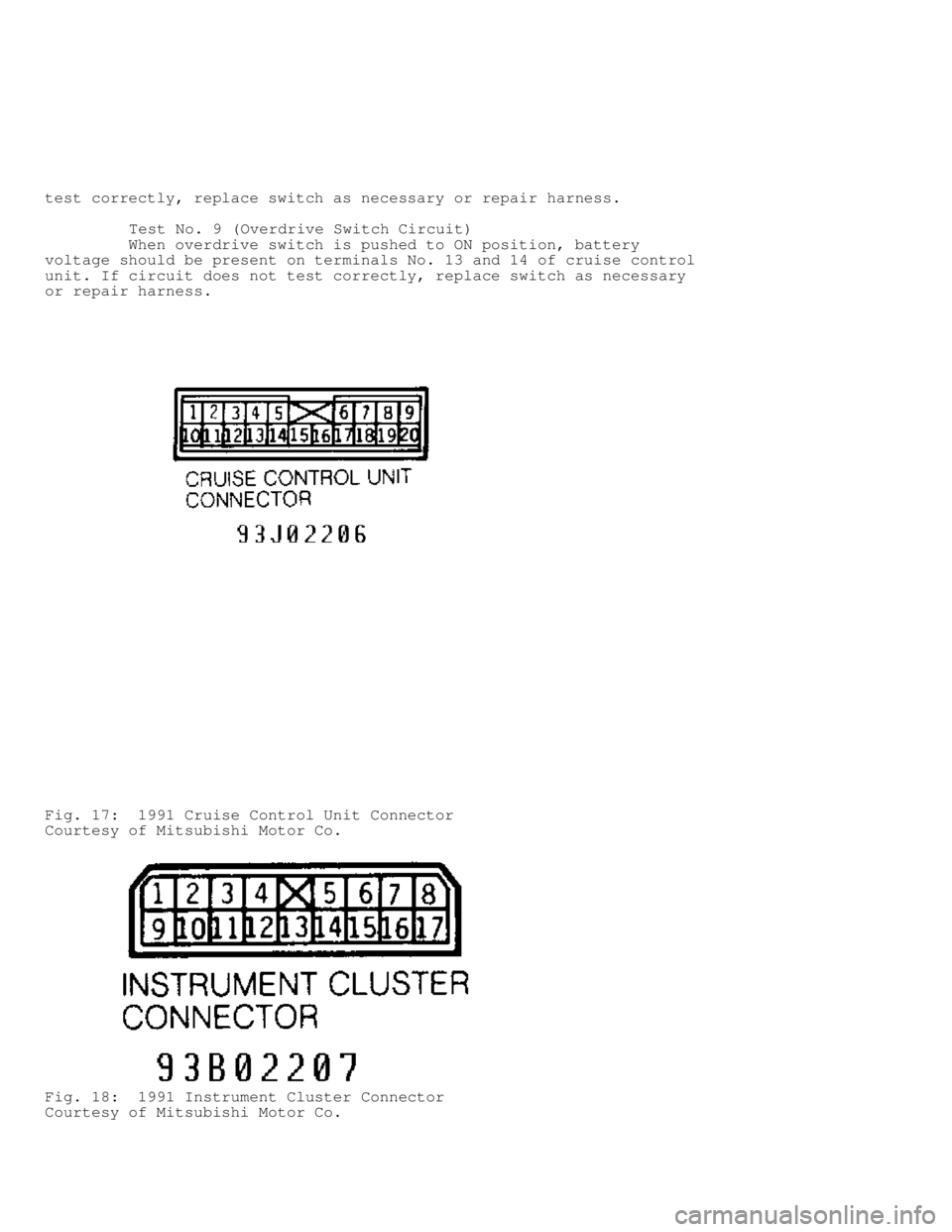
test correctly, replace switch as necessary or repair harness.
Test No. 9 (Overdrive Switch Circuit)
When overdrive switch is pushed to ON position, battery
voltage should be present on terminals No. 13 and 14 of cruise control
unit. If circuit does not test correctly, replace switch as necessary
or repair harness.
Fig. 17: 1991 Cruise Control Unit Connector
Courtesy of Mitsubishi Motor Co.
Fig. 18: 1991 Instrument Cluster Connector
Courtesy of Mitsubishi Motor Co.
Page 242 of 1333
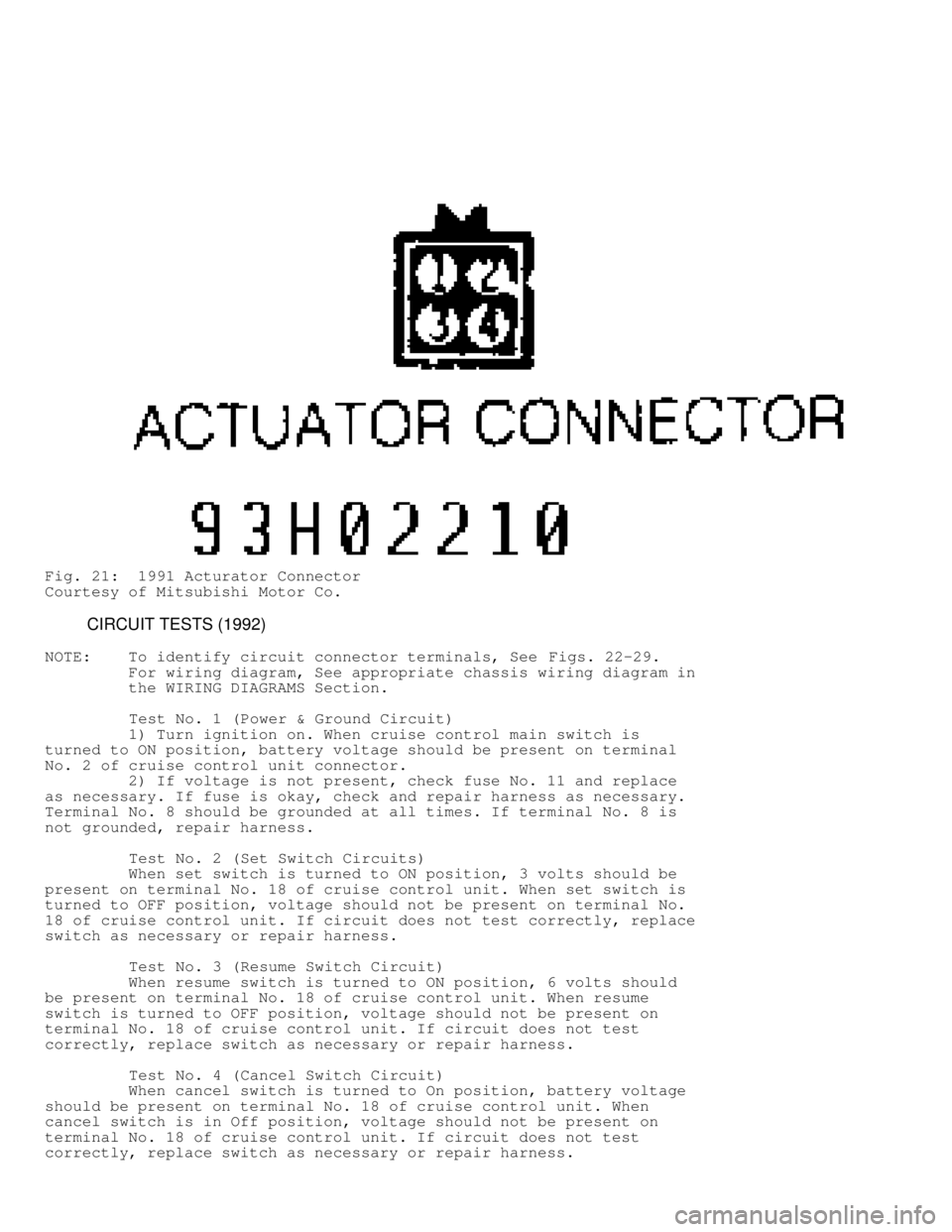
Fig. 21: 1991 Acturator Connector
Courtesy of Mitsubishi Motor Co.
CIRCUIT TESTS (1992)
NOTE: To identify circuit connector terminals, See Figs. 22-29.
For wiring diagram, See appropriate chassis wiring diagram in
the WIRING DIAGRAMS Section.
Test No. 1 (Power & Ground Circuit)
1) Turn ignition on. When cruise control main switch is
turned to ON position, battery voltage should be present on terminal
No. 2 of cruise control unit connector.
2) If voltage is not present, check fuse No. 11 and replace
as necessary. If fuse is okay, check and repair harness as necessary.
Terminal No. 8 should be grounded at all times. If terminal No. 8 is
not grounded, repair harness.
Test No. 2 (Set Switch Circuits)
When set switch is turned to ON position, 3 volts should be
present on terminal No. 18 of cruise control unit. When set switch is
turned to OFF position, voltage should not be present on terminal No.
18 of cruise control unit. If circuit does not test correctly, replace
switch as necessary or repair harness.
Test No. 3 (Resume Switch Circuit)
When resume switch is turned to ON position, 6 volts should
be present on terminal No. 18 of cruise control unit. When resume
switch is turned to OFF position, voltage should not be present on
terminal No. 18 of cruise control unit. If circuit does not test
correctly, replace switch as necessary or repair harness.
Test No. 4 (Cancel Switch Circuit)
When cancel switch is turned to On position, battery voltage
should be present on terminal No. 18 of cruise control unit. When
cancel switch is in Off position, voltage should not be present on
terminal No. 18 of cruise control unit. If circuit does not test
correctly, replace switch as necessary or repair harness.
Page 243 of 1333

Test No. 5 (Vehicle Speed Sensor Circuit)
When vehicle moves slowly, 0-2 or more volts should alternate
at terminal No. 19 of cruise control unit. If circuit does not test
correctly, replace sensor as necessary or repair harness.
Test No. 6 (Vacuum Pump Circuit)
1) When cruise system is in deceleration or release mode,
battery voltage should be present on terminals No. 26 and 13 of cruise
control unit. If circuit does not test correctly, replace vacuum pump
as necessary or repair harness.
2) When cruise system is in release mode, battery voltage
should be present on terminal No. 12 of cruise control unit. When
cruise system is in hold mode, voltage on terminals No. 12, 13 and 26
will go from battery voltage to zero volts depending on driving
conditions. If circuit does not test correctly, replace vacuum pump as
necessary or repair harness.
Test No. 7 (Stoplight Switch Circuit)
When brake pedal is pressed, battery voltage should be
present on terminal No. 15 of cruise control unit. If voltage is not
present, adjust or replace brake switch. If circuit does not test
correctly, replace switch as necessary or repair harness.
Test No. 8 (Clutch Switch Circuit)
When clutch pedal is pressed, battery voltage should be
present at terminal No. 1 of cruise control unit. If circuit does not
test correctly, replace switch as necessary or repair harness.
Test No. 9 (Inhibitor Switch Circuit)
When transmission is in Neutral position, battery voltage
should be present on terminal No. 1 of cruise control unit. If circuit
does not test correctly, replace switch as necessary or repair
harness.
Test No. 10 (Overdrive Switch Circuit)
When overdrive switch is pushed to ON position, battery
voltage should be present on terminal No. 11 of cruise control unit.
If circuit does not test correctly, replace switch as necessary or
repair harness.
Test No. 11 (Idle Switch & Throttle Position Sensor Circuit)
1) When accelerator pedal is pressed, 4.5-5.5 volts should be
present on terminal No. 4 (idle switch) of cruise control unit. When
accelerator pedal is released, voltage should not be present on
terminal No. 4 of cruise control unit.
2) When accelerator pedal is pressed to wide open throttle,
4.0-5.5 volts should be present on terminal No. 5 (throttle position
sensor) of cruise control unit. When accelerator pedal is released, .
5-.7 volts should be present on terminal No. 5 of cruise control unit.
If circuit does not test correctly, replace sensor as necessary or
repair harness.
Fig. 22: 1992 Cruise Control Unit Connector
Courtesy of Mitsubishi Motor Co.
Page 248 of 1333

Replace cruise control switch if it does not test correctly.
Main Switch (1992)
1) In each switch position, continuity should be present
between terminals No. 2 and 7 for switch illumination. See Figs. 22-
29. When switch is moved to Neutral position, continuity should be
present between terminals No. 1 and 4.
2) When switch is moved to ON position, continuity should be
present between terminals No. 1, 4 and 5. Connect battery voltage to
terminal No. 5 and ground terminal No. 4.
3) Battery voltage should then be present on terminal No. 1
when main switch is moved to On position. Replace switch if it does
not test correctly.
BRAKELIGHT/STOPLIGHT SWITCH TEST
Disconnect switch connector. When brake pedal is pressed,
continuity should be present between terminals No. 2 and 3. See
Figs. 22 -29. When brake pedal is released, continuity should be
present between terminals No. 1 and 4. Replace switch if it does not
test correctly.
IDLE SWITCH & THROTTLE POSITION SENSOR TESTS
Throttle Position Sensor (1992)
1) Disconnect sensor connector. Resistance between terminals
No. 1 and 4 should be 3500-6500 ohms. Use an analog ohmmeter to
measure resistance between terminals No. 1 and 3. See Figs. 22-29.
2) Slowly open throttle valve to wide open throttle.
Resistance should change smoothly as throttle is opened. Replace
throttle position sensor if it does not test correctly.
Idle Switch (1992)
1) Disconnect throttle position sensor connector. Continuity
should be present between terminals No. 1 and 2 with accelerator pedal
released. See Figs. 22-29. Continuity should not be present with
accelerator pedal pressed.
2) If continuity is not present with accelerator released,
loosen throttle position sensor mounting screw. Turn throttle position
sensor completely clockwise. Recheck continuity. Replace throttle
position sensor if idle switch does not test correctly.
INHIBITOR SWITCH TEST
Disconnect switch connector. Shift transaxle into Neutral and
Park positions. On 1991 models, continuity should be present between
Black/Yellow wire terminals No. 3 and 4. On 1992 models, continuity
should be present between terminals No. 7 and 12. See Figs. 22-29. On
all models, if continuity is not present, adjust inhibitor switch. If
switch is adjusted properly, replace switch.
VACUUM PUMP TEST
1992
1) Remove vacuum pump connector. Resistance should be 50-60
ohms between terminal No. 1 and terminals No. 2 and 3. See Figs. 22-
29. Ensure solenoid valve makes operating noise when battery voltage
is applied between terminal No. 1 and terminals No. 2 and 3.
2) If solenoid valve does not make noise, replace vacuum pump
assembly. Apply battery voltage to terminals No. 1 and 4, motor should
operate. Replace vacuum pump if motor does not operate.
Page 249 of 1333
ACTUATOR TESTS
Resistance Test (1991)
Disconnect actuator connector. Resistance between terminals
No. 1 and 2 should be 20 ohms. See Figs. 17-21. If resistance is not
correct, replace actuator assembly.
Operational Test (1991)
1) With connector disconnected, connect battery voltage to
terminal No. 1. See Figs. 17-21. Ground terminal No. 2. Connect
ammeter between positive side of battery and terminal No. 1 of
actuator connector.
2) Solenoid should make a click sound. Ammeter should read .
5-.7 amps. Connect positive side of battery to terminal No. 4 and
ground terminal No. 3. Actuator should pull in and stop.
3) While actuator is moving in, ammeter should read less than
.5 amps. When actuator travel reaches midpoint, disconnect terminal
No. 1 from positive side of battery. Actuator should return to
original position. If actuator does not test correctly, replace
actuator.
4) Reverse connections of terminals No. 4 and 3 in step 2).
Connect battery voltage to terminal No. 3 and ground terminal No. 4.
Actuator should move out then stop. While actuator is moving, ammeter
should read less than .5 amps.
1992
Remove actuator. Apply vacuum to actuator. Actuator linkage
holder should move more than 1.38" (35 mm). Actuator diaphragm should
hold vacuum. Replace actuator if actuator does not test correctly.
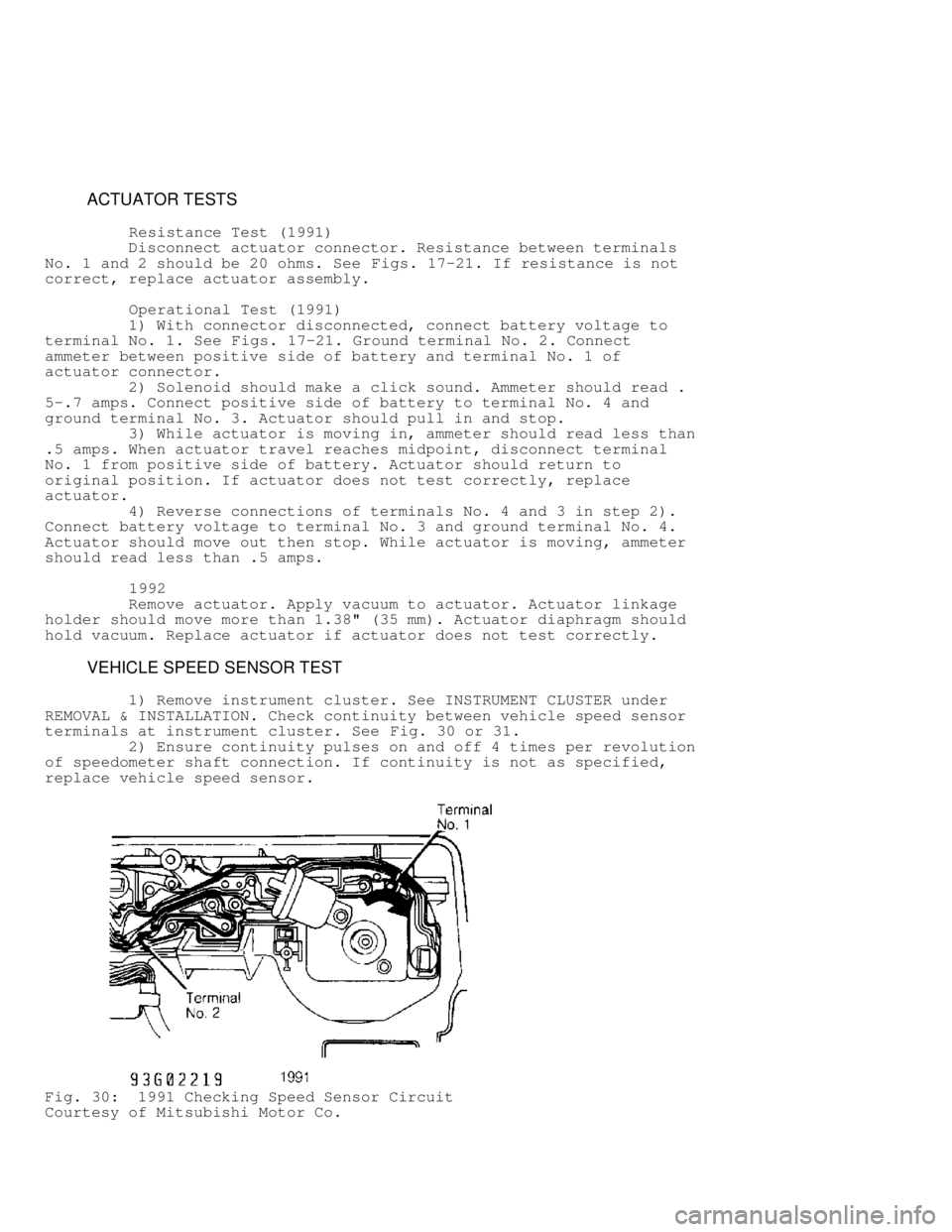
VEHICLE SPEED SENSOR TEST
1) Remove instrument cluster. See INSTRUMENT CLUSTER under
REMOVAL & INSTALLATION. Check continuity between vehicle speed sensor
terminals at instrument cluster. See Fig. 30 or 31.
2) Ensure continuity pulses on and off 4 times per revolution
of speedometer shaft connection. If continuity is not as specified,
replace vehicle speed sensor.
Fig. 30: 1991 Checking Speed Sensor Circuit
Courtesy of Mitsubishi Motor Co.
Page 251 of 1333

Remove lower steering column cover. Disconnect electrical
connectors. Remove screws attaching cruise control switch to steering
column. Remove switch. To install, reverse removal procedure.
STEERING COLUMN SWITCH
WARNING: DO NOT hammer steering wheel. Collapsible steering column
mechanism may be damaged.
Removal & Installation (1991)
Remove horn pad and steering wheel. Remove upper and lower
column covers. Remove column switch. To install, reverse removal
procedure.
VEHICLE SPEED SENSOR
Removal & Installation
Remove instrument cluster. See INSTRUMENT CLUSTER in this
article. Speed sensor is a part of speedometer.
INSTRUMENT CLUSTER
Removal & Installation
Disconnect negative battery cable. Remove cluster cover.
Disconnect speedometer cable. Remove instrument cluster. To install,
reverse removal procedure.
CONTROL UNIT
Removal & Installation (1991)
Cruise control unit is located behind left front kick panel.
Remove left front kick panel. Remove control unit. To install, reverse
removal procedure.
Removal & Installation (1992)
Cruise control unit is located behind center of dash panel.
Remove center trim panel and radio or radio plug bezel. Remove control
unit. To install, reverse removal procedure.
WIRING DIAGRAMS
For 1992 wiring diagram, See appropriate chassis wiring
diagram in the WIRING DIAGRAMS Section.
Page 255 of 1333
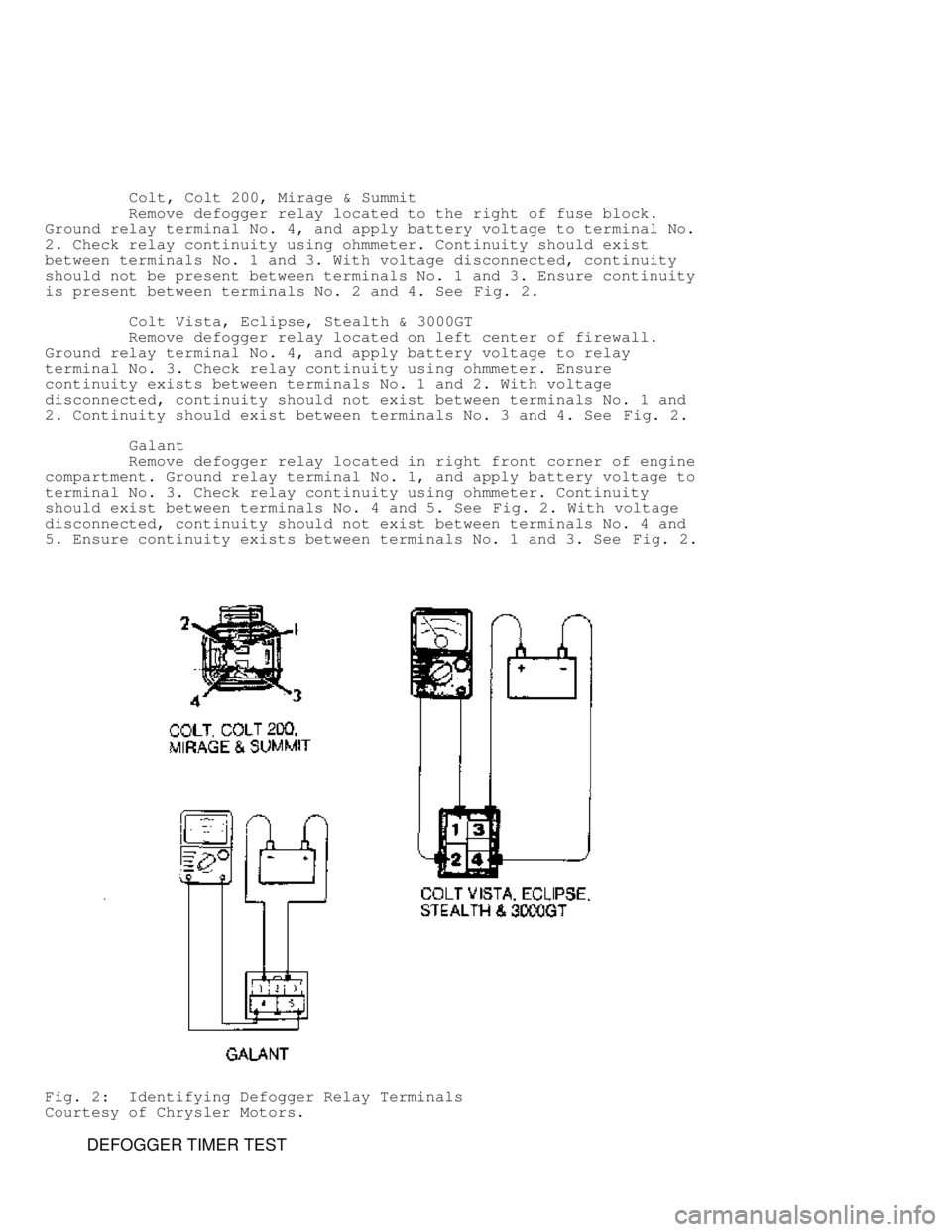
Colt, Colt 200, Mirage & Summit
Remove defogger relay located to the right of fuse block.
Ground relay terminal No. 4, and apply battery voltage to terminal No.
2. Check relay continuity using ohmmeter. Continuity should exist
between terminals No. 1 and 3. With voltage disconnected, continuity
should not be present between terminals No. 1 and 3. Ensure continuity
is present between terminals No. 2 and 4. See Fig. 2.
Colt Vista, Eclipse, Stealth & 3000GT
Remove defogger relay located on left center of firewall.
Ground relay terminal No. 4, and apply battery voltage to relay
terminal No. 3. Check relay continuity using ohmmeter. Ensure
continuity exists between terminals No. 1 and 2. With voltage
disconnected, continuity should not exist between terminals No. 1 and
2. Continuity should exist between terminals No. 3 and 4. See Fig. 2.
Galant
Remove defogger relay located in right front corner of engine
compartment. Ground relay terminal No. 1, and apply battery voltage to
terminal No. 3. Check relay continuity using ohmmeter. Continuity
should exist between terminals No. 4 and 5. See Fig. 2. With voltage
disconnected, continuity should not exist between terminals No. 4 and
5. Ensure continuity exists between terminals No. 1 and 3. See Fig. 2.
Fig. 2: Identifying Defogger Relay Terminals
Courtesy of Chrysler Motors.
DEFOGGER TIMER TEST
Page 256 of 1333
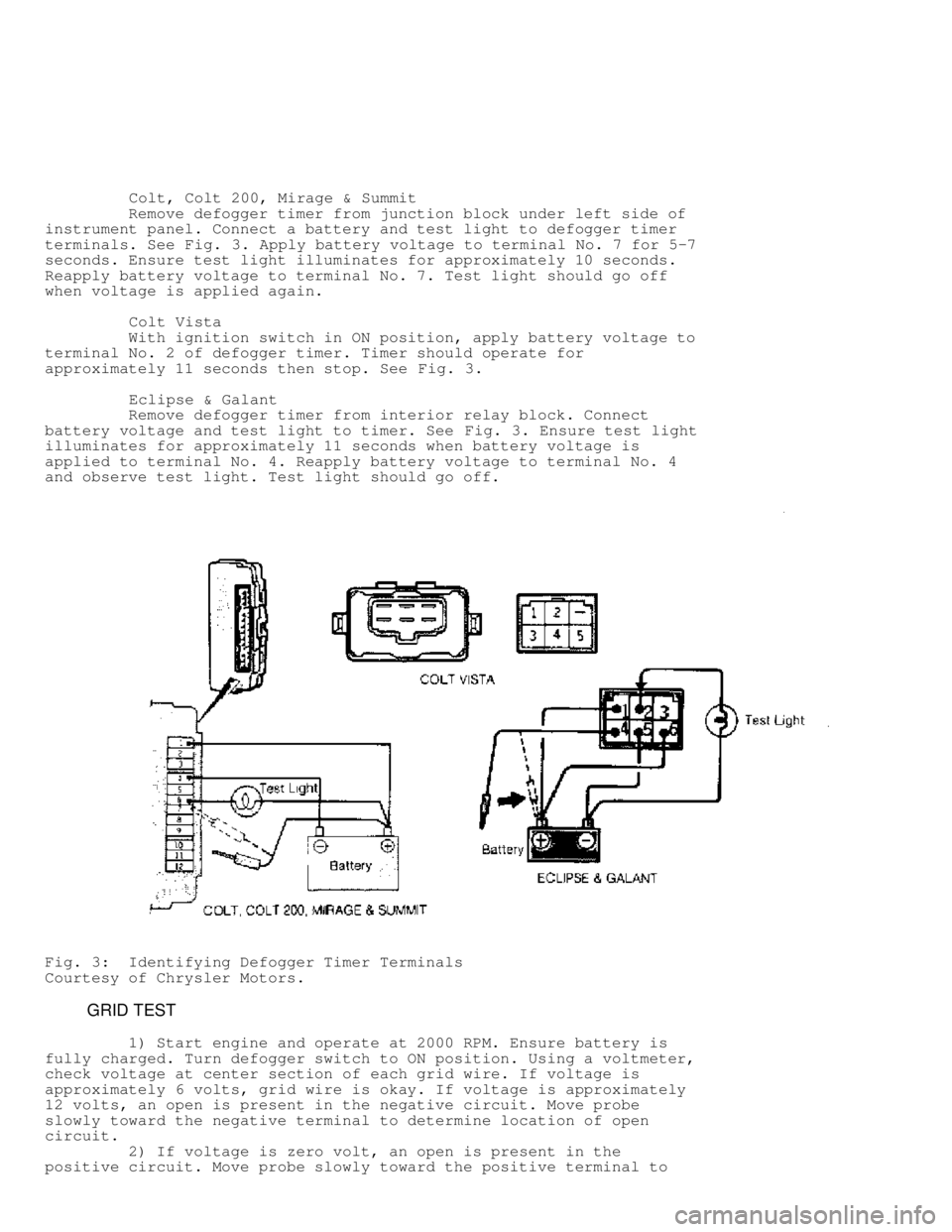
Colt, Colt 200, Mirage & Summit
Remove defogger timer from junction block under left side of
instrument panel. Connect a battery and test light to defogger timer
terminals. See Fig. 3. Apply battery voltage to terminal No. 7 for 5-7
seconds. Ensure test light illuminates for approximately 10 seconds.
Reapply battery voltage to terminal No. 7. Test light should go off
when voltage is applied again.
Colt Vista
With ignition switch in ON position, apply battery voltage to
terminal No. 2 of defogger timer. Timer should operate for
approximately 11 seconds then stop. See Fig. 3.
Eclipse & Galant
Remove defogger timer from interior relay block. Connect
battery voltage and test light to timer. See Fig. 3. Ensure test light
illuminates for approximately 11 seconds when battery voltage is
applied to terminal No. 4. Reapply battery voltage to terminal No. 4
and observe test light. Test light should go off.
Fig. 3: Identifying Defogger Timer Terminals
Courtesy of Chrysler Motors.
GRID TEST
1) Start engine and operate at 2000 RPM. Ensure battery is
fully charged. Turn defogger switch to ON position. Using a voltmeter,
check voltage at center section of each grid wire. If voltage is
approximately 6 volts, grid wire is okay. If voltage is approximately
12 volts, an open is present in the negative circuit. Move probe
slowly toward the negative terminal to determine location of open
circuit.
2) If voltage is zero volt, an open is present in the
positive circuit. Move probe slowly toward the positive terminal to