Oil MITSUBISHI OUTLANDER 2015 3.G Owner's Manual
[x] Cancel search | Manufacturer: MITSUBISHI, Model Year: 2015, Model line: OUTLANDER, Model: MITSUBISHI OUTLANDER 2015 3.GPages: 446, PDF Size: 59.52 MB
Page 393 of 446
Rear axle oil (All-wheel drive models) 9-12 Vehicle care and maintenance
9
N00915201279
Whenever the oil level is checked, add oil as necessary to maintain the proper level. Fill with the oil according to the table below.
N00938601313
The windshield and rear
window washer fluid
reservoir is in the engine compartment.
Check the washer fluid
level at regular inter-
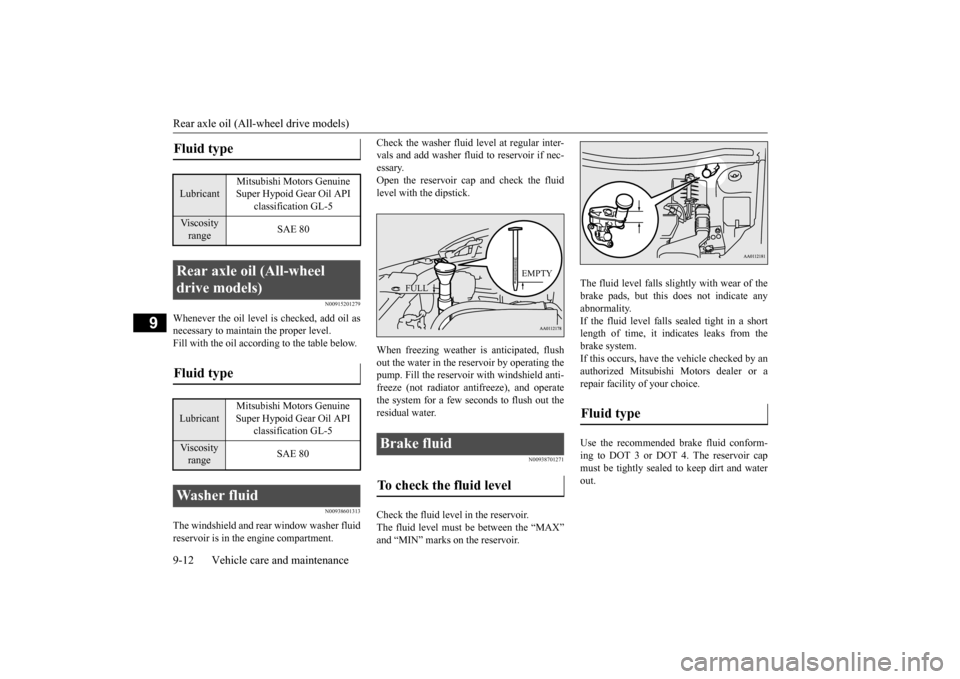
vals and add washer fluid to reservoir if nec-essary. Open the reservoir cap and check the fluid level with the dipstick. When freezing weather is anticipated, flush out the water in the reservoir by operating thepump. Fill the reservoir with windshield anti- freeze (not radiator
antifreeze), and operate
the system for a few se
conds to flush out the
residual water.
N00938701271
Check the fluid level in the reservoir.The fluid level must be between the “MAX” and “MIN” marks on the reservoir.
The fluid level falls slightly with wear of the brake pads, but this
does not indicate any
abnormality. If the fluid level falls se
aled tight in a short
length of time, it indi
cates leaks from the
brake system. If this occurs, have the vehicle checked by an authorized Mitsubishi Motors dealer or arepair facility of your choice. Use the recommended brake fluid conform- ing to DOT 3 or DOT
4. The reservoir cap
must be tightly sealed to keep dirt and water out.
Fluid type Lubricant
Mitsubishi Motors Genuine Super Hypoid Gear Oil API
classification GL-5
Viscosity range
SAE 80
Rear axle oil (All-wheel drive models) Fluid type Lubricant
Mitsubishi Motors Genuine Super Hypoid Gear Oil API
classification GL-5
Viscosity range
SAE 80
Washer fluid
Brake fluid To check the fluid level
EMPTY
FULL
Fluid type
BK0211800US.book 12 ページ 2014年3月12日 水曜日 午後2時42分
Page 400 of 446
Tires
Vehicle care and maintenance 9-19
9
Keep your tires inflated to the recom- mended pressures. (See the tire and load-ing information placard attached to the driver’s door sill.) Stay within the recommended load limits. Make sure that the weight of any load in your vehicle is evenly distributed. Drive at safe speeds. After filling your tires to the correct pres- sure, check them for damage and air leaks. Be sure to reinstall the caps on the valve stems.
N00939600241
N00939700141
The following maintenance steps are recom- mended: Check tire pressures regularly. Have regular maintenance done on the wheel balance and front
and rear suspen-
sion alignment. Rotate your tires regularly as described in the “Tire rotation” se
ction on page 9-20.
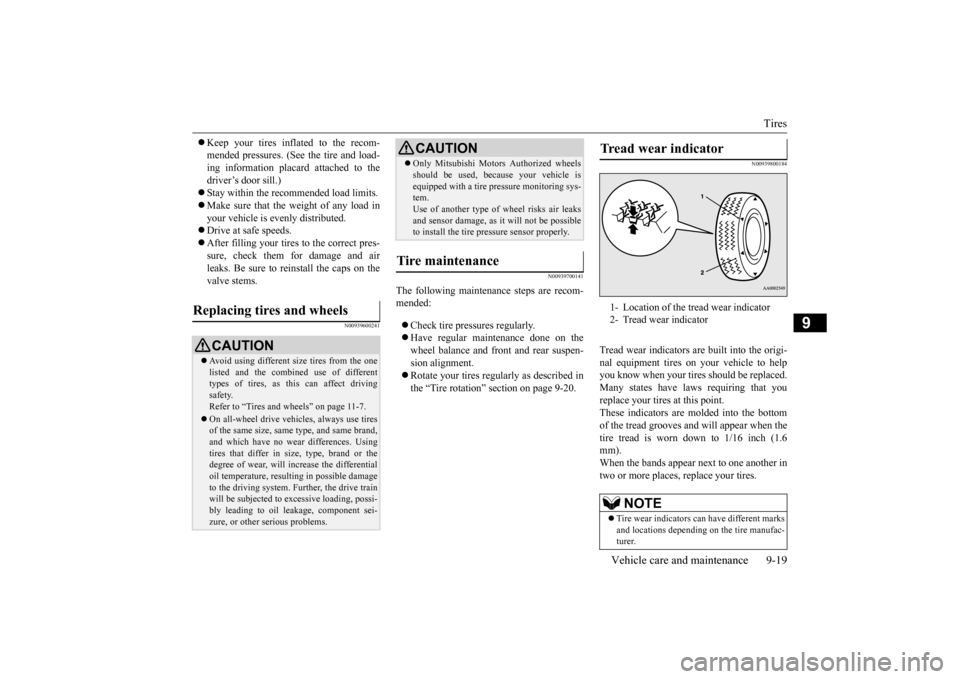
N00939800184
Tread wear indicators ar
e built into the origi-
nal equipment tires on
your vehicle to help
you know when your tires should be replaced. Many states have la
ws requiring that you
replace your tires at this point.These indicators are molded into the bottom of the tread grooves and will appear when the tire tread is worn down to 1/16 inch (1.6mm). When the bands appear next to one another in two or more places
, replace your tires.
Replacing tires and wheels
CAUTIONAvoid using different size tires from the one listed and the combined use of different types of tires, as this can affect driving safety.Refer to “Tires and wheels” on page 11-7. On all-wheel drive vehi
cles, always use tires
of the same size, same
type, and same brand,
and which have no wear differences. Using tires that differ in si
ze, type, brand or the
degree of wear, will increase the differential oil temperature, resulting in possible damage to the driving system. Further, the drive trainwill be subjected to ex
cessive loading, possi-
bly leading to oil leakage, component sei- zure, or other serious problems.
Only Mitsubishi Motors Authorized wheels should be used, beca
use your vehicle is
equipped with a tire pr
essure monitoring sys-
tem. Use of another type of
wheel risks air leaks
and sensor damage, as
it will not be possible
to install the tire pressure sensor properly.
Tire maintenance
CAUTION
Tread wear indicator 1- Location of the tread wear indicator 2- Tread wear indicator
NOTE
Tire wear indicators ca
n have different marks
and locations dependi
ng on the tire manufac-
turer.
BK0211800US.book 19 ページ 2014年3月12日 水曜日 午後2時42分
Page 405 of 446
For cold and snowy weather 9-24 Vehicle care and maintenance
9
N00942201118
The best way to keep carbon monoxide gas from entering inside your
vehicle is to have
the engine exhaust syst
em properly serviced.
Have a competent mechanic inspect the com- plete exhaust system
and nearby body areas
for broken, damaged, deteriorated, or mispo- sitioned parts if you no
tice any of the follow-
ing: A change in the sound of the exhaust sys- tem The smell of exhaust fumes inside the vehicle The underside or rear of the vehicle is damaged
Also check the exhaust system each time the vehicle is raised for l
ubrication, oil changes,
or required service. A
ny open seams or loose
connections could le
t dangerous exhaust
fumes seep into the
luggage and passenger
compartments.
Check for holes or exhaust gas leaks caused by corrosion or damage. Check the joints and connections for looseness or exhaust gas leaks. Check the rubber hangers and brackets for damage.
N00942300079
The timing belt should be replaced with a new one at the mileage listed in the “WAR- RANTY AND MAINTENANCE MAN-UAL”.
N00942501124
The hood lock release mechanism and hood safety catch should be
checked, cleaned, and
oiled when needed for easy movement and toprevent rust and wear. Use Multipurpose Grease NLGI Grade 2 sp
aringly for all sliding
parts of the hood latc
h and release lever.
Work the grease into the hood lock mecha- nism until all the mo
vable surfaces are cov-
ered.
Also, put a light coat
of the same grease on
the safety catch wherever moving parts touch.
N00942600102
The ventilation slots in
front of the wind-
shield should be brushed clear after a heavy snowfall so that the operation of the heating and ventilation
systems will not be impaired.
To prevent freezing of the weatherstripping on the doors, engine hood, etc., they shouldbe treated with silicone grease. It is a good idea to carry a shovel or a short- handled spade in the vehicle during the win-ter so that you can clear away snow if you get stranded. A small hand-brush for sweeping snow off the vehicle a
nd a plastic scraper for
Exhaust system
WA R N I N GCarbon monoxide gas
from your vehicle’s
exhaust is poisonous. Breathing thesefumes can cause unconsciousness or death.
Check for any of the following conditions: Timing belt Hood lock release mechanism and safety catch
For cold and snowy weather Ventilation slots Weatherstripping Additional equipment (For regions where snow is encoun- tered)
BK0211800US.book 24 ページ 2014年3月12日 水曜日 午後2時42分
Page 408 of 446
Fuses
Vehicle care and maintenance 9-27
9
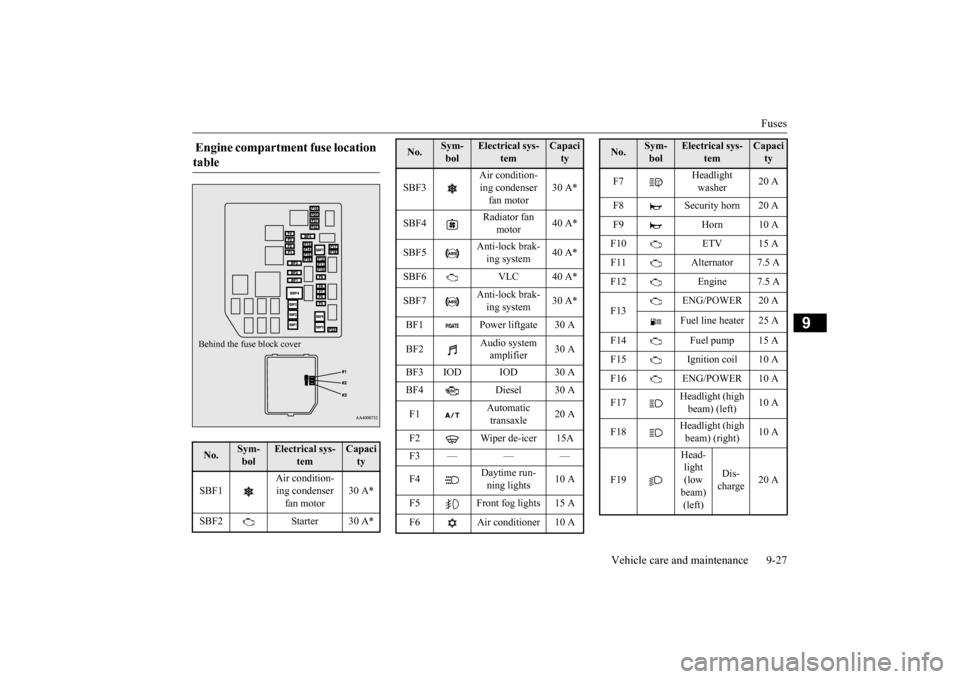
Engine compartment fuse location table No.
Sym- bol
Electrical sys-
tem
Capacity
SBF1
Air condition- ing condenser fan motor
30 A*
SBF2 Starter 30 A*Behind the fuse block cover
SBF3
Air condition- ing condenser fan motor
30 A*
SBF4
Radiator fan
motor
40 A*
SBF5
Anti-lock brak- ing system
40 A*
SBF6 VLC 40 A* SBF7
Anti-lock brak- ing system
30 A*
BF1 Power liftgate 30 A BF2
Audio system amplifier
30 A
BF3 IOD IOD 30 A BF4 Diesel 30 A F1
Automatic transaxle
20 A
F2 Wiper de-icer 15A F3 — — — F4
Daytime run- ning lights
10 A
F5 Front fog lights 15 A F6 Air conditioner 10 ANo.
Sym- bol
Electrical sys-
tem
Capacity
F7
Headlight washer
20 A
F8 Security horn 20 A F9 Horn 10 AF10 ETV 15 A F11 Alternator 7.5 A F12 Engine 7.5 A F13
ENG/POWER 20 A Fuel line heater 25 A
F14 Fuel pump 15 A F15 Ignition coil 10 A F16 ENG/POWER 10 A F17
Headlight (high beam) (left)
10 A
F18
Headlight (high beam) (right)
10 A
F19
Head- light (low beam) (left)
Dis- charge
20 A
No.
Sym- bol
Electrical sys-
tem
Capacity
BK0211800US.book 27 ページ 2014年3月12日 水曜日 午後2時42分
Page 410 of 446
Replacement of light bulbs
Vehicle care and maintenance 9-29
9
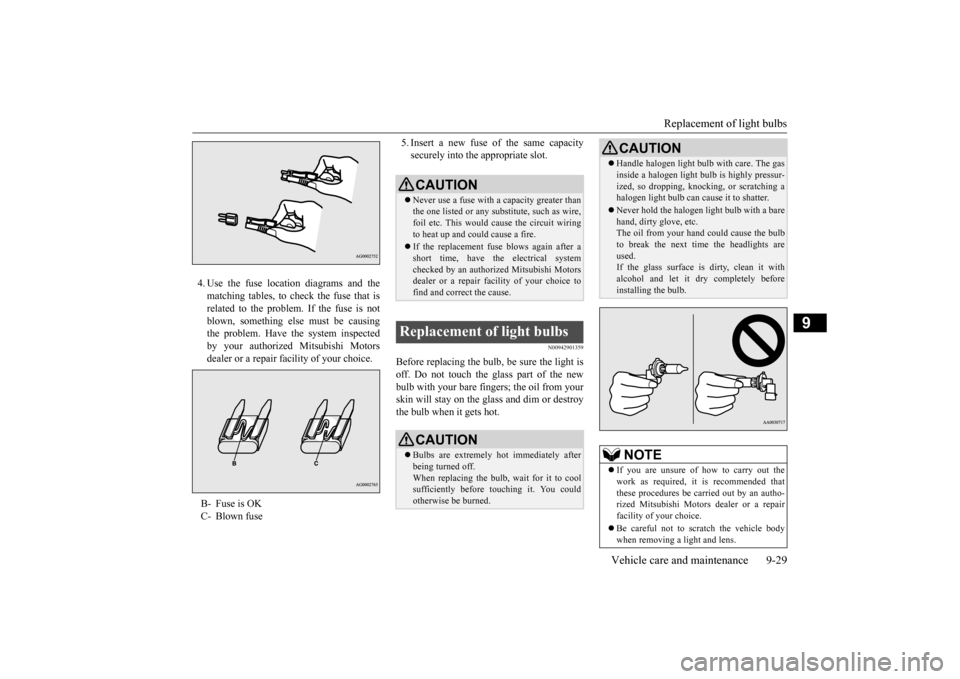
4. Use the fuse location diagrams and the matching tables, to check the fuse that isrelated to the problem. If the fuse is not blown, something else must be causing the problem. Have the system inspectedby your authorized Mitsubishi Motors dealer or a repair facility of your choice.
5. Insert a new fuse
of the same capacity
securely into the appropriate slot.
N00942901359
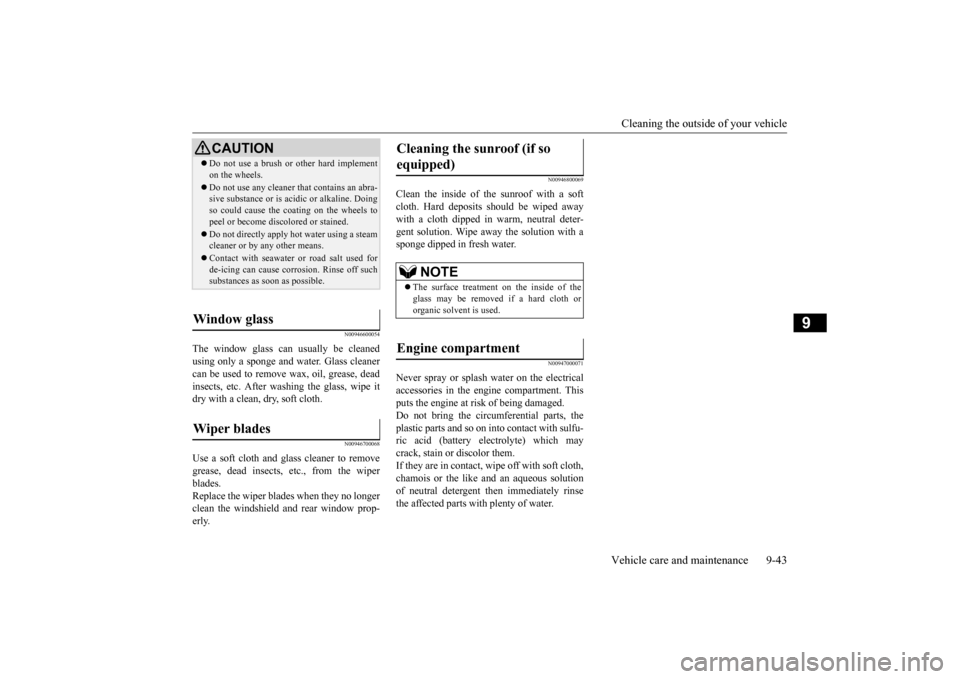
Before replacing the bulb, be sure the light is off. Do not touch the glass part of the new bulb with your bare fingers; the oil from yourskin will stay on the glass and dim or destroy the bulb when it gets hot.
B- Fuse is OK C- Blown fuse
CAUTION Never use a fuse with a capacity greater than the one listed or any s
ubstitute, such as wire,
foil etc. This would
cause the circuit wiring
to heat up and could cause a fire. If the replacement fuse blows again after a short time, have the electrical systemchecked by an authorized Mitsubishi Motors dealer or a repair faci
lity of your choice to
find and correct
the cause.
Replacement of light bulbs
CAUTIONBulbs are extremely hot immediately after being turned off. When replacing the bulb, wait for it to coolsufficiently before
touching it. You could
otherwise be burned.
Handle halogen light bul
b with care. The gas
inside a halogen light
bulb is highly pressur-
ized, so dropping, knocki
ng, or scratching a
halogen light bulb can
cause it to shatter.
Never hold the halogen
light bulb with a bare
hand, dirty glove, etc. The oil from your hand could cause the bulb to break the next time the headlights areused. If the glass surface is dirty, clean it with alcohol and let it dry completely beforeinstalling the bulb.NOTE
If you are unsure of how to carry out the work as required, it is recommended that these procedures be carried out by an autho- rized Mitsubishi Motors dealer or a repairfacility of your choice. Be careful not to scratch the vehicle body when removing a light and lens.CAUTION
BK0211800US.book 29 ページ 2014年3月12日 水曜日 午後2時42分
Page 421 of 446
Cleaning the outside of your vehicle 9-40 Vehicle care and maintenance
9
Use a vacuum cleaner and brush to clean the seats. If stained,
vinyl and synthetic
leather should be cleaned with an appro- priate cleaner. Cloth fabrics can be cleaned with either upholstery cleaner or a3% solution of gentle soap in lukewarm water. 2. Clean the carpeting with a vacuumcleaner and remove any stains with carpet cleaner. Oil and grea
se can be removed by
lightly dabbing with
a clean white cloth
and spot remover.
N00945600187
1. To clean, lightly wipe the leather with a soft cloth soaked in a 5% solution of gen- tle soap and water. 2. To rinse, dip the cloth in fresh water,wring it out well, a
nd wipe off all the
soap. 3. To preserve and prot
ect, use a leather pro-
tecting agent on the genuine leather sur- face.
N00945700058
To protect your vehicle’s finish, wash it often and thoroughly. If desired, you may wax your vehicle using a nonabra
sive automobile wax.
N00945800033
Industrial pollution, road tar, bird droppings, tree sap, insect remain
s, sea water and other
foreign matters can damage the finish on yourvehicle. Generally, the longer any foreign material stays on the finish, the worse the damage.Wash your vehicle as soon as possible when- ever the finish gets soiled.
N00945901637
Chemicals cont
ained in the dirt and dust
picked up from air, rain, snow, or road sur-faces can damage the paint and body of your vehicle if left on. Frequent washing and wa
xing is the best way
to protect your vehicl
e from this damage.
Do not wash the vehicle in direct sunlight. Park the vehicle in the shade and spray it withwater to remove dust.
Next, using plenty of
clean water and
a car washing mitt or sponge,
wash the vehicle from top to bottom.Use a mild car washing soap if necessary. Rinse thoroughly and wipe dry with a cham- ois or soft cloth. Af
ter washing
the vehicle,
carefully clean the joints and flanges of the doors, hood, etc., where dirt is likely to remain.
NOTE
If fuzzing is difficult to remove from the seat upholstery, draw a suit
able defuzzing brush
over the surface in one direction.
Genuine leather
(if so equipped)
NOTE
If genuine leather is we
t with water, wipe it
with a dry, soft cloth. If left damp, mildewmay grow. The genuine leather su
rface can be damaged
if brushed with a nylon or synthetic fiberbrush. Organic solvents such as benzine, kerosene, alcohol, gasoline, or acid
or alkaline solvents
can discolor the genuine
leather surface and
should not be used. Genuine leather can
mildew if not kept
clean. Clean up any o
il stains immediately.
The genuine leather su
rface may harden and
shrink if it is exposed to the direct sunlightfor long hours. When your vehicle is parked, place it in the shade as much as possible. When the temperature of the vehicle interior rises in summer, vinyl
products left on the
genuine leather seat
may deteriorate and
stick to the seat.
Cleaning the outside of your vehicle
Foreign material Wa s h i n g
BK0211800US.book 40 ページ 2014年3月12日 水曜日 午後2時42分
Page 423 of 446
Cleaning the outside of your vehicle 9-42 Vehicle care and maintenance
9
N00946100046
If painted surfaces have
been severely dam-
aged and lost their original luster and color tone, polish the surface
lightly with a fine
polishing compound. Avoid limiting your polishing to the damage
d surface only; polish
a somewhat wider area, moving the polishingcloth in one direction.
After polishing, flush
the compound from the surface and apply a coat of wax to regain a beautiful luster.
N00946201099
Small cracks and scratches in the paint coat should be touched up as
soon as possible with
touch-up paint to prevent corrosion.Check body areas facing the road or the tires carefully for damage to the paint caused by flying stones, etc. The
paint code number for
your vehicle can be found on the vehicle information code plate located on the front passenger door sill.
N00946301221
Use a sponge or chamois to clean these parts.If the vehicle wax sticks to a gray or black rough surface of the bumper, molding or lights, the surface may appear white in color.In this case, wipe it
off using lukewarm water
and a soft cloth or chamois.
N00946400052
To prevent spots and corrosion of chrome parts, wash with water, dry thoroughly, and apply a nonabrasive automotive wax. If the chrome is severely da
maged or pitted, use a
commercially available chrome polish.
N00946500183
1. Remove dirt using a wet sponge.2. Use a mild detergent on any dirt that can- not be removed ea
sily with water.
Rinse off the detergent after washing thewheel. 3. Dry the wheel thoroughly using a chamois leather or a soft cloth.
Do not use gasoline, benzine, kerosene or paint thinners to remove
road tar or other dirt
from the vehicle surface. Do not put wax on the areas having black matte coating because
it can cause uneven
discoloration, patches,
blurs, etc. If these get
wax on them, wipe the wax off right away with a soft clot
h and warm water.
On vehicles with sunr
oof, be careful not to
apply any wax on the weatherstrip (blackrubber) when waxing the area around the sunroof opening. If stained with wax,
the weatherstrip cannot
maintain a weatherproof seal with the sun- roof.
Polishing
CAUTION
Damaged paint Cleaning plastic parts
CAUTION Do not use a scrubbing brush or other rough scrubber as these may
damage the plastic
surface. Do not use wax containing compounds (pol- ishing powder) which
may damage the plas-
tic surface.
Do not let plastic parts
get soiled with gaso-
line, oil, brake fluids
, engine oils, greases,
paint thinner, and sulfuric acid (battery elec-trolyte), as such substa
nces will cause stains,
cracks, or discoloration. If any of these get on a plastic part, wipethem up with a soft cloth or chamois and a mild solution of soap and water. Then rinse them immediately with water.
Chrome parts Aluminum wheels
(if so equipped)
CAUTION
BK0211800US.book 42 ページ 2014年3月12日 水曜日 午後2時42分
Page 424 of 446
Cleaning the outside of your vehicle Vehicle care and maintenance 9-43
9
N00946600054
The window glass can
usually be cleaned
using only a sponge and
water. Glass cleaner
can be used to remove
wax, oil, grease, dead
insects, etc. After washing the glass, wipe it dry with a clean, dry, soft cloth.
N00946700068
Use a soft cloth and gl
ass cleaner to remove
grease, dead insects, etc., from the wiperblades. Replace the wiper blades when they no longer clean the windshield and rear window prop-erly.
N00946800069
Clean the inside of the sunroof with a softcloth. Hard deposits
should be wiped away
with a cloth dipped in
warm, neutral deter-
gent solution. Wipe away the solution with a sponge dipped in fresh water.
N00947000071
Never spray or splash
water on the electrical
accessories in the engine compartment. Thisputs the engine at risk of being damaged. Do not bring the circum
ferential parts, the
plastic parts and so on
into contact with sulfu-
ric acid (battery electrolyte) which may crack, stain or discolor them. If they are in contact, wipe off with soft cloth,chamois or the like and an aqueous solution of neutral detergent th
en immediately rinse
the affected parts with plenty of water.
CAUTION Do not use a brush or other hard implement on the wheels. Do not use any cleaner that contains an abra- sive substance or is ac
idic or alkaline. Doing
so could cause the co
ating on the wheels to
peel or become disc
olored or stained.
Do not directly apply
hot water using a steam
cleaner or by any other means. Contact with seawater or road salt used for de-icing can cause corr
osion. Rinse off such
substances as soon as possible.
Window glass Wiper blades
Cleaning the sunroof (if so equipped)
NOTE
The surface treatment on the inside of the glass may be removed
if a hard cloth or
organic solvent is used.
Engine compartment
BK0211800US.book 43 ページ 2014年3月12日 水曜日 午後2時42分
Page 438 of 446
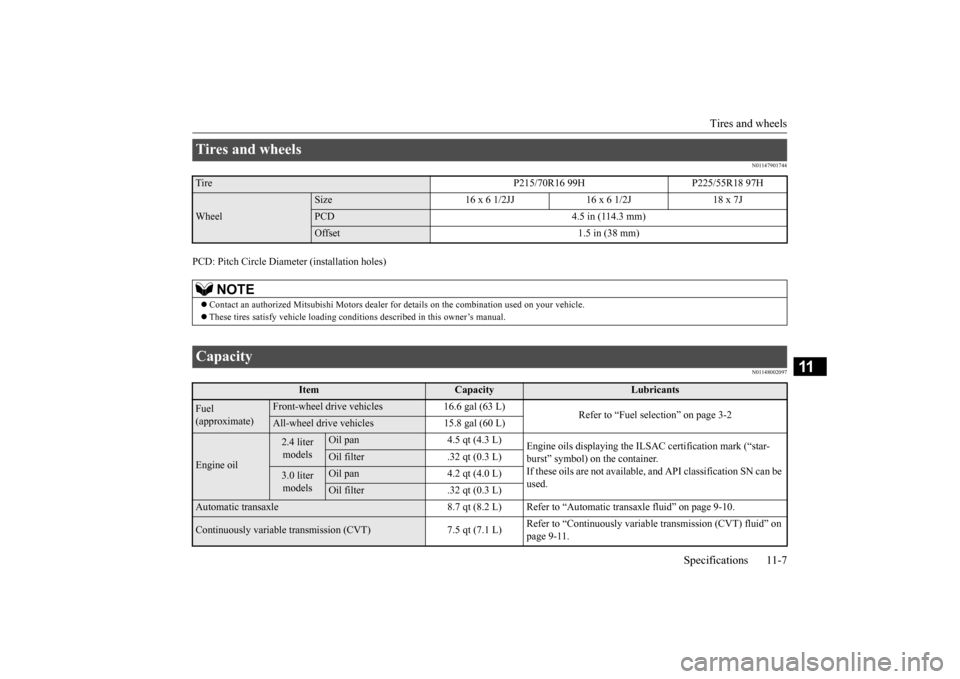
Tires and wheels
Specifications 11-7
11
N01147901744
PCD: Pitch Circle
Diameter (ins
tallation holes)
N01148002097
Tires and wheels Tire P215/70R16 99H P225/55R18 97HWheel
Size 16 x 6 1/2JJ 16 x 6 1/2J 18 x 7JPCD 4.5 in (114.3 mm)Offset 1.5 in (38 mm)
NOTE
Contact an authorized Mitsubishi
Motors dealer for de
tails on the combinati
on used on your vehicle.
These tires satisfy vehicle loading condi
tions described in
this owner’s manual.
Capacity
Item
Capacity
Lubricants
Fuel (approximate)
Front-wheel drive ve
hicles 16.6 gal (63 L)
Refer to “Fuel selection” on page 3-2
All-wheel drive vehicles 15.8 gal (60 L)
Engine oil
2.4 liter models
Oil pan 4.5 qt (4.3 L)
Engine oils displayi
ng the ILSAC certification mark (“star-
burst” symbol) on the container. If these oils are not available,
and API classification SN can be
used.
Oil filter .32 qt (0.3 L)
3.0 liter models
Oil pan 4.2 qt (4.0 L)Oil filter .32 qt (0.3 L)
Automatic transaxle 8.7 qt (8.2 L) Refer to
“Automatic transaxle fluid” on page 9-10.
Continuously variable transm
ission (CVT) 7.5 qt (7.1 L)
Refer to “Continuously variable
transmission (CVT) fluid” on
page 9-11.
BK0211800US.book 7 ページ 2014年3月12日 水曜日 午後2時42分
Page 439 of 446
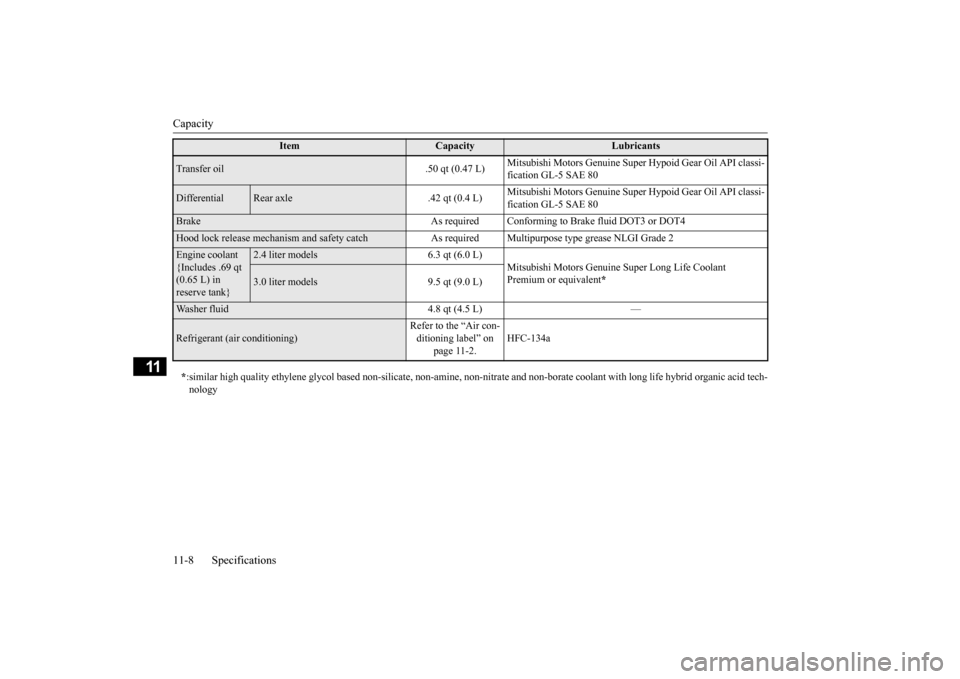
Capacity 11-8 Specifications
11
Transfer oil .50 qt (0.47 L)
Mitsubishi Motors Genuine Supe
r Hypoid Gear Oil API classi-
fication GL-5 SAE 80
Differential
Rear axle .42 qt (0.4 L)
Mitsubishi Motors Genuine Supe
r Hypoid Gear Oil API classi-
fication GL-5 SAE 80
Brake As required Conforming to Brake fluid DOT3 or DOT4Hood lock release mechanism and safety catch A
s required Multipurpose type
grease NLGI Grade 2
Engine coolant {Includes .69 qt (0.65 L) in reserve tank}
2.4 liter models 6.3 qt (6.0 L)
Mitsubishi Motors Genuine
Super Long Life Coolant
Premium or equivalent
*
3.0 liter models 9.5 qt (9.0 L)
Washer fluid 4.8 qt (4.5 L) —Refrigerant (air conditioning)
Refer to the “Air con- ditioning label” on
page 11-2.
HFC-134a
* :similar high quality ethylene
glycol based non-silicate, non-amine, non-nitrate
and non-borate coolant with long life hybrid o
rganic acid tech-
nology
Item
Capacity
Lubricants
BK0211800US.book 8 ページ 2014年3月12日 水曜日 午後2時42分