door lock MITSUBISHI OUTLANDER 2016 3.G Repair Manual
[x] Cancel search | Manufacturer: MITSUBISHI, Model Year: 2016, Model line: OUTLANDER, Model: MITSUBISHI OUTLANDER 2016 3.GPages: 464, PDF Size: 60.77 MB
Page 389 of 464
How to change a tire
For emergencies 8-7
8
6. Get the jack, bar and wheel nut wrench ready.(Refer to “Jack and t
ools” on page 8-5.)
N00849600315
The compact spare tire is stowed below the luggage compartment fl
oor. It is designed to
save space in the luggage compartment. Itslighter weight makes it easier to use if a flat tire occurs.
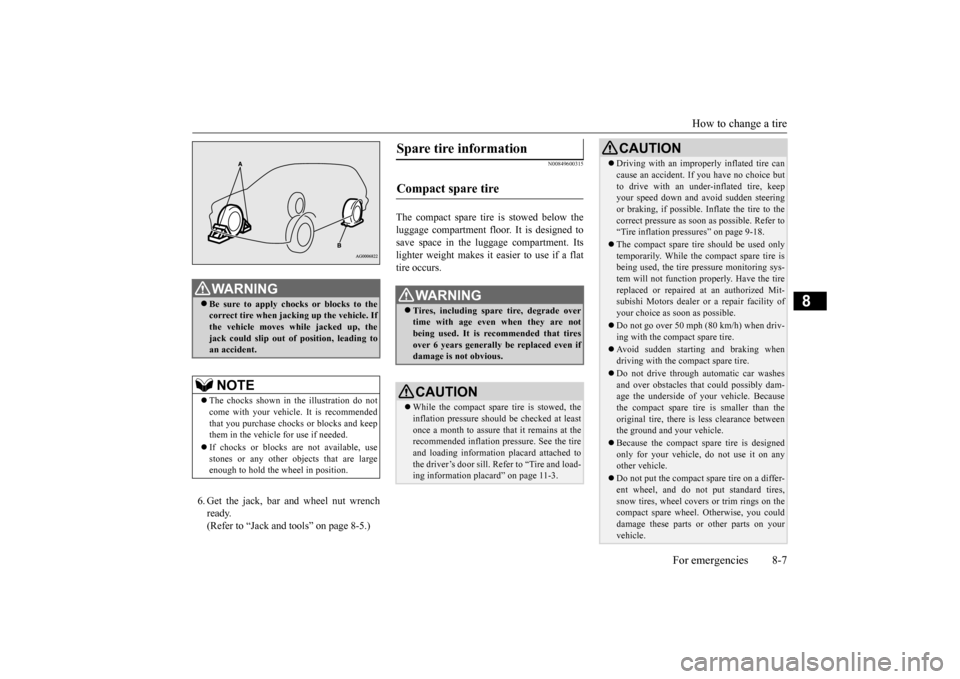
WA R N I N G Be sure to apply choc
ks or blocks to the
correct tire when jacking up the vehicle. Ifthe vehicle moves while jacked up, the jack could slip out of
position, leading to
an accident.NOTE
The chocks shown in the illustration do not come with your vehicl
e. It is recommended
that you purchase chocks or blocks and keep them in the vehicle for use if needed. If chocks or blocks
are not available, use
stones or any other obj
ects that are large
enough to hold the wheel in position.
Spare tire information Compact spare tire
WA R N I N G Tires, including spar
e tire, degrade over
time with age even when they are not being used. It is recommended that tiresover 6 years generally
be replaced even if
damage is not obvious.CAUTION While the compact spare tire is stowed, the inflation pressure shoul
d be checked at least
once a month to assure that it remains at the recommended inflation pressure. See the tire and loading informati
on placard attached to
the driver’s door sill. Refer to “Tire and load-ing information placard” on page 11-3.
Driving with an imprope
rly inflated tire can
cause an accident. If
you have no choice but
to drive with an under-inflated tire, keepyour speed down and avoid sudden steering or braking, if possible. Inflate the tire to the correct pressure as s
oon as possible. Refer to
“Tire inflation pressures” on page 9-18. The compact spare tire should be used only temporarily. While the compact spare tire is being used, the tire pr
essure monitoring sys-
tem will not function pr
operly. Have the tire
replaced or repaired at an authorized Mit- subishi Motors dealer or
a repair facility of
your choice as soon as possible. Do not go over 50 mph (80 km/h) when driv- ing with the compact spare tire. Avoid sudden starting and braking when driving with the compact spare tire. Do not drive through automatic car washes and over obstacles that
could possibly dam-
age the underside of your vehicle. Because the compact spare tire is smaller than the original tire, there is less clearance betweenthe ground and your vehicle. Because the compact spare tire is designed only for your vehicle, do not use it on any other vehicle. Do not put the compact spare tire on a differ- ent wheel, and do not put standard tires, snow tires, wheel covers
or trim rings on the
compact spare wheel. Otherwise, you could damage these parts or other parts on your vehicle.CAUTION
BK0223400US.book 7 ページ 2015年2月13日 金曜日 午後12時15分
Page 393 of 464
How to change a tire
For emergencies 8-11
8
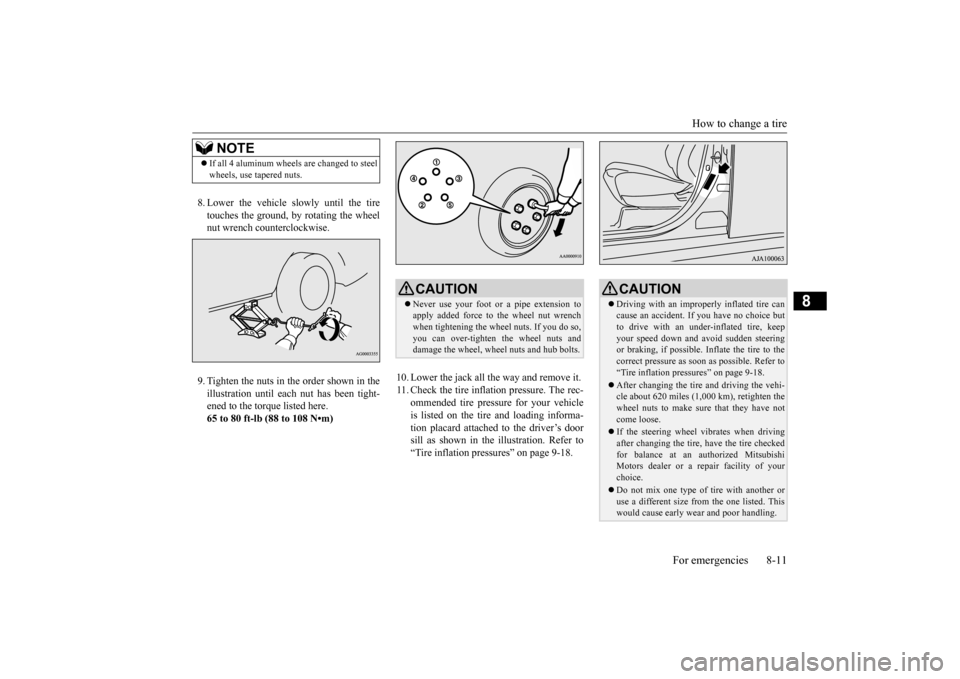
8. Lower the vehicle slowly until the tire touches the ground, by rotating the wheel nut wrench counterclockwise. 9. Tighten the nuts in the order shown in the illustration until each
nut has been tight-
ened to the torque listed here.65 to 80 ft-lb (88 to 108 N•m)
10. Lower the jack all the way and remove it. 11. Check the tire inflation pressure. The rec-
ommended tire pressure for your vehicleis listed on the tire
and loading informa-
tion placard attached to the driver’s door sill as shown in the illustration. Refer to“Tire inflation pressures” on page 9-18.
NOTE
If all 4 aluminum wheels are changed to steel wheels, use tapered nuts.
CAUTION Never use your foot or a pipe extension to apply added force to the wheel nut wrenchwhen tightening the wheel nuts. If you do so, you can over-tighten the wheel nuts and damage the wheel, wheel nuts and hub bolts.
CAUTION Driving with an imprope
rly inflated tire can
cause an accident. If
you have no choice but
to drive with an under-inflated tire, keep your speed down and avoid sudden steering or braking, if possible. Inflate the tire to thecorrect pressure as s
oon as possible. Refer to
“Tire inflation pressures” on page 9-18. After changing the tire
and driving the vehi-
cle about 620 miles (1,000 km), retighten the wheel nuts to make sure
that they have not
come loose. If the steering wheel vibrates when driving after changing the tire, have the tire checked for balance at an authorized Mitsubishi Motors dealer or a repair facility of yourchoice. Do not mix one type of tire with another or use a different size from the one listed. This would cause ea
rly wear and poor handling.
BK0223400US.book 11 ページ 2015年2月13日 金曜日 午後12時15分
Page 401 of 464
Engine hood
Vehicle care and maintenance 9-3
9
To reduce the possibili
ty of catalytic con-
verter damage: Use UNLEADED GASOLINE ONLY of the type of recommended in the “Fuel selection”. Do not drive with an extremely low fuel level. Running out of gas could damage the catalytic converter. Do not try to start the engine by pushing or towing the vehicle. If the battery is weak or run down, use jumper cables toproperly start the engine.
Do not idle the engine with any spark plug wires disconnected or removed, such aswhen performing
diagnosti
c tests.
Do not idle the engine
for a long time if it
is idling roughly or otherwise obviouslymalfunctioning. To prevent the catalytic converter from being damaged from unburned gas, do notrace the engine when turning off the igni- tion switch. Stop driving the vehicle if you think the performance is noticeably low, or the engine has a malfunction such as with theignition, etc. If you are not able to stop driving immediately,
slow down and drive
for only a short time. Have your vehiclechecked at an authorized Mitsubishi Motors dealer or a repair facility of your choice as soon
as possible.
In unusual situations involving major engine problems, a burning odor may indicate severe and abnormal catalyticconverter overheating.
If this occurs, stop
in a safe place, shut the engine off and let the vehicle cool. Once
the engine is cool,
immediately take your
vehicle to a dealer
or a repair facility of your choice for ser- vice.
N00937501588
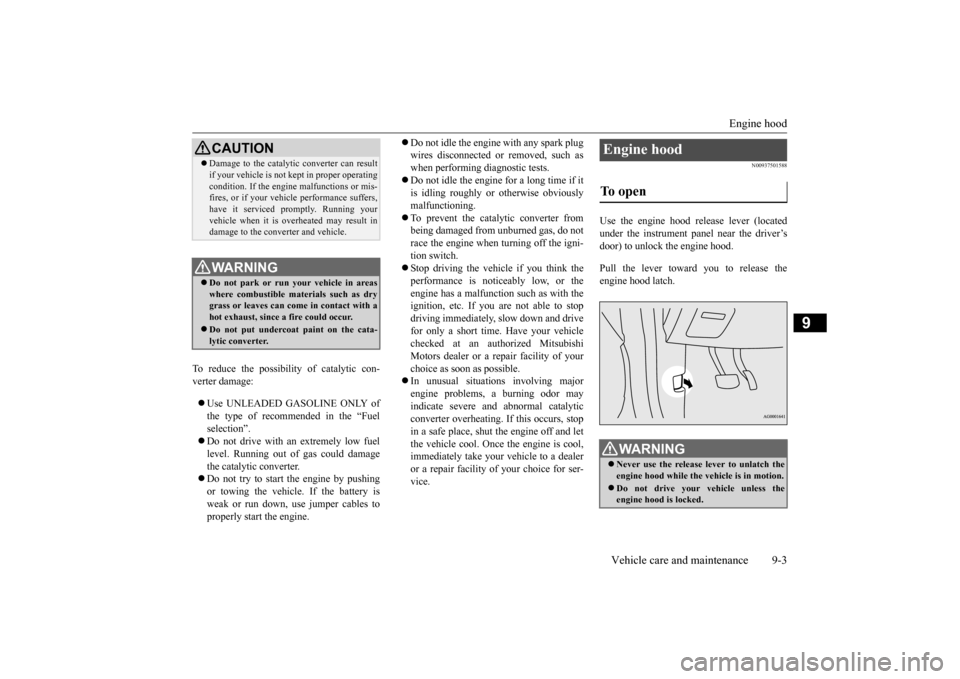
Use the engine hood release lever (located under the instrument panel near the driver’s door) to unlock the engine hood. Pull the lever toward you to release the engine hood latch.
CAUTION Damage to the catalyti
c converter can result
if your vehicle is not
kept in proper operating
condition. If the engine
malfunctions or mis-
fires, or if your vehi
cle performance suffers,
have it serviced promptly. Running your vehicle when it is
overheated may result in
damage to the converter and vehicle.WA R N I N G Do not park or run your vehicle in areas where combustible materials such as dry grass or leaves can come
in contact with a
hot exhaust, since a fire could occur. Do not put undercoat paint on the cata- lytic converter.
Engine hood To open
WA R N I N G Never use the release lever to unlatch the engine hood while the
vehicle is in motion.
Do not drive your vehicle unless the engine hood is locked.
BK0223400US.book 3 ページ 2015年2月13日 金曜日 午後12時15分
Page 423 of 464
For cold and snowy weather
Vehicle care and maintenance 9-25
9
N00942501124
The hood lock release mechanism and hood safety catch should be
checked, cleaned, and
oiled when needed for easy movement and to prevent rust and wear. Use Multipurpose Grease NLGI Grade 2 sp
aringly for all sliding
parts of the hood latc
h and release lever.
Work the grease into the hood lock mecha- nism until all the mo
vable surfaces are cov-
ered. Also, put a light coat of the same grease onthe safety catch wherever moving parts touch.
N00942600102
The ventilation slots in front of the wind-shield should be brus
hed clear after a heavy
snowfall so that the operation of the heating and ventilation systems
will not be impaired.
To prevent freezing of the weatherstripping on the doors, engine hood, etc., they should be treated with silicone grease. It is a good idea to carry a shovel or a short- handled spade in the vehicle during the win-ter so that you can clear away snow if you get stranded. A small hand-brush for sweeping snow off the vehicle a
nd a plastic scraper for
the windshield, side an
d rear window are also
useful.
N00942700291
The fusible links will melt to prevent a fire ifa large current attempts
to flow through cer-
tain electrical systems.In case of a melted fusible link, see your authorized Mitsubishi Motors dealer or a repair facility of your
choice for inspection
and replacement. For the fusible links, pl
ease refer to “Fuse
load capacities” on page 9-26.
N00942801912
To prevent damage to the electrical systemfrom short-circuiting
or overloading, each
individual circuit is e
quipped with a fuse. The
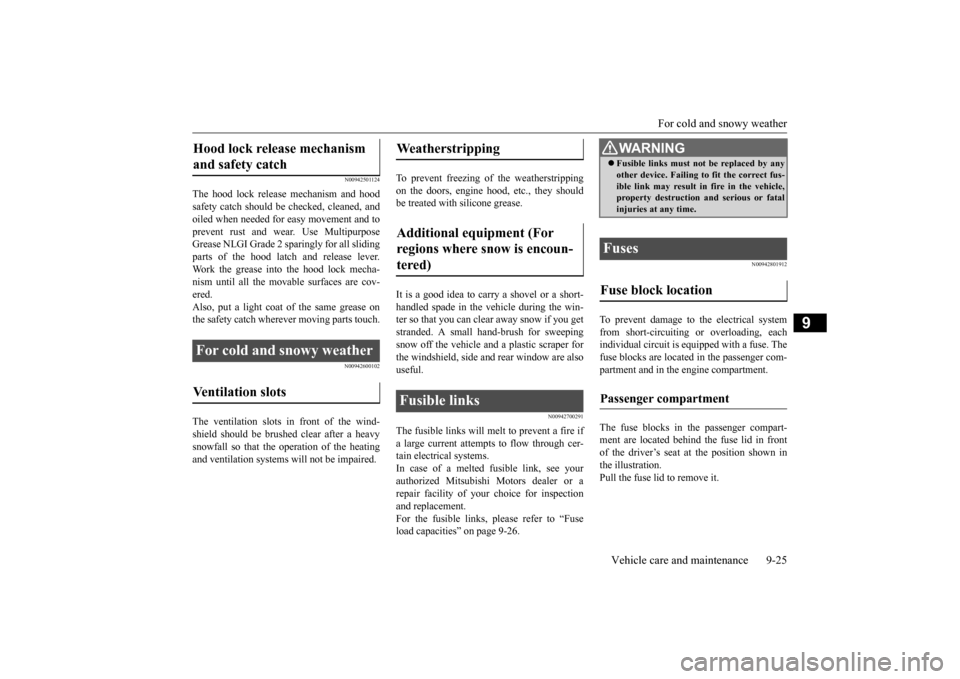
fuse blocks are located in the passenger com- partment and in the engine compartment. The fuse blocks in the passenger compart- ment are located behind the fuse lid in frontof the driver’s seat at the position shown in the illustration. Pull the fuse lid to remove it.
Hood lock release mechanism and safety catch For cold and snowy weather Ventilation slots
Weatherstripping Additional equipment (For regions where snow is encoun- tered) Fusible links
WA R N I N G Fusible links must not be replaced by any other device. Failing to fit the correct fus-ible link may result in fire in the vehicle,property destruction and serious or fatal injuries at any time.
Fuses Fuse block location Passenger compartment
BK0223400US.book 25 ページ 2015年2月13日 金曜日 午後12時15分
Page 424 of 464
Fuses 9-26 Vehicle care and maintenance
9
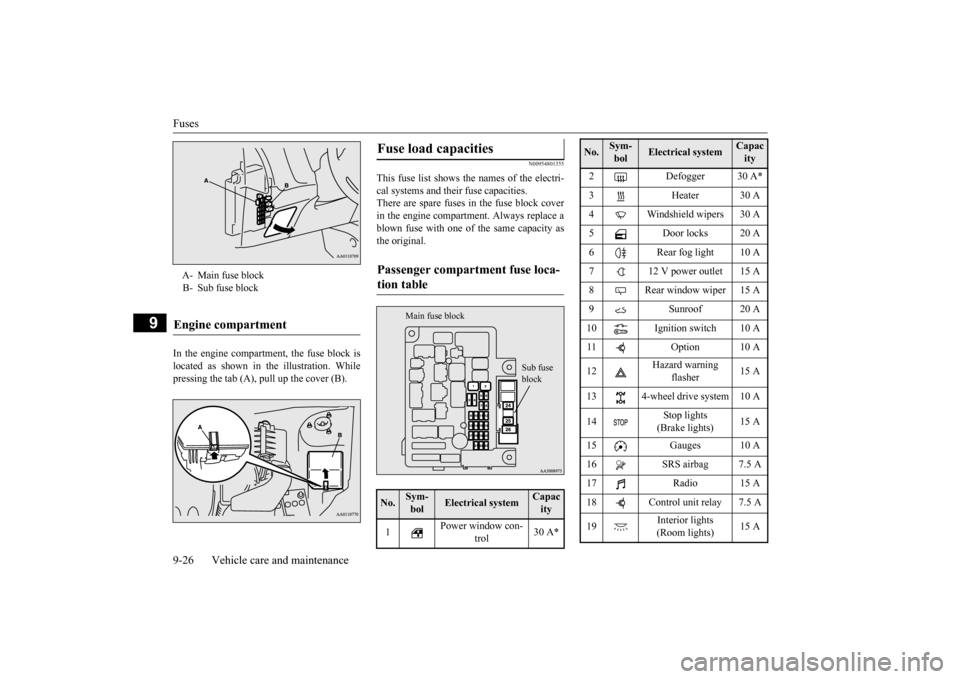
In the engine compartment, the fuse block is located as shown in the illustration. Whilepressing the tab (A), pull up the cover (B).
N00954801355
This fuse list shows the names of the electri- cal systems and their fuse capacities. There are spare fuses in the fuse block coverin the engine compartment. Always replace a blown fuse with one of the same capacity as the original.
A- Main fuse block B- Sub fuse blockEngine compartment
Fuse load capacities Passenger compartment fuse loca- tion table No.
Sym- bol
Electrical system
Capacity
1
Power window con-
trol
30 A*
Sub fuse block
Main fuse block
2 Defogger 30 A* 3 Heater 30 A 4 Windshield wipers 30 A 5 Door locks 20 A6 Rear fog light 10 A7 12 V power outlet 15 A8 Rear window wiper 15 A9 Sunroof 20 A 10 Ignition switch 10 A 11 Option 10 A 12
Hazard warning
flasher
15 A
13 4-wheel drive system 10 A 14
Stop lights (Brake lights)
15 A
15 Gauges 10 A 16 SRS airbag 7.5 A 17 Radio 15 A18 Control unit relay 7.5 A 19
Interior lights (Room lights)
15 A
No.
Sym- bol
Electrical system
Capacity
BK0223400US.book 26 ページ 2015年2月13日 金曜日 午後12時15分
Page 436 of 464
Vehicle care precautions 9-38 Vehicle care and maintenance
9
N00943900102 N00945100166
In order to maintain the value of your vehicle, perform regular maintenance using the proper materials and procedures
. Be sure to use only
those materials and proc
edures that meet your
local environmental pollution control regula- tions. Choose the material
s you will use care-
fully, to be sure that they do not contain corrosives. If you are not sure, contact an authorized Mitsubishi Mo
tors dealer for help
in choosing these materials.
These can all be danger
ous, and they all can
damage your vehicle.
N00945200095
After washing the inside
of your vehicle with
any cleaner, wipe it dry in a shady, well venti- lated area.
N00945300155
1. Lightly wipe these off with a soft clothsoaked in a 3% solution of gentle soap and water. 2. To rinse, dip the cloth in fresh water,wring it out well, a
nd wipe off all the
soap.
High-mounted stop light
NOTE
The high-mounted stop light uses an LED instead of the bulb. Check with an authorizedMitsubishi Motors dealer
or a repair facility
of your choice when the light needs to be repaired or replaced.
Vehicle care precautions
CAUTION Cleaning products can be dangerous. Some are poisonous and others
are highly flamma-
ble. Some are dangerous if you breathe theirfumes in a closed sp
ace. When you use any-
thing in a container to
clean your vehicle, be
sure to follow the in
structions. Always open
your vehicle doors or windows when you’re cleaning the inside. Never use the following chemicals to clean your vehicle:• Gasoline• Carbon Tetrachloride• Benzine• Kerosene• Naphtha• Acetone• Turpentine• Paint Thinner• Lacquer Thinner• Nail Polish Remover
Cleaning the inside of your vehicle
CAUTION Do not use organic substances (solvents, benzine, kerosene, alc
ohol, gasoline, etc.) or
alkaline or acidic solutions.These chemicals can cause discoloring, staining or cracking of the surface. If you use cleaners or polishing agents, makesure their ingredients do not include the sub- stances mentioned above.NOTE
Always read the instru
ctions on the cleaner
label.
Plastic, vinyl leather, fabric and flocked parts
BK0223400US.book 38 ページ 2015年2月13日 金曜日 午後12時15分
Page 449 of 464
Vehicle labeling
Specifications 11-3
11
The engine serial num
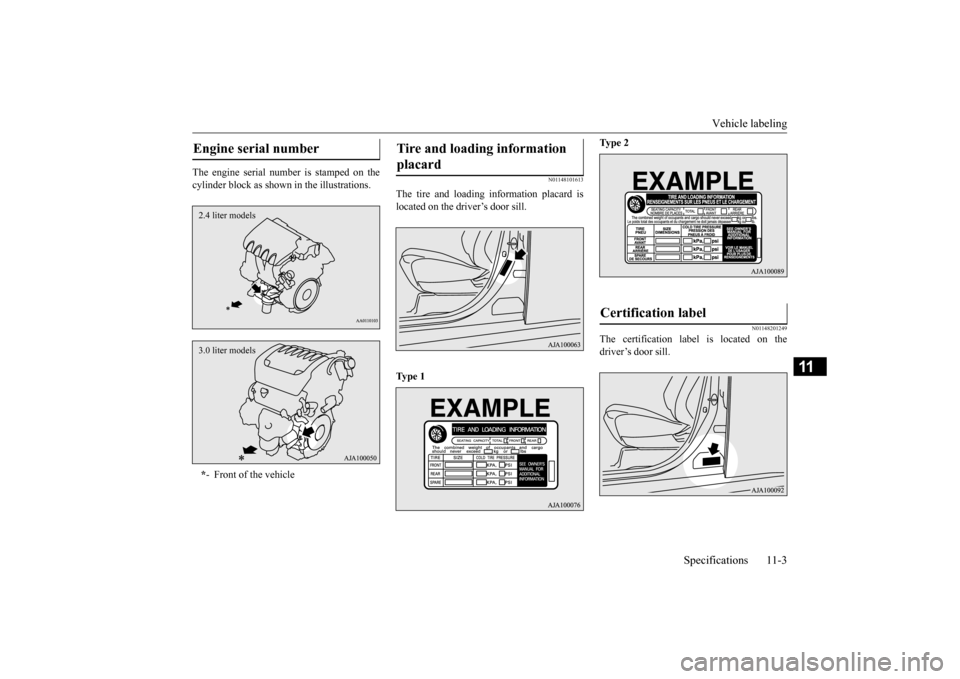
ber is stamped on the
cylinder block as shown
in the illustrations.
N01148101613
The tire and loading information placard is located on the driver’s door sill. Ty p e 1
Ty p e 2
N01148201249
The certification label is located on the driver’s door sill.
Engine serial number * - Front of the vehicle2.4 liter models3.0 liter models
Tire and loading information placard
Certification label
BK0223400US.book 3 ページ 2015年2月13日 金曜日 午後12時15分
Page 458 of 464

Alphabetical index 12-2
12
Child safety locks for rear door
............
5-36
Cleaning
Inside of your vehicle
......................
9-38
Outside of your vehicle
...................
9-39
Clock
.................................................
7-51
Coat hook
........................................
5-235
Consumer information
........................
10-2
Continuously variable transmission (CVT)
....
5-71 Fluid
....................................
9-11
, 11-7
Selector lever operation
...................
5-72
Selector le
ver positions
...................
5-75
Sports mode
...................................
5-76
Coolant (engine)
..........................
9-8
, 11-7
Cruise control
.....................................
5-96
Cup holder
.......................................
5-232
D
Daytime running lights
Bulb capacity
.................................
9-30
Replacement
..................................
9-34
Defogger (rear window)
....................
5-190
Defrosting or defogging (windshield, door windows)
..................................
7-9
, 7-13
Digital clock
Time setting
...................................
7-47
Dimensions
........................................
11-4
Dimmer (high/lo
w beam change)
.......
5-180
Disc brake pads
...................................
9-24
Dome light (front)/Reading lights
.......
5-226
Bulb capacity
..................................
9-32
Dome light (rear)
...............................
5-226
Bulb capacity
..................................
9-32
Doors
Lock
..............................................
5-33
Power door locks
............................
5-35
Driving during cold weather
..................
6-5
Driving precaution
...............................
6-2
Driving, alcohol and drugs
....................
6-2
E
ECO mode switch
.............................
5-184
Electric power steering system (EPS)
....
5-93
Electric rear window
defogger switch
..5-190
Electronic immobilizer (Anti-theft starting system)
.....................................
5-4
, 5-27
Electronically cont
rolled 4WD system
..5-79
Emission-control system maintenance
...
9-22
Engine
Compartment
...................................
9-5
Coolant
...................................
9-8
, 11-7
Hood
...............................................
9-3
Malfunction indicator light
.............
5-173
MIVEC
.................................
5-25
, 5-64
Oil and oil filter
.......................
9-6
, 11-7
Overheating
.....................................
8-4
Serial number
.................................
11-2
Specification
..................................
11-6
Engine hood
.........................................
9-3
Engine switch
.....................................
5-18
Exhaust system
...................................
9-24
F
Floor console box
.............................
5-229
Floor mat
.............................................
6-3
Fluid
Automatic transaxle fluid
.......
9-11
, 11-7
Brake fluid
............................
9-12
, 11-7
Continuously variable transmission (CVT) fluid
...................................
9-11
, 11-7
Engine coolant
........................
9-8
, 11-7
Engine oil
...............................
9-6
, 11-7
Rear axle oil
..........................
9-12
, 11-7
Transfer oil
...........................
9-12
, 11-7
Washer fluid
.........................
9-12
, 11-7
Fluid capacities and lubricants
.............
11-7
Forward Collision Miti
gation System (FCM)
5-111 Free-hand advanced security transmitter (F.A.S.T.-key)
..................................
5-12
Front fog lights
Bulb capacity
.................................
9-30
Indicators
.....................................
5-172
Replacement
..................................
9-35
Switch
.........................................
5-184
BK0223400US.book 2 ページ 2015年2月13日 金曜日 午後12時15分