Car seat MITSUBISHI OUTLANDER 2017 3.G User Guide
[x] Cancel search | Manufacturer: MITSUBISHI, Model Year: 2017, Model line: OUTLANDER, Model: MITSUBISHI OUTLANDER 2017 3.GPages: 521, PDF Size: 14.91 MB
Page 42 of 521
Making a cargo area
Seat and restraint systems 4-13
4
N00405501115
N00405701146
The second row seat can be folded to create an additional cargo area.
1. When folding the left side second row seat, store the seat belt for the middle seating position of the second row seat.Refer to “Detachable
center seat belt for
second row” on page 4-21. 2. Lower the head restraint for second rowmiddle seating position to its lowest posi- tion. Refer to “Head restraints” on page 4-11.3. Pull the strap (A), then fold forward the head restraints for second row outside seating position.
Making a cargo area
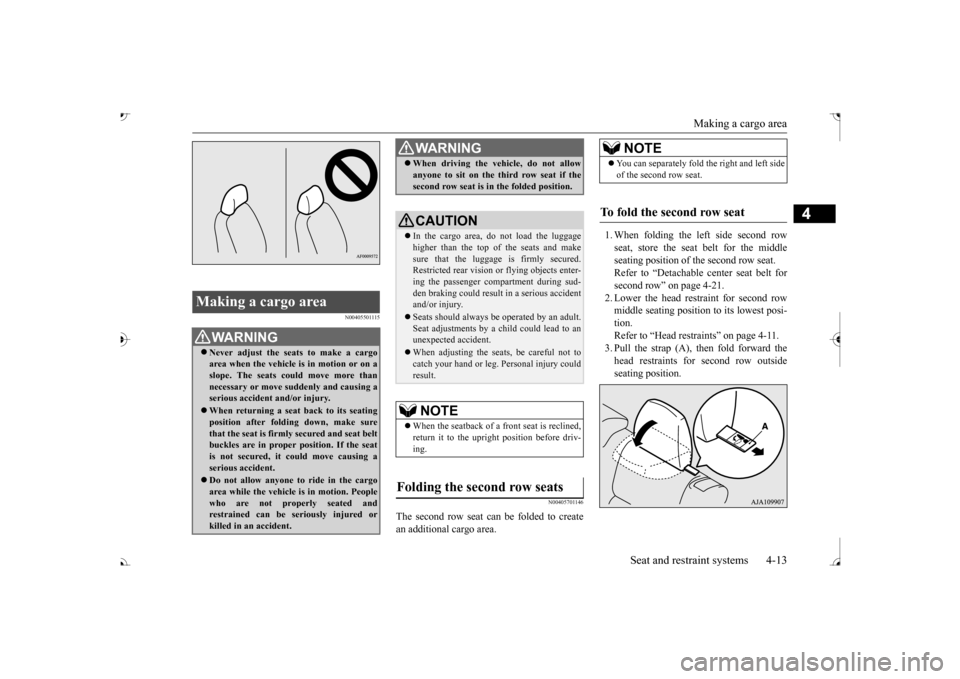
WA R N I N G Never adjust the seats to make a cargo area when the vehicle is in motion or on a slope. The seats co
uld move more than
necessary or move su
ddenly and causing a
serious accident
and/or injury.
When returning a seat back to its seating position after fold
ing down, make sure
that the seat is firmly secured and seat beltbuckles are in proper position. If the seat is not secured, it could move causing a serious accident. Do not allow anyone to ride in the cargo area while the vehicle
is in motion. People
who are not properly seated and restrained can be seriously injured or killed in an accident.
When driving the vehicle, do not allow anyone to sit on the third row seat if thesecond row seat is in the folded position.CAUTION In the cargo area, do not load the luggage higher than the top of the seats and makesure that the luggage is firmly secured. Restricted rear vision or
flying objects enter-
ing the passenger compartment during sud-den braking could result
in a serious accident
and/or injury. Seats should always be
operated by an adult.
Seat adjustments by a child could lead to an unexpected accident. When adjusting the seats, be careful not to catch your hand or leg.
Personal injury could
result.NOTE
When the seatback of a front seat is reclined, return it to the upright
position before driv-
ing.
Folding the second row seats
WA R N I N G
NOTE
You can separately fold
the right and left side
of the second row seat.
To fold the second row seat
BK0239700US.book 13 ページ 2016年6月16日 木曜日 午前10時58分
Page 43 of 521

Making a cargo area 4-14 Seat and restraint systems
4
4. On vehicles with th
e second row seat slide
function, move the second row seat fullybackward. Refer to “To adjust the seat forward or backward” on page 4-8. 5. Pull the strap (B), then flip the seat cush- ion forward.
6. Fold forward the seat belt buckle. 7. Pull up the lever (D), then fold the seat- back forward.
NOTE
If you do not move the second row seat fully backward, you may not be able to fold the second row seat.
CAUTION Do not allow any person
to get on the plastic
cover (C), and do not
place luggage on it.
Doing so could damage
the plastic cover.
CAUTIONDo not allow any person to sit on the flipped seat cushion, and do
not place luggage on it.
The seat’s mounting fittings could bendunder the weight, making it impossible for the seat cushion to be secured when it returns to the original position.NOTE
If the seatback cannot be folded, follow the steps below. 1. Raise the seatback once until it locks.2. Pull the strap again. 3. Pull up the lever, then fold the seatback forward.
BK0239700US.book 14 ページ 2016年6月16日 木曜日 午前10時58分
Page 44 of 521

Making a cargo area
Seat and restraint systems 4-15
4
1. Raise the seatback until it locks securely into place. 2. While lifting the seat belt buckle (A), gen- tly lower the seat cushion. Make sure thatthere is a hook (B) at the position shown in the illustration.
3. Push down the seat cushion until it locks securely into place. 4. Make sure that all seat belt buckles are properly positioned on the seat cushion. 5. Return the folded head restraint to itsoriginal position.
6. If the center seat
belt is stored;
• Pull out the detachable anchor plate (D) from the seatback.• Pull the small latch plate (E) slowly and insert it into the detachable anchor plate until a click is heard.• Make sure that the seat belt is not twisted. For details, refer to
“Detachable center
seat belt for second row” on 4-21.
To r e t u r n
NOTE
A rubber strap (C) is atta
ched to the seat belt
buckle for the left out
board seating position.
This helps raise the seat
belt buckle while the
seat cushion returns to the original position.
WA R N I N G Ensure that the head restraints are returned to their original positions beforethe seats are occupied. Failure to do socould cause serious inju
ry if involved in an
accident.
BK0239700US.book 15 ページ 2016年6月16日 木曜日 午前10時58分
Page 45 of 521
Making a flat seat 4-16 Seat and restraint systems
4
N00409800021
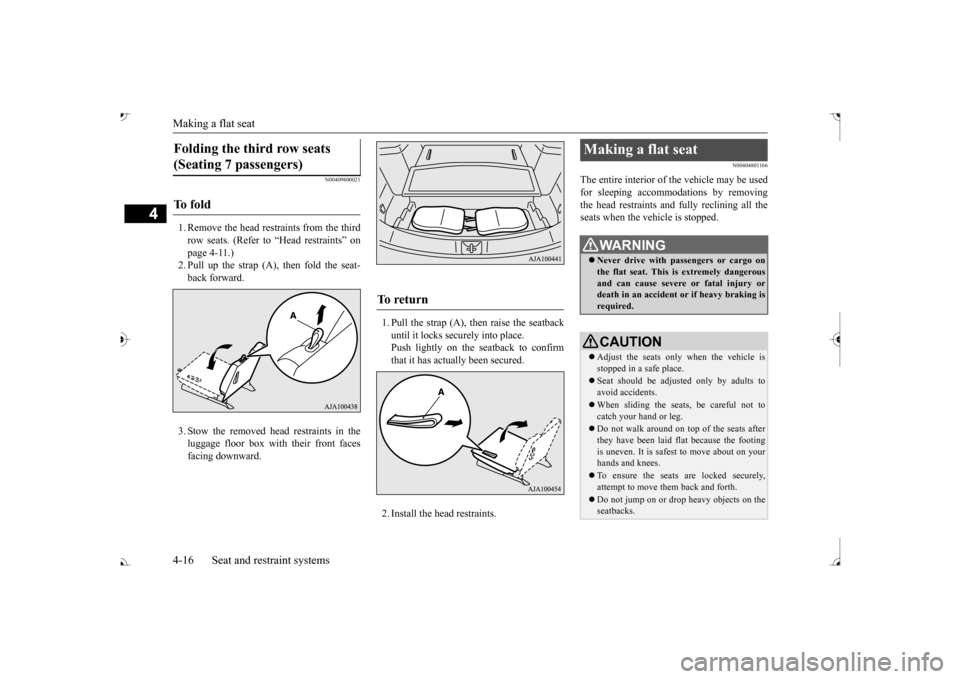
1. Remove the head restraints from the third row seats. (Refer to “Head restraints” on page 4-11.)2. Pull up the strap (A), then fold the seat- back forward. 3. Stow the removed head restraints in the luggage floor box with their front faces facing downward.
1. Pull the strap (A), then raise the seatback until it locks securely into place.Push lightly on the seatback to confirm that it has actually been secured. 2. Install the head restraints.
N00404801166
The entire interior of the vehicle may be used for sleeping accommoda
tions by removing
the head restraints and fully reclining all theseats when the vehicle is stopped.
Folding the third row seats (Seating 7 passengers) To f o l d
To r e t u r n
Making a flat seat
WA R N I N G Never drive with passengers or cargo on the flat seat. This is extremely dangerousand can cause severe or fatal injury or death in an accident
or if heavy braking is
required.CAUTION Adjust the seats only when the vehicle is stopped in a safe place. Seat should be adjusted only by adults to avoid accidents. When sliding the seat
s, be careful not to
catch your hand or leg. Do not walk around on top of the seats after they have been laid flat because the footingis uneven. It is safest to move about on your hands and knees. To ensure the seats are locked securely, attempt to move them back and forth. Do not jump on or drop heavy objects on the seatbacks.
BK0239700US.book 16 ページ 2016年6月16日 木曜日 午前10時58分
Page 46 of 521
Making a flat seat
Seat and restraint systems 4-17
4
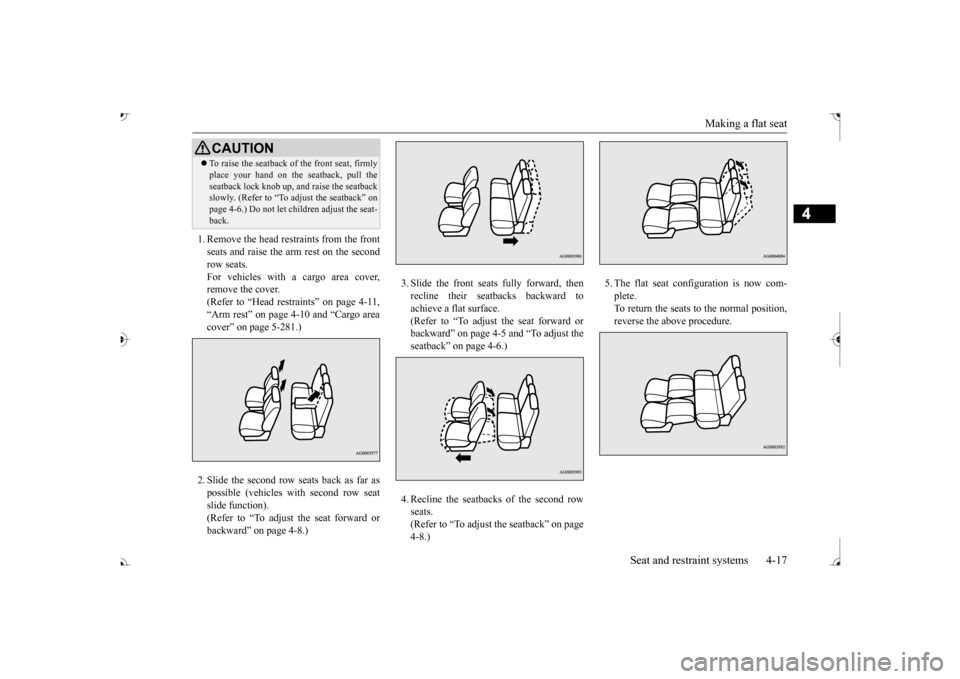
1. Remove the head restraints from the front seats and raise the arm rest on the secondrow seats. For vehicles with a cargo area cover, remove the cover.(Refer to “Head restraints” on page 4-11, “Arm rest” on page 4-10 and “Cargo area cover” on page 5-281.) 2. Slide the second row seats back as far as possible (vehicles with second row seat slide function).(Refer to “To adjust the seat forward or backward” on page 4-8.)
3. Slide the front seats fully forward, then recline their seatbacks backward toachieve a flat surface. (Refer to “To adjust the seat forward or backward” on page 4-5 and “To adjust theseatback” on page 4-6.) 4. Recline the seatbacks of the second row seats.(Refer to “To adjust the seatback” on page 4-8.)
plete.To return the seats to the normal position, reverse the above procedure.
To raise the seatback of the front seat, firmly place your hand on the
seatback, pull the
seatback lock knob up, and raise the seatbackslowly. (Refer to “To adjust the seatback” on page 4-6.) Do not let children adjust the seat- back.CAUTION
BK0239700US.book 17 ページ 2016年6月16日 木曜日 午前10時58分
Page 47 of 521

Seat belts 4-18 Seat and restraint systems
4
N00406001511
Seat belts are in
stalled in your vehicle to help
reduce the risk of injury to the driver and pas- senger in the event of an accident. Alwaysuse the provided seat belts. Carefully review the
following information
for proper seat belt usage.Seat belts
WA R N I N G To help reduce the risk of injury or death in an accident, se
at belts and child
restraint systems must always be used. Refer to “Child restraint systems” on page4-27 for additional information. Never use one seat belt
for more than one
person. Never carry more peop
le in you
r vehicle
than there are seat belts. Always adjust the seat
belt for a snug fit.
Always place the shou
lder belt over your
shoulder and across
your chest. Never put
it behind you or under your arm. Always wear the lap be
lt as low as possible
across your hips, not around your waist.
Never insert any foreig
n object, such as a
piece of plastic, paper clip, button or coin,into the seat belt buckle. Never modify or alter the seat belts in your vehicle. To reduce the risk to the driver of serious injury or death durin
g deployment of the
driver’s airbag, always
properly wear the
seat belt and adjust th
e driver’s seat as far
back as possible while maintaining a posi- tion that still enables
you to fully apply the
pedals, easily control the steering wheel, and safely operate the vehicle. To reduce the risk to a front seat passen- ger of serious injury or death from a deploying airbag, make sure the passengeralways wears the seat belt properly, remains seated all the way back and upright in their seat,
and moves the seat as
far back as possible. Refer to “Supplemen- tal Restraint System (SRS) - airbag” on page 4-34 for additional information.WA R N I N G
Never hold an infant
or child in your arms
or on your lap when ri
ding in this vehicle
even when you are we
aring your seat belt.
Never place any part of the seat belt you are wearing around an infant or child. Failure to follow these simple instructionscreates a risk of serious injury or death to your child in the event of an accident or sudden stop. Children 12 years ol
d and under should
always ride in the re
ar seat and be prop-
erly restrained. This reduces their risk of serious injury or de
ath in an accident,
especially due to a deploying front passen-ger’s airbag. Refer to
“Child restraint sys-
tems” on page 4-
27 for additional
information. Any child who is too small to properly wear a seat belt
must be properly
restrained in an appropriate child restraint system. Infants MUST be plac
ed in a rear-facing
child safety seat and
positioned in the rear
seat. In the event of an ac
cident, all seat belt
assemblies, including retractors andattachment hardware, should be inspected by an authorized
Mitsubishi Motors
dealer to determine whether replacementis necessary.WA R N I N G
BK0239700US.book 18 ページ 2016年6月16日 木曜日 午前10時58分
Page 55 of 521

Seat belt pre-tensioner
and force limiter systems
4-26 Seat and restraint systems
4
The driver and front pa
ssenger seat belts are
equipped with a seat belt pre-tensioner sys- tem. In a moderate-to-severe frontal or sidecollision or when a rollover or overturning of the vehicle is detected, the pre-tensioner sys- tem operates simultaneous
ly with the deploy-
ment of the front airb
ags, side airbags or
curtain airbags. The seat belt pre-tensi
oners are located in the
driver’s and front passenger’s seat belt retrac- tors (A) and in the front
passenger se
at’s final
anchor (B). When activated, the pre-tension- ers quickly draw back seat belt webbing and increase seat belt performance. The seat belt pre-tens
ioner system includes
the following components:
The airbag control unit monitors the readiness of the electronic parts of the system whenever the ignition switch or the operation mode is under the following conditions. These includeall of the items listed
above and all related
wiring. [Except for vehicles
equipped with the
F. A . S . T. - k e y ] The ignition switch is in the “ON” or “START” position. [Vehicles equipped with the F.A.S.T.-key] The operation mode is in ON.
The seat belt pre-tens
ioners will operate
under the same conditions
as the airbag con-
trol unit. When the seat belt pre-tensioners activate, some smoke is released
and a loud noise will
be heard. The smoke is
not harmful, but care
should be taken not to in
tentionally inhale it,
as it may cause some
temporary irritation to
people with respiratory problems.Even in the event of a severe impact, the pre- tensioners will
not operate if the seat belts are
not fastened. The seat be
lt pre-tensioners may
not activate in certai
n collisions, even though
the vehicle may appear
to be severely dam-
aged. Such non-activation does not mean that something is wrong with
the seat belt pre-ten-
sioner system, but rather that the collisionforces were not severe
enough to activate the
system.
Pre-tensioner system
1- SRS warning light 2- Front impact sensors 3- Seat belt
pre-tensioner
4- Airbag control unit5- Side impact sensors 6- Seat belt
buckle switches
WA R N I N GThe seat belt pre-tensioner system is designed to work only
once. After the seat
belt pre-tensioners have been activated, they will not work again. They must promptly be replaced and the entire seatbelt pre-tensioner system inspected by an authorized Mitsubis
hi Motors dealer.
BK0239700US.book 26 ページ 2016年6月16日 木曜日 午前10時58分
Page 73 of 521

Supplemental Restraint System (SRS) - airbag 4-44 Seat and restraint systems
4
The front airbags and driver’s knee airbag may deploy if the underside of the vehiclesuffers a moderate to
severe impact (under-
carriage impact). Some
typical situations are
shown in the illustration. Since the front airbags and driver’s knee air- bag may deploy in certain types of unex- pected impacts, as show
n in the illustrations,
and these unexpected
impacts can move you
out of position, it is
important to always wear
your seat belts properly.
When worn properly,
seat belts can help maintain your distance from the airbags when they begin to inflate. The initial stage of airbag inflation is themost forceful and can cause serious injury or death if you are close to the deploying airbag.The front airbags and driver’s knee airbag MAY DEPLOY when …
Collision with an elevat
ed median/island or
curb Vehicle travels over a deep hole/pothole Vehicle drives down a steep slope and hits the ground
WA R N I N G Do not attach anything to the steering wheel’s padded cover, such as trim mate-rial, badges, etc. These could strike andinjure an occupant if the airbag inflates. Do not set anything on, or attach anything to, the instrument
panel above the glove
compartment. Such items could strike and injure an occupant if the airbag inflates.WA R N I N G Do not attach accessories to, or put them in front of, the windshield. They could restrict the airbag infl
ation, or strike and
injure an occupant
, when the airbag
inflates.
BK0239700US.book 44 ページ 2016年6月16日 木曜日 午前10時58分
Page 75 of 521
Supplemental Restraint System (SRS) - airbag 4-46 Seat and restraint systems
4
N00419201315
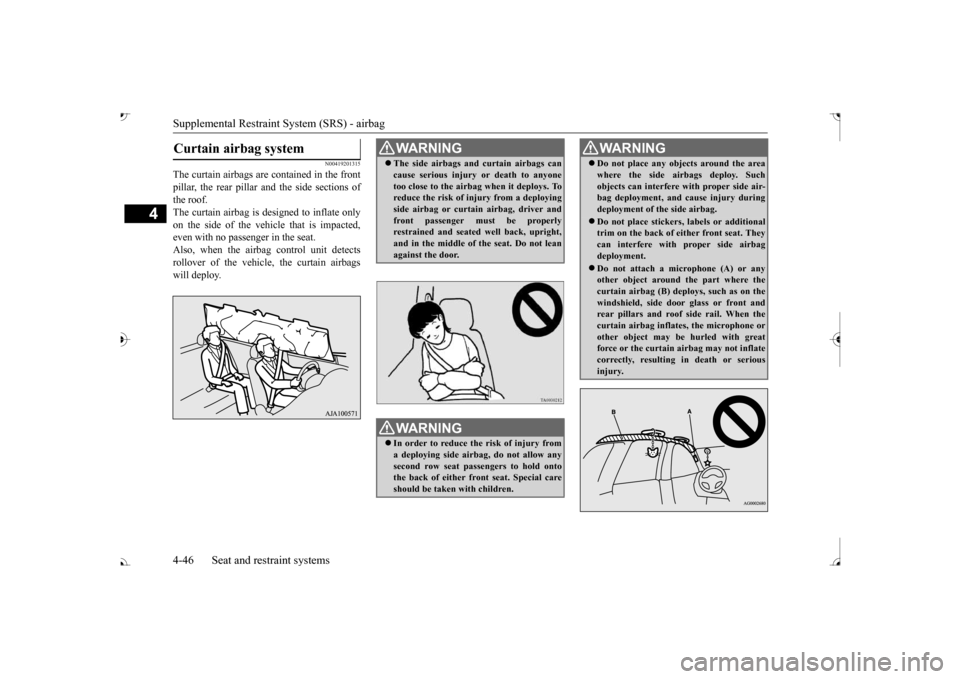
The curtain airbags are contained in the front pillar, the rear pillar and the side sections of the roof.The curtain airbag is designed to inflate only on the side of the vehi
cle that is impacted,
even with no passenger in the seat.Also, when the airbag control unit detects rollover of the vehicle, the curtain airbags will deploy.Curtain airbag system
WA R N I N G The side airbags and curtain airbags can cause serious injury
or death to anyone
too close to the airbag when it deploys. Toreduce the risk of in
jury from a deploying
side airbag or curtai
n airbag, dr
iver and
front passenger must be properlyrestrained and seated well back, upright, and in the middle of the seat. Do not lean against the door.WA R N I N G In order to reduce the risk of injury from a deploying side airb
ag, do not allow any
second row seat passengers to hold onto the back of either front seat. Special careshould be taken with children.
Do not place any obje
cts around the area
where the side airbags deploy. Suchobjects can interfere with proper side air-bag deployment, and cause injury during deployment of the side airbag. Do not place stickers,
labels or additional
trim on the back of either front seat. They can interfere with proper side airbagdeployment. Do not attach a microphone (A) or any other object around
the part where the
curtain airbag (B) depl
oys, such as on the
windshield, side door
glass or front and
rear pillars and roof
side rail. When the
curtain airbag inflates, the microphone or other object may be
hurled with great
force or the curtain airbag may not inflate correctly, resulting
in death or serious
injury.WA R N I N G
BK0239700US.book 46 ページ 2016年6月16日 木曜日 午前10時58分
Page 79 of 521

Supplemental Restraint System (SRS) - airbag 4-50 Seat and restraint systems
4
• Steering wheel • Instrument panel[For vehicles so
ld in U.S.A.]
To contact Mitsubishi Motors NorthAmerica, Inc. call 1-888-648-7820 or write to: Mitsubishi Motors North America, Inc.Customer Relations Department P.O. Box 6400 Cypress, CA 90630-0064 [For vehicles sold in Canada] To contact Mitsubishi Motor Sales ofCanada, Inc. call 1-888-576-4878 or write to: Mitsubishi Motor Sales of Canada, Inc.Customer Relations Department P.O. Box 41009 4141 Dixie RoadMississauga, ON L4W 5C9NOTE
[For vehicles sold in Puerto Rico]To contact Mitsubishi Motor Sales ofCaribbean, Inc. call 1-787-251-8715 or write to: Mitsubishi Motor Sales of Caribbean,Inc. Customer Service Department P.O. Box 192216SAN JUAN PR 00919-2216 [For vehicles
sold in Guam]
To contact Triple J Enterprises Inc. call (671) 649-3673 or write to:Triple J Enterprises, Inc. P.O. Box 6066 TAMUNINGGUAM 96931 [For vehicles so
ld in Saipan]
To contact Triple J Motors call (670) 234-7133 or write to: Triple J MotorsP.O. Box 500487 SAIPAN, MP96950-0487
[For vehicles sold
in American Samoa]
To contact Pacific Marketing Inc.call 684 (699) 9140 or write to: Pacific Marketing, Inc. P.O. Box 698PA G O PA G O , AMERICAN SAMOA AS, 96799
BK0239700US.book 50 ページ 2016年6月16日 木曜日 午前10時58分