roof MITSUBISHI OUTLANDER 2017 3.G User Guide
[x] Cancel search | Manufacturer: MITSUBISHI, Model Year: 2017, Model line: OUTLANDER, Model: MITSUBISHI OUTLANDER 2017 3.GPages: 521, PDF Size: 14.91 MB
Page 202 of 521
Forward Collision Mitigation System (FCM) (if so equipped)
Features and controls 5-121
5
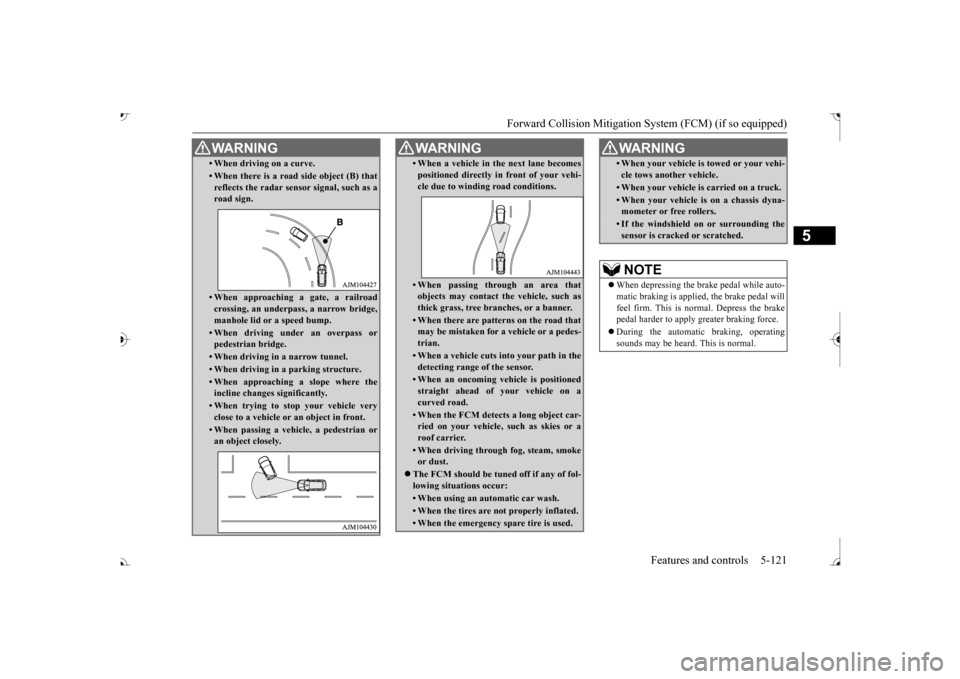
• When driving on a curve.• When there is a road
side object (B) that
reflects the radar sensor signal, such as a road sign.• When approaching a gate, a railroad crossing, an underpa
ss, a narrow bridge,
manhole lid or
a speed bump.
• When driving unde
r an overpass or
pedestrian bridge.• When driving in
a narrow tunnel.
• When driving in a parking structure.• When approaching a slope where the incline changes
significantly.
• When trying to stop your vehicle very close to a vehicle or
an object in front.
• When passing a vehicle, a pedestrian or an object closely.WA R N I N G
• When a vehicle in the next lane becomespositioned directly in
front of your vehi-
cle due to winding road conditions.• When passing through an area that objects may contact the vehicle, such as thick grass, tree br
anches, or a banner.
• When there are patterns on the road that may be mistaken for
a vehicle or a pedes-
trian.• When a vehicle cuts in
to your path in the
detecting range of the sensor.• When an oncoming vehicle is positionedstraight ahead of your vehicle on a curved road.• When the FCM detects a long object car-ried on your vehicle, such as skies or a roof carrier.• When driving through fog, steam, smokeor dust.
The FCM should be tuned off if any of fol- lowing situations occur:• When using an automatic car wash.• When the tires are not properly inflated. • When the emergency spare tire is used.WA R N I N G
• When your vehicle is
towed or
your vehi-
cle tows another vehicle.• When your vehicle is
carried on a truck.
• When your vehicle is on a chassis dyna- mometer or free rollers.• If the windshield on or surrounding thesensor is cracke
d or scratched.
NOTE
When depressing the brake pedal while auto- matic braking is applie
d, the brake pedal will
feel firm. This is normal. Depress the brake pedal harder to apply
greater braking force.
During the automatic braking, operating sounds may be heard. This is normal. WA R N I N G
BK0239700US.book 121 ページ 2016年6月16日 木曜日 午前10時58分
Page 371 of 521
Parking 6-6 Driving safety
6
On snowy roads, ice can form on the braking system, making the brakes less effective. While driving in such conditions, pay closeattention to surrounding
vehicles and to the
condition of the road surface. From time to time, lightly depress the brake pedal andcheck how effective the brakes are. It is important to take
advantage of the engine
braking by downshifting while driving on steep downhill roads in order to prevent thebrakes from overheating.
N00629601385
When parking on a hill, set the parking brake,and turn the front wheels toward the curb on a downhill, or away from
the curb on an uphill.
If necessary, apply chocks to the wheels.Be sure that the parki
ng brake is firmly set
when parked and that the selector lever is in the “P” (PARK) position.
When parking on a hill, it is important to set the parking brake befo
re moving the selector
lever to the “P” (PARK) position. This pre- vents loading the parking brake against the transaxle. When this ha
ppens, it is difficult to
move the selector lever out of the “P” Never leave the engine running while you take a short nap or rest. Also, never leave the engine running in a closed or poorly venti- lated place. Your front bumper can be damaged if you scrape it over curbs or parking stop blocks.Be careful when traveling up or down steep slopes where your bumper can scrape the road.
Always carry the key and lock all doors and the liftgate when leaving the vehicle unat- tended. Always try to park your vehicle in a well litarea. Move effort could be required to turn the steering wheel. Refer to “Electric power steering system(EPS)” on page 5-99.
N00629901434
It is very important to know how muchweight your vehicle can carry. This weight is called the vehicle ca
pacity weight and
includes the weight of
all occupants, cargo
(including the roof load), non-factory-
When driving in cold weather When driving downhill Parking Parking on a hill
Parking with the engine run- ning
WA R N I N G Leaving the engine ru
nning risks injury or
death from accidentally moving the selec- tor lever or the accumulation of toxicexhaust fumes in the passenger compart- ment.
Where you park
WA R N I N G Do not park your vehicle in areas where combustible materials
such as dry grass or
leaves can come in contact with a hotexhaust, since a fire could occur.
When leaving the vehicle Do not keep the steering wheel fully turned for a long time Loading information
BK0239700US.book 6 ページ 2016年6月16日 木曜日 午前10時58分
Page 372 of 521
Loading information Driving safety 6-7
6
installed options, and
the tongue weight of
the trailer, if any, being towed. The tire andloading information placard located on the driver’s door sill of your vehicle will show how much weight it may properly carry. It is important to famil
iarize yourself with the
following terms before loading your vehicle: Vehicle maximum load on the tire: load on an individual tire that is determined by distributing to each axle its share of the maximum loaded vehicle weight anddividing by two. Vehicle normal load on the tire: load on an individual tire that is determined by dis-tributing to each axle its share of the curb weight, accessory weight, and normal occupant weight and dividing by two. Maximum loaded vehicle weight: the sum of - (a) Curb weight;(b) Accessory weight; (c) Vehicle capacity weight; and (d) Production options weight.
Curb weight: the weight of a motor vehi- cle with standard equipment including themaximum capacity of
fuel, oil, and cool-
ant. Accessory weight: the combined weight (in excess of those st
andard items which
may be replaced) of automatic transaxle, power steering, power brakes, power win-dows, power seats, radio, and heater, to the extent that these items are available as factory- installed equipment (whether installed or not). Vehicle capacity weight: the rated cargo and luggage load plus 150 lbs (68 kg) * times the vehicle’s designated seating capacity. Production options weight: the combined weight of those installed regular produc- tion options weighing over 5 lbs (2.3 kg)in excess of those standard items which they replace, not prev
iously considered in
curb weight or accessory weight, includ-ing heavy duty brakes,
ride levelers, roof
rack, heavy duty battery, and special trim. Normal occupant weight: 150 lbs (68 kg) * times the number of
specified occupants
(3 in the case of your vehicle) Occupant distribution:
Occupant distribu-
tion within the passenger compartment (In your vehicle the distribution is 2 in front, 1 in second row seat)
N00630101407
The tire and loading information placard islocated on the inside sill of the driver’s door. This placard shows the maximum number of occupants permitted to
ride in your vehicle as
well as “the combined
weight of occupants
and cargo” (A), which
is called the vehicle
capacity weight. The weight of any non-fac- tory installed options, as well as the tongueweight of a trailer being towed and roof load is included in the defi
nition of “cargo” when
determining the vehicle
capacity weight. This
WA R N I N GNever overload your ve
hicle. Overloading
can damage your vehicl
e, adversely affect
vehicle performance, including handling and braking, cause tire failure, and resultin an accident.
* :150 lbs (68 kg) is the weight of one per- son as defined by U.
S.A. and Canadian
regulations.
Tire and loading information placard
BK0239700US.book 7 ページ 2016年6月16日 木曜日 午前10時58分
Page 375 of 521
Cargo loads 6-10 Driving safety
6
N00629700435 N00630301092
To determine the cargo load capacity for your vehicle, subtract the
weight of all vehicle
occupants from the vehi
cle capacity weight.
For additional information, if needed, refer to “Steps for Determining Correct Load Limit” on page 6-8. DO NOT USE the Gross Vehicle Weight Rat- ing and Gross Axle Weight Rating numberslisted on the safety certification label located on the inside sill of the driver’s door as the guide for passengers and/or cargo weight.(Except for Vehicles for Mexico)
N00630401123
Cargo loads Cargo load precautions
WA R N I N G To reduce the risk of serious injury or death, the combined weights of the driver,passengers and cargo and must neverexceed the vehicle capacity weight. Exceeding the vehicle capacity weight will adversely affect ve
hicle performance,
including handling and braking, and may cause an accident. Do not load cargo or luggage higher than the top of the seatback. Be sure that yourcargo or luggage cann
ot move when your
vehicle is in motion. Having either the re
ar view blocked, or
your cargo being thrown
inside the cabin
if you suddenly have to brake can cause a serious accident or
injury or death.
Put cargo or luggage in the cargo area of your vehicle. Try to spread the weightevenly.
Loading cargo on the roof
WA R N I N G Weight placed on the
roof of the vehicle
will raise the vehicle’ and adversely affect
its handling charac-
teristics. As a result, driving errors oremergency maneuvers could lead to a loss of control and result in an accident. Drive slowly and avoid excessive maneuverssuch as sudden brak
ing or quick turning.
Make sure that the
weight of luggage and
the roof carrier do not exceed the maxi-mum roof load, 110 lb (50 kg). If the maxi-mum roof load is ex
ceeded, this could
cause damage to the ve
hicle or result in an
accident. The total weight of all occupants and lug- gage, including your r
oof load, must not
exceed the vehicle capacity weight. For more information, refer to “Tire and load- ing information placard” on page 11-3 Roof load is determined by adding the weight of the roof
carrier and the weight
of the luggage placed
on the roof carrier.
For additional information, refer to “Maximum roof load” on page 11-5.CAUTION Do not load luggage directly onto the roof. Use a roof carrier that properly fits your vehicle. For installation, refer to the instruction man-ual provided with the roof carrier. Place the luggage on the carrier so that its weight is distri
buted evenly with the heaviest
items on the bottom. Do not load items that are wider than the roof carrier.WA R N I N G
BK0239700US.book 10 ページ 2016年6月16日 木曜日 午前10時58分
Page 376 of 521
Trailer towing
Driving safety 6-11
6
N00630601112
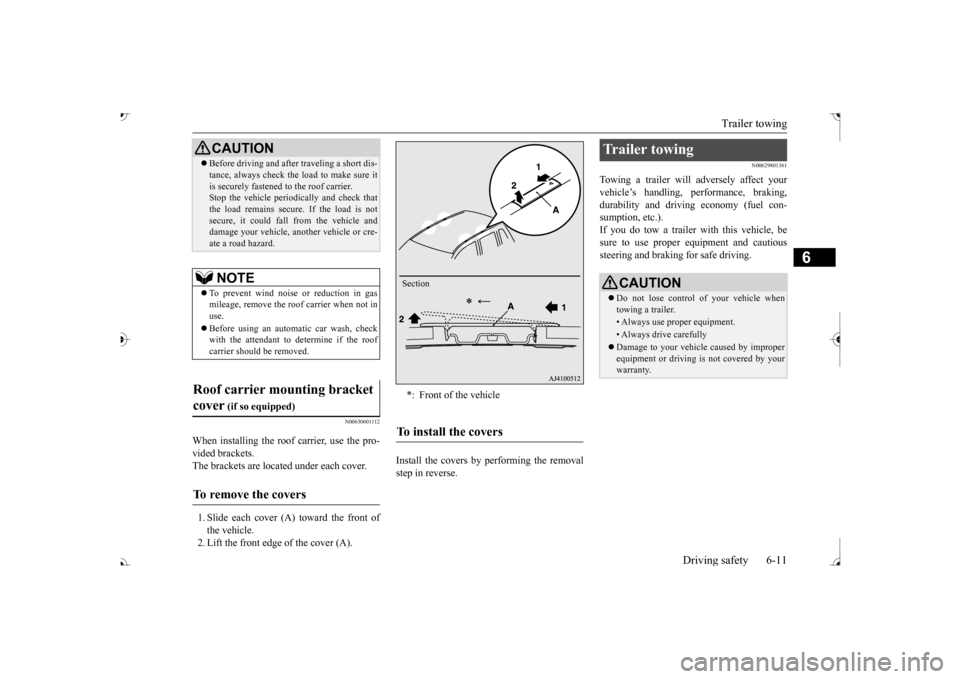
When installing the roof carrier, use the pro- vided brackets. The brackets are located under each cover. 1. Slide each cover (A) toward the front of the vehicle. 2. Lift the front edge of the cover (A).
Install the covers by performing the removal step in reverse.
N00629801361
Towing a trailer will adversely affect yourvehicle’s handling, performance, braking, durability and driving economy (fuel con-sumption, etc.). If you do tow a trailer
with this vehicle, be
sure to use proper e
quipment and cautious
steering and braking for safe driving.
Before driving and after traveling a short dis- tance, always check the load to make sure itis securely fastened to the roof carrier.Stop the vehicle periodi
cally and check that
the load remains secure. If the load is not secure, it could fall from the vehicle anddamage your vehicle,
another vehicle or cre-
ate a road hazard.NOTE
To prevent wind noise or reduction in gas mileage, remove the roof carrier when not in use. Before using an automatic car wash, check with the attendant to determine if the roofcarrier should be removed.
Roof carrier mounting bracket cover
(if so equipped)
To remove the covers
CAUTION
*: Front of the vehicleTo install the covers
Section
Trailer towing
CAUTION Do not lose control of your vehicle when towing a trailer.• Always use proper equipment.• Always drive carefully Damage to your vehicle caused by improper equipment or driving is not covered by your warranty.
BK0239700US.book 11 ページ 2016年6月16日 木曜日 午前10時58分
Page 481 of 521
Fuses 9-28 Vehicle care and maintenance
9
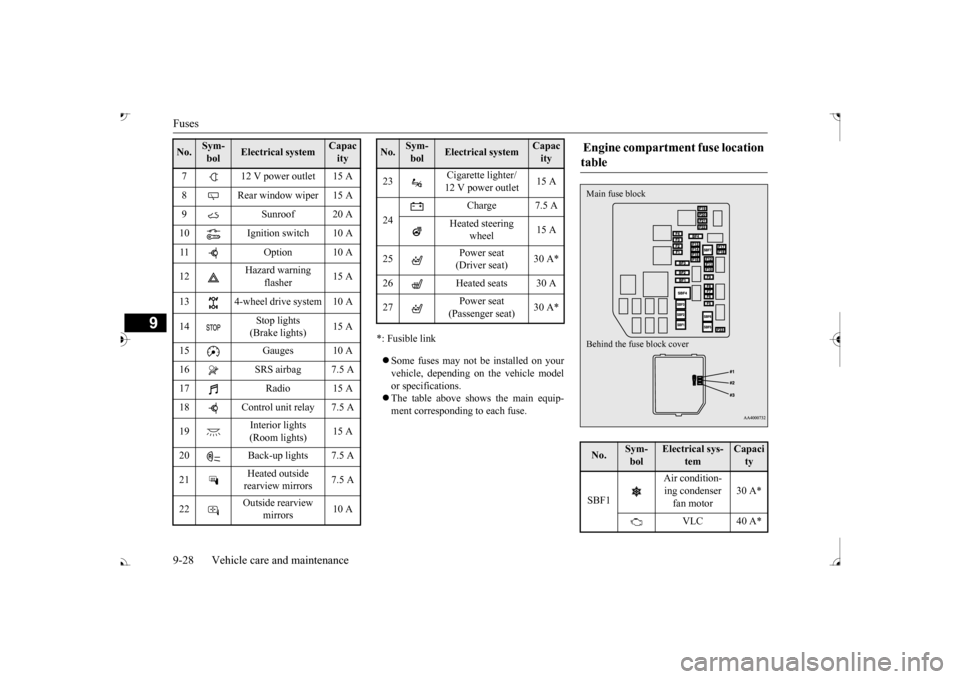
*: Fusible link Some fuses may not be installed on your vehicle, depending on
the vehicle model
or specifications. The table above show
s the main equip-
ment corresponding to each fuse.
7 12 V power outlet 15 A 8 Rear window wiper 15 A 9 Sunroof 20 A 10 Ignition switch 10 A11 Option 10 A 12
Hazard warning
flasher
15 A
13 4-wheel drive system 10 A 14
Stop lights (Brake lights)
15 A
15 Gauges 10 A 16 SRS airbag 7.5 A 17 Radio 15 A18 Control unit relay 7.5 A 19
Interior lights (Room lights)
15 A
20 Back-up lights 7.5 A 21
Heated outside rearview mirrors
7.5 A
22
Outside rearview
mirrors
10 A
No.
Sym- bol
Electrical system
Capacity
23
Cigarette lighter/ 12 V power outlet
15 A
24
Charge 7.5 A
Heated steering
wheel
15 A
25
Power seat (Driver seat)
30 A*
26 Heated seats 30 A 27
Power seat (Passenger seat)
No.
Sym- bol
Electrical system
Capacity
Engine compartment fuse location table No.
Sym- bol
Electrical sys-
tem
Capacity
SBF1
Air condition- ing condenser fan motor
30 A*
VLC 40 A*
Behind the fuse block cover Main fuse block
BK0239700US.book 28 ページ 2016年6月16日 木曜日 午前10時58分
Page 495 of 521
Cleaning the outside of your vehicle 9-42 Vehicle care and maintenance
9
Salt and other chemicals used on winter roads in some geographical areas can have a detri- mental effect on the vehicle underbody. Youshould flush the underbody with a high pres- sure hose every time you wash the outside of your vehicle.Take special care to remove mud or other debris which could trap and hold salt and moisture.After washing your vehicle, wipe off all waterdrops from the rubber parts around the doors to prevent the doors from freezing.
N00946000205
Wax your vehicle once or twice a year, orwhen water does not bead up on the paint.Use a soft cloth to put a small amount of wax on the painted surfaces.
After the wax has
dried, polish with
a dry soft cloth.
Do not wax your vehicle in direct sunlight. You should wax when the painted surfaces are cool.
Never spray or splash water on the electrical parts in the engine compartment. This maydamage them. Be careful also when washingthe underbody to ensure that water does not enter the engine compartment. Avoid automatic car washers that use rotat- ing brushes. These br
ushes may scratch the
paint surface a
nd make it dull.
Scratches are more not
iceable on darker col-
ored vehicles. Some hot water wash
ing equipment uses
high pressure and heat
to clean your vehicle.
Because hot water can da
mage plastics parts
and seep inside your ve
hicle, make sure you
do the following when using such equip- ment:• Keep the washing nozzle at least 28 inches(70 cm) away from the vehicle body.• When washing around the door glass, holdthe nozzle at a distance of more than 28inches (70 cm) and at a right angle to the glass surface.
Make sure to do the following when using an automatic car wash, with help from either this manual or the car wash operator, toavoid damaging your vehicle:• Fold the outside
rearview mirrors.
• Tape or remove the rear wiper arm assem- bly.• If your vehicle is equi
pped with a roof rails,
check with the car wash operator beforeusing the car wash.CAUTION
• If your vehicle is e
quipped with the rain
sensor, place th
e wiper switch lever in the
“OFF” position to deac
tivate the rain sen-
sor.• If your vehicle is e
quipped with the Ultra-
sonic misaccelerati
on Mitigation System,
turn off the system. Refer to “FCM and Ultrasonic misaccelera-tion Mitigation System ON/OFF switch” on page 5-122.
During cold weather
CAUTION
NOTE
When the door is frozen, opening it by force may tear off or crack the rubber gasketinstalled around the door. Pour warm waterto melt the ice. Be sure to thoroughly wipe off the water after opening the door. To pre- vent freezing of the we
atherstripping on the
doors, hood, etc., treat with silicone lubri- cant.
Waxing
CAUTION Waxes containing high abrasive compounds should not be used. Th
ese waxes remove rust
and stain effectively fr
om the paintwork, but
are harmful to the finish of the paint, becausethey also remove
paint/clearcoat.
They are also harmful to other glossy sur- faces such as the grille, trim, moldings, etc.
BK0239700US.book 42 ページ 2016年6月16日 木曜日 午前10時58分
Page 496 of 521
Cleaning the outside of your vehicle Vehicle care and maintenance 9-43
9
N00946100046
If painted surfaces ha
ve been severely dam-
aged and lost their original luster and color tone, polish the surface lightly with a finepolishing compound. Avoid limiting your polishing to the damage
d surface only; polish
a somewhat wider area, moving the polishingcloth in one direction.
After polishing, flush
the compound from the surface and apply a coat of wax to regain a beautiful luster.
N00946201099
Small cracks and scratches in the paint coat should be touched up as soon as possible with touch-up paint to prevent corrosion.Check body areas facing the road or the tires carefully for damage to the paint caused by flying stones, etc. The paint code number foryour vehicle can be found on the vehicle information code plate located on the front passenger door sill.
N00946301221
Use a sponge or chamoi
s to clean these parts.
If the vehicle wax sticks to a gray or black rough surface of the bumper, molding or lights, the surface may appear white in color.In this case, wipe it off using lukewarm water and a soft cloth or chamois.
N00946400052
To prevent spots and corrosion of chrome parts, wash with water, dry thoroughly, and apply a nonabrasive automotive wax. If the chrome is severely damaged or pitted, use acommercially available chrome polish.
N00946500183
1. Remove dirt using a wet sponge.2. Use a mild detergent
on any dirt that can-
not be removed easily with water. Rinse off the detergent after washing thewheel. 3. Dry the wheel thoroughly using a chamois leather or a soft cloth.
Do not use gasoline, benzine, kerosene or paint thinners to remove road tar or other dirtfrom the vehicle surface. Do not put wax on the areas having black matte coating because
it can cause uneven
discoloration, patches, bl
urs, etc. If these get
wax on them, wipe the wax off right away with a soft clot
h and warm water.
On vehicles with sunr
oof, be careful not to
apply any wax on the
weatherstrip (black
rubber) when waxing the area around the sunroof opening. If stained with wax,
the weatherstrip cannot
maintain a weatherproof seal with the sun- roof.
Polishing
CAUTION
Damaged paint Cleaning plastic parts
CAUTION Do not use a scrubbing brush or other rough scrubber as these may damage the plasticsurface. Do not use wax containing compounds (pol- ishing powder) which ma
y damage the plas-
tic surface.
Do not let plastic parts
get soiled with gaso-
line, oil, brake fluids, engine oils, greases,paint thinner, and sulfuric acid (battery elec-trolyte), as such substa
nces will cause stains,
cracks, or discoloration. If any of these get on a plastic part, wipethem up with a soft cloth or chamois and a mild solution of soap and water. Then rinse them immediately with water.
Chrome parts Aluminum wheels
(if so equipped)
CAUTION
BK0239700US.book 43 ページ 2016年6月16日 木曜日 午前10時58分
Page 497 of 521
Cleaning the outside of your vehicle 9-44 Vehicle care and maintenance
9
N00946600054
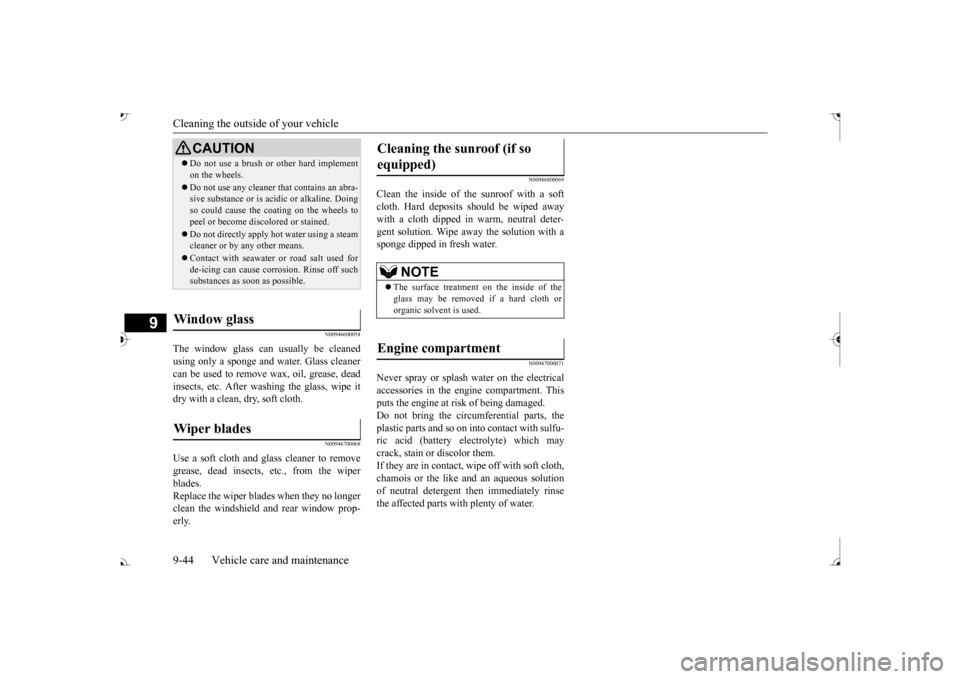
The window glass can
usually be cleaned
using only a sponge and
water. Glass cleaner
can be used to remove
wax, oil, grease, dead
insects, etc. After washing the glass, wipe it dry with a clean, dry, soft cloth.
N00946700068
Use a soft cloth and glass cleaner to removegrease, dead insects,
etc., from the wiper
blades. Replace the wiper blades when they no longer clean the windshield a
nd rear window prop-
erly.
N00946800069
Clean the inside of the sunroof with a softcloth. Hard deposits
should be wiped away
with a cloth dipped in
warm, neutral deter-
gent solution. Wipe away the solution with a sponge dipped in fresh water.
N00947000071
Never spray or splash
water on the electrical
accessories in the engine compartment. Thisputs the engine at ri
sk of being damaged.
Do not bring the circum
ferential parts, the
plastic parts and so on in
to contact with sulfu-
ric acid (battery electrolyte) which may crack, stain or discolor them. If they are in contact, wipe off with soft cloth,chamois or the like and an aqueous solution of neutral detergent then immediately rinse the affected parts with plenty of water.
CAUTION Do not use a brush or other hard implement on the wheels. Do not use any cleaner th
at contains an abra-
sive substance or is ac
idic or alkaline. Doing
so could cause the coating on the wheels topeel or become disc
olored or stained.
Do not directly apply
hot water using a steam
cleaner or by any other means. Contact with seawater or road salt used for de-icing can cause corro
sion. Rinse off such
substances as s
oon as possible.
Window glass Wiper blades
Cleaning the sunroof (if so equipped)
NOTE
The surface treatment on the inside of the glass may be removed
if a hard cloth or
organic solvent is used.
Engine compartment
BK0239700US.book 44 ページ 2016年6月16日 木曜日 午前10時58分
Page 510 of 521
Vehicle weights
Specifications 11-5
11
N01147601998
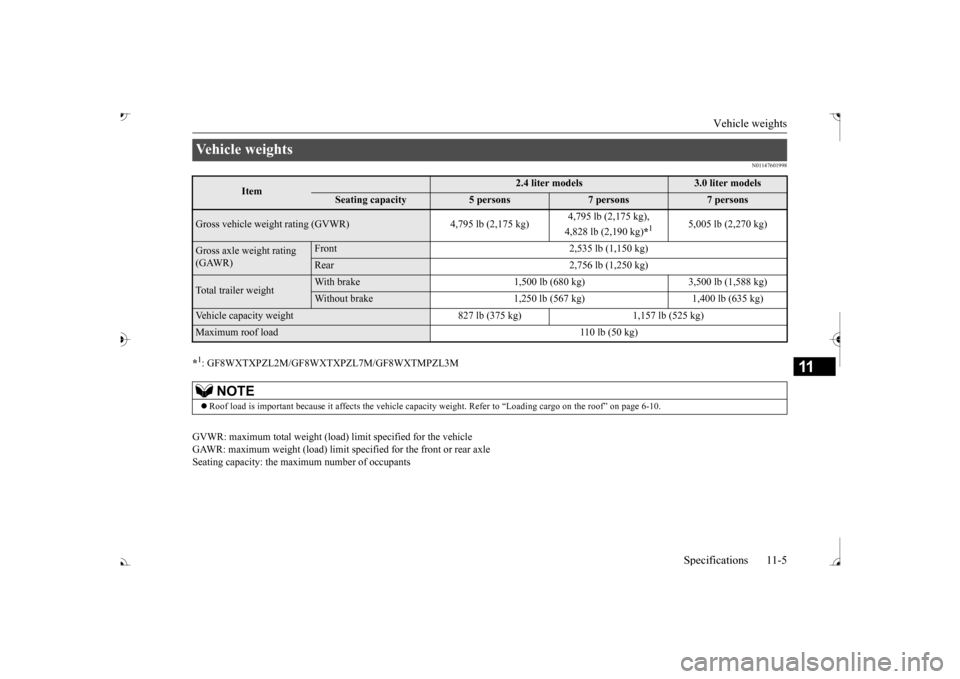
*1: GF8WXTXPZL2M/GF8WXTXPZL7M/GF8WXTMPZL3M GVWR: maximum total weight (load) limit specified for the vehicle GAWR: maximum weight (load) limit specified for the front or rear axle Seating capacity: the maxi
mum number of occupants
Vehicle weights
Item
2.4 liter models
3.0 liter models
Seating capacity
5 persons
7 persons
7 persons
Gross vehicle wei
ght rating (GVWR) 4,795 lb (2,175 kg)
4,795 lb (2,175 kg), 4,828 lb (2,190 kg)
*1
5,005 lb (2,270 kg)
Gross axle weight rating (GAWR)
Rear 2,756 lb (1,250 kg)
Total trailer weight
With brake 1,500 lb (680 kg) 3,500 lb (1,588 kg)Without brake 1,250 lb (567 kg) 1,400 lb (635 kg)
Vehicle capacity weight 827 lb (375 kg) 1,157 lb (525 kg)
NOTE
Roof load is important becaus
e it affects the vehicle capacity weight. Refe
r to “Loading cargo on the roof” on page 6-10.
BK0239700US.book 5 ページ 2016年6月16日 木曜日 午前10時58分