Child MITSUBISHI OUTLANDER 2017 3.G Owner's Manual
[x] Cancel search | Manufacturer: MITSUBISHI, Model Year: 2017, Model line: OUTLANDER, Model: MITSUBISHI OUTLANDER 2017 3.GPages: 521, PDF Size: 14.91 MB
Page 64 of 521
Supplemental Restraint System (SRS) - airbag
Seat and restraint systems 4-35
4
and partial ejection fro
m the vehicle through
side windows in both side impact and roll-over type accidents. The SRS airbags are NOT a substitute for use of the seat belts. For maximum protection in all types of accidents, seat belts mustALWAYS be worn by everyone who drives or rides in this vehicle
(with infants and small
children in an appropriate child restraint sys-tem in the rear seat, and older children buck- led in the rear seat). Refer to “Child restraint systems” on page 4-27.
WA R N I N G IT IS VERY IMPORTANT TO ALWAYS WEAR YOUR SEAT BELT PROPERLY EVEN WITH AN AIRBAG.• Seat belts help keep the driver and pas-sengers properly positioned. This reduces the risk of injury in all collisions,and reduces the risk of serious injuries or death when the
airbags inflate.
During sudden braking just before a col-lision, an unrestra
ined or
improperly
restrained driver or front passenger can move forward into direct contact with, orwithin close proximi
ty to, the airbag
when it begins to inflate. The beginning stage of
airbag inflation is
the most forceful and can cause serious injuries or death if the occupant comes in contact with the airbag at this time.
• Seat belts reduce the risk of injury inrear impact collisions, and in lower-speed frontal collisions because the air-bags are not designed
to inflate in those
situations.• Seat belts reduce the risk of beingthrown from your vehi
cle in a collision or
rollover.WA R N I N G IT IS VERY IMPORTANT TO BE PROP- ERLY SEATED.• A driver or front passenger sitting tooclose to the steering wheel or instrumentpanel during airbag deployment can be seriously inju
red or killed.
• Airbags inflate ve
ry quickly and with
great force. If the driver and front pas- senger are not properly seated andrestrained, the airbag may not provide the proper protection, and can cause serious injuries or death when it inflates.• To reduce the risk to the driver of seriousinjury or death due to a deployingdriver’s airbag, al
ways properly wear
your seat belt and adju
st the driver’s seat
as far back as possible, maintaining a position that still allows the driver tohave good control of the steering wheel, brake, accelerator, and other vehicle con- trols.WA R N I N G
• To reduce the risk to the front passengerof serious injury or
death from a deploy-
ing passenger’s airbag, make sure thepassenger always wears the seat belt properly, remains seat
ed upright and all
the way back in the
seat, and positions
the seat as far back as possible.• Seat all infants and children in the rearseat, properly restrain
ed in an appropri-
ate child restraint system.WA R N I N G Airbags inflate very
quickly and with
great force. Do not sit on the edge of the seat or sit with your
lower legs too close to
the instrument panel,
or lean your head or
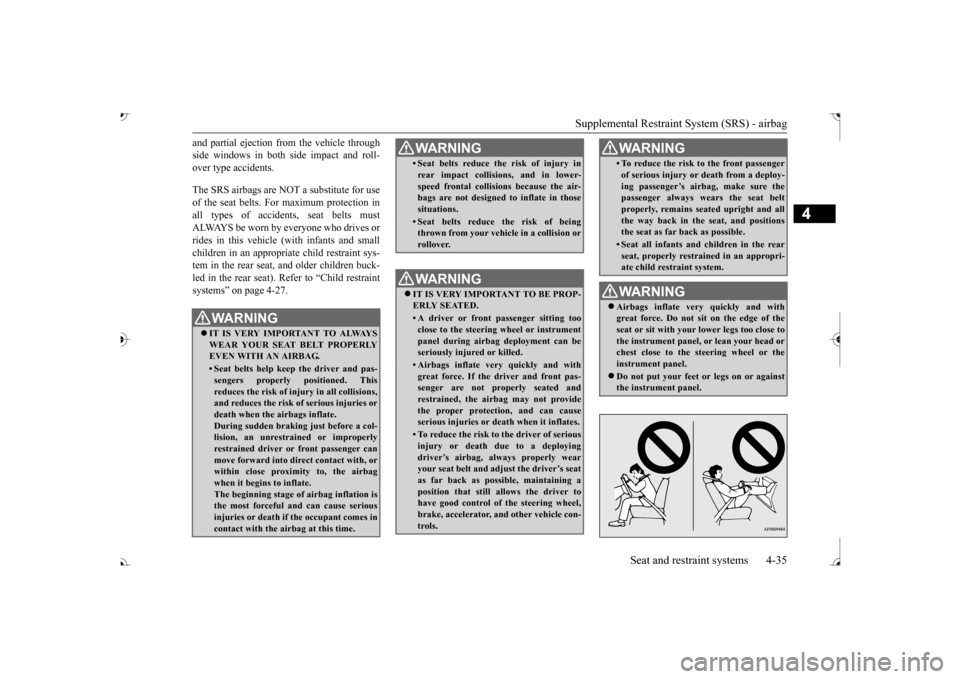
chest close to the steering wheel or the instrument panel. Do not put your feet or legs on or against the instrument panel.WA R N I N G
BK0239700US.book 35 ページ 2016年6月16日 木曜日 午前10時58分
Page 65 of 521
Supplemental Restraint System (SRS) - airbag 4-36 Seat and restraint systems
4
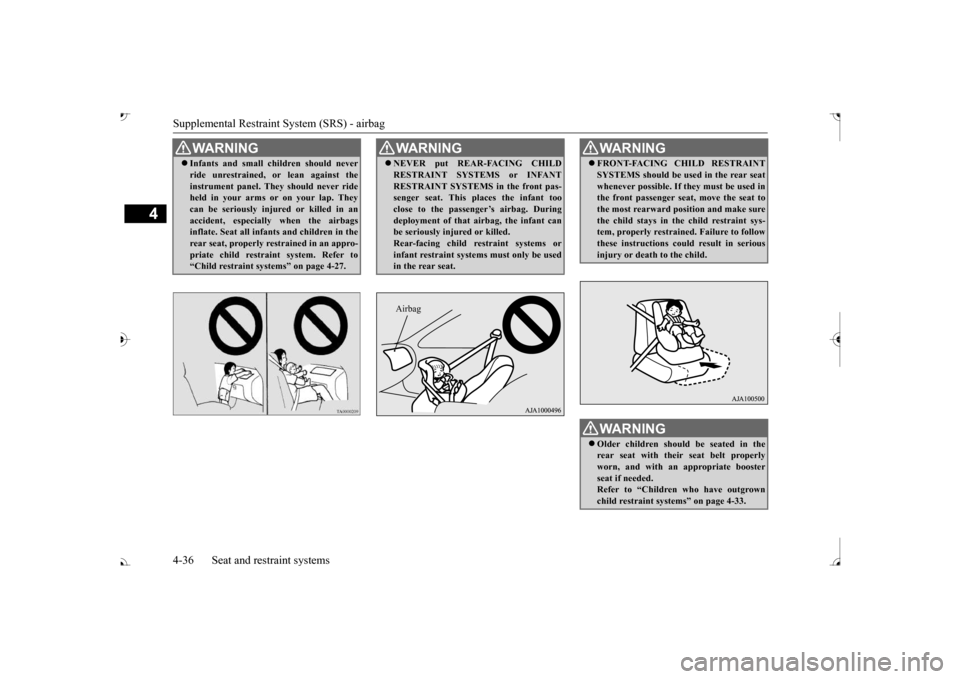
WA R N I N G Infants and small children should never ride unrestrained,
or lean against the
instrument panel. They should never rideheld in your arms or
on your lap. They
can be seriously inju
red or killed in an
accident, especially when the airbagsinflate. Seat all infa
nts and children in the
rear seat, properly re
strained in an appro-
priate child restraint system. Refer to“Child restraint systems” on page 4-27.
WA R N I N G NEVER put REAR-FACING CHILD RESTRAINT SYSTEMS or INFANTRESTRAINT SYSTEMS in the front pas-senger seat. This pl
aces the infant too
close to the passenger’s airbag. During deployment of that airbag, the infant canbe seriously inju
red or killed.
Rear-facing child restraint systems or infant restraint systems must only be usedin the rear seat.Airbag
WA R N I N G FRONT-FACING CHILD RESTRAINT SYSTEMS should be used in the rear seatwhenever possible. If they must be used inthe front passenger se
at, move the seat to
the most rearward po
sition and make sure
the child stays in the child restraint sys-tem, properly restrained. Failure to follow these instructions could result in serious injury or death to the child.WA R N I N G Older children should be seated in the rear seat with thei
r seat belt properly
worn, and with an
appropriate booster
seat if needed. Refer to “Children
who have outgrown
child restraint systems” on page 4-33.
BK0239700US.book 36 ページ 2016年6月16日 木曜日 午前10時58分
Page 68 of 521
Supplemental Restraint System (SRS) - airbag
Seat and restraint systems 4-39
4
bag control unit controls deployment of the passenger’s front airbag in accordance withthe information it receives from this system. The passenger’s front ai
rbag will not deploy
in an impact when the system senses no occu-pant on the front passenger’s seat or a child in a child restraint system. In this case, the pas- senger airbag off indi
cator will come on.
Refer to “Passenger’s ai
rbag off indicator” on
page 4-39. If there is a problem involving the passen- ger’s seat occupant cl
assification sensor sys-
tem, the SRS warning light in the instrumentpanel will come on. Refer to “SRS warning light/display” on page 4-40.
N00418101346
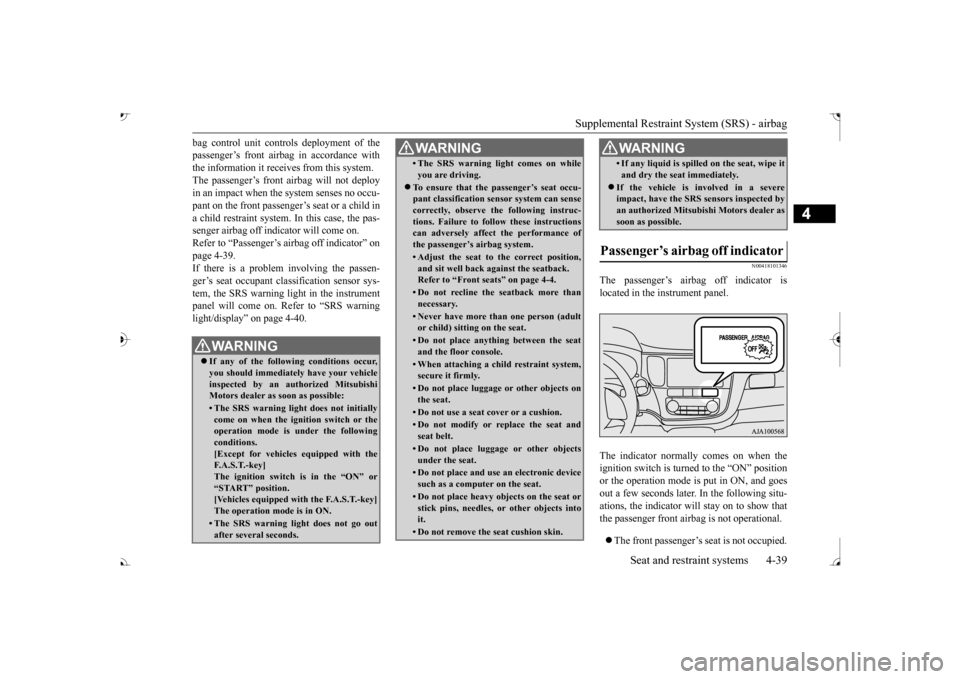
The passenger’s airbag off indicator is located in the instrument panel. The indicator normall
y comes on when the
ignition switch is turned to the “ON” position or the operation mode is put in ON, and goes out a few seconds later. In the following situ-ations, the indicator will stay on to show that the passenger front airb
ag is not operational.
The front passenger’s seat is not occupied.
WA R N I N GIf any of the following conditions occur, you should immediatel
y have your vehicle
inspected by an au
thorized Mitsubishi
Motors dealer as
soon as possible:
• The SRS warning light does not initially come on when the ignition switch or the operation mode is under the followingconditions. [Except for vehicles equipped with the F. A . S . T. - k e y ]The ignition switch is in the “ON” or “START” position. [Vehicles equipped with the F.A.S.T.-key]The operation mode is in ON.• The SRS warning light does not go outafter several seconds.
• The SRS warning li
ght comes on while
you are driving.
To ensure that the passenger’s seat occu- pant classification sensor system can sense correctly, observe the following instruc-tions. Failure to follow these instructions can adversely affect
the performance of
the passenger’s airbag system.• Adjust the seat to the correct position,and sit well back
against the seatback.
Refer to “Front seats” on page 4-4.• Do not recline the seatback more thannecessary.• Never have more than one person (adultor child) sitting
on the seat.
• Do not place anything between the seat and the floor console.• When attaching a chil
d restraint system,
secure it firmly.• Do not place luggage
or other objects on
the seat.• Do not use a seat cover or a cushion.• Do not modify or replace the seat andseat belt.• Do not place luggage or other objectsunder the seat.• Do not place and use
an electronic device
such as a computer on the seat.• Do not place heavy objects on the seat orstick pins, needles, or other objects intoit.• Do not remove the seat cushion skin.WA R N I N G
• If any liquid is spilled on the seat, wipe itand dry the seat
immediately.
If the vehicle is involved in a severe impact, have the SRS sensors inspected by an authorized
Mitsubishi Motors dealer as
soon as possible.
Passenger’s airbag off indicator
WA R N I N G
BK0239700US.book 39 ページ 2016年6月16日 木曜日 午前10時58分
Page 69 of 521
Supplemental Restraint System (SRS) - airbag 4-40 Seat and restraint systems
4
The system senses that a child is using a child restraint system on the front passen-ger’s seat.
When the passenger’s seat occupant classifi- cation sensor sy
stem sense there is a person
seated in the front passenger’s seat, the indi-cator goes out to show that the passenger’s front airbag is operational.
N00408301589
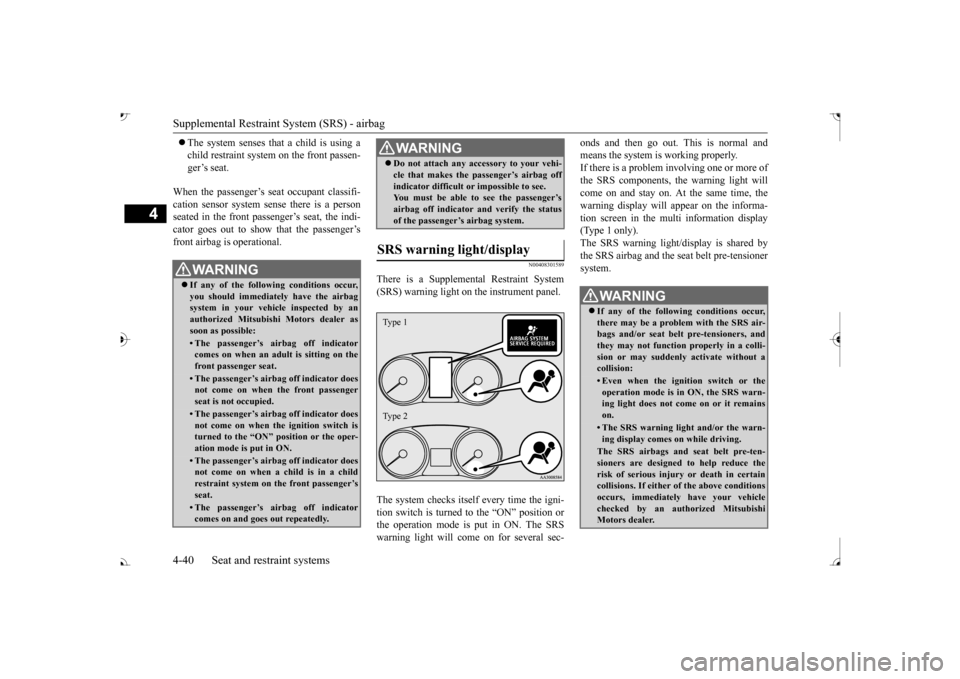
There is a Supplemental Restraint System (SRS) warning light on
the instrument panel.
The system checks itself every time the igni- tion switch is turned
to the “ON” position or
the operation mode is put in ON. The SRS warning light will co
me on for several sec-
onds and then go out. This is normal and means the system is working properly.If there is a problem involving one or more of the SRS components, the warning light will come on and stay on. At the same time, thewarning display will
appear on the informa-
tion screen in the multi information display (Type 1 only).The SRS warning light/display is shared by the SRS airbag and the seat belt pre-tensioner system.
WA R N I N G If any of the follow
ing conditions occur,
you should immediat
ely have the airbag
system in your vehicle inspected by anauthorized Mitsubishi
Motors dealer as
soon as possible:• The passenger’s airbag off indicatorcomes on when an adul
t is sitting on the
front passenger seat.• The passenger’s airb
ag off indicator does
not come on when the front passengerseat is not occupied.• The passenger’s airb
ag off indicator does
not come on when the ignition switch is turned to the “ON” position or the oper- ation mode is put in ON.• The passenger’s airb
ag off indicator does
not come on when a child is in a childrestraint system on the front passenger’s seat.• The passenger’s airbag off indicatorcomes on and goes out repeatedly.
Do not attach any ac
cessory to your vehi-
cle that makes the passenger’s airbag offindicator difficult or impossible to see.You must be able to see the passenger’s airbag off indicator and verify the status of the passenger’s airbag system.
SRS warning light/display
WA R N I N G
Type 1 Type 2
WA R N I N G If any of the follow
ing conditions occur,
there may be a proble
m with the SRS air-
bags and/or seat belt pre-tensioners, and they may not function
properly in a colli-
sion or may suddenly
activate without a
collision:• Even when the ignition switch or theoperation mode is in
ON, the SRS warn-
ing light does not come on or it remainson.• The SRS warning ligh
t and/or the warn-
ing display comes on while driving.The SRS airbags and seat belt pre-ten-sioners are designed to help reduce the risk of serious injury
or death in certain
collisions. If either
of the above conditions
occurs, immediately
have your vehicle
checked by an auth
orized Mitsubishi
Motors dealer.
BK0239700US.book 40 ページ 2016年6月16日 木曜日 午前10時58分
Page 70 of 521
Supplemental Restraint System (SRS) - airbag
Seat and restraint systems 4-41
4
N00407901331
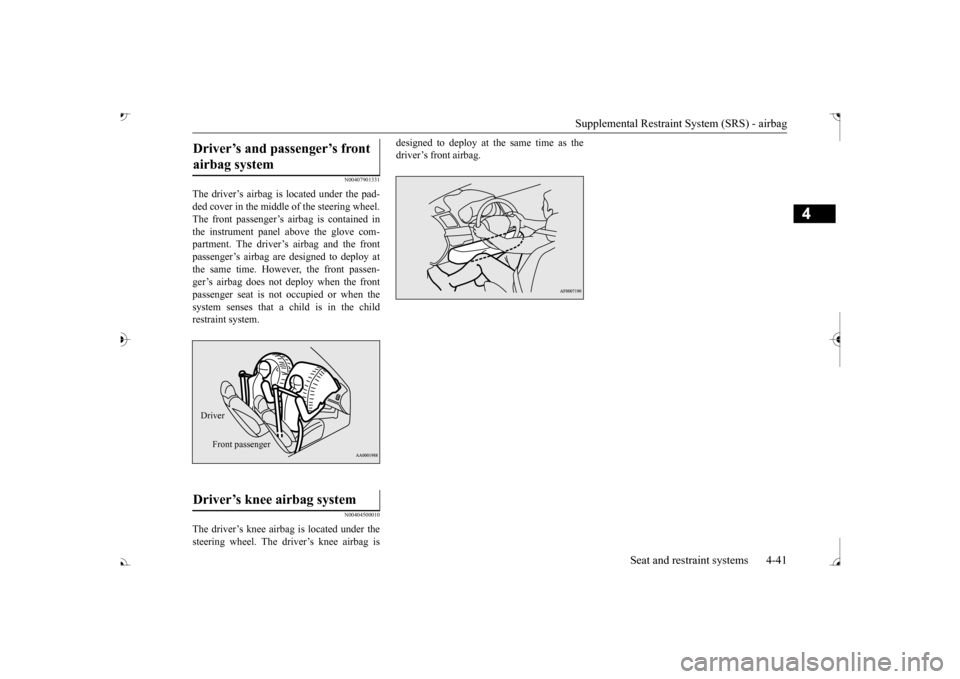
The driver’s airbag is located under the pad- ded cover in the middle of the steering wheel.The front passenger’s ai
rbag is contained in
the instrument panel above the glove com- partment. The driver’s airbag and the frontpassenger’s airbag ar
e designed to deploy at
the same time. However, the front passen- ger’s airbag does not deploy when the front passenger seat is not
occupied or when the
system senses that a child is in the childrestraint system.
N00404500010
The driver’s knee airbag is located under the steering wheel. The driver’s knee airbag is
designed to deploy at the same time as the driver’s front airbag.
Driver’s and passenger’s front airbag system Driver’s knee airbag system Driver
Front passenger
BK0239700US.book 41 ページ 2016年6月16日 木曜日 午前10時58分
Page 75 of 521
Supplemental Restraint System (SRS) - airbag 4-46 Seat and restraint systems
4
N00419201315
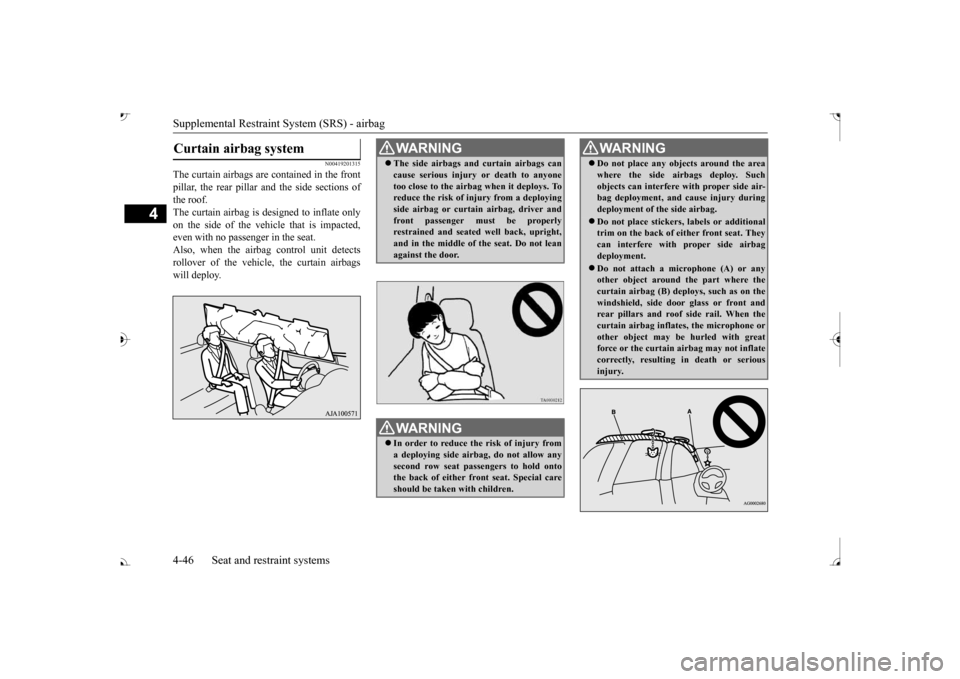
The curtain airbags are contained in the front pillar, the rear pillar and the side sections of the roof.The curtain airbag is designed to inflate only on the side of the vehi
cle that is impacted,
even with no passenger in the seat.Also, when the airbag control unit detects rollover of the vehicle, the curtain airbags will deploy.Curtain airbag system
WA R N I N G The side airbags and curtain airbags can cause serious injury
or death to anyone
too close to the airbag when it deploys. Toreduce the risk of in
jury from a deploying
side airbag or curtai
n airbag, dr
iver and
front passenger must be properlyrestrained and seated well back, upright, and in the middle of the seat. Do not lean against the door.WA R N I N G In order to reduce the risk of injury from a deploying side airb
ag, do not allow any
second row seat passengers to hold onto the back of either front seat. Special careshould be taken with children.
Do not place any obje
cts around the area
where the side airbags deploy. Suchobjects can interfere with proper side air-bag deployment, and cause injury during deployment of the side airbag. Do not place stickers,
labels or additional
trim on the back of either front seat. They can interfere with proper side airbagdeployment. Do not attach a microphone (A) or any other object around
the part where the
curtain airbag (B) depl
oys, such as on the
windshield, side door
glass or front and
rear pillars and roof
side rail. When the
curtain airbag inflates, the microphone or other object may be
hurled with great
force or the curtain airbag may not inflate correctly, resulting
in death or serious
injury.WA R N I N G
BK0239700US.book 46 ページ 2016年6月16日 木曜日 午前10時58分
Page 76 of 521
Supplemental Restraint System (SRS) - airbag
Seat and restraint systems 4-47
4
N00408201591
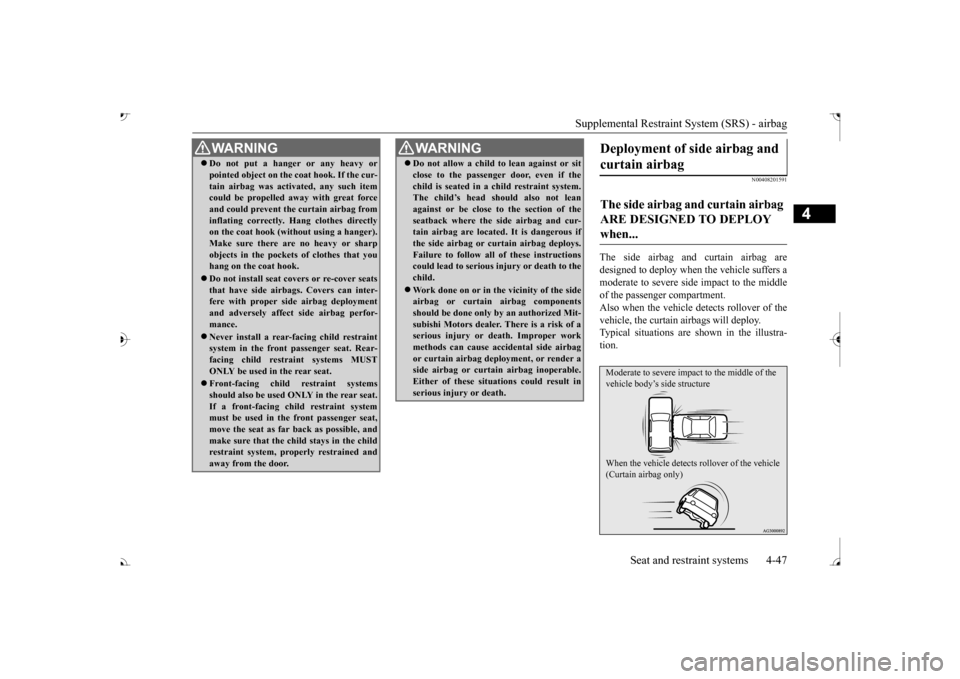
The side airbag and curtain airbag are designed to deploy when
the vehicle suffers a
moderate to severe side
impact to the middle
of the passenger compartment.Also when the vehicle detects rollover of the vehicle, the curtain airbags will deploy. Typical situations are
shown in the illustra-
tion.
WA R N I N G Do not put a hanger or any heavy or pointed object on the
coat hook. If the cur-
tain airbag was activated, any such itemcould be propelled away with great force and could prevent the curtain airbag from inflating correctly. Hang clothes directlyon the coat hook (without using a hanger). Make sure there ar
e no heavy or sharp
objects in the pocket
s of clothes that you
hang on the coat hook. Do not install seat covers or re-cover seats that have side airb
ags. Covers can inter-
fere with proper si
de airbag deployment
and adversely affect
side airbag perfor-
mance. Never install a rear-facing child restraint system in the front passenger seat. Rear- facing child restraint systems MUST ONLY be used in the rear seat. Front-facing child restraint systems should also be used ONLY in the rear seat.If a front-facing child restraint system must be used in the front passenger seat, move the seat as far
back as possible, and
make sure that the child stays in the child restraint system, properly restrained and away from the door.
Do not allow a child to
lean against or sit
close to the passenger door, even if thechild is seated in a child restraint system.The child’s head sh
ould also not lean
against or be close to the section of the seatback where the side airbag and cur-tain airbag are located. It is dangerous if the side airbag or cu
rtain airbag deploys.
Failure to follow all of these instructionscould lead to serious in
jury or death to the
child. Work done on or in th
e vicinity of the side
airbag or curtain
airbag components
should be done only
by an authorized Mit-
subishi Motors dealer. There is a risk of a serious injury or de
ath. Improper work
methods can cause acci
dental side airbag
or curtain airbag depl
oyment, or render a
side airbag or curtai
n airbag inoperable.
Either of these situations could result inserious injury or death.WA R N I N G
Deployment of side airbag and curtain airbag The side airbag and curtain airbag ARE DESIGNED TO DEPLOY when... Moderate to severe impact to the middle of the vehicle body’s side structure When the vehicle detects rollover of the vehicle (Curtain airbag only)
BK0239700US.book 47 ページ 2016年6月16日 木曜日 午前10時58分
Page 82 of 521
5
Features and controlsBreak-in recommendations ..............................................................5-3 Keys .................................................................................................5-3 Electronic immobilizer (Anti-theft starting system) ........................5-4Keyless entry system (if so equipped) ..............................................5-7 Free-hand Advanced Security
Transmitter (F.A.S.T.-key)
(if so equipped) ..........................................................................5-13Door locks ......................................................................................5-34 Power door locks ......
...........
...........
...........
...........
...........
.........
.....5-36
Child safety locks for rear door ..........
...........
.........
.........
.........
.....5-37
Liftgate (except for vehi
cles equipped with the
power liftgate) ....5-38
Power liftgate (if so equipped) .......................................................5-39 Inside liftgate release .....................................................................5-46Theft-alarm system ........................................................................5-46 Power window control ...................................................................5-49 Sunroof (if so equipped) .................................................................5-51Parking brake .................................................................................5-53 Steering wheel height and reach adjustment ..................................5-57 Inside rearview mirror ...................................................................5-57Outside rearview mirrors ...............................................................5-60 Ignition switch ...............................................................................5-63 Steering wheel lock (if so equipped) ..............................................5-65Starting the engine .........................................................................5-66 Automatic transaxle (if so equipped)..............................................5-67 Continuously variable transmission
(CVT) (if so equipped)..........5-75
Electronically controlled
4WD system (if so equipped).................5-82
S-AWC (Super-All Wheel Control) (if
so equipped) .....................5-85
4-wheel drive operation .................................................................5-88Inspection and maintenance followi
ng rough road operation ........5-91
Cautions on the handling of 4-wheel dr
ive vehicles ..................... 5-91
Service brake ................................................................................. 5-92 Brake auto hold (if so equipped) .................................................... 5-93Hill start assist (if so equipped) ...................................................... 5-95 Brake assist system ........................................................................ 5-96 Anti-lock braking system .............................................................. 5-97Electric power steering system (EPS) ........................................... 5-99 Active stability control (ASC) ..................................................... 5-100 Cruise control (if so equipped) ..................................................... 5-102Adaptive Cruise Control System (ACC)
(if so equipped) ............ 5-106
Forward Collision Mitigation System
(FCM) (if so equipped) .... 5-117
Ultrasonic misacceleration Mitigati
on System (if so equipped) .. 5-127
Blind Spot Warning (BSW) (wit
h Lane Change Assist) (if so
equipped) .................................................................................. 5-131 Rear Cross Traffic Alert (RCTA) (if so equipped) ....................... 5-136Lane Departure Warning System (LDW
) (if so equipped)........... 5-139
Tire pressure monitoring system ................................................. 5-142 Parking sensors (Front/Rear) (if so equipped).............................. 5-147Rear-view camera (if so equipped)............................................... 5-151 Multi Around Monitor (if so
equipped)..................
...........
........... 5-154
Instrument cluster ........................................................................ 5-163Multi Information display - Type 1 ............................................. 5-164 Multi Information display - Type 2 ............................................. 5-183 Indicator light, warning light, and information screen display list (multi informati
on display - Type 1) .......... 5-191
Indicator and warning light package (multi information display - Type 2) ....................................... 5-214Indicators ..................................................................................... 5-215
BK0239700US.book 1 ページ 2016年6月16日 木曜日 午前10時58分
Page 115 of 521
Door locks 5-34 Features and controls
5
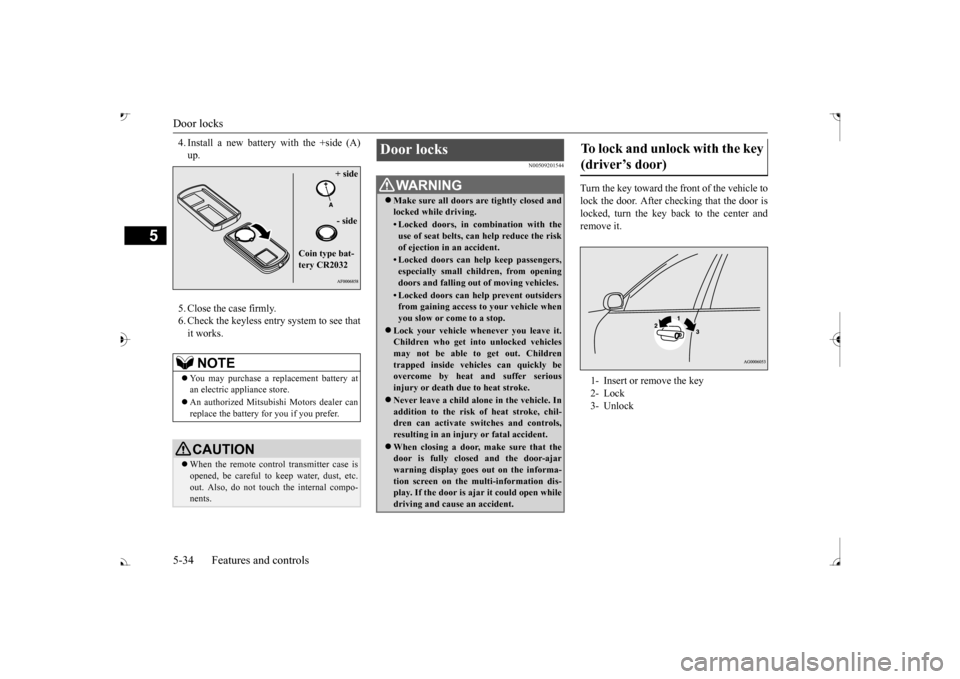
4. Install a new battery with the +side (A) 5. Close the case firmly. 6. Check the keyless entry system to see that it works.
N00509201544
Turn the key toward the front of the vehicle tolock the door. After checking that the door is locked, turn the key back to the center andremove it.
NOTE
You may purchase a re
placement battery at
an electric appliance store. An authorized Mitsubishi Motors dealer can replace the battery for you if you prefer.CAUTION When the remote control transmitter case is opened, be careful to
keep water, dust, etc.
out. Also, do not touch the internal compo- nents.
+ side - side
Coin type bat- tery CR2032
Door locks
WA R N I N G Make sure all doors are tightly closed and locked while driving.• Locked doors, in co
mbination with the
use of seat belts, can help reduce the riskof ejection in
an accident.
• Locked doors can help keep passengers, especially small children, from opening doors and falling out
of moving vehicles.
• Locked doors can help
prevent outsiders
from gaining access to your vehicle when you slow or come to a stop.
Lock your vehicle when
ever you leave it.
Children who get into
unlocked vehicles
may not be able to get out. Children trapped inside vehicles can quickly be overcome by heat
and suffer serious
injury or death due to heat stroke. Never leave a ch
ild alone in the vehicle. In
addition to the risk
of heat stroke, chil-
dren can activate switches and controls, resulting in an injury
or fatal accident.
When closing a door,
make sure that the
door is fully closed and the door-ajarwarning display goes
out on the informa-
tion screen on the multi-information dis- play. If the door is aj
ar it could open while
driving and cause an accident.
To lock and unlock with the key (driver’s door) 1- Insert or remove the key 2- Lock3- Unlock
BK0239700US.book 34 ページ 2016年6月16日 木曜日 午前10時58分
Page 118 of 521
Child safety locks for rear door Features and controls 5-37
5
N00563401119
All doors and the liftg
ate will unlock when
the ignition switch is turned to the “OFF” or“LOCK” position or the operation mode is put in OFF. All doors and the liftg
ate will unlock when
the selector lever is moved to the “P” (PARK) position with the ignition switch or the opera-tion mode in ON.
N00509401298
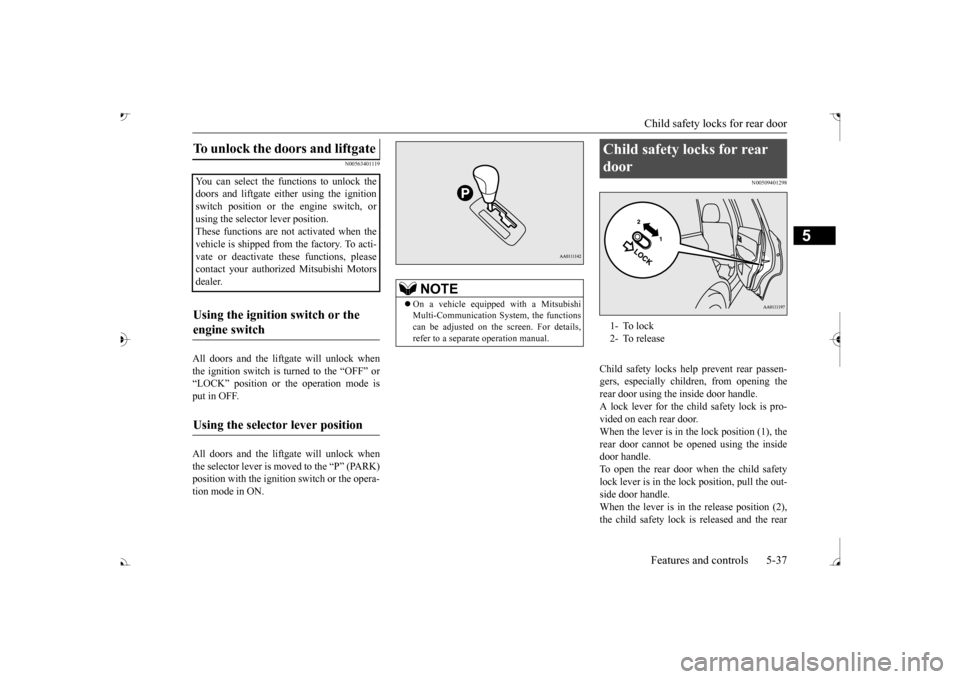
Child safety locks help prevent rear passen-gers, especially children, from opening therear door using the inside door handle. A lock lever for the child safety lock is pro- vided on each rear door.When the lever is in the lock position (1), the rear door cannot be opened using the inside door handle.To open the rear door when the child safety lock lever is in the lock position, pull the out- side door handle.When the lever is in the release position (2), the child safety lock is released and the rear
To unlock the doors and liftgate You can select the functions to unlock the doors and liftgate eith
er using the ignition
switch position or the engine switch, or using the selector lever position. These functions are not activated when thevehicle is shipped from the factory. To acti- vate or deactivate th
ese functions, please
contact your authori
zed Mitsubishi Motors
dealer.Using the ignition switch or the engine switch Using the selector lever position
NOTE
On a vehicle equippe
d with a Mitsubishi
Multi-Communication System, the functionscan be adjusted on the screen. For details, refer to a separa
te operation manual.
Child safety locks for rear door 1- To lock 2- To release
BK0239700US.book 37 ページ 2016年6月16日 木曜日 午前10時58分