cargo MITSUBISHI OUTLANDER 2017 3.G Owner's Manual
[x] Cancel search | Manufacturer: MITSUBISHI, Model Year: 2017, Model line: OUTLANDER, Model: MITSUBISHI OUTLANDER 2017 3.GPages: 521, PDF Size: 14.91 MB
Page 372 of 521
Loading information Driving safety 6-7
6
installed options, and
the tongue weight of
the trailer, if any, being towed. The tire andloading information placard located on the driver’s door sill of your vehicle will show how much weight it may properly carry. It is important to famil
iarize yourself with the
following terms before loading your vehicle: Vehicle maximum load on the tire: load on an individual tire that is determined by distributing to each axle its share of the maximum loaded vehicle weight anddividing by two. Vehicle normal load on the tire: load on an individual tire that is determined by dis-tributing to each axle its share of the curb weight, accessory weight, and normal occupant weight and dividing by two. Maximum loaded vehicle weight: the sum of - (a) Curb weight;(b) Accessory weight; (c) Vehicle capacity weight; and (d) Production options weight.
Curb weight: the weight of a motor vehi- cle with standard equipment including themaximum capacity of
fuel, oil, and cool-
ant. Accessory weight: the combined weight (in excess of those st
andard items which
may be replaced) of automatic transaxle, power steering, power brakes, power win-dows, power seats, radio, and heater, to the extent that these items are available as factory- installed equipment (whether installed or not). Vehicle capacity weight: the rated cargo and luggage load plus 150 lbs (68 kg) * times the vehicle’s designated seating capacity. Production options weight: the combined weight of those installed regular produc- tion options weighing over 5 lbs (2.3 kg)in excess of those standard items which they replace, not prev
iously considered in
curb weight or accessory weight, includ-ing heavy duty brakes,
ride levelers, roof
rack, heavy duty battery, and special trim. Normal occupant weight: 150 lbs (68 kg) * times the number of
specified occupants
(3 in the case of your vehicle) Occupant distribution:
Occupant distribu-
tion within the passenger compartment (In your vehicle the distribution is 2 in front, 1 in second row seat)
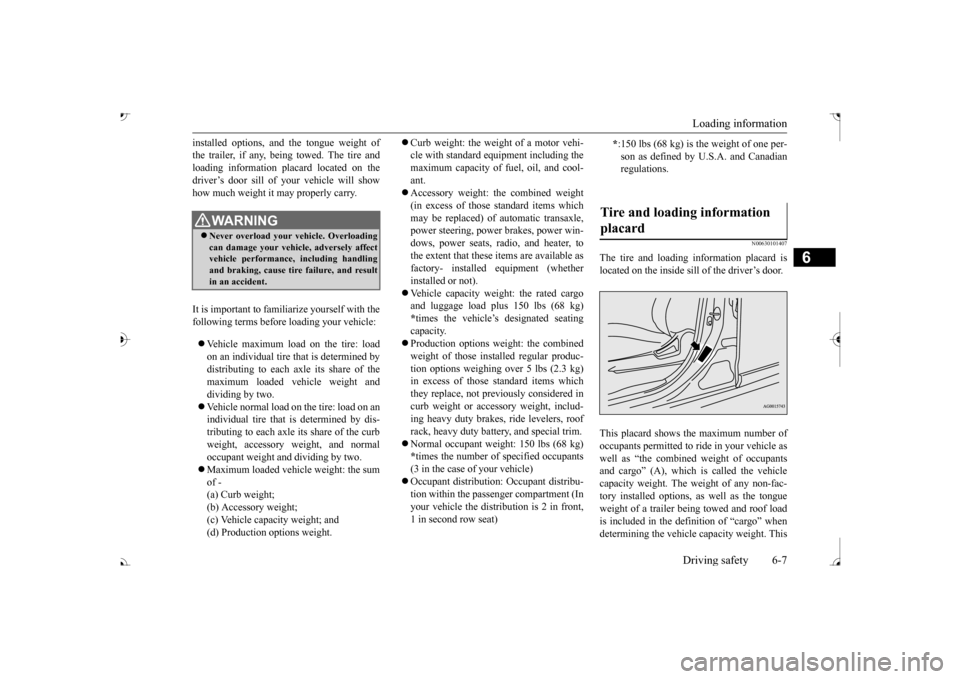
N00630101407
The tire and loading information placard islocated on the inside sill of the driver’s door. This placard shows the maximum number of occupants permitted to
ride in your vehicle as
well as “the combined
weight of occupants
and cargo” (A), which
is called the vehicle
capacity weight. The weight of any non-fac- tory installed options, as well as the tongueweight of a trailer being towed and roof load is included in the defi
nition of “cargo” when
determining the vehicle
capacity weight. This
WA R N I N GNever overload your ve
hicle. Overloading
can damage your vehicl
e, adversely affect
vehicle performance, including handling and braking, cause tire failure, and resultin an accident.
* :150 lbs (68 kg) is the weight of one per- son as defined by U.
S.A. and Canadian
regulations.
Tire and loading information placard
BK0239700US.book 7 ページ 2016年6月16日 木曜日 午前10時58分
Page 373 of 521
Loading information 6-8 Driving safety
6
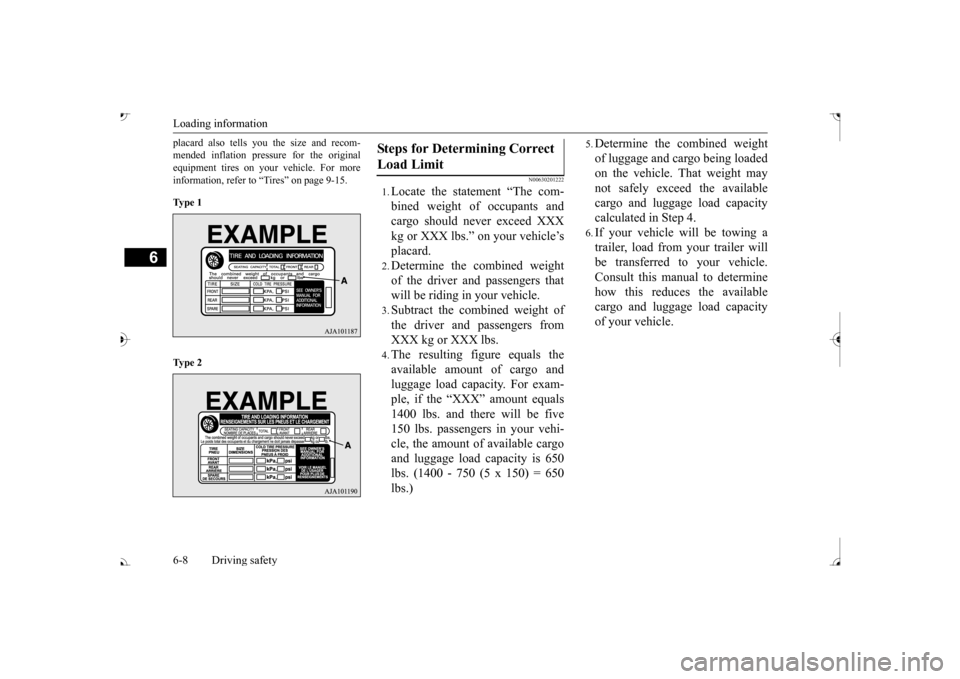
placard also tells you the size and recom- mended inflation pressure for the originalequipment tires on your vehicle. For more information, refer to “Tires” on page 9-15. Ty p e 1 Ty p e 2
N00630201222
1.Locate the statement “The com- bined weight of occupants and cargo should never exceed XXX kg or XXX lbs.” on your vehicle’splacard.2.Determine the combined weightof the driver and passengers thatwill be riding in your vehicle.3.Subtract the combined weight ofthe driver and passengers fromXXX kg or XXX lbs.4.The resulting figure equals theavailable amount of cargo andluggage load capacity. For exam- ple, if the “XXX” amount equals 1400 lbs. and there will be five150 lbs. passengers in your vehi- cle, the amount of available cargo and luggage load
capacity is 650
lbs. (1400 - 750 (5 x 150) = 650lbs.)
5.Determine the combined weightof luggage and cargo being loaded on the vehicle. That weight may not safely exceed the availablecargo and luggage load capacity calculated in Step 4.6.If your vehicle will be towing a trailer, load from your trailer will be transferred to your vehicle. Consult this manual to determinehow this reduces the available cargo and luggage load capacity of your vehicle.
Steps for Determining Correct Load Limit
BK0239700US.book 8 ページ 2016年6月16日 木曜日 午前10時58分
Page 374 of 521
Loading information Driving safety 6-9
6
NOTE
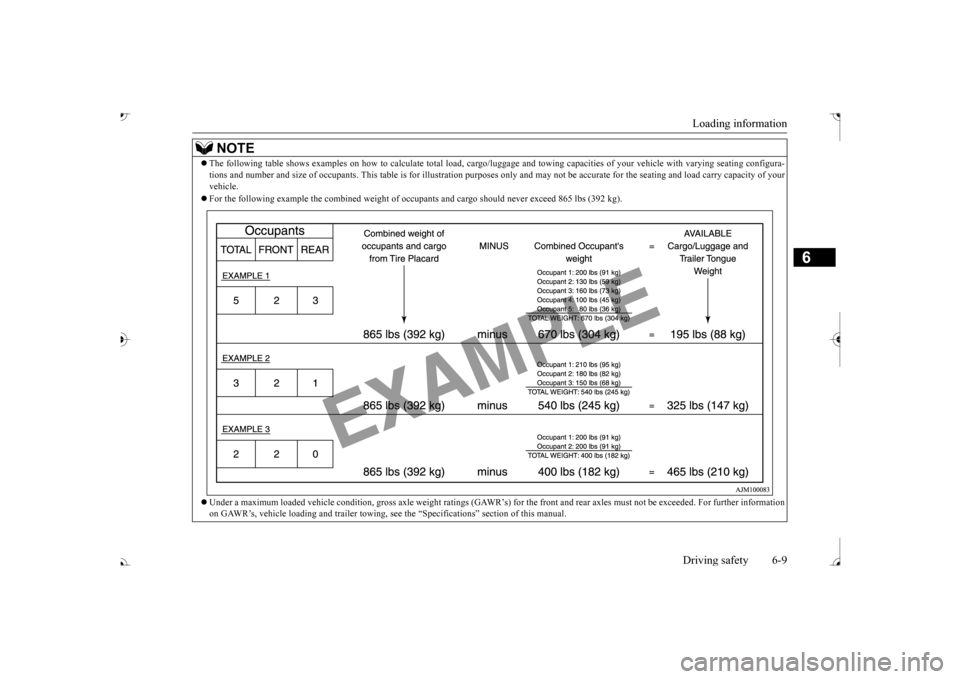
The following table shows examples on how to
calculate tota
l load, cargo/luggage and towing capa
cities of your vehicle with var
ying seating configura-
tions and number and size of occ
upants. This table is for illu
stration purposes only and may not
be accurate for the seating an
d load carry capacity of your
vehicle. For the following example the combined weight of oc
cupants and cargo should ne
ver exceed 865 lbs (392 kg).
Under a maximum loaded vehicle c
ondition, gross axle weight ratings (GAWR’s) for
the front and rear axles must not be exceeded.
For further information
on GAWR’s, vehicle loading and tr
ailer towing, see the “Specifica
tions” section of this manual.
BK0239700US.book 9 ページ 2016年6月16日 木曜日 午前10時58分
Page 375 of 521
Cargo loads 6-10 Driving safety
6
N00629700435 N00630301092
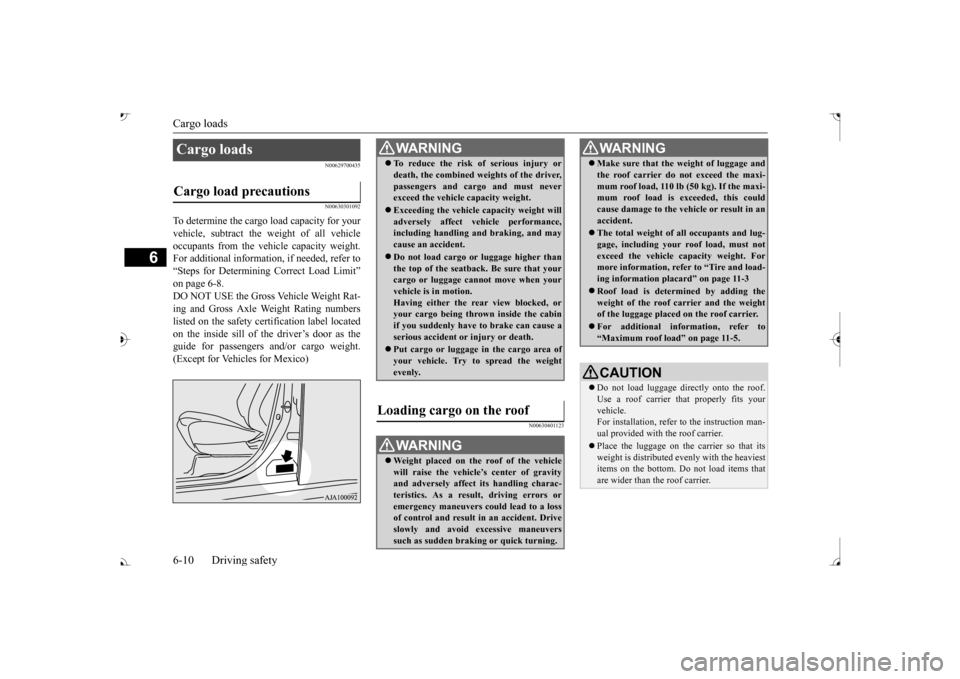
To determine the cargo load capacity for your vehicle, subtract the
weight of all vehicle
occupants from the vehi
cle capacity weight.
For additional information, if needed, refer to “Steps for Determining Correct Load Limit” on page 6-8. DO NOT USE the Gross Vehicle Weight Rat- ing and Gross Axle Weight Rating numberslisted on the safety certification label located on the inside sill of the driver’s door as the guide for passengers and/or cargo weight.(Except for Vehicles for Mexico)
N00630401123
Cargo loads Cargo load precautions
WA R N I N G To reduce the risk of serious injury or death, the combined weights of the driver,passengers and cargo and must neverexceed the vehicle capacity weight. Exceeding the vehicle capacity weight will adversely affect ve
hicle performance,
including handling and braking, and may cause an accident. Do not load cargo or luggage higher than the top of the seatback. Be sure that yourcargo or luggage cann
ot move when your
vehicle is in motion. Having either the re
ar view blocked, or
your cargo being thrown
inside the cabin
if you suddenly have to brake can cause a serious accident or
injury or death.
Put cargo or luggage in the cargo area of your vehicle. Try to spread the weightevenly.
Loading cargo on the roof
WA R N I N G Weight placed on the
roof of the vehicle
will raise the vehicle’ and adversely affect
its handling charac-
teristics. As a result, driving errors oremergency maneuvers could lead to a loss of control and result in an accident. Drive slowly and avoid excessive maneuverssuch as sudden brak
ing or quick turning.
Make sure that the
weight of luggage and
the roof carrier do not exceed the maxi-mum roof load, 110 lb (50 kg). If the maxi-mum roof load is ex
ceeded, this could
cause damage to the ve
hicle or result in an
accident. The total weight of all occupants and lug- gage, including your r
oof load, must not
exceed the vehicle capacity weight. For more information, refer to “Tire and load- ing information placard” on page 11-3 Roof load is determined by adding the weight of the roof
carrier and the weight
of the luggage placed
on the roof carrier.
For additional information, refer to “Maximum roof load” on page 11-5.CAUTION Do not load luggage directly onto the roof. Use a roof carrier that properly fits your vehicle. For installation, refer to the instruction man-ual provided with the roof carrier. Place the luggage on the carrier so that its weight is distri
buted evenly with the heaviest
items on the bottom. Do not load items that are wider than the roof carrier.WA R N I N G
BK0239700US.book 10 ページ 2016年6月16日 木曜日 午前10時58分
Page 377 of 521
Trailer towing 6-12 Driving safety
6
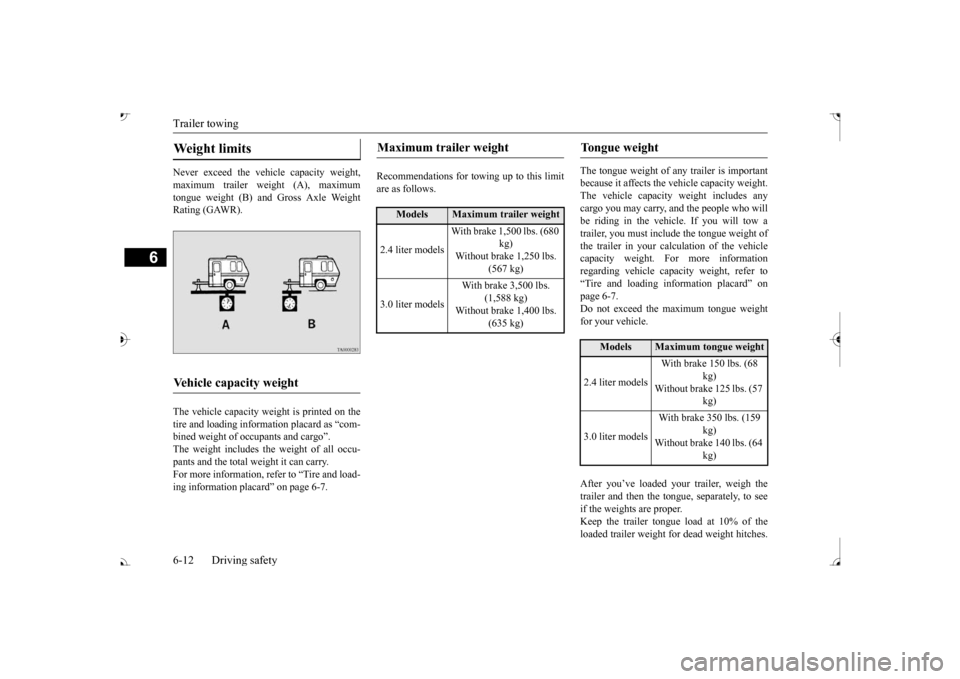
Never exceed the vehicle capacity weight, maximum trailer weight (A), maximum tongue weight (B) and Gross Axle Weight Rating (GAWR). The vehicle capacity weight is printed on the tire and loading inform
ation placard as “com-
bined weight of oc
cupants and cargo”.
The weight includes the weight of all occu- pants and the total weight it can carry.For more information, refer to “Tire and load- ing information plac
ard” on page 6-7.
Recommendations for to
wing up to this limit
are as follows.
The tongue weight of a
ny trailer is important
because it affects the ve
hicle capacity weight.
The vehicle capacity weight includes any cargo you may carry, a
nd the people who will
be riding in the vehi
cle. If you will tow a
trailer, you must include the tongue weight of the trailer in your calculation of the vehiclecapacity weight. For more information regarding vehicle capa
city weight, refer to
“Tire and loading information placard” on page 6-7. Do not exceed the maximum tongue weightfor your vehicle. After you’ve loaded your trailer, weigh the trailer and then the to
ngue, separately, to see
if the weights are proper.Keep the trailer tongue load at 10% of the loaded trailer weight fo
r dead weight hitches.
Weight limits Vehicle capacity weight
Maximum trailer weight
Models
Maximum trailer weight
2.4 liter models
With brake 1,500 lbs. (680
kg)
Without brake 1,250 lbs.
(567 kg)
3.0 liter models
With brake 3,500 lbs.
(1,588 kg)
Without brake 1,400 lbs.
(635 kg)
Tongue weight
Models
Maximum tongue weight
2.4 liter models
With brake 150 lbs. (68
kg)
Without brake 125 lbs. (57
kg)
3.0 liter models
With brake 350 lbs. (159
kg)
Without brake 140 lbs. (64
kg)
BK0239700US.book 12 ページ 2016年6月16日 木曜日 午前10時58分
Page 486 of 521
Replacement of light bulbs
Vehicle care and maintenance 9-33
9
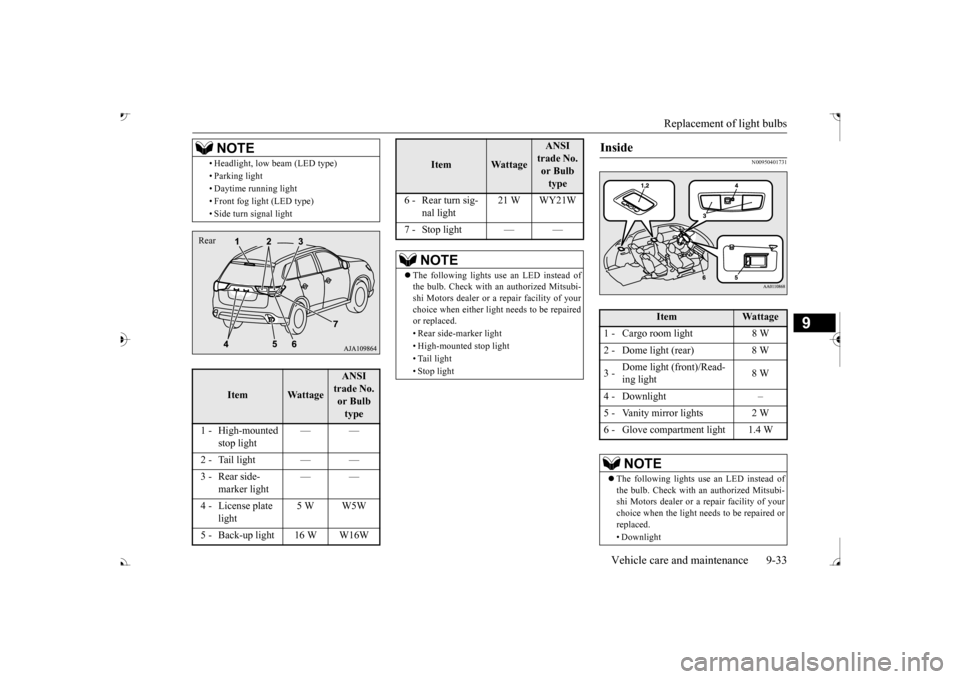
N00950401731
• Headlight, low be
am (LED type)
• Parking light • Daytime running light • Front fog light (LED type) • Side turn signal light
Item
Wattage
ANSI trade No. or Bulb type
1 - High-mounted
stop light
——
2 - Tail light — —
marker light
——
4 - License plate
light
5 W W5W
5 - Back-up light 16 W W16W
NOTE
Rear
6 - Rear turn sig-
nal light
21 W WY21W
7 - Stop light — — The following lights use an LED instead of the bulb. Check with an authorized Mitsubi- shi Motors dealer or a
repair facility of your
choice when either light
needs to be repaired
or replaced. • Rear side-marker light• High-mounted stop light • Tail light • Stop light
Item
Wattage
ANSI trade No. or Bulb type
Inside
Item
Wattage
1 - Cargo room light 8 W 2 - Dome light (rear) 8 W 3 -
Dome light (front)/Read- ing light
8 W
4 - Downlight – 6 - Glove compartment light 1.4 W
NOTE
The following lights us
e an LED instead of
the bulb. Check with an authorized Mitsubi- shi Motors dealer or a repair facility of yourchoice when the light needs to be repaired or replaced. • Downlight
BK0239700US.book 33 ページ 2016年6月16日 木曜日 午前10時58分
Page 510 of 521
Vehicle weights
Specifications 11-5
11
N01147601998
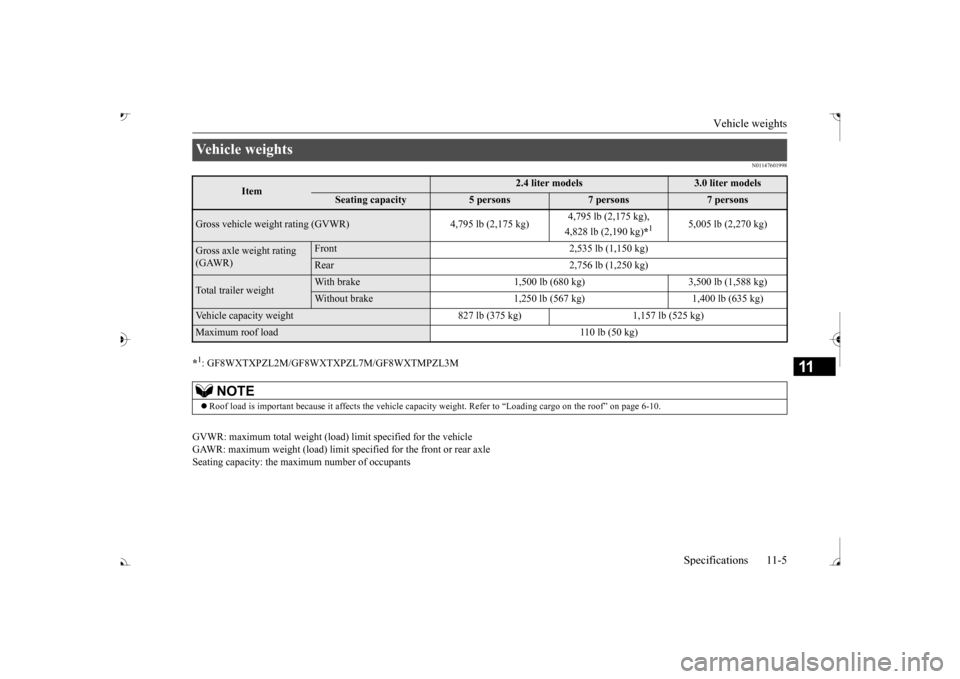
*1: GF8WXTXPZL2M/GF8WXTXPZL7M/GF8WXTMPZL3M GVWR: maximum total weight (load) limit specified for the vehicle GAWR: maximum weight (load) limit specified for the front or rear axle Seating capacity: the maxi
mum number of occupants
Vehicle weights
Item
2.4 liter models
3.0 liter models
Seating capacity
5 persons
7 persons
7 persons
Gross vehicle wei
ght rating (GVWR) 4,795 lb (2,175 kg)
4,795 lb (2,175 kg), 4,828 lb (2,190 kg)
*1
5,005 lb (2,270 kg)
Gross axle weight rating (GAWR)
Rear 2,756 lb (1,250 kg)
Total trailer weight
With brake 1,500 lb (680 kg) 3,500 lb (1,588 kg)Without brake 1,250 lb (567 kg) 1,400 lb (635 kg)
Vehicle capacity weight 827 lb (375 kg) 1,157 lb (525 kg)
NOTE
Roof load is important becaus
e it affects the vehicle capacity weight. Refe
r to “Loading cargo on the roof” on page 6-10.
BK0239700US.book 5 ページ 2016年6月16日 木曜日 午前10時58分
Page 514 of 521
Alphabetical index
12-1
12
Numerics
12 V power outlets
............................
5-267
4-wheel drive operation
.......................
5-88
A
Accessory (installation)
.........................
3-6
Active stability control (ASC)
............
5-100
Adaptive Cruise C
ontrol System (ACC)
.......
5-106 Air cleaner filter
...................................
9-9
Air conditioner
Dual-zone automatic climate control air conditioner
.....................................
7-5
Important air condi
tioning operating tips
..
7-13
Air purifier
.........................................
7-14
Airbag
...............................................
4-34
All-wheel drive operation
....................
5-88
Aluminum wheels
...............................
9-43
AM/FM radio
.....................................
7-14
Anti-lock braking system
.....................
5-97
Arm rest
.............................................
4-10
Assist grip
........................................
5-283
Audio
AM/FM radio
.................................
7-14
CD player
......................................
7-14
Troubleshooting
.............................
7-47
Automatic high beam system
..............
5-224
Automatic transaxle
............................
5-67
Fluid
.....................................
9-11
, 11-7
Selector le
ver operation
..................
5-68
Selector lever positions
...................
5-71
Sports mode
...................................
5-72
B
Back-up light
Bulb capacity
.................................
9-32
Replacement
..................................
9-38
Ball joint, steering linka
ge seals, drive shaft
boots
...............................................
9-24
Battery
..............................................
9-13
Charging system warning light
.......
5-217
Checking battery
electrolyte level
....
9-13
Disconnection and connection
.........
9-14
During cold weather
.......................
9-13
Specification
..................................
11-6
Blind Spot Warning (BSW)
................
5-131
Bluetooth® 2.0 interface
....................
5-240
Bottle holders
....................................
5-280
Brake
Fluid
.....................................
9-12
, 11-7
Brake assist
........................................
5-96
Braking
Anti-lock braking system
................
5-97
Braking
...........................................
6-5
Hose
..............................................
9-24
Pad wear alarm
...............................
5-93
Parking brake
.................................
5-53
Pedal
.............................................
5-92
Pedal free play
................................
9-21
Power brakes
..................................
5-92
Service brake
..................................
5-92
Warning lights and buzzer
.............
5-216
Break-in recommendations
....................
5-3
Bulb capacity
......................................
9-32
C
California Perchl
orate Materials
Requirements
.....................................
3-7
Capacities
..........................................
11-7
Card holder
............................
5-266
, 5-277
Cargo area cover
...............................
5-281
Cargo loads
........................................
6-10
Cargo room light
...............................
5-275
Bulb capacity
.................................
9-33
Catalytic converter
................................
9-2
Cautions on the handling of all-wheel drive vehicles
............................................
5-91
CD player
...........................................
7-14
Certification label
...............................
11-3
Charging system warning light
...........
5-217
Child restraint systems
........................
4-27
Child safety locks for rear door
............
5-37
BK0239700US.book 1 ページ 2016年6月16日 木曜日 午前10時58分
Page 517 of 521

Alphabetical index 12-4
12
M
MIVEC engine
..........................
5-26
, 5-67
Modification of your vehicle
..................
3-5
Multi Around Monitor
.......................
5-154
Multi information display - Type 1
.....
5-164
Multi information display - Type 2
.....
5-183
O
Octane number
.....................................
3-2
Oil
Engine oil
......................................
11-7
Rear axle oil
...................................
11-7
Transfer oil
....................................
11-7
Operation under adverse driving conditions
...
8-15 Outside rearview mirrors
.....................
5-60
Overheating
.........................................
8-4
P
Parking
................................................
6-6
Parking brake
.................................
5-53
Parking brake lever stroke
...................
9-22
Parking lights
Bulb capacity
.................................
9-32
Replacement
..................................
9-36
Parking sensors
................................
5-147
Polishing
............................................
9-43
Power brakes
......................................
5-92
Power liftgate
.....................................
5-39
Power outlet
.....................................
5-267
Power windows
...................................
5-49
Puncture (Tire changing)
.......................
8-6
R
Radiator cap
........................................
9-9
Radio
.................................................
7-14
General information
about your radio 7-50
Reading lights
Bulb capacity
..................................
9-33
Rear axle oil
..............................
9-12
, 11-7
Rear combination lights
Bulb capacity
..................................
9-32
Replacement
...................................
9-37
Rear Cross Traffic Alert
.....................
5-136
Rear side-marker lights
Bulb capacity
..................................
9-32
Rear turn signal light
Bulb capacity
..................................
9-32
Replacement
...................................
9-37
Rear-view camera
.............................
5-151
Rearview mirror
Inside rearview mirror
.....................
5-57
Outside rearview mirrors
.................
5-60
Replacement of light bulbs
..................
9-31
Replacing tires and wheels
...................
9-19
Reporting Safety Defects
.....................
10-2
S
Safe driving techniques
.........................
6-4
S-AWC (Super-All Wheel Control)
......
5-85
Seat belt
.............................................
4-18
Adjustable seat belt shoulder anchor
.4-24
Child restraint systems
....................
4-27
Front passenger seat belt warning light
.....
4-23Maintenance and inspection
.............
4-34
Seat belt extender
...........................
4-25
Seat belt force limitter
.....................
4-27
Seat belt pr
e-tensioners
...................
4-25
Seat belt use
during pregnancy
.........
4-25
Seats
....................................................
4-2
Arm rest
........................................
4-10
Front seats
.......................................
4-4
Head restraints
...............................
4-11
Heated seat
......................................
4-8
Making a cargo area
........................
4-13
Making a flat seat
...........................
4-16
Seat arrangement
..............................
4-3
Seats and restraint systems
................
4-4
Second row seats
..............................
4-8
Third row seats
...............................
4-10
Service brake
......................................
5-92
Service precautions
...............................
9-2
BK0239700US.book 4 ページ 2016年6月16日 木曜日 午前10時58分