page 6 MITSUBISHI OUTLANDER 2017 3.G Owner's Manual
[x] Cancel search | Manufacturer: MITSUBISHI, Model Year: 2017, Model line: OUTLANDER, Model: MITSUBISHI OUTLANDER 2017 3.GPages: 521, PDF Size: 14.91 MB
Page 62 of 521
Child restraint systems
Seat and restraint systems 4-33
4
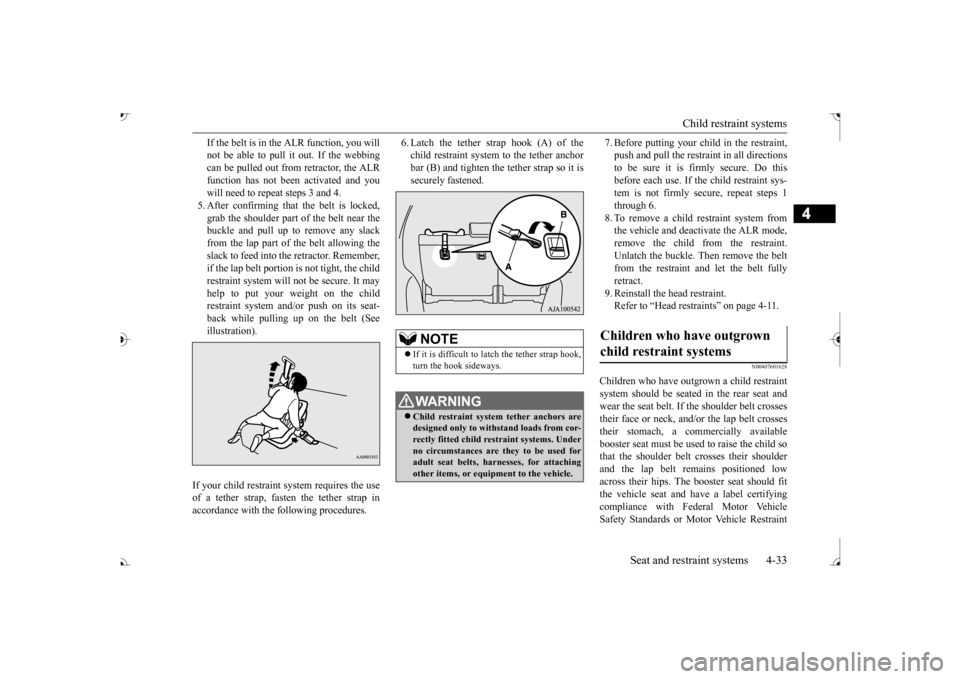
If the belt is in the ALR function, you will not be able to pull it out. If the webbingcan be pulled out from retractor, the ALR function has not been activated and you will need to repeat steps 3 and 4.5. After confirming that the belt is locked, grab the shoulder part of the belt near the buckle and pull up to remove any slackfrom the lap part of the belt allowing the slack to feed into the retractor. Remember, if the lap belt portion is not tight, the child restraint system will not be secure. It may help to put your weight on the childrestraint system and/or push on its seat- back while pulling up on the belt (See illustration).
6. Latch the tether strap hook (A) of the child restraint system to the tether anchorbar (B) and tighten the tether strap so it is securely fastened.
7. Before putting your child in the restraint, push and pull the restra
int in all directions
to be sure it is firmly secure. Do this before each use. If the child restraint sys- tem is not firmly secure, repeat steps 1through 6. 8. To remove a child restraint system from the vehicle and deactivate the ALR mode,remove the child from the restraint. Unlatch the buckle. Then remove the belt from the restraint and let the belt fully retract. 9. Reinstall the head restraint.Refer to “Head restraints” on page 4-11.
N00407601628
Children who have outgr
own a child restraint
system should be seated in the rear seat and wear the seat belt. If the shoulder belt crossestheir face or neck, and/
or the lap belt crosses
their stomach, a commercially available booster seat must be used to raise the child sothat the shoulder belt
crosses their shoulder
and the lap belt remains positioned low across their hips. The
booster seat should fit
the vehicle seat and have a label certifying compliance with Federal Motor Vehicle Safety Standards or Mo
tor Vehicle Restraint
If your child restraint system requires the use of a tether strap, fasten the tether strap inaccordance with the following procedures.
NOTE
If it is difficult to latch the tether strap hook, turn the hook sideways.WA R N I N G Child restraint system tether anchors are designed only to with
stand loads from cor-
rectly fitted child restraint systems. Underno circumstances are they to be used for adult seat belts, harnesses, for attaching other items, or equipment to the vehicle.
Children who have outgrown child restraint systems
BK0239700US.book 33 ページ 2016年6月16日 木曜日 午前10時58分
Page 64 of 521
Supplemental Restraint System (SRS) - airbag
Seat and restraint systems 4-35
4
and partial ejection fro
m the vehicle through
side windows in both side impact and roll-over type accidents. The SRS airbags are NOT a substitute for use of the seat belts. For maximum protection in all types of accidents, seat belts mustALWAYS be worn by everyone who drives or rides in this vehicle
(with infants and small
children in an appropriate child restraint sys-tem in the rear seat, and older children buck- led in the rear seat). Refer to “Child restraint systems” on page 4-27.
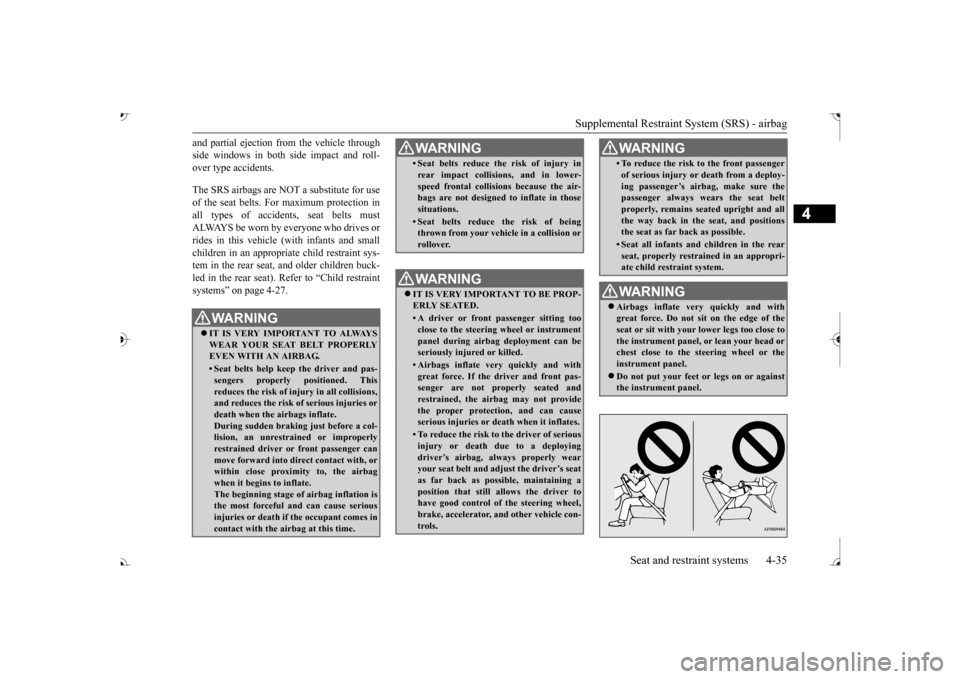
WA R N I N G IT IS VERY IMPORTANT TO ALWAYS WEAR YOUR SEAT BELT PROPERLY EVEN WITH AN AIRBAG.• Seat belts help keep the driver and pas-sengers properly positioned. This reduces the risk of injury in all collisions,and reduces the risk of serious injuries or death when the
airbags inflate.
During sudden braking just before a col-lision, an unrestra
ined or
improperly
restrained driver or front passenger can move forward into direct contact with, orwithin close proximi
ty to, the airbag
when it begins to inflate. The beginning stage of
airbag inflation is
the most forceful and can cause serious injuries or death if the occupant comes in contact with the airbag at this time.
• Seat belts reduce the risk of injury inrear impact collisions, and in lower-speed frontal collisions because the air-bags are not designed
to inflate in those
situations.• Seat belts reduce the risk of beingthrown from your vehi
cle in a collision or
rollover.WA R N I N G IT IS VERY IMPORTANT TO BE PROP- ERLY SEATED.• A driver or front passenger sitting tooclose to the steering wheel or instrumentpanel during airbag deployment can be seriously inju
red or killed.
• Airbags inflate ve
ry quickly and with
great force. If the driver and front pas- senger are not properly seated andrestrained, the airbag may not provide the proper protection, and can cause serious injuries or death when it inflates.• To reduce the risk to the driver of seriousinjury or death due to a deployingdriver’s airbag, al
ways properly wear
your seat belt and adju
st the driver’s seat
as far back as possible, maintaining a position that still allows the driver tohave good control of the steering wheel, brake, accelerator, and other vehicle con- trols.WA R N I N G
• To reduce the risk to the front passengerof serious injury or
death from a deploy-
ing passenger’s airbag, make sure thepassenger always wears the seat belt properly, remains seat
ed upright and all
the way back in the
seat, and positions
the seat as far back as possible.• Seat all infants and children in the rearseat, properly restrain
ed in an appropri-
ate child restraint system.WA R N I N G Airbags inflate very
quickly and with
great force. Do not sit on the edge of the seat or sit with your
lower legs too close to
the instrument panel,
or lean your head or
chest close to the steering wheel or the instrument panel. Do not put your feet or legs on or against the instrument panel.WA R N I N G
BK0239700US.book 35 ページ 2016年6月16日 木曜日 午前10時58分
Page 65 of 521
Supplemental Restraint System (SRS) - airbag 4-36 Seat and restraint systems
4
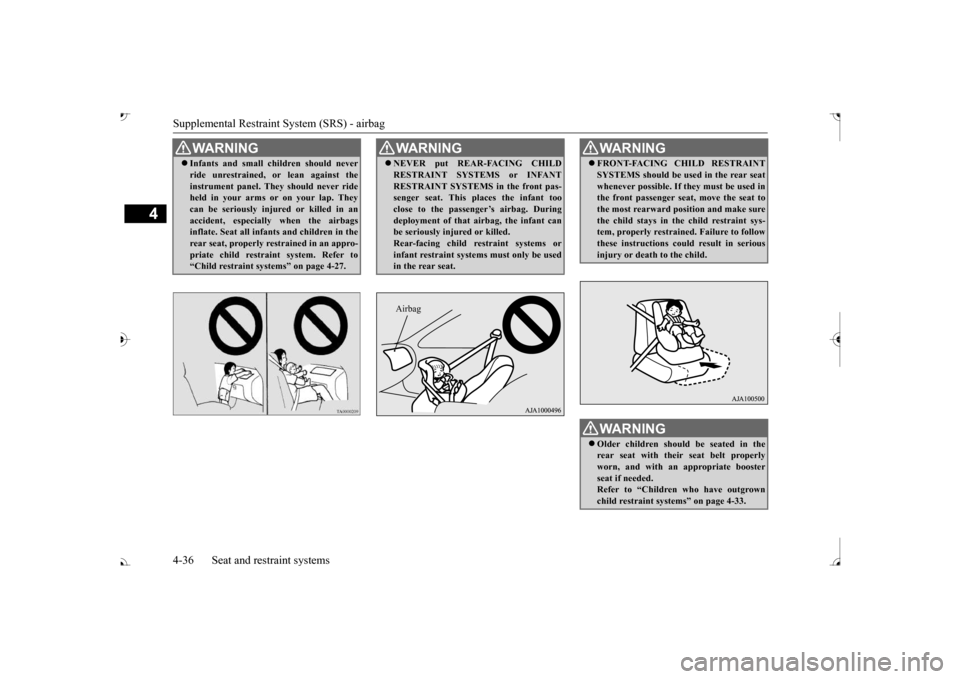
WA R N I N G Infants and small children should never ride unrestrained,
or lean against the
instrument panel. They should never rideheld in your arms or
on your lap. They
can be seriously inju
red or killed in an
accident, especially when the airbagsinflate. Seat all infa
nts and children in the
rear seat, properly re
strained in an appro-
priate child restraint system. Refer to“Child restraint systems” on page 4-27.
WA R N I N G NEVER put REAR-FACING CHILD RESTRAINT SYSTEMS or INFANTRESTRAINT SYSTEMS in the front pas-senger seat. This pl
aces the infant too
close to the passenger’s airbag. During deployment of that airbag, the infant canbe seriously inju
red or killed.
Rear-facing child restraint systems or infant restraint systems must only be usedin the rear seat.Airbag
WA R N I N G FRONT-FACING CHILD RESTRAINT SYSTEMS should be used in the rear seatwhenever possible. If they must be used inthe front passenger se
at, move the seat to
the most rearward po
sition and make sure
the child stays in the child restraint sys-tem, properly restrained. Failure to follow these instructions could result in serious injury or death to the child.WA R N I N G Older children should be seated in the rear seat with thei
r seat belt properly
worn, and with an
appropriate booster
seat if needed. Refer to “Children
who have outgrown
child restraint systems” on page 4-33.
BK0239700US.book 36 ページ 2016年6月16日 木曜日 午前10時58分
Page 67 of 521
Supplemental Restraint System (SRS) - airbag 4-38 Seat and restraint systems
4
The main purpose of an EDR is to record, in certain crash or near crash-like situations,such as an airbag deployment or hitting a road obstacle, data that
will assist in under-
standing how a vehicle’s systems performed.The EDR is designed to
record data related to
vehicle dynamics and sa
fety systems for a
short period of time,
typically 30 seconds or
less. The EDR in this vehicle is designed to record such data as: How various systems in your vehicle were operating; Whether or not the driver and front pas- senger safety belts
were buckled/fastened;
How far (if at all) the driver was depress- ing the accelerator and/or brake pedal; and, How fast the vehicle was traveling.
These data can help provide a better under- standing of the circumstances in which crashes and injuries occur.
To read data recorded
by an EDR, special
equipment is required, a
nd access to the vehi-
cle or the EDR is needed. In addition to thevehicle manufacturer, ot
her parties, such as
law enforcement, that have the special equip- ment, can read the information if they haveaccess to the vehicle or the EDR.
N00417900177
The driver’s seat posit
ion sensor is attached
to the seat rail and provides the airbag control unit with information
on the seat’s fore-aft
position. The airbag control unit controlsdeployment of the driver’s front airbag in accordance with the information it receives from this sensor.If there is a problem involving the driver’s seat position sensor, th
e SRS warning light in
the instrument panel will come on. Refer to “SRS warning light/display” on page 4-40.
N00418001374
The passenger’s seat oc
cupant classification
sensor system is attached to the front passen- ger seat cushion and provides the airbag con-trol unit with inform
ation regarding the
occupant on the front passenger seat. The air-
NOTE
EDR data are recorded by your vehicle only if a non-trivial crash situation occurs; no dataare recorded by the EDR under normal driv-ing conditions and no
personal data (e.g.,
name, gender, age, and crash location) are recorded. However, other parties, such aslaw enforcement, could combine the EDR data with the type of personally identifying data routinely acquire
d during a crash inves-
tigation.
Driver’s seat position sensor
WA R N I N G If the SRS warning li
ght or warning dis-
play comes on, have th
e vehicle inspected
by an authorized
Mitsubishi Motors
dealer as soon
as possible.
Please observe the following instructions to ensure that the driver’s seat positionsensor can operate correctly.• Adjust the seat to the correct position,and sit well back
against the seatback.
Refer to “Front seats” on page 4-4.• Do not recline the seatback more thannecessary when driving.• Do not place metall
ic objects or luggage
under the front seat.
If the vehicle is involved in a severe impact, have the SRS sensors inspected by an authorized
Mitsubishi Motors dealer as
soon as possible.
Passenger’s seat occupant clas- sification sensor system
BK0239700US.book 38 ページ 2016年6月16日 木曜日 午前10時58分
Page 68 of 521
Supplemental Restraint System (SRS) - airbag
Seat and restraint systems 4-39
4
bag control unit controls deployment of the passenger’s front airbag in accordance withthe information it receives from this system. The passenger’s front ai
rbag will not deploy
in an impact when the system senses no occu-pant on the front passenger’s seat or a child in a child restraint system. In this case, the pas- senger airbag off indi
cator will come on.
Refer to “Passenger’s ai
rbag off indicator” on
page 4-39. If there is a problem involving the passen- ger’s seat occupant cl
assification sensor sys-
tem, the SRS warning light in the instrumentpanel will come on. Refer to “SRS warning light/display” on page 4-40.
N00418101346
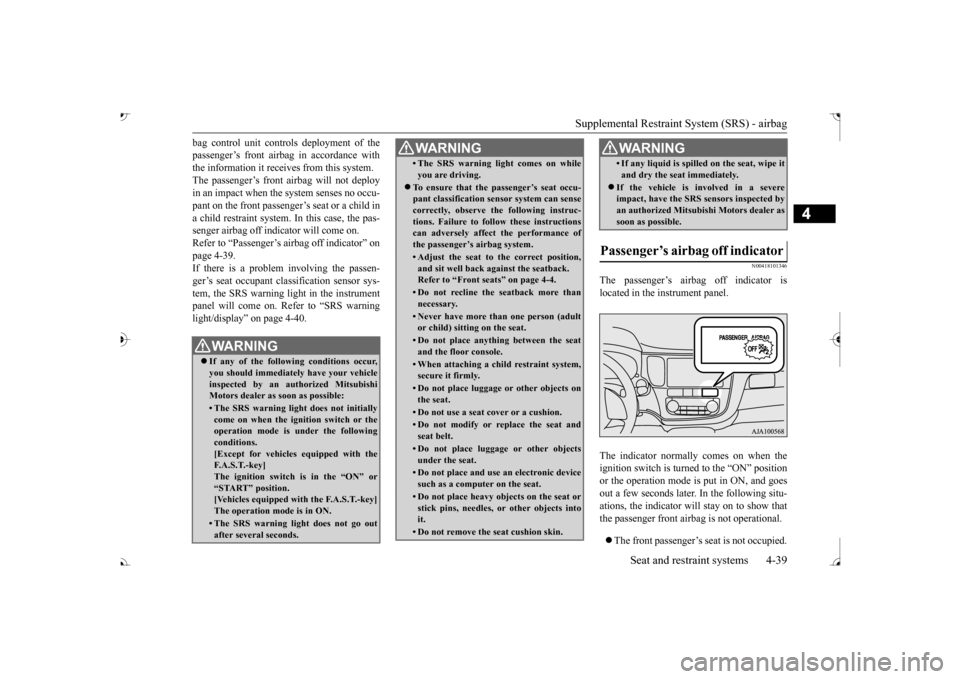
The passenger’s airbag off indicator is located in the instrument panel. The indicator normall
y comes on when the
ignition switch is turned to the “ON” position or the operation mode is put in ON, and goes out a few seconds later. In the following situ-ations, the indicator will stay on to show that the passenger front airb
ag is not operational.
The front passenger’s seat is not occupied.
WA R N I N GIf any of the following conditions occur, you should immediatel
y have your vehicle
inspected by an au
thorized Mitsubishi
Motors dealer as
soon as possible:
• The SRS warning light does not initially come on when the ignition switch or the operation mode is under the followingconditions. [Except for vehicles equipped with the F. A . S . T. - k e y ]The ignition switch is in the “ON” or “START” position. [Vehicles equipped with the F.A.S.T.-key]The operation mode is in ON.• The SRS warning light does not go outafter several seconds.
• The SRS warning li
ght comes on while
you are driving.
To ensure that the passenger’s seat occu- pant classification sensor system can sense correctly, observe the following instruc-tions. Failure to follow these instructions can adversely affect
the performance of
the passenger’s airbag system.• Adjust the seat to the correct position,and sit well back
against the seatback.
Refer to “Front seats” on page 4-4.• Do not recline the seatback more thannecessary.• Never have more than one person (adultor child) sitting
on the seat.
• Do not place anything between the seat and the floor console.• When attaching a chil
d restraint system,
secure it firmly.• Do not place luggage
or other objects on
the seat.• Do not use a seat cover or a cushion.• Do not modify or replace the seat andseat belt.• Do not place luggage or other objectsunder the seat.• Do not place and use
an electronic device
such as a computer on the seat.• Do not place heavy objects on the seat orstick pins, needles, or other objects intoit.• Do not remove the seat cushion skin.WA R N I N G
• If any liquid is spilled on the seat, wipe itand dry the seat
immediately.
If the vehicle is involved in a severe impact, have the SRS sensors inspected by an authorized
Mitsubishi Motors dealer as
soon as possible.
Passenger’s airbag off indicator
WA R N I N G
BK0239700US.book 39 ページ 2016年6月16日 木曜日 午前10時58分
Page 84 of 521
Break-in recommendations
Features and controls 5-3
5
N00508701366
Advanced automobile
manufacturing tech-
niques permit you to operate your new vehi- cle without requiring a long break-in periodof low-speed driving. However, you can add to the future perfor- mance and economy of your vehicle byobserving the following precautions during the first 300 miles (500 km). Drive your vehicle at m
oderate speeds during
the break-in period. Avoid revving the engine. Avoid rough driving such as sudden starts, sudden accelerati
on, prolonged high-
speed driving and sudden braking. These actions would have a detrimental effect onthe engine and lead to increased fuel and oil consumption; th
is could ultimately
result in the malfunction of engine com-ponents. Be particularly careful to avoid full acceleration while in low shift posi- tion (low gears). Do not overload the vehicle. Stay within the seating capacity. (Refer to “Cargo load precautions” on page 6-10.) Refrain from towing a trailer or other vehicle (Refer to “T
railer towing” on page
6-11).
N00508801716
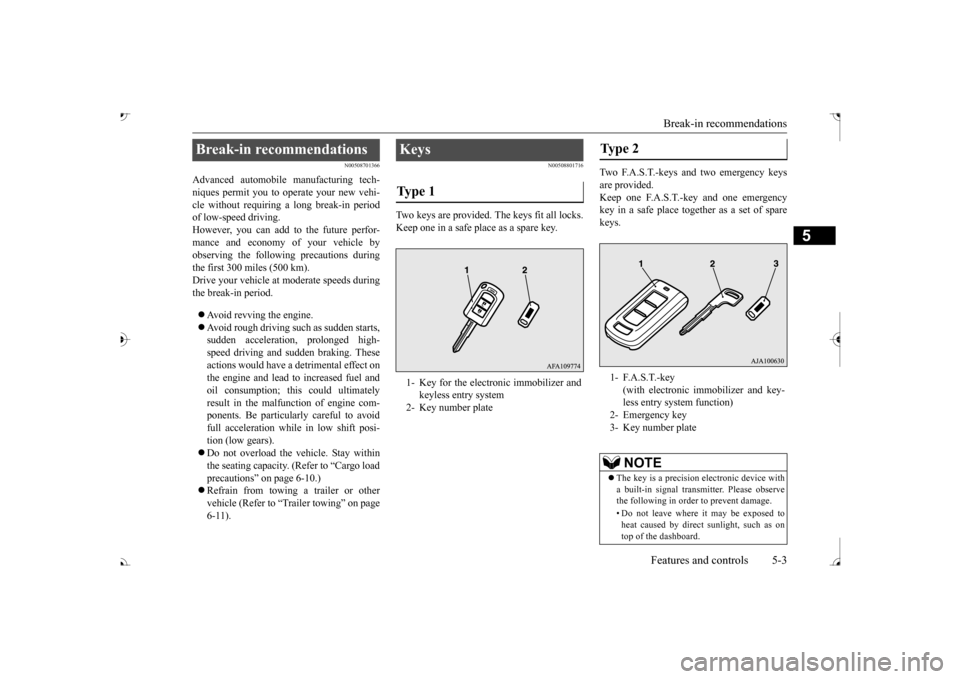
Two keys are provided. The keys fit all locks.Keep one in a safe place as a spare key.
Two F.A.S.T.-keys and two emergency keys are provided. Keep one F.A.S.T.-key and one emergency key in a safe pl
ace together as a set of spare
keys.
Break-in recommendations
Keys Ty p e 1 1- Key for the electronic immobilizer and
keyless entry system
2- Key number plate
Type 2 1- F.A.S.T.-key
(with electronic im
mobilizer and key-
less entry system function)
3- Key number plate
NOTE
The key is a precision
electronic device with
a built-in signal transm
itter. Please observe
the following in order to prevent damage. • Do not leave where it may be exposed to heat caused by direct
sunlight, such as on
top of the dashboard.
BK0239700US.book 3 ページ 2016年6月16日 木曜日 午前10時58分
Page 85 of 521
![MITSUBISHI OUTLANDER 2017 3.G Owners Manual Electronic immobilizer (Anti-theft starting system)
5
N00509101888
[For vehicles equippe
d with the Free-hand
Advanced Security Transmitter (F.A.S.T.-key)] For information on ope
rations for vehicl](/img/19/7536/w960_7536-84.png "MITSUBISHI OUTLANDER 2017 3.G Owners Manual Electronic immobilizer (Anti-theft starting system)
5
N00509101888
[For vehicles equippe
d with the Free-hand
Advanced Security Transmitter (F.A.S.T.-key)] For information on ope
rations for vehicl")
Electronic immobilizer (Anti-theft starting system)
5
N00509101888
[For vehicles equippe
d with the Free-hand
Advanced Security Transmitter (F.A.S.T.-key)] For information on ope
rations for vehicles
equipped with the Free-hand Advanced Secu-rity Transmitter (F.A
.S.T.-key), refer to
“Free-hand Advanced
Security Transmitter
(F.A.S.T.-key): Electr
onic immobilizer (Anti-
theft starting system)” on page 5-18.
[Except for vehicles equipped with the Free- hand Advanced Security Transmitter(F.A.S.T.-key)] The electronic immobilize
r is designed to sig-
nificantly reduce the
possibility of vehicle
theft. The purpose of the system is to immo- bilize the vehicle if
an invalid start is
attempted. A valid st
art attempt can only be
achieved (subject to ce
rtain conditions) using
a key “registered” to the immobilizer system. All of the keys provided with your new vehi- cle have been program
med to the vehicle’s
electronics.
• Do not take the remote control transmitter apart. • Do not excessively be
nd the key or subject
it to strong impacts. • Keep the remote control transmitter dry. • Keep away from magnetic objects such as key rings. • Keep away from devi
ces that produce mag-
netism, such as audio systems, computers and televisions. • Keep away from devices that emit strong electromagneti
c waves, such as cellular
phones, wireless devices and high fre-quency equipment (i
ncluding medical
devices). • Do not clean with
ultrasonic cleaners.
• Do not leave the key where it may be exposed to high temperature or high humid- ity.
If you lose your key, to prevent the theft of the vehicle immediatel
y contact an autho-
rized Mitsubishi Motors dealer.If you notify an authorized Mitsubishi Motors dealer of the key number, they can make a new key. The key number is stampedon the key number plate. Keep the key num- ber plate in a safe pl
ace separate from the
key itself.NOTE
No keys other than those registered in advance can be used
to start the engine.
Refer to “Electronic immobilizer (Anti-theftstarting system)” on page 5-4. Refer to “Free-hand
Advanced Security
Transmitter (F.A.S.T.-key): “Electronicimmobilizer (Anti-thef
t starting system)” on
page 5-18. When the theft-alarm is in the system opera- tional status, the alarm operates if a door or liftgate is opened after using the key, thedoor lock knob or the power door lock switch to unlock the vehicle. The system does not enter the preparation status if the keyless entry system or the F.A.S.T.-key operation was not used to lockthe vehicle.
Electronic immobilizer (Anti-theft starting system)
NOTE
NOTE
In the following cases, the vehicle may not be able to recognize
the registered ID code
from the key. This mean
s the engine will not
start even when the key is turned to the “START” position. • When the key contacts a key ring or other metallic or ma
gnetic object
BK0239700US.book 4 ページ 2016年6月16日 木曜日 午前10時58分
Page 87 of 521
Electronic immobilizer (Anti-theft starting system)
5
N00562201149
You can program new keys to the system if you have two valid (alr
eady registered) keys
and blank immobilizer ke
y (specially cut for
your vehicle at your Mitsubishi Motorsdealer) by doing the following: 1. Insert the first valid key into the ignition switch and turn the key to the “ON” posi-tion for 5 seconds. 2. Turn the key to the “OFF” or “LOCK” position and remove the first key.3. Within 30 seconds of removing the first key, insert the second valid key into the ignition and turn it to the “ON” position.About 10 seconds la
ter, the immobilizer
display will start to blink.
4. When the immobilizer display starts blinking, turn the second valid key to the“OFF” or “LOCK” position and remove it. Within 30 seconds after doing so, insert a blank immobilizer ke
y into the ignition
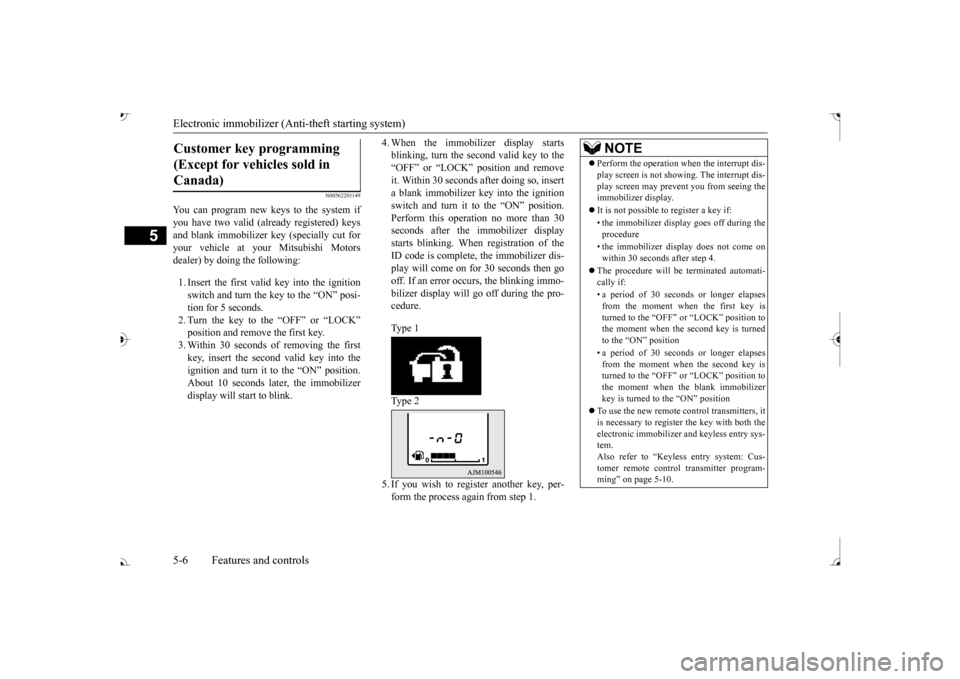
switch and turn it to the “ON” position. Perform this operation no more than 30 seconds after the immobilizer displaystarts blinking. When registration of the ID code is complete, the immobilizer dis- play will come on for 30 seconds then go off. If an error occurs, the blinking immo- bilizer display will
go off during the pro-
cedure. Type 1 Type 2 5. If you wish to register another key, per- form the process again from step 1.
Customer key programming (Except for vehicles sold in Canada)
NOTE
Perform the operation when the interrupt dis- play screen is not show
ing. The interrupt dis-
play screen may prevent you from seeing theimmobilizer display. It is not possible to
register a key if:
• the immobilizer disp
lay goes off during the
procedure • the immobilizer disp
lay does not come on
within 30 seconds after step 4.
The procedure will be terminated automati- cally if: • a period of 30 seconds or longer elapses from the moment when the first key isturned to the “OFF” or “LOCK” position to the moment when the second key is turned to the “ON” position • a period of 30 seconds or longer elapses from the moment when the second key isturned to the “OFF” or “LOCK” position to the moment when the blank immobilizer key is turned to the “ON” position
To use the new remote control transmitters, it is necessary to register
the key with both the
electronic immobilizer
and keyless entry sys-
tem. Also refer to “Keyless entry system: Cus-tomer remote control transmitter program- ming” on page 5-10.
BK0239700US.book 6 ページ 2016年6月16日 木曜日 午前10時58分
Page 88 of 521
Keyless entry system (if so equipped)
Features and controls 5-7
5
N00562301094
Your electronic immo
bilizer operates on a
radio frequency subject to Federal Communi- cations Commission (FCC)
Rules (For vehi-
cles sold in U.S.A.
) and Industry Canada
Rules (For vehicles so
ld in Canada). This
device complies with part 15 of FCC Rulesand Industry Canada
licence-exempt RSS
standard(s). Operation is subject to the following two con- ditions. This device may not
cause harmful inter-
ference. This device must ac
cept any interference
received, including interference that may cause undesired operation.
N00509002028
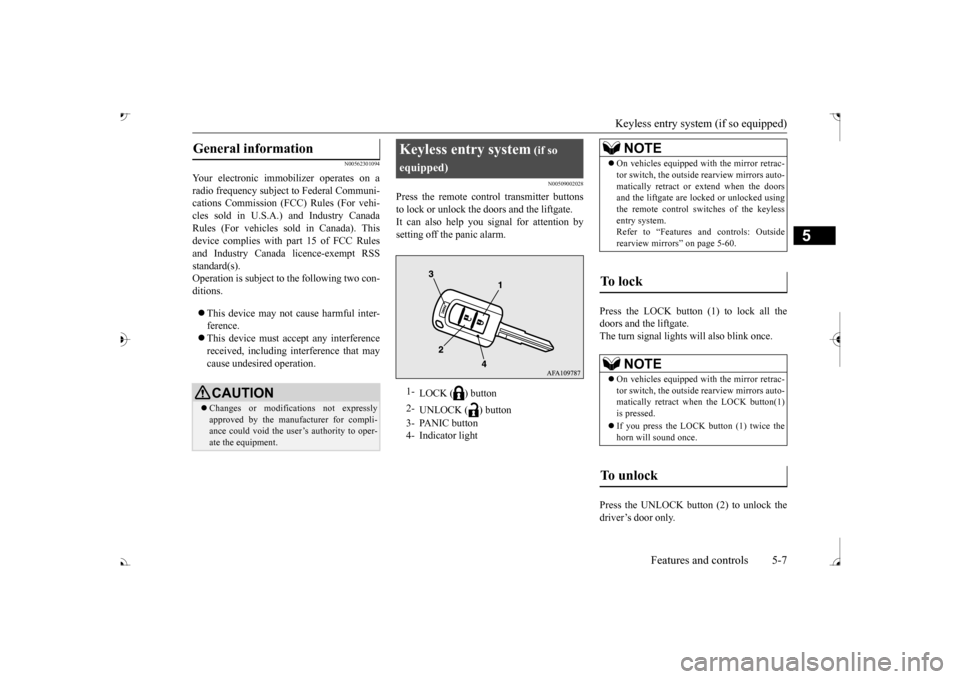
Press the remote control transmitter buttons to lock or unlock the doors and the liftgate. It can also help you signal for attention bysetting off the panic alarm.
Press the LOCK button (1) to lock all the doors and the liftgate.The turn signal lights
will also blink once.
Press the UNLOCK button (2) to unlock the driver’s door only.
General information
CAUTION Changes or modifica
tions not expressly
approved by the manufacturer for compli- ance could void the user’s authority to oper-ate the equipment.
Keyless entry system
(if so
equipped)
LOCK ( ) button
2-
UNLOCK ( ) button
3- PANIC button 4- Indicator light
NOTE
On vehicles equipped wi
th the mirror retrac-
tor switch, the outside rearview mirrors auto-matically retract or extend when the doorsand the liftgate are locked or unlocked using the remote control swit
ches of the keyless
entry system.Refer to “Features and controls: Outside rearview mirrors” on page 5-60.
To l o c k
NOTE
On vehicles equipped wi
th the mirror retrac-
tor switch, the outside rearview mirrors auto- matically retract when
the LOCK button(1)
is pressed. If you press the LOCK button (1) twice the horn will sound once.
To unlock
BK0239700US.book 7 ページ 2016年6月16日 木曜日 午前10時58分
Page 89 of 521
Keyless entry system (if so equipped) 5-8 Features and controls
5
Within about 2 seconds, press the UNLOCK button one more time to unlock all the doorsand liftgate. The dome light will turn on for 30 seconds. The turn signal lights will also blink twice.The front side-marker and parking lights will also turn on for about 30 seconds. Refer to “Welcome light” on page 5-228.
Within 30 seconds of locking the doors and liftgate using the LOCK button, press the LOCK button twice rapidly to retract the out- side rearview mirrors. Within 30 seconds of unlocking the doors and liftgate using the UNLOCK button, press the UNLOCK button twice rapidly to return theoutside rearview mirrors to their extended positions. The outside rearview mirrors are not initially set to work as described above. If you wantthem to work as described above, you need to set them so that they do not retract/extend when the doors and liftgate arelocked/unlocked using
the keyless entry sys-
tem. For details, please consult an authorized Mit-subishi Motors dealer.
In a vehicle equipped
with the Mitsubishi
Multi-Communication Syst
em, it is possible
to change the setting by means of screen operations. Refer to the separate owner’s manual fordetails. The horn and turn signal lights of the keyless entry system answerback function can be changed as required. This is done with thekey removed from the ignition switch. The answerback function can be set in the following three ways. Each time the answerback function is set, a chime will sound to
tell you the condition of
the answerback function.
NOTE
On vehicles equipped wi
th the mirror retrac-
tor switch, the outside rearview mirrors auto- matically extend when the UNLOCK button(2) is pressed. On vehicles equippe
d with a Mitsubishi
Multi-Communication System, the functionscan be adjusted on the screen. For details, refer to the separate operation manual. The door and liftgate
unlock function can be
set so that all doors a
nd liftgate unlock when
the UNLOCK button (2) is pressed once.Refer to “Setting of door
and liftgate unlock
function” on page 5-9.
Operation of the outside rear- view mirrors (Vehicles equipped with the mirror retractor switch)
To r e t r a c t
To e x t e n d
Answerback function
NOTE
The answerback functi
on will not operate if
any of the doors are open.
Horn deactivation/reactivation
One chime: The horn will not sound. Two chimes: The horn will sound.
BK0239700US.book 8 ページ 2016年6月16日 木曜日 午前10時58分