towing MITSUBISHI OUTLANDER 2017 3.G Owner's Manual
[x] Cancel search | Manufacturer: MITSUBISHI, Model Year: 2017, Model line: OUTLANDER, Model: MITSUBISHI OUTLANDER 2017 3.GPages: 521, PDF Size: 14.91 MB
Page 379 of 521
Trailer towing 6-14 Driving safety
6
Trailer lights and equipment must comply with federal, state,
and local regulations.
Check with your loca
l recreational vehicle
dealer for the requirements in your area, and use only equipment designed for your vehi- cle. Since lighting and wiring
vary by trailer type
and brand, you should have a qualified tech- nician install a suitable connector between thevehicle and the trailer.
Improper equipment or
installation can cause da
mage to your vehi-
cle’s electrical system
and affect your vehicle
warranty. Many states and Canadi
an provinces require
special outside mirrors when towing a trailer. Even if not required,
you should install spe-
cial mirrors if you ca
nnot clearly see behind
you, or if the trailer
creates a blind spot.
Ask your trailer sales or
rental agency if any
other items are recomm
ended or required for
your towing situation.
Towing a trailer requires a certain amount of experience. Before setting out for the open road, you’ll want to get to know your trailer. Acquaint
yourself with the feel of handling and braking with the added weight of the trailer. Alwayskeep in mind that the vehicle you are driving is now a good deal longer and not nearly as responsive as your vehicl
e is without a trailer.
Before you start, check the trailer hitch, safety chains, tires
and mirror adjustment.
Be sure your vehicle’s ti
res are inflated to the
cold inflation pressure listed in the manual. You’ll find these numbe
rs on the tire and
loading information placard at the sill of thedriver’s door. Refer to “Tire inflati
on pressures” on page
9-18. Stay at least twice as far behind the vehicle ahead as you would when driving your vehi- cle without a trailer.
This can help you avoid
situations that require
heavy braking and sud-
den turns.
Trailer lights Additional trailer equipment
Operating hints
WA R N I N G If you have a rear window open and you tow a trailer with
your vehicle, carbon
monoxide gas which
you cannot see or
smell could come into your vehicle. It can cause unconsciousness or death. Refer to“Exhaust system” on page 9-24. To maximize your safe
ty when towing a
trailer: Have your exhaust system inspected for leaks, and make necessary repairs beforestarting on your trip. Keep the rear windows closed.If exhaust does come into your vehicle through a window or
another opening,
drive with your front, main heating or cooling system on an
d with the blower on
any speed. This will
bring fresh, outside
air into your vehicle. Do not use recircula- tion because it only recirculates the air inside your vehicle. Refer to “Air selectionswitch” on page 7-9.
Driver preparation
Vehicle preparation Tire Following distance
BK0239700US.book 14 ページ 2016年6月16日 木曜日 午前10時58分
Page 380 of 521
Trailer towing
Driving safety 6-15
6
You’ll need more passing distance up ahead when you’re towing a trailer. And, because you’re a good deal longer, you’ll need to gomuch farther beyond the passed vehicle before you can return to your lane. Hold the bottom of the steering wheel with one hand. Then, to move the trailer to the left,just move that hand to the left. To move the trailer to the right, move your hand to the right. Always back up sl
owly and, if possible,
have someone guide you. When you’re turning with a trailer, make wider than normal turns to help prevent the trailer from striking shoulders, curbs, roadsigns, trees or other objects.
Avoid jerky or sudden maneuvers. Signal well in advance. Towing a trailer puts additional burden on the engine and transaxle,
which may cause over-
heating. Following ar
e some suggestions to
reduce overheating: When towing at high al
titudes, engine coolant
and automatic transaxle oil will overheat at a lower temperature than at normal altitudes. If you turn your engine off immediately aftertowing at high altitude
on steep uphill grades,
your vehicle may show
signs similar to over-
heating. To avoid this
, let the engine run
while parked (preferably on level ground) with the automatic transaxle in the “P”turning the engine off.
If the engine coolant temperature indica- tor flashes on the information screen in the multi-information display or the engine power drops suddenly, refer to “Engine overheati
ng” on page 8-4.
If the warning display or warning display illuminates, re
fer to “Warning dis-
play” on page 5-70, 5-78.
Reduce speed and downshift before you start down a long or steep downgrade. If you don’t downshift, over using the brakes can cause reduced brake efficiency. You can tow in “D” (DRIVE) position. You may want to shift the selector lever to the 3rd or a lower position, under heavy loads or hilly conditions. Always place chocks or blocks under both the vehicle and trailer wheels when parking. Besure that the parking brake is firmly set and that the selector lever is in the “P” (PARK) position. Avoid parki
ng on a hill with a
trailer, but if it cannot be avoided, do so only after performing the following:
Passing Backing up Making turns
CAUTION Making sharp turns while towing a trailer could cause the
trailer to come in contact
with the vehicle. Your
vehicle could be dam-
aged. Avoid making sharp turns while tow- ing a trailer.
Overheating Cause of overheating
Solution
Air conditioning on Turn off Highway speeds Reduce speed Going up hills Select lower gear posi-
tion
Stop-and-go city traf- fic
With the vehicle stopped, shift to the “N” (NEUTRAL) position and idle the engine at high idle.
Driving on hills Parking
BK0239700US.book 15 ページ 2016年6月16日 木曜日 午前10時58分
Page 381 of 521

Trailer towing 6-16 Driving safety
6
1. Apply the brakes a
nd keep them applied.
2. Have someone plac
e chocks or blocks
under both the vehicle and trailer wheels. 3. When the chocks or blocks are in place, release your brakes slowly until thechocks or blocks absorb the load. 4. Apply the parking brake firmly. 5. Set the selector lever to the
Page 436 of 521
8
For emergenciesIf the vehicle breaks down ...............................................................8-2 Jump-starting the engine ..................................................................8-2 Engine overheating ..........................................................................8-4Jack and tools ...................................................................................8-5 How to change a tire ........................................................................8-6 Towing ...........................................................................................8-14Operation under adverse driving conditions
...........
.........
.........
.....8-15
Fuel Pump Shut-off System ...........................................................8-16
BK0239700US.book 1 ページ 2016年6月16日 木曜日 午前10時58分
Page 437 of 521
If the vehicle breaks down 8-2 For emergencies
8
N00836301230
If your vehicle breaks down on the road, move to the shoulder and turn on the hazard warning flashers. If there is no shoulder, orthe shoulder is not safe, drive in the right lane slowly with the hazard
lights flashing, until
you come to a safe stopping place. Keep theflashers flashing. If the engine stops, there will be no power assist to the steering and brakes, making these difficult to use. The brake booster will not work, so the brakes will not grip well. The brake pedal will be harder to press than usual. Since there is no power steering assist, the steering wheel will be hard to turn.
Get help from your passengers, bystanders, etc. to push the vehicle
and move it to a safe
area.
N00836401778
If the engine cannot be started because the battery is weak or de
ad, you can start it with
the battery from anothe
r vehicle using jumper
cables. 1. Take off any metal jewelry such as watch bands or bracelets th
at might create an
accidental electrical contact. 2. Position the vehi
cles close enough
together so that the jumper cables canreach, but be sure the vehicles aren’t touching each other.
3. Set the parking brake firmly on your vehi- cle and move the selector lever into the “P” (PARK) position. 4. Set the parking brake firmly on the othervehicle. Put the automatic transaxle in “P”5. Turn the ignition switch (the engine switch) on each vehicle to the “LOCK” or “OFF” position. 6. Make sure your battery electrolyte is at the proper level. (Refer to “Battery” on page 9-13.)
If the vehicle breaks down If the engine stops/fails When the engine fails at the intersection
Jump-starting the engine
WA R N I N G To reduce the risk of igniting flammable gas that may be emitted from the battery,carefully read this section before jump- starting the vehicle. Do not try to start you
r vehicle by pushing
or towing. This can cause an accident resulting in serious
injury or death and
can damage the vehicle.NOTE
Do not use jumper cables if they have dam- age or corrosion.
CAUTION Check the other vehicle.
It must have a 12-
volt battery. If the other system isn’t 12-volt,both systems can be damaged.NOTE
Turn off all lights, heat
er, and othe
r electrical
loads. This will avoid sparks and help saveboth batteries.
BK0239700US.book 2 ページ 2016年6月16日 木曜日 午前10時58分
Page 449 of 521
Towing 8-14 For emergencies
8
N00837001898
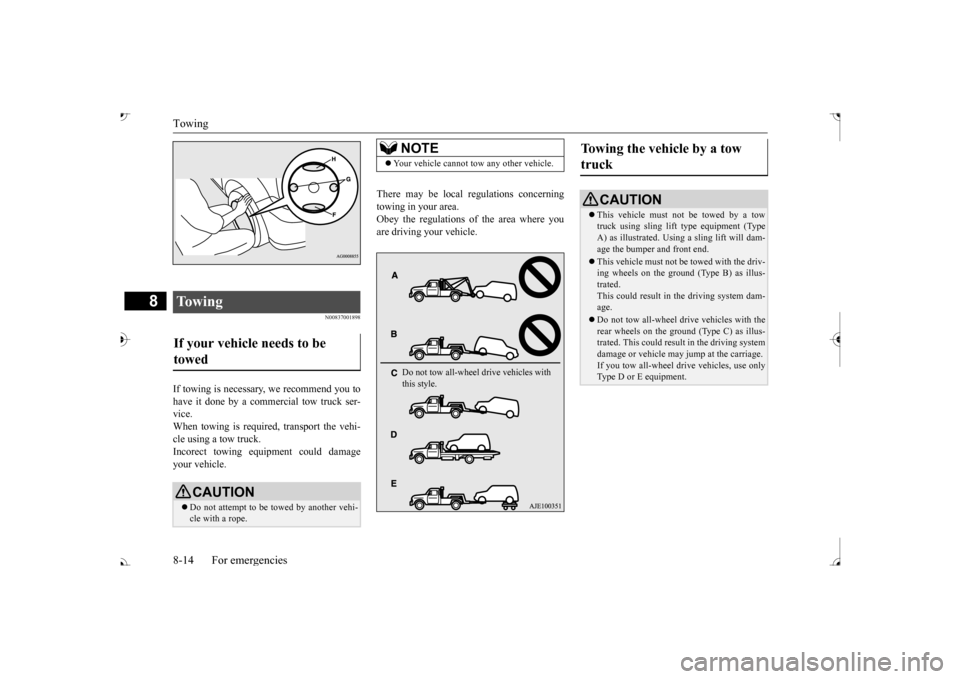
If towing is necessary,
we recommend you to
have it done by a commercial tow truck ser- vice.When towing is required, transport the vehi- cle using a tow truck. Incorect towing equipment could damageyour vehicle.
There may be local re
gulations concerning
towing in your area. Obey the regulations of the area where youare driving your vehicle.
To w i n g If your vehicle needs to be towed
CAUTION Do not attempt to be
towed by another vehi-
cle with a rope.
NOTE
Your vehicle cannot to
w any other vehicle.
Do not tow all-wheel drive vehicles with this style.
Towing the vehicle by a tow truck
CAUTION This vehicle must not be towed by a tow truck using sling lift
type equipment (Type
A) as illustrated. Usi
ng a sling lift will dam-
age the bumper and front end. This vehicle must not be towed with the driv- ing wheels on the ground (Type B) as illus- trated. This could result in the driving system dam-age. Do not tow all-wheel drive vehicles with the rear wheels on the ground (Type C) as illus- trated. This could result in the driving system damage or vehicle may
jump at the carriage.
If you tow all-wheel driv
e vehicles, use only
Type D or E equipment.
BK0239700US.book 14 ページ 2016年6月16日 木曜日 午前10時58分
Page 456 of 521
Engine hood
Vehicle care and maintenance 9-3
9
Normally, the catalyti
c converter does not
require maintenance. However, it is importantto keep the engine properly tuned for the con- verter to continue to work properly. To reduce the possibili
ty of catalytic con-
verter damage: Use UNLEADED GASOLINE ONLY of the type of recommended in the “Fuel selection”. Do not drive with an extremely low fuel level. Running out of gas could damage the catalytic converter.
Do not try to start the engine by pushing or towing the vehicle. If the battery isweak or run down, use jumper cables to properly start the engine. Do not idle the engine with any spark plug wires disconnected or removed, such as when performing
diagnosti
c tests.
Do not idle the engine
for a long time if it
is idling roughly or otherwise obviously malfunctioning. To prevent the catalytic converter from being damaged from unburned gas, do not race the engine when turning off the igni-tion switch. Stop driving the vehicle if you think the performance is noticeably low, or theengine has a malfunction such as with the ignition, etc. If you are not able to stop driving immediately,
slow down and drive
for only a short time. Have your vehicle checked at an authorized Mitsubishi Motors dealer or a repair facility of yourchoice as soon
as possible.
In unusual situations involving major engine problems, a burning odor mayindicate severe and abnormal catalytic converter overheating.
If this occurs, stop
in a safe place, shut the engine off and letthe vehicle cool. Once
the engine is cool,
immediately take
your vehicle to an
authorized Mitsubishi
Motors dealer or a
repair facility of your choice for service.
N00937501588
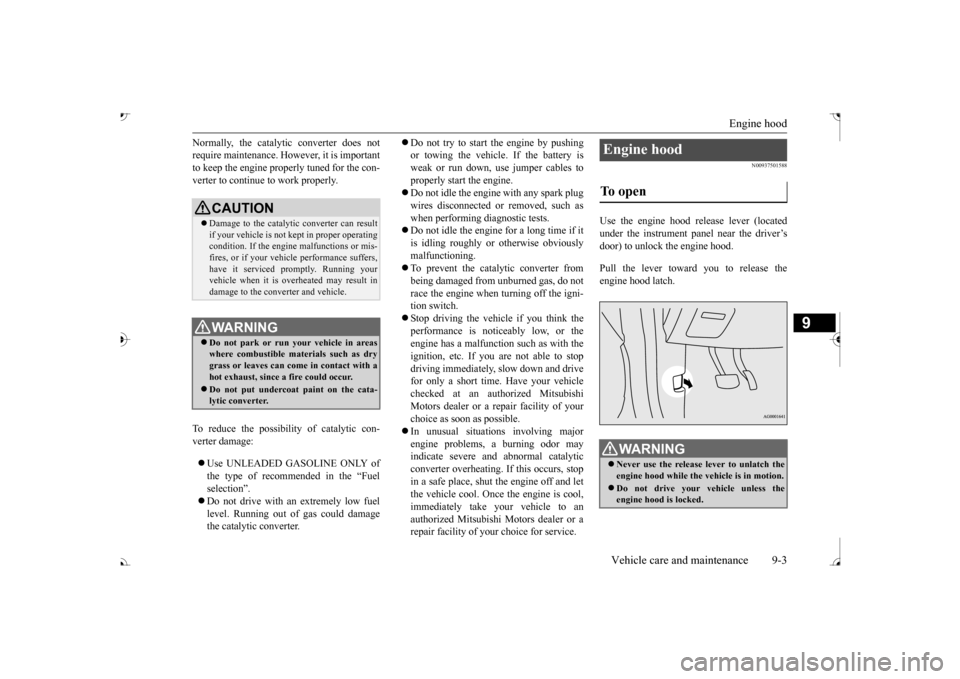
Use the engine hood release lever (located under the instrument panel near the driver’s door) to unlock the engine hood. Pull the lever toward you to release the engine hood latch.
CAUTION Damage to the catalyti
c converter can result
if your vehicle is not
kept in proper operating
condition. If the engine
malfunctions or mis-
fires, or if your vehi
cle performance suffers,
have it serviced promptly. Running your vehicle when it is
overheated may result in
damage to the converter and vehicle.WA R N I N G Do not park or run your vehicle in areas where combustible materials such as dry grass or leaves can come
in contact with a
hot exhaust, since a fire could occur. Do not put undercoat paint on the cata- lytic converter.
Engine hood To open
WA R N I N G Never use the release lever to unlatch the engine hood while the
vehicle is in motion.
Do not drive your vehicle unless the engine hood is locked.
BK0239700US.book 3 ページ 2016年6月16日 木曜日 午前10時58分
Page 518 of 521
Alphabetical index
12-5
12
Side turn-signal light
Bulb capacity
.................................
9-32
Snow tires
..........................................
9-21
Spark plugs
........................................
9-23
Starting the engine
.....................
5-25
, 5-66
Steering
Steering wheel height
and reach adjustment
5-57Wheel lock
............................
5-24
, 5-65
Stop lights
Bulb capacity
.................................
9-32
Storage spaces
..................................
5-276
Sun visors
........................................
5-266
Sunglasses holder
.............................
5-279
Sunroof
..............................................
5-51
Super-all wheel control (S-AWC)
S-AWC drive mode display
.............
5-87
S-AWC drive mode-selector
............
5-86
S-AWC operation display
................
5-87
Supplemental Re
straint System
............
4-34
How the Supplemental Restraint System works
..........................................
4-37
Maintenance service
........................
4-49
T
Tail light
Bulb capacity
.................................
9-32
Tank capacity
.....................................
11-7
Theft-alarm system
.............................
5-46
Time Setting
......................................
7-46
Timing belt
........................................
9-24
Tire
...................................................
9-15
Inflation pressure
............................
9-18
Maintenance
..................................
9-19
Quality grading
..............................
10-2
Replacing tires and wheels
..............
9-19
Rotation
........................................
9-20
Size (tire and wheel)
.......................
11-7
Snow tires
.....................................
9-21
Tire and loading information placard 11-3 Tire chains
.....................................
9-21
To change a tire
................................
8-6
Tread wear indicator
.......................
9-20
Tire pressure monitoring system
.........
5-142
Tools
...................................................
8-6
Storage
............................................
8-5
Towing
..............................................
8-14
Trailer towing
....................................
6-11
Transfer oil
................................
9-12
, 11-7
Turn signal light
Indicators
.....................................
5-215
Lever
...........................................
5-230
U
Ultrasonic misacceleration Mitigation System 5-127 USB input terminal
............................
5-263
How to connect a USB memory device
....
5-263How to connect an iPod
.................
5-264
V
Vanity mirror
....................................
5-266
Vanity mirror lights
Bulb capacity
.................................
9-33
Vehicle care precautions
......................
9-39
Vehicle dimensions
.............................
11-4
Vehicle labeling
..................................
11-2
Vehicle preparation before driving
..........
6-4
Vehicle weights
..................................
11-5
Vents
...................................................
7-2
W
Warning lights
..................................
5-216
Washer
Fluid
.....................................
9-12
, 11-7
Rear window washer
.....................
5-236
Switch
.........................................
5-235
Washing
.............................................
9-41
Waxing
..............................................
9-42
Weights
.............................................
11-5
Wheel
Covers
...........................................
8-13
Specification
..................................
11-7
BK0239700US.book 5 ページ 2016年6月16日 木曜日 午前10時58分