engine oil MITSUBISHI OUTLANDER III 2015 User Guide
[x] Cancel search | Manufacturer: MITSUBISHI, Model Year: 2015, Model line: OUTLANDER III, Model: MITSUBISHI OUTLANDER III 2015Pages: 446, PDF Size: 59.52 MB
Page 386 of 446

View of the engine compartment
Vehicle care and maintenance 9-5
9
N00937601710
View of the engine compartment
2.4 L models 3.0 L models
1- Engine oil level gauge 2- Engine oil cap 3- Air cleaner filter4- Brake fluid reservoir 5- Washer fluid reservoir 6- Automatic transaxle fluid level dipstick7- Engine coolant reservoir 8- Battery
BK0211800US.book 5 ページ 2014年3月12日 水曜日 午後2時42分
Page 387 of 446
Engine oil and oil filter 9-6 Vehicle care and maintenance
9
N00937702024
It is normal for an engi
ne to use oil. You may
need to add oil between the recommended oil change intervals. Befo
re starting the engine,
check the engine oil leve
l. Refill if necessary.
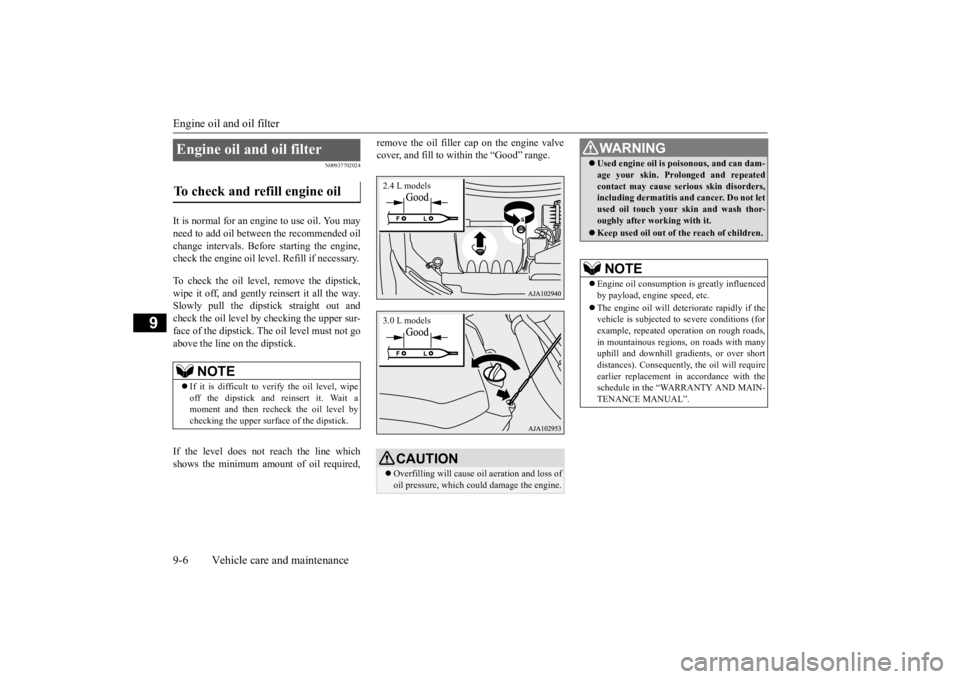
To check the oil level,
remove the dipstick,
wipe it off, and gently reinsert it all the way.Slowly pull the dipsti
ck straight out and
check the oil level by checking the upper sur- face of the dipstick. The oil level must not goabove the line on the dipstick. If the level does not reach the line which shows the minimum am
ount of oil required,
remove the oil filler cap on the engine valve cover, and fill to within the “Good” range.
Engine oil and oil filter To check and refill engine oil
NOTE
If it is difficult to verify the oil level, wipe off the dipstick and
reinsert it. Wait a
moment and then recheck the oil level by checking the upper surface of the dipstick.
CAUTION Overfilling will cause
oil aeration and loss of
oil pressure, which coul
d damage the engine.
2.4 L models3.0 L models
WA R N I N GUsed engine oil is po
isonous, and can dam-
age your skin. Prolonged and repeatedcontact may cause serious skin disorders,including dermatitis and cancer. Do not let used oil touch your sk
in and wash thor-
oughly after working with it. Keep used oil out of
the reach of children.
NOTE
Engine oil consumption
is greatly influenced
by payload, engine speed, etc. The engine oil wi
ll deteriorate rapidly if the
vehicle is subjected to
severe conditions (for
example, repeated operation on rough roads, in mountainous regions, on roads with many uphill and downhill grad
ients, or over short
distances). Consequently
, the oil will require
earlier replacement in accordance with the schedule in the “WARRANTY AND MAIN-TENANCE MANUAL”.
BK0211800US.book 6 ページ 2014年3月12日 水曜日 午後2時42分
Page 388 of 446
Engine oil and oil filter
Vehicle care and maintenance 9-7
9
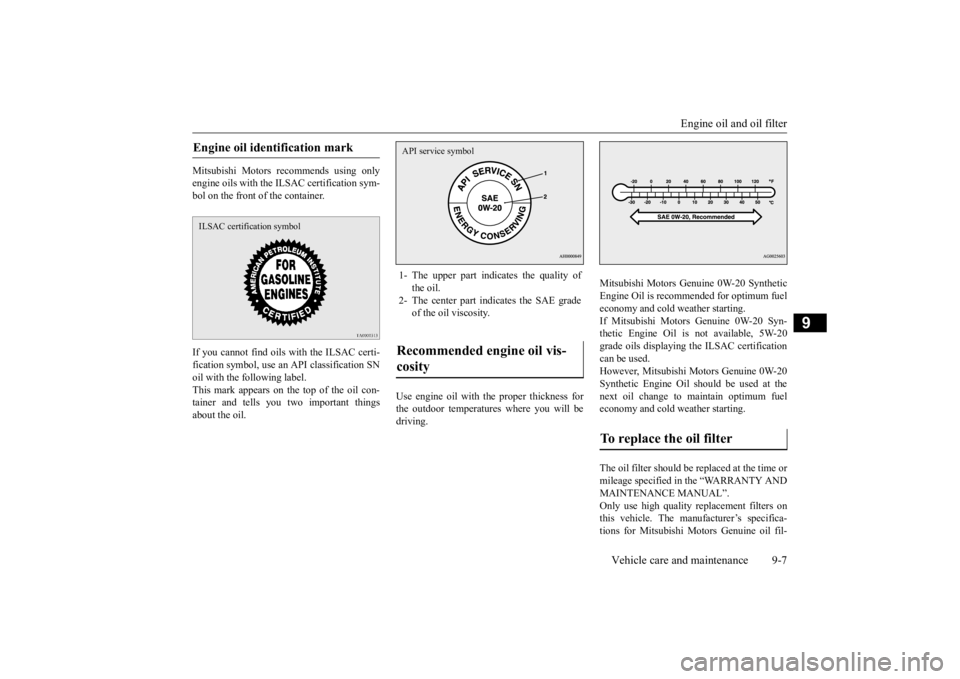
Mitsubishi Motors re
commends using only
engine oils with the ILSAC certification sym- bol on the front of the container. If you cannot find oils
with the ILSAC certi-
fication symbol, use an
API classification SN
oil with the following label. This mark appears on the top of the oil con-tainer and tells you two important things about the oil.
Use engine oil with the proper thickness for the outdoor temperatures where you will bedriving.
Mitsubishi Motors Genui
ne 0W-20 Synthetic
Engine Oil is recommended for optimum fueleconomy and cold weather starting. If Mitsubishi Motors Genuine 0W-20 Syn- thetic Engine Oil is not available, 5W-20grade oils displaying the ILSAC certification can be used. However, Mitsubishi
Motors Genuine 0W-20
Synthetic Engine Oil s
hould be used at the
next oil change to maintain optimum fuel economy and cold weather starting. The oil filter should be replaced at the time or mileage specified in the “WARRANTY ANDMAINTENANCE MANUAL”. Only use high quality replacement filters on this vehicle. The manufacturer’s specifica-tions for Mitsubishi Mo
tors Genuine oil fil-
Engine oil identification mark ILSAC certification symbol
1- The upper part indi
cates the quality of
the oil.
2- The center part i
ndicates the SAE grade
of the oil viscosity.
Recommended engine oil vis- cosity API service symbol
To replace the oil filter
BK0211800US.book 7 ページ 2014年3月12日 水曜日 午後2時42分
Page 389 of 446
Engine coolant 9-8 Vehicle care and maintenance
9
ters require that the filter can withstand a pressure of 256 psi (1.8 MPa). A MitsubishiMotors Genuine oil filter
is the best replace-
ment filter. Follow the installation instructions printed onthe filter.
N00937801594
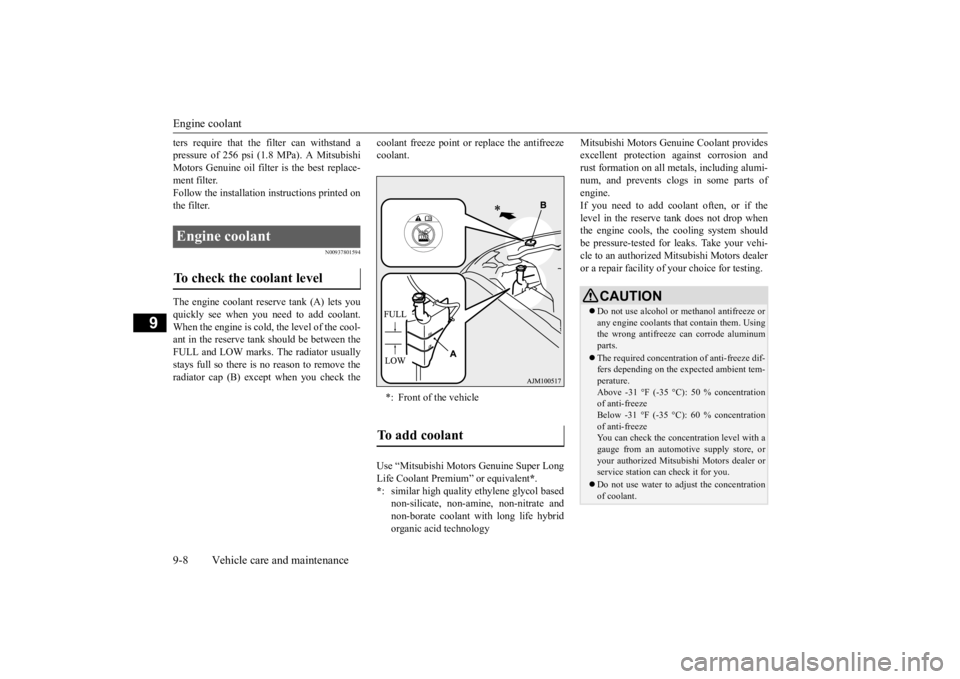
The engine coolant reserve tank (A) lets youquickly see when you need to add coolant. When the engine is cold, the level of the cool- ant in the reserve tank should be between theFULL and LOW marks. The radiator usually stays full so there is no reason to remove the radiator cap (B) except when you check the
coolant freeze point or
replace the antifreeze
coolant.
Mitsubishi Motors Genui
ne Coolant provides
excellent protection against corrosion andrust formation on all metals, including alumi- num, and prevents clogs in some parts of engine.If you need to add coolant often, or if the level in the reserve tank does not drop when the engine cools, the cooling system shouldbe pressure-tested for le
aks. Take your vehi-
cle to an authorized Mitsubishi Motors dealer or a repair facility of
your choice for testing.
Engine coolant To check the coolant level
*: Front of the vehicleTo add coolant Use “Mitsubishi Motors Genuine Super Long Life Coolant Premium” or equivalent
*.
* : similar high quality et
hylene glycol based
non-silicate, non-amine, non-nitrate andnon-borate coolant with long life hybrid organic acid technology
CAUTION Do not use alcohol or methanol antifreeze or any engine coolants th
at contain them. Using
the wrong antifreeze can corrode aluminum parts. The required concentrati
on of anti-freeze dif-
fers depending on the
expected ambient tem-
perature. Above -31 °F (-35 °C): 50 % concentration of anti-freezeBelow -31 °F (-35 °C): 60 % concentration of anti-freeze You can check the concentration level with agauge from an automotive supply store, or your authorized Mitsubi
shi Motors dealer or
service station can check it for you. Do not use water to adjust the concentration of coolant.
BK0211800US.book 8 ページ 2014年3月12日 水曜日 午後2時42分
Page 390 of 446
Air cleaner filter
Vehicle care and maintenance 9-9
9
The radiator cap must be sealed tight to pre- vent losing coolant, which may result in engine damage. Only use a Mitsubishi Motors Genuine Parts radiator cap, or anapproved equivalent. Do not overfill the reserve tank.
Your vehicle uses a
special radiator cap
that stays sealed and lets the coolant flowfrom the reserve tank back to the radiator when the engine cools down. If you need to change the cap, use the exact samekind. Check the coolant freeze point in the radi- ator with the proper gauge, and only whenit is safe. If you add antifreeze, the con- tents of the reserve ta
nk must be protected
against freezing. Keep the front of the radiator and con- denser clean. If the engine coolan
t temperature does not
rise after the engine
is warmed-up, take
your vehicle to an au
thorized Mitsubishi
Motors dealer or a repair facility of your choice to have the thermostat checked, and replaced if necessary.
N00937901410
The air cleaner filter
will get dirty and dusty
from use and not filter
properly. Replace it
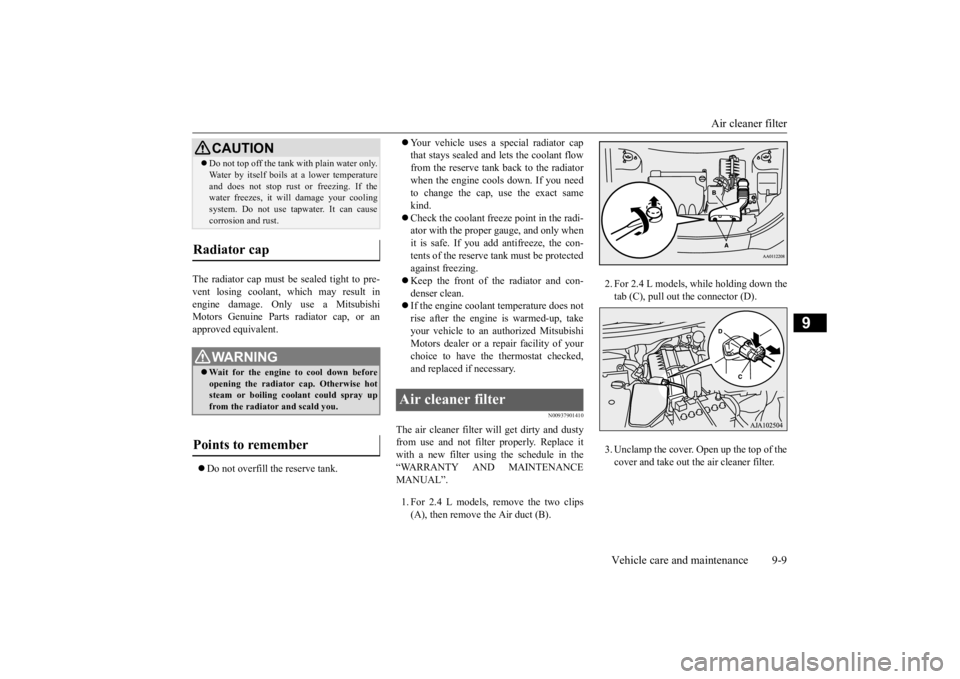
with a new filter using the schedule in the “WARRANTY AND MAINTENANCE MANUAL”. 1. For 2.4 L models, remove the two clips (A), then remove the Air duct (B).
2. For 2.4 L models,
while holding down the
tab (C), pull out the connector (D). 3. Unclamp the cover. Open up the top of the cover and take out th
e air cleaner filter.
Do not top off the tank with plain water only. Water by itself boils at
a lower temperature
and does not stop rust or freezing. If thewater freezes, it will
damage your cooling
system. Do not use ta
pwater. It can cause
corrosion and rust.
Radiator cap
WA R N I N G Wait for the engine to cool down before opening the radiator
cap. Otherwise hot
steam or boiling c
oolant could spray up
from the radiator and scald you.
Points to remember
CAUTION
Air cleaner filter
BK0211800US.book 9 ページ 2014年3月12日 水曜日 午後2時42分
Page 392 of 446
Continuously variable transmission (CVT) fluid (if so equipped)
Vehicle care and maintenance 9-11
9
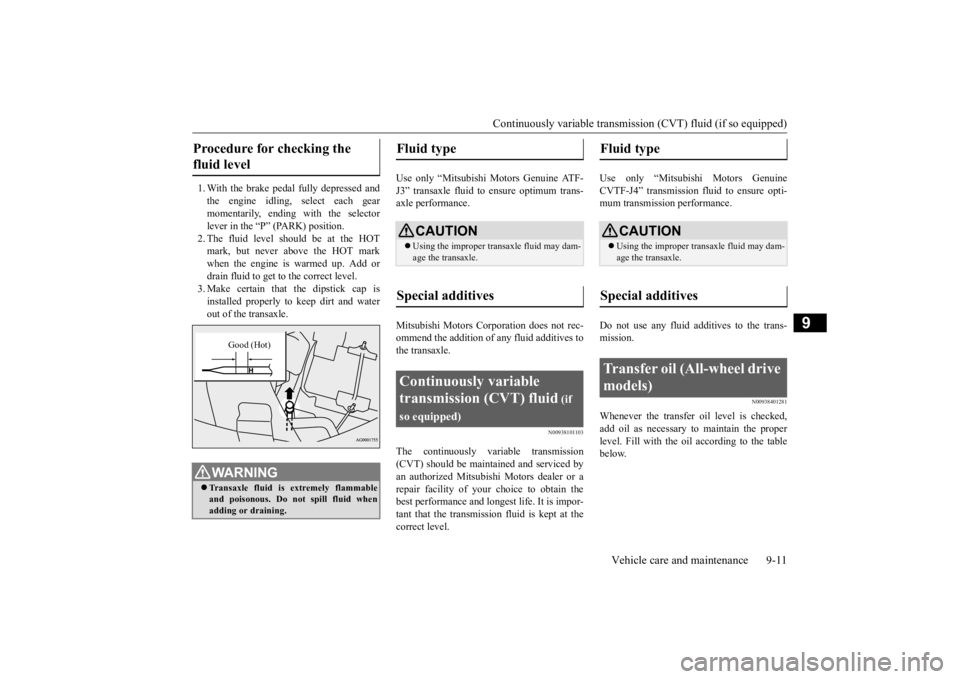
1. With the brake pedal fully depressed and the engine idling,
select each gear
momentarily, ending with the selectorlever in the “P” (PARK) position. 2. The fluid level should be at the HOT mark, but never a
bove the HOT mark
when the engine is warmed up. Add or drain fluid to get to the correct level. 3. Make certain that the dipstick cap is installed properly to
keep dirt and water
out of the transaxle.
Use only “Mitsubishi Motors Genuine ATF- J3” transaxle fluid to
ensure optimum trans-
axle performance. Mitsubishi Motors Cor
poration does not rec-
ommend the addition of
any fluid additives to
the transaxle.
N00938101103
The continuously variable transmission (CVT) should be maintained and serviced byan authorized Mitsubishi Motors dealer or a repair facility of your choice to obtain the best performance and longest life. It is impor-tant that the transmission fluid is kept at the correct level.
Use only “Mitsubish
i Motors Genuine
CVTF-J4” transmission fluid to ensure opti- mum transmission performance. Do not use any fluid additives to the trans- mission.
N00938401281
Whenever the transfer oil level is checked,add oil as necessary to
maintain the proper
level. Fill with the oil according to the table below.
Procedure for checking the fluid level
WA R N I N G Transaxle fluid is extremely flammable and poisonous. Do not spill fluid when adding or draining.
Good (Hot)
Fluid type
CAUTION Using the improper transaxle fluid may dam- age the transaxle.
Special additives
Continuously variable transmission (CVT) fluid
(if
so equipped)
Fluid type
CAUTION Using the improper transaxle fluid may dam- age the transaxle.
Special additives
Transfer oil (All-wheel drive models)
BK0211800US.book 11 ページ 2014年3月12日 水曜日 午後2時42分
Page 393 of 446

Rear axle oil (All-wheel drive models) 9-12 Vehicle care and maintenance
9
N00915201279
Whenever the oil level is checked, add oil as necessary to maintain the proper level. Fill with the oil according to the table below.
N00938601313
The windshield and rear
window washer fluid
reservoir is in the engine compartment.
Check the washer fluid
level at regular inter-
vals and add washer fluid to reservoir if nec-essary. Open the reservoir cap and check the fluid level with the dipstick. When freezing weather is anticipated, flush out the water in the reservoir by operating thepump. Fill the reservoir with windshield anti- freeze (not radiator
antifreeze), and operate
the system for a few se
conds to flush out the
residual water.
N00938701271
Check the fluid level in the reservoir.The fluid level must be between the “MAX” and “MIN” marks on the reservoir.
The fluid level falls slightly with wear of the brake pads, but this
does not indicate any
abnormality. If the fluid level falls se
aled tight in a short
length of time, it indi
cates leaks from the
brake system. If this occurs, have the vehicle checked by an authorized Mitsubishi Motors dealer or arepair facility of your choice. Use the recommended brake fluid conform- ing to DOT 3 or DOT
4. The reservoir cap
must be tightly sealed to keep dirt and water out.
Fluid type Lubricant
Mitsubishi Motors Genuine Super Hypoid Gear Oil API
classification GL-5
Viscosity range
SAE 80
Rear axle oil (All-wheel drive models) Fluid type Lubricant
Mitsubishi Motors Genuine Super Hypoid Gear Oil API
classification GL-5
Viscosity range
SAE 80
Washer fluid
Brake fluid To check the fluid level
EMPTY
FULL
Fluid type
BK0211800US.book 12 ページ 2014年3月12日 水曜日 午後2時42分
Page 405 of 446
For cold and snowy weather 9-24 Vehicle care and maintenance
9
N00942201118
The best way to keep carbon monoxide gas from entering inside your
vehicle is to have
the engine exhaust syst
em properly serviced.
Have a competent mechanic inspect the com- plete exhaust system
and nearby body areas
for broken, damaged, deteriorated, or mispo- sitioned parts if you no
tice any of the follow-
ing: A change in the sound of the exhaust sys- tem The smell of exhaust fumes inside the vehicle The underside or rear of the vehicle is damaged
Also check the exhaust system each time the vehicle is raised for l
ubrication, oil changes,
or required service. A
ny open seams or loose
connections could le
t dangerous exhaust
fumes seep into the
luggage and passenger
compartments.
Check for holes or exhaust gas leaks caused by corrosion or damage. Check the joints and connections for looseness or exhaust gas leaks. Check the rubber hangers and brackets for damage.
N00942300079
The timing belt should be replaced with a new one at the mileage listed in the “WAR- RANTY AND MAINTENANCE MAN-UAL”.
N00942501124
The hood lock release mechanism and hood safety catch should be
checked, cleaned, and
oiled when needed for easy movement and toprevent rust and wear. Use Multipurpose Grease NLGI Grade 2 sp
aringly for all sliding
parts of the hood latc
h and release lever.
Work the grease into the hood lock mecha- nism until all the mo
vable surfaces are cov-
ered.
Also, put a light coat
of the same grease on
the safety catch wherever moving parts touch.
N00942600102
The ventilation slots in
front of the wind-
shield should be brushed clear after a heavy snowfall so that the operation of the heating and ventilation
systems will not be impaired.
To prevent freezing of the weatherstripping on the doors, engine hood, etc., they shouldbe treated with silicone grease. It is a good idea to carry a shovel or a short- handled spade in the vehicle during the win-ter so that you can clear away snow if you get stranded. A small hand-brush for sweeping snow off the vehicle a
nd a plastic scraper for
Exhaust system
WA R N I N GCarbon monoxide gas
from your vehicle’s
exhaust is poisonous. Breathing thesefumes can cause unconsciousness or death.
Check for any of the following conditions: Timing belt Hood lock release mechanism and safety catch
For cold and snowy weather Ventilation slots Weatherstripping Additional equipment (For regions where snow is encoun- tered)
BK0211800US.book 24 ページ 2014年3月12日 水曜日 午後2時42分
Page 408 of 446
Fuses
Vehicle care and maintenance 9-27
9
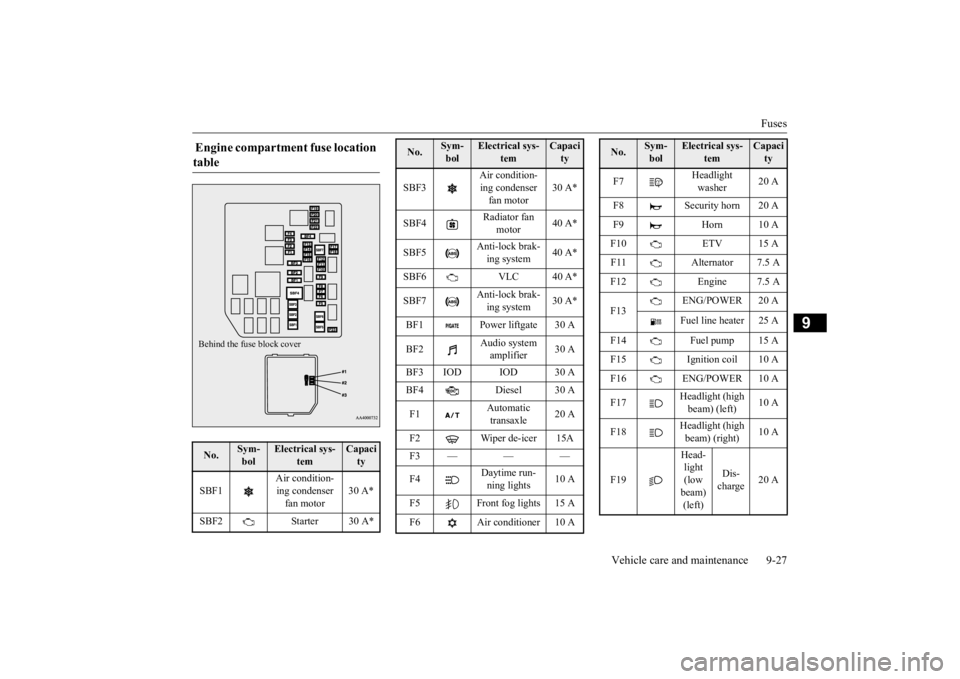
Engine compartment fuse location table No.
Sym- bol
Electrical sys-
tem
Capacity
SBF1
Air condition- ing condenser fan motor
30 A*
SBF2 Starter 30 A*Behind the fuse block cover
SBF3
Air condition- ing condenser fan motor
30 A*
SBF4
Radiator fan
motor
40 A*
SBF5
Anti-lock brak- ing system
40 A*
SBF6 VLC 40 A* SBF7
Anti-lock brak- ing system
30 A*
BF1 Power liftgate 30 A BF2
Audio system amplifier
30 A
BF3 IOD IOD 30 A BF4 Diesel 30 A F1
Automatic transaxle
20 A
F2 Wiper de-icer 15A F3 — — — F4
Daytime run- ning lights
10 A
F5 Front fog lights 15 A F6 Air conditioner 10 ANo.
Sym- bol
Electrical sys-
tem
Capacity
F7
Headlight washer
20 A
F8 Security horn 20 A F9 Horn 10 AF10 ETV 15 A F11 Alternator 7.5 A F12 Engine 7.5 A F13
ENG/POWER 20 A Fuel line heater 25 A
F14 Fuel pump 15 A F15 Ignition coil 10 A F16 ENG/POWER 10 A F17
Headlight (high beam) (left)
10 A
F18
Headlight (high beam) (right)
10 A
F19
Head- light (low beam) (left)
Dis- charge
20 A
No.
Sym- bol
Electrical sys-
tem
Capacity
BK0211800US.book 27 ページ 2014年3月12日 水曜日 午後2時42分
Page 423 of 446
Cleaning the outside of your vehicle 9-42 Vehicle care and maintenance
9
N00946100046
If painted surfaces have
been severely dam-
aged and lost their original luster and color tone, polish the surface
lightly with a fine
polishing compound. Avoid limiting your polishing to the damage
d surface only; polish
a somewhat wider area, moving the polishingcloth in one direction.
After polishing, flush
the compound from the surface and apply a coat of wax to regain a beautiful luster.
N00946201099
Small cracks and scratches in the paint coat should be touched up as
soon as possible with
touch-up paint to prevent corrosion.Check body areas facing the road or the tires carefully for damage to the paint caused by flying stones, etc. The
paint code number for
your vehicle can be found on the vehicle information code plate located on the front passenger door sill.
N00946301221
Use a sponge or chamois to clean these parts.If the vehicle wax sticks to a gray or black rough surface of the bumper, molding or lights, the surface may appear white in color.In this case, wipe it
off using lukewarm water
and a soft cloth or chamois.
N00946400052
To prevent spots and corrosion of chrome parts, wash with water, dry thoroughly, and apply a nonabrasive automotive wax. If the chrome is severely da
maged or pitted, use a
commercially available chrome polish.
N00946500183
1. Remove dirt using a wet sponge.2. Use a mild detergent on any dirt that can- not be removed ea
sily with water.
Rinse off the detergent after washing thewheel. 3. Dry the wheel thoroughly using a chamois leather or a soft cloth.
Do not use gasoline, benzine, kerosene or paint thinners to remove
road tar or other dirt
from the vehicle surface. Do not put wax on the areas having black matte coating because
it can cause uneven
discoloration, patches,
blurs, etc. If these get
wax on them, wipe the wax off right away with a soft clot
h and warm water.
On vehicles with sunr
oof, be careful not to
apply any wax on the weatherstrip (blackrubber) when waxing the area around the sunroof opening. If stained with wax,
the weatherstrip cannot
maintain a weatherproof seal with the sun- roof.
Polishing
CAUTION
Damaged paint Cleaning plastic parts
CAUTION Do not use a scrubbing brush or other rough scrubber as these may
damage the plastic
surface. Do not use wax containing compounds (pol- ishing powder) which
may damage the plas-
tic surface.
Do not let plastic parts
get soiled with gaso-
line, oil, brake fluids
, engine oils, greases,
paint thinner, and sulfuric acid (battery elec-trolyte), as such substa
nces will cause stains,
cracks, or discoloration. If any of these get on a plastic part, wipethem up with a soft cloth or chamois and a mild solution of soap and water. Then rinse them immediately with water.
Chrome parts Aluminum wheels
(if so equipped)
CAUTION
BK0211800US.book 42 ページ 2014年3月12日 水曜日 午後2時42分