belt MITSUBISHI OUTLANDER III 2015 Workshop Manual
[x] Cancel search | Manufacturer: MITSUBISHI, Model Year: 2015, Model line: OUTLANDER III, Model: MITSUBISHI OUTLANDER III 2015Pages: 446, PDF Size: 59.52 MB
Page 368 of 446
Jump-starting the engine For emergencies 8-3
8
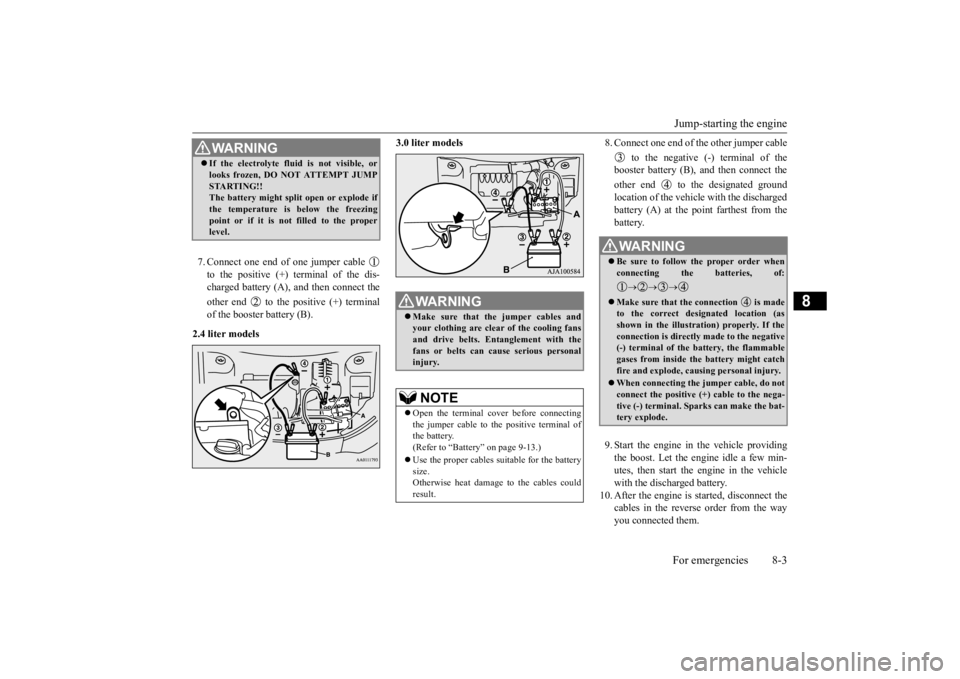
7. Connect one end of one jumper cable to the positive (+) terminal of the dis- charged battery (A),
and then connect the
other end to the positive (+) terminal of the booster battery (B).
2.4 liter models
3.0 liter models
8. Connect one end of the other jumper cable
to the negative (-) terminal of the booster battery (B), a
nd then connect the
other end to the designated ground location of the vehicl
e with the discharged
battery (A) at the point farthest from the battery. 9. Start the engine in the vehicle providing the boost. Let the engine idle a few min- utes, then start the engine in the vehiclewith the discharged battery.
10. After the engine is
started, disconnect the
cables in the reverse order from the wayyou connected them.
WA R N I N G If the electrolyte flui
d is not visible, or
looks frozen, DO NOT ATTEMPT JUMPSTARTING!!The battery might split open or explode if the temperature is below the freezing point or if it is not filled to the properlevel.
WA R N I N G Make sure that the jumper cables and your clothing are clear of the cooling fans and drive belts. Entanglement with thefans or belts can ca
use serious personal
injury.NOTE
Open the terminal cover before connecting the jumper cable to the positive terminal of the battery.(Refer to “Battery” on page 9-13.) Use the proper cables suitable for the battery size. Otherwise heat damage
to the cables could
result.
WA R N I N G Be sure to follow the proper order when connecting the batteries, of:
Make sure that the connection is made to the correct designated location (as shown in the illustration) properly. If theconnection is directly made to the negative (-) terminal of the battery, the flammable gases from inside the battery might catchfire and explode, caus
ing personal injury.
When connecting the jumper cable, do not connect the positive (+) cable to the nega- tive (-) terminal. Sparks can make the bat- tery explode.
BK0211800US.book 3 ページ 2014年3月12日 水曜日 午後2時42分
Page 383 of 446
Service precautions 9-2 Vehicle care and maintenance
9
N00937301384
Taking regular care of your vehicle will pre- serve its value and appe
arance as long as pos-
sible. You can do some of the maintenance work yourself, and the rest should only be per- formed by an authorized Mitsubishi Motors dealer or a repair facility of your choice. If you discover a malfunction or other prob- lem, have it corrected by an authorized Mit-subishi Motors dealer or a repair facility of your choice. This section descri
bes the maintenance
inspections that you can do yourself, if you so desire. Follow the instructions and precau- tions for each procedure.
Have you purchased the Mitsubishi Motors Diamond Care Protection Plan? The Plansupplements your new
vehicle warranties.
See your authorized Mitsubishi Motors dealer for details.
N00937401457
The catalytic converter requires you to useunleaded fuel only. Leaded gasoline willdestroy the emission-control effectiveness of the converter. Normally, the
catalytic converter does not
require maintenance. Ho
wever, it is important
to keep the engine properly tuned for the con- verter to continue to work properly.
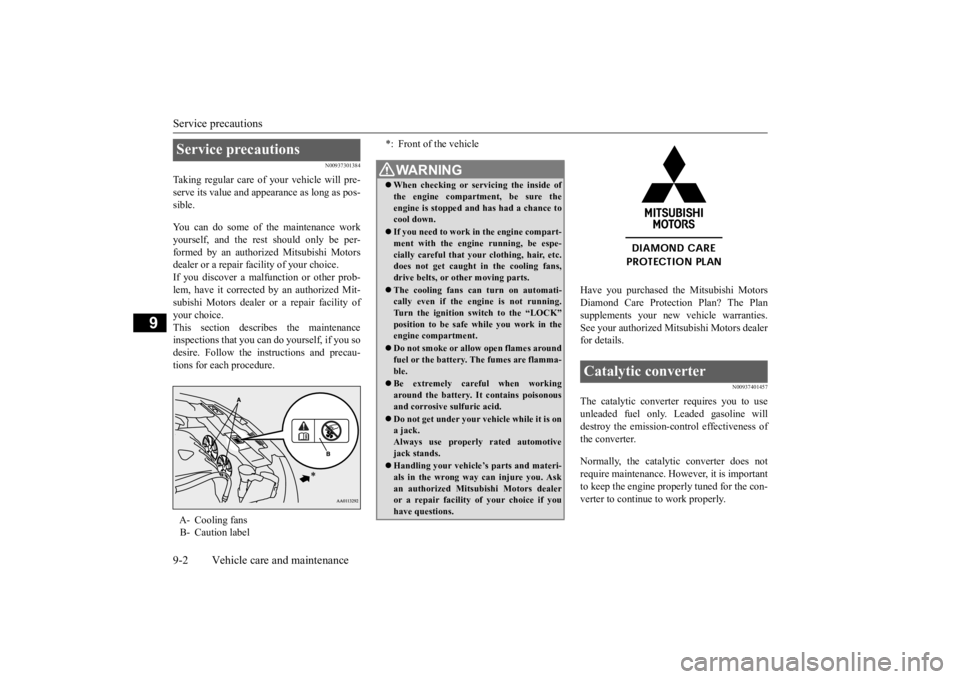
Service precautions A- Cooling fans B- Caution label
*: Front of the vehicleWA R N I N G When checking or servicing the inside of the engine compartment, be sure theengine is stopped and has had a chance to cool down. If you need to work
in the engine compart-
ment with the engine running, be espe- cially careful that your clothing, hair, etc.does not get caught in the cooling fans, drive belts, or other moving parts. The cooling fans can turn on automati- cally even if the engine is not running. Turn the ignition switch to the “LOCK”position to be safe while you work in the engine compartment. Do not smoke or allow open flames around fuel or the battery. The fumes are flamma- ble. Be extremely careful when working around the battery. It
contains poisonous
and corrosive sulfuric acid. Do not get under your ve
hicle while it is on
a jack. Always use properly rated automotive jack stands. Handling your vehicle’s parts and materi- als in the wrong way can injure you. Askan authorized Mitsub
ishi Motors dealer
or a repair facility of your choice if you have questions.
Catalytic converter
BK0211800US.book 2 ページ 2014年3月12日 水曜日 午後2時42分
Page 405 of 446
For cold and snowy weather 9-24 Vehicle care and maintenance
9
N00942201118
The best way to keep carbon monoxide gas from entering inside your
vehicle is to have
the engine exhaust syst
em properly serviced.
Have a competent mechanic inspect the com- plete exhaust system
and nearby body areas
for broken, damaged, deteriorated, or mispo- sitioned parts if you no
tice any of the follow-
ing: A change in the sound of the exhaust sys- tem The smell of exhaust fumes inside the vehicle The underside or rear of the vehicle is damaged
Also check the exhaust system each time the vehicle is raised for l
ubrication, oil changes,
or required service. A
ny open seams or loose
connections could le
t dangerous exhaust
fumes seep into the
luggage and passenger
compartments.
Check for holes or exhaust gas leaks caused by corrosion or damage. Check the joints and connections for looseness or exhaust gas leaks. Check the rubber hangers and brackets for damage.
N00942300079
The timing belt should be replaced with a new one at the mileage listed in the “WAR- RANTY AND MAINTENANCE MAN-UAL”.
N00942501124
The hood lock release mechanism and hood safety catch should be
checked, cleaned, and
oiled when needed for easy movement and toprevent rust and wear. Use Multipurpose Grease NLGI Grade 2 sp
aringly for all sliding
parts of the hood latc
h and release lever.
Work the grease into the hood lock mecha- nism until all the mo
vable surfaces are cov-
ered.
Also, put a light coat
of the same grease on
the safety catch wherever moving parts touch.
N00942600102
The ventilation slots in
front of the wind-
shield should be brushed clear after a heavy snowfall so that the operation of the heating and ventilation
systems will not be impaired.
To prevent freezing of the weatherstripping on the doors, engine hood, etc., they shouldbe treated with silicone grease. It is a good idea to carry a shovel or a short- handled spade in the vehicle during the win-ter so that you can clear away snow if you get stranded. A small hand-brush for sweeping snow off the vehicle a
nd a plastic scraper for
Exhaust system
WA R N I N GCarbon monoxide gas
from your vehicle’s
exhaust is poisonous. Breathing thesefumes can cause unconsciousness or death.
Check for any of the following conditions: Timing belt Hood lock release mechanism and safety catch
For cold and snowy weather Ventilation slots Weatherstripping Additional equipment (For regions where snow is encoun- tered)
BK0211800US.book 24 ページ 2014年3月12日 水曜日 午後2時42分
Page 433 of 446
Vehicle labeling 11-2 Specifications
11
N01147401749
Keep a record of the chassis number and vehicle identification
number. Such informa-
tion will assist police if
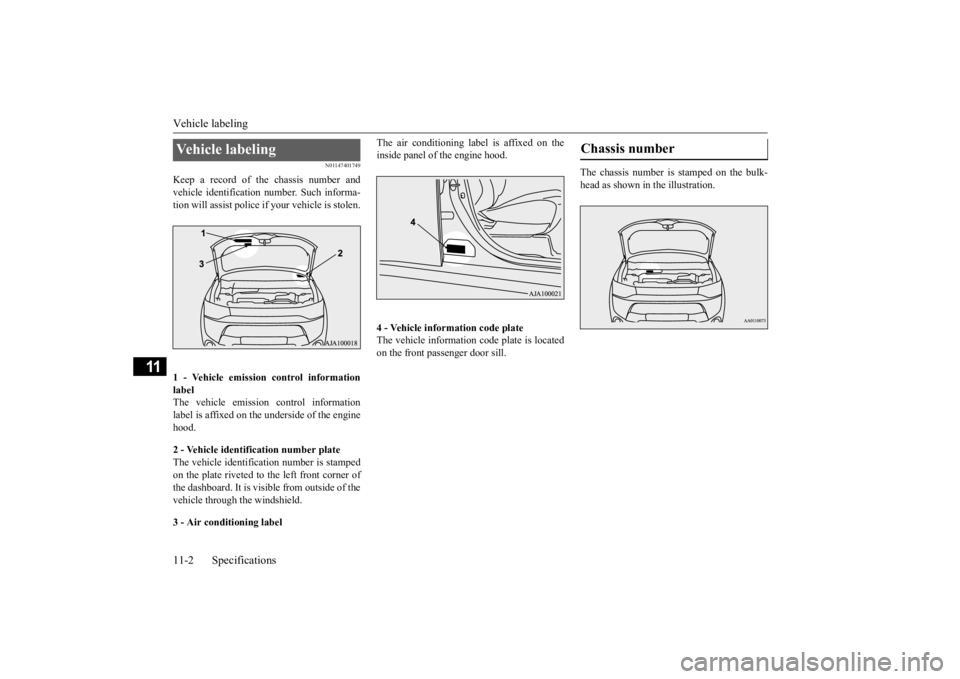
your vehicle is stolen.
1 - Vehicle emission control information labelThe vehicle emission control information label is affixed on the underside of the engine hood. 2 - Vehicle identification number plate The vehicle identification number is stamped on the plate riveted to the left front corner of the dashboard. It is visible from outside of thevehicle through the windshield. 3 - Air conditioning label
The air conditioning label is affixed on the inside panel of the engine hood. 4 - Vehicle information code plate The vehicle information code plate is locatedon the front passenger door sill.
The chassis number is stamped on the bulk- head as shown in the illustration.
Vehicle labeling
Chassis number
BK0211800US.book 2 ページ 2014年3月12日 水曜日 午後2時42分
Page 443 of 446

Alphabetical index 12-4
12
Multi information display - Type 1
.....
5-122
Multi information display - Type 2
.....
5-140
O
Octane rating
........................................
3-2
Oil
Engine oil
......................................
11-7
Rear axle oil
...................................
11-7
Transfer oil
....................................
11-7
Operation under adverse driving conditions
...
8-15 Outside rearview mirrors
.....................
5-54
Overheating
.........................................
8-4
P
Parking
................................................
6-6
Parking brake
.................................
5-52
Parking lights
Bulb capacity
.................................
9-30
Replacement
..................................
9-34
Polishing
............................................
9-42
Power brakes
......................................
5-84
Power liftgate
.....................................
5-36
Power outlet
.....................................
5-210
Power windows
..................................
5-47
Puncture (Tire changing)
.......................
8-6
R
Radiator cap
........................................
9-9
Radio
.................................................
7-15
General information
about your radio 7-48
Reading lights
Bulb capacity
..................................
9-32
Rear axle oil
..............................
9-12
, 11-7
Rear combination lights
Bulb capacity
..................................
9-30
Replacement
...................................
9-36
Rear side-marker lights
Bulb capacity
..................................
9-30
Rear turn signal light
Bulb capacity
..................................
9-30
Replacement
...................................
9-36
Rear-view camera
.............................
5-118
Rearview mirror
Inside rearview mirror
.....................
5-53
Outside rearview mirrors
.................
5-54
Replacement of light bulbs
...................
9-29
Replacing tires and wheels
...................
9-19
Reporting Safety Defects
.....................
10-2
Roof antenna
......................................
7-47
S
Safe driving techniques
.........................
6-4
S-AWC (Super-All Wheel Control)
......
5-77
Seat belt
.............................................
4-17
Adjustable seat belt shoulder anchor
.4-23
Child restraint systems
....................
4-25
Front passenger seat belt warning light
.....
4-22Maintenance and inspection
.............
4-32
Seat belt extender
...........................
4-24
Seat belt force limitter
.....................
4-25
Seat belt pr
e-tensioners
...................
4-24
Seat belt use
during pregnancy
.........
4-24
Seats
....................................................
4-2
Arm rest
..........................................
4-9
Front seats
.......................................
4-4
Head restraints
...............................
4-10
Heated seat
......................................
4-7
Making a cargo area
........................
4-12
Making a flat seat
...........................
4-16
Seat arrangement
..............................
4-3
Seats and restraint systems
................
4-4
Second row seats
..............................
4-8
Third row seats
...............................
4-10
Service brake
......................................
5-84
Service precautions
...............................
9-2
Side turn-signal light
Bulb capacity
.................................
9-30
Snow tires
..........................................
9-20
Spark plugs
........................................
9-22
Starting the engine
.....................
5-23
, 5-58
Steering
Steering wheel height and reach adjustment
BK0211800US.book 4 ページ 2014年3月12日 水曜日 午後2時42分
Page 444 of 446
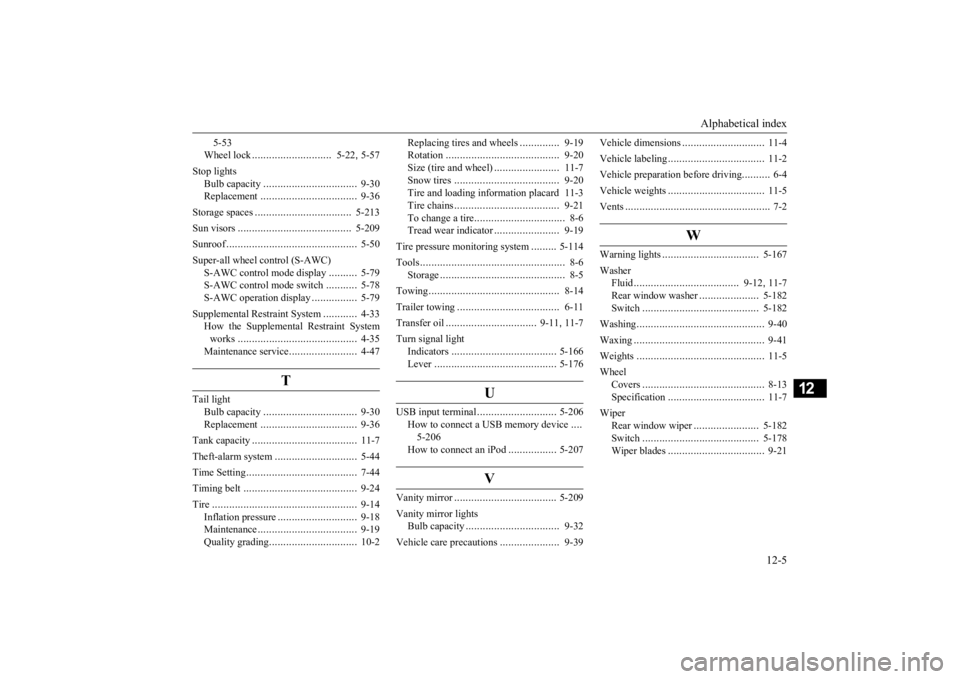
Alphabetical index
12-5
12
5-53 Wheel lock
............................
5-22
, 5-57
Stop lights
Bulb capacity
.................................
9-30
Replacement
..................................
9-36
Storage spaces
..................................
5-213
Sun visors
........................................
5-209
Sunroof
..............................................
5-50
Super-all wheel control (S-AWC)
S-AWC control mode display
..........
5-79
S-AWC control mode switch
...........
5-78
S-AWC operation display
................
5-79
Supplemental Re
straint System
............
4-33
How the Supplemental Restraint System works
..........................................
4-35
Maintenance service
........................
4-47
T
Tail light
Bulb capacity
.................................
9-30
Replacement
..................................
9-36
Tank capacity
.....................................
11-7
Theft-alarm system
.............................
5-44
Time Setting
.......................................
7-44
Timing belt
........................................
9-24
Tire
...................................................
9-14
Inflation pressure
............................
9-18
Maintenance
...................................
9-19
Quality grading
...............................
10-2
Replacing tires and wheels
..............
9-19
Rotation
........................................
9-20
Size (tire and wheel)
.......................
11-7
Snow tires
.....................................
9-20
Tire and loading information placard 11-3Tire chains
.....................................
9-21
To change a tire
................................
8-6
Tread wear indicator
.......................
9-19
Tire pressure monitoring system
.........
5-114
Tools
...................................................
8-6
Storage
............................................
8-5
Towing
..............................................
8-14
Trailer towing
....................................
6-11
Transfer oil
................................
9-11
, 11-7
Turn signal light
Indicators
.....................................
5-166
Lever
...........................................
5-176
U
USB input terminal
............................
5-206
How to connect a USB memory device
....
5-206 How to connect an iPod
.................
5-207
V
Vanity mirror
....................................
5-209
Vanity mirror lights
Bulb capacity
.................................
9-32
Vehicle care precautions
.....................
9-39
Vehicle dimensions
.............................
11-4
Vehicle labeling
..................................
11-2
Vehicle preparation before driving
..........
6-4
Vehicle weights
..................................
11-5
Vents
...................................................
7-2
W
Warning lights
..................................
5-167
Washer
Fluid
.....................................
9-12
, 11-7
Rear window washer
.....................
5-182
Switch
.........................................
5-182
Washing
.............................................
9-40
Waxing
..............................................
9-41
Weights
.............................................
11-5
Wheel
Covers
...........................................
8-13
Specification
..................................
11-7
Wiper
Rear window wiper
.......................
5-182
Switch
.........................................
5-178
Wiper blades
..................................
9-21
BK0211800US.book 5 ページ 2014年3月12日 水曜日 午後2時42分