brake MITSUBISHI OUTLANDER III 2017 Owners Manual
[x] Cancel search | Manufacturer: MITSUBISHI, Model Year: 2017, Model line: OUTLANDER III, Model: MITSUBISHI OUTLANDER III 2017Pages: 521, PDF Size: 14.95 MB
Page 451 of 521
Fuel Pump Shut-off System 8-16 For emergencies
8
When driving on a road covered with snow or ice, use s
now tires. Tire chains
cannot be used on your vehicle. There may be state or local regulations aboutusing snow tires. Al
ways check the regu-
lations in your local area before using them. Refer to “Snow tires” on page 9-21and “Tire chains” on page 9-21. Drive slowly. Do not make sudden starts or stops, sharp turns, or slam on the brakes. Allow extra distance
between your vehi-
cle and the vehicle in front of you, and avoid sudden braking. If a skid occurs when the accelerator pedal is depressed, take your foot off the pedal. Steer gently in the direction of the skid. Your vehicle is equipped with an anti-lock braking system (ABS). Hold the brake pedal down firmly and keep it depressed.Do not pump the brake pedal which will result in reduced braking performance. After parking on snowy or icy roads, it may be difficult to move your vehicle due to the brake being frozen. Depress the accelerator pedal little by little to movethe vehicle when safe to do so.
Drive as slow as pos
sible when driving on
bumpy, rutted roads or over potholes.
N00860600031
In the event of a collision causing frontal air-bag deployment, the fuel pump shut-off sys-tem will activate to st
op fuel supply to the
engine.
On snowy or icy roads
CAUTION Do not depress the acce
lerator pedal rapidly.
The vehicle could start moving when itbreaks free from the
ice, possibly resulting in
an accident.
On a bumpy or rutted road
CAUTION Driving on bumpy, rutted roads or over pot- holes can damage th
e tires and wheels.
Wheels with low-profiles tires or under-inflated tires are especially at risk for dam- age.
Fuel Pump Shut-off System
WA R N I N G Before attempting to restart the engine after a collision, alw
ays inspect the ground
under the vehicle for leaking fuel. If a fuelleak is found or a fuel
odor is detected, do
not restart the engine. Mitsubishi Motors recommends that your vehicle be inspected by
an author
ized Mit-
subishi Motors dealer
after any collision.
BK0239700US.book 16 ページ 2016年6月16日 木曜日 午前10時58分
Page 454 of 521
9
Vehicle care and maintenanceService precautions ..........................................................................9-2 Catalytic converter ...........................................................................9-2 Engine hood .........
...........
...........
............
...........
.........
........
.........
.....9-3
View of the engine compartment .....................................................9-5 Engine oil and oil filter ....................................................................9-6 Engine coolant .................................................................................9-8Air cleaner filter ...............................................................................9-9 Automatic transaxle fluid (if so equipped) ..................................... 9-11 Continuously variable transmission
(CVT) fluid (if so equipped) . 9-11
Transfer oil (All-wheel drive models) ...........................................9-12 Rear axle oil (All-wheel drive models) .........................................9-12 Washer fluid ...................................................................................9-12Brake fluid .....................................................................................9-12 Battery ............................................................................................9-13 Tires ...............................................................................................9-15Brake pedal free play .....................................................................9-21 Parking brake lever stroke (if so equipped) ....................................9-22 Wiper blades ..................................................................................9-22Emission-control system maintenance ..........................................9-22 General maintenance .....................................................................9-23 For cold and snowy weather ..........................................................9-25Fusible links ...................................................................................9-25 Fuses ..............................................................................................9-25 Replacement of light bulbs ............................................................9-31Vehicle care precautions ................................................................9-39 Cleaning the inside of your vehicle .......
...........
...........
...........
.......9-40
Cleaning the outside of your vehicle .....
...........
...........
...........
.......9-41
BK0239700US.book 1 ページ 2016年6月16日 木曜日 午前10時58分
Page 458 of 521
View of the engine compartment
Vehicle care and maintenance 9-5
9
N00937601749
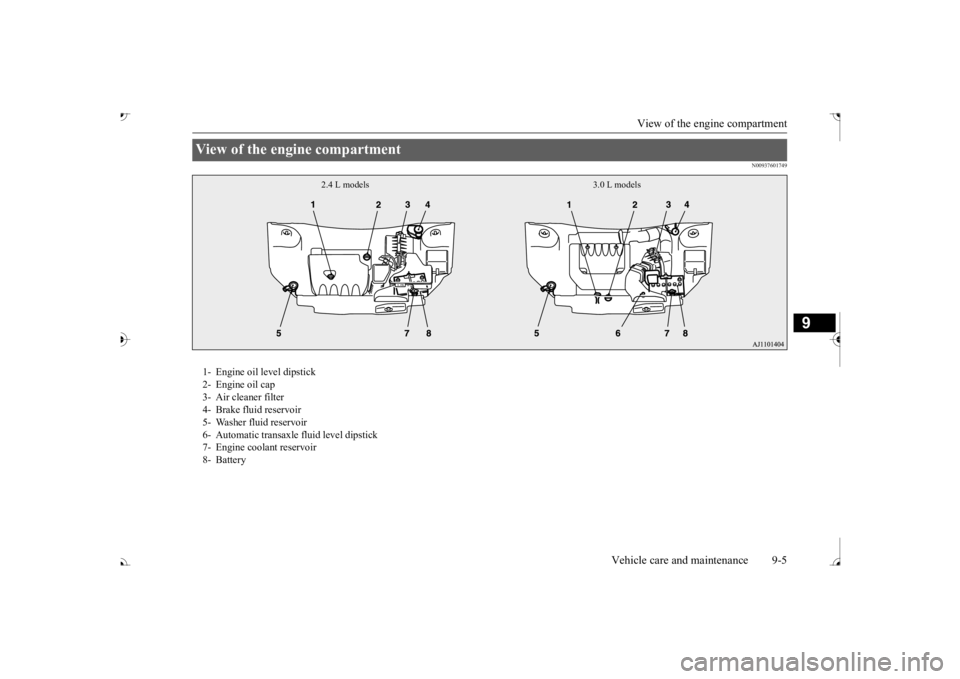
View of the engine compartment
2.4 L models 3.0 L models
1- Engine oil level dipstick 2- Engine oil cap 3- Air cleaner filter4- Brake fluid reservoir 5- Washer fluid reservoir 6- Automatic transaxle fluid level dipstick7- Engine coolant reservoir 8- Battery
BK0239700US.book 5 ページ 2016年6月16日 木曜日 午前10時58分
Page 464 of 521
Automatic transaxle fluid (if so equipped)
Vehicle care and maintenance 9-11
9
N00938000570
The automatic transaxl
e should be maintained
and serviced by an authorized MitsubishiMotors dealer or a repair facility of your choice to obtain the
best performance and
longest life. It is impor
tant that the transaxle
fluid is kept at the correct level. The fluid level should be checked when the bar graph for the engine coolant temperature display on the multi-information displayshows the engine is warmed up and the fluid in the transaxle is heated to its normal work- ing temperature. Driving with the wrong fluidlevel will rapidly wear
out the transaxle and
destroy the fluid. 1. With the brake pedal fully depressed and the engine idling,
select each gear
momentarily, ending with the selectorlever in the “P” (PARK) position.
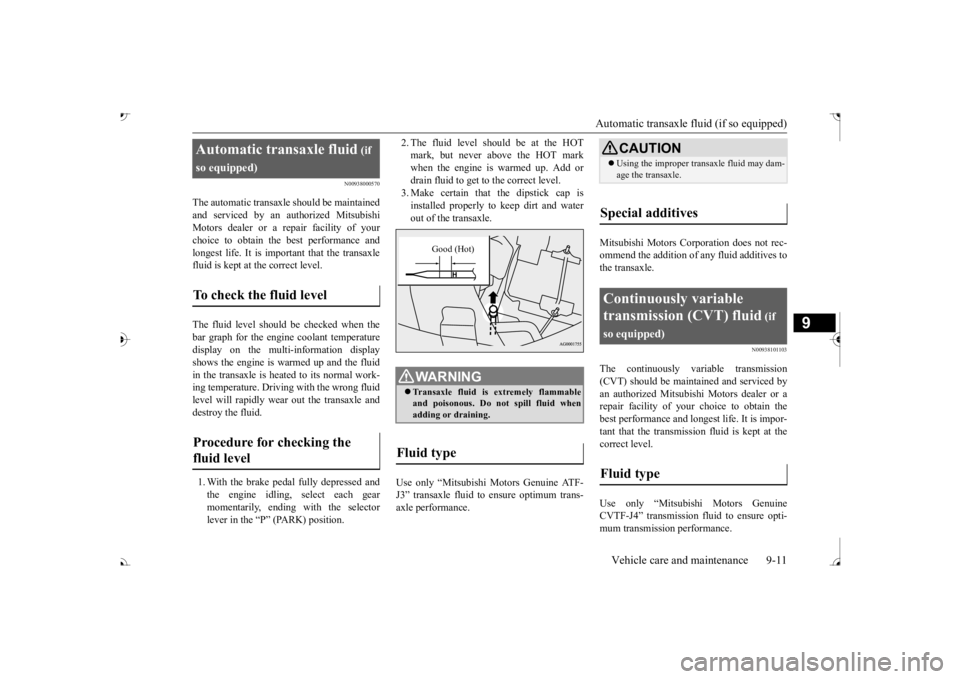
2. The fluid level should be at the HOT mark, but never above the HOT markwhen the engine is warmed up. Add or drain fluid to get to the correct level. 3. Make certain that the dipstick cap isinstalled properly to keep dirt and water out of the transaxle.
Use only “Mitsubishi Motors Genuine ATF- J3” transaxle fluid to
ensure optimum trans-
axle performance.
Mitsubishi Motors Corp
oration does not rec-
ommend the addition of
any fluid additives to
the transaxle.
N00938101103
The continuously variable transmission (CVT) should be maintained and serviced by an authorized Mitsubishi Motors dealer or arepair facility of your
choice to obtain the
best performance and longe
st life. It is impor-
tant that the transmission fluid is kept at thecorrect level. Use only “Mitsubish
i Motors Genuine
CVTF-J4” transmission fluid to ensure opti- mum transmission performance.
Automatic transaxle fluid
(if
so equipped)To check the fluid level
Procedure for checking the fluid level
WA R N I N G Transaxle fluid is extremely flammable and poisonous. Do not spill fluid when adding or draining.
Fluid type
Good (Hot)
CAUTION Using the improper transaxle fluid may dam- age the transaxle.
Special additives
Continuously variable transmission (CVT) fluid
(if
so equipped)Fluid type
BK0239700US.book 11 ページ 2016年6月16日 木曜日 午前10時58分
Page 465 of 521
Transfer oil (All-w
heel drive models)
9-12 Vehicle care and maintenance
9
Do not use any fluid additives to the trans- mission.
N00938401281
Whenever the transfer oil level is checked,add oil as necessary to maintain the properlevel. Fill with the oil according to the table below.
N00915201279
Whenever the oil level is checked, add oil asnecessary to maintain the proper level. Fill with the oil according to the table below.
N00938601342
The windshield and rear window washer fluid reservoir is in the
engine compartment.
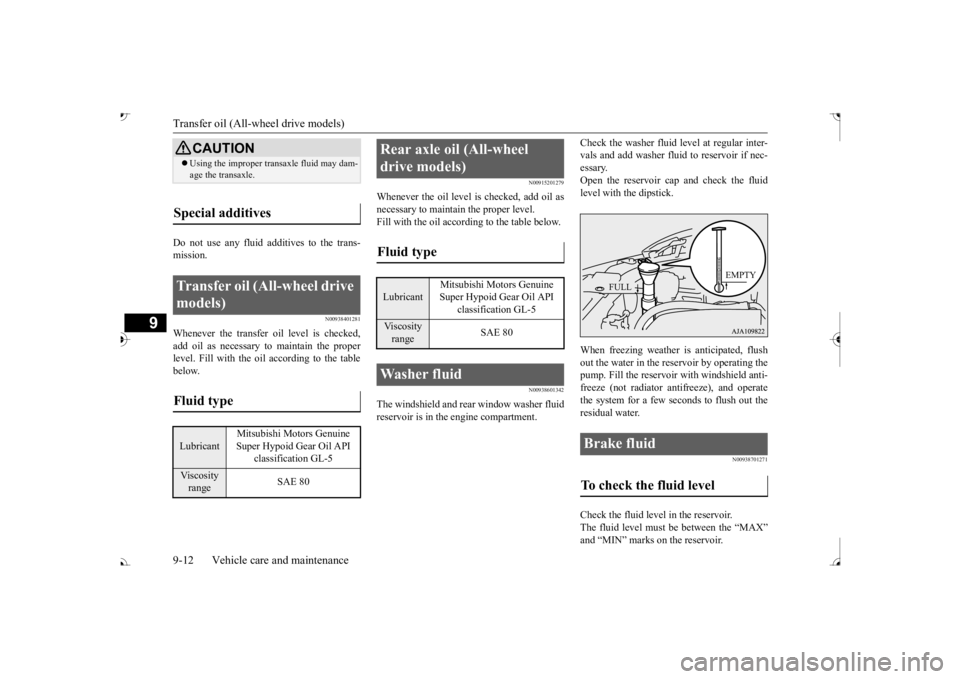
Check the washer fluid
level at regular inter-
vals and add washer fluid to reservoir if nec-essary. Open the reservoir cap and check the fluid level with the dipstick. When freezing weather is anticipated, flush out the water in the reservoir by operating thepump. Fill the reservoi
r with windshield anti-
freeze (not radiator an
tifreeze), and operate
the system for a few seconds to flush out theresidual water.
N00938701271
Check the fluid level in the reservoir.The fluid level must be between the “MAX” and “MIN” marks on the reservoir.
CAUTION Using the improper transaxle fluid may dam- age the transaxle.
Special additives
Transfer oil (All-wheel drive models) Fluid type Lubricant
Mitsubishi Motors Genuine Super Hypoid Gear Oil API
classification GL-5
Viscosity range
SAE 80
Rear axle oil (All-wheel drive models) Fluid type Lubricant
Mitsubishi Motors Genuine Super Hypoid Gear Oil API
classification GL-5
Viscosity range
SAE 80
Washer fluid
Brake fluid To check the fluid level
FULL
EMPTY
BK0239700US.book 12 ページ 2016年6月16日 木曜日 午前10時58分
Page 466 of 521
Battery
Vehicle care and maintenance 9-13
9
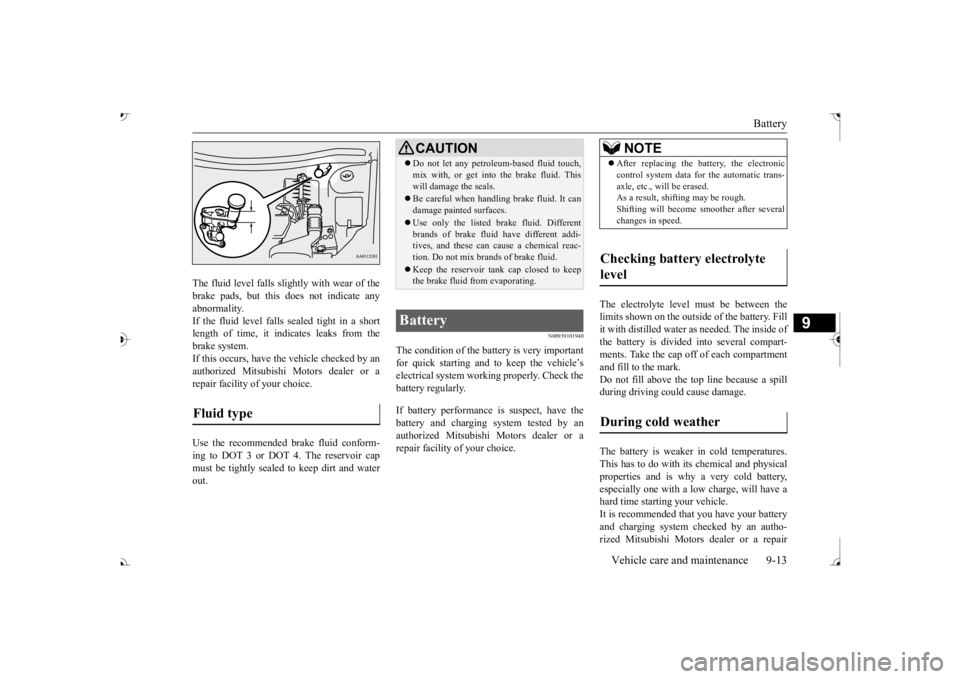
The fluid level falls slightly with wear of the brake pads, but this
does not indicate any
abnormality. If the fluid level falls sealed tight in a short length of time, it indi
cates leaks from the
brake system. If this occurs, have the vehicle checked by an authorized Mitsubishi Motors dealer or arepair facility
of your choice.
Use the recommended brake fluid conform- ing to DOT 3 or DOT 4. The reservoir cap must be tightly sealed to keep dirt and water out.
N00939101940
The condition of the battery is very importantfor quick starting and to keep the vehicle’selectrical system work
ing properly. Check the
battery regularly. If battery performance is suspect, have the battery and charging system tested by anauthorized Mitsubishi Motors dealer or a repair facility of your choice.
The electrolyte level
must be between the
limits shown on the outside of the battery. Fillit with distilled water as needed. The inside of the battery is divided into several compart- ments. Take the cap off of each compartmentand fill to the mark. Do not fill above the top line because a spill during driving could cause damage. The battery is weaker in cold temperatures. This has to do with it
s chemical and physical
properties and is why a very cold battery, especially one with a low charge, will have a hard time starting your vehicle.It is recommended th
at you have your battery
and charging system checked by an autho- rized Mitsubishi Motors dealer or a repair
Fluid type
CAUTION Do not let any petrol
eum-based fluid touch,
mix with, or get into
the brake fluid. This
will damage the seals. Be careful when handli
ng brake fluid. It can
damage painted surfaces. Use only the listed brak
e fluid. Different
brands of brake fluid
have different addi-
tives, and these can cause a chemical reac- tion. Do not mix brands of brake fluid. Keep the reservoir ta
nk cap closed to keep
the brake fluid from evaporating.
Battery
NOTE
After replacing the battery, the electronic control system data for the automatic trans-axle, etc., will be erased.As a result, shifting may be rough. Shifting will become
smoother after several
changes in speed.
Checking battery electrolyte level During cold weather
BK0239700US.book 13 ページ 2016年6月16日 木曜日 午前10時58分
Page 472 of 521
Tires
Vehicle care and maintenance 9-19
9
Tire pressures should be checked, and adjusted if necessary, at least once a month.Pressures should be checked more often whenever weather temperatures change severely, becaus
e tire pressures change with
outdoor temperatures. The pressures listed are always “cold inflation pressure”. Cold inflation pressure is measured after thevehicle has been parked
for at least three
hours or is driven less than 1 mile (1.6 km) after having been parked for three hours. Cold inflation pressure
must not go above the
maximum values molded into the tire side-wall. After driving se
veral miles, your tire
inflation pressure may increase 2 to 6 psi (14 to 41 kPa) from the cold inflation pressure.Do not let air out of the tires to get back to the specified cold pressure, or your tires will be too low.Check your tires each t
ime you refuel. If one
tire looks lower than the others, check the pressure for all of them.You should also take the following safety pre- cautions:
Keep your tires inflated to the recom- mended pressures. (See the tire and load-ing information placard attached to the driver’s door sill.) Stay within the recommended load limits. Make sure that the weight of any load in your vehicle is evenly distributed. Drive at safe speeds. After filling your tires to the correct pres- sure, check them for damage and air leaks. Be sure to reinstall the caps on the valve stems.
N00939601479
N00939700141
The following maintenance steps are recom- mended: Check tire pressures regularly. Have regular maintenance done on the wheel balance and front
and rear suspen-
sion alignment. Rotate your tires regul
arly as described in
the “Tire rotation” section on page 9-20.
Compact spare wheel
T155/90D16 T155/80D17
420 KPA, 60
PSI
Item
Tire size
Front
Rear
Replacing tires and wheels
CAUTION Avoid using different size tires from the one listed and the combined use of different types of tires, as this can affect driving safety.Refer to “Tires and wheels” on page 11-7. On all-wheel drive vehi
cles, always use tires
of the same size, same
type, and same brand,
and which have no wear differences. Using tires that differ in size, type, brand or thedegree of wear, will increase the differential oil temperature, resul
ting in possible damage
to the driving system. Further, the drive trainwill be subjected to ex
cessive loading, possi-
bly leading to oil leakage, component sei- zure, or other serious problems.
Only Mitsubishi Motors Authorized wheels should be used, beca
use your vehicle is
equipped with a tire pr
essure monitoring sys-
tem. Use of another type of wheel risks air leaks and sensor damage, as it
will not be possible
to install the tire pressure sensor properly.NOTE
On vehicles with Elec
tric parking brake, 16
inches steel wheel cannot be used on your vehicle because it interferes with brake parts. Additionally, 16 inches aluminum wheelmay not be used on your vehicle depending on its type, even if a Mitsubishi Motors Gen- uine wheels.Consult an authoriz
ed Mitsubishi Motors
dealer before using wh
eels that you have.
Tire maintenance
CAUTION
BK0239700US.book 19 ページ 2016年6月16日 木曜日 午前10時58分
Page 474 of 521
Brake pedal free play
Vehicle care and maintenance 9-21
9
N00940000320
In some areas of the country, snow tires are required for winter driving. If snow tires are required in your area, you must choose snowtires of the same size
and type as the original
tires provided with your
vehicle. Snow tires
should also be
installed on all four wheels.
Otherwise your safety
and vehicle handling
can be reduced. Even where laws may permit it, snow tiresshould not be operated
at sustained speeds
over 75 mph (120 km/h).
N00940101139
N00940300293
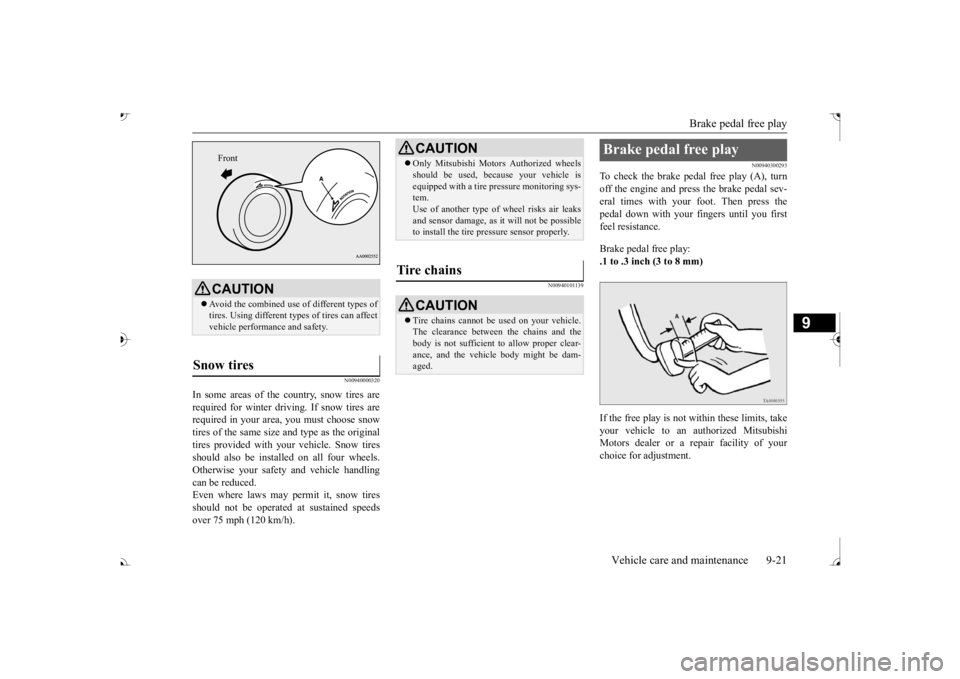
To check the brake pedal free play (A), turn off the engine and press the brake pedal sev- eral times with your
foot. Then press the
pedal down with your fingers until you first feel resistance. Brake pedal free play: .1 to .3 inch (3 to 8 mm) If the free play is not within these limits, take your vehicle to an authorized Mitsubishi Motors dealer or a repair facility of yourchoice for adjustment.
CAUTION Avoid the combined use of different types of tires. Using different t
ypes of tires can affect
vehicle performa
nce and safety.
Snow tires
Front
CAUTIONOnly Mitsubishi Motors Authorized wheels should be used, beca
use your vehicle is
equipped with a tire pr
essure monitoring sys-
tem. Use of another type of
wheel risks air leaks
and sensor damage, as
it will not be possible
to install the tire pressure sensor properly.
Tire chains
CAUTION Tire chains cannot be used on your vehicle. The clearance between the chains and the body is not sufficient to allow proper clear-ance, and the vehicle body might be dam- aged.
Brake pedal free play
BK0239700US.book 21 ページ 2016年6月16日 木曜日 午前10時58分
Page 475 of 521
Parking brake lever stroke (if so equipped) 9-22 Vehicle care and maintenance
9
N00940401275
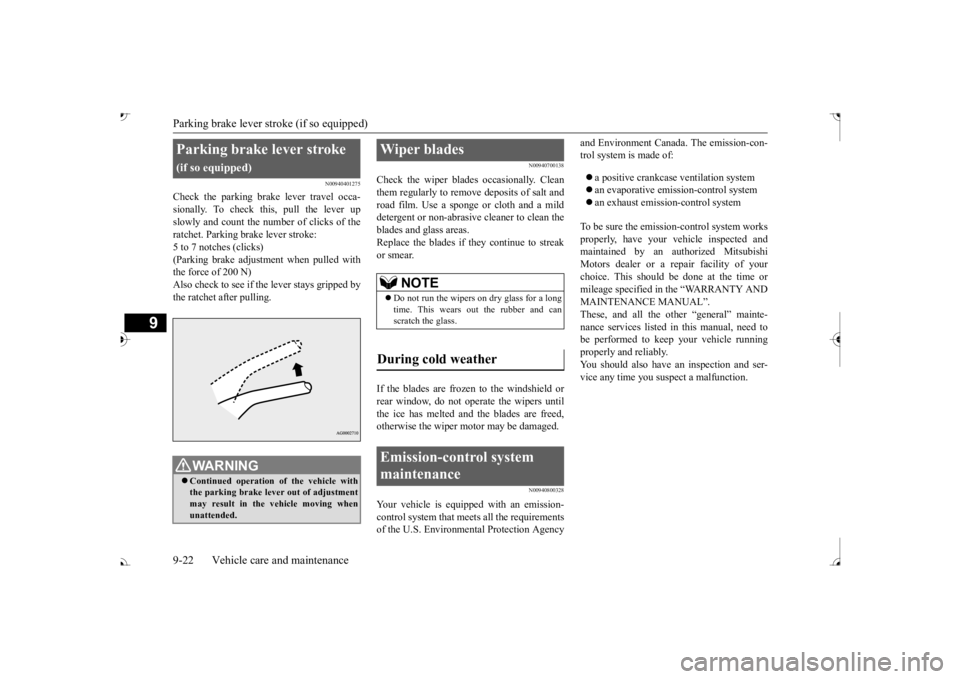
Check the parking brak
e lever travel occa-
sionally. To check this, pull the lever up slowly and count the number of clicks of theratchet. Parking brake lever stroke: 5 to 7 notches (clicks) (Parking brake adjustme
nt when pulled with
the force of 200 N) Also check to see if the lever stays gripped by the ratchet after pulling.
N00940700138
Check the wiper blades
occasionally. Clean
them regularly to remo
ve deposits of salt and
road film. Use a sponge or cloth and a milddetergent or non-abrasive cleaner to clean the blades and glass areas. Replace the blades if they continue to streakor smear. If the blades are frozen to the windshield or rear window, do not operate the wipers until the ice has melted and the blades are freed, otherwise the wiper mo
tor may be damaged.
N00940800328
Your vehicle is equi
pped with an emission-
control system that meets all the requirementsof the U.S. Environm
ental Protection Agency
and Environment Cana
da. The emission-con-
trol system is made of: a positive crankcase
ventilation system
an evaporative emission-control system an exhaust emission-control system
To be sure the emission-control system works properly, have your vehicle inspected andmaintained by an authorized Mitsubishi Motors dealer or a repair facility of your choice. This should be
done at the time or
mileage specified in
the “WARRANTY AND
MAINTENANCE MANUAL”.These, and all the other “general” mainte- nance services listed in this manual, need to be performed to keep your vehicle runningproperly and reliably. You should also have an inspection and ser- vice any time you
suspect a malfunction.
Parking brake lever stroke
(if so equipped) Continued operation
of the vehicle with
the parking brake leve
r out of adjustment
may result in the
vehicle moving when
unattended.
Wiper blades
NOTE
Do not run the wipers on dry glass for a long time. This wears out the rubber and canscratch the glass.
During cold weather Emission-control system maintenance
BK0239700US.book 22 ページ 2016年6月16日 木曜日 午前10時58分
Page 477 of 521
General maintenance 9-24 Vehicle care and maintenance
9
there are other parts which do not usually need regular maintenance.But, if any of these parts stops working prop- erly, your vehicle performance could suffer. Have these items ch
ecked if you notice a
problem with them. If you have any questions, see your autho- rized Mitsubishi Motors
dealer for assistance.
N00941600059
Good brakes are essential for safe driving. Check the brake pads for wear. For goodbraking performance, re
place the brake pads
with the same type pads as the originals.
N00941700076
Brake hoses and tubing should be checkedfor: Severe surface cracking, scuffing or worn spots. If the fabric casing of the hose isshowing through any cracks or worn spots in the rubber hose cover, the hose should be replaced. The brakes can fail if thehose wears through. Improper installation
may cause twisting,
or wheel, tire or chassis interference.
N00941800093
Check the following parts for damage andgrease leaks: Ball joint boots of the suspension and steering linkage Bellows on both ends of the drive shaft
N00942201118
The best way to keep carbon monoxide gas from entering inside your
vehicle is to have
the engine exhaust syst
em properly serviced.
Have a competent mechanic inspect the com- plete exhaust
system and nearby body areas
for broken, damaged, de
teriorated, or mispo-
sitioned parts if you not
ice any of the follow-
ing: A change in the sound of the exhaust sys- tem The smell of exhaust fumes inside the vehicle
The underside or rear of the vehicle is damaged
Also check the exhaust system each time the vehicle is raised for l
ubrication, oil changes,
or required service. Any open seams or loose connections could le
t dangerous exhaust
fumes seep into the luggage and passenger compartments. Check for holes or exhaust gas leaks caused by corrosion or damage. Check the joints and connections for looseness or exhaust gas leaks. Check the rubber hangers and brackets for damage.
N00942300079
The timing belt should
be replaced with a
new one at the mileage listed in the “WAR- RANTY AND MAINTENANCE MAN-UAL”.
Brake hoses
Ball joint, steering linkage seals, drive shaft boots Exhaust system
WA R N I N G Carbon monoxide gas
from your vehicle’s
exhaust is poisonous. Breathing thesefumes can cause unconsciousness or death.
Check for any of the following conditions: Timing belt
BK0239700US.book 24 ページ 2016年6月16日 木曜日 午前10時58分