child restraint MITSUBISHI OUTLANDER III 2017 Owner's Manual
[x] Cancel search | Manufacturer: MITSUBISHI, Model Year: 2017, Model line: OUTLANDER III, Model: MITSUBISHI OUTLANDER III 2017Pages: 521, PDF Size: 14.95 MB
Page 64 of 521
Supplemental Restraint System (SRS) - airbag
Seat and restraint systems 4-35
4
and partial ejection fro
m the vehicle through
side windows in both side impact and roll-over type accidents. The SRS airbags are NOT a substitute for use of the seat belts. For maximum protection in all types of accidents, seat belts mustALWAYS be worn by everyone who drives or rides in this vehicle
(with infants and small
children in an appropriate child restraint sys-tem in the rear seat, and older children buck- led in the rear seat). Refer to “Child restraint systems” on page 4-27.
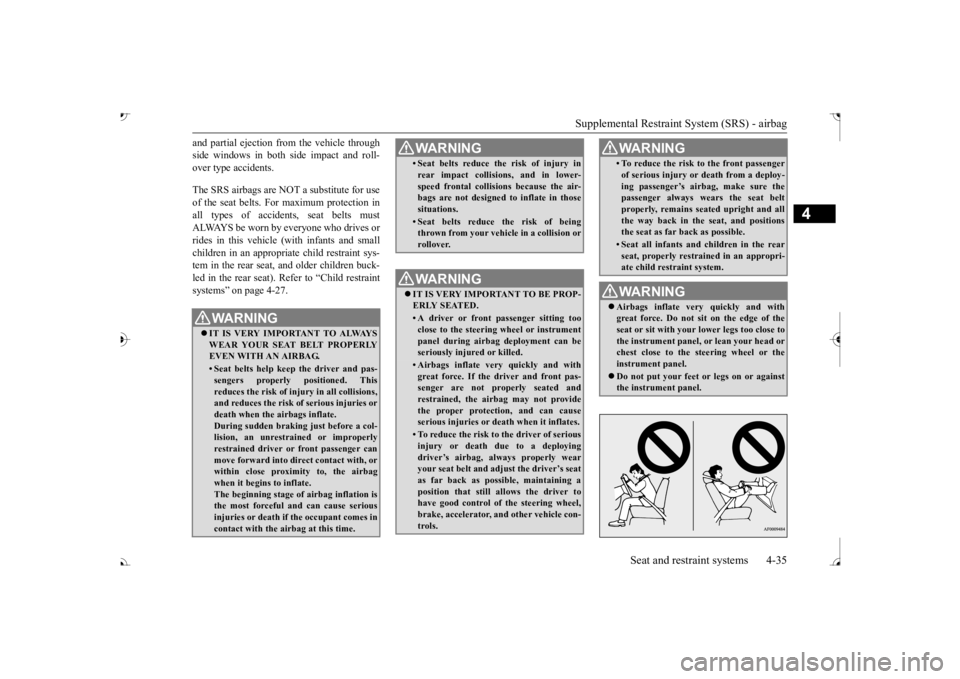
WA R N I N G IT IS VERY IMPORTANT TO ALWAYS WEAR YOUR SEAT BELT PROPERLY EVEN WITH AN AIRBAG.• Seat belts help keep the driver and pas-sengers properly positioned. This reduces the risk of injury in all collisions,and reduces the risk of serious injuries or death when the
airbags inflate.
During sudden braking just before a col-lision, an unrestra
ined or
improperly
restrained driver or front passenger can move forward into direct contact with, orwithin close proximi
ty to, the airbag
when it begins to inflate. The beginning stage of
airbag inflation is
the most forceful and can cause serious injuries or death if the occupant comes in contact with the airbag at this time.
• Seat belts reduce the risk of injury inrear impact collisions, and in lower-speed frontal collisions because the air-bags are not designed
to inflate in those
situations.• Seat belts reduce the risk of beingthrown from your vehi
cle in a collision or
rollover.WA R N I N G IT IS VERY IMPORTANT TO BE PROP- ERLY SEATED.• A driver or front passenger sitting tooclose to the steering wheel or instrumentpanel during airbag deployment can be seriously inju
red or killed.
• Airbags inflate ve
ry quickly and with
great force. If the driver and front pas- senger are not properly seated andrestrained, the airbag may not provide the proper protection, and can cause serious injuries or death when it inflates.• To reduce the risk to the driver of seriousinjury or death due to a deployingdriver’s airbag, al
ways properly wear
your seat belt and adju
st the driver’s seat
as far back as possible, maintaining a position that still allows the driver tohave good control of the steering wheel, brake, accelerator, and other vehicle con- trols.WA R N I N G
• To reduce the risk to the front passengerof serious injury or
death from a deploy-
ing passenger’s airbag, make sure thepassenger always wears the seat belt properly, remains seat
ed upright and all
the way back in the
seat, and positions
the seat as far back as possible.• Seat all infants and children in the rearseat, properly restrain
ed in an appropri-
ate child restraint system.WA R N I N G Airbags inflate very
quickly and with
great force. Do not sit on the edge of the seat or sit with your
lower legs too close to
the instrument panel,
or lean your head or
chest close to the steering wheel or the instrument panel. Do not put your feet or legs on or against the instrument panel.WA R N I N G
BK0239700US.book 35 ページ 2016年6月16日 木曜日 午前10時58分
Page 65 of 521
Supplemental Restraint System (SRS) - airbag 4-36 Seat and restraint systems
4
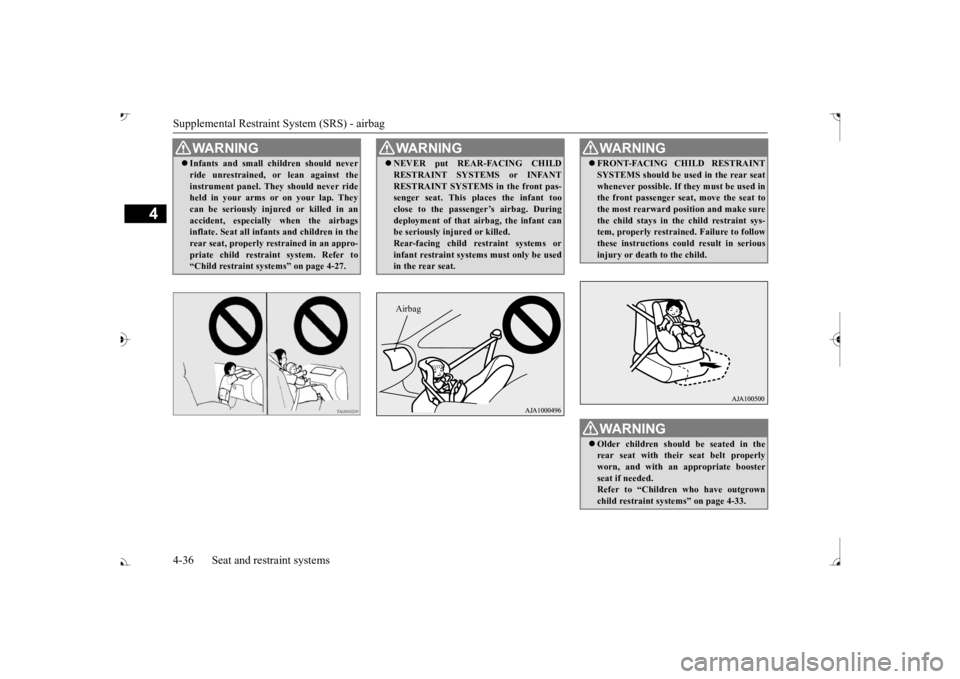
WA R N I N G Infants and small children should never ride unrestrained,
or lean against the
instrument panel. They should never rideheld in your arms or
on your lap. They
can be seriously inju
red or killed in an
accident, especially when the airbagsinflate. Seat all infa
nts and children in the
rear seat, properly re
strained in an appro-
priate child restraint system. Refer to“Child restraint systems” on page 4-27.
WA R N I N G NEVER put REAR-FACING CHILD RESTRAINT SYSTEMS or INFANTRESTRAINT SYSTEMS in the front pas-senger seat. This pl
aces the infant too
close to the passenger’s airbag. During deployment of that airbag, the infant canbe seriously inju
red or killed.
Rear-facing child restraint systems or infant restraint systems must only be usedin the rear seat.Airbag
WA R N I N G FRONT-FACING CHILD RESTRAINT SYSTEMS should be used in the rear seatwhenever possible. If they must be used inthe front passenger se
at, move the seat to
the most rearward po
sition and make sure
the child stays in the child restraint sys-tem, properly restrained. Failure to follow these instructions could result in serious injury or death to the child.WA R N I N G Older children should be seated in the rear seat with thei
r seat belt properly
worn, and with an
appropriate booster
seat if needed. Refer to “Children
who have outgrown
child restraint systems” on page 4-33.
BK0239700US.book 36 ページ 2016年6月16日 木曜日 午前10時58分
Page 68 of 521
Supplemental Restraint System (SRS) - airbag
Seat and restraint systems 4-39
4
bag control unit controls deployment of the passenger’s front airbag in accordance withthe information it receives from this system. The passenger’s front ai
rbag will not deploy
in an impact when the system senses no occu-pant on the front passenger’s seat or a child in a child restraint system. In this case, the pas- senger airbag off indi
cator will come on.
Refer to “Passenger’s ai
rbag off indicator” on
page 4-39. If there is a problem involving the passen- ger’s seat occupant cl
assification sensor sys-
tem, the SRS warning light in the instrumentpanel will come on. Refer to “SRS warning light/display” on page 4-40.
N00418101346
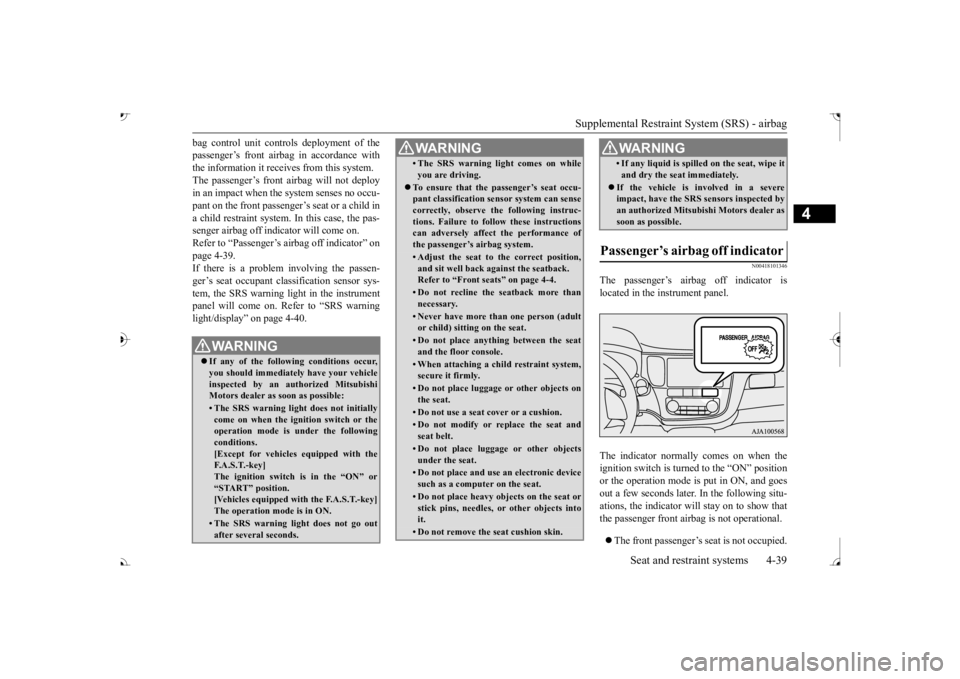
The passenger’s airbag off indicator is located in the instrument panel. The indicator normall
y comes on when the
ignition switch is turned to the “ON” position or the operation mode is put in ON, and goes out a few seconds later. In the following situ-ations, the indicator will stay on to show that the passenger front airb
ag is not operational.
The front passenger’s seat is not occupied.
WA R N I N GIf any of the following conditions occur, you should immediatel
y have your vehicle
inspected by an au
thorized Mitsubishi
Motors dealer as
soon as possible:
• The SRS warning light does not initially come on when the ignition switch or the operation mode is under the followingconditions. [Except for vehicles equipped with the F. A . S . T. - k e y ]The ignition switch is in the “ON” or “START” position. [Vehicles equipped with the F.A.S.T.-key]The operation mode is in ON.• The SRS warning light does not go outafter several seconds.
• The SRS warning li
ght comes on while
you are driving.
To ensure that the passenger’s seat occu- pant classification sensor system can sense correctly, observe the following instruc-tions. Failure to follow these instructions can adversely affect
the performance of
the passenger’s airbag system.• Adjust the seat to the correct position,and sit well back
against the seatback.
Refer to “Front seats” on page 4-4.• Do not recline the seatback more thannecessary.• Never have more than one person (adultor child) sitting
on the seat.
• Do not place anything between the seat and the floor console.• When attaching a chil
d restraint system,
secure it firmly.• Do not place luggage
or other objects on
the seat.• Do not use a seat cover or a cushion.• Do not modify or replace the seat andseat belt.• Do not place luggage or other objectsunder the seat.• Do not place and use
an electronic device
such as a computer on the seat.• Do not place heavy objects on the seat orstick pins, needles, or other objects intoit.• Do not remove the seat cushion skin.WA R N I N G
• If any liquid is spilled on the seat, wipe itand dry the seat
immediately.
If the vehicle is involved in a severe impact, have the SRS sensors inspected by an authorized
Mitsubishi Motors dealer as
soon as possible.
Passenger’s airbag off indicator
WA R N I N G
BK0239700US.book 39 ページ 2016年6月16日 木曜日 午前10時58分
Page 69 of 521
Supplemental Restraint System (SRS) - airbag 4-40 Seat and restraint systems
4
The system senses that a child is using a child restraint system on the front passen-ger’s seat.
When the passenger’s seat occupant classifi- cation sensor sy
stem sense there is a person
seated in the front passenger’s seat, the indi-cator goes out to show that the passenger’s front airbag is operational.
N00408301589
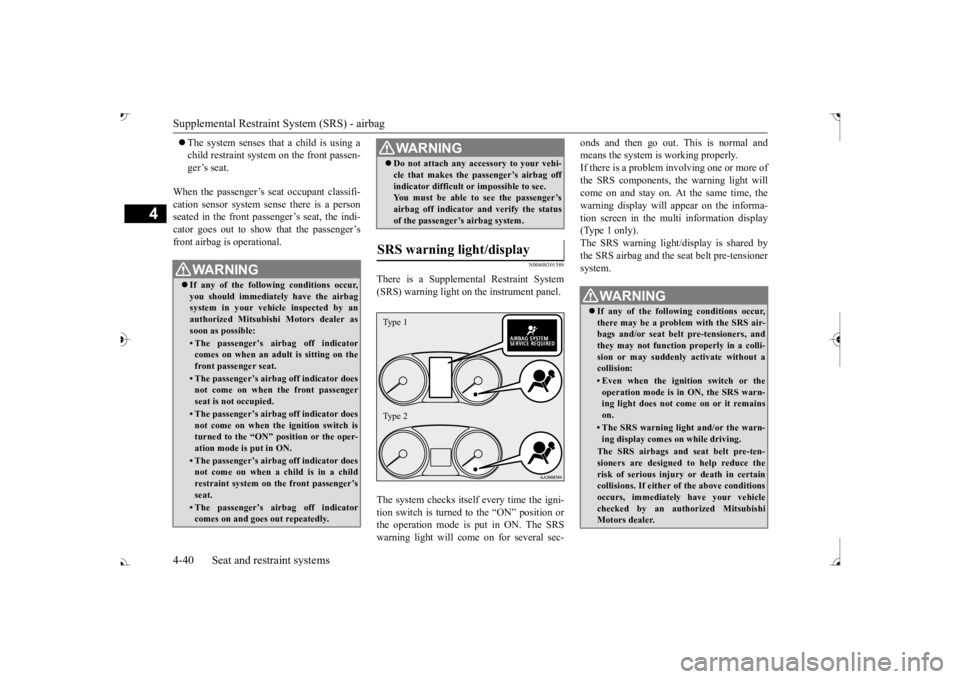
There is a Supplemental Restraint System (SRS) warning light on
the instrument panel.
The system checks itself every time the igni- tion switch is turned
to the “ON” position or
the operation mode is put in ON. The SRS warning light will co
me on for several sec-
onds and then go out. This is normal and means the system is working properly.If there is a problem involving one or more of the SRS components, the warning light will come on and stay on. At the same time, thewarning display will
appear on the informa-
tion screen in the multi information display (Type 1 only).The SRS warning light/display is shared by the SRS airbag and the seat belt pre-tensioner system.
WA R N I N G If any of the follow
ing conditions occur,
you should immediat
ely have the airbag
system in your vehicle inspected by anauthorized Mitsubishi
Motors dealer as
soon as possible:• The passenger’s airbag off indicatorcomes on when an adul
t is sitting on the
front passenger seat.• The passenger’s airb
ag off indicator does
not come on when the front passengerseat is not occupied.• The passenger’s airb
ag off indicator does
not come on when the ignition switch is turned to the “ON” position or the oper- ation mode is put in ON.• The passenger’s airb
ag off indicator does
not come on when a child is in a childrestraint system on the front passenger’s seat.• The passenger’s airbag off indicatorcomes on and goes out repeatedly.
Do not attach any ac
cessory to your vehi-
cle that makes the passenger’s airbag offindicator difficult or impossible to see.You must be able to see the passenger’s airbag off indicator and verify the status of the passenger’s airbag system.
SRS warning light/display
WA R N I N G
Type 1 Type 2
WA R N I N G If any of the follow
ing conditions occur,
there may be a proble
m with the SRS air-
bags and/or seat belt pre-tensioners, and they may not function
properly in a colli-
sion or may suddenly
activate without a
collision:• Even when the ignition switch or theoperation mode is in
ON, the SRS warn-
ing light does not come on or it remainson.• The SRS warning ligh
t and/or the warn-
ing display comes on while driving.The SRS airbags and seat belt pre-ten-sioners are designed to help reduce the risk of serious injury
or death in certain
collisions. If either
of the above conditions
occurs, immediately
have your vehicle
checked by an auth
orized Mitsubishi
Motors dealer.
BK0239700US.book 40 ページ 2016年6月16日 木曜日 午前10時58分
Page 70 of 521
Supplemental Restraint System (SRS) - airbag
Seat and restraint systems 4-41
4
N00407901331
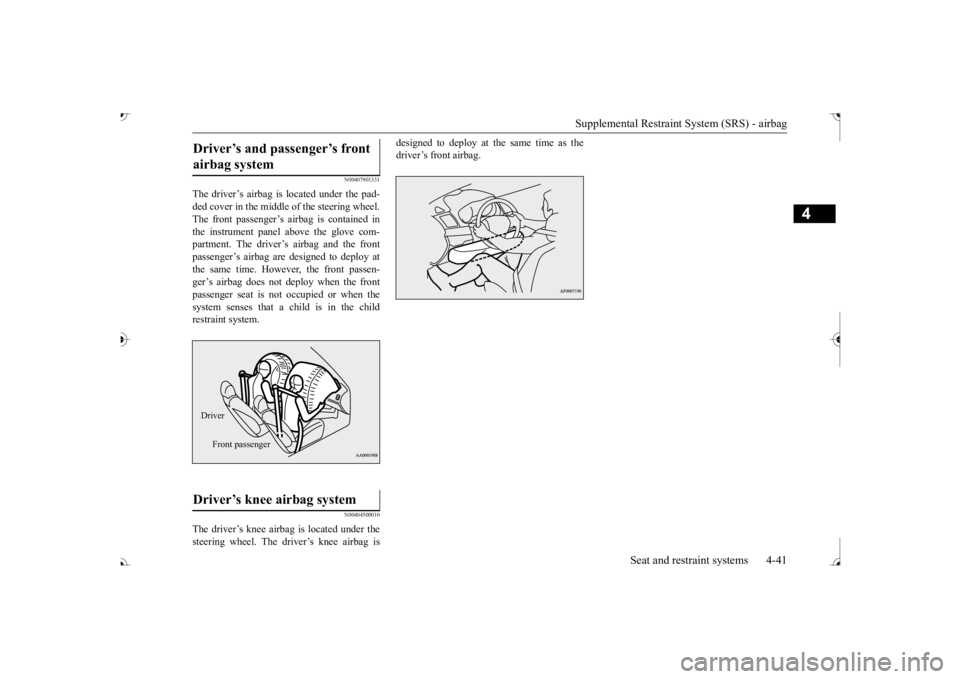
The driver’s airbag is located under the pad- ded cover in the middle of the steering wheel.The front passenger’s ai
rbag is contained in
the instrument panel above the glove com- partment. The driver’s airbag and the frontpassenger’s airbag ar
e designed to deploy at
the same time. However, the front passen- ger’s airbag does not deploy when the front passenger seat is not
occupied or when the
system senses that a child is in the childrestraint system.
N00404500010
The driver’s knee airbag is located under the steering wheel. The driver’s knee airbag is
designed to deploy at the same time as the driver’s front airbag.
Driver’s and passenger’s front airbag system Driver’s knee airbag system Driver
Front passenger
BK0239700US.book 41 ページ 2016年6月16日 木曜日 午前10時58分
Page 75 of 521
Supplemental Restraint System (SRS) - airbag 4-46 Seat and restraint systems
4
N00419201315
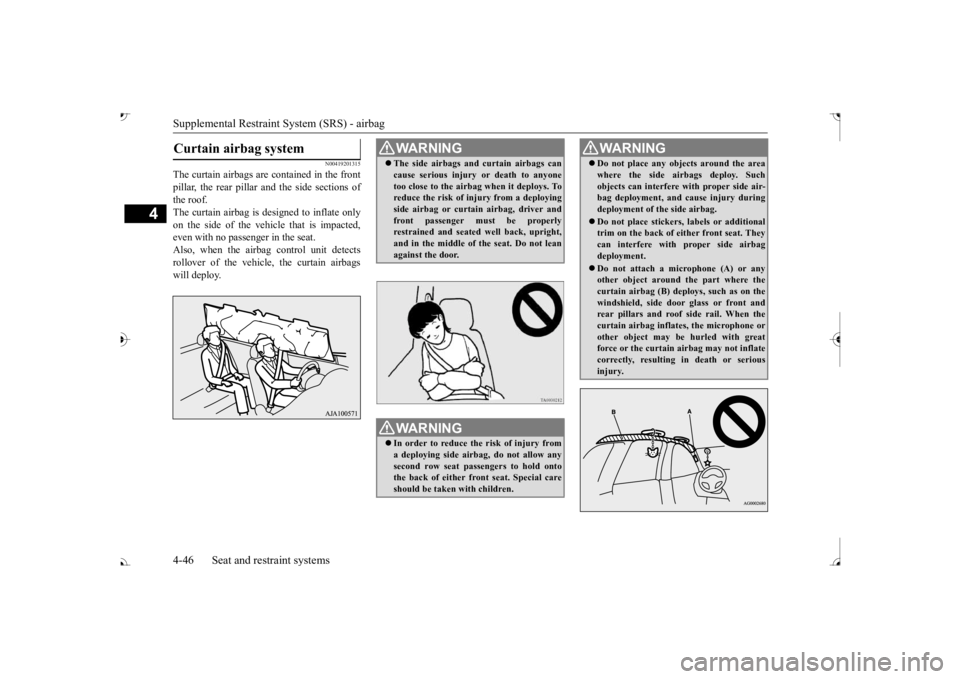
The curtain airbags are contained in the front pillar, the rear pillar and the side sections of the roof.The curtain airbag is designed to inflate only on the side of the vehi
cle that is impacted,
even with no passenger in the seat.Also, when the airbag control unit detects rollover of the vehicle, the curtain airbags will deploy.Curtain airbag system
WA R N I N G The side airbags and curtain airbags can cause serious injury
or death to anyone
too close to the airbag when it deploys. Toreduce the risk of in
jury from a deploying
side airbag or curtai
n airbag, dr
iver and
front passenger must be properlyrestrained and seated well back, upright, and in the middle of the seat. Do not lean against the door.WA R N I N G In order to reduce the risk of injury from a deploying side airb
ag, do not allow any
second row seat passengers to hold onto the back of either front seat. Special careshould be taken with children.
Do not place any obje
cts around the area
where the side airbags deploy. Suchobjects can interfere with proper side air-bag deployment, and cause injury during deployment of the side airbag. Do not place stickers,
labels or additional
trim on the back of either front seat. They can interfere with proper side airbagdeployment. Do not attach a microphone (A) or any other object around
the part where the
curtain airbag (B) depl
oys, such as on the
windshield, side door
glass or front and
rear pillars and roof
side rail. When the
curtain airbag inflates, the microphone or other object may be
hurled with great
force or the curtain airbag may not inflate correctly, resulting
in death or serious
injury.WA R N I N G
BK0239700US.book 46 ページ 2016年6月16日 木曜日 午前10時58分
Page 76 of 521
Supplemental Restraint System (SRS) - airbag
Seat and restraint systems 4-47
4
N00408201591
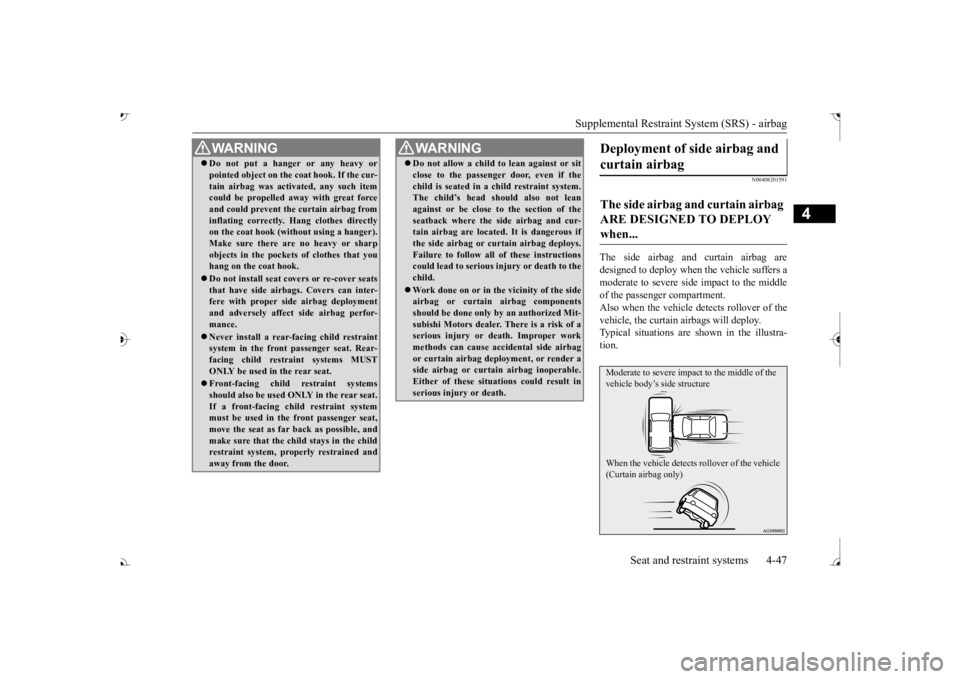
The side airbag and curtain airbag are designed to deploy when
the vehicle suffers a
moderate to severe side
impact to the middle
of the passenger compartment.Also when the vehicle detects rollover of the vehicle, the curtain airbags will deploy. Typical situations are
shown in the illustra-
tion.
WA R N I N G Do not put a hanger or any heavy or pointed object on the
coat hook. If the cur-
tain airbag was activated, any such itemcould be propelled away with great force and could prevent the curtain airbag from inflating correctly. Hang clothes directlyon the coat hook (without using a hanger). Make sure there ar
e no heavy or sharp
objects in the pocket
s of clothes that you
hang on the coat hook. Do not install seat covers or re-cover seats that have side airb
ags. Covers can inter-
fere with proper si
de airbag deployment
and adversely affect
side airbag perfor-
mance. Never install a rear-facing child restraint system in the front passenger seat. Rear- facing child restraint systems MUST ONLY be used in the rear seat. Front-facing child restraint systems should also be used ONLY in the rear seat.If a front-facing child restraint system must be used in the front passenger seat, move the seat as far
back as possible, and
make sure that the child stays in the child restraint system, properly restrained and away from the door.
Do not allow a child to
lean against or sit
close to the passenger door, even if thechild is seated in a child restraint system.The child’s head sh
ould also not lean
against or be close to the section of the seatback where the side airbag and cur-tain airbag are located. It is dangerous if the side airbag or cu
rtain airbag deploys.
Failure to follow all of these instructionscould lead to serious in
jury or death to the
child. Work done on or in th
e vicinity of the side
airbag or curtain
airbag components
should be done only
by an authorized Mit-
subishi Motors dealer. There is a risk of a serious injury or de
ath. Improper work
methods can cause acci
dental side airbag
or curtain airbag depl
oyment, or render a
side airbag or curtai
n airbag inoperable.
Either of these situations could result inserious injury or death.WA R N I N G
Deployment of side airbag and curtain airbag The side airbag and curtain airbag ARE DESIGNED TO DEPLOY when... Moderate to severe impact to the middle of the vehicle body’s side structure When the vehicle detects rollover of the vehicle (Curtain airbag only)
BK0239700US.book 47 ページ 2016年6月16日 木曜日 午前10時58分
Page 367 of 521
Driving precaution 6-2 Driving safety
6
N00629301092
Your vehicle has been designed for both nor- mal and occasional off-road use. However, avoid driving the vehicle through areas wherethe tires may get stuck in deep sand or mud as your vehicle is designe
d primarily for use on
pavement, unlike a conventional off-roadvehicle. Keep in mind that 2-wheel drive vehicles are less capable than 4-wh
eel drive vehicles for
driving on muddy, slippery, wet or snow-cov- ered roads. Utility vehicles have
higher ground clearance
and a narrower track, which enables them toperform in a wide variety of off-road situa- tions. Because of the higher ground clear- ance, these vehicles have a higher center ofgravity, which makes them handle differently than ordinary vehicles when driving on pave- ment. They are not designed to maneuver orcorner at the same speed on pavement as con- ventional 2-wheel driv
e passenger cars any
more than low-slung sports cars are designed
to perform satisfactorily in off-road condi- tions.Always drive safely
and steer the vehicle
carefully. Avoid operating the vehicle in a manner that might require sharp turns orabrupt maneuvers. As wi
th other vehicles of
this type, failure to operate this vehicle cor- rectly can result in lo
ss of control or vehicle
rollover. In a rollover crash, an unbelted person is sig- nificantly more likely to die than a person wearing a seat belt. Be
fore starting the vehi-
cle, always make cert
ain that you and all your
passengers are properly wearing their seat belts (with children in the rear seat, in appro- priate restraints).
N00628801191
Fuel economy is depe
ndent on many factors.
Your personal driving habits can have a sig-nificant effect on your fuel consumption. Several recommendations
for achieving the
greatest fuel economy are listed below. Whenever accelerating from a stop, always accelerate
slowly and smoothly.
When parked for even a short period, do not idle the engine. Shut it off. Plan your trips to avoid unnecessary stops.
Keep your tires inflated to the recom- mended pressures. When driving a 4-wheel drive vehicle on highways or dry improved roads, set the drive mode to “4WD ECO” or “4WDAUTO” (Electronically controlled 4WD), or “AWC ECO” or “NORMAL” (S- AW C ) . For freeway driving, maintain a speed of approximately 50 mph (80 km/h) when traffic, roadway and weather conditions safely permit. Keep your air filter clean and your vehicle lubricated according
to the recommenda-
tions in this manual. Always keep your ve
hicle well main-
tained. A poorly maintained engine wastes fuel and costs money. Never overload your vehicle.
N00628900049
Drunk driving is one of the most frequent causes of accidents.Your driving ability ca
n be seriously impaired
even with blood alcohol levels far below the legal minimum. If you
have been drinking,
don’t drive. Ride with a designated non- drinking driver, call a cab or a friend, or use public transportation. Drinking coffee or tak-ing a cold shower will not make you sober.
Driving precaution
WA R N I N G Utility vehicles have
a significantly higher
rollover rate than othe
r types of vehicles.
Avoid abrupt maneuvers and excessive speed. Always buckle up.
Fuel economy
Driving, alcohol and drugs
BK0239700US.book 2 ページ 2016年6月16日 木曜日 午前10時58分
Page 369 of 521
Vehicle preparation before driving 6-4 Driving safety
6
N00629001709
For a safer and more enjoyable trip, always check for the following: Before starting the vehicle, make certain that you and all passengers are seated andwearing their seat
belts properly (with
children in the rear seat, in appropriate restraints), and that all the doors and theliftgate are locked.
Move the driver’s seat as far backward as possible, while keeping good visibility,and good control of the steering wheel, brakes, accelerator, and controls. Check the instrument panel indicators and multi-information display
for any possible prob-
lem. Similarly, the front
passenger seat should
also be moved as fa
r back as possible.
Make sure that infants and small children are properly restrained in accordance with all laws and
regulations.
Check these by selecting the defroster mode, and set the blower swit
ch on high. You should
be able to feel the air blowing against thewindshield. Refer to “Defrosti
ng or defogging (wind-
shield, door windows)” on page 7-12 Check all the tires for heavy tread wear or uneven wear patterns. Look for stones, nails,glass, or other objects
stuck in the tread. Look
for any tread cuts or
sidewall cracks. Check
the wheel nuts for tightness, and the tires(including spare tire) for proper pressure.
Replace your tires before they are heavily worn out.As your vehicle is equi
pped with a tire pres-
sure monitoring system, there is a risk of damage to the tire inflation pressure sensorswhen the tire is replaced on the rim. Tire replacement should, onl
y, be performed by an
authorized Mitsubishi Motors dealer. Have someone watch wh
ile you turn all the
exterior lights on and off. Also check the turn signal indicators and hi
gh-beam indicators on
the instrument panel. Check the ground under the vehicle after parking overnight, for
fuel, water, oil, or
other leaks. Make sure
all the fluid levels are
correct. Also, if you
can smell fuel, you need
to find out why imme
diately and have it
fixed.
N00629201134
Even this vehicle’s sa
fety equipment, and
your safest driving, ca
nnot guarantee that you
can avoid an accident or injury. However, if
Vehicle preparation before driving Seat belts and seats
Defrosters Tires
Lights Fluid leaks Safe driving techniques
BK0239700US.book 4 ページ 2016年6月16日 木曜日 午前10時58分
Page 514 of 521
Alphabetical index
12-1
12
Numerics
12 V power outlets
............................
5-267
4-wheel drive operation
.......................
5-88
A
Accessory (installation)
.........................
3-6
Active stability control (ASC)
............
5-100
Adaptive Cruise C
ontrol System (ACC)
.......
5-106 Air cleaner filter
...................................
9-9
Air conditioner
Dual-zone automatic climate control air conditioner
.....................................
7-5
Important air condi
tioning operating tips
..
7-13
Air purifier
.........................................
7-14
Airbag
...............................................
4-34
All-wheel drive operation
....................
5-88
Aluminum wheels
...............................
9-43
AM/FM radio
.....................................
7-14
Anti-lock braking system
.....................
5-97
Arm rest
.............................................
4-10
Assist grip
........................................
5-283
Audio
AM/FM radio
.................................
7-14
CD player
......................................
7-14
Troubleshooting
.............................
7-47
Automatic high beam system
..............
5-224
Automatic transaxle
............................
5-67
Fluid
.....................................
9-11
, 11-7
Selector le
ver operation
..................
5-68
Selector lever positions
...................
5-71
Sports mode
...................................
5-72
B
Back-up light
Bulb capacity
.................................
9-32
Replacement
..................................
9-38
Ball joint, steering linka
ge seals, drive shaft
boots
...............................................
9-24
Battery
..............................................
9-13
Charging system warning light
.......
5-217
Checking battery
electrolyte level
....
9-13
Disconnection and connection
.........
9-14
During cold weather
.......................
9-13
Specification
..................................
11-6
Blind Spot Warning (BSW)
................
5-131
Bluetooth® 2.0 interface
....................
5-240
Bottle holders
....................................
5-280
Brake
Fluid
.....................................
9-12
, 11-7
Brake assist
........................................
5-96
Braking
Anti-lock braking system
................
5-97
Braking
...........................................
6-5
Hose
..............................................
9-24
Pad wear alarm
...............................
5-93
Parking brake
.................................
5-53
Pedal
.............................................
5-92
Pedal free play
................................
9-21
Power brakes
..................................
5-92
Service brake
..................................
5-92
Warning lights and buzzer
.............
5-216
Break-in recommendations
....................
5-3
Bulb capacity
......................................
9-32
C
California Perchl
orate Materials
Requirements
.....................................
3-7
Capacities
..........................................
11-7
Card holder
............................
5-266
, 5-277
Cargo area cover
...............................
5-281
Cargo loads
........................................
6-10
Cargo room light
...............................
5-275
Bulb capacity
.................................
9-33
Catalytic converter
................................
9-2
Cautions on the handling of all-wheel drive vehicles
............................................
5-91
CD player
...........................................
7-14
Certification label
...............................
11-3
Charging system warning light
...........
5-217
Child restraint systems
........................
4-27
Child safety locks for rear door
............
5-37
BK0239700US.book 1 ページ 2016年6月16日 木曜日 午前10時58分