4WD MITSUBISHI OUTLANDER III 2018 User Guide
[x] Cancel search | Manufacturer: MITSUBISHI, Model Year: 2018, Model line: OUTLANDER III, Model: MITSUBISHI OUTLANDER III 2018Pages: 441, PDF Size: 13.71 MB
Page 272 of 441
Indicator light, warning light, and information screen display list (multi information display - Type 1)
Features and controls 5-191
5
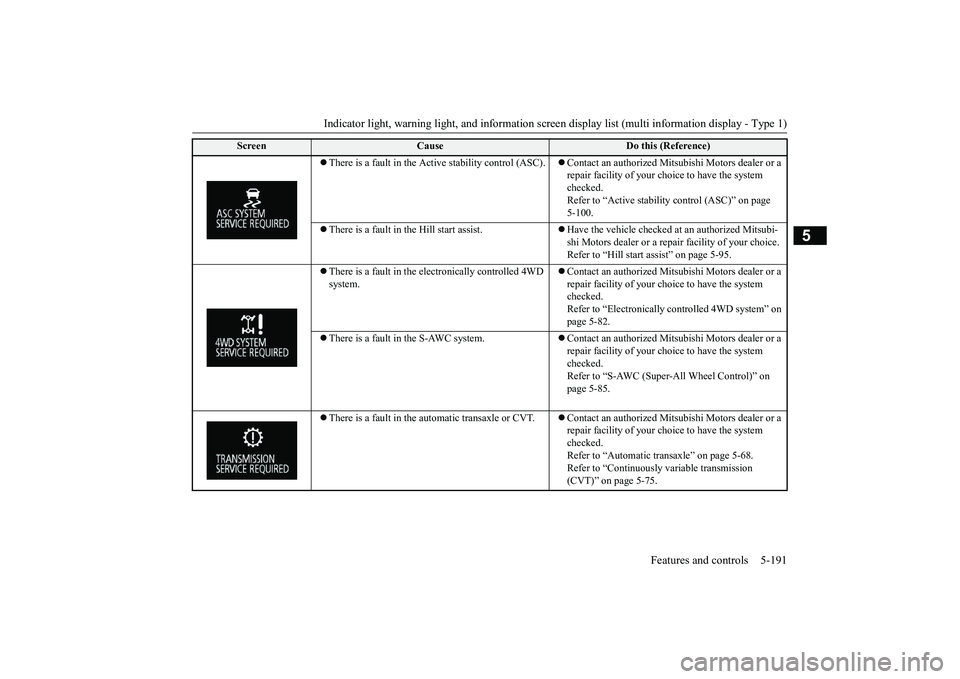
There is a fault in the Active stability control (ASC).
Contact an authorized Mitsubishi Motors dealer or a repair facility of your choi
ce to have the system
checked.Refer to “Active stability control (ASC)” on page 5-100.
There is a fault in the Hill start assist.
Have the vehicle checked at
an authorized Mitsubi-
shi Motors dealer or a repa
ir facility of your choice.
Refer to “Hill start
assist” on page 5-95.
There is a fault in the electronically controlled 4WD system.
Contact an authorized Mitsubishi Motors dealer or a repair facility of your choi
ce to have the system
checked.Refer to “Electronically
controlled 4WD system” on
page 5-82.
There is a fault in the S-AWC system.
Contact an authorized Mitsubishi Motors dealer or a repair facility of your choi
ce to have the system
checked.Refer to “S-AWC (Super-All Wheel Control)” on page 5-85.
There is a fault in the automatic transaxle or CVT.
Contact an authorized Mitsubishi Motors dealer or a repair facility of your choi
ce to have the system
checked.Refer to “Automatic tr
ansaxle” on page 5-68.
Refer to “Continuously variable transmission (CVT)” on page 5-75.
Screen
Cause
Do this (Reference)
BK0249100US.book 191 ページ 2017年5月10日 水曜日 午前8時49分
Page 273 of 441
Indicator light, warning light, and information screen display list (multi information display - Type 1)
5
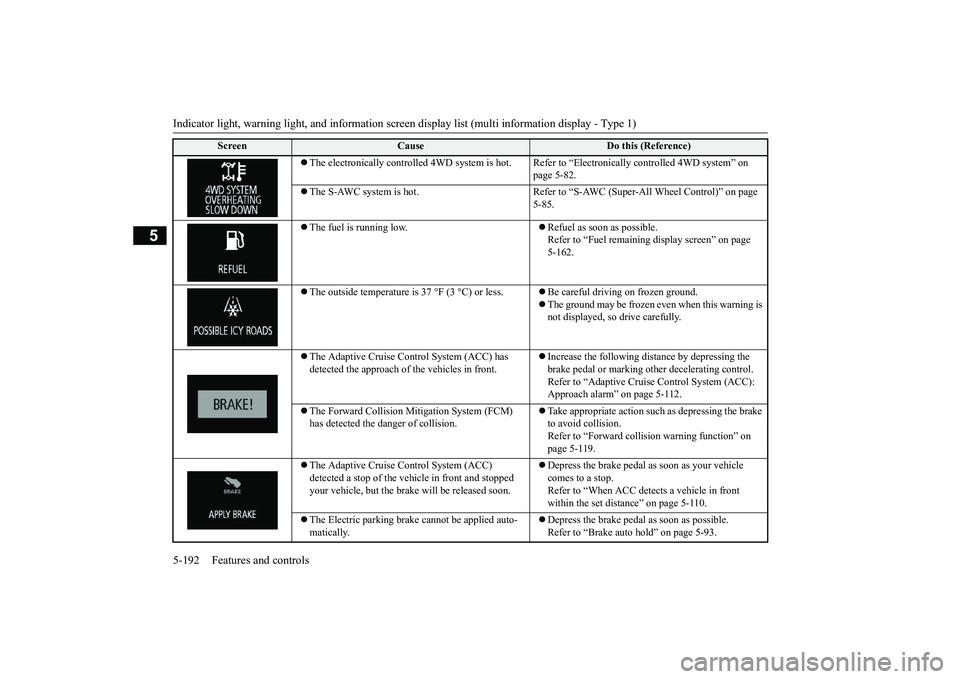
The electronically controlled 4WD
system is hot. Refer to “Electr
onically controlled
4WD system” on
page 5-82.
The S-AWC system is hot. Refer to “S-A
WC (Super-All Wheel Control)” on page
5-85.
The fuel is running low.
Refuel as soon as possible. Refer to “Fuel remaining
display screen” on page
5-162.
The outside temperature is
37 °F (3 °C) or less.
Be careful driving on frozen ground.The ground may be frozen even when this warning is not displayed, so drive carefully.
The Adaptive Cruise Control System (ACC) has detected the approach of
the vehicles in front.
Increase the following di
stance by depressing the
brake pedal or marking ot
her decelerating control.
Refer to “Adaptive Cruise
Control System (ACC):
Approach alarm” on page 5-112.
The Forward Collision Mitigation System (FCM) has detected the da
nger of collision.
Take appropriate action such
as depressing the brake
to avoid collision.Refer to “Forward colli
sion warning function” on
page 5-119.
The Adaptive Cruise Control System (ACC) detected a stop of the vehi
cle in front and stopped
your vehicle, but the brake
will be released soon.
Depress the brake pedal as soon as your vehicle comes to a stop.Refer to “When ACC dete
cts a vehicle in front
within the set distance” on page 5-110.
The Electric parking brake
cannot be applied auto-
matically.
Depress the brake pedal as soon as possible.Refer to “Brake auto hold” on page 5-93.
Screen
Cause
Do this (Reference)
BK0249100US.book 192 ページ 2017年5月10日 水曜日 午前8時49分
Page 278 of 441
Indicator light, warning light, and information screen display list (multi information display - Type 1)
Features and controls 5-197
5
N00558201353
The operation status of each syst
em is displayed on the informat
ion screen. For furthe
r details, refer to
the appropriate page
for each system.
Other interrupt displays
Screen
Cause
Do this (Reference)
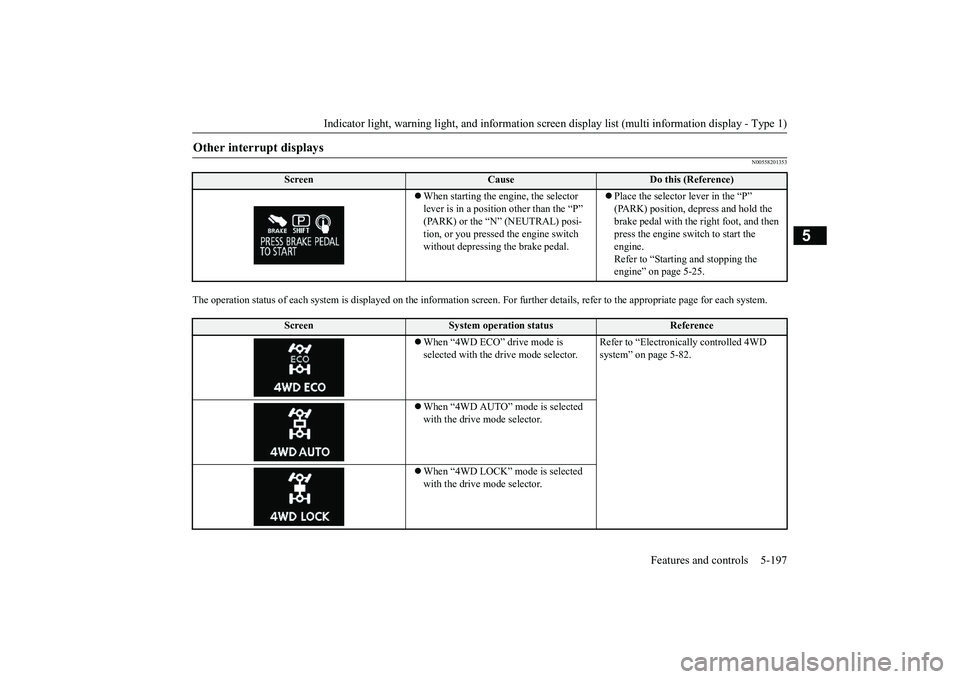
When starting the engine, the selector lever is in a positi
on other than the “P”
tion, or you pressed the engine switch without depressing the brake pedal.
Place the selector lever in the “P” (PARK) position, depress and hold the brake pedal with the right foot, and then press the engine switch to start the engine.Refer to “Starting and stopping the engine” on page 5-25.
Screen
System operation status
Reference
When “4WD ECO” drive mode is selected with the drive mode selector.
Refer to “Electronica
lly controlled 4WD
system” on page 5-82.
When “4WD AUTO” mode is selected with the drive mode selector.When “4WD LOCK” mode is selected with the drive mode selector.
BK0249100US.book 197 ページ 2017年5月10日 水曜日 午前8時49分
Page 282 of 441
Indicator and warning light package (multi information display - Type 2)
Features and controls 5-201
5
N00519801921
Indicator and warning light package (mu
lti information display - Type 2)
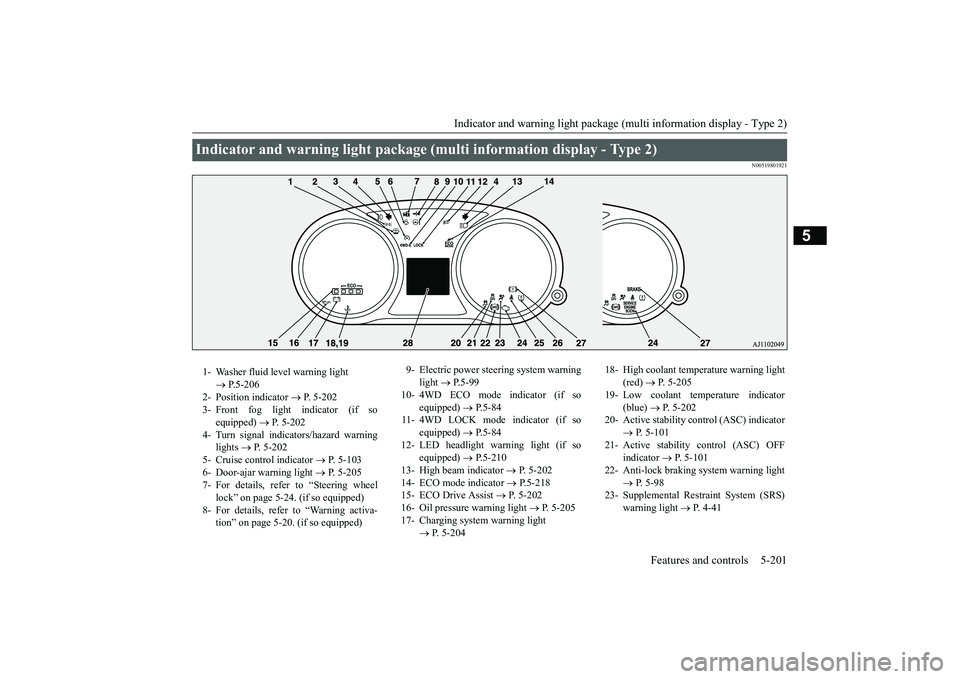
1- Washer fluid level warning light
P.5-206
2- Position indicator
P. 5-202
3- Front fog light indicator (if so
equipped)
P. 5-202
4- Turn signal indicators/hazard warning
lights
P. 5-202
5- Cruise control indicator
P. 5-103
6- Door-ajar warning light
P. 5-205
7- For details, refer to “Steering wheel
lock” on page 5-24. (if so equipped)
8- For details, refer to “Warning activa-
tion” on page 5-20. (if so equipped)
9- Electric power steering system warning
light
P.5-99
10- 4WD ECO mode indicator (if so
equipped)
P.5-84
11- 4WD LOCK mode indicator (if so
equipped)
P.5-84
12- LED headlight warning light (if so
equipped)
P.5-210
13- High beam indicator
P. 5-202
14- ECO mode indicator
P.5-218
15- ECO Drive Assist
P. 5-202
16- Oil pressure warning light
P. 5-205
17- Charging system warning light
P. 5-204
18- High coolant temperature warning light
(red)
P. 5-205
19- Low coolant temp
erature indicator
(blue)
P. 5-202
20- Active stability control (ASC) indicator
P. 5-101
21- Active stability control (ASC) OFF
indicator
P. 5-101
22- Anti-lock braking system warning light
P. 5-98
23- Supplemental Restra
int System (SRS)
warning light
P. 4 - 4 1
BK0249100US.book 201 ページ 2017年5月10日 水曜日 午前8時49分
Page 299 of 441
Hazard warning flasher switch5-218 Features and controls
5
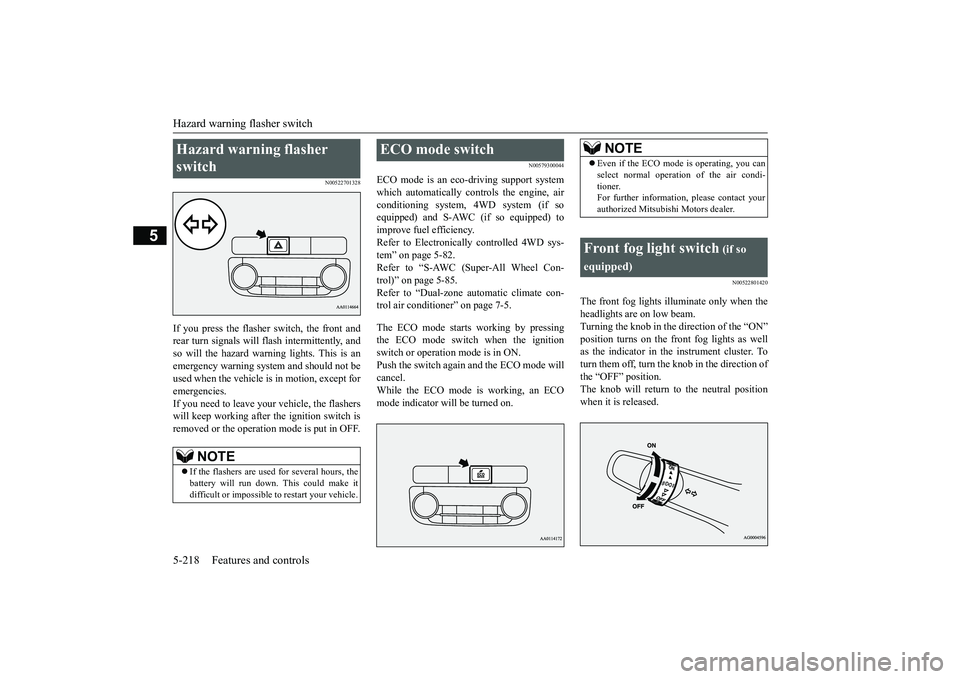
N00522701328
If you press the flasher switch, the front andrear turn signals will flash intermittently, andso will the hazard warn
ing lights. This is an
emergency warning syst
em and should not be
used when the vehicle is in motion, except foremergencies.If you need to leave your vehicle, the flasherswill keep working afte
r the ignition switch is
removed or the operation mode is put in OFF.
N00579300044
ECO mode is an eco-driving support systemwhich automatically cont
rols the engine, air
conditioning system,
4WD system (if so
equipped) and S-AWC (if so equipped) toimprove fuel efficiency.Refer to Electronically
controlled 4WD sys-
tem” on page 5-82.Refer to “S-AWC (Super-All Wheel Con-trol)” on page 5-85.Refer to “Dual-zone automatic climate con-trol air conditioner” on page 7-5.The ECO mode starts
working by pressing
the ECO mode switch when the ignitionswitch or operation mode is in ON.Push the switch again and the ECO mode willcancel.While the ECO mode is working, an ECOmode indicator will be turned on.
N00522801420
The front fog lights illuminate only when theheadlights are on low beam.Turning the knob in the direction of the “ON”position turns on the front fog lights as wellas the indicator in the instrument cluster. Toturn them off, turn the knob in the direction ofthe “OFF” position.The knob will return to the neutral positionwhen it is released.
Hazard warning flasher switch
NOTE
If the flashers are used for several hours, thebattery will run down.
This could make it
difficult or impossible
to restart your vehicle.
ECO mode switch
NOTE
Even if the ECO mode is operating, you canselect normal operati
on of the air condi-
tioner.For further information, please contact yourauthorized Mitsubishi Motors dealer.
Front fog light switch
(if so
equipped)
BK0249100US.book 218 ページ 2017年5月10日 水曜日 午前8時49分
Page 331 of 441
Driving precaution6-2 Driving safety
6
N00629301092
Your vehicle has been designed for both nor-mal and occasional off-road use. However,avoid driving the vehicle through areas wherethe tires may get stuck in deep sand or mud asyour vehicle is designe
d primarily for use on
pavement, unlike a conventional off-roadvehicle.Keep in mind that 2-wheel drive vehicles areless capable than 4-wh
eel drive vehicles for
driving on muddy, slippery, wet or snow-cov-ered roads.Utility vehicles have
higher ground clearance
and a narrower track, which enables them toperform in a wide variety of off-road situa-tions. Because of the higher ground clear-ance, these vehicles have a higher center ofgravity, which makes them handle differentlythan ordinary vehicles when driving on pave-ment. They are not designed to maneuver orcorner at the same speed on pavement as con-ventional 2-wheel driv
e passenger cars any
more than low-slung sports cars are designed
to perform satisfactorily in off-road condi-tions.Always drive safely
and steer the vehicle
carefully. Avoid operating the vehicle in amanner that might require sharp turns orabrupt maneuvers. As wi
th other vehicles of
this type, failure to operate this vehicle cor-rectly can result in lo
ss of control or vehicle
rollover.In a rollover crash, an unbelted person is sig-nificantly more likely to die than a personwearing a seat belt. Be
fore starting the vehi-
cle, always make cert
ain that you and all your
passengers are properly wearing their seatbelts (with children in the rear seat, in appro-priate restraints).
N00628801191
Fuel economy is depe
ndent on many factors.
Your personal driving habits can have a sig-nificant effect on your fuel consumption.Several recommendations
for achieving the
greatest fuel economy are listed below.Whenever accelerating from a stop,always accelerate
slowly and smoothly.
When parked for even a short period, donot idle the engine. Shut it off.Plan your trips to avoid unnecessarystops.
Keep your tires inflated to the recom-mended pressures.When driving a 4-wheel drive vehicle onhighways or dry improved roads, set thedrive mode to “4WD ECO” or “4WDAUTO” (Electronically controlled 4WD),or “AWC ECO” or “NORMAL” (S-AW C ) .For freeway driving, maintain a speed ofapproximately 50 mph (80 km/h) whentraffic, roadway and weather conditionssafely permit.Keep your air filter clean and your vehiclelubricated according
to the recommenda-
tions in this manual.Always keep your ve
hicle well main-
tained. A poorly maintained enginewastes fuel and costs money.Never overload your vehicle.
N00628900049
Drunk driving is one of the most frequentcauses of accidents.Your driving ability ca
n be seriously impaired
even with blood alcohol levels far below thelegal minimum. If you
have been drinking,
don’t drive. Ride with a designated non-drinking driver, call a cab or a friend, or usepublic transportation. Drinking coffee or tak-ing a cold shower will not make you sober.
Driving precaution
WA R N I N GUtility vehicles have
a significantly higher
rollover rate than othe
r types of vehicles.
Avoid abrupt maneuvers and excessivespeed. Always buckle up.
Fuel economy
Driving, alcohol and drugs
BK0249100US.book 2 ページ 2017年5月10日 水曜日 午前8時49分
Page 432 of 441
Vehicle weights
Specifications 11-5
11
N01147602038
*1: Vehicles sold in CanadaGVWR: maximum total weight (load) limit specified for the vehicleGAWR: maximum weight (load) limit specified for the front or rear axleSeating capacity: the maxi
mum number of occupants
Vehicle weights
Item
2.4 liter models
3.0 liter models
Seating capacity
5 persons
7 persons
7 persons
2WD
4WD
Vehicles without
S-AWC
Ve h i c l e s w i t h
S-AWC
Gross vehicle
weight rating
(GVWR)
4,795 lb (2,175 kg) 4,795 lb (2,175 kg)
4,828 lb (2,190 kg), 4,861 lb (2,205 kg)
1
4,861 lb (2,205 kg) 5,005 lb (2,270 kg)
Gross axle weight rating (GAWR)
Rear 2,756 lb (1,250 kg)
Total trailer weight
With brake 1,500 lb (680 kg) 3,500 lb (1,588 kg)Without brake 1,250 lb (567 kg) 1,400 lb (635 kg)
Vehicle capacity weight 827 lb (375 kg) 1,157 lb (525 kg)Maximum roof load 110 lb (50 kg)
NOTE
Roof load is important becaus
e it affects the vehicle capacity weight. Refe
r to “Loading cargo on the roof” on page 6-10.
SC00001100-9.fm 5 ページ 2017年5月11日 木曜日 午後1時33分
Page 437 of 441
Alphabetical index12-2
12
Fluid
....................................
9-11
, 11-7
Selector lever operation
...................
5-75
Selector le
ver positions
...................
5-79
Sports mode
...................................
5-80
Coolant (engine)
..........................
9-8
, 11-7
Cruise control
...................................
5-103
Cup holder
.......................................
5-242
D
Daytime running lights
Bulb capacity
.................................
9-32
Replacement
..................................
9-36
Defogger (rear window)
....................
5-225
Defrosting or defogging (windshield, door windows)
..................................
7-8
, 7-12
Dimensions
........................................
11-4
Dimmer (high/lo
w beam change)
.......
5-210
Disc brake pads
..................................
9-24
Dome light (front)/Reading lights
.......
5-236
Bulb capacity
.................................
9-33
Dome light (rear)
..............................
5-237
Bulb capacity
.................................
9-33
Doors
Lock
..............................................
5-34
Power door locks
............................
5-36
Driving during cold weather
..................
6-5
Driving precaution
................................
6-2
Driving, alcohol and drugs
.....................
6-2
Dual-zone automatic climate control air conditioner
........................................
7-5
E
ECO mode switch
.............................
5-218
Electric parking brake
..........................
5-54
Electric power steering system (EPS)
....
5-99
Electric rear window
defogger switch
..5-225
Electronic immobilizer (Anti-theft starting system)
.....................................
5-4
, 5-28
Electronically cont
rolled 4WD system
..5-82
Emission-control system maintenance
...
9-23
Engine
Compartment
...................................
9-5
Coolant
...................................
9-8
, 11-7
Hood
...............................................
9-3
Malfunction indicator light
.............
5-204
MIVEC
.................................
5-26
, 5-67
Oil and oil filter
.......................
9-6
, 11-7
Overheating
.....................................
8-4
Serial number
.................................
11-2
Specification
...................................
11-6
Engine hood
........................................
9-3
Engine switch
.....................................
5-18
Exhaust system
...................................
9-24
F
Floor console box
..............................
5-240
Floor mat
.............................................
6-3
Fluid
Automatic transaxle fluid
.......
9-11
, 11-7
Brake fluid
............................
9-13
, 11-7
Continuously variable transmission (CVT)fluid
...................................
9-11
, 11-7
Engine coolant
........................
9-8
, 11-7
Engine oil
...............................
9-6
, 11-7
Rear axle oil
..........................
9-12
, 11-7
Transfer oil
...........................
9-12
, 11-7
Washer fluid
.........................
9-12
, 11-7
Fluid capacities and lubricants
.............
11-7
Forward Collision Miti
gation System (FCM)
5-118Free-hand advanced security transmitter (F.A.S.T.-key)
..................................
5-13
Front fog lights
Bulb capacity
.................................
9-32
Indicators
.....................................
5-202
Replacement
..................................
9-36
Switch
.........................................
5-218
Front side-marker lights
Bulb capacity
.................................
9-32
Replacement
..................................
9-35
Front turn signal light
Bulb capacity
.................................
9-32
Replacement
..................................
9-36
Fuel
Filling the fuel tank
...........................
3-3
Fuel economy
...................................
6-2
BK0249100US.book 2 ページ 2017年5月10日 水曜日 午前8時49分