cruise control MITSUBISHI OUTLANDER III 2018 User Guide
[x] Cancel search | Manufacturer: MITSUBISHI, Model Year: 2018, Model line: OUTLANDER III, Model: MITSUBISHI OUTLANDER III 2018Pages: 441, PDF Size: 13.71 MB
Page 192 of 441
Adaptive Cruise Control System (ACC) (if so equipped)
Features and controls 5-111
5
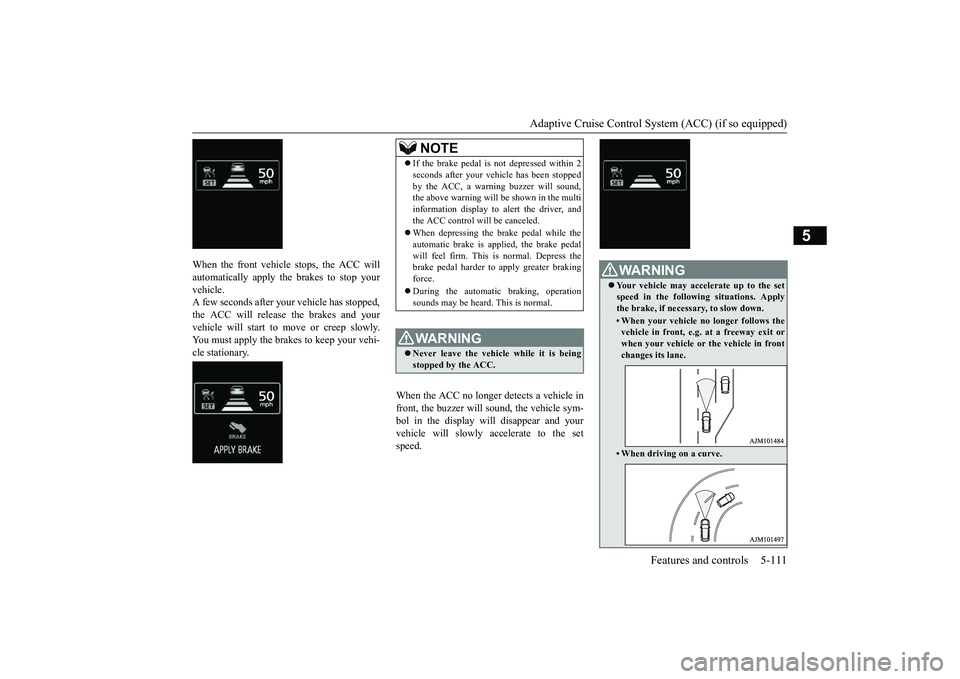
When the front vehicle stops, the ACC willautomatically apply the brakes to stop yourvehicle.A few seconds after your vehicle has stopped,the ACC will release the brakes and yourvehicle will start to move or creep slowly.You must apply the brakes to keep your vehi-cle stationary.
When the ACC no longer detects a vehicle infront, the buzzer will sound, the vehicle sym-bol in the display will disappear and yourvehicle will slowly accelerate to the setspeed.
NOTE
If the brake pedal is not depressed within 2seconds after your vehi
cle has been stopped
by the ACC, a warni
ng buzzer will sound,
the above warning will be shown in the multiinformation display to alert the driver, andthe ACC control will be canceled.When depressing the brake pedal while theautomatic brake is applied, the brake pedalwill feel firm. This is normal. Depress thebrake pedal harder to
apply greater braking
force.During the automatic braking, operationsounds may be heard. This is normal.WA R N I N GNever leave the vehicle while it is beingstopped by the ACC.
WA R N I N GYour vehicle may accelerate up to the setspeed in the following situations. Applythe brake, if necessary, to slow down.• When your vehicle no longer follows thevehicle in front, e.g. at a freeway exit orwhen your vehicle or
the vehicle in front
changes its lane.• When driving on a curve.
BK0249100US.book 111 ページ 2017年5月10日 水曜日 午前8時49分
Page 193 of 441
Adaptive Cruise Control System (ACC) (if so equipped)5-112 Features and controls
5
N00576900036
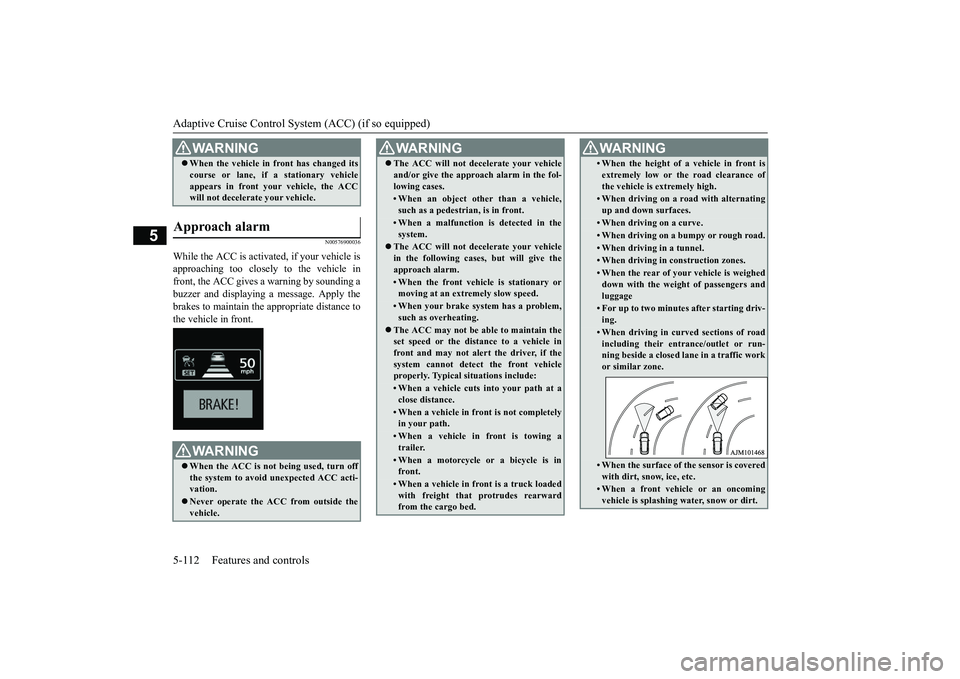
While the ACC is activated, if your vehicle isapproaching too closely to the vehicle infront, the ACC gives a warning by sounding abuzzer and displaying a message. Apply thebrakes to maintain the appropriate distance tothe vehicle in front.When the vehicle in
front has changed its
course or lane, if a stationary vehicleappears in front you
r vehicle, the ACC
will not decelerate your vehicle.
Approach alarm
WA R N I N GWhen the ACC is not being used, turn offthe system to avoid
unexpected ACC acti-
vation.Never operate the AC
C from outside the
vehicle.WA R N I N G
The ACC will not decelerate your vehicleand/or give the approach alarm in the fol-lowing cases.• When an object other than a vehicle,such as a pedestri
an, is in front.
• When a malfunction is detected in thesystem.
The ACC will not decelerate your vehiclein the following cases, but will give theapproach alarm.• When the front vehicle is stationary ormoving at an extr
emely slow speed.
• When your brake system has a problem,such as overheating.
The ACC may not be able to maintain theset speed or the dist
ance to a vehicle in
front and may not alert the driver, if thesystem cannot detect the front vehicleproperly. Typical situations include: • When a vehicle cuts
into your path at a
close distance.• When a vehicle in front is not completelyin your path.• When a vehicle in front is towing atrailer.• When a motorcycle or a bicycle is infront.• When a vehicle in fr
ont is a truck loaded
with freight that protrudes rearwardfrom the cargo bed.WA R N I N G
• When the height of a vehicle in front isextremely low or the road clearance ofthe vehicle is extremely high.• When driving on a r
oad with alternating
up and down surfaces.• When driving on a curve.• When driving on a bumpy or rough road.• When driving in a tunnel.• When driving in construction zones.• When the rear of your vehicle is weigheddown with the weight of passengers andluggage• For up to two minutes after starting driv-ing.• When driving in curved sections of roadincluding their entrance/outlet or run-ning beside a closed lane in a traffic workor similar zone.• When the surface of th
e sensor is covered
with dirt, snow, ice, etc.• When a front vehicle or an oncomingvehicle is splashing wa
ter, snow or dirt.
WA R N I N G
BK0249100US.book 112 ページ 2017年5月10日 水曜日 午前8時49分
Page 194 of 441

Adaptive Cruise Control System (ACC) (if so equipped)
Features and controls 5-113
5
N00581500027
There are two ways to increase the set speed.The set speed will increase by 1 mph (1km/h) every time you push up the “RES +”switch while the ACC is activated. If youhold the switch pushed up, the set speedincreases in 5 mph (5 km/h) increments.
When the accelerator
pedal is depressed
while driving with the ACC control working,you can accelerate the vehicle beyond thepresently set speed.When the vehicle speed reaches your desiredspeed, push down and release the “SET -”
a winding road.
Never use the ACC in the following situa-tions:• In heavy traffic.• On winding roads.• On slippery roads, such as icy, snow-cov-ered or dirt roads.• In adverse weather conditions, such asrain, snow or sand storms, etc.• On steep downslopes.• When the inclination of a road fre-quently changes.• When the approach alarm frequentlysounds.• When your vehicle is towed or is towinganother vehicle.• When your vehicle is on a chassis dyna-mometer or free rollers.• When tire inflation pressures are notadequate.• When the temporary sp
are tire is being
used.• When the radar sensor and/or its sur-rounding area are damaged or deformed.WA R N I N G
CAUTIONTo maintain proper performance of the ACC:• Always clean the surface of the radar sen-sor.• Avoid impacting the radar sensor or its sur-rounding area.• Do not put a sticker on the radar sensor orits surrounding area.• Do not paint the radar sensor.• Do not install a grill guard.• Do not modify the radar sensor or its sur-rounding area.• Always use tires of the same size, sametype, and same brand, and which have nosignificant wear differences.• Do not modify the vehicle’s suspension.
To increase the set speed
By using the “RES +” switch:
NOTE
There is some time
lag until the vehicle
begins accelerating to
the new set speed after
the set speed has been changed.The set speed can be changed even whileyour vehicle is followi
ng a vehicle in front
using the ACC. In this case, however,although the set speed itself is increased,your vehicle will
not accelerate.
When the switch is held, a buzzer will soundevery time the set speed changes
By using the accelerator pedal:
BK0249100US.book 113 ページ 2017年5月10日 水曜日 午前8時49分
Page 195 of 441
Adaptive Cruise Control System (ACC) (if so equipped)5-114 Features and controls
5
switch and release the accelerator pedal; thenew speed is then set in the system.
N00581600028
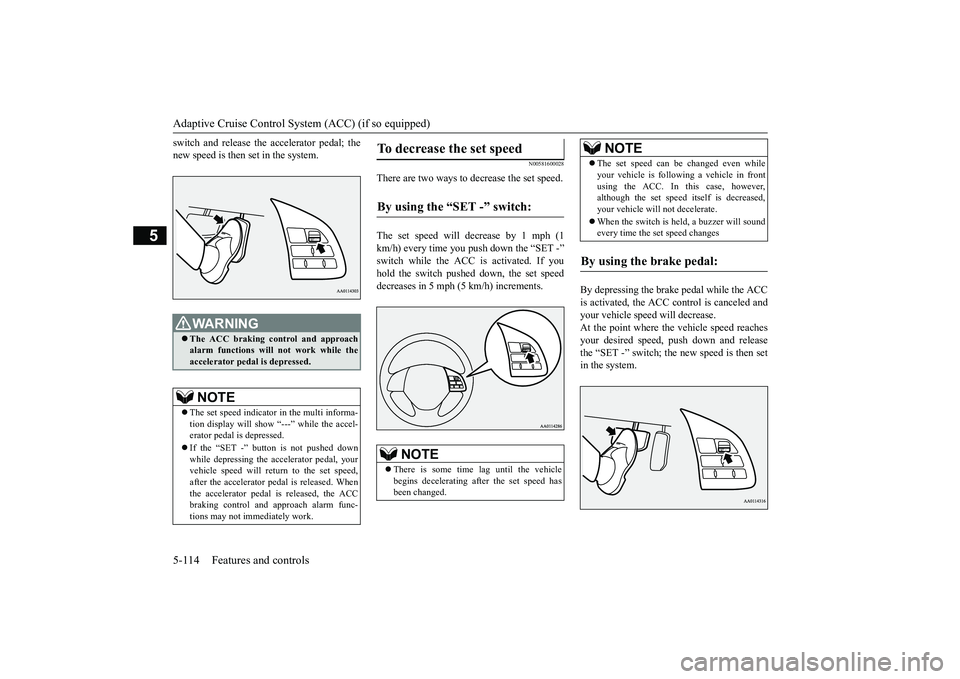
There are two ways to decrease the set speed.The set speed will decrease by 1 mph (1km/h) every time you push down the “SET -”hold the switch pushed down, the set speeddecreases in 5 mph (5 km/h) increments.
By depressing the brake pedal while the ACCis activated, the ACC c
ontrol is canceled and
your vehicle speed will decrease.At the point where the vehicle speed reachesyour desired speed,
push down and release
the “SET -” switch; the new speed is then setin the system.
WA R N I N GThe ACC braking control and approachalarm functions will
not work while the
accelerator pedal is depressed.NOTE
The set speed indicator in the multi informa-tion display will show
“---” while the accel-
erator pedal is depressed.If the “SET -” button is not pushed downwhile depressing the ac
celerator pedal, your
vehicle speed will return to the set speed,after the accelerator pedal is released. Whenthe accelerator pedal is released, the ACCbraking control and approach alarm func-tions may not i
mmediately work.
To decrease the set speed
By using the “SET -” switch:
NOTE
There is some time
lag until the vehicle
begins decelerating after the set speed hasbeen changed.
The set speed can be changed even whileyour vehicle is follow
ing a vehicle in front
using the ACC. In this case, however,although the set speed it
self is decreased,
your vehicle will
not decelerate.
When the switch is held, a buzzer will soundevery time the set speed changes
By using the brake pedal:
NOTE
BK0249100US.book 114 ページ 2017年5月10日 水曜日 午前8時49分
Page 196 of 441
Adaptive Cruise Control System (ACC) (if so equipped)
Features and controls 5-115
5
N00582800027
Simply depress the accelerator pedal to tem-porarily accelerate the
vehicle. Releasing the
pedal automatically sl
ows down the vehicle
to the set speed and ACC restarts its control.
N00581700061
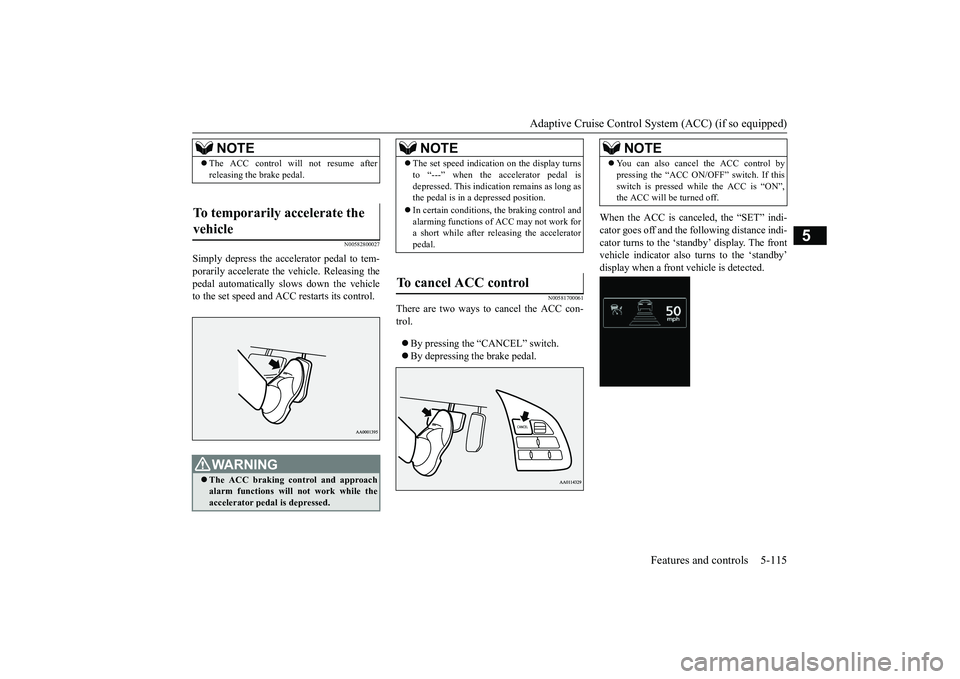
There are two ways to cancel the ACC con-trol. By pressing the “CANCEL” switch.By depressing the brake pedal.
When the ACC is canceled, the “SET” indi-cator goes off and the following distance indi-cator turns to the ‘standby’ display. The frontvehicle indicator also turns to the ‘standby’display when a front vehicle is detected.
NOTE
The ACC control will
not resume after
releasing the brake pedal.
To temporarily accelerate the vehicle
WA R N I N GThe ACC braking control and approachalarm functions will not work while theaccelerator pedal is depressed.
NOTE
The set speed indication on the display turnsto “---” when the accelerator pedal isdepressed. This indication remains as long asthe pedal is in a depressed position.In certain conditions, th
e braking control and
alarming functions of ACC may not work fora short while after releasing the acceleratorpedal.
To cancel ACC control
NOTE
You can also cancel the ACC control bypressing the “ACC ON/OFF” switch. If thisswitch is pressed while the ACC is “ON”,the ACC will be turned off.
BK0249100US.book 115 ページ 2017年5月10日 水曜日 午前8時49分
Page 197 of 441

Adaptive Cruise Control System (ACC) (if so equipped)5-116 Features and controls
5
In any of the situations listed below, the ACCcontrol is automatica
lly canceled, a buzzer
sounds and a message is shown in the multi-information display.When your vehicle stops.When the ASC is turned off.While ABS, ASC or TCL is activated.When the selector lever is in a positionother than “D” (DRIVE) and “Ds”(DOWNSHIFT & SPORTY DRIVING).When the parking brake is applied.
When the ACC system determines that itsperformance has been degraded, a buzzer willsound and a message will be displayed in themulti information display.This can occur whenForeign objects, such as dirt, snow or ice,adhere to the surface
of the radar sensor.
In adverse weather conditions, such asrain, snow or sand storms, etc.A front vehicle or an oncoming vehicle issplashing water, snow or dirt.Driving on a nonbusy road with a fewvehicles and obsta
cles in front.
The brake system is
overheating due to
continuous brake control on long down-hill slope.
If the display keeps showing the message,there is a possibility that the ACC has a mal-function. Contact your authorized MitsubishiMotors dealer.When the ACC system
detects an abnormal-
ity in the system, the ACC system will beturned off, a buzzer will sound and a messagewill be displayed in the multi information dis-play. If the message remains after the opera-tion mode has been tu
rned to the “OFF”
position, contact your au
thorized Mitsubishi
Motors dealer.
N00581800059
After the ACC control has been canceled withthe ACC turned on, the ACC control can beresumed by pushing up
and releasing the
“RES +” switch.To resume the control
BK0249100US.book 116 ページ 2017年5月10日 水曜日 午前8時49分
Page 198 of 441
Adaptive Cruise Control System (ACC) (if so equipped)
Features and controls 5-117
5
N00581900021
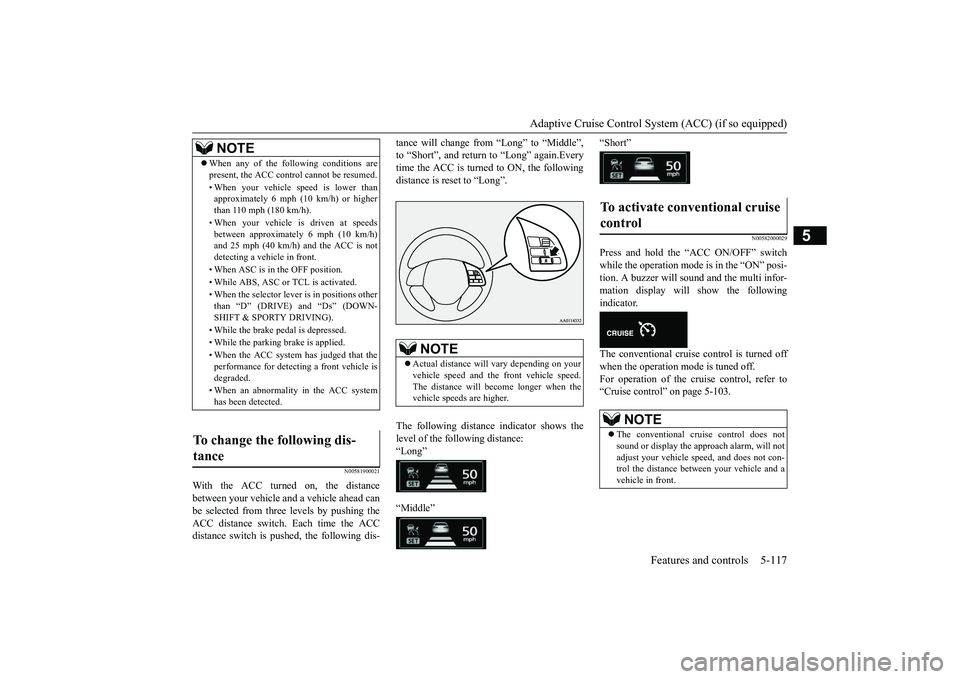
With the ACC turned on, the distancebetween your vehicle and a vehicle ahead canbe selected from thre
e levels by pushing the
ACC distance switch. Each time the ACCdistance switch is pus
hed, the following dis-
tance will change fro
m “Long” to “Middle”,
to “Short”, and return to “Long” again.Everytime the ACC is turned to ON, the followingdistance is re
set to “Long”.
The following distance indicator shows thelevel of the following distance:“Long”“Middle”
“Short”
N00582000029
Press and hold the “ACC ON/OFF” switchwhile the operation mode
is in the “ON” posi-
tion. A buzzer will sound and the multi infor-mation display will show the followingindicator.The conventional cruise
control is turned off
when the operation mode is tuned off.For operation of the cruise control, refer to“Cruise control” on page 5-103.
NOTE
When any of the following conditions arepresent, the ACC cont
rol cannot be resumed.
• When your vehicle speed is lower thanapproximately 6 mph (10 km/h) or higherthan 110 mph (180 km/h).• When your vehicle is driven at speedsbetween approxi
mately 6 mph (10 km/h)
and 25 mph (40 km/h) and the ACC is notdetecting a vehi
cle in front.
• When ASC is in the OFF position.• While ABS, ASC or TCL is activated.• When the selector lever
is in positions other
than
Page 237 of 441
![MITSUBISHI OUTLANDER III 2018 User Guide Multi Information display - Type 15-156 Features and controls
5
[With ignition switch or operation mode in ON]1- Drive mode indicator display screen (if
so equipped)
P.5-84
2- S-AWC drive mode di](/img/19/58144/w960_58144-236.png "MITSUBISHI OUTLANDER III 2018 User Guide Multi Information display - Type 15-156 Features and controls
5
[With ignition switch or operation mode in ON]1- Drive mode indicator display screen (if
so equipped)
P.5-84
2- S-AWC drive mode di")
Multi Information display - Type 15-156 Features and controls
5
[With ignition switch or operation mode in ON]1- Drive mode indicator display screen (if
so equipped)
P.5-84
2- S-AWC drive mode display screen (if
so equipped)
P.5-87
3-
Warning display screen
P.5-161
4- Forward Collision Mitigation System
(FCM) OFF display screen (if soequipped)
P.5-118
5- Lane Departure Warning (LDW) sys-
tem display screen (if so equipped)P.5-134
6- ECO mode indicator display screen
P.5-218
7- Information screen
P.5-157
8- Selector lever
position display
P.5-70, 5-77
9- Engine coolant temperature display
P.5-161
10- Odometer
P.5-162
11- Cruise control display screen (if so
equipped)
P.5-103
12- Adaptive Cruise Control System (ACC)
display screen (if so equipped) P.5-107
13- ECO indicator
P.5-166
14-
“ ” or “ ” mark indicator
P.5-160
15- Fuel remaining display screen
P.5-162
16- Outside temperature display screen
P.5-162NOTE
The fuel units, outside temperature units,display language, and ot
her settings can be
changed.Refer to “Changing th
e function settings” on
page 5-167.
BK0249100US.book 156 ページ 2017年5月10日 水曜日 午前8時49分
Page 273 of 441
Indicator light, warning light, and information screen display list (multi information display - Type 1)
5
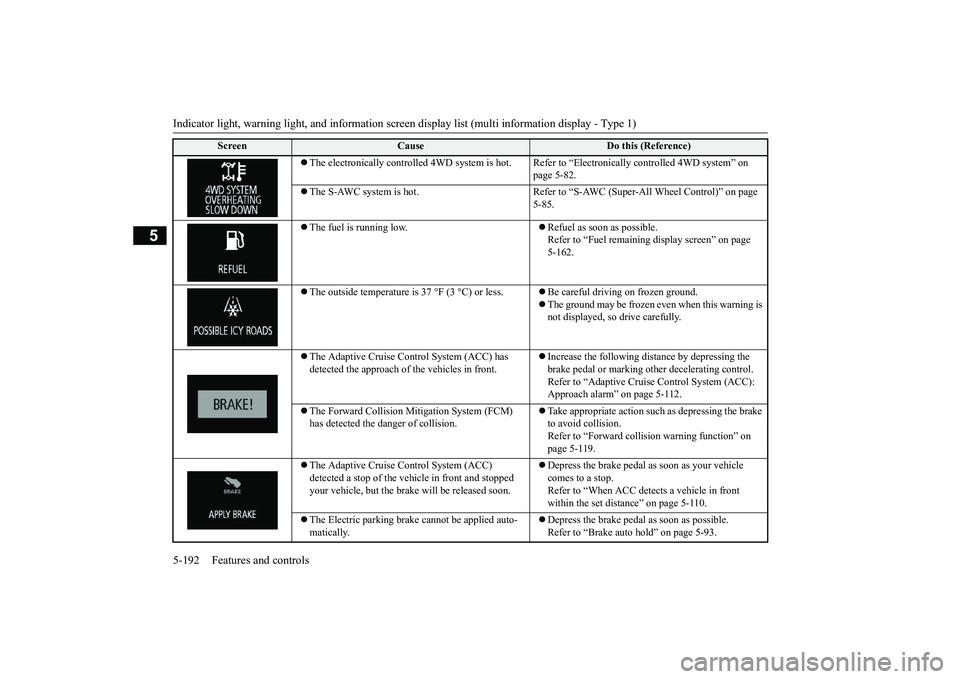
The electronically controlled 4WD
system is hot. Refer to “Electr
onically controlled
4WD system” on
page 5-82.
The S-AWC system is hot. Refer to “S-A
WC (Super-All Wheel Control)” on page
5-85.
The fuel is running low.
Refuel as soon as possible. Refer to “Fuel remaining
display screen” on page
5-162.
The outside temperature is
37 °F (3 °C) or less.
Be careful driving on frozen ground.The ground may be frozen even when this warning is not displayed, so drive carefully.
The Adaptive Cruise Control System (ACC) has detected the approach of
the vehicles in front.
Increase the following di
stance by depressing the
brake pedal or marking ot
her decelerating control.
Refer to “Adaptive Cruise
Control System (ACC):
Approach alarm” on page 5-112.
The Forward Collision Mitigation System (FCM) has detected the da
nger of collision.
Take appropriate action such
as depressing the brake
to avoid collision.Refer to “Forward colli
sion warning function” on
page 5-119.
The Adaptive Cruise Control System (ACC) detected a stop of the vehi
cle in front and stopped
your vehicle, but the brake
will be released soon.
Depress the brake pedal as soon as your vehicle comes to a stop.Refer to “When ACC dete
cts a vehicle in front
within the set distance” on page 5-110.
The Electric parking brake
cannot be applied auto-
matically.
Depress the brake pedal as soon as possible.Refer to “Brake auto hold” on page 5-93.
Screen
Cause
Do this (Reference)
BK0249100US.book 192 ページ 2017年5月10日 水曜日 午前8時49分
Page 274 of 441
Indicator light, warning light, and information screen display list (multi information display - Type 1)
Features and controls 5-193
5
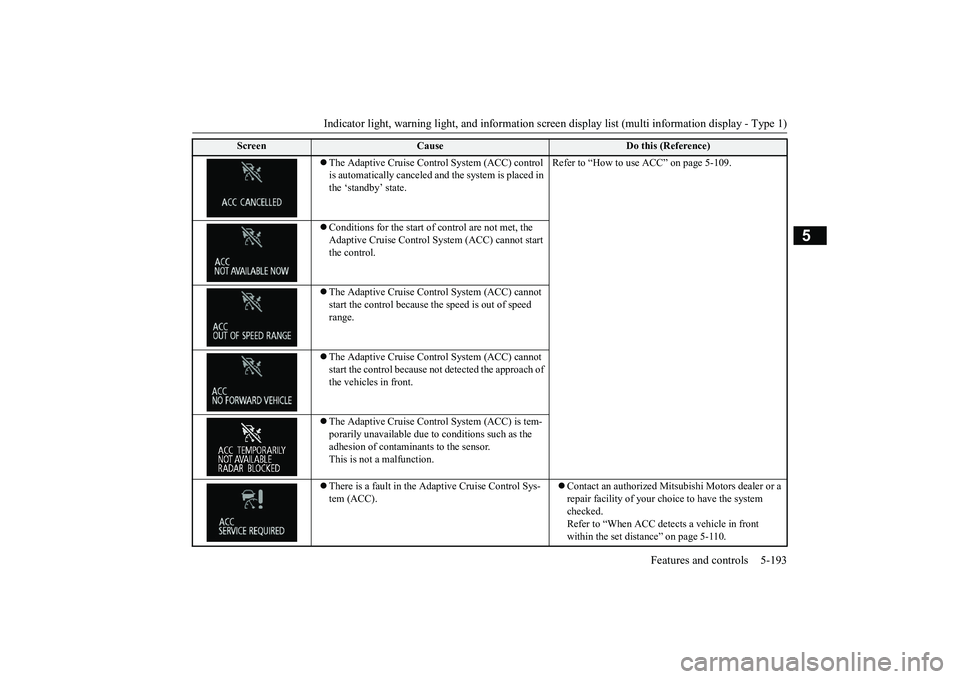
The Adaptive Cruise Control System (ACC) control is automatically canceled and the system is placed in the ‘standby’ state.
Refer to “How to use ACC” on page 5-109.
Conditions for the start of control are not met, the Adaptive Cruise Control
System (ACC) cannot start
the control.The Adaptive Cruise Control System (ACC) cannot start the control because the speed is out of speed range.The Adaptive Cruise Control System (ACC) cannot start the control because not detected the approach of the vehicles in front.The Adaptive Cruise Control System (ACC) is tem-porarily unavailable due to
conditions such as the
adhesion of contaminants to the sensor.This is not a malfunction.There is a fault in the Adaptive Cruise Control Sys-tem (ACC).
Contact an authorized Mitsubishi Motors dealer or a repair facility of your choi
ce to have the system
checked.Refer to “When ACC dete
cts a vehicle in front
within the set dist
ance” on page 5-110.
Screen
Cause
Do this (Reference)
BK0249100US.book 193 ページ 2017年5月10日 水曜日 午前8時49分