height MITSUBISHI OUTLANDER III 2018 User Guide
[x] Cancel search | Manufacturer: MITSUBISHI, Model Year: 2018, Model line: OUTLANDER III, Model: MITSUBISHI OUTLANDER III 2018Pages: 441, PDF Size: 13.71 MB
Page 138 of 441
Steering wheel height
and reach adjustment
Features and controls 5-57
5
Warning light (yellow)Warning displayIf there is a malfunction in the system, thewarning light will come on. In addition, thewarning display appears on the informationscreen in the multi information display.
Under normal conditions, the warning lightonly comes on when the operation mode isput in ON and goes off a few seconds later.
N00511501241
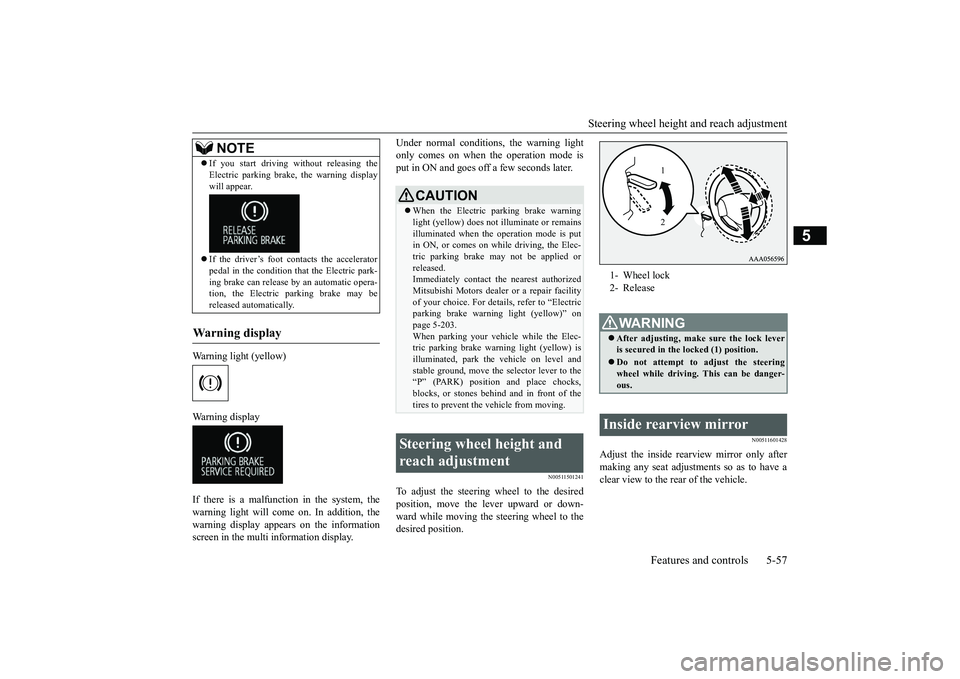
To adjust the steering wheel to the desiredposition, move the lever upward or down-ward while moving the steering wheel to thedesired position.
N00511601428
Adjust the inside rearview mirror only aftermaking any seat adjustme
nts so as to have a
clear view to the rear of the vehicle.
If you start driving wi
thout releasing the
Electric parking brake, the warning displaywill appear.If the driver’s foot contacts the acceleratorpedal in the condition th
at the Electric park-
ing brake can release by an automatic opera-tion, the Electric parking brake may bereleased automatically.
Wa r n i n g d is p la y
NOTE
CAUTIONWhen the Electric parking brake warninglight (yellow) does not
illuminate or remains
illuminated when the operation mode is putin ON, or comes on while driving, the Elec-tric parking brake may not be applied orreleased.Immediately contact the nearest authorizedMitsubishi Motors dealer
or a repair facility
of your choice. For detail
s, refer to “Electric
parking brake warni
ng light (yellow)” on
page 5-203.When parking your vehi
cle while the Elec-
tric parking brake warning light (yellow) isilluminated, park th
e vehicle on level and
stable ground, move the
selector lever to the
“P” (PARK) position and place chocks,blocks, or stones behind and in front of thetires to prevent the vehicle from moving.
Steering wheel height and reach adjustment
1- Wheel lock2- ReleaseWA R N I N GAfter adjusting, make sure the lock leveris secured in the locked (1) position.Do not attempt to adjust the steeringwheel while driving. This can be danger-ous.
Inside rearview mirror
12
BK0249100US.book 57 ページ 2017年5月17日 水曜日 午後2時31分
Page 193 of 441
Adaptive Cruise Control System (ACC) (if so equipped)5-112 Features and controls
5
N00576900036
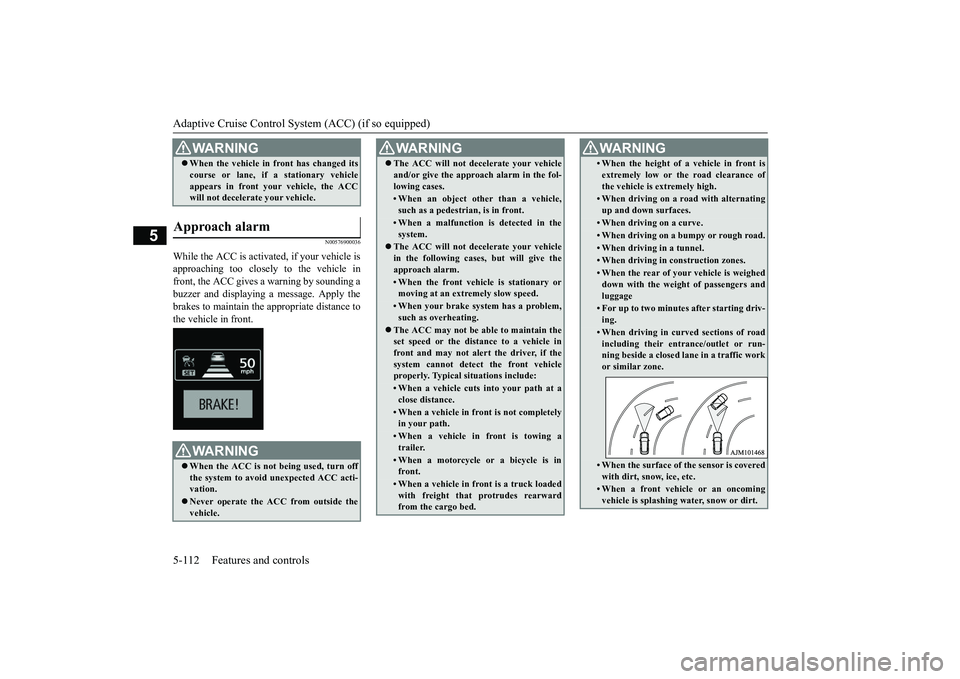
While the ACC is activated, if your vehicle isapproaching too closely to the vehicle infront, the ACC gives a warning by sounding abuzzer and displaying a message. Apply thebrakes to maintain the appropriate distance tothe vehicle in front.When the vehicle in
front has changed its
course or lane, if a stationary vehicleappears in front you
r vehicle, the ACC
will not decelerate your vehicle.
Approach alarm
WA R N I N GWhen the ACC is not being used, turn offthe system to avoid
unexpected ACC acti-
vation.Never operate the AC
C from outside the
vehicle.WA R N I N G
The ACC will not decelerate your vehicleand/or give the approach alarm in the fol-lowing cases.• When an object other than a vehicle,such as a pedestri
an, is in front.
• When a malfunction is detected in thesystem.
The ACC will not decelerate your vehiclein the following cases, but will give theapproach alarm.• When the front vehicle is stationary ormoving at an extr
emely slow speed.
• When your brake system has a problem,such as overheating.
The ACC may not be able to maintain theset speed or the dist
ance to a vehicle in
front and may not alert the driver, if thesystem cannot detect the front vehicleproperly. Typical situations include: • When a vehicle cuts
into your path at a
close distance.• When a vehicle in front is not completelyin your path.• When a vehicle in front is towing atrailer.• When a motorcycle or a bicycle is infront.• When a vehicle in fr
ont is a truck loaded
with freight that protrudes rearwardfrom the cargo bed.WA R N I N G
• When the height of a vehicle in front isextremely low or the road clearance ofthe vehicle is extremely high.• When driving on a r
oad with alternating
up and down surfaces.• When driving on a curve.• When driving on a bumpy or rough road.• When driving in a tunnel.• When driving in construction zones.• When the rear of your vehicle is weigheddown with the weight of passengers andluggage• For up to two minutes after starting driv-ing.• When driving in curved sections of roadincluding their entrance/outlet or run-ning beside a closed lane in a traffic workor similar zone.• When the surface of th
e sensor is covered
with dirt, snow, ice, etc.• When a front vehicle or an oncomingvehicle is splashing wa
ter, snow or dirt.
WA R N I N G
BK0249100US.book 112 ページ 2017年5月10日 水曜日 午前8時49分
Page 209 of 441
Blind Spot Warning (BSW) (with Lane Change Assist) (if so equipped)
5
N00593500040
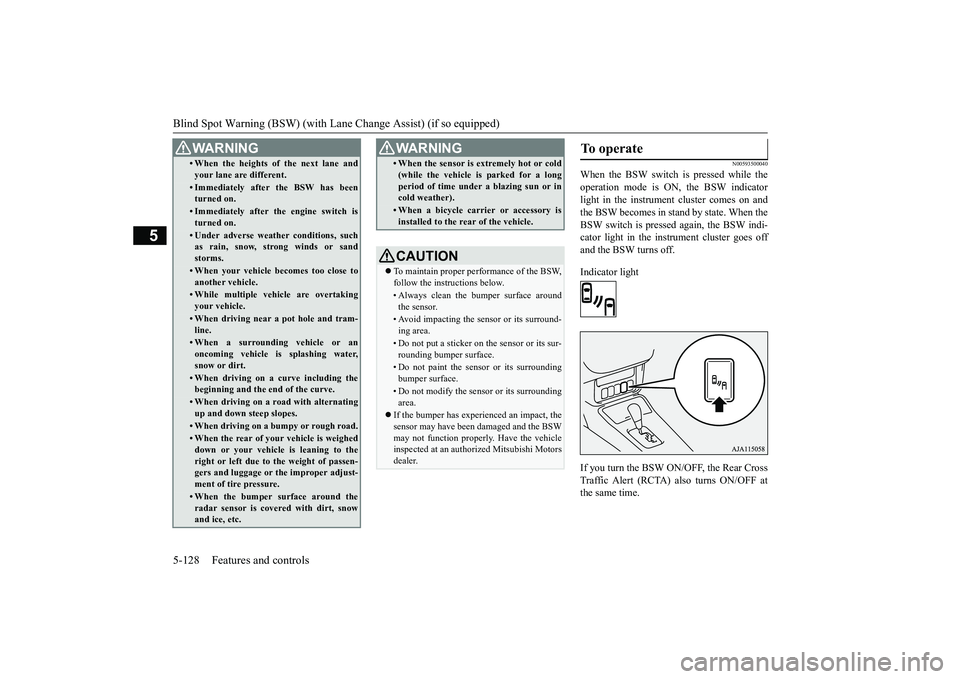
When the BSW switch is pressed while theoperation mode is ON,
the BSW indicator
light in the instrument cluster comes on andthe BSW becomes in stand by state. When theBSW switch is pressed again, the BSW indi-cator light in the instrument cluster goes offand the BSW turns off.Indicator lightIf you turn the BSW ON/OFF, the Rear CrossTraffic Alert (RCTA) also turns ON/OFF atthe same time.
• When the heights of the next lane andyour lane are different.• Immediately after the BSW has beenturned on.• Immediately after the engine switch isturned on.• Under adverse weather conditions, suchas rain, snow, strong winds or sandstorms.• When your vehicle becomes too close toanother vehicle.• While multiple ve
hicle are overtaking
your vehicle.• When driving near a pot hole and tram-line.• When a surroundin
g vehicle or an
oncoming vehicle is splashing water,snow or dirt.• When driving on a curve including thebeginning and the end of the curve.• When driving on a r
oad with alternating
up and down steep slopes.• When driving on a bumpy or rough road.• When the rear of your vehicle is weigheddown or your vehicl
e is leaning to the
right or left due to the weight of passen-gers and luggage or th
e improper adjust-
ment of tire pressure. • When the bumper surface around theradar sensor is covered with dirt, snowand ice, etc.WA R N I N G
• When the sensor is extremely hot or cold(while the vehicle is parked for a longperiod of time unde
r a blazing sun or in
cold weather).• When a bicycle carrier or accessory isinstalled to the re
ar of the vehicle.
CAUTIONTo maintain proper performance of the BSW,follow the instructions below.• Always clean the bumper surface aroundthe sensor.• Avoid impacting the sensor or its surround-ing area.• Do not put a sticker on
the sensor or its sur-
rounding bumper surface.• Do not paint the sensor or its surroundingbumper surface.• Do not modify the sensor or its surroundingarea.
If the bumper has experienced an impact, thesensor may have been
damaged and the BSW
may not function properl
y. Have the vehicle
inspected at an authorized Mitsubishi Motorsdealer.WA R N I N G
To operate
BK0249100US.book 128 ページ 2017年5月10日 水曜日 午前8時49分
Page 342 of 441
Trailer towing
Driving safety 6-13
6
Tongue loads can be adjusted by proper dis-tribution of the load in the trailer. This can bechecked by separately
weighing the loaded
trailer and then the tongue.The GAWRs are printed on the certificationlabel which is riveted on the door sill on thedriver’s side.Refer to “Vehicle labeling” on page 11-2.Choose a proper hitch and ball, and makesure it is installed at a height that is compati-ble with the trailer.Use a good equalizing hitch which uniformlydistributes the trailer tongue load throughoutthe frame.
A safety chain must al
ways be used between
the towing vehicle and the trailer. Leave suf-ficient slack in the chain for turns. The chainshould cross under the trailer tongue to pre-vent the tongue from dropping to the groundin case it becomes damaged or separated.For correct safety chai
n procedures, consult
your authorized Mitsub
ishi Motors dealer.
Your vehicle will need service more oftenwhen you’re towing a trailer. Refer to “WAR-RANTY AND MAINTENANCE MAN-UAL”. Especially important in traileroperation are automatic transaxle fluid,engine oil, rear axle
oil, belt, c
ooling system
and brake system. Each
of these is covered in
this manual.For details, please refer to the “Vehicle careand maintenance” section.Check periodically to see that all hitch nutsand bolts are tight.Mitsubishi Motors recommends that anytrailer having a total we
ight of 1,250 lbs (567
kg) or more (2400 models), 1,400 lbs (635kg) or more (3000 mode
ls) be equipped with
its own electric or surge-type brakes.If you choose electric br
akes, be sure they are
electrically actuated. Do not attempt to tapinto your vehicle’s hydraulic system. No mat-ter how successful it
may seem, any attempt
to attach trailer brakes to your vehicle’shydraulic system will lower braking effec-tiveness and create a potential hazard.
Gross axle weight rating (GAWR) Trailer hitches
WA R N I N GIf you make any holes in the body of yourvehicle for installing
a trailer hitch, be
sure to seal the holes later when youremove the hitch. If
you don’t seal them,
deadly carbon monoxide (CO) from yourexhaust can enter your vehicle. Refer to“Exhaust system” on page 9-24.
NOTE
Mitsubishi Motors recommends that swaycontrol be used whenever you are towing, toimprove towing stability.For further informati
on, please contact your
authorized Mitsubishi Motors dealer.
Safety chains
CAUTIONNever tow a trailer wi
thout using a safety
chain securely attached to both the trailerand the vehicle. If the
coupling unit or hitch
ball experiences a probl
em, the trailer may
separate from
your vehicle.
Maintenance when trailer tow-ing Trailer brakes
BK0249100US.book 13 ページ 2017年5月10日 水曜日 午前8時49分
Page 393 of 441
Tires9-16 Vehicle care and maintenance
9
Ply: a layer of r
ubber-coated parallel
cords.Cord: the strands forming the plies in thetire.Rim: a metal support for a tire or a tireand tube assembly upon which the tirebeads are seated.Rim diameter: nominal diameter of thebead seat.Groove: the space between two adjacenttread ribs.
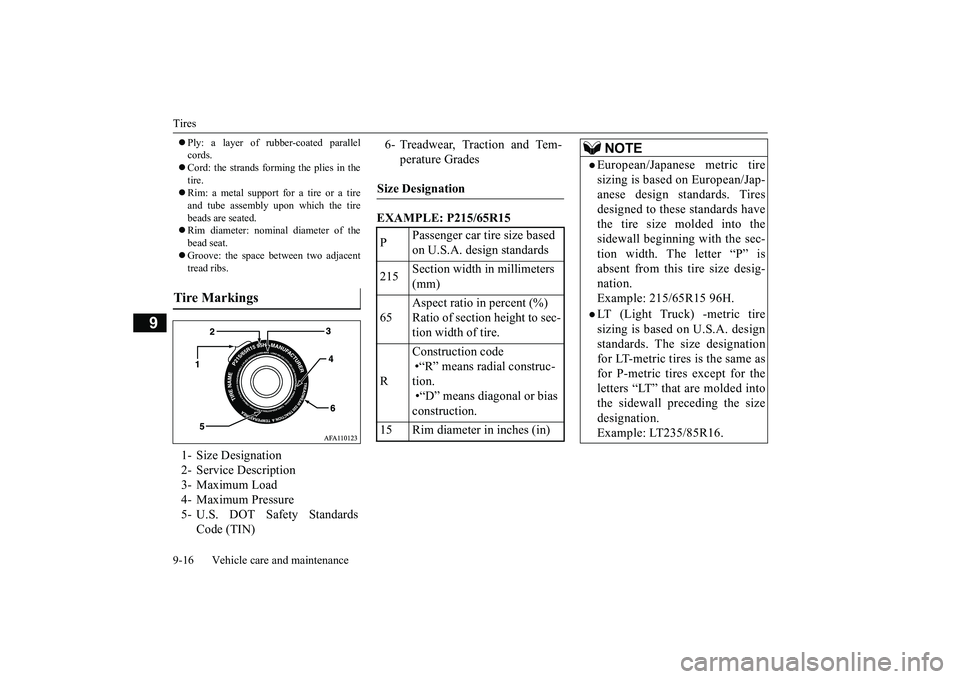
EXAMPLE: P215/65R15
Tire Markings 1- Size Designation2- Service Description3- Maximum Load4- Maximum Pressure5- U.S. DOT Safety Standards
Code (TIN)
6- Treadwear, Traction and Tem-
perature Grades
Size Designation P
Passenger car tire size based on U.S.A. design standards
215
Section width in millimeters (mm)
65
Aspect ratio in percent (%)Ratio of section height to sec-tion width of tire.
R
Construction code •“R” means radial construc-tion. •“D” means diagonal or bias construction.
15 Rim diameter in inches (in)
NOTE
European/Japanese metric tiresizing is based on European/Jap-anese design standards. Tiresdesigned to these standards havethe tire size molded into thesidewall beginning with the sec-tion width. The letter “P” isabsent from this tire size desig-nation.Example: 215/65R15 96H.LT (Light Truck) -metric tiresizing is based on U.S.A. designstandards. The size designationfor LT-metric tires is the same asfor P-metric tires except for theletters “LT” that are molded intothe sidewall preceding the sizedesignation.Example: LT235/85R16.
BK0249100US.book 16 ページ 2017年5月10日 水曜日 午前8時49分
Page 431 of 441
Vehicle dimensions11-4 Specifications
11
N01147501678
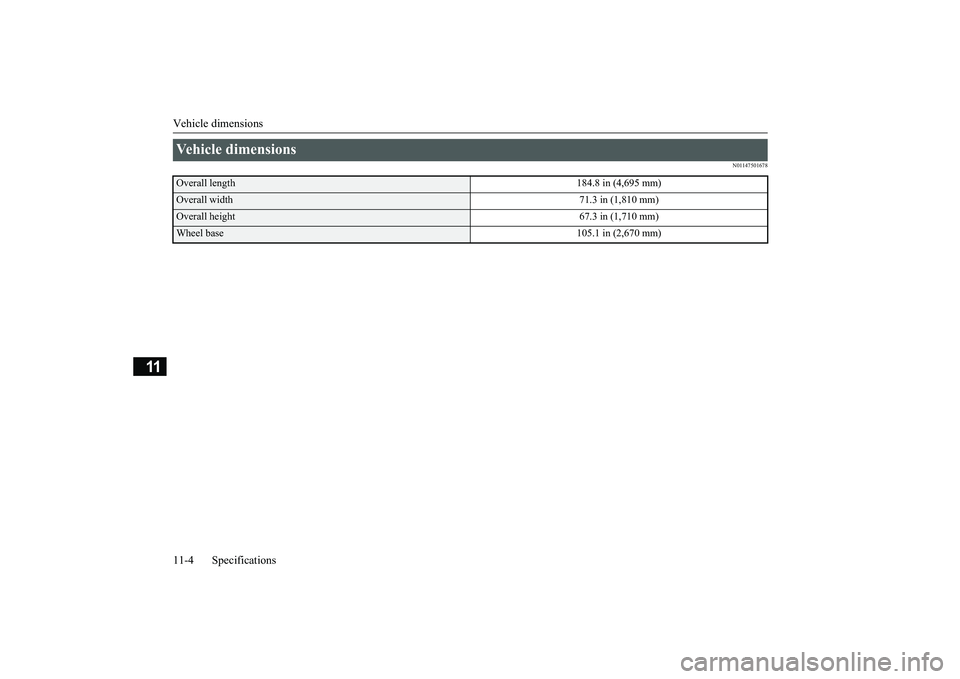
Vehicle dimensions Overall length
184.8 in (4,695 mm)
Overall width
71.3 in (1,810 mm)
Overall height
67.3 in (1,710 mm)
Wheel base
105.1 in (2,670 mm)
BK0249100US.book 4 ページ 2017年5月10日 水曜日 午前8時49分
Page 439 of 441
Alphabetical index12-4
12
O
Octane number
.....................................
3-2
Oil
Engine oil
......................................
11-7
Rear axle oil
...................................
11-7
Transfer oil
....................................
11-7
Operation under adverse driving conditions
...
8-15Outside rearview mirrors
.....................
5-60
Overheating
.........................................
8-4
P
Parking
................................................
6-6
Parking brake
.................................
5-53
Parking brake lever stroke
...................
9-22
Parking lights
Bulb capacity
.................................
9-32
Replacement
..................................
9-36
Polishing
............................................
9-43
Power brakes
......................................
5-92
Power liftgate
.....................................
5-39
Power outlet
.....................................
5-230
Power windows
..................................
5-49
Puncture (Tire changing)
.......................
8-6
R
Radiator cap
........................................
9-9
Radio
General information
about your radio 7-14
Reading lights
Bulb capacity
..................................
9-33
Rear axle oil
..............................
9-12
, 11-7
Rear combination lights
Bulb capacity
..................................
9-32
Replacement
...................................
9-37
Rear Cross Traffic Alert
.....................
5-131
Rear side-marker lights
Bulb capacity
..................................
9-32
Rear turn signal light
Bulb capacity
..................................
9-32
Replacement
...................................
9-37
Rear-view camera
.............................
5-142
Rearview mirror
Inside rearview mirror
.....................
5-57
Outside rearview mirrors
.................
5-60
Replacement of light bulbs
...................
9-31
Replacing tires and wheels
...................
9-19
Reporting Safety Defects
.....................
10-2
S
Safe driving techniques
.........................
6-4
S-AWC (Super-All Wheel Control)
......
5-85
Seat belt
.............................................
4-18
Adjustable seat belt shoulder anchor
.4-24
Child restraint systems
....................
4-27
Front passenger seat belt warning light
.....
4-23Maintenance and inspection
.............
4-34
Seat belt extender
...........................
4-25
Seat belt force limitter
.....................
4-27
Seat belt pr
e-tensioners
...................
4-25
Seat belt use
during pregnancy
.........
4-25
Seats
....................................................
4-2
Arm rest
........................................
4-10
Front seats
.......................................
4-4
Head restraints
...............................
4-11
Heated seat
......................................
4-8
Making a cargo area
........................
4-13
Making a flat seat
...........................
4-16
Seat arrangement
..............................
4-3
Seats and restraint systems
................
4-4
Second row seats
..............................
4-8
Third row seats
...............................
4-10
Service brake
......................................
5-92
Service precautions
...............................
9-2
Side turn-signal light
Bulb capacity
.................................
9-32
Snow tires
..........................................
9-21
Spark plugs
........................................
9-23
Starting the engine
.....................
5-25
, 5-66
Steering
Steering wheel height and reach adjustment
BK0249100US.book 4 ページ 2017年5月10日 水曜日 午前8時49分