overheating MITSUBISHI OUTLANDER III 2018 User Guide
[x] Cancel search | Manufacturer: MITSUBISHI, Model Year: 2018, Model line: OUTLANDER III, Model: MITSUBISHI OUTLANDER III 2018Pages: 441, PDF Size: 13.71 MB
Page 243 of 441
Multi Information display - Type 15-162 Features and controls
5
N00556601180
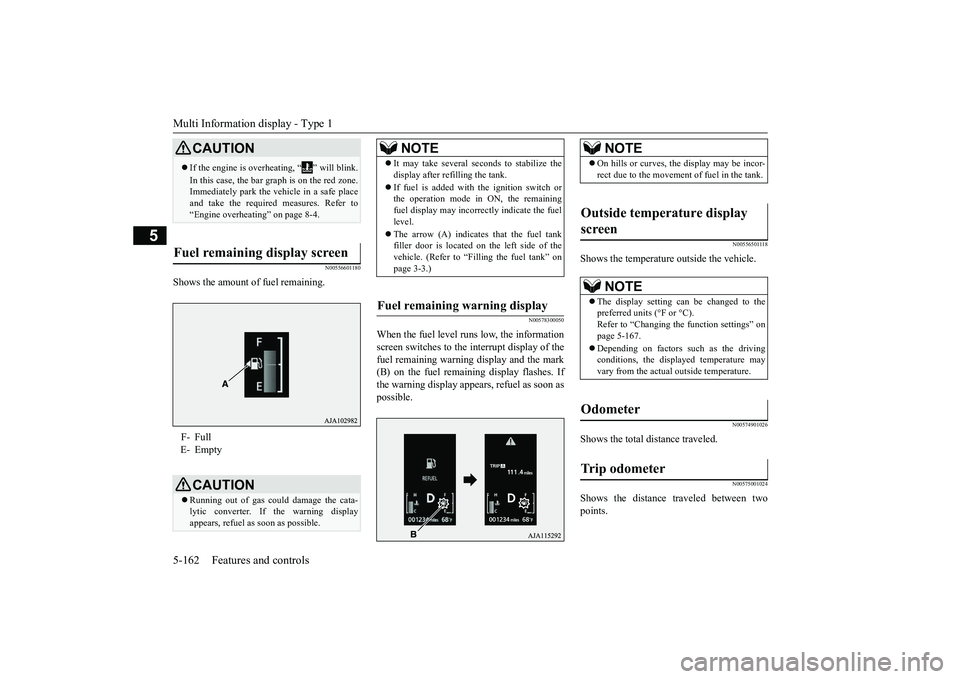
Shows the amount of fuel remaining.
N00578300050
When the fuel level runs low, the informationscreen switches to the interrupt display of thefuel remaining warning display and the mark(B) on the fuel remaini
ng display flashes. If
the warning display appear
s, refuel as soon as
possible.
N00556501118
Shows the temperature outside the vehicle.
N00574901026
Shows the total distance traveled.
N00575001024
Shows the distance traveled between twopoints.
CAUTIONIf the engine is overheating, “ ” will blink.In this case, the bar graph is on the red zone.Immediately park the vehicle in a safe placeand take the require
d measures. Refer to
“Engine overheating” on page 8-4.
Fuel remaining display screen F- FullE- Empty
CAUTIONRunning out of gas coul
d damage the cata-
lytic converter. If the warning displayappears, refuel as soon as possible.
NOTE
It may take several se
conds to stabilize the
display after re
filling the tank.
If fuel is added with
the ignition switch or
the operation mode in ON, the remainingfuel display may incorre
ctly indicate the fuel
level.The arrow (A) indicates that the fuel tankfiller door is located on
the left side of the
vehicle. (Refer to “F
illing the fuel tank” on
page 3-3.)
Fuel remaining warning display
NOTE
On hills or curves, the display may be incor-rect due to the movement
of fuel in the tank.
Outside temperature display screen
NOTE
The display setting ca
n be changed to the
preferred units (°F or °C).
e function settings” on
page 5-167.Depending on factors such as the drivingconditions, the displa
yed temperature may
vary from the actual outside temperature.
Odometer Trip odometer
BK0249100US.book 162 ページ 2017年5月10日 水曜日 午前8時49分
Page 286 of 441
Warning lights
Features and controls 5-205
5
tion switch is turned to the “ON” position(engine off) or the operation mode is put inON. On vehicle equipped with the multiinformation display - Type 1, a warning isalso displayed in the multi information dis-play. When the engine is started, the lightshould go out. Check to make sure that thelight has gone out before driving.
N00520701278
This light comes on when the engine oil pres-sure is below normal. If the light stays onwhile driving, stop the engine as soon as pos-sible. Do not run the engine until the cause ofthe low oil pressure is corrected.
N00575701021
This light comes on in red if the coolant tem-perature becomes excessively high.
N00520901339
This light comes on when any door or the lift-gate is open or not completely closed.When the vehicle is moving at more than 5mph (8 km/h) and any door or the liftgate isopen or ajar, a tone will sound 4 times toinform the driver that any door or the liftgateis not properly shut.
CAUTIONIf the warning light stays on while the engineis running, park your ve
hicle in a safe place
as soon as possible and
contact an authorized
Mitsubishi Motors dealer
or a repair facility
of your choice to have the system checked.
Oil pressure warning light (Vehicle equipped with the multi information display - Type 2)
CAUTIONIf this light comes on when the engine oillevel is not low, have
your vehicle checked at
an authorized Mitsubish
i Motors dealer or a
repair facility
of your choice.
This warning light does not show the amountof oil in the crankcase. This can only bedetermined by checking the oil level with thedipstick with the engine turned off.
High coolant temperature warning light - red (Vehicle equipped with the multi infor-mation display - Type 2)
CAUTIONIf the light comes on
during vehicle opera-
tion, it indicates that
the engine is possibly
overheating. Continue
d driving could make
the engine fail. Immedi
ately stop the vehicle
in a safe place and ta
ke appropriate action.
(Refer to “Engine overh
eating” on page 8-4.)
NOTE
The high coolant temp
erature warning light
may illuminate when
the vehicle has been
driven at high speeds or on hilly roads. Thisilluminating does not ne
cessarily indicate a
problem. It should stop if you keep theengine running for a whil
e or continue driv-
ing the vehicle.
Door-ajar warning light and buzzer (Vehicle equipped with the multi information display - Type 2)
CAUTIONBefore driving, make sure that the door-ajarwarning light is off.
BK0249100US.book 205 ページ 2017年5月10日 水曜日 午前8時49分
Page 314 of 441
HomeLink® Wireless Control System (if so equipped)
Features and controls 5-233
5
• If the device does not operate, continuewith “Programming a new HomeLink
®”
steps 5 to 7 to complete the program-ming of a rolling code equipped device.
5. At the garage door opener receiver(motor-head unit) in the garage, locate the“Learn” or “Smart” but
ton. This can usu-
ally be found where the hanging antennawire is attached to the motor-head unit(see the garage
door opener manual to
identify the “Learn” button.)6. Firmly press and release the “Learn” or“Smart” button. (The name and color ofthe button may vary by manufacturer.)
seconds to initiate
step 7.7. Return to the vehi
cle and firmly press,
hold for 2 seconds and release the pro-grammed HomeLink
® button. Repeat the
“press/hold/release”
sequence a second
time, and, depending on the brand of thegarage door opener (or other rolling codeequipped device), repe
at this sequence a
third time to complete the programmingprocess.HomeLink
® should now activate your
rolling code equipped device.
N00584800021
Canadian radio-frequenc
y laws require trans-
mitter signals to “time-out” (or quit) afterseveral seconds of tr
ansmission - which may
not be long enough for HomeLink
® to pick
up the signal during programming. Similar tothis Canadian law, some U.S. gate operatorsare designed to “time-
out” in the same man-
ner.The indicator LED on the hand-held transmit-ter will go off when the device times out indi-cating that it has fi
nished transmitting.
If you live in Canada or you are having diffi-culties programming a gate operator orgarage door opener by using the “Program-ming” procedures, re
place “Programming a
new HomeLink
®” step 3 with the following:
3. Press and release - every 2 seconds(“cycle”) your hand-held transmitter until theHomeLink
® indicator light changes from
slowly flashing orange to either rapidly flash-ing green (rolling code
) or continuously lit
green (fixed code). Now you may release thehand-held transmitter button.Proceed with “Programming a new Home-Link
®” step 4 to complete.
N00584900022
The HomeLink
® has the capab
ility of receiv-
ing garage door status from compatiblegarage door opener systems. Check yourgarage door opener manual for the availablefeature and HomeLink
® compatibility. Also
for a listing of compatible systems contactHomeLink
® at: www.homelink.com
NOTE
In the event that there are still programmingdifficulties or questi
ons, additional Home-
Link
® information and programming videos
can be found online at www.homelink.com,www.youtube.com/HomeLinkGentex, or bycalling the HomeLink
® Hotline.
Gate operator/Canadian pro-gramming
NOTE
If programming a garage door opener or gateoperator, it is advise
d to unplug the device
during the “cycling” pr
ocess to prevent pos-
sible overheating.
Additional steps for program-ming a door system with feed-back
BK0249100US.book 233 ページ 2017年5月10日 水曜日 午前8時49分
Page 334 of 441
Driving during cold weather
Driving safety 6-5
6
you give extra attention to the followingareas, you can better protect yourself andyour passengers:Drive defensively. Be aware of traffic,road and weather c
onditions. Leave plenty
of stopping distance
between your vehicle
and the vehicle ahead.Before changing lanes, check your mir-rors, blind spots, a
nd use your turn-signal
light.While driving, watch the behavior ofother drivers, bicycl
ists, and pedestrians.
Always obey applicab
le laws and regula-
tions. Be a polite and alert driver. Alwaysleave room for unexpected events, such assudden braking.If you plan to drive in another country,obey their vehicle re
gistration laws and
make sure you will be able to get the rightfuel.
N00629400445
Check the battery. At the same time,check the terminals and wiring. Duringextremely cold weather, the battery willnot be as strong. Also, the battery powerlevel may drop beca
use more power is
used for cold starting and driving.
Before driving the vehicle, check to see ifthe engine runs at the proper speed and ifthe headlights are as bright as normally.Charge or replace the battery if necessary.During extreme cold weather, it is possi-ble that a very low battery could freeze.Warm the engine sufficiently. After start-ing the engine, allow a short warm-uptime to distribute oil to all cylinders. Thendrive your vehicle slowly.Stay at low speeds at first so that thetransaxle, transfer case and rear axle oilhave time to spread to all lubricationpoints.Check the engine antifreeze.If there is not enough coolant because of aleak or from engine
overheating, add Mit-
subishi Motors Genuine Super Long LifeCoolant Premium or equivalent.Please read this section in conjunctionwith the “Engine coolant” on page 9-8.
N00629501528
All the parts of the brake system are criticalto safety. Have the
vehicle serviced by an
authorized Mitsubishi Motors dealer or arepair facility of your
choice at regular inter-
vals according to the “WARRANTY ANDMAINTENANCE MANUAL”.Check the brake system while driving at alow speed immediately
after starting, espe-
cially when the brakes are wet, to confirmthey work normally.A film of water can be formed on the brakediscs and prevent normal braking after driv-ing in heavy rain or through large puddles, orafter the vehicle is washed. If this occurs, drythe brakes out by drivi
ng slowly while lightly
depressing the brake pedal.
Driving during cold weather
WA R N I N GThe battery gives off explosive hydrogengas. Any spark or flame can cause the bat-tery to explode, which could cause seriousinjury or death.Always wear protecti
ve clothes and a face
mask when working with your battery, orlet a skilled mechanic do it.
WA R N I N GNever open the radiator cap when theradiator is hot. You could be seriouslyburned.
Braking When brakes are wet
BK0249100US.book 5 ページ 2017年5月10日 水曜日 午前8時49分
Page 335 of 441
Parking6-6 Driving safety
6
On snowy roads, ice can form on the brakingsystem, making the brakes less effective.While driving in such conditions, pay closeattention to surrounding
vehicles and to the
condition of the road surface. From time totime, lightly depress the brake pedal andcheck how effective the brakes are.It is important to take
advantage of the engine
braking by downshifting while driving onsteep downhill roads in order to prevent thebrakes from overheating.
N00629601385
When parking on a hill, set the parking brake,and turn the front wheels toward the curb on adownhill, or away from
the curb on an uphill.
If necessary, apply chocks to the wheels.Be sure that the parki
ng brake is firmly set
when parked and that the selector lever is inthe “P” (PARK) position.
When parking on a hill, it is important to setthe parking brake befo
re moving the selector
lever to the “P” (PARK) position. This pre-vents loading the parking brake against thetransaxle. When this ha
ppens, it is difficult to
move the selector lever out of the “P”Never leave the engine running while youtake a short nap or rest. Also, never leave theengine running in a closed or poorly venti-lated place.Your front bumper can be damaged if youscrape it over curbs or parking stop blocks.Be careful when traveling up or down steepslopes where your bumper can scrape theroad.
Always carry the key and lock all doors andthe liftgate when leaving the vehicle unat-tended.Always try to park your vehicle in a well litarea.Move effort could be required to turn thesteering wheel.Refer to “Electric power steering system(EPS)” on page 5-99.
N00629901434
It is very important to know how muchweight your vehicle can carry. This weight iscalled the vehicle ca
pacity weight and
includes the weight of
all occupants, cargo
(including the roof load), non-factory-
When driving in cold weather When driving downhill Parking Parking on a hill
Parking with the engine run-ning
WA R N I N GLeaving the engine ru
nning risks injury or
death from accidentally moving the selec-tor lever or the accumulation of toxicexhaust fumes in the passenger compart-ment.
Where you park
WA R N I N GDo not park your vehicle in areas wherecombustible materials
such as dry grass or
leaves can come in contact with a hotexhaust, since a fire could occur.
When leaving the vehicle Do not keep the steering wheel fully turned for a long time Loading information
BK0249100US.book 6 ページ 2017年5月10日 水曜日 午前8時49分
Page 344 of 441
Trailer towing
Driving safety 6-15
6
You’ll need more passing distance up aheadwhen you’re towing a trailer. And, becauseyou’re a good deal longer, you’ll need to gomuch farther beyond the passed vehiclebefore you can return to your lane.Hold the bottom of the steering wheel withone hand. Then, to move the trailer to the left,just move that hand to the left. To move thetrailer to the right, move your hand to theright. Always back up sl
owly and, if possible,
have someone guide you.When you’re turning with a trailer, makewider than normal turns to help prevent thetrailer from striking shoulders, curbs, roadsigns, trees or other objects.
Avoid jerky or sudden maneuvers. Signalwell in advance.Towing a trailer puts additional burden on theengine and transaxle,
which may cause over-
heating. Following ar
e some suggestions to
reduce overheating:When towing at high al
titudes, engine coolant
and automatic transaxle oil will overheat at alower temperature than at normal altitudes.If you turn your engine off immediately aftertowing at high altitude
on steep uphill grades,
your vehicle may show
signs similar to over-
heating. To avoid this
, let the engine run
while parked (preferably on level ground)with the automatic transaxle in the “P”turning the engine off.
If the engine coolant temperature indica-tor flashes on the information screen inthe multi-information display or theengine power drops suddenly, refer to“Engine overheati
ng” on page 8-4.
If the warning display or warningdisplay illuminates, re
fer to “Warning dis-
play” on page 5-70, 5-78.
Reduce speed and downshift before you startdown a long or steep downgrade. If you don’tdownshift, over using the brakes can causereduced brake efficiency.You can tow in “D” (DRIVE) position. Youmay want to shift the selector lever to the 3rdor a lower position, under heavy loads or hillyconditions.Always place chocks or blocks under both thevehicle and trailer wheels when parking. Besure that the parking brake is firmly set andthat the selector lever is in the “P” (PARK)position. Avoid parki
ng on a hill with a
trailer, but if it cannot be avoided, do so onlyafter performing the following:
Passing Backing up Making turns
CAUTIONMaking sharp turns while towing a trailercould cause the
trailer to come in contact
with the vehicle. Your
vehicle could be dam-
aged. Avoid making sharp turns while tow-ing a trailer.
Overheating Cause of overheating
Solution
Air conditioning on Turn offHighway speeds Reduce speedGoing up hills Select lower gear posi-
tion
Stop-and-go city traf-fic
With the vehicle stopped, shift to the “N” (NEUTRAL) position and idle the engine at high idle.
Driving on hills Parking
BK0249100US.book 15 ページ 2017年5月10日 水曜日 午前8時49分
Page 362 of 441
8
For emergenciesIf the vehicle breaks down ...............................................................8-2Jump-starting the engine ..................................................................8-2Engine overheating ..........................................................................8-4Jack and tools ...................................................................................8-5How to change a tire ........................................................................8-6Towing ...........................................................................................8-14Operation under adverse driving conditions
...........
.........
.........
.....8-15
Fuel Pump Shut-off System ...........................................................8-16
BK0249100US.book 1 ページ 2017年5月10日 水曜日 午前8時49分
Page 365 of 441
Engine overheating8-4 For emergencies
8
If you drive your vehicl
e with a low battery
charge after the engine has been started byusing jumper cables, th
e engine may misfire.
This can cause the anti-lock braking systemwarning light to blink on
and off. This is only
due to the low battery voltage. It is not aproblem with the brake system. If this hap-pens, fully charge the battery and ensure thecharging system is operating properly.
N00836501375
When the engine is overheating, the warningwill be displayed in th
e instrument cluster as
follows.The information screen in the multi infor-mation display will be interrupted and theengine coolant temp
erature warning dis-
play will appear. Also “ ” will blink.(Color liquid crystal display type)lamp will illuminate.
(Mono-color liquid
crystal display type)
If these warnings are displayed:
1. Stop the vehicle in a safe place. Turn onthe hazard warning flashers.2. With the engine st
ill running, carefully
raise the engine hood to vent the enginecompartment.3. Check that the cooling fan is running. Ifthe fan is not turn
ing, stop the engine
immediately and cont
act an authorized
Mitsubishi Motors dealer or a repair facil-ity of your choice for assistance.4. If you see steam or spray coming fromunder the hood, turn off the engine.5. If you do not see steam or spray comingfrom under the hood, leave the engine onuntil the high coolant
temperature warn-
ing goes off. After the high coolant tem-perature warning has gone off, you canstart driving again. If the high coolanttemperature warning stays on, turn off theengine.
Charging the battery by using an external battery charger
WA R N I N GAlways remove the
battery from your
vehicle when the battery is charged by anexternal battery charger.Keep sparks, cigarette
s, and flames away
from the battery because the battery couldexplode.Keep your work area well vented whencharging or using
the battery in an
enclosed space.Remove all the caps before charging thebattery.Electrolyte (battery acid) is made of corro-sive diluted sulfuric acid. If electrolytecomes in contact with your hands, eyes,clothes, or the pain
ted surface of your
vehicle, thoroughly
flush with water. If
electrolyte gets in your eyes, flush themimmediately and thor
oughly with water,
and get prompt medical attention.Always wear protective clothing and gog-gles when working near the battery.Keep the battery out of the reach of chil-dren.
As your vehicle has anti-lock brakes Engine overheating
WA R N I N GTo avoid personal injury, keep hands, hair,jewelry and clothes aw
ay from the cooling
fan. The cooling fan ca
n start at any time.
BK0249100US.book 4 ページ 2017年5月10日 水曜日 午前8時49分
Page 380 of 441
Engine hood
Vehicle care and maintenance 9-3
9
Normally, the catalyti
c converter does not
require maintenance. However, it is importantto keep the engine properly tuned for the con-verter to continue to work properly.To reduce the possibili
ty of catalytic con-
verter damage:Use UNLEADED GASOLINE ONLY ofthe type of recommended in the “Fuelselection”.Do not drive with an extremely low fuellevel. Running out of gas could damagethe catalytic converter.
Do not try to start the engine by pushingor towing the vehicle. If the battery isweak or run down, use jumper cables toproperly start the engine.Do not idle the engine with any spark plugwires disconnected or removed, such aswhen performing
diagnosti
c tests.
Do not idle the engine
for a long time if it
is idling roughly or otherwise obviouslymalfunctioning.To prevent the catalytic converter frombeing damaged from unburned gas, do notrace the engine when turning off the igni-tion switch.Stop driving the vehicle if you think theperformance is noticeably low, or theengine has a malfunction such as with theignition, etc. If you are not able to stopdriving immediately,
slow down and drive
for only a short time. Have your vehiclechecked at an authorized MitsubishiMotors dealer or a repair facility of yourchoice as soon
as possible.
In unusual situations involving majorengine problems, a burning odor mayindicate severe and abnormal catalyticconverter overheating.
If this occurs, stop
in a safe place, shut the engine off and letthe vehicle cool. Once
the engine is cool,
immediately take
your vehicle to an
authorized Mitsubishi
Motors dealer or a
repair facility of your choice for service.
N00937501588
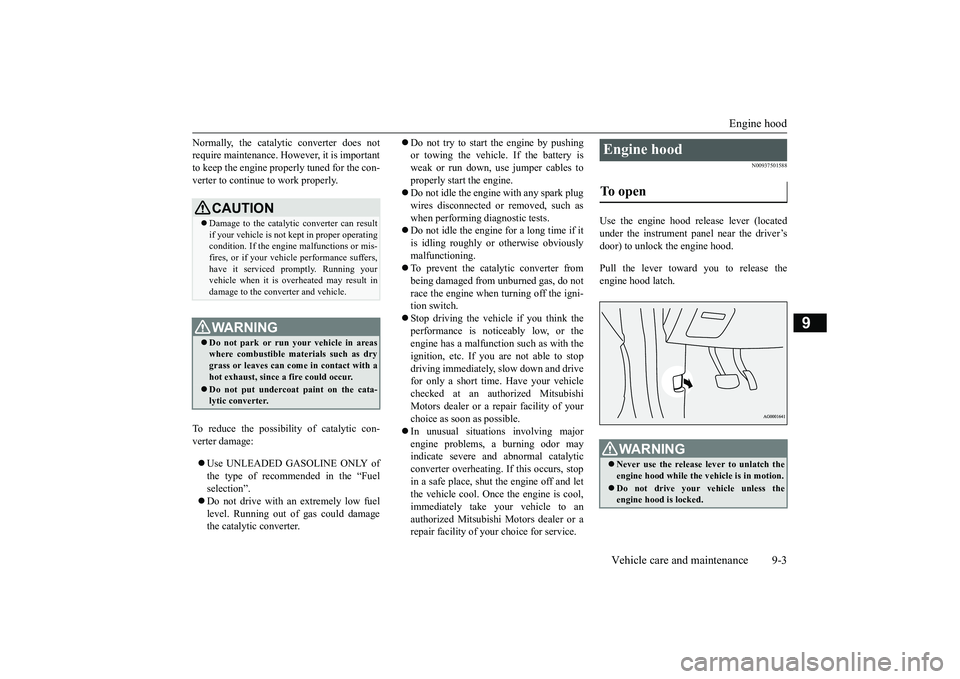
Use the engine hood release lever (locatedunder the instrument panel near the driver’sdoor) to unlock the engine hood.Pull the lever toward you to release theengine hood latch.
CAUTIONDamage to the catalyti
c converter can result
if your vehicle is not
kept in proper operating
condition. If the engine
malfunctions or mis-
fires, or if your vehi
cle performance suffers,
have it serviced promptly. Running yourvehicle when it is
overheated may result in
damage to the converter and vehicle.WA R N I N GDo not park or run your vehicle in areaswhere combustible materials such as drygrass or leaves can come
in contact with a
hot exhaust, since a fire could occur.Do not put undercoat paint on the cata-lytic converter.
Engine hood To open
WA R N I N GNever use the release lever to unlatch theengine hood while the
vehicle is in motion.
Do not drive your vehicle unless theengine hood is locked.
BK0249100US.book 3 ページ 2017年5月10日 水曜日 午前8時49分
Page 437 of 441
Alphabetical index12-2
12
Fluid
....................................
9-11
, 11-7
Selector lever operation
...................
5-75
Selector le
ver positions
...................
5-79
Sports mode
...................................
5-80
Coolant (engine)
..........................
9-8
, 11-7
Cruise control
...................................
5-103
Cup holder
.......................................
5-242
D
Daytime running lights
Bulb capacity
.................................
9-32
Replacement
..................................
9-36
Defogger (rear window)
....................
5-225
Defrosting or defogging (windshield, door windows)
..................................
7-8
, 7-12
Dimensions
........................................
11-4
Dimmer (high/lo
w beam change)
.......
5-210
Disc brake pads
..................................
9-24
Dome light (front)/Reading lights
.......
5-236
Bulb capacity
.................................
9-33
Dome light (rear)
..............................
5-237
Bulb capacity
.................................
9-33
Doors
Lock
..............................................
5-34
Power door locks
............................
5-36
Driving during cold weather
..................
6-5
Driving precaution
................................
6-2
Driving, alcohol and drugs
.....................
6-2
Dual-zone automatic climate control air conditioner
........................................
7-5
E
ECO mode switch
.............................
5-218
Electric parking brake
..........................
5-54
Electric power steering system (EPS)
....
5-99
Electric rear window
defogger switch
..5-225
Electronic immobilizer (Anti-theft starting system)
.....................................
5-4
, 5-28
Electronically cont
rolled 4WD system
..5-82
Emission-control system maintenance
...
9-23
Engine
Compartment
...................................
9-5
Coolant
...................................
9-8
, 11-7
Hood
...............................................
9-3
Malfunction indicator light
.............
5-204
MIVEC
.................................
5-26
, 5-67
Oil and oil filter
.......................
9-6
, 11-7
Overheating
.....................................
8-4
Serial number
.................................
11-2
Specification
...................................
11-6
Engine hood
........................................
9-3
Engine switch
.....................................
5-18
Exhaust system
...................................
9-24
F
Floor console box
..............................
5-240
Floor mat
.............................................
6-3
Fluid
Automatic transaxle fluid
.......
9-11
, 11-7
Brake fluid
............................
9-13
, 11-7
Continuously variable transmission (CVT)fluid
...................................
9-11
, 11-7
Engine coolant
........................
9-8
, 11-7
Engine oil
...............................
9-6
, 11-7
Rear axle oil
..........................
9-12
, 11-7
Transfer oil
...........................
9-12
, 11-7
Washer fluid
.........................
9-12
, 11-7
Fluid capacities and lubricants
.............
11-7
Forward Collision Miti
gation System (FCM)
5-118Free-hand advanced security transmitter (F.A.S.T.-key)
..................................
5-13
Front fog lights
Bulb capacity
.................................
9-32
Indicators
.....................................
5-202
Replacement
..................................
9-36
Switch
.........................................
5-218
Front side-marker lights
Bulb capacity
.................................
9-32
Replacement
..................................
9-35
Front turn signal light
Bulb capacity
.................................
9-32
Replacement
..................................
9-36
Fuel
Filling the fuel tank
...........................
3-3
Fuel economy
...................................
6-2
BK0249100US.book 2 ページ 2017年5月10日 水曜日 午前8時49分