traction control MITSUBISHI OUTLANDER III 2018 User Guide
[x] Cancel search | Manufacturer: MITSUBISHI, Model Year: 2018, Model line: OUTLANDER III, Model: MITSUBISHI OUTLANDER III 2018Pages: 441, PDF Size: 13.71 MB
Page 395 of 441
Tires9-18 Vehicle care and maintenance
9
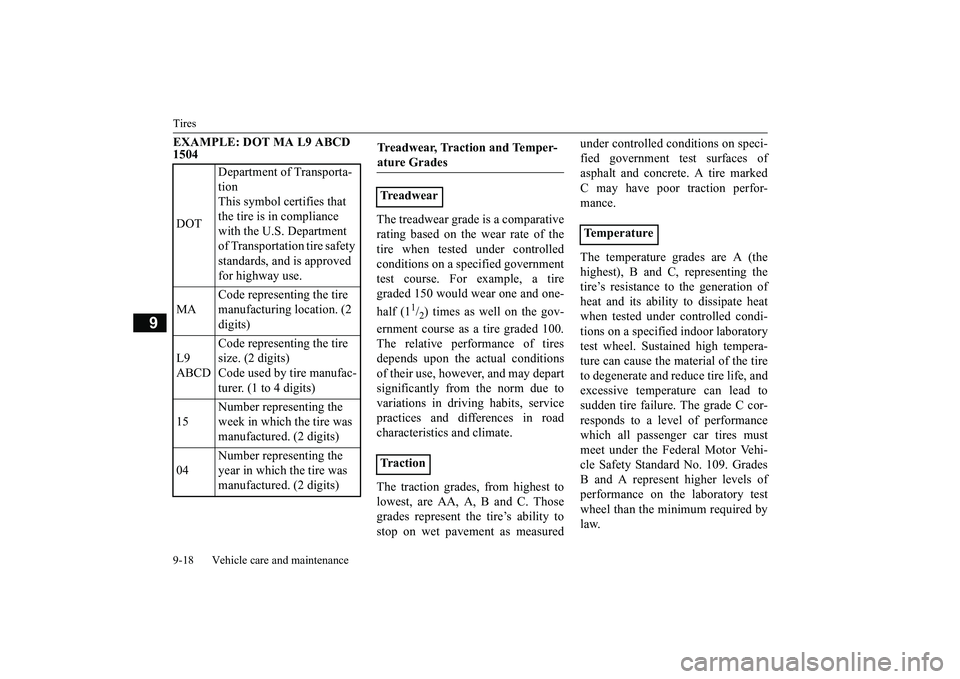
EXAMPLE: DOT MA L9 ABCD 1504
The treadwear grade is a comparativerating based on the wear rate of thetire when tested under controlledconditions on a specified governmenttest course. For example, a tiregraded 150 would wear one and one-half (1
1/2) times as well on the gov-
ernment course as a tire graded 100.The relative performance of tiresdepends upon the
actual conditions
of their use, however, and may departsignificantly from the norm due tovariations in driv
ing habits, service
practices and differences in roadcharacteristics and climate.The traction grades, from highest tolowest, are AA, A, B and C. Thosegrades represent the tire’s ability tostop on wet pavement as measured
under controlled co
nditions on speci-
fied government test surfaces ofasphalt and concrete. A tire markedC may have poor traction perfor-mance.The temperature grades are A (thehighest), B and C, representing thetire’s resistance to the generation ofheat and its ability to dissipate heatwhen tested under controlled condi-tions on a specified indoor laboratorytest wheel. Sustained high tempera-ture can cause the material of the tireto degenerate and reduce tire life, andexcessive temperature can lead tosudden tire failure. The grade C cor-responds to a level of performancewhich all passenger car tires mustmeet under the Federal Motor Vehi-cle Safety Standard No. 109. GradesB and A represent higher levels ofperformance on the laboratory testwheel than the minimum required bylaw.
DOT
Department of Transporta-tionThis symbol certifies that the tire is in compliance with the U.S. Department of Transportation tire safety standards, and is approved for highway use.
MA
Code representing the tire manufacturing location. (2 digits)
L9ABCD
Code representing the tire size. (2 digits)turer. (1 to 4 digits)
15
Number representing the week in which the tire was manufactured. (2 digits)
04
Number representing the year in which the tire was manufactured. (2 digits)
Treadwear, Traction and Temper-ature Grades Tr e a d w e a rTr a c t i o n
Te m p e r a t u r e
BK0249100US.book 18 ページ 2017年5月10日 水曜日 午前8時49分
Page 423 of 441
Consumer information (For vehicles sold in U.S.A.)10-2 Customer assistance/Re
porting Safety Defects
10
N01047100171
This information is provided in compliancewith the requirements of the National High-way Traffic Safety Ad
ministration, Depart-
ment of Transportation. It provides thepurchasers and/or prospective purchaserswith information on repor
ting safety defects.
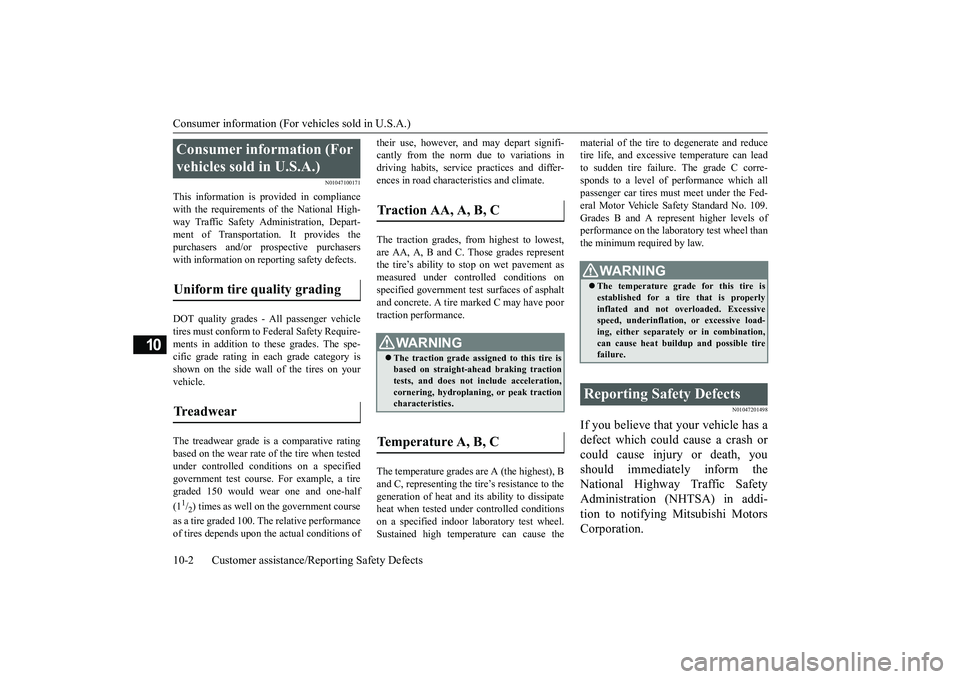
DOT quality grades - Al
l passenger vehicle
tires must conform to
Federal Safety Require-
ments in addition to these grades. The spe-cific grade rating in each grade category isshown on the side wall of the tires on yourvehicle. The treadwear grade is a comparative ratingbased on the wear rate of
the tire when tested
under controlled conditions on a specifiedgovernment test course
. For example, a tire
graded 150 would wear one and one-half(11/2) times as well on the government course
as a tire graded 100.
The relative performance
of tires depends upon the actual conditions of
their use, however, and may depart signifi-cantly from the norm due to variations indriving habits, service practices and differ-ences in road characteristics and climate. The traction grades, from highest to lowest,are AA, A, B and C. Those grades representthe tire’s ability to
stop on wet pavement as
measured under controlled conditions onspecified government te
st surfaces of asphalt
and concrete. A tire marked C may have poortraction performance. The temperature grades are A (the highest), Band C, representing the ti
re’s resistance to the
generation of heat and it
s ability to dissipate
heat when tested un
der controlled conditions
on a specified indoor
laboratory test wheel.
Sustained high temperature can cause the
material of the tire to
degenerate and reduce
tire life, and excessive temperature can leadto sudden tire failure. The grade C corre-sponds to a level of performance which allpassenger car tires must meet under the Fed-eral Motor Vehicle Safety Standard No. 109.Grades B and A represent higher levels ofperformance on the labora
tory test wheel than
the minimum required by law.
N01047201498
If you believe that your vehicle has adefect which could cause a crash orcould cause injury or death, youshould immediately inform theNational Highway Traffic SafetyAdministration (NHTSA) in addi-tion to notifying Mitsubishi MotorsCorporation.
Consumer information (For vehicles sold in U.S.A.) Uniform tire quality grading Treadwear
Traction AA, A, B, C
WA R N I N GThe traction grade assi
gned to this tire is
based on straight-ahead braking tractiontests, and does not include acceleration,cornering, hydroplani
ng, or peak traction
characteristics.
Temperature A, B, C
WA R N I N GThe temperature grade for this tire isestablished for a tire that is properlyinflated and not overloaded. Excessivespeed, underinflation
, or excessive load-
ing, either separately
or in combination,
can cause heat buildup and possible tirefailure.
Reporting Safety Defects
BK0249100US.book 2 ページ 2017年5月10日 水曜日 午前8時49分