check engine light MITSUBISHI OUTLANDER III 2018 Owner's Manual
[x] Cancel search | Manufacturer: MITSUBISHI, Model Year: 2018, Model line: OUTLANDER III, Model: MITSUBISHI OUTLANDER III 2018Pages: 441, PDF Size: 13.71 MB
Page 290 of 441
![MITSUBISHI OUTLANDER III 2018 Owners Manual Combination headlights and dimmer switch
Features and controls 5-209
5
[When the engine is not
running, or when the
engine is running but the parking brake is notreleased]The engine starts when the l](/img/19/58144/w960_58144-289.png "MITSUBISHI OUTLANDER III 2018 Owners Manual Combination headlights and dimmer switch
Features and controls 5-209
5
[When the engine is not
running, or when the
engine is running but the parking brake is notreleased]The engine starts when the l")
Combination headlights and dimmer switch
Features and controls 5-209
5
[When the engine is not
running, or when the
engine is running but the parking brake is notreleased]The engine starts when the lights are off.
N00532601649
If the following operation is performedwith the combination headlights and dim-mer switch in the “ ” or “ ” position,the lights automatically turn off.[Except for vehicles equipped with theF. A . S . T. - k e y ]The ignition switch is turned to the “OFF”
the key is removed
from the ignition switch and the driver’sdoor is opened.[For vehicles equipped with the F.A.S.T.-key]The operation mode is changed to OFF orACC and the driver’s door is opened.If the following operation is performedwith the combination headlights and dim-mer switch in the “ ” or “ ” position,the lights automatically turn off afterapproximately 3 minutes.[Except for vehicles equipped with theF. A . S . T. - k e y ]The ignition switch is turned to the “OFF”
the key is removed
from the ignition switch and the driver’sdoor is not opened.
The daytime running lights illumi-natedTail, front and re
ar side-marker
lights, license pl
ate, instrument
panel lights and downlight onHeadlights and other lights on
NOTE
Once the daytime running light come on,they do not go out until the ignition switch isturned to the “OFF” or “ACC” position orthe operation mode is changed to OFF orACC.OFF All lights offAUTO
Headlights and other lights turn on and off automatically in accor-dance with outside light level.Parking, tail, front
and rear side-
marker lights, license plate, instru-ment panel lights and downlight onHeadlights and other lights on
NOTE
The sensitivity of the automatic on/off con-trol can be adjusted.For further informati
on, please contact your
authorized Mitsubishi
Motors dealer or a
repair facility
of your choice.
On vehicles equippe
d with the Smartphone
Link Display Audio, sc
reen operations can
be used to make the adjustment.Refer to the separate
owner’s manual for
details.Do not cover the sensor (A) for the automaticon/off control by affixing
a sticker or label to
the windshield.If the lights do not turn on or off with theswitch in the “AUTO”operate the switch. Have the system checkedby an authorized Mitsubishi Motors dealer ora repair facility of your choice.
Light auto-cutout function (headlights and other lights)
BK0249100US.book 209 ページ 2017年5月10日 水曜日 午前8時49分
Page 291 of 441
![MITSUBISHI OUTLANDER III 2018 Owners Manual Combination headlights and dimmer switch5-210 Features and controls
5
[For vehicles equipped
with the F.A.S.T.-
key]The operation mode is changed to OFF orACC and the driver’s door is not opened.
I](/img/19/58144/w960_58144-290.png "MITSUBISHI OUTLANDER III 2018 Owners Manual Combination headlights and dimmer switch5-210 Features and controls
5
[For vehicles equipped
with the F.A.S.T.-
key]The operation mode is changed to OFF orACC and the driver’s door is not opened.
I")
Combination headlights and dimmer switch5-210 Features and controls
5
[For vehicles equipped
with the F.A.S.T.-
key]The operation mode is changed to OFF orACC and the driver’s door is not opened.
If the combination headlights and dimmerswitch is turned to the “ ” or “ ” posi-tion again after the engine is turned off, theapproximately 3-minute
auto-cutout function
described above will not
work. The lights (the
parking lights, tail li
ghts and license plate
lights) will stay on and will not turn off auto-matically.
N00584500028
This warning light will illuminate when thereis a malfunction in the LED headlights.
N00549801236
[When using a key to start the engine]If the driver’s door is opened with the key inthe “OFF” or “LOCK” or “ACC” position orremoved from the ignition switch while thelights are on, the tone
will sound to remind
you to turn off the lights.[When using the F.A.S.T.-key to start theengine]If the driver’s door is opened with the opera-tion mode is put in OFF or ACC, or if theoperation mode is changed to OFF while thelights are on, the tone
will sound to remind
you to turn off the lights.In either case, the lights will turn off automat-ically and so will the tone. Or you can turnthe light switch to the “OFF” position to stopthe tone.
N00549901178
To change the headlights from high beam tolow beam and vice vers
a, pull the turn signal
lever to (1). Switch the headlights to lowbeam as a courtesy whenever there areoncoming vehicles, or when there is trafficmoving ahead of you. An illuminated blue
NOTE
The light auto-cutout
function can be deacti-
vated.See your authorized Mitsubishi Motorsdealer for details.For vehicles equipped with the SmartphoneLink Display Audio, adjustments can bemade using screen ope
rations. For further
details, refer to the se
parate owner’s manual.
When you want to keep the lights on:
LED headlight warning light
(if
so equipped)If the warning light il
luminates, there may be
a malfunction in the unit. Contact an autho-rized Mitsubishi Motors dealer or a repairfacility of your choice to have the systemchecked.Type 1Type 2
Headlight reminder buzzer Dimmer (high/low beam change)
BK0249100US.book 210 ページ 2017年5月10日 水曜日 午前8時49分
Page 317 of 441
Interior lights5-236 Features and controls
5
This equipment complies with FCC radiationexposure limits set forth for an uncontrolledenvironment. End Users must follow the spe-cific operating instruc
tions for satisfying RF
exposure compliance. This transmitter mustbe at least 12 inches (20 cm) from the userand must not be co-located or operating inconjunction with any other antenna or trans-mitter.The term “IC:” before the certification/regis-tration number only signi
fies that Industry
Canada technical spec
ifications were met.
N00525301660
N00525401531
CAUTIONThe transmitter has been tested and complieswith FCC and IC rules.Changes or modifica
tions not expressly
approved by the party responsible for com-pliance could void the
user’s authority to
operate the device.
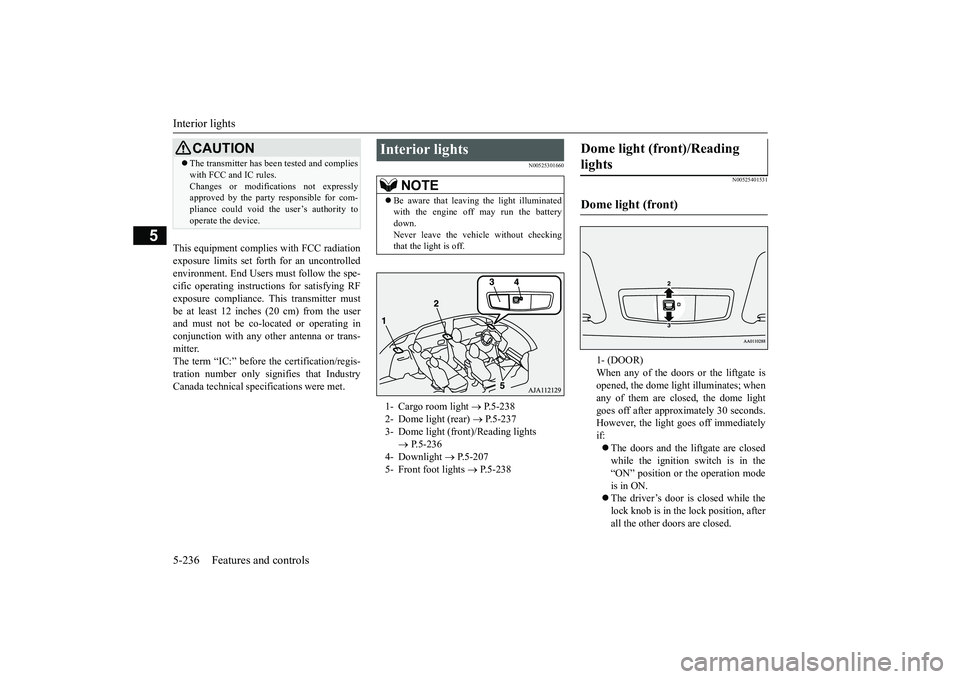
Interior lights
NOTE
Be aware that leaving the light illuminatedwith the engine off may run the batterydown.Never leave the vehi
cle without checking
that the light is off.1- Cargo room light
P.5-238
2- Dome light (rear)
P.5-237
3- Dome light (front)/Reading lights
P.5-236
4- Downlight
P.5-207
5- Front foot lights
P.5-238
Dome light (front)/Reading lights Dome light (front)
1- (DOOR)When any of the doors or the liftgate isopened, the dome light illuminates; whenany of them are closed, the dome lightgoes off after approx
imately 30 seconds.
However, the light
goes off immediately
if:The doors and the liftgate are closedwhile the ignition switch is in the“ON” position or the operation modeis in ON.The driver’s door is closed while thelock knob is in the lock position, afterall the other doors are closed.
BK0249100US.book 236 ページ 2017年5月10日 水曜日 午前8時49分
Page 334 of 441
Driving during cold weather
Driving safety 6-5
6
you give extra attention to the followingareas, you can better protect yourself andyour passengers:Drive defensively. Be aware of traffic,road and weather c
onditions. Leave plenty
of stopping distance
between your vehicle
and the vehicle ahead.Before changing lanes, check your mir-rors, blind spots, a
nd use your turn-signal
light.While driving, watch the behavior ofother drivers, bicycl
ists, and pedestrians.
Always obey applicab
le laws and regula-
tions. Be a polite and alert driver. Alwaysleave room for unexpected events, such assudden braking.If you plan to drive in another country,obey their vehicle re
gistration laws and
make sure you will be able to get the rightfuel.
N00629400445
Check the battery. At the same time,check the terminals and wiring. Duringextremely cold weather, the battery willnot be as strong. Also, the battery powerlevel may drop beca
use more power is
used for cold starting and driving.
Before driving the vehicle, check to see ifthe engine runs at the proper speed and ifthe headlights are as bright as normally.Charge or replace the battery if necessary.During extreme cold weather, it is possi-ble that a very low battery could freeze.Warm the engine sufficiently. After start-ing the engine, allow a short warm-uptime to distribute oil to all cylinders. Thendrive your vehicle slowly.Stay at low speeds at first so that thetransaxle, transfer case and rear axle oilhave time to spread to all lubricationpoints.Check the engine antifreeze.If there is not enough coolant because of aleak or from engine
overheating, add Mit-
subishi Motors Genuine Super Long LifeCoolant Premium or equivalent.Please read this section in conjunctionwith the “Engine coolant” on page 9-8.
N00629501528
All the parts of the brake system are criticalto safety. Have the
vehicle serviced by an
authorized Mitsubishi Motors dealer or arepair facility of your
choice at regular inter-
vals according to the “WARRANTY ANDMAINTENANCE MANUAL”.Check the brake system while driving at alow speed immediately
after starting, espe-
cially when the brakes are wet, to confirmthey work normally.A film of water can be formed on the brakediscs and prevent normal braking after driv-ing in heavy rain or through large puddles, orafter the vehicle is washed. If this occurs, drythe brakes out by drivi
ng slowly while lightly
depressing the brake pedal.
Driving during cold weather
WA R N I N GThe battery gives off explosive hydrogengas. Any spark or flame can cause the bat-tery to explode, which could cause seriousinjury or death.Always wear protecti
ve clothes and a face
mask when working with your battery, orlet a skilled mechanic do it.
WA R N I N GNever open the radiator cap when theradiator is hot. You could be seriouslyburned.
Braking When brakes are wet
BK0249100US.book 5 ページ 2017年5月10日 水曜日 午前8時49分
Page 335 of 441
Parking6-6 Driving safety
6
On snowy roads, ice can form on the brakingsystem, making the brakes less effective.While driving in such conditions, pay closeattention to surrounding
vehicles and to the
condition of the road surface. From time totime, lightly depress the brake pedal andcheck how effective the brakes are.It is important to take
advantage of the engine
braking by downshifting while driving onsteep downhill roads in order to prevent thebrakes from overheating.
N00629601385
When parking on a hill, set the parking brake,and turn the front wheels toward the curb on adownhill, or away from
the curb on an uphill.
If necessary, apply chocks to the wheels.Be sure that the parki
ng brake is firmly set
when parked and that the selector lever is inthe “P” (PARK) position.
When parking on a hill, it is important to setthe parking brake befo
re moving the selector
lever to the “P” (PARK) position. This pre-vents loading the parking brake against thetransaxle. When this ha
ppens, it is difficult to
move the selector lever out of the “P”Never leave the engine running while youtake a short nap or rest. Also, never leave theengine running in a closed or poorly venti-lated place.Your front bumper can be damaged if youscrape it over curbs or parking stop blocks.Be careful when traveling up or down steepslopes where your bumper can scrape theroad.
Always carry the key and lock all doors andthe liftgate when leaving the vehicle unat-tended.Always try to park your vehicle in a well litarea.Move effort could be required to turn thesteering wheel.Refer to “Electric power steering system(EPS)” on page 5-99.
N00629901434
It is very important to know how muchweight your vehicle can carry. This weight iscalled the vehicle ca
pacity weight and
includes the weight of
all occupants, cargo
(including the roof load), non-factory-
When driving in cold weather When driving downhill Parking Parking on a hill
Parking with the engine run-ning
WA R N I N GLeaving the engine ru
nning risks injury or
death from accidentally moving the selec-tor lever or the accumulation of toxicexhaust fumes in the passenger compart-ment.
Where you park
WA R N I N GDo not park your vehicle in areas wherecombustible materials
such as dry grass or
leaves can come in contact with a hotexhaust, since a fire could occur.
When leaving the vehicle Do not keep the steering wheel fully turned for a long time Loading information
BK0249100US.book 6 ページ 2017年5月10日 水曜日 午前8時49分
Page 363 of 441
If the vehicle breaks down8-2 For emergencies
8
N00836301230
If your vehicle breaks down on the road,move to the shoulder and turn on the hazardwarning flashers. If there is no shoulder, orthe shoulder is not safe, drive in the right laneslowly with the hazard
lights flashing, until
you come to a safe stopping place. Keep theflashers flashing.If the engine stops, there will be no powerassist to the steering and brakes, making thesedifficult to use.The brake booster will not work, so thebrakes will not grip well. The brake pedalwill be harder to press than usual.Since there is no power steering assist, thesteering wheel will be hard to turn.
Get help from your passengers, bystanders,etc. to push the vehicle
and move it to a safe
area.
N00836401778
If the engine cannot be started because thebattery is weak or de
ad, you can start it with
the battery from anothe
r vehicle using jumper
cables.1. Take off any metal jewelry such as watchbands or bracelets th
at might create an
accidental electrical contact.2. Position the vehi
cles close enough
together so that the jumper cables canreach, but be sure the vehicles aren’ttouching each other.
3. Set the parking brake firmly on your vehi-cle and move the selector lever into the“P” (PARK) position.4. Set the parking brake firmly on the othervehicle. Put the automatic transaxle in “P”5. Turn the ignition switch (the engineswitch) on each vehicle to the “LOCK” or“OFF” position.6. Make sure your battery electrolyte is atthe proper level. (Refer to “Battery” onpage 9-13.)
If the vehicle breaks down If the engine stops/fails When the engine fails at the intersection
Jump-starting the engine
WA R N I N GTo reduce the risk of igniting flammablegas that may be emitted from the battery,carefully read this section before jump-starting the vehicle.Do not try to start you
r vehicle by pushing
or towing. This can cause an accidentresulting in serious
injury or death and
can damage the vehicle.NOTE
Do not use jumper cables if they have dam-age or corrosion.
CAUTIONCheck the other vehicle.
It must have a 12-
volt battery. If the other system isn’t 12-volt,both systems can be damaged.NOTE
Turn off all lights, heat
er, and othe
r electrical
loads. This will avoid sparks and help saveboth batteries.
BK0249100US.book 2 ページ 2017年5月10日 水曜日 午前8時49分
Page 365 of 441
Engine overheating8-4 For emergencies
8
If you drive your vehicl
e with a low battery
charge after the engine has been started byusing jumper cables, th
e engine may misfire.
This can cause the anti-lock braking systemwarning light to blink on
and off. This is only
due to the low battery voltage. It is not aproblem with the brake system. If this hap-pens, fully charge the battery and ensure thecharging system is operating properly.
N00836501375
When the engine is overheating, the warningwill be displayed in th
e instrument cluster as
follows.The information screen in the multi infor-mation display will be interrupted and theengine coolant temp
erature warning dis-
play will appear. Also “ ” will blink.(Color liquid crystal display type)lamp will illuminate.
(Mono-color liquid
crystal display type)
If these warnings are displayed:
1. Stop the vehicle in a safe place. Turn onthe hazard warning flashers.2. With the engine st
ill running, carefully
raise the engine hood to vent the enginecompartment.3. Check that the cooling fan is running. Ifthe fan is not turn
ing, stop the engine
immediately and cont
act an authorized
Mitsubishi Motors dealer or a repair facil-ity of your choice for assistance.4. If you see steam or spray coming fromunder the hood, turn off the engine.5. If you do not see steam or spray comingfrom under the hood, leave the engine onuntil the high coolant
temperature warn-
ing goes off. After the high coolant tem-perature warning has gone off, you canstart driving again. If the high coolanttemperature warning stays on, turn off theengine.
Charging the battery by using an external battery charger
WA R N I N GAlways remove the
battery from your
vehicle when the battery is charged by anexternal battery charger.Keep sparks, cigarette
s, and flames away
from the battery because the battery couldexplode.Keep your work area well vented whencharging or using
the battery in an
enclosed space.Remove all the caps before charging thebattery.Electrolyte (battery acid) is made of corro-sive diluted sulfuric acid. If electrolytecomes in contact with your hands, eyes,clothes, or the pain
ted surface of your
vehicle, thoroughly
flush with water. If
electrolyte gets in your eyes, flush themimmediately and thor
oughly with water,
and get prompt medical attention.Always wear protective clothing and gog-gles when working near the battery.Keep the battery out of the reach of chil-dren.
As your vehicle has anti-lock brakes Engine overheating
WA R N I N GTo avoid personal injury, keep hands, hair,jewelry and clothes aw
ay from the cooling
fan. The cooling fan ca
n start at any time.
BK0249100US.book 4 ページ 2017年5月10日 水曜日 午前8時49分
Page 366 of 441
Jack and tools
For emergencies 8-5
8
6. When you do not see any more steam orspray, open the hood. Look for obviousleaks, such as a split radiator hose. Becareful as components will be hot. Anyleak source must be repaired.7. If there is no obvious leak source, checkthe coolant level in the engine coolantreserve tank. If there is
none, or if it is too
low, slowly add coolant.8. If the engine coolant reserve tank needscoolant, you will probably also need toadd coolant to the radiator. Do not loosenor remove the radiator cap until the enginehas cooled down.
9. Start the engine, a
nd slowly add coolant,
up to the bottom of the filler neck. Useplain water if you have to (and replace itwith the right coolant as soon as possible).
10. Replace the radiator cap and tighten it
fully. Check the engine coolant tempera-ture display on the mu
lti information dis-
play (Color liquid crystal display type) orthe high coolant temperature warninglight (Mono-color liqui
d crystal display
type). You can start driving again whenthe high coolant temperature warningdoes not come on.
11. Have the system inspected by your autho-
rized Mitsubishi Motors
dealer or a repair
facility of your choice.
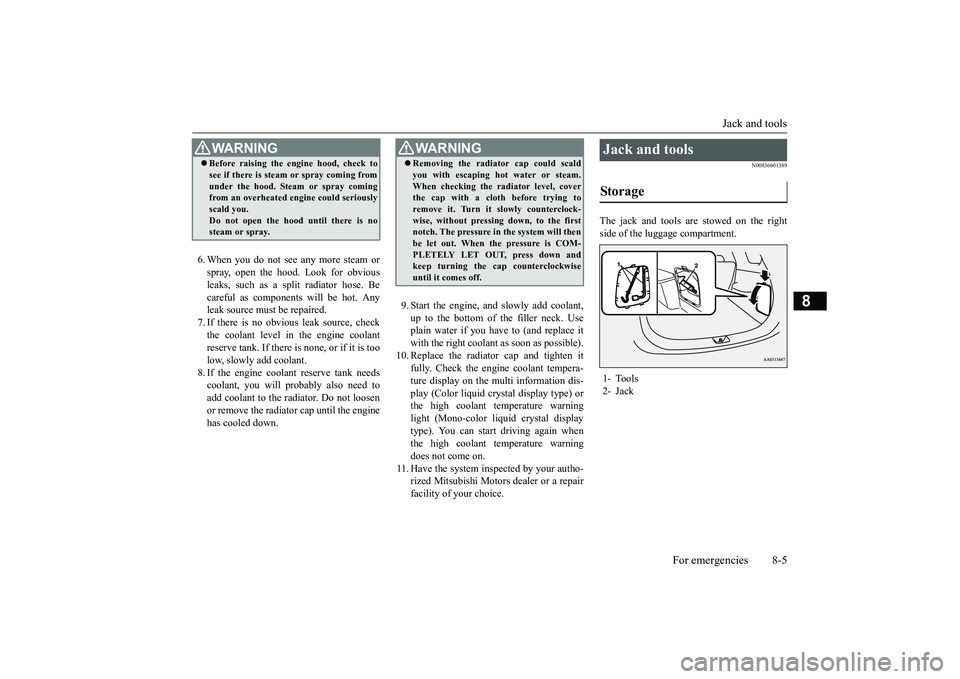
N00836601389
The jack and tools are stowed on the rightside of the luggage compartment.
WA R N I N GBefore raising the en
gine hood, check to
see if there is steam or spray coming fromunder the hood. Steam or spray comingfrom an overheated en
gine could seriously
scald you.Do not open the hood until there is nosteam or spray.
WA R N I N GRemoving the radiat
or cap could scald
you with escaping hot water or steam.When checking the radiator level, coverthe cap with a cloth before trying toremove it. Turn it slowly counterclock-wise, without pressing down, to the firstnotch. The pressure in the system will thenbe let out. When the pressure is COM-PLETELY LET OUT, press down andkeep turning the cap counterclockwiseuntil it comes off.
Jack and tools Storage 1- Tools2- Jack
BK0249100US.book 5 ページ 2017年5月10日 水曜日 午前8時49分
Page 400 of 441
Emission-control system maintenanceVehicle care and maintenance 9-23
9
N00940800328
Your vehicle is equi
pped with an emission-
control system that meets all the requirementsof the U.S. Environm
ental Protection Agency
and Environment Cana
da. The emission-con-
trol system is made of:a positive crankcase
ventilation system
an evaporative emis
sion-control system
an exhaust emission-control system
To be sure the emissi
on-control system works
properly, have your vehicle inspected andmaintained by an authorized MitsubishiMotors dealer or a repair facility of yourchoice. This should be done at the time ormileage specified in the “WARRANTY ANDMAINTENANCE MANUAL”.These, and all the other “general” mainte-nance services listed in this manual, need tobe performed to keep
your vehicle running
properly and reliably.You should also have an inspection and ser-vice any time you suspect a malfunction.
N00940900231
Spark plugs must fire properly to ensureproper engine perfo
rmance and emission-
control.Do not reuse spark plugs by cleaning orregapping. Spark plugs should be replaced atthe mileage specified in the “WARRANTYAND MAINTENANCE MANUAL”.
Check the hose surfaces for any heat andmechanical damage, hard and brittle rubber,cracking, tears, cuts and abrasions. Pay spe-cial attention to the hos
es closest to high heat
sources such as the exhaust manifold. Checkall the hose connections
, such as clamps and
couplings, to make sure
they are secure and
that there are no leaks. If you see any wear ordamage, replace the
hoses immediately.
N00950100050
Have the valve clea
rance checked at an
authorized Mitsubishi Motors dealer at themileage specified in the “WARRANTY ANDMAINTENANCE MANUAL”.If the engine sounds abnormally loud, haveadjustments made by an authorizedMitsubishi Motors dealer.
N00941300173
Check these regularly for damage or leaks inthe fuel lines and connections. Check the fueltank filler cap for dama
ge or looseness. Pay
special attention to the fuel lines closest to
Emission-control system maintenance
NOTE
To meet government regulations and pro-mote cleaner air, your
vehicle is equipped
with an onboard dia
gnostic system (OBD).
The engine electronic control module thatcontrols OBD functions stores various data(especially a
bout the exhaust emissions).
This data will be erased if the battery cable isdisconnected, which c
ould make a rapid
diagnosis difficult.
Do not disconnect the
battery cable when the engine malfunctionindicator (“SERVICE ENGINE SOON” or“Check engine
light”) is ON.
Spark plugs
NOTE
Use the recommended or equivalent sparkplugs listed under “Engin
e specifications” on
page 11-6. Use of other plugs could causeengine damage, loss of performance or radionoise.
Fuel hoses Intake valve clearance Fuel system (tank, pipe line and connection, and fuel tank filler cap)
BK0249100US.book 23 ページ 2017年5月10日 水曜日 午前8時49分
Page 402 of 441
For cold and snowy weather
Vehicle care and maintenance 9-25
9
The underside or rear of the vehicle isdamaged
Also check the exhaust system each time thevehicle is raised for l
ubrication, oil changes,
or required service. A
ny open seams or loose
connections could le
t dangerous exhaust
fumes seep into the luggage and passengercompartments.Check for holes or exhaust gas leakscaused by corrosion or damage.Check the joints and connections forlooseness or exhaust gas leaks.Check the rubber hangers and brackets fordamage.
N00942300079
The timing belt should be replaced with anew one at the mileage listed in the “WAR-RANTY AND MAINTENANCE MAN-UAL”.
N00942501124
The hood lock release mechanism and hoodsafety catch should be checked, cleaned, andoiled when needed for easy movement and toprevent rust and wear. Use MultipurposeGrease NLGI Grade 2 sparingly for all slidingparts of the hood latch and release lever.Work the grease into the hood lock mecha-nism until all the movable surfaces are cov-ered.Also, put a light coat
of the same grease on
the safety catch wherever moving parts touch.
N00942600102
The ventilation slots in
front of the wind-
shield should be brushed clear after a heavysnowfall so that the operation of the heatingand ventilation systems will not be impaired.
To prevent freezing of the weatherstrippingon the doors, engine hood, etc., they shouldbe treated with
silicone grease.
It is a good idea to carry a shovel or a short-handled spade in the vehicle during the win-ter so that you can clear away snow if you getstranded. A small hand-brush for sweepingsnow off the vehicle a
nd a plastic scraper for
the windshield, side a
nd rear window are also
useful.
N00942700291
The fusible links will melt to prevent a fire ifa large current attempts to flow through cer-tain electrical systems.In case of a melted fusible link, see yourauthorized Mitsubishi Motors dealer or arepair facility of your choice for inspectionand replacement.For the fusible links, please refer to “Fuseload capacities” on page 9-27.
Check for any of the following conditions: Timing belt
Hood lock release mechanism and safety catch For cold and snowy weather Ventilation slots
Weatherstripping Additional equipment (For regions where snow is encoun-tered) Fusible links
BK0249100US.book 25 ページ 2017年5月10日 水曜日 午前8時49分