steering MITSUBISHI OUTLANDER III 2018 Owner's Manual
[x] Cancel search | Manufacturer: MITSUBISHI, Model Year: 2018, Model line: OUTLANDER III, Model: MITSUBISHI OUTLANDER III 2018Pages: 441, PDF Size: 13.71 MB
Page 153 of 441
Automatic transaxle (if so equipped)5-72 Features and controls
5
This position is used for most city and high-way driving. The transaxle will automaticallychange its gear depe
nding on road and driv-
ing conditions.
This position is for dr
iving up very steep hills
and for engine braking at low speeds whendriving down steep hills.
N00514401485
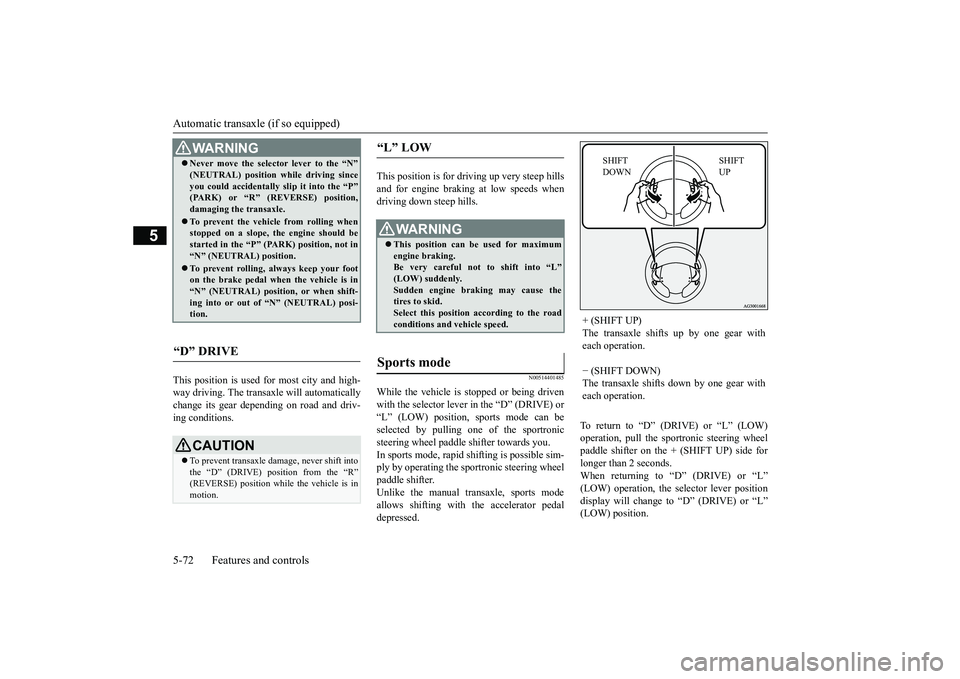
While the vehicle is stopped or being drivenwith the selector lever in the “D” (DRIVE) or“L” (LOW) position, sports mode can beselected by pulling one of the sportronicsteering wheel paddle shifter towards you.In sports mode, rapid shifting is possible sim-ply by operating the spor
tronic steering wheel
paddle shifter.Unlike the manual transaxle, sports modeallows shifting with the accelerator pedaldepressed.
To return to
Page 154 of 441
Automatic transaxle (if so equipped)
Features and controls 5-73
5
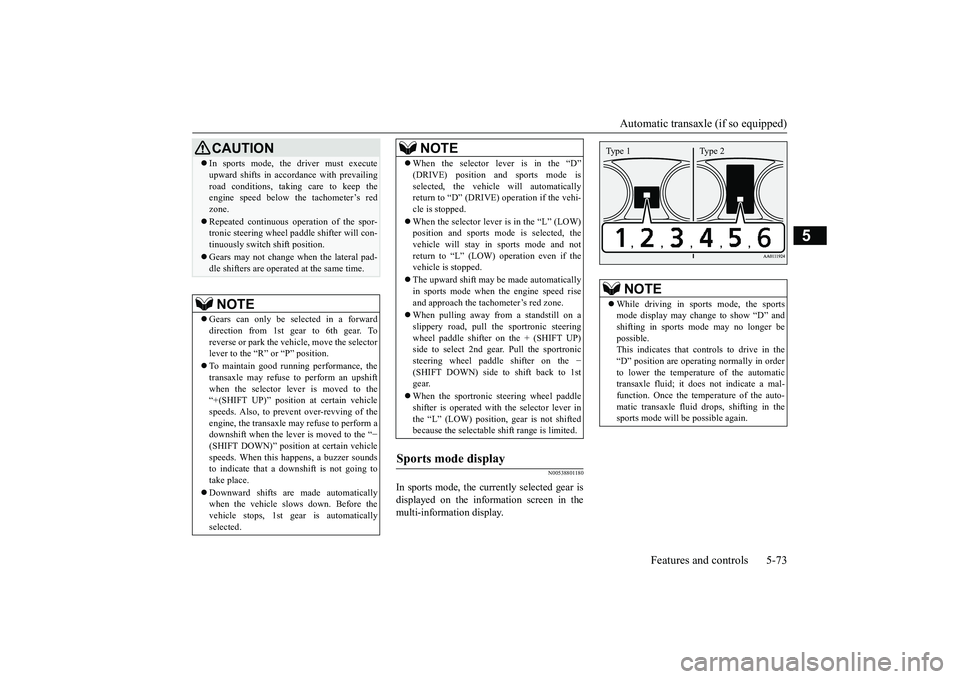
N00538801180
In sports mode, the currently selected gear isdisplayed on the information screen in themulti-information display.
CAUTIONIn sports mode, the driver must executeupward shifts in accordance with prevailingroad conditions, taking care to keep theengine speed below the tachometer’s redzone.Repeated continuous ope
ration of the spor-
tronic steering wheel pa
ddle shifter will con-
tinuously switch shift position.Gears may not change when the lateral pad-dle shifters are operate
d at the same time.
NOTE
Gears can only be selected in a forwarddirection from 1st gear to 6th gear. Toreverse or park the vehi
cle, move the selector
lever to the “R” or “P” position.To maintain good running performance, thetransaxle may refuse to perform an upshiftwhen the selector lever is moved to the“+(SHIFT UP)” positi
on at certain vehicle
speeds. Also, to prevent over-revving of theengine, the transaxle may refuse to perform adownshift when the lever is moved to the “
−
(SHIFT DOWN)” positi
on at certain vehicle
speeds. When this happens, a buzzer soundsto indicate that a dow
nshift is not going to
take place.Downward shifts are made automaticallywhen the vehicle slow
s down. Before the
vehicle stops, 1st gear
is automatically
selected.
When the selector lever is in the “D”selected, the vehicle will automaticallyreturn to “D” (DRIVE)
operation if the vehi-
cle is stopped.When the selector lever is in the
Page 156 of 441
Continuously variable transmission (CVT) (if so equipped)
Features and controls 5-75
5
and then move the sele
ctor lever to the “P”
(PARK) position.If the transaxle does not change gears whiledriving, or your vehicle does not pick upenough speed when starting on an uphillslope, it may be that there is somethingunusual happening in the
transaxle, causing a
safety device to activa
te. Have your vehicle
checked at an authorized Mitsubishi Motorsdealer or a repair facility of your choiceimmediately.
N00560201060
The CVT will automati
cally and continuously
change its gear ratio depending on road anddriving conditions. This helps achievesmooth driving and excellent fuel efficiency.If your vehicle is equipped with the spor-tronic steering wheel paddle shifter, you canmanually shift up and shift down the trans-mission. Refer to “Sports mode” on page5-80.The transmission prevents unnecessaryupshifts even when the accelerator pedal isreleased and ensures smooth driving.According to the condi
tions, the transmission
will automatically shift to a lower gear ratioto achieve stronger engine braking. This mayhelp reduce your need
to use the service
brake.
N00560301090
As an additional safe
ty precaution, models
equipped with a continuously variable trans-mission have a shift-lock device that holdsthe selector lever in the “P” (PARK) position.To move the selector lever from the “P”the steps below.1. Press and hold the brake pedal down.2. Move the selector lever to the desiredposition.
The CVT selects an optimum ratio automati-cally when the selector lever is in the “D”
nding on the speed of
the vehicle and the positi
on of the accelerator
pedal.
When the automatic transaxle makes no gear change
NOTE
When the warning display and “SLOWDOWN” or the warning display and“SERVICE REQUIRED” appear on theinformation screen in
the multi-information
display, there could be
a malfunction in the
automatic transaxle. Refer to “Automatictransaxle: Warning di
splay” on page 5-70.
Continuously variable transmission (CVT)
(if so
equipped)
DRIVING DOWNHILL
Selector lever operation
NOTE
The selector lever cannot
be moved from “P”
switch is set to the “OFF” or “LOCK” or“ACC” position, or if the key has beenremoved, or the opera
tion mode is put in
OFF or ACC, or if the brake pedal is notpressed and held down.
BK0249100US.book 75 ページ 2017年5月10日 水曜日 午前8時49分
Page 157 of 441
Continuously variable transmission (CVT) (if so equipped)5-76 Features and controls
5
N00563301062
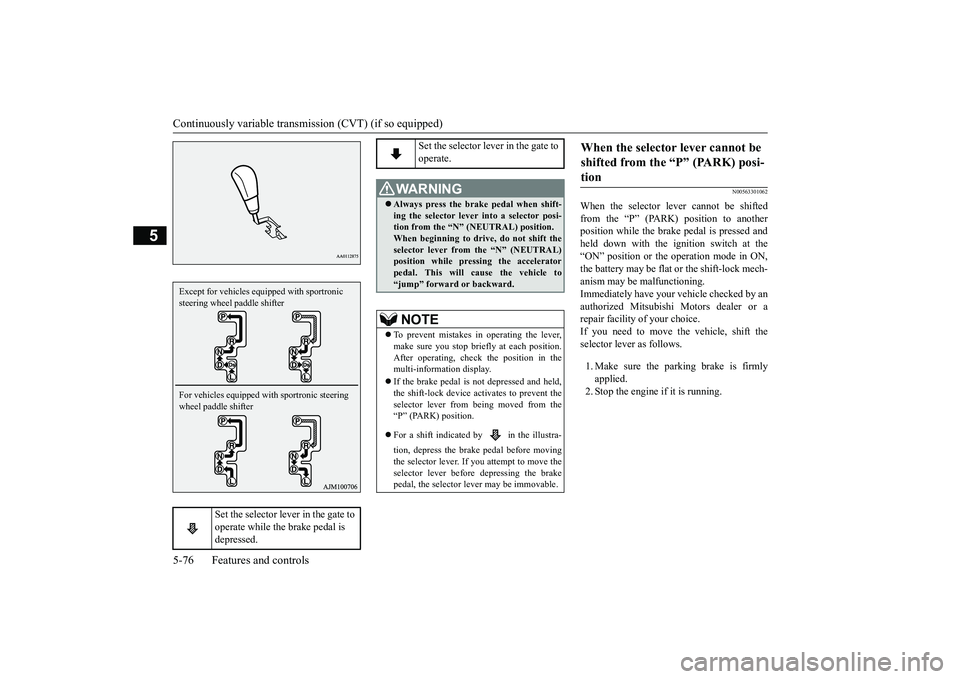
When the selector lever cannot be shiftedfrom the “P” (PARK) position to anotherposition while the brake pedal is pressed andheld down with the ignition switch at the“ON” position or the operation mode in ON,the battery may be flat or the shift-lock mech-anism may be malfunctioning.Immediately have your
vehicle checked by an
authorized Mitsubishi Motors dealer or arepair facility of your choice.If you need to move the vehicle, shift theselector lever as follows.1. Make sure the parking brake is firmlyapplied.2. Stop the engine if it is running.
Set the selector lever in the gate to operate while the brake pedal is depressed.
Except for vehicles equipped with sportronic steering wheel paddle shifterFor vehicles equipped with sportronic steering wheel paddle shifter
Set the selector lever in the gate to operate.
WA R N I N GAlways press the brake pedal when shift-ing the selector lever into a selector posi-tion from the
Page 161 of 441
Continuously variable transmission (CVT) (if so equipped)5-80 Features and controls
5
This position is for driving up very steep hillsand for engine braking at low speeds whendriving down steep hills.
N00560701094
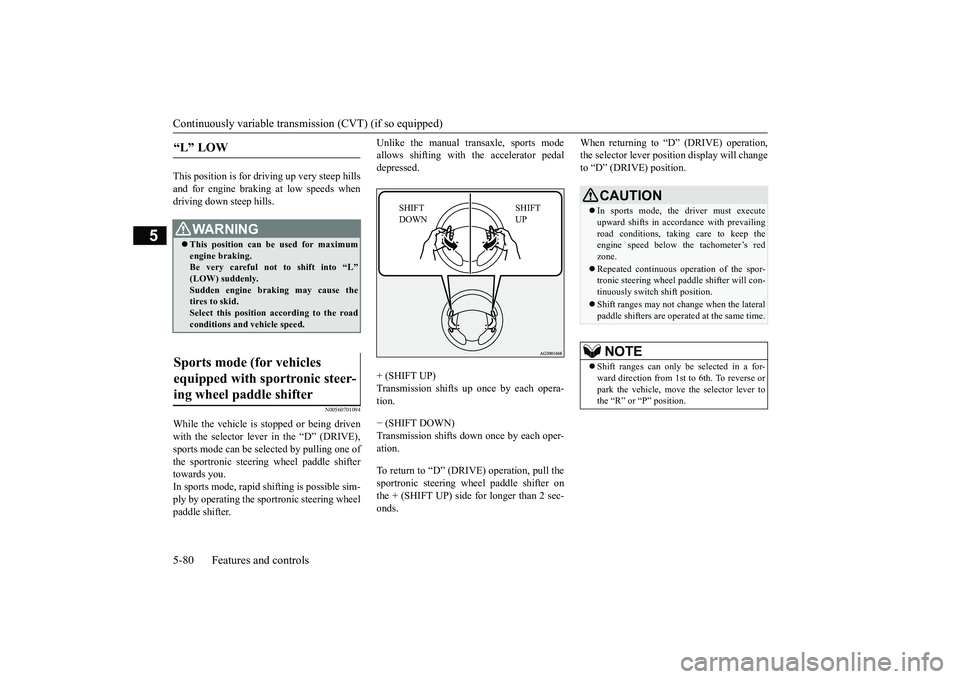
While the vehicle is stopped or being drivenwith the selector lever in the “D” (DRIVE),sports mode can be se
lected by pulling one of
the sportronic steering wheel paddle shiftertowards you.In sports mode, rapid
shifting is possible sim-
ply by operating the sportronic steering wheelpaddle shifter.
Unlike the manual transaxle, sports modeallows shifting with the accelerator pedaldepressed.+ (SHIFT UP)
up once by each opera-
tion.− (SHIFT DOWN)Transmission shifts down once by each oper-ation.To return to “D” (DRIVE) operation, pull thesportronic steering wheel paddle shifter onthe + (SHIFT UP) side for longer than 2 sec-onds.
When returning to “D” (DRIVE) operation,the selector lever posit
ion display will change
to “D” (DRIVE) position.
“L” LOW
WA R N I N GThis position can be used for maximumengine braking.Be very careful not to shift into “L”Sudden engine brak
ing may cause the
tires to skid.Select this position according to the roadconditions and vehicle speed.
Sports mode (for vehicles equipped with sportronic steer-ing wheel paddle shifter
SHIFT UP
SHIFT DOWN
CAUTIONIn sports mode, the driver must executeupward shifts in accordance with prevailingroad conditions, taking care to keep theengine speed below the tachometer’s redzone.Repeated continuous ope
ration of the spor-
tronic steering wheel pa
ddle shifter will con-
tinuously switch shift position.Shift ranges may not change when the lateralpaddle shifters are opera
ted at the same time.
NOTE
Shift ranges can only be
selected in a for-
ward direction from 1st to 6th. To reverse orpark the vehicle, move
the selector lever to
the “R” or “P” position.
BK0249100US.book 80 ページ 2017年5月10日 水曜日 午前8時49分
Page 162 of 441
Continuously variable transmission (CVT) (if so equipped)
Features and controls 5-81
5
N00560901067
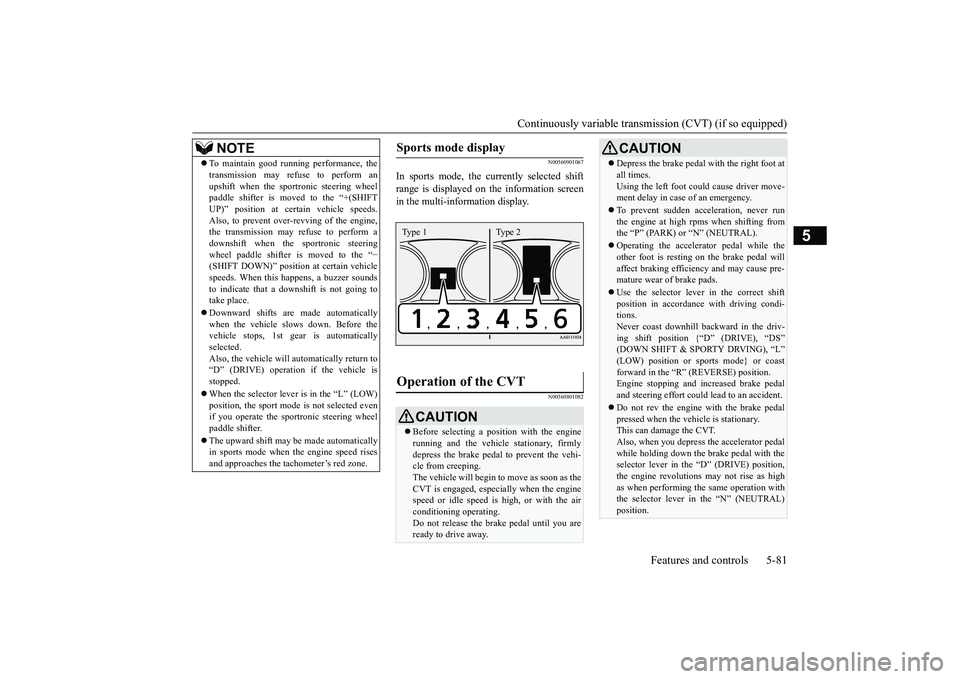
In sports mode, the currently selected shiftrange is displayed on the information screenin the multi-information display.
N00560801082
To maintain good running performance, thetransmission may refuse to perform anupshift when the spor
tronic steering wheel
paddle shifter is moved to the “+(SHIFTUP)” position at cert
ain vehicle speeds.
Also, to prevent over-revving of the engine,the transmission may refuse to perform adownshift when the sportronic steeringwheel paddle shifter is moved to the “
−
(SHIFT DOWN)” positi
on at certain vehicle
speeds. When this happens, a buzzer soundsto indicate that a dow
nshift is not going to
take place.Downward shifts are made automaticallywhen the vehicle slow
s down. Before the
vehicle stops, 1st gear
is automatically
selected.Also, the vehicle will automatically return to“D” (DRIVE) operation if the vehicle isstopped.When the selector lever is in the
Page 167 of 441
S-AWC (Super-All Wheel Control) (if so equipped)
5
The Differential assembly that limits the frontleft-right differential
speed by operating elec-
tronic control clutch arranged in the transferassembly.The left-right differen
tial limiting function is
a function that enhanc
es driving performance
and vehicle stability by preventing idle spin-ning of a wheel when driving on slipperyroad or when the road surfaces of left andright wheels are different.The yaw control function is a function thatenhances vehicle corn
ering performance and
vehicle stability with
management of vehicle
turning power (yaw moment) by controllingthe drive power difference of the left andright wheels and the braking force when thevehicle does not turn
in response to steering
input, such as when the steering wheel isturned quickly or when driving on slipperyroad.
N00542401086
Select the drive mode from the following fourtypes to suit the driving conditions.
4-wheel drive operation requires special driv-ing skills.Carefully read the “4-wheel drive operation”section on page 5-88 and take care to drivesafety.
N00583000055
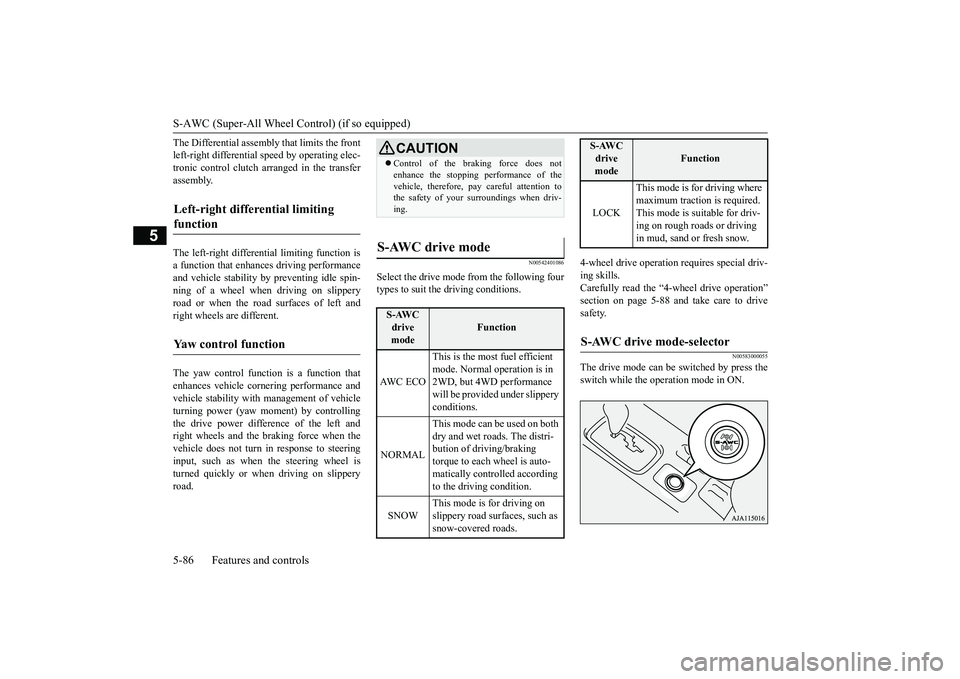
The drive mode can be switched by press theswitch while the operation mode in ON.
Left-right differential limiting function
Yaw control function
CAUTIONControl of the braking force does notenhance the stopping performance of thevehicle, therefore, pa
y careful attention to
the safety of your surroundings when driv-ing.
S-AWC drive mode
S-AWC drive mode
Function
AW C E C O
This is the most fuel efficient mode. Normal operation is in 2WD, but 4WD performance will be provided under slippery conditions.
NORMAL
This mode can be used on both dry and wet roads. The distri-bution of driving/braking torque to each wheel is auto-matically controlled according to the driving condition.
SNOW
This mode is for driving on slippery road surfaces, such as snow-covered roads.
LOCK
This mode is for driving where maximum traction is required. This mode is suitable for driv-ing on rough roads or driving in mud, sand or fresh snow.
S-AWC drive mode-selector
S-AWC drive mode
Function
BK0249100US.book 86 ページ 2017年5月10日 水曜日 午前8時49分
Page 170 of 441
4-wheel drive operation
Features and controls 5-89
5
When turning a sharp corner in “4WDLOCK” (Electronically
controlled 4WD) or
“LOCK” (S-AWC) position at low speed, a
slight difference in
steering may be experi-
enced similar to feeling as if the brakes wereapplied. This is called tight corner brakingand results from each of the four tires being ata different distance from the corner. The phe-nomenon is typical of 4-wheel drive vehicles.If this occurs, either straighten out the steer-ing wheel or change to another mode.Set the drive mode-selector to “4WDAUTO”, “4WD LOCK” (Electronically con-trolled 4WD) or “SNOW” (S-AWC) in accor-dance with the road conditions, and thengradually depress the ac
celerator pedal for a
smooth start.
WA R N I N GDo not over-rely on th
e 4-wheel drive vehi-
cles. Even 4-wheel drive vehicles have lim-its to the system and ability to maintaincontrol and traction.
Reckless driving may
lead to accidents. Always drive carefully,taking account of the road conditions.Improperly operating
this vehicle on or
off-pavement can cause an accident orrollover in which you
and your passengers
could be seriously
injured or killed.
• Follow all instructions and guidelines inthe owner’s manual.• Keep your speed low and do not drivefaster than conditions.NOTE
Driving on rough roads can be hard on avehicle. Before you le
ave the pavement, be
sure all scheduled ma
intenance and service
has been done, and that
you have inspected
your vehicle. Pay spec
ial attention to the
condition of the ti
res, and check the tire pres-
sures.Mitsubishi Motors is not responsible to theoperator for any damage or injury caused orliability incurred by improper and negligentoperation of a vehicl
e. All techniques of
vehicle operation depend on the skill andexperience of the opera
tor and other partici-
pating parties. Any de
viation from the rec-
ommended operating instru
ctions above is at
their own risk.
Note that the stopping distance required ofthe 4-wheel drive vehicl
e differs very little
from that of the front-wheel drive vehicle.When driving on a snow-covered road or aslippery, muddy surface,
make sure that you
keep a sufficient dist
ance between your vehi-
cle and the one ahead of you.The driving posture should be more upright;adjust the seat to a good position for easysteering and pedal operati
on. Be sure to wear
the seat belt.After driving on rough roads, check eachpart of the vehicle and wash it thoroughlywith water. Refer to the “Inspection andmaintenance following rough road opera-tion” section and “Vehic
le care and Mainte-
nance” sections.CAUTIONSetting the drive mode-selector to “4WDLOCK” (Electronically
controlled 4WD) or
“LOCK” (S-AWC) position to drive on drypaved road will increa
se fuel consumption,
with possible noise generation.
Turning sharp corners
NOTE
On snowy or icy roads
NOTE
The use of snow tires is recommended.Maintain a safe distan
ce between
vehicles,
avoid sudden braking, and use engine brak-ing (downshifting).CAUTIONAvoid sudden braking,
sudden acceleration
and sharp turning. Sk
idding occurs and con-
trol of the vehicle could be lost.
BK0249100US.book 89 ページ 2017年5月10日 水曜日 午前8時49分
Page 178 of 441
Anti-lock braking system
Features and controls 5-97
5
N00517900240
The anti-lock braking system helps preventthe wheels from locking up when braking.This helps maintain vehicle drivability andsteering wheel handling.When using the anti-lock brakes (suddenbraking), steering is slightly differentfrom normal driving conditions. Use thesteering wheel carefully.Always keep a safe distance from thevehicle in front of you. Even if your vehi-cle is equipped with
the anti-lock braking
system, leave a greater braking distancewhen:• Driving on gravel or snow-coveredroads.• Driving on uneven road surfaces.
Operation of anti-lock braking system isnot restricted situations where brakes areapplied suddenly. This system may alsoprevent the wheels from locking whenyou drive over manholes, steel roadworkplates, road markings
, or any uneven road
surface.When the anti-lock braking system is inuse, you may feel the brake pedal vibrat-ing and hear a unique sound. It may alsofeel as if the pedal
resists being pressed.
In this situation, si
mply hold the brake
pedal down firmly. Do not pump thebrake, which will result in reducedbraking performance.
CAUTIONThe brake assist system is not a devicedesigned to exercise
braking force greater
than its capacity. Make sure to always keep asufficient distance be
tween your vehicle and
a vehicle in front of
you without relying too
much on the brake assist system.NOTE
Once the brake assist system is operational,it maintains great braking force even if thebrake pedal is lightly released.To stop its operation, completely removeyour foot from the brake pedal.The brake assist system may become opera-tional when the brake pedal is fullydepressed even if it
has not been depressed
suddenly.When the brake assist system is in use whiledriving, you may feel as if the depressedbrake pedal is soft, the pedal moves in smallmotions in conjunction with the operationnoise, or the vehicle body and the steeringwheel vibrate. This occurs when the brakeassist system is ope
rating normally and does
not indicate faulty
operation. Continue to
depress the brake pedal.You may hear an operation noise when thebrake pedal is suddenl
y or fully depressed
while stationary. This does not indicate amalfunction and the brake assist system isoperating normally.
When the anti-lock brake system warninglight or only active st
ability control warning
light illuminate, the brake assist system innot functioning.
Anti-lock braking system Driving hints
NOTE
CAUTIONThe anti-lock braking system cannot preventaccidents. It is your
responsibility to take
safety precautions a
nd to drive carefully.
To prevent failure of the anti-lock brakingsystem, be sure all 4 wheels and tires are thesame size and the same type.NOTE
A whining sound is emitted from the enginecompartment when driving immediatelyafter starting the engine. These are the nor-mal sounds the anti-lock braking systemmakes when performing a self-check. It doesnot indicate
a malfunction.
BK0249100US.book 97 ページ 2017年5月10日 水曜日 午前8時49分
Page 180 of 441
Electric power steering system (EPS)
Features and controls 5-99
5
The anti-lock braking system and brake forcedistribution function ma
y not work, so hard
braking could make the vehicle unstable.Avoid hard braking and high-speed driving.Stop the vehicle in a safe place and contact anauthorized Mitsubishi Mo
tors dealer or repair
facility of your choice.
N00529201090
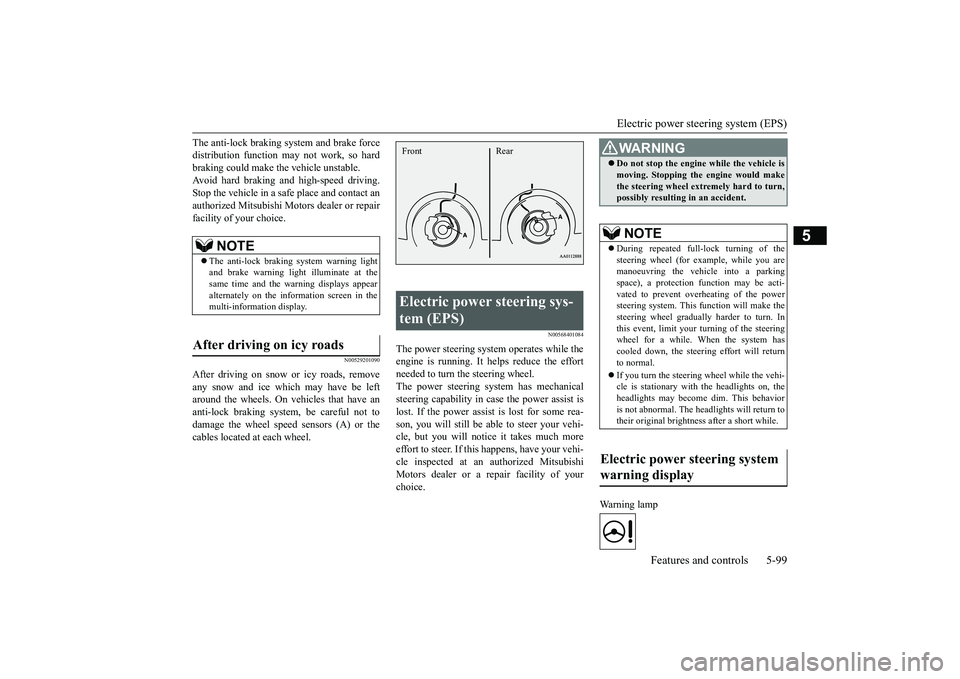
After driving on snow or icy roads, removeany snow and ice which may have be leftaround the wheels. On vehicles that have ananti-lock braking syst
em, be careful not to
damage the wheel spee
d sensors (A) or the
cables located at each wheel.
N00568401084
The power steering system operates while theengine is running. It helps reduce the effortneeded to turn the steering wheel.The power steering sy
stem has mechanical
steering capability in case the power assist islost. If the power assist is lost for some rea-son, you will still be able to steer your vehi-cle, but you will notice it takes much moreeffort to steer. If this happens, have your vehi-cle inspected at an authorized MitsubishiMotors dealer or a repair facility of yourchoice.
Warning lamp
NOTE
The anti-lock braking
system warning light
and brake warning light illuminate at thesame time and the wa
rning displays appear
alternately on the information screen in themulti-information display.
After driving on icy roads
Electric power steering sys-tem (EPS) Front Rear
WA R N I N GDo not stop the engine while the vehicle ismoving. Stopping the engine would makethe steering wheel extremely hard to turn,possibly resulting
in an accident.
NOTE
During repeated full-lock turning of thesteering wheel (for example, while you aremanoeuvring the vehicle into a parkingspace), a protection f
unction may be acti-
vated to prevent overheating of the powersteering system. This f
unction will make the
steering wheel graduall
y harder to turn. In
this event, limit your turning of the steeringwheel for a while. When the system hascooled down, the steering effort will returnto normal.If you turn the steering wheel while the vehi-cle is stationary with the headlights on, theheadlights may become
dim. This behavior
is not abnormal. The he
adlights will return to
their original brightness after a short while.
Electric power steering system warning display
BK0249100US.book 99 ページ 2017年5月10日 水曜日 午前8時49分