inflation pressure MITSUBISHI OUTLANDER PHEV 2016 (in English) User Guide
[x] Cancel search | Manufacturer: MITSUBISHI, Model Year: 2016, Model line: OUTLANDER PHEV, Model: MITSUBISHI OUTLANDER PHEV 2016Pages: 490, PDF Size: 22.02 MB
Page 395 of 490
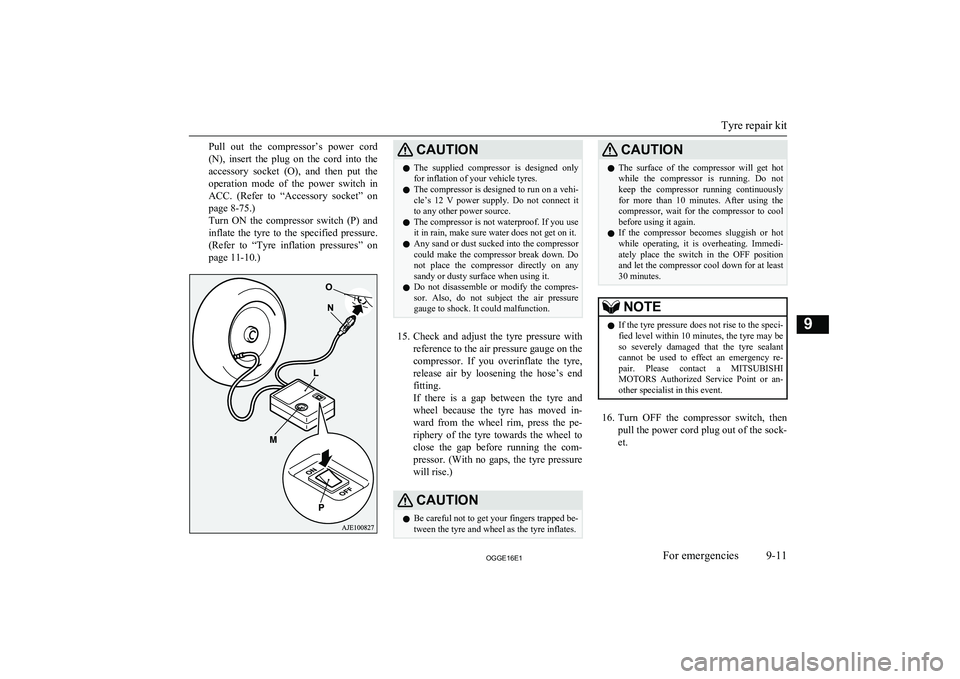
Pull out the compressor’s power cord
(N), insert the plug on the cord into the
accessory socket (O), and then put the operation mode of the power switch in ACC. (Refer to “Accessory socket” on
page 8-75.)
Turn ON the compressor switch (P) and
inflate the tyre to the specified pressure. (Refer to “Tyre inflation pressures” on
page 11-10.)CAUTIONl The supplied compressor is designed only
for inflation of your vehicle tyres.
l The compressor is designed to run on a vehi-
cle’s 12 V power supply. Do not connect itto any other power source.
l The compressor is not waterproof. If you use
it in rain, make sure water does not get on it.
l Any sand or dust sucked into the compressor
could make the compressor break down. Do not place the compressor directly on anysandy or dusty surface when using it.
l Do not disassemble or modify the compres-
sor. Also, do not subject the air pressure
gauge to shock. It could malfunction.
15. Check and adjust the tyre pressure with
reference to the air pressure gauge on the
compressor. If you overinflate the tyre, release air by loosening the hose’s end
fitting.
If there is a gap between the tyre and
wheel because the tyre has moved in-
ward from the wheel rim, press the pe- riphery of the tyre towards the wheel to
close the gap before running the com- pressor. (With no gaps, the tyre pressure
will rise.)
CAUTIONl Be careful not to get your fingers trapped be-
tween the tyre and wheel as the tyre inflates.CAUTIONl The surface of the compressor will get hot
while the compressor is running. Do not
keep the compressor running continuously for more than 10 minutes. After using the compressor, wait for the compressor to cool
before using it again.
l If the compressor becomes sluggish or hot
while operating, it is overheating. Immedi- ately place the switch in the OFF positionand let the compressor cool down for at least30 minutes.NOTEl If the tyre pressure does not rise to the speci-
fied level within 10 minutes, the tyre may be
so severely damaged that the tyre sealant
cannot be used to effect an emergency re- pair. Please contact a MITSUBISHI
MOTORS Authorized Service Point or an-
other specialist in this event.
16. Turn OFF the compressor switch, then
pull the power cord plug out of the sock- et.
Tyre repair kit
9-11OGGE16E1For emergencies9
Page 400 of 490
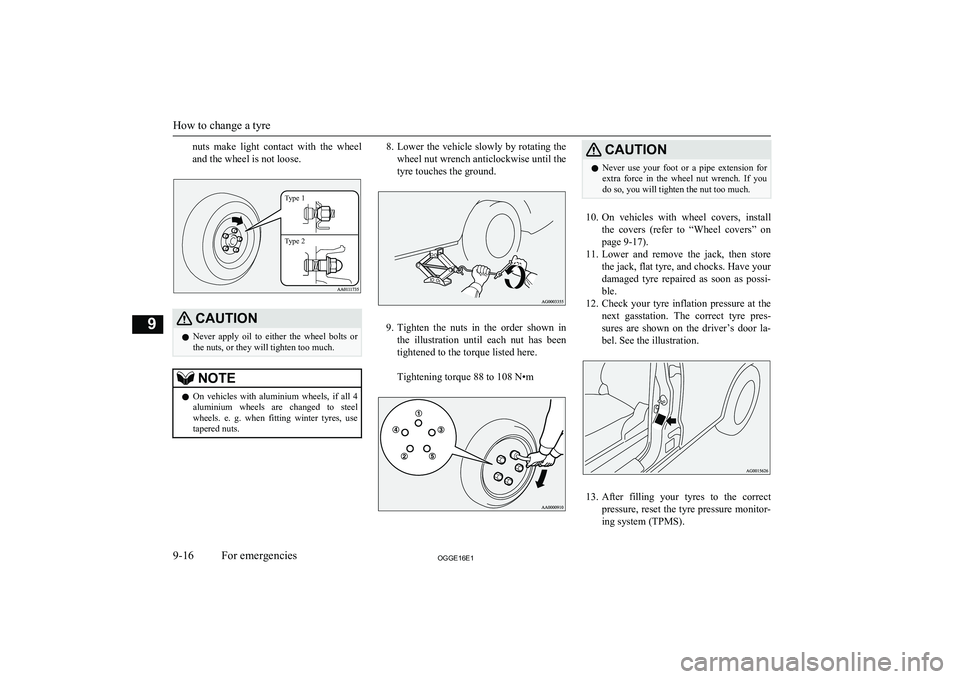
nuts make light contact with the wheel
and the wheel is not loose.Type 1Type 2
CAUTIONl Never apply oil to either the wheel bolts or
the nuts, or they will tighten too much.NOTEl On vehicles with aluminium wheels, if all 4
aluminium wheels are changed to steel wheels. e. g. when fitting winter tyres, use
tapered nuts.8. Lower the vehicle slowly by rotating the
wheel nut wrench anticlockwise until the
tyre touches the ground.
9. Tighten the nuts in the order shown in
the illustration until each nut has been tightened to the torque listed here.
Tightening torque 88 to 108 N•m
CAUTIONl Never use your foot or a pipe extension for
extra force in the wheel nut wrench. If you
do so, you will tighten the nut too much.
10. On vehicles with wheel covers, install
the covers (refer to “Wheel covers” on
page 9-17).
11. Lower and remove the jack, then store
the jack, flat tyre, and chocks. Have your
damaged tyre repaired as soon as possi- ble.
12. Check your tyre inflation pressure at the
next gasstation. The correct tyre pres-
sures are shown on the driver’s door la- bel. See the illustration.
13. After filling your tyres to the correct
pressure, reset the tyre pressure monitor-
ing system (TPMS).
How to change a tyre
9-16OGGE16E1For emergencies9
Page 406 of 490
WARNINGlWhen trying to rock your vehicle out of a
stuck position, make sure that there are
no people nearby. The rocking motion can make your vehicle suddenly lurch for-
ward or backward, and injure any by- standers.
On a flooded road
l Do not drive on a flooded road. If you
drive on a flooded road, not only does the Plugin Hybrid EV System stop but
there may be a failure like electric leak- age or short circuit.
If you inevitably had to run on a flooded
road and the vehicle was exposed to wa- ter, be sure to have your vehicle inspec-
ted by a MITSUBISHI MOTORS Au-
thorized Service Point.
l If there is water on the brakes after driv-
ing through puddles or washing the vehi- cle, resulting in temporarily ineffective
brakes. In such cases, lightly depress the brake pedal to see if the brakes operate
properly. If they do not, lightly depress the pedal several times while driving in
order to dry the brake pads.
l When driving in rain or on a road with
many puddles a layer of water may form
between the tyres and the road surface.
This reduces a tyre’s frictional resistance
on the road, resulting in loss of steering stability and braking capability.
To cope with this, observe the following
items: A- Drive your vehicle at slow speed.B- Do not drive on worn tyres.
C- Always maintain the specified tyre
inflation pressures.
On a snow-covered or frozen road
l When driving on a snow-covered or fro-
zen road, it is recommended that you use snow tyres or snow traction device (tyre chains).
Refer to the “Snow tyres” and “Snow
traction device (tyre chains)” sections.
l Avoid high-speed operation, sudden ac-
celeration, abrupt brake application and
sharp cornering.
l Depressing the brake pedal during travel
on snowy or icy roads may cause tyre
slippage and skidding. When traction be-
tween the tyres and the road is reduced the wheels may skid and the vehicle can-
not readily be brought to a stop by con- ventional braking techniques. Brakingwill differ, depending upon whether you
have anti-lock brake system (ABS). As your vehicle is equipped with ABS,brake by pressing the brake pedal hard,
and keeping it pressed.
l Allow extra distance between your vehi-
cle and the vehicle in front of you, and avoid sudden braking.
l Accumulation of ice on the braking sys-
tem can cause the wheels to lock. Pullaway from a standstill slowly after con-
firming safety around the vehicle.CAUTIONl Do not press the accelerator pedal rapidly. If
the wheels break free of the ice, the vehicle
could suddenly start moving and possibly cause an accident.
On a bumpy or rutted road
Drive as slow as possible when driving on
bumpy or rutted roads.
Operation under adverse driving conditions
9-22OGGE16E1For emergencies9
Page 424 of 490
TyresE01001300255WARNINGlDriving with tyres that are worn, dam-
aged or improperly inflated can lead to a
loss of control or blow out of the tyres which can result in a collision with serious
or fatal injury.Tyre inflation pressures
E01001402726
Tyre sizeFrontRear215/70R16 100H2.4 bar (35 psi) [240 kPa], 2.6 bar (38 psi) [260 kPa]*225/55R18 98H2.4 bar (35 psi) [240 kPa], 2.6 bar (38 psi) [260 kPa]*
*: Above 160 km/h (99 mph)
Check the tyre inflation pressure of all the tyres while they are cold; if insufficient or excessive, adjust to the specified value.
After the tyre inflation pressure has been adjusted, check the tyres for damage and air leaks. Be sure to put caps on the valves.
Tyres
11-10OGGE16E1Maintenance11
Page 460 of 490
Switch........................................................... 6-54
Rear Motor coolant..........................................12-10
Rear room lamp................................................. 8-76 Bulb capacity.............................................. 11-24
Rear turn-signal lamps
Bulb capacity.............................................. 11-23
Replacement..................................... 11-26,11-28
Rear window demister switch........................... 6-61
Rear-view camera..............................................7-84
Rear-view mirror Inside............................................................. 7-05
Outside.......................................................... 7-07
Refill capacities............................................... 12-10
Regenerative braking level selector (paddle).... 7-16
Replacement of lamp bulbs............................. 11-22
Reversing lamps Bulb capacity.............................................. 11-23
Replacement................................................ 11-28
Reversing sensor system................................... 7-77
Roof carrier precaution......................................7-97
Room lamp........................................................ 8-76
S
S-AWC (Super-All Wheel Control).................. 7-17
Safe driving techniques..................................... 7-02
Safety and disposal information for used engine oil................................................. 2-16
Seat belt Adjustable seat belt anchor........................... 5-12Child restraint................................................5-15Force limiter.................................................. 5-15
Inspection...................................................... 5-28
Pregnant women restraint............................. 5-14
Pretensioner...................................................5-15
Seat belt reminder..............................................5-11
Seat belts........................................................... 5-09
Seat Adjustment.................................................... 5-02Front seats..................................................... 5-03
Head restraints.............................................. 5-05
Heated seats.................................................. 5-04
Making a flat seat.......................................... 5-08
Making a luggage area.................................. 5-07
Rear seat........................................................ 5-05
Security alarm system....................................... 4-27
Select Position indicator.................................... 7-14
Selector Lever (Joystick Type)......................... 7-13
Sensor system.................................................... 7-81
Service precaution........................................... 11-02
Side turn-signal lamps Bulb capacity.............................................. 11-23
Snow traction device (Tyre chains).................11-13
Snow tyres....................................................... 11-12
Spark plug....................................................... 12-08
Specifications.................................................. 12-02
Speed Limiter.................................................... 7-38
Starting and stopping the Plug-in Hy- brid EV System................................................ 7-11
Steering Steering wheel height adjustment................. 7-05
Stop lamps
Bulb capacity.............................................. 11-23
Stopping the Plug-in Hybrid EV System.......... 7-12
Storage spaces................................................... 8-78
Sun visors.......................................................... 8-73
Sunglasses holder.............................................. 8-80Sunroof.............................................................. 4-36
Supplemental restraint system...........................5-29 Caution for installing the child re-straint on vehicles with a front
passenger airbag.................................. 5-15,5-31
Servicing....................................................... 5-39
System check screen..........................................6-13
T
Tail lampsBulb capacity.............................................. 11-23
Tailgate.............................................................. 4-18
Tank capacity.................................................... 2-14
Time Setting...................................................... 8-45
Tools.................................................................. 9-06 Storage.......................................................... 9-06
Towing.............................................................. 9-18
Trailer towing.................................................... 7-97
Transaxle fluid ................................................12-10
Turn-signal indication lamps.............................6-43
Turn/Lane-change signals................................. 6-52
Tyre pressure monitoring system (TPMS)........ 7-72
Tyre repair kit.................................................... 9-07
Tyres................................................................ 11-10 How to change a tyre.................................... 9-13Inflation pressures....................................... 11-10
Rotation....................................................... 11-11
Size (tyre and wheel).................................. 12-08
Snow traction device (Tyre chains)............ 11-13
Snow tyres................................................... 11-12
Tread wear indicators.................................. 11-11
Tyre pressure monitoring system (TPMS).. 11-10
Tyre repair kit............................................... 9-07
Alphabetical index
13- 4 OGGE16E1Alphabetical index