child seat MITSUBISHI OUTLANDER PHEV 2016 (in English) Owner's Guide
[x] Cancel search | Manufacturer: MITSUBISHI, Model Year: 2016, Model line: OUTLANDER PHEV, Model: MITSUBISHI OUTLANDER PHEV 2016Pages: 490, PDF Size: 22.02 MB
Page 122 of 490
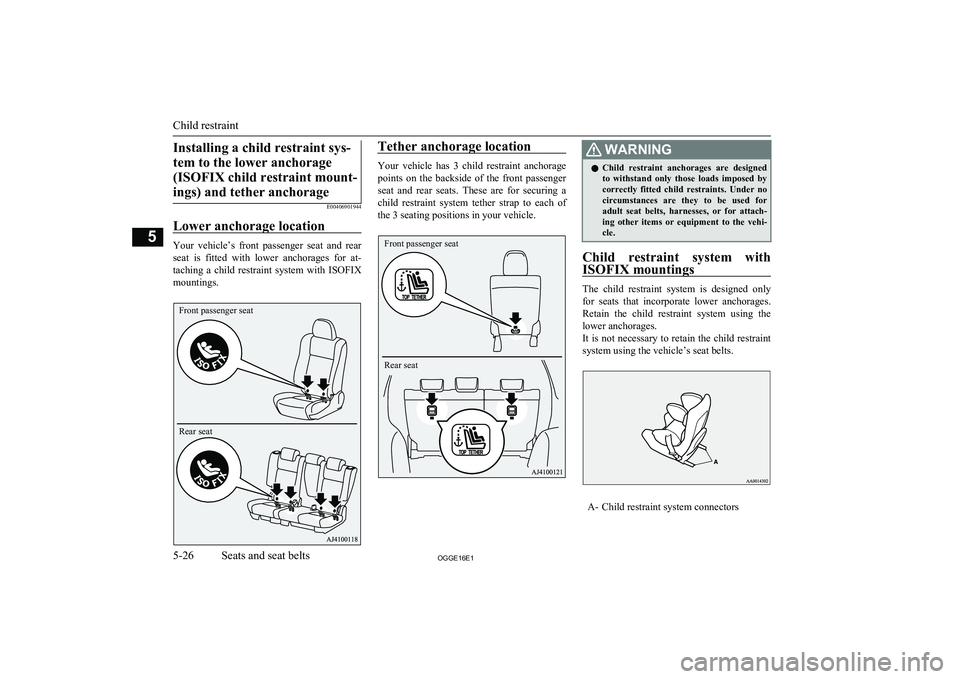
Installing a child restraint sys-tem to the lower anchorage (ISOFIX child restraint mount-ings) and tether anchorage
E00406901944
Lower anchorage location
Your vehicle’s front passenger seat and rear seat is fitted with lower anchorages for at-
taching a child restraint system with ISOFIX mountings.
Tether anchorage location
Your vehicle has 3 child restraint anchoragepoints on the backside of the front passenger seat and rear seats. These are for securing a
child restraint system tether strap to each of the 3 seating positions in your vehicle.
WARNINGl Child restraint anchorages are designed
to withstand only those loads imposed by
correctly fitted child restraints. Under no circumstances are they to be used for adult seat belts, harnesses, or for attach-
ing other items or equipment to the vehi- cle.
Child restraint system with
ISOFIX mountings
The child restraint system is designed only
for seats that incorporate lower anchorages.
Retain the child restraint system using the lower anchorages.
It is not necessary to retain the child restraint
system using the vehicle’s seat belts.
A- Child restraint system connectors
Child restraint
5-26OGGE16E1Seats and seat belts5Front passenger seat
Rear seat Front passenger seat Rear seat
Page 123 of 490
To install
1.Remove any foreign material in or
around the connectors and ensure the ve-
hicle seat belt is in its normal storage po-
sition.
2. Remove the head restraint from the loca-
tion in which you wish to install a child
restraint.
Refer to “Head restraints” on page 5-05.
3. When installing a child restraint system
in the front passenger seat, adjust seat
slide to its most rearward position.
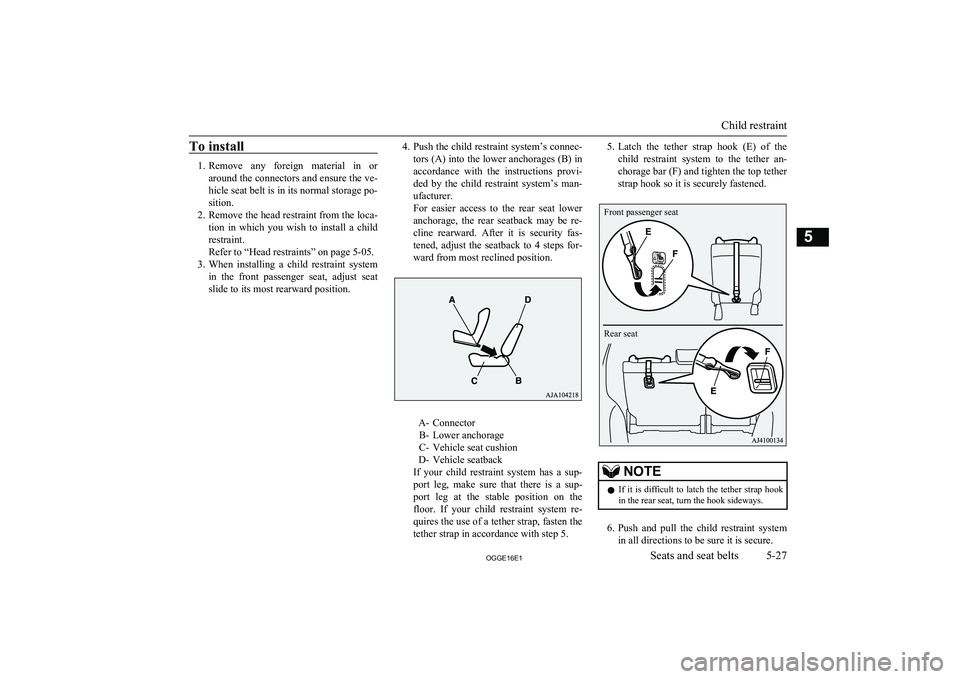
4. Push the child restraint system’s connec-
tors (A) into the lower anchorages (B) in accordance with the instructions provi-
ded by the child restraint system’s man-
ufacturer.
For easier access to the rear seat lower
anchorage, the rear seatback may be re- cline rearward. After it is security fas-
tened, adjust the seatback to 4 steps for- ward from most reclined position.
A- Connector B- Lower anchorage
C- Vehicle seat cushion
D- Vehicle seatback
If your child restraint system has a sup- port leg, make sure that there is a sup-
port leg at the stable position on the floor. If your child restraint system re-
quires the use of a tether strap, fasten the
tether strap in accordance with step 5.
5. Latch the tether strap hook (E) of the
child restraint system to the tether an-
chorage bar (F) and tighten the top tether strap hook so it is securely fastened.NOTEl If it is difficult to latch the tether strap hook
in the rear seat, turn the hook sideways.
6. Push and pull the child restraint system
in all directions to be sure it is secure.
Child restraint
5-27OGGE16E1Seats and seat belts5 Front passenger seat
Rear seat
Page 124 of 490
To remove
Remove the child restraint system in accord-
ance with the instructions provided by the
child restraint system’s manufacturer.
Installing a child restraint sys-
tem to a 3-point type seat belt (with emergency locking mech-anism)
E00408701816
Installation:
1. Put a child restraint system on the seat in
which you wish to install it, and remove
the head restraint from the seat.
Refer to “Head restraints” on page 5-05.
2. When installing a child restraint system
in the front passenger seat, adjust seat slide to its most rearward position and
adjust the front seatback angle to 2 steps
rearward from the first locking position.
3. Route the belt through the child restraint
according to the child restraint system
manufacturer’s instructions, then insert
the latch plate into the buckle.
4. Remove all slack of a lap belt by pulling
the webbing through the belt’s adjust-
ment feature.
3-point type seat belt requires no length adjustment, remove all slack by usingthe locking clip.
5. If your child restraint system has a sup-
port leg, make sure that there is a sup-
port leg at the stable position on the floor.
6. Before putting the child in the restraint,
push and pull the restraint in all direc- tions to be sure it is secure. Do this be-
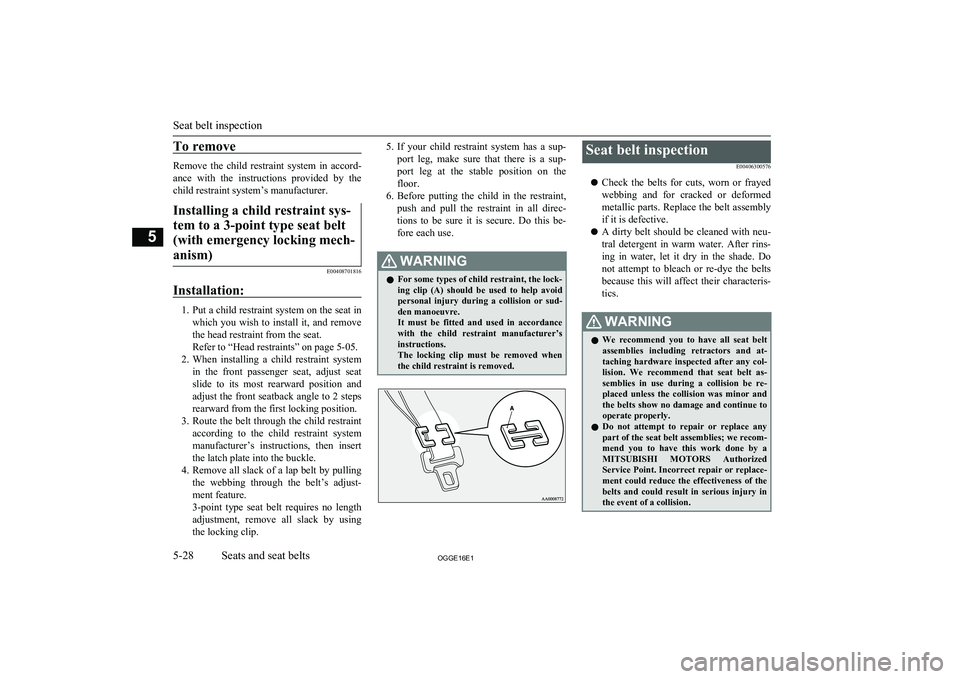
fore each use.WARNINGl For some types of child restraint, the lock-
ing clip (A) should be used to help avoid
personal injury during a collision or sud- den manoeuvre.
It must be fitted and used in accordance with the child restraint manufacturer’s
instructions.
The locking clip must be removed when the child restraint is removed.Seat belt inspection
E00406300576
l Check the belts for cuts, worn or frayed
webbing and for cracked or deformed metallic parts. Replace the belt assembly
if it is defective.
l A dirty belt should be cleaned with neu-
tral detergent in warm water. After rins-
ing in water, let it dry in the shade. Do
not attempt to bleach or re-dye the belts
because this will affect their characteris-
tics.WARNINGl We recommend you to have all seat belt
assemblies including retractors and at- taching hardware inspected after any col- lision. We recommend that seat belt as-
semblies in use during a collision be re- placed unless the collision was minor and
the belts show no damage and continue to operate properly.
l Do not attempt to repair or replace any
part of the seat belt assemblies; we recom- mend you to have this work done by aMITSUBISHI MOTORS Authorized
Service Point. Incorrect repair or replace- ment could reduce the effectiveness of the
belts and could result in serious injury in
the event of a collision.
Seat belt inspection
5-28OGGE16E1Seats and seat belts5
Page 126 of 490
Only when the operation mode of the powerswitch is in ON, the airbags will operate.The airbags deployment produces a sudden,
loud noise, and releases some smoke and powder, but these conditions are not injuri- ous, and do not indicate a fire in the vehicle.
People with respiratory problems may feel
some temporary irritation from chemicals used to produce the deployment; open the
windows after airbag deployment, if safe to
do so.
The airbags deflate very rapidly after deploy- ment, so there is little danger of obscured vi-
sion.CAUTIONl Airbags inflate at an extremely rapid speed.
In certain situations, contact with inflatingairbags can result in abrasions, bruises, light
cuts, and the like.WARNINGl IT IS VERY IMPORTANT TO BE
PROPERLY SEATED.
A driver or front passenger too close to the steering wheel or instrument panel
during airbag deployment can be killed or seriously injured.
Airbags inflate very fast, and with great force.
If the driver and front passenger are not
properly seated and restrained, the air-
bags may not protect you properly, and could cause serious or fatal injuries whenit inflates.
l Do not sit on the edge of the seat, or sit
with your lower legs too close to the in-
strument panel, or lean head or chest close to the steering wheel or instrument panel. Do not put feet or legs on or againstthe instrument panel.
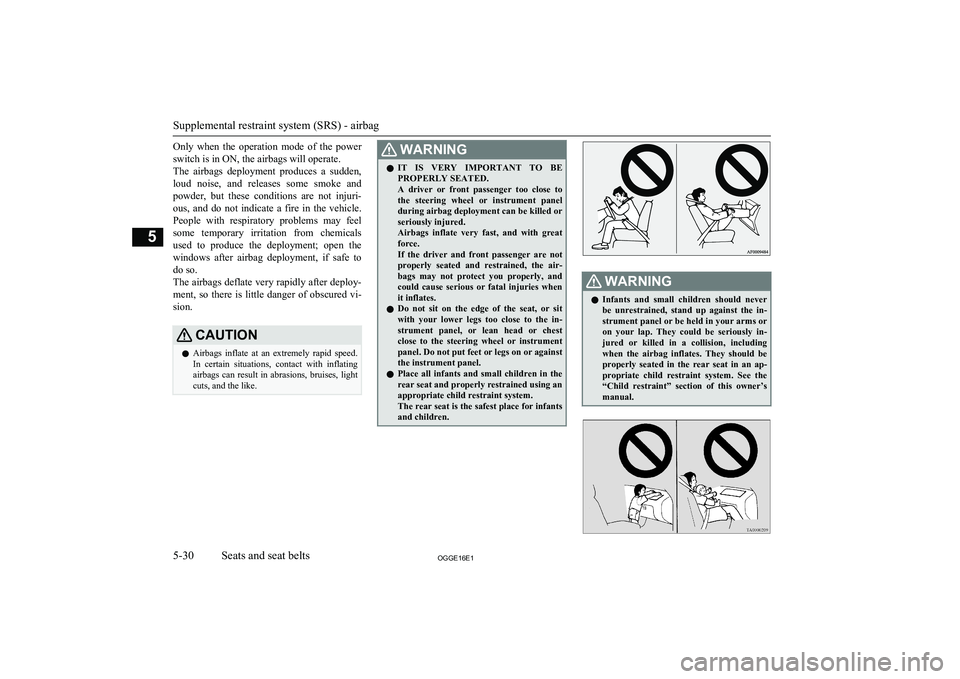
l Place all infants and small children in the
rear seat and properly restrained using an
appropriate child restraint system.
The rear seat is the safest place for infants
and children.WARNINGl Infants and small children should never
be unrestrained, stand up against the in-strument panel or be held in your arms or on your lap. They could be seriously in-jured or killed in a collision, including when the airbag inflates. They should be
properly seated in the rear seat in an ap- propriate child restraint system. See the
“Child restraint” section of this owner’s
manual.
Supplemental restraint system (SRS) - airbag
5-30OGGE16E1Seats and seat belts5
Page 127 of 490
WARNINGlOlder children should be seated in the
rear seat, properly wearing the seat belt,with an appropriate booster seat if nee- ded.Caution for installing the child
restraint on vehicles with a front passenger airbag
E00408802016
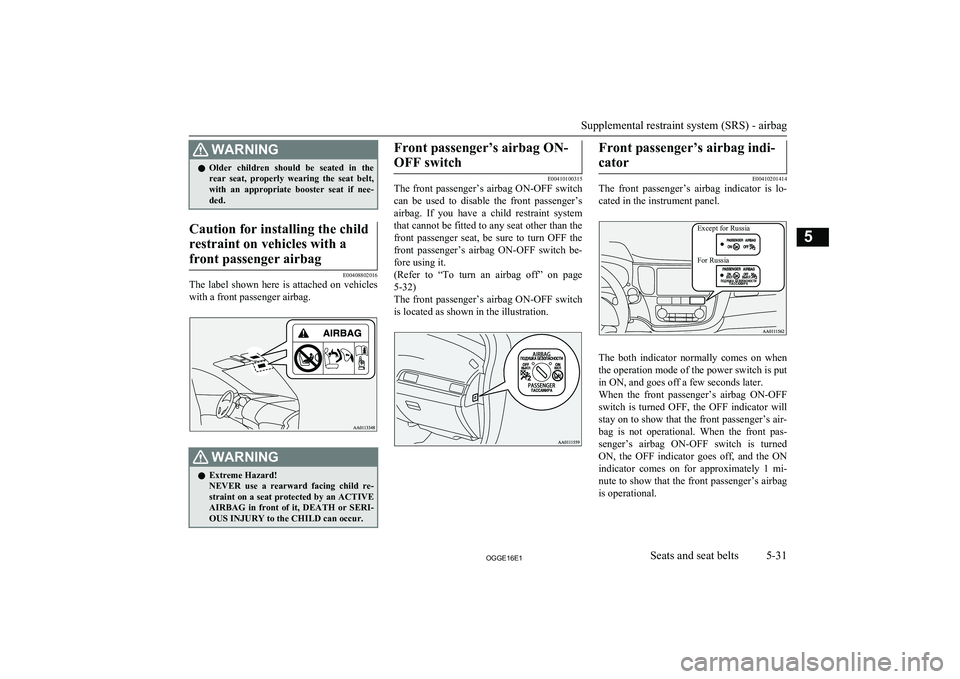
The label shown here is attached on vehicles with a front passenger airbag.
WARNINGl Extreme Hazard!
NEVER use a rearward facing child re- straint on a seat protected by an ACTIVEAIRBAG in front of it, DEATH or SERI- OUS INJURY to the CHILD can occur.Front passenger’s airbag ON-
OFF switch
E00410100315
The front passenger’s airbag ON-OFF switch
can be used to disable the front passenger’s airbag. If you have a child restraint system
that cannot be fitted to any seat other than the front passenger seat, be sure to turn OFF the front passenger’s airbag ON-OFF switch be-
fore using it.
(Refer to “To turn an airbag off” on page
5-32)
The front passenger’s airbag ON-OFF switch
is located as shown in the illustration.
Front passenger’s airbag indi-
cator
E00410201414
The front passenger’s airbag indicator is lo-
cated in the instrument panel.
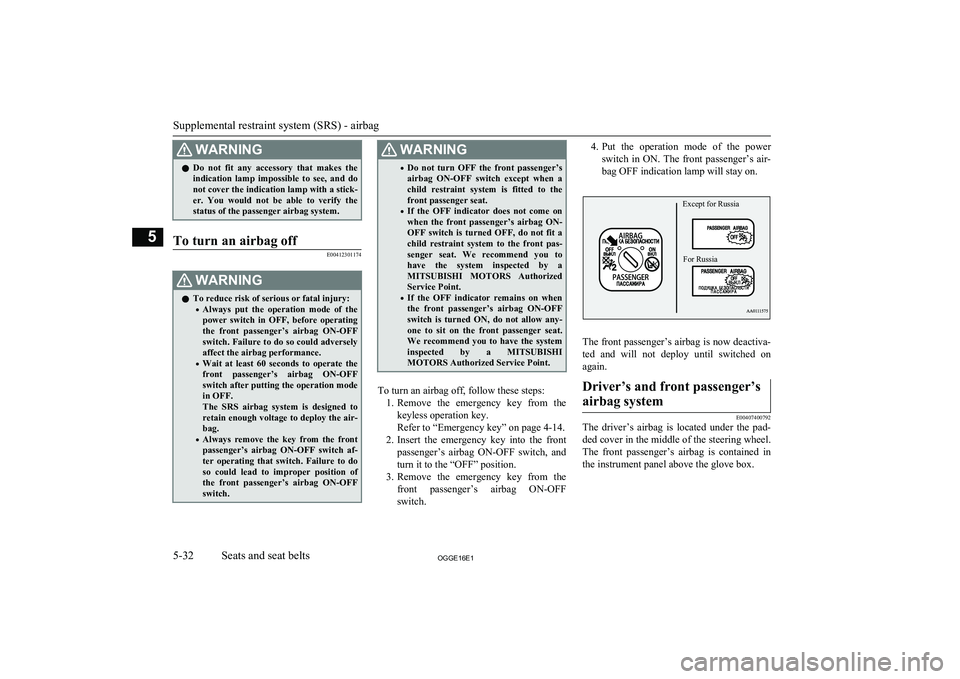
Except for RussiaFor Russia
The both indicator normally comes on when
the operation mode of the power switch is put
in ON, and goes off a few seconds later.
When the front passenger’s airbag ON-OFF switch is turned OFF, the OFF indicator will stay on to show that the front passenger’s air-
bag is not operational. When the front pas-
senger’s airbag ON-OFF switch is turned
ON, the OFF indicator goes off, and the ON indicator comes on for approximately 1 mi- nute to show that the front passenger’s airbagis operational.
Supplemental restraint system (SRS) - airbag
5-31OGGE16E1Seats and seat belts5
Page 128 of 490
WARNINGlDo not fit any accessory that makes the
indication lamp impossible to see, and do
not cover the indication lamp with a stick- er. You would not be able to verify thestatus of the passenger airbag system.To turn an airbag off
E00412301174WARNINGl To reduce risk of serious or fatal injury:
• Always put the operation mode of the
power switch in OFF, before operating
the front passenger’s airbag ON-OFF
switch. Failure to do so could adversely affect the airbag performance.
• Wait at least 60 seconds to operate the
front passenger’s airbag ON-OFF switch after putting the operation mode
in OFF.
The SRS airbag system is designed to retain enough voltage to deploy the air-
bag.
• Always remove the key from the front
passenger’s airbag ON-OFF switch af-ter operating that switch. Failure to do
so could lead to improper position of the front passenger’s airbag ON-OFF switch.WARNING• Do not turn OFF the front passenger’s
airbag ON-OFF switch except when a child restraint system is fitted to the
front passenger seat.
• If the OFF indicator does not come on
when the front passenger’s airbag ON- OFF switch is turned OFF, do not fit a
child restraint system to the front pas- senger seat. We recommend you to
have the system inspected by a
MITSUBISHI MOTORS Authorized
Service Point.
• If the OFF indicator remains on when
the front passenger’s airbag ON-OFF switch is turned ON, do not allow any- one to sit on the front passenger seat.
We recommend you to have the system inspected by a MITSUBISHI
MOTORS Authorized Service Point.
To turn an airbag off, follow these steps:
1. Remove the emergency key from the
keyless operation key.
Refer to “Emergency key” on page 4-14.
2. Insert the emergency key into the front
passenger’s airbag ON-OFF switch, and turn it to the “OFF” position.
3. Remove the emergency key from the
front passenger’s airbag ON-OFF switch.
4. Put the operation mode of the power
switch in ON. The front passenger’s air- bag OFF indication lamp will stay on.
The front passenger’s airbag is now deactiva-ted and will not deploy until switched on
again.
Driver’s and front passenger’s
airbag system
E00407400792
The driver’s airbag is located under the pad- ded cover in the middle of the steering wheel. The front passenger’s airbag is contained in
the instrument panel above the glove box.
Supplemental restraint system (SRS) - airbag
5-32OGGE16E1Seats and seat belts5 Except for RussiaFor Russia
Page 134 of 490
WARNINGlDo not allow any rear seat occupant to
hold onto the seatback of either front seat,
in order to reduce risk of injury from the
deploying side airbag. Special care should
be taken with children.
l Do not place any objects near or in front
of the seatback of either front seat. They could interfere with proper side airbag in-
flation, and also could cause injury if thrown free by side airbag deployment.
l Do not place stickers, labels or additional
trim on the seatback of either front seat. They could interfere with proper side air-bag inflation.
l Do not install seat covers on seats with
side airbags.
Do not re-cover seats that have side air-
bags. This could interfere with proper side airbag inflation.
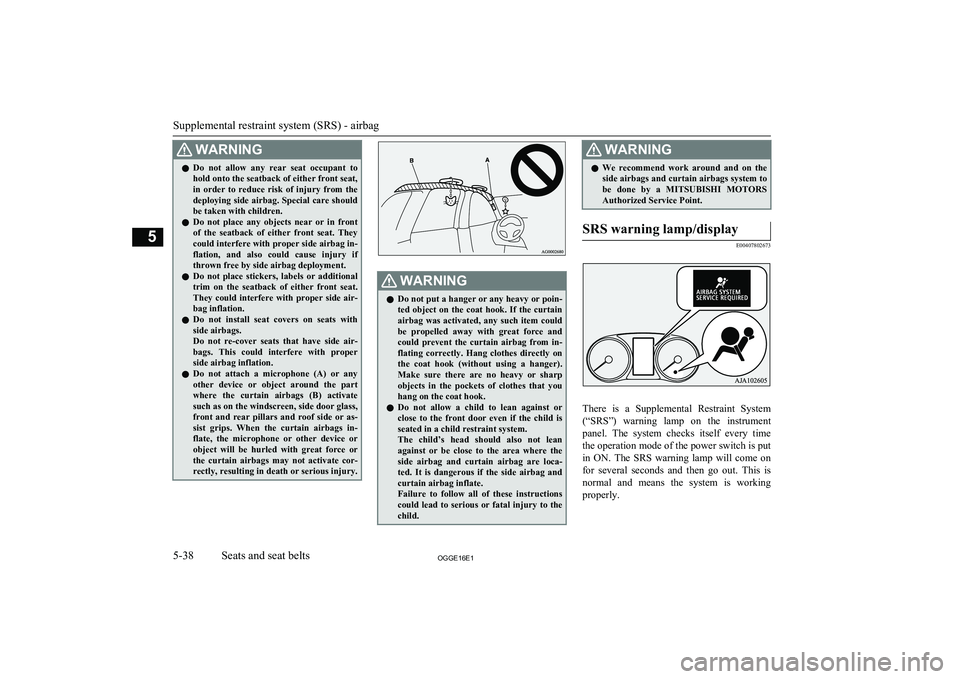
l Do not attach a microphone (A) or any
other device or object around the part
where the curtain airbags (B) activate
such as on the windscreen, side door glass, front and rear pillars and roof side or as- sist grips. When the curtain airbags in-
flate, the microphone or other device or object will be hurled with great force orthe curtain airbags may not activate cor-
rectly, resulting in death or serious injury.WARNINGl Do not put a hanger or any heavy or poin-
ted object on the coat hook. If the curtain
airbag was activated, any such item could
be propelled away with great force and could prevent the curtain airbag from in-
flating correctly. Hang clothes directly on the coat hook (without using a hanger).
Make sure there are no heavy or sharp objects in the pockets of clothes that you
hang on the coat hook.
l Do not allow a child to lean against or
close to the front door even if the child is
seated in a child restraint system.
The child’s head should also not lean against or be close to the area where the
side airbag and curtain airbag are loca-
ted. It is dangerous if the side airbag and curtain airbag inflate.
Failure to follow all of these instructions
could lead to serious or fatal injury to the
child.WARNINGl We recommend work around and on the
side airbags and curtain airbags system to
be done by a MITSUBISHI MOTORS
Authorized Service Point.SRS warning lamp/display
E00407802673
There is a Supplemental Restraint System
(“SRS”) warning lamp on the instrument
panel. The system checks itself every time
the operation mode of the power switch is put in ON. The SRS warning lamp will come on
for several seconds and then go out. This is
normal and means the system is working
properly.
Supplemental restraint system (SRS) - airbag
5-38OGGE16E1Seats and seat belts5
Page 203 of 490
Seat belts
Before starting the vehicle, make sure that
you and your passengers have fastened your seat belts.
Floor mats
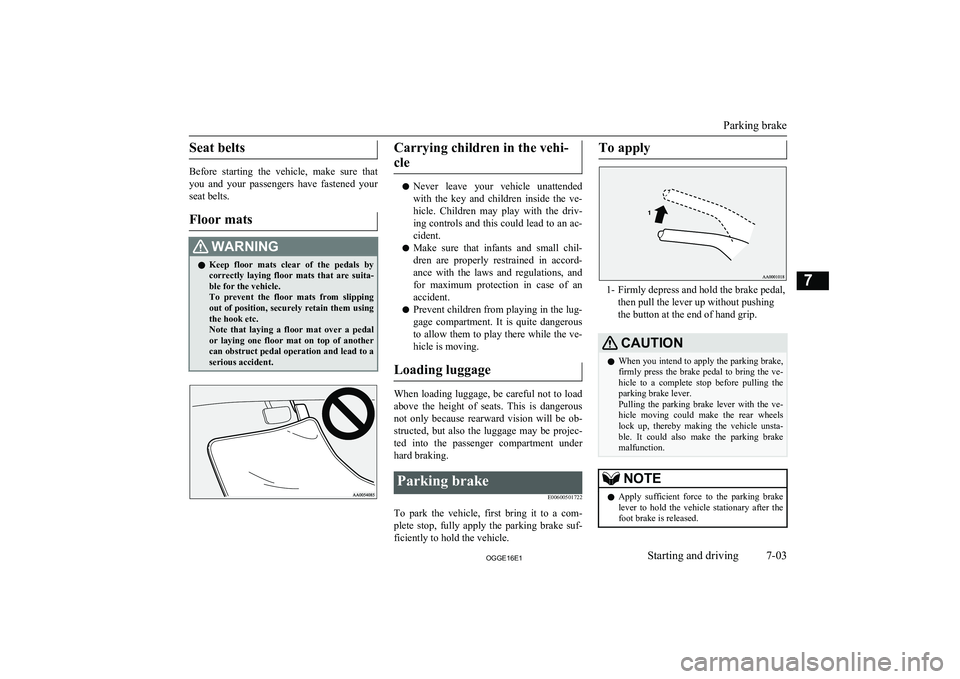
WARNINGl Keep floor mats clear of the pedals by
correctly laying floor mats that are suita-
ble for the vehicle.
To prevent the floor mats from slipping out of position, securely retain them usingthe hook etc.
Note that laying a floor mat over a pedal
or laying one floor mat on top of another can obstruct pedal operation and lead to a
serious accident.Carrying children in the vehi-
cle
l Never leave your vehicle unattended
with the key and children inside the ve-hicle. Children may play with the driv-
ing controls and this could lead to an ac- cident.
l Make sure that infants and small chil-
dren are properly restrained in accord-
ance with the laws and regulations, and
for maximum protection in case of an accident.
l Prevent children from playing in the lug-
gage compartment. It is quite dangerous
to allow them to play there while the ve- hicle is moving.
Loading luggage
When loading luggage, be careful not to load above the height of seats. This is dangerous
not only because rearward vision will be ob- structed, but also the luggage may be projec-ted into the passenger compartment underhard braking.
Parking brake
E00600501722
To park the vehicle, first bring it to a com-plete stop, fully apply the parking brake suf-
ficiently to hold the vehicle.
To apply
1- Firmly depress and hold the brake pedal, then pull the lever up without pushing
the button at the end of hand grip.
CAUTIONl When you intend to apply the parking brake,
firmly press the brake pedal to bring the ve-hicle to a complete stop before pulling theparking brake lever.
Pulling the parking brake lever with the ve-
hicle moving could make the rear wheels lock up, thereby making the vehicle unsta-
ble. It could also make the parking brake malfunction.NOTEl Apply sufficient force to the parking brake
lever to hold the vehicle stationary after the foot brake is released.
Parking brake
7-03OGGE16E1Starting and driving7
Page 460 of 490
Switch........................................................... 6-54
Rear Motor coolant..........................................12-10
Rear room lamp................................................. 8-76 Bulb capacity.............................................. 11-24
Rear turn-signal lamps
Bulb capacity.............................................. 11-23
Replacement..................................... 11-26,11-28
Rear window demister switch........................... 6-61
Rear-view camera..............................................7-84
Rear-view mirror Inside............................................................. 7-05
Outside.......................................................... 7-07
Refill capacities............................................... 12-10
Regenerative braking level selector (paddle).... 7-16
Replacement of lamp bulbs............................. 11-22
Reversing lamps Bulb capacity.............................................. 11-23
Replacement................................................ 11-28
Reversing sensor system................................... 7-77
Roof carrier precaution......................................7-97
Room lamp........................................................ 8-76
S
S-AWC (Super-All Wheel Control).................. 7-17
Safe driving techniques..................................... 7-02
Safety and disposal information for used engine oil................................................. 2-16
Seat belt Adjustable seat belt anchor........................... 5-12Child restraint................................................5-15Force limiter.................................................. 5-15
Inspection...................................................... 5-28
Pregnant women restraint............................. 5-14
Pretensioner...................................................5-15
Seat belt reminder..............................................5-11
Seat belts........................................................... 5-09
Seat Adjustment.................................................... 5-02Front seats..................................................... 5-03
Head restraints.............................................. 5-05
Heated seats.................................................. 5-04
Making a flat seat.......................................... 5-08
Making a luggage area.................................. 5-07
Rear seat........................................................ 5-05
Security alarm system....................................... 4-27
Select Position indicator.................................... 7-14
Selector Lever (Joystick Type)......................... 7-13
Sensor system.................................................... 7-81
Service precaution........................................... 11-02
Side turn-signal lamps Bulb capacity.............................................. 11-23
Snow traction device (Tyre chains).................11-13
Snow tyres....................................................... 11-12
Spark plug....................................................... 12-08
Specifications.................................................. 12-02
Speed Limiter.................................................... 7-38
Starting and stopping the Plug-in Hy- brid EV System................................................ 7-11
Steering Steering wheel height adjustment................. 7-05
Stop lamps
Bulb capacity.............................................. 11-23
Stopping the Plug-in Hybrid EV System.......... 7-12
Storage spaces................................................... 8-78
Sun visors.......................................................... 8-73
Sunglasses holder.............................................. 8-80Sunroof.............................................................. 4-36
Supplemental restraint system...........................5-29 Caution for installing the child re-straint on vehicles with a front
passenger airbag.................................. 5-15,5-31
Servicing....................................................... 5-39
System check screen..........................................6-13
T
Tail lampsBulb capacity.............................................. 11-23
Tailgate.............................................................. 4-18
Tank capacity.................................................... 2-14
Time Setting...................................................... 8-45
Tools.................................................................. 9-06 Storage.......................................................... 9-06
Towing.............................................................. 9-18
Trailer towing.................................................... 7-97
Transaxle fluid ................................................12-10
Turn-signal indication lamps.............................6-43
Turn/Lane-change signals................................. 6-52
Tyre pressure monitoring system (TPMS)........ 7-72
Tyre repair kit.................................................... 9-07
Tyres................................................................ 11-10 How to change a tyre.................................... 9-13Inflation pressures....................................... 11-10
Rotation....................................................... 11-11
Size (tyre and wheel).................................. 12-08
Snow traction device (Tyre chains)............ 11-13
Snow tyres................................................... 11-12
Tread wear indicators.................................. 11-11
Tyre pressure monitoring system (TPMS).. 11-10
Tyre repair kit............................................... 9-07
Alphabetical index
13- 4 OGGE16E1Alphabetical index