overheating MITSUBISHI OUTLANDER PHEV 2016 Owner's Manual (in English)
[x] Cancel search | Manufacturer: MITSUBISHI, Model Year: 2016, Model line: OUTLANDER PHEV, Model: MITSUBISHI OUTLANDER PHEV 2016Pages: 490, PDF Size: 22.02 MB
Page 165 of 490
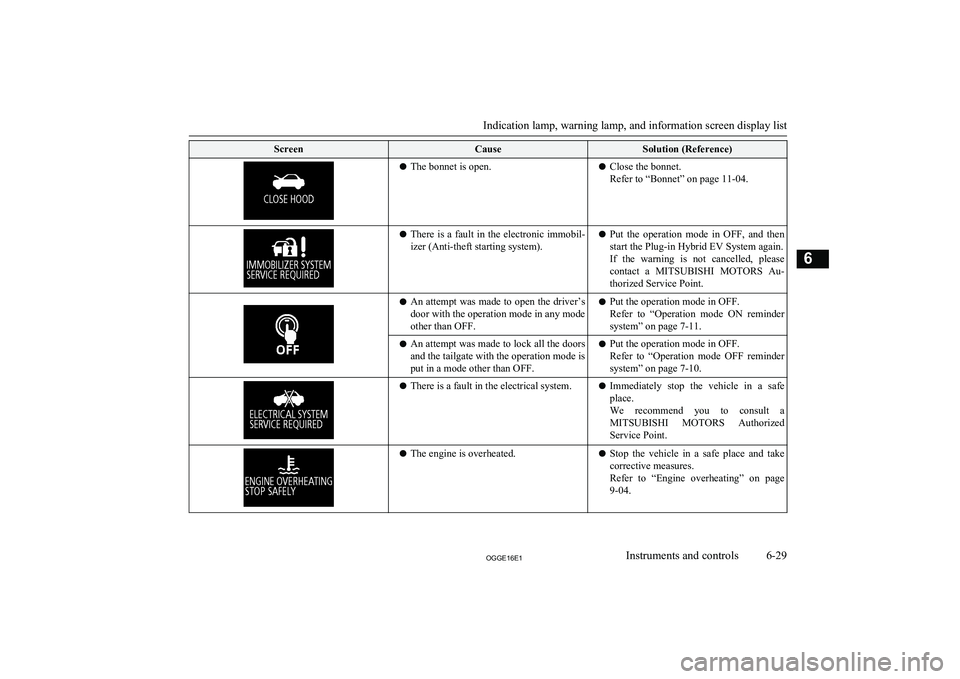
ScreenCauseSolution (Reference)lThe bonnet is open.lClose the bonnet.
Refer to “Bonnet” on page 11-04.l There is a fault in the electronic immobil-
izer (Anti-theft starting system).l Put the operation mode in OFF, and then
start the Plug-in Hybrid EV System again.If the warning is not cancelled, please
contact a MITSUBISHI MOTORS Au-
thorized Service Point.l An attempt was made to open the driver’s
door with the operation mode in any mode
other than OFF.l Put the operation mode in OFF.
Refer to “Operation mode ON reminder system” on page 7-11.l An attempt was made to lock all the doors
and the tailgate with the operation mode is
put in a mode other than OFF.l Put the operation mode in OFF.
Refer to “Operation mode OFF reminder system” on page 7-10.l There is a fault in the electrical system.l Immediately stop the vehicle in a safe
place.
We recommend you to consult a
MITSUBISHI MOTORS Authorized
Service Point.l The engine is overheated.lStop the vehicle in a safe place and take
corrective measures.
Refer to “Engine overheating” on page 9-04.
Indication lamp, warning lamp, and information screen display list
6-29OGGE16E1Instruments and controls6
Page 196 of 490
NOTElThe interval for intermittent operation can be
adjusted.
For further information, we recommend you to consult a MITSUBISHI MOTORS Au-
thorized Service Point.
On vehicles equipped with MITSUBISHI
Multi-Communication System (MMCS), screen operations can be used to make theadjustment. Refer to the separate owner’s
manual for details.Headlamp washer switch
E00510101502
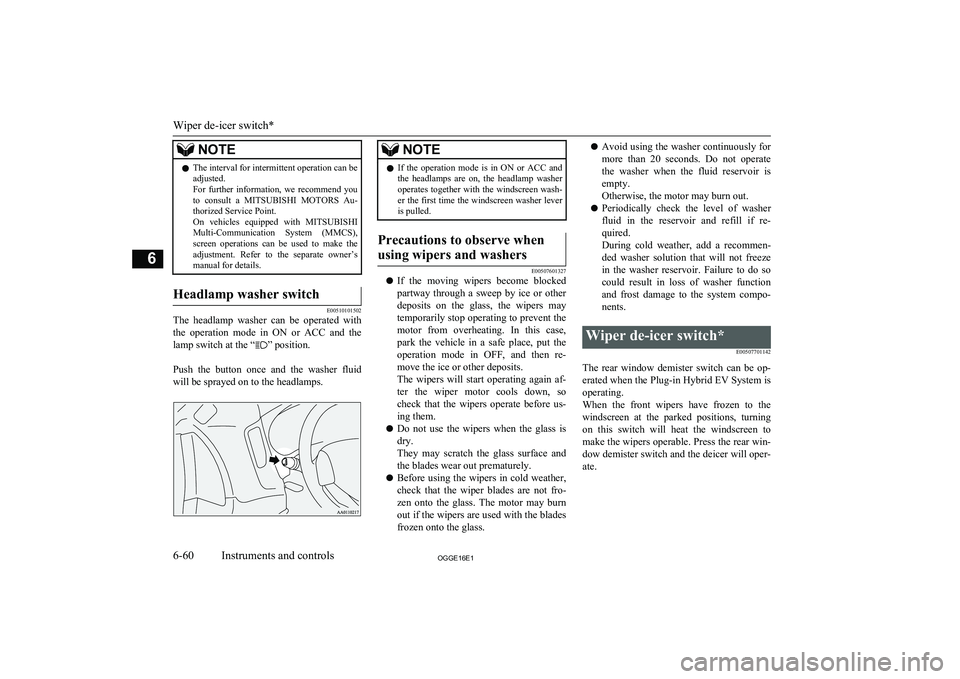
The headlamp washer can be operated with
the operation mode in ON or ACC and the lamp switch at the “
” position.
Push the button once and the washer fluid will be sprayed on to the headlamps.
NOTEl If the operation mode is in ON or ACC and
the headlamps are on, the headlamp washer operates together with the windscreen wash-
er the first time the windscreen washer lever is pulled.Precautions to observe when
using wipers and washers
E00507601327
l If the moving wipers become blocked
partway through a sweep by ice or other deposits on the glass, the wipers maytemporarily stop operating to prevent the
motor from overheating. In this case,
park the vehicle in a safe place, put the operation mode in OFF, and then re-
move the ice or other deposits.
The wipers will start operating again af- ter the wiper motor cools down, so
check that the wipers operate before us- ing them.
l Do not use the wipers when the glass is
dry.
They may scratch the glass surface and the blades wear out prematurely.
l Before using the wipers in cold weather,
check that the wiper blades are not fro-
zen onto the glass. The motor may burn out if the wipers are used with the blades
frozen onto the glass.
l Avoid using the washer continuously for
more than 20 seconds. Do not operate the washer when the fluid reservoir isempty.
Otherwise, the motor may burn out.
l Periodically check the level of washer
fluid in the reservoir and refill if re- quired.
During cold weather, add a recommen- ded washer solution that will not freeze
in the washer reservoir. Failure to do so
could result in loss of washer function and frost damage to the system compo- nents.Wiper de-icer switch*
E00507701142
The rear window demister switch can be op-erated when the Plug-in Hybrid EV System is
operating.
When the front wipers have frozen to the
windscreen at the parked positions, turning
on this switch will heat the windscreen to
make the wipers operable. Press the rear win- dow demister switch and the deicer will oper-
ate.
Wiper de-icer switch*
6-60OGGE16E1Instruments and controls6
Page 225 of 490
BrakingE00607002967
All the parts of the brake system are critical
to safety. We recommend you to have the ve- hicle checked at regular intervals according
to the service booklet.CAUTIONl Avoid driving habits that cause heavy brak-
ing and never “ride” the brakes by resting
your foot on the brake pedal while driving.
It causes brake overheating and fade.
Brake system
The service brake is divided into two brake
circuits. And your vehicle is equipped with
power brakes. If one brake circuit fails, the other is available to stop the vehicle. If you
should lose the power assist for some reason, the brakes will still work. In these situations,
even if the brake pedal moves down to the very end of its possible stroke or resists being
depressed, keep depressing the brake pedal
down harder and further than usual; stop
driving as soon as possible and have the brake system repaired.
WARNINGl Do not turn off the Plug-in Hybrid EV
System while your vehicle is in motion. If
you turn off the Plug-in Hybrid EV Sys- tem while driving, the power assistancefor the braking system will stop working
and your brakes will not work effectively.
l If the power assist is lost or if either brake
hydraulic system stops working properly,
have your vehicle checked immediately.
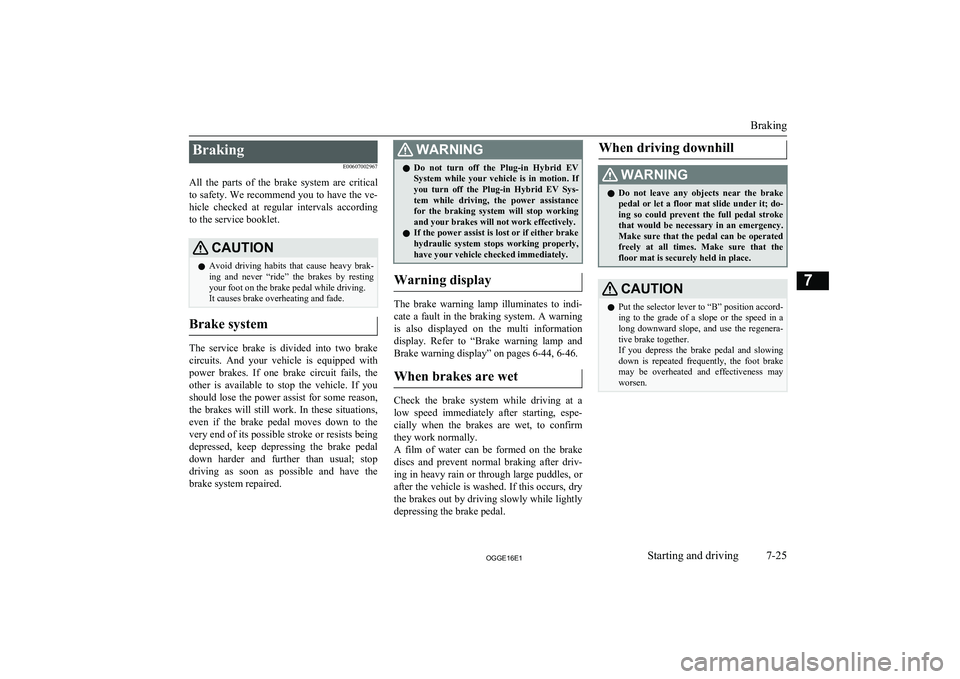
Warning display
The brake warning lamp illuminates to indi-
cate a fault in the braking system. A warning
is also displayed on the multi information display. Refer to “Brake warning lamp and Brake warning display” on pages 6-44, 6-46.
When brakes are wet
Check the brake system while driving at a
low speed immediately after starting, espe- cially when the brakes are wet, to confirmthey work normally.
A film of water can be formed on the brake
discs and prevent normal braking after driv-
ing in heavy rain or through large puddles, or after the vehicle is washed. If this occurs, dry the brakes out by driving slowly while lightly
depressing the brake pedal.
When driving downhillWARNINGl Do not leave any objects near the brake
pedal or let a floor mat slide under it; do- ing so could prevent the full pedal stroke
that would be necessary in an emergency. Make sure that the pedal can be operated freely at all times. Make sure that thefloor mat is securely held in place.CAUTIONl Put the selector lever to “B” position accord-
ing to the grade of a slope or the speed in along downward slope, and use the regenera-
tive brake together.
If you depress the brake pedal and slowing down is repeated frequently, the foot brake
may be overheated and effectiveness may worsen.
Braking
7-25OGGE16E1Starting and driving7
Page 231 of 490
After driving on icy roads
E00618800219
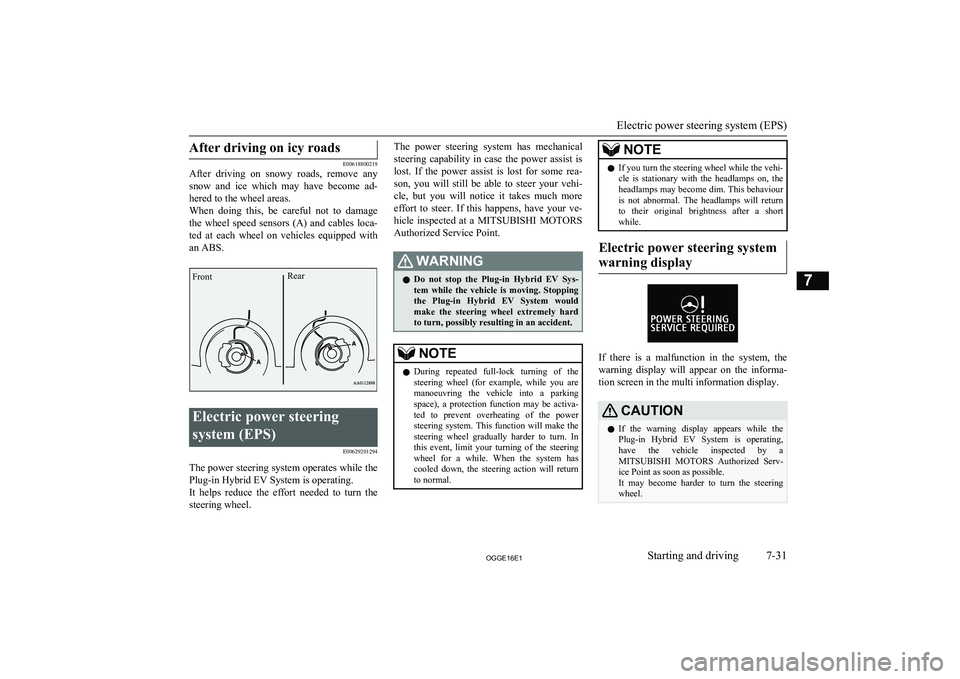
After driving on snowy roads, remove any
snow and ice which may have become ad-
hered to the wheel areas.
When doing this, be careful not to damage the wheel speed sensors (A) and cables loca-ted at each wheel on vehicles equipped with an ABS.
Electric power steering
system (EPS) E00629201294
The power steering system operates while thePlug-in Hybrid EV System is operating.
It helps reduce the effort needed to turn the steering wheel.
The power steering system has mechanical
steering capability in case the power assist is lost. If the power assist is lost for some rea-
son, you will still be able to steer your vehi-
cle, but you will notice it takes much more
effort to steer. If this happens, have your ve- hicle inspected at a MITSUBISHI MOTORS
Authorized Service Point.WARNINGl Do not stop the Plug-in Hybrid EV Sys-
tem while the vehicle is moving. Stopping the Plug-in Hybrid EV System would
make the steering wheel extremely hard to turn, possibly resulting in an accident.NOTEl During repeated full-lock turning of the
steering wheel (for example, while you are manoeuvring the vehicle into a parking space), a protection function may be activa-
ted to prevent overheating of the power steering system. This function will make the
steering wheel gradually harder to turn. In
this event, limit your turning of the steering wheel for a while. When the system has
cooled down, the steering action will return to normal.NOTEl If you turn the steering wheel while the vehi-
cle is stationary with the headlamps on, the headlamps may become dim. This behaviour
is not abnormal. The headlamps will return to their original brightness after a shortwhile.
Electric power steering system
warning display
If there is a malfunction in the system, the warning display will appear on the informa-
tion screen in the multi information display.
CAUTIONl If the warning display appears while the
Plug-in Hybrid EV System is operating,
have the vehicle inspected by a
MITSUBISHI MOTORS Authorized Serv-
ice Point as soon as possible.
It may become harder to turn the steering wheel.
Electric power steering system (EPS)
7-31OGGE16E1Starting and driving7FrontRear
Page 233 of 490
“ASC OFF” switch
E00619201581
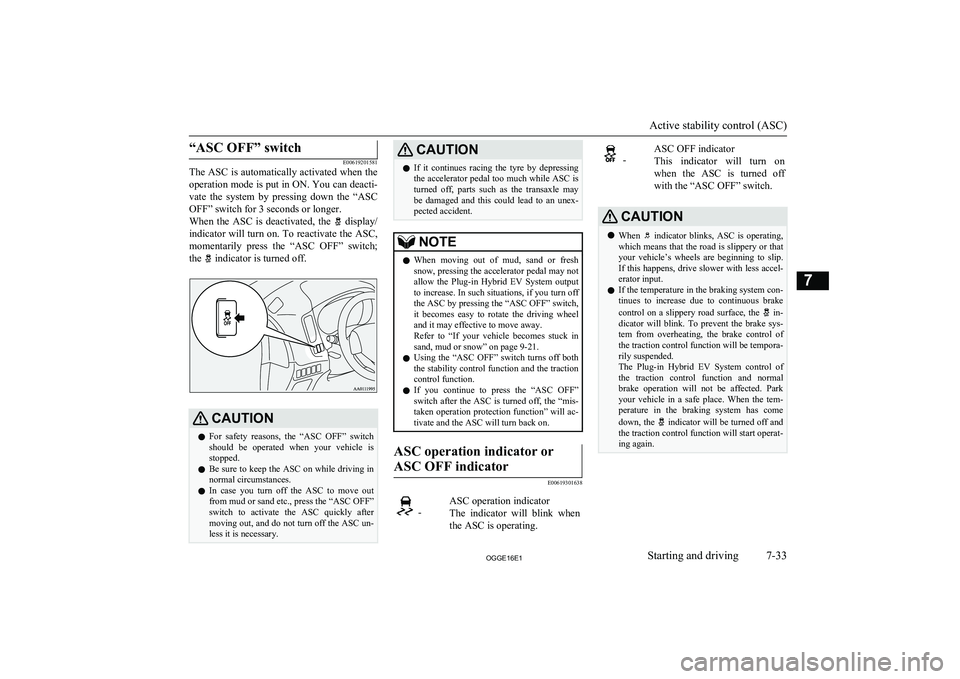
The ASC is automatically activated when the
operation mode is put in ON. You can deacti-
vate the system by pressing down the “ASC
OFF” switch for 3 seconds or longer.
When the ASC is deactivated, the
display/
indicator will turn on. To reactivate the ASC, momentarily press the “ASC OFF” switch;
the
indicator is turned off.
CAUTIONl For safety reasons, the “ASC OFF” switch
should be operated when your vehicle is stopped.
l Be sure to keep the ASC on while driving in
normal circumstances.
l In case you turn off the ASC to move out
from mud or sand etc., press the “ASC OFF” switch to activate the ASC quickly aftermoving out, and do not turn off the ASC un-
less it is necessary.CAUTIONl If it continues racing the tyre by depressing
the accelerator pedal too much while ASC is turned off, parts such as the transaxle may
be damaged and this could lead to an unex- pected accident.NOTEl When moving out of mud, sand or fresh
snow, pressing the accelerator pedal may not
allow the Plug-in Hybrid EV System output to increase. In such situations, if you turn off the ASC by pressing the “ASC OFF” switch,
it becomes easy to rotate the driving wheel
and it may effective to move away.
Refer to “If your vehicle becomes stuck in sand, mud or snow” on page 9-21.
l Using the “ASC OFF” switch turns off both
the stability control function and the traction control function.
l If you continue to press the “ASC OFF”
switch after the ASC is turned off, the “mis- taken operation protection function” will ac-tivate and the ASC will turn back on.ASC operation indicator or
ASC OFF indicator
E00619301638
-ASC operation indicator
The indicator will blink when the ASC is operating. -ASC OFF indicator
This indicator will turn on
when the ASC is turned off with the “ASC OFF” switch.CAUTIONl When indicator blinks, ASC is operating,
which means that the road is slippery or that your vehicle’s wheels are beginning to slip.
If this happens, drive slower with less accel- erator input.
l If the temperature in the braking system con-
tinues to increase due to continuous brake
control on a slippery road surface, the
in-
dicator will blink. To prevent the brake sys- tem from overheating, the brake control of the traction control function will be tempora-
rily suspended.
The Plug-in Hybrid EV System control of the traction control function and normal
brake operation will not be affected. Park your vehicle in a safe place. When the tem-
perature in the braking system has come
down, the
indicator will be turned off and
the traction control function will start operat-
ing again.
Active stability control (ASC)
7-33OGGE16E1Starting and driving7
Page 253 of 490
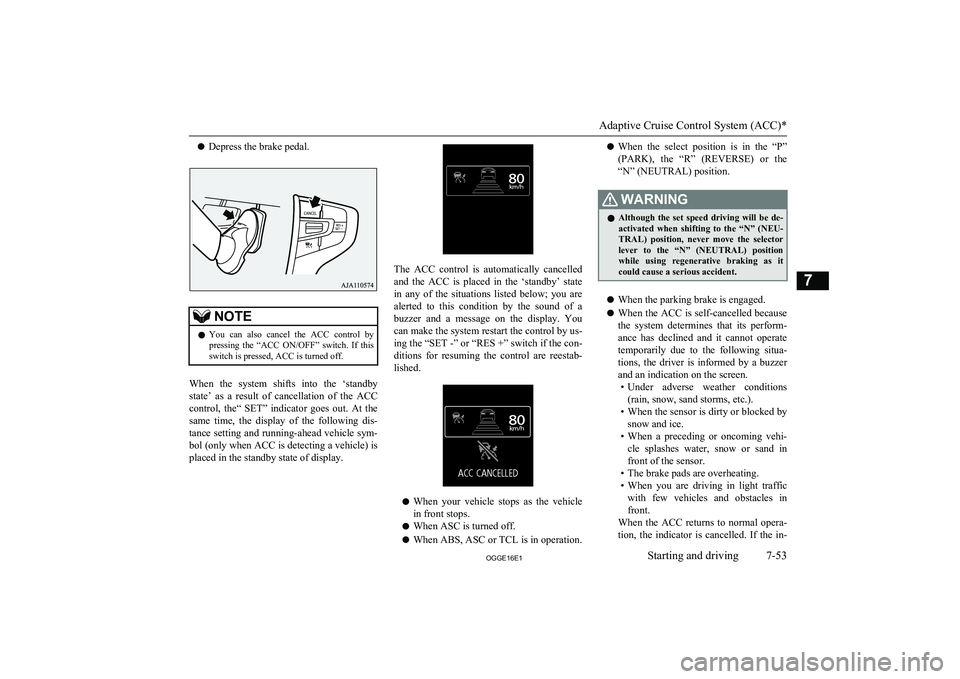
lDepress the brake pedal.NOTElYou can also cancel the ACC control by
pressing the “ACC ON/OFF” switch. If thisswitch is pressed, ACC is turned off.
When the system shifts into the ‘standby
state’ as a result of cancellation of the ACC
control, the“ SET” indicator goes out. At the same time, the display of the following dis-
tance setting and running-ahead vehicle sym- bol (only when ACC is detecting a vehicle) is
placed in the standby state of display.
The ACC control is automatically cancelled
and the ACC is placed in the ‘standby’ state
in any of the situations listed below; you are
alerted to this condition by the sound of a
buzzer and a message on the display. You can make the system restart the control by us-ing the “SET -” or “RES +” switch if the con-
ditions for resuming the control are reestab-
lished.
l When your vehicle stops as the vehicle
in front stops.
l When ASC is turned off.
l When ABS, ASC or TCL is in operation.
lWhen the select position is in the “P”
(PARK), the “R” (REVERSE) or the “N” (NEUTRAL) position.WARNINGl Although the set speed driving will be de-
activated when shifting to the “N” (NEU- TRAL) position, never move the selector
lever to the “N” (NEUTRAL) position
while using regenerative braking as it could cause a serious accident.
l When the parking brake is engaged.
l When the ACC is self-cancelled because
the system determines that its perform- ance has declined and it cannot operate
temporarily due to the following situa- tions, the driver is informed by a buzzer
and an indication on the screen. • Under adverse weather conditions
(rain, snow, sand storms, etc.).
• When the sensor is dirty or blocked by
snow and ice.
• When a preceding or oncoming vehi-
cle splashes water, snow or sand in front of the sensor.
• The brake pads are overheating.
• When you are driving in light traffic
with few vehicles and obstacles in front.
When the ACC returns to normal opera-
tion, the indicator is cancelled. If the in-
Adaptive Cruise Control System (ACC)*
7-53OGGE16E1Starting and driving7
Page 298 of 490
If you tow a trailer at an altitude of more than
1,000 m above sea-level, reduce your weight by 10 % of the gross combination weight for
every increase of 1,000 m above sea-level, as
the engine output is lowered owing to de-
crease in atmospheric pressure.
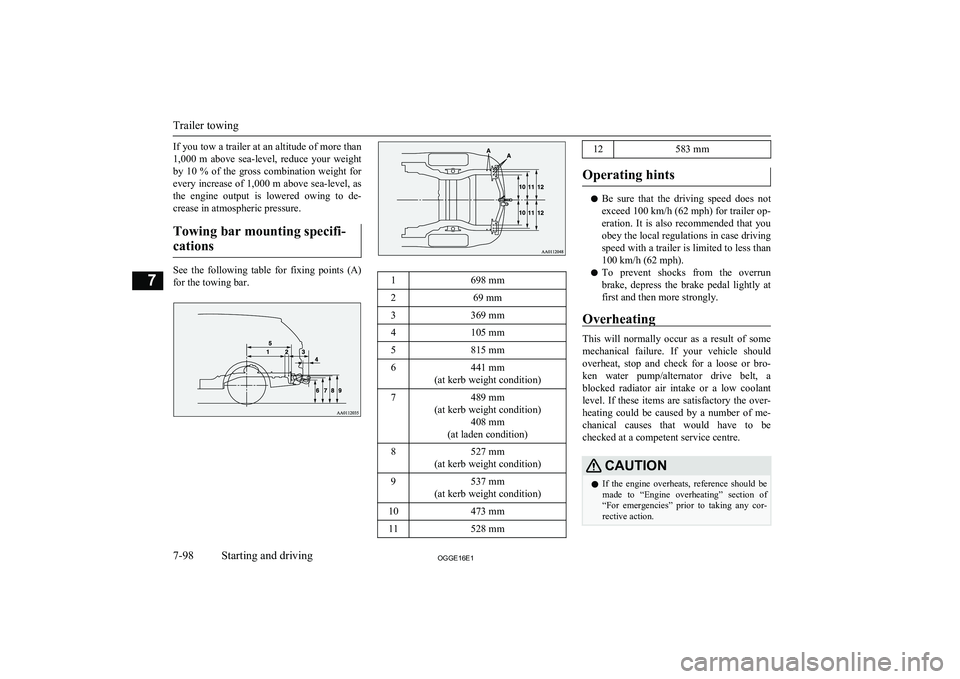
Towing bar mounting specifi- cations
See the following table for fixing points (A) for the towing bar.
1698 mm269 mm3369 mm4105 mm5815 mm6441 mm
(at kerb weight condition)7489 mm
(at kerb weight condition) 408 mm
(at laden condition)8527 mm
(at kerb weight condition)9537 mm
(at kerb weight condition)10473 mm11528 mm12583 mm
Operating hints
l Be sure that the driving speed does not
exceed 100 km/h (62 mph) for trailer op-
eration. It is also recommended that you obey the local regulations in case driving speed with a trailer is limited to less than
100 km/h (62 mph).
l To prevent shocks from the overrun
brake, depress the brake pedal lightly at first and then more strongly.
Overheating
This will normally occur as a result of some
mechanical failure. If your vehicle should overheat, stop and check for a loose or bro-ken water pump/alternator drive belt, a
blocked radiator air intake or a low coolant level. If these items are satisfactory the over-
heating could be caused by a number of me-
chanical causes that would have to be
checked at a competent service centre.
CAUTIONl If the engine overheats, reference should be
made to “Engine overheating” section of
“For emergencies” prior to taking any cor- rective action.
Trailer towing
7-98OGGE16E1Starting and driving7
Page 385 of 490
If the vehicle breaks down.................................................................. 9-02Emergency starting............................................................................. 9-02
Engine overheating............................................................................. 9-04
Tools and jack..................................................................................... 9-06
Tyre repair kit......................................................................................9-07
How to change a tyre.......................................................................... 9-13
Towing................................................................................................ 9-18
Operation under adverse driving conditions....................................... 9-21For emergencies
OGGE16E19
Page 386 of 490
If the vehicle breaks downE00800102408
If the vehicle breaks down on the road, move it to the shoulder and use the hazard warning
flashers and/or the warning triangle etc.
Refer to “Hazard warning flasher switch” on page 6-52.
If you need to push your vehicle, put the op-
eration mode of the power switch in ON and put the select position in “N” (NEUTRAL) position.WARNINGl If you are unable to safely assess the vehi-
cle due to vehicle damage, do not touch
the vehicle. Leave the vehicle and contact emergency services. Advise emergency
responders that this is a Plug-in Hybrid Electric vehicle.
If the ready indicator goes out
while driving
Vehicle operation and control are affected if
the ready indicator goes out while driving.
Before moving the vehicle to a safe area, be aware of the following:
l The brake booster may becomes inoper-
ative and the pedal effort will increase.
Press down the brake pedal harder than usual.
l The power steering system may not op-
erate, the steering wheel feels heavy when turning it.Emergency starting
E00800504204
If the Plug-in Hybrid EV system cannot be
started because the auxiliary battery is weak or dead, the battery from another vehicle can
be used with jumper cables to start the Plug-
in Hybrid EV system.
WARNINGl To start the Plug-in Hybrid EV system us-
ing jumper cables from another vehicle
and perform the correct procedures ac-
cording to the instruction below. Incor-
rect procedures could result in a fire, ex- plosion, electric shock or damage to the
vehicles.
l Keep sparks, cigarettes and flames away
from the battery because the battery may
produce an explosion.CAUTIONl The Plug-in Hybrid EV system cannot be
started by pulling or pushing the vehicle.
l Check the other vehicle. It must have a 12-
volt battery. If the other system isn’t 12-volt, shorting can damage both vehicles.CAUTIONl Use the proper cables suitable for the battery
size to prevent overheating of the cables.
l Check the jumper cables for damage and
corrosion before use.
l Always wear protective eye goggles when
working near the battery.
l Keep the battery out of the reach of children.
l Do not attempt jump starting the auxiliary
battery while the drive battery is being charged. Doing so could damage the charg-
ing equipment or the vehicle.NOTEl If the auxiliary battery is disconnected, the
operation mode of the power switch is mem-
orized. When a booster battery is connected
by jumper cables, the operation mode re- turns to the state before the auxiliary battery
ran down.
Pay due attention if you do not know the op-
eration mode before the auxiliary battery
was fully discharged.
l If the auxiliary battery is fully discharged
with the select position in the “P” (PARK)
position, the select position cannot be changed to other position from the “P”
(PARK) position in some cases. In such a case, the front wheels have been locked.
Therefore, the vehicle cannot be moved.
If the vehicle breaks down
9-02OGGE16E1For emergencies9
Page 388 of 490
CAUTIONlTake care not to get the jumper cable caught
in the cooling fan or other rotating part in
the engine compartment.NOTEl If the jumper cable is connected to any posi-
tion other than the appointed one, it may
could cause damage to the vehicle.
7. Start the engine in the vehicle which has
the booster battery, let the engine idle a
few minutes, then start the Plug-in Hy- brid EV system in your vehicle.
8. Check that the ready indicator illumi-
nates. If the ready indicator does not il- luminate, contact a MITSUBISHI
MOTORS Authorized Service Point.
9. When the ready indicator illuminates,
disconnect the jumper cables in the re-
verse order of connection.
10. Check that the select position can be
shifted to all positions other than the “P”(PARK) position.
11. Have the auxiliary battery inspected by
your nearest MITSUBISHI MOTORS
Authorized Service Point.
CAUTIONl Your vehicle is equipped with an exclusive
auxiliary battery. Even if the battery type is the same, the battery may not be correctly
installed in your vehicle. When replacing the auxiliary battery, request a MITSUBISHI
MOTORS Authorized Service Point to do
so.Engine overheating
E00800604058
When the engine is overheating, the informa-tion screen in the multi information display
will be interrupted and the engine coolant
temperature warning display will appear.
If this occurs, take the following corrective measures: 1. Stop the vehicle in a safe place.
2. Check whether steam is coming from the
engine compartment.
[If steam does not come from the engine
compartment]
With the Plug-in Hybrid EV system still starting, raise the bonnet to ventilate the
engine compartment.
[If steam is coming from the engine
compartment]
Stop the Plug-in Hybrid EV system, and
when the steam stops, raise the bonnet to
ventilate the engine compartment. Re-
start the Plug-in Hybrid EV system.WARNINGl Do not open the bonnet while steam is
coming from the engine compartment. It could cause steam or hot water to spurt
out, causing burns. Hot water could spurt out even when there is no steam coming
out, and some parts will be very hot. Be
very careful when opening the bonnet.
l Be careful of hot steam, which could be
blowing off the reserve tank cap.
l Do not attempt to remove the radiator
cap while the engine is hot.
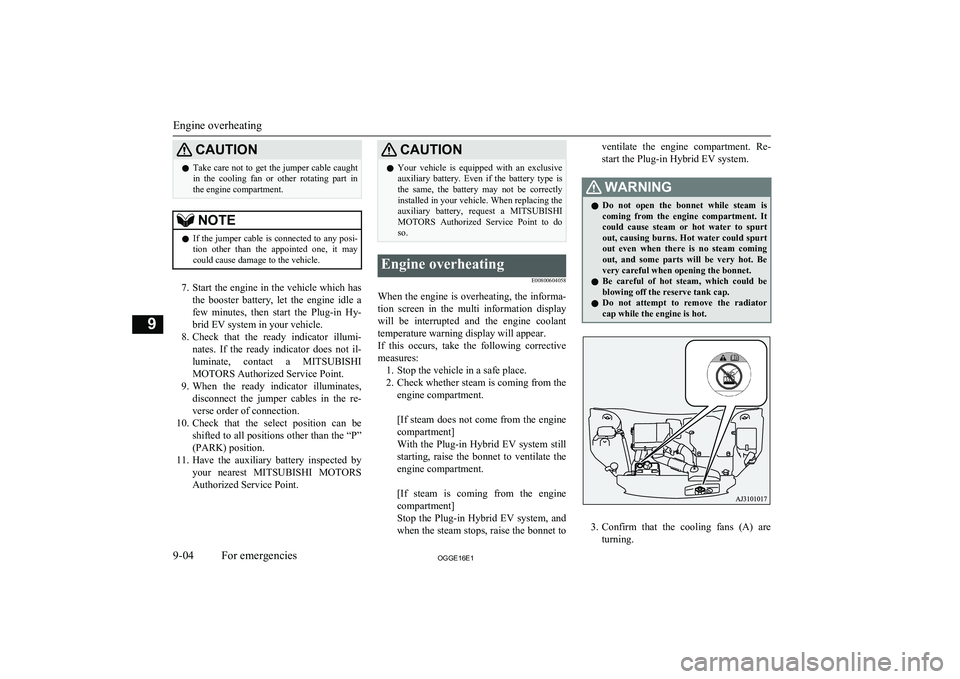
3. Confirm that the cooling fans (A) are
turning.
Engine overheating
9-04OGGE16E1For emergencies9