fuel type MITSUBISHI OUTLANDER PHEV 2017 Owner's Manual (in English)
[x] Cancel search | Manufacturer: MITSUBISHI, Model Year: 2017, Model line: OUTLANDER PHEV, Model: MITSUBISHI OUTLANDER PHEV 2017Pages: 548, PDF Size: 25.5 MB
Page 7 of 548
![MITSUBISHI OUTLANDER PHEV 2017 Owners Manual (in English) 1. Audio* p. 8-14MITSUBISHI Multi-Communication System (MMCS)*
Multi Around Monitor* p. 7-106
[For DISPLAY AUDIO, Smartphone Link Display Audio and
MMCS,
refer to the separate owner’s manuals.]
2. H](/img/19/34889/w960_34889-6.png "MITSUBISHI OUTLANDER PHEV 2017 Owners Manual (in English) 1. Audio* p. 8-14MITSUBISHI Multi-Communication System (MMCS)*
Multi Around Monitor* p. 7-106
[For DISPLAY AUDIO, Smartphone Link Display Audio and
MMCS,
refer to the separate owner’s manuals.]
2. H")
1. Audio* p. 8-14MITSUBISHI Multi-Communication System (MMCS)*
Multi Around Monitor* p. 7-106
[For DISPLAY AUDIO, Smartphone Link Display Audio and
MMCS,
refer to the separate owner’s manuals.]
2. Hazard warning flasher switch p. 6-62
3. ECO mode switch p. 6-62
4. Front passenger’s airbag indicator p. 5-30
5. Passenger’s ventilators p. 8-02
6. Accessory socket* p. 8-75 Cigarette lighter* p. 8-74
7. Electric tailgate power switch* p. 4-20
8. Key slot p. 7-15
9. 220-240 V AC power supply switch* p. 8-76
10. Blind Spot Warning (BSW) switch* p. 7-80
11. Heated steering wheel switch* p. 6-71
12. Heated windscreen switch* p. 6-70
13. Cup holder p. 8-83
14. Selector lever (Joystick type) p. 7-16
15. 220-240 V AC power supply* p. 8-76
16. Floor console box p. 8-82 Arm rest
Accessory socket p. 8-75
USB input terminal p. 8-70
17. Fuel tank filler door release lever p. 2-15
18. Bonnet release lever p. 11-04
19. Rear window demister switch p. 6-69 Wiper de-icer switch* p. 6-69
20. Air conditioner p. 8-04
21. Seat belt reminder p. 5-11
Instruments and controls
1-04OGGE17E1Overview1LHD
Page 8 of 548
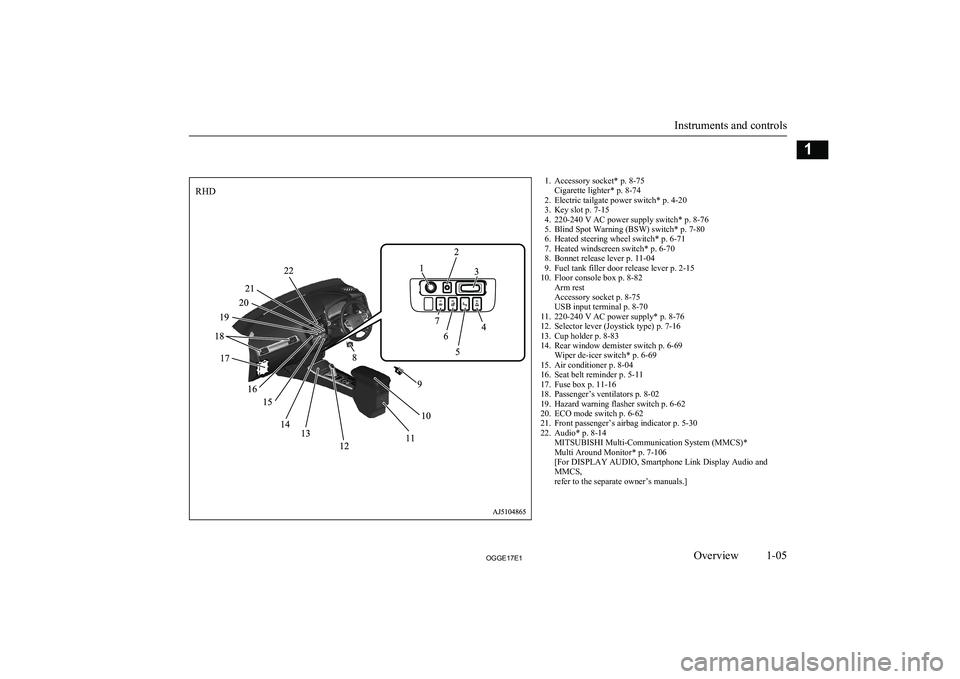
1. Accessory socket* p. 8-75Cigarette lighter* p. 8-74
2. Electric tailgate power switch* p. 4-20
3. Key slot p. 7-15
4. 220-240 V AC power supply switch* p. 8-76
5. Blind Spot Warning (BSW) switch* p. 7-80
6. Heated steering wheel switch* p. 6-71
7. Heated windscreen switch* p. 6-70
8. Bonnet release lever p. 11-04
9. Fuel tank filler door release lever p. 2-15
10. Floor console box p. 8-82 Arm rest
Accessory socket p. 8-75
USB input terminal p. 8-70
11. 220-240 V AC power supply* p. 8-76
12. Selector lever (Joystick type) p. 7-16
13. Cup holder p. 8-83
14. Rear window demister switch p. 6-69 Wiper de-icer switch* p. 6-69
15. Air conditioner p. 8-04
16. Seat belt reminder p. 5-11
17. Fuse box p. 11-16
18. Passenger’s ventilators p. 8-02
19. Hazard warning flasher switch p. 6-62
20. ECO mode switch p. 6-62
21. Front passenger’s airbag indicator p. 5-30
22. Audio* p. 8-14 MITSUBISHI Multi-Communication System (MMCS)*
Multi Around Monitor* p. 7-106
[For DISPLAY AUDIO, Smartphone Link Display Audio and
MMCS,
refer to the separate owner’s manuals.]
Instruments and controls
1-05OGGE17E1Overview1RHD
Page 16 of 548

Outside (Front)E085004020391. Front-view camera* p. 7-1062. Bonnet p. 11-04
3. Windscreen wipers p. 6-64
4. Sensor* [for Automatic high-beam system, Forward Collision Mit- igation System (FCM) and Lane Departure Warning (LDW)]
p. 6-56, 7-64, 7-85
Rain sensor p. 6-64
5. Sunroof* p. 4-36
6. Electric window control p. 4-34
7. Fuel tank filler p. 2-15
8. Side turn-signal lamps p. 6-61, 11-24 Side view camera* p. 7-106
9. Ultrasonic misacceleration Mitigation System* p. 7-74 Parking sensors* p. 7-98
10. Front fog lamps p. 6-63, 11-24, 11-27
11. Headlamps, high-beam p. 6-56, 11-24, 11-26
12. Headlamps, low beam p. 6-56, 11-24, 11-25
13. Position lamps p. 6-53, 11-24 Daytime running lamps p. 11-27, 11-24
14. Front turn-signal lamps p. 6-61, 11-24, 11-27
15. Headlamps, high-beam p. 6-56, 11-24, 11-26
16. Headlamps, low beam p. 6-56, 11-24, 11-25
17. Position lamps p. 6-53, 11-24 Daytime running lamps p. 6-55, 11-24
18. Front turn-signal lamps p. 6-61, 11-24, 11-27
Outside (Front)
1-13OGGE17E1Overview1Halogen headlamps type LED headlamps type
Page 23 of 548
You can shift the selector lever to “B” onlywhen the select position is in the “D”
(DRIVE) position.
Selector lever positions
“P” PARK
The wheel are locked. When you park your
vehicle, be sure to apply the parking brake and press the electrical parking switch.
“R” REVERSE
This position is to back up.
“N” NEUTRAL
No power is transmitted to the wheels. The wheels are not locked.
“D” DRIVE
This position is for normal driving.
“B” REGENERATIVE BRAKE
This position is for the regenerative braking.
You can adjust the regenerative braking force up to two levels.
Refer to “Selector lever (Joystick type)” on
page 7-16
Multi information display
E08501201284
Always stop the vehicle in a safe place before operating.
The following information is included on the multi information display: odometer, tripme-
ter, average fuel consumption etc.
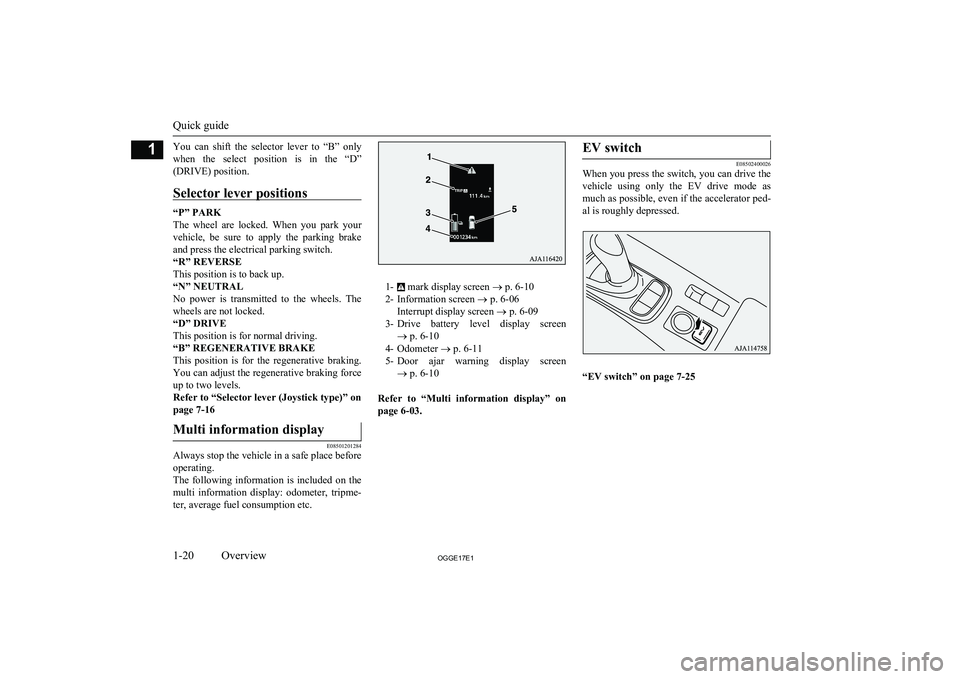
1- mark display screen ® p. 6-10
2- Information screen ® p. 6-06
Interrupt display screen ® p. 6-09
3- Drive battery level display screen
® p. 6-10
4- Odometer ® p. 6-11
5- Door ajar warning display screen
® p. 6-10
Refer to “Multi information display” on page 6-03.
EV switch
E08502400026
When you press the switch, you can drive the
vehicle using only the EV drive mode as
much as possible, even if the accelerator ped- al is roughly depressed.
“EV switch” on page 7-25
Quick guide
1-20OGGE17E1Overview1
Page 40 of 548
NOTElPoor quality petrol can cause problems such
as difficult starting, stalling, engine noise
and hesitation. If you experience these prob- lems, try another brand and/or grade of pet-
rol.
If the check engine warning lamp flashes,
have the system checked as soon as possible at a MITSUBISHI MOTORS Authorized
Service Point.
E10 type petrol
The petrol engine are compatible with E10
type petrol (containing 10 % ethanol) con- forming to European standards EN 228.
CAUTIONl Do not use more than 10 % concentration of
ethanol (grain alcohol) by volume.
Use of more than 10 % concentration may
lead to damage to your vehicle fuel system,
engine, engine sensors and exhaust system.Filling the fuel tank
E00200204393WARNINGlWhen handling fuel, comply with the safe-
ty regulations displayed by garages and
filling stations.WARNINGl Gasoline is highly flammable and explo-
sive. You could be burned or seriously in-
jured when handling it. When refueling
your vehicle, always put the operation mode of the power switch in OFF and
keep away from flames, sparks, and smoking materials. Always handle fuel in
well-ventilated outdoor areas.
l Before removing the fuel cap, be sure to
get rid of your body’s static electricity by touching a metal part of the car or fuel pump. Any static electricity on your body
could create a spark that ignites fuel va- pour.
l Perform the whole refueling process
(opening the fuel tank filler door, remov-
ing the fuel cap, etc.) by yourself. Do not let any other person come near the fuel
tank filler. If you allowed a person to help you and that person was carrying static electricity, fuel vapour could be ignited.
l Do not perform charging and refueling at
the same time. If you charged with static
electricity, fuel vapour could be ignited by the discharge spark.
l Do not move away from the fuel tank fill-
er until refueling is finished. If you moved
away and did something else (for exam-
ple, sitting on a seat) part-way through the refueling process, you could pick up afresh charge of static electricity.
l Be careful not to inhale fuel vapour. Fuel
contains toxic substances.WARNINGl Keep the doors and windows closed while
refueling the vehicle. If they were open,fuel vapour could get into the cabin.
l If the tank cap must be replaced, use only
a MITSUBISHI MOTORS genuine part.CAUTIONl The fuel in the fuel tank may not be con-
sumed and it may stagnate for a long time
depending on the use situation of the vehi- cle, the quality of fuel may change, and it
may have a bad influence on the engine or the parts of a fuel system.
Observe the following instructions for pre-
vention.
• Press the battery charge switch to start the
engine within three months at once.Refer to “Battery charge mode switch” on
page 7-28.
• Refill the fuel more than 15 litres at once
within three months. If the fuel remaining
display will be below half, you can refill the fuel more than 15 litres certainly.
Refer to “Fuel remaining display screen” on page 6-10.
Fuel tank capacity
45 litres
Filling the fuel tank
2-15OGGE17E1General information2
Page 341 of 548
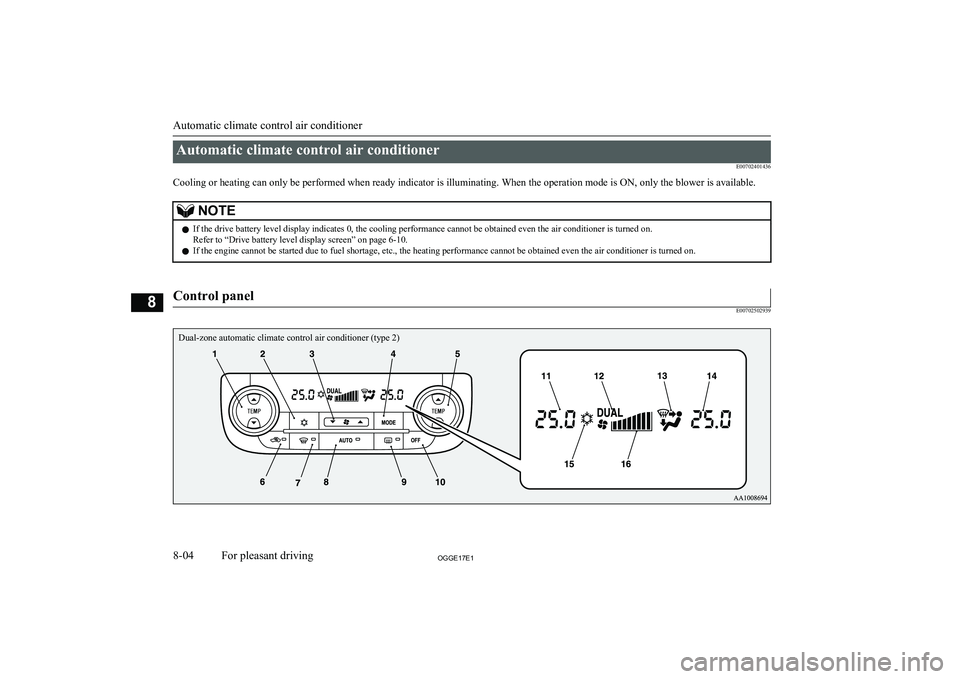
Automatic climate control air conditionerE00702401436
Cooling or heating can only be performed when ready indicator is illuminating. When the operation mode is ON, only the blower is available.NOTEl If the drive battery level display indicates 0, the cooling performance cannot be obtained even the air conditioner is turned on.
Refer to “Drive battery level display screen” on page 6-10.
l If the engine cannot be started due to fuel shortage, etc., the heating performance cannot be obtained even the air conditioner is turned on.
Control panel
E00702502939
Automatic climate control air conditioner
8-04OGGE17E1For pleasant driving8 Dual-zone automatic climate control air conditioner (type 2)
Page 448 of 548
If a wheel gets stuck in a ditch, do not try to
tow the vehicle.
Please contact your MITSUBISHI MOTORS
Authorized Service Point or a commercial
tow truck service for assistance.
Your vehicle may be temporarily towed by
another vehicle with a rope in emergency sit- uations such as running out of fuel.
If your vehicle is to be towed by another ve-
hicle, carefully tow your vehicle for the shortest distance possible and in accordance
with the instructions given in “Emergency towing” in this part.
The regulations concerning towing may dif-
fer from country to country. It is recommen-
ded that you obey the regulations of the area where you are driving your vehicle.CAUTIONl If the drivetrain or suspension has a prob-
lem, do not tow the vehicle with only the
rear wheels or front wheels placed on a dol- ly.
Towing the vehicle by a tow
truck
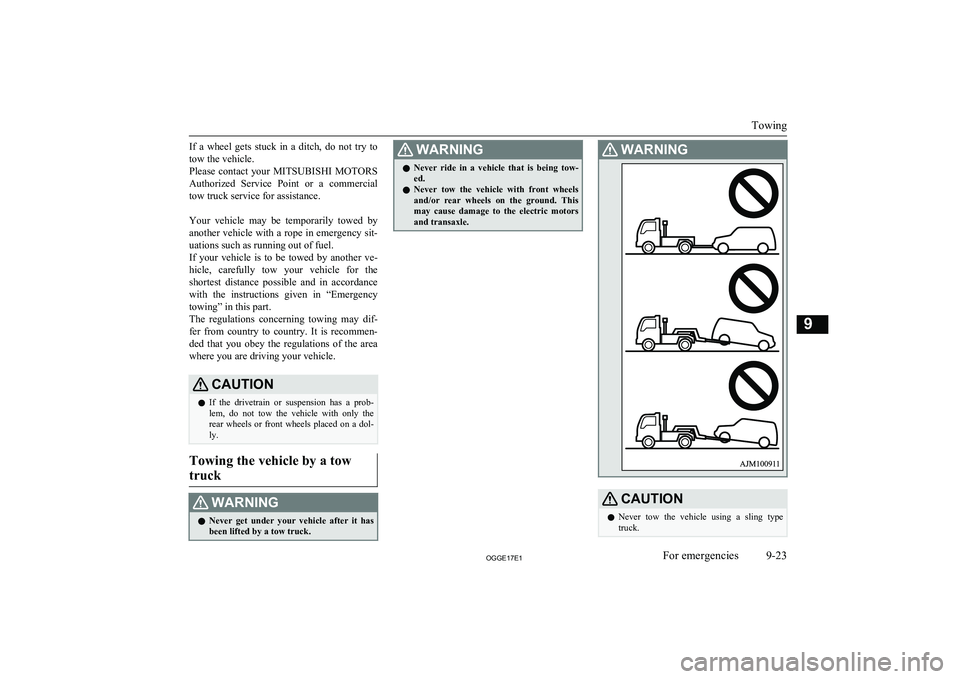
WARNINGl Never get under your vehicle after it has
been lifted by a tow truck.WARNINGl Never ride in a vehicle that is being tow-
ed.
l Never tow the vehicle with front wheels
and/or rear wheels on the ground. This
may cause damage to the electric motors and transaxle.WARNINGCAUTIONl Never tow the vehicle using a sling type
truck.
Towing
9-23OGGE17E1For emergencies9
Page 457 of 548
CAUTIONlAs your vehicle is equipped with the rain
sensor, place the wiper switch lever in the“OFF” position to deactivate the rain sensor
before washing the vehicle. Otherwise, the wipers will operate in the presence of waterspray on the windscreen and may get dam-
aged as a result.
l Refrain from excessively using a car wash as
its brushes may scratch the paint surface,
causing it to lose its gloss. Scratches will be
especially visible on darker coloured vehi-
cles.
l Never spray or splash water on the electrical
components in the engine compartment. Do- ing so could have an adverse effect on the
Plug-in Hybrid EV system startability.
Exercise caution also when washing the un-
derbody; be careful not to spray water into the engine compartment.
l Some types of hot water washing equipment
apply high pressure and heat to the vehicle. They may cause heat distortion and damage
to the vehicle resin parts and may result in flooding of the vehicle interior.
Therefore:
• Maintain a distance of approx. 70 cm or
more between the vehicle body and the washing nozzle.
• When washing around the door glass,
hold the nozzle at a distance of more than
70 cm and at right angles to the glass sur- face.CAUTIONl After washing the vehicle, drive the vehicle
slowly while lightly depressing the brake
pedal several times in order to dry out the
brakes.
Leaving the brakes wet could result in re- duced braking performance. Also, there is a possibility that they could freeze up or be-
come inoperative due to rust, rendering the vehicle unable to move.
l When using an automatic car wash, pay at-
tention to the following items, referring to the operation manual or consulting a car
wash operator. If the following procedure is not followed, it could result in damage to
your vehicle.
• The outside mirrors are retracted.
• The wiper arms are secured in place with
tape.
• As your vehicle is equipped with roof
rails, consult a car wash operator before using a car wash.
• As your vehicle is equipped with the rain
sensor, place the wiper switch lever in the“OFF” position to deactivate the rain sen-
sor.
• Make sure that the charging lid and the
fuel lid are completely closed.
• If your vehicle is equipped with the Ultra-
sonic misacceleration Mitigation System,
turn the system off by using “FCM and
Ultrasonic misacceleration Mitigation System ON/OFF switch” on page 7-69.During cold weather
Salt and other chemicals spread on the roads
in some areas in winter can have a harmful effect on the vehicle body. You should there-
fore wash the vehicle as often as possible in accordance with our care-instructions. It is
recommended to have a preservative applied
and the underfloor protection checked before and after the cold weather season.
After washing your vehicle, wipe off all wa- terdrops from the rubber parts around the
doors to prevent the doors from freezing.
NOTEl To prevent freezing of the weatherstripping
on the doors, bonnet, etc., they should be treated with silicone spray.Waxing
E00901000919
Waxing the vehicle will help prevent the ad-
herence of dust and road chemicals to the paintwork. Apply a wax solution after wash- ing the vehicle, or at least once every three
months to assist displacing of water.
Do not wax your vehicle in direct sunlight.
You should wax after the surfaces have
cooled.
For information on how to use wax refer to the instruction manual of the wax.
Cleaning the exterior of your vehicle
10-04OGGE17E1Vehicle care10
Page 462 of 548
WARNINGlIf it is necessary to do work in the engine
compartment with the plug-in hybrid EV
system starting, be especially careful that
your clothing, hair, etc., does not become caught by the cooling fans, drive belts, orother moving parts.
l After performing the maintenance, make
sure that no tools or cloths are left behind in the engine compartment. If they are left
behind, a fire or damage to the vehicle
may occur.
l The cooling fans can turn on automatical-
ly even if the plug-in hybrid EV system is
stopping. Put the operation mode of the
power switch in OFF to be safe while you work in the engine compartment.
l Make sure that the engine and Plug-in
Hybrid EV system has cooled down be- fore removing the radiator cap and EV cooling system reserve tank cap, because
hot steam or boiling water will otherwise
gush from the filler port and may scald you.
l Do not smoke, cause sparks or allow open
flames around fuel or auxiliary battery.
The fumes are flammable.
l Be extremely cautious when working
around the auxiliary battery. It contains
poisonous and corrosive sulphuric acid.
l Do not get under your vehicle with just
the body jack supporting it. Always use
automotive jack stands.WARNINGl Improper handling of components and
materials used in the vehicle can endangeryour personal safety. We recommend you to consult a specialist for necessary infor- mation.
l The components inside the engine room
might be very hot to the touch.
To avoid being burnt, make sure all com- ponents have sufficiently cooled before beginning an inspection. These compo-
nents are affixed with the label indicating precautions for handling. Follow the in-
structions on the label.
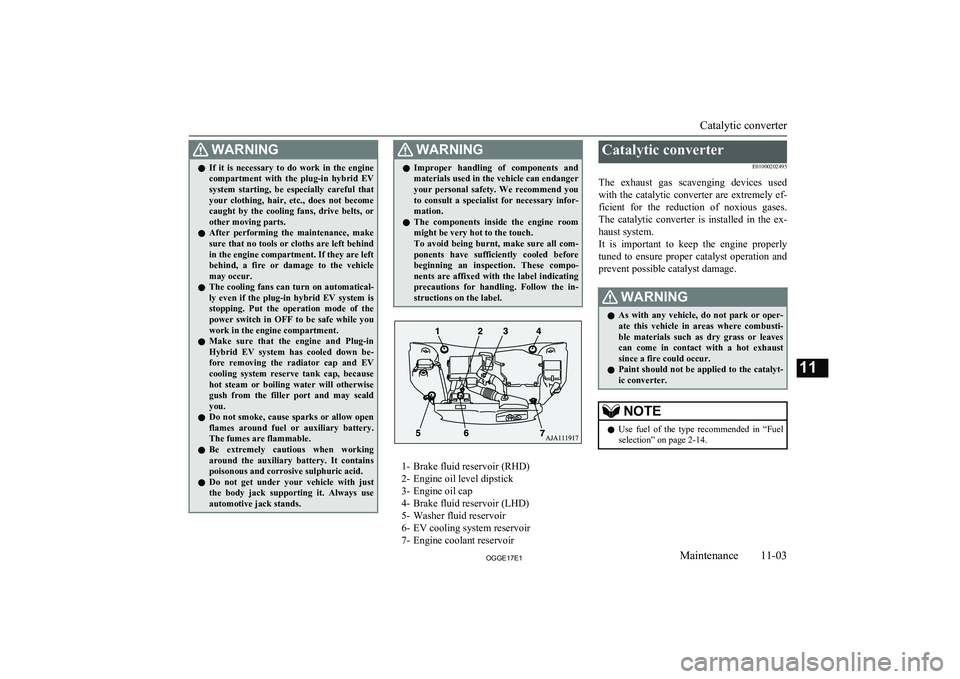
1- Brake fluid reservoir (RHD)
2- Engine oil level dipstick
3- Engine oil cap
4- Brake fluid reservoir (LHD)
5- Washer fluid reservoir
6- EV cooling system reservoir
7- Engine coolant reservoir
Catalytic converter
E01000202495
The exhaust gas scavenging devices used with the catalytic converter are extremely ef- ficient for the reduction of noxious gases.
The catalytic converter is installed in the ex- haust system.
It is important to keep the engine properly
tuned to ensure proper catalyst operation and prevent possible catalyst damage.WARNINGl As with any vehicle, do not park or oper-
ate this vehicle in areas where combusti- ble materials such as dry grass or leaves
can come in contact with a hot exhaust
since a fire could occur.
l Paint should not be applied to the catalyt-
ic converter.NOTEl Use fuel of the type recommended in
“Fuel
selection” on page 2-14.
Catalytic converter
11-03OGGE17E1Maintenance11
Page 468 of 548
Fluid type
Use brake fluid conforming to DOT3 or
DOT4 from a sealed container. The brake fluid is hygroscopic. Too much moisture in
the brake fluid will adversely affect the brake system, reducing the performance.
CAUTIONl Take care in handling brake fluid as it is
harmful to the eyes, may irritate your skin
and also damage painted surfaces.
l Use only the specified brake fluid.
Do not mix or add different brands of brake fluid to prevent chemical reactions.
Do not let any petroleum-based fluid touch, mix with, or get into the brake fluid.
This will damage the seals.
l Keep the reservoir tank cap closed to pre-
vent the brake fluid from deteriorating ex- cept maintenance.
l Clean the filler cap before removing and
close the cap securely after maintenance.Auxiliary battery
E01001203705
The condition of the auxiliary battery is very
important for quick starting of the plug-in hy-
brid EV system and proper functioning of the vehicle’s electrical system. Regular inspec- tion is especially important in cold weather.
Be sure to have a MITSUBISHI MOTORS
Authorized Service Point check the auxiliary battery.WARNINGl Be sure to have a
MITSUBISHI
MOTORS Authorized Service Point
charge the battery. Do not charge the bat- tery yourself. Flammable gases may leak
and explode.CAUTIONl There is a type of auxiliary battery is not
properly installed in the vehicle, even if thesame specification.
When replacing the auxiliary battery, please
contact a MITSUBISHI MOTORS Author-
ized Service Point.NOTEl When the auxiliary battery is removed, the
controlling timer for forcibly starting the en-
gine may be reset.
Since a fuel injection device may cause a clogging if the state where the engine does
not operate continues after reset of the timer,
please press the battery charge switch in or-
der to start the engine. However, when the drive battery is near full charge, even if the
battery charge switch is pressed, the engine
may not start. In that case, press the battery charge switch again after the drive battery
quantity decreases. Refer to “Battery charge
mode switch” on page 7-28.
l When the auxiliary battery is removed, since
the timer control of the MITSUBISHI Re-
mote Control is reset and the drive battery temperature control cannot be used, commu-
nicate the wireless LAN device and your ve-
hicle again.
l When the auxiliary battery is removed, the
timer control of the MITSUBISHI Remote
Control is reset and each function of the MITSUBISHI Remote Control cannot be
used. Also the drive battery cannot be
warmed up.
Communicate the wireless LAN device and your vehicle again.
Auxiliary battery
11-09OGGE17E1Maintenance11