airbag MITSUBISHI OUTLANDER PHEV 2018 (in English) Owner's Guide
[x] Cancel search | Manufacturer: MITSUBISHI, Model Year: 2018, Model line: OUTLANDER PHEV, Model: MITSUBISHI OUTLANDER PHEV 2018Pages: 538, PDF Size: 25.01 MB
Page 139 of 538

The front airbags and driver’s knee airbag
will deploy if the severity of the impact is above the designed threshold level, compara-ble to a collision at approximately 25 km/h
(16 mph) when impacting straight into a solid
wall that does not move or deform. If the se-
verity of the impact is below the above threshold level, the front airbags and driver’s knee airbag may not deploy. However, this
threshold speed will be considerably higher if
the vehicle strikes an object that absorbs the impact by either deforming or moving (for
example, another stationary vehicle, pole or a
guard rail).
Because frontal collisions can easily move you out of position, it is important to always
properly wear your seat belts. Your seat belts will help keep you a safe distance from thesteering wheel and instrument panel during
the initial stages of airbag deployment. The
initial stage of airbag inflation is the most forceful, and can possibly cause serious or fa-tal injuries. Moreover, the seat belts in your
vehicle are your primary means of protection
in a collision. The SRS airbags are designed to provide additional protection. Therefore,
for your safety and the safety of all occu- pants, be sure to always properly wear your
seat belts.The front airbags and driver’s
knee airbag MAY NOT DE- PLOY when…
With certain types of frontal collisions, thevehicle’s body structure is designed to absorb
the shock to help protect the occupants from harm. (The vehicle body’s front area may de-form significantly as it absorbs the impact.) Under such circumstances, the front airbags and driver’s knee airbag may not deploy irre-
spective of the deformation and damage to
the vehicle body.
Examples of some typical conditions are shown in the illustration.
1- Collision with a utility pole, tree or other narrow object
2- Vehicle slides under the rear body of a truck
3- Oblique frontal impacts
Because the front airbags and driver’s knee
airbag do not protect the occupant in all types of frontal collisions, be sure to always prop-erly wear your seat belts.
The front airbags and driver’s
knee airbag ARE NOT DE- SIGNED TO DEPLOY when…
The front airbags and driver’s knee airbag are
not designed to deploy in conditions where they cannot typically provide protection to
the occupant.
Such conditions are shown in the illustration.
1- Rear end collisions
2- Side collisions
3- Vehicle rolls onto its side or roof
Because the front airbags and driver’s knee
airbag do not protect the occupant in all types of collisions, be sure to always properly wearyour seat belts.
Supplemental restraint system (SRS)-airbag
5-31OGGE18E1Seats and seat belts5
Page 140 of 538
The front airbags and driver’s
knee airbag MAY DEPLOY when…
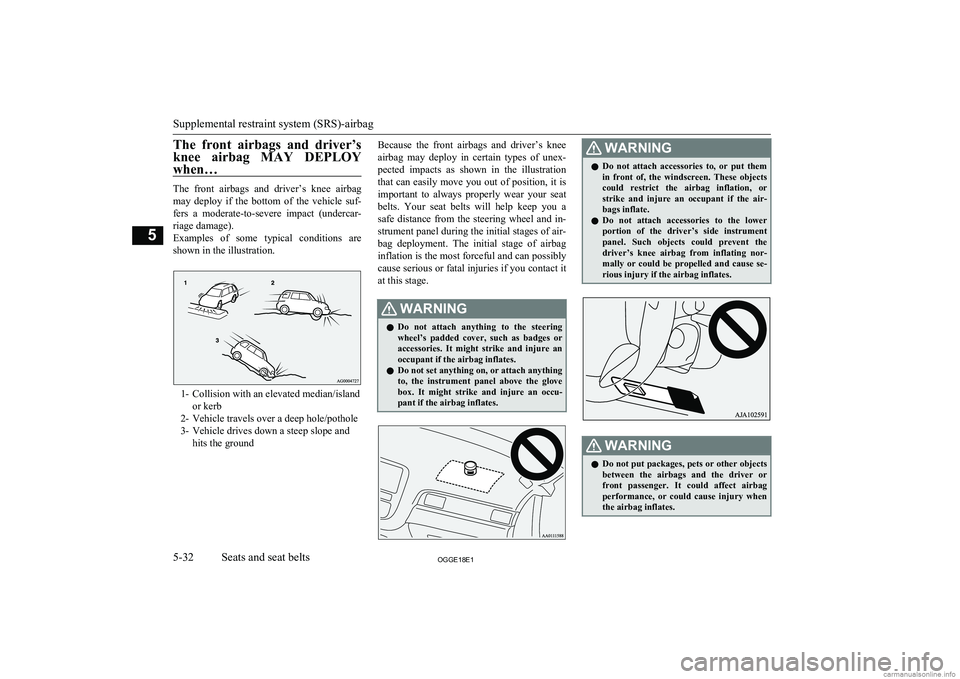
The front airbags and driver’s knee airbagmay deploy if the bottom of the vehicle suf-
fers a moderate-to-severe impact (undercar- riage damage).
Examples of some typical conditions are shown in the illustration.
1- Collision with an elevated median/island or kerb
2- Vehicle travels over a deep hole/pothole
3- Vehicle drives down a steep slope and hits the ground
Because the front airbags and driver’s knee
airbag may deploy in certain types of unex- pected impacts as shown in the illustration that can easily move you out of position, it is important to always properly wear your seat belts. Your seat belts will help keep you a
safe distance from the steering wheel and in- strument panel during the initial stages of air-
bag deployment. The initial stage of airbag inflation is the most forceful and can possibly
cause serious or fatal injuries if you contact it
at this stage.WARNINGl Do not attach anything to the steering
wheel’s padded cover, such as badges or accessories. It might strike and injure an
occupant if the airbag inflates.
l Do not set anything on, or attach anything
to, the instrument panel above the glove box. It might strike and injure an occu- pant if the airbag inflates.WARNINGl Do not attach accessories to, or put them
in front of, the windscreen. These objects
could restrict the airbag inflation, or strike and injure an occupant if the air-
bags inflate.
l Do not attach accessories to the lower
portion of the driver’s side instrumentpanel. Such objects could prevent the
driver’s knee airbag from inflating nor-
mally or could be propelled and cause se- rious injury if the airbag inflates.WARNINGl Do not put packages, pets or other objects
between the airbags and the driver orfront passenger. It could affect airbagperformance, or could cause injury when the airbag inflates.
Supplemental restraint system (SRS)-airbag
5-32OGGE18E1Seats and seat belts5
Page 141 of 538

WARNINGlRight after the airbag inflation, several
airbag system components will be hot. Do
not touch these components. There is a
danger of being burnt.
l The airbag system is designed to work on-
ly once. Once the airbags have deployed,
they will not work again. They must
promptly be replaced, and we recommend you to have the entire airbag system in-spected by a MITSUBISHI MOTORS
Authorized Service Point.Side airbag system
E00407600619
The side airbags (A) are contained in the
driver and front passenger seatbacks.
The side airbag is designed to inflate only on the side of the vehicle that is impacted, evenwith no passenger in the front seat.
The label shown here is attached to the seat-
backs with a side airbag.Curtain airbag system
E00409101686
The curtain airbags are contained in the front pillars and roof side rail. The curtain airbag is
designed to inflate only on the side of the ve- hicle that is impacted, even with no passen- ger in the front seat or rear seat.
Deployment of side airbags and
curtain airbags
E00407702731
The side airbags and curtain airbags ARE DESIGNED TO
DEPLOY when...
The side airbags and curtain airbags are de- signed to deploy when the vehicle suffers a
moderate-to-severe side impact to the middle of the passenger compartment.
The typical condition is shown in the illustra- tion.
The seat belts in your vehicle are your pri-mary means of protection in a collision. The SRS side airbags and curtain airbags are de-
signed to provide additional protection. Therefore, for your safety and the safety of all occupants, be sure to always properly
wear your seat belts.
Supplemental restraint system (SRS)-airbag
5-33OGGE18E1Seats and seat belts5
Page 142 of 538

The side airbags and curtainairbags MAY NOT DEPLOY
when...
With certain types of side collisions, the ve- hicle’s body structure is designed to absorb
the shock to help protect the occupants fromharm. (The vehicle body’s side area may de-
form significantly as it absorbs the impact.) Under such circumstances, the side airbags and curtain airbags may not deploy irrespec-tive of the deformation and damage to the ve-
hicle body. Examples of some typical condi- tions are shown in the illustration.
1- Side impacts in an area away from the
passenger compartment
2- Motorcycle or other similar small vehi-
cle collides with the side of vehicle
3- Collision with a utility pole, tree or other
narrow object
4- Oblique side impacts
5- Vehicle rolls onto its side or roof
Because the side airbags and curtain airbags do not protect the occupant in all types of side collisions, be sure to always properlywear your seat belts.
The side airbags and curtain
airbags ARE NOT DESIGNED TO DEPLOY when...
The side airbags and curtain airbags are notdesigned to deploy in conditions where they
cannot usually provide protection to the oc- cupant. Typical conditions are shown in the
illustration.
1- Head-on collisions
2- Rear end collisions
Because the side airbags and curtain airbags do not protect the occupant in all types of collisions, be sure to always properly wearyour seat belts.
WARNINGl The side airbags and curtain airbags are
designed to supplement the driver and
passenger seat belts in certain side im- pacts. Seat belts should always be wornproperly, and the driver and passenger
should sit well back and upright without
leaning against the window or door.
Supplemental restraint system (SRS)-airbag
5-34OGGE18E1Seats and seat belts5
Page 143 of 538

WARNINGlThe side airbag and curtain airbag inflate
with great force. The driver and passen-ger should not put their arms out of the
window, and should not lean against the door, in order to reduce the risk of serious
or possible fatal injury from the deploying
side airbag and curtain airbag.WARNINGl Do not allow any rear seat occupant to
hold onto the seatback of either front seat,
in order to reduce risk of injury from the
deploying side airbag. Special care should
be taken with children.
l Do not place any objects near or in front
of the seatback of either front seat. They could interfere with proper side airbag in-
flation, and also could cause injury if thrown free by side airbag deployment.WARNINGl Do not place stickers, labels or additional
trim on the seatback of either front seat.They could interfere with proper side air-bag inflation.
l Do not install seat covers on seats with
side airbags.
Do not re-cover seats that have side air- bags. This could interfere with properside airbag inflation.
l Do not attach a microphone (A) or any
other device or object around the part where the curtain airbags (B) activate
such as on the windscreen, side door glass, front and rear pillars and roof side or as- sist grips. When the curtain airbags in-
flate, the microphone or other device or
object will be hurled with great force or the curtain airbags may not activate cor-
rectly, resulting in death or serious injury.WARNINGl Do not put a hanger or any heavy or poin-
ted object on the coat hook. If the curtain
airbag was activated, any such item could
be propelled away with great force and could prevent the curtain airbag from in-
flating correctly. Hang clothes directly on the coat hook (without using a hanger).
Make sure there are no heavy or sharp objects in the pockets of clothes that you
hang on the coat hook.
l Do not allow a child to lean against or
close to the front door even if the child is
seated in a child restraint system.
The child’s head should also not lean against or be close to the area where the
side airbag and curtain airbag are loca-
ted. It is dangerous if the side airbag and curtain airbag inflate.
Failure to follow all of these instructions
could lead to serious or fatal injury to the
child.
l We recommend work around and on the
side airbags and curtain airbags system to
be done by a MITSUBISHI MOTORS
Authorized Service Point.
Supplemental restraint system (SRS)-airbag
5-35OGGE18E1Seats and seat belts5
Page 144 of 538
SRS warning lamp/display
E00407803191
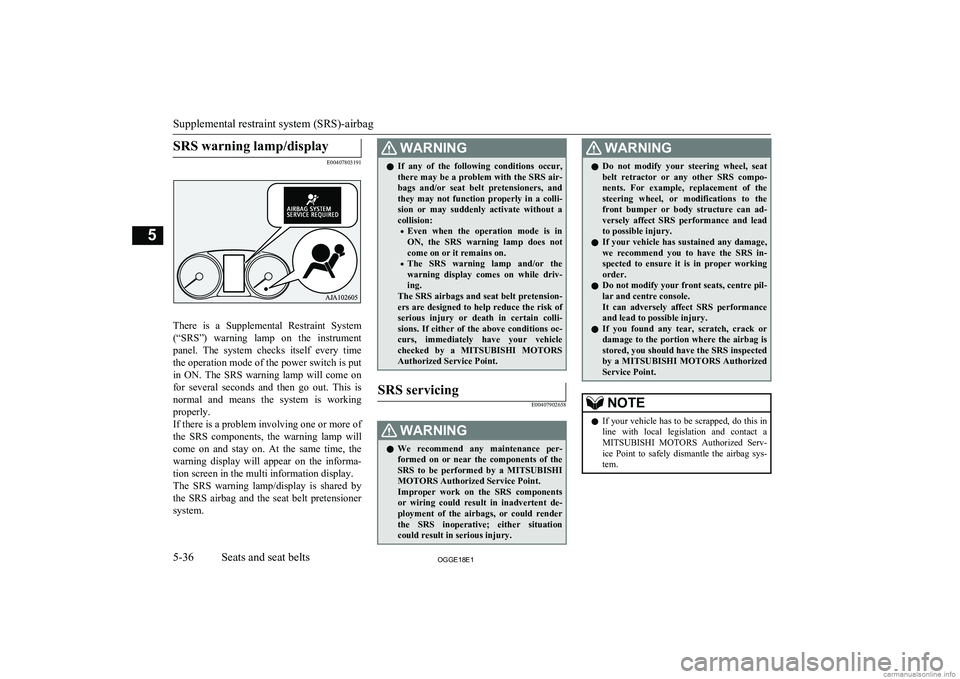
There is a Supplemental Restraint System(“SRS”) warning lamp on the instrument panel. The system checks itself every time
the operation mode of the power switch is put in ON. The SRS warning lamp will come on
for several seconds and then go out. This is
normal and means the system is working
properly.
If there is a problem involving one or more of
the SRS components, the warning lamp will come on and stay on. At the same time, thewarning display will appear on the informa-
tion screen in the multi information display.
The SRS warning lamp/display is shared by
the SRS airbag and the seat belt pretensioner system.
WARNINGl If any of the following conditions occur,
there may be a problem with the SRS air- bags and/or seat belt pretensioners, and they may not function properly in a colli-
sion or may suddenly activate without a
collision:
• Even when the operation mode is in
ON, the SRS warning lamp does not come on or it remains on.
• The SRS warning lamp and/or the
warning display comes on while driv- ing.
The SRS airbags and seat belt pretension- ers are designed to help reduce the risk of
serious injury or death in certain colli- sions. If either of the above conditions oc-
curs, immediately have your vehicle checked by a MITSUBISHI MOTORS
Authorized Service Point.SRS servicing
E00407902658WARNINGl We recommend any maintenance per-
formed on or near the components of the
SRS to be performed by a MITSUBISHI
MOTORS Authorized Service Point.
Improper work on the SRS components
or wiring could result in inadvertent de- ployment of the airbags, or could render
the SRS inoperative; either situation could result in serious injury.WARNINGl Do not modify your steering wheel, seat
belt retractor or any other SRS compo- nents. For example, replacement of the
steering wheel, or modifications to the
front bumper or body structure can ad- versely affect SRS performance and lead
to possible injury.
l If your vehicle has sustained any damage,
we recommend you to have the SRS in- spected to ensure it is in proper workingorder.
l Do not modify your front seats, centre pil-
lar and centre console.
It can adversely affect SRS performance and lead to possible injury.
l If you found any tear, scratch, crack or
damage to the portion where the airbag is stored, you should have the SRS inspected
by a MITSUBISHI MOTORS Authorized
Service Point.NOTEl If your vehicle has to be scrapped, do this in
line with local legislation and contact a
MITSUBISHI MOTORS Authorized Serv-
ice Point to safely dismantle the airbag sys- tem.
Supplemental restraint system (SRS)-airbag
5-36OGGE18E1Seats and seat belts5
Page 176 of 538
ScreenCauseSolution (Reference)lThe brake auto hold is not available.l Refer to “Brake auto hold” on page 7-32.lThe brake auto hold system does not turn
on because the driver’s seat belt is not fas-
tened.l Press the brake auto hold switch after fas-
tening the driver’s seat belt.
Refer to “Brake auto hold” on page 7-32.l The brake auto hold system does not turn
off because the brake pedal is not pressed.l Depress the brake pedal more firmly than
usual with the right foot. Then, press the
brake auto hold switch.
Refer to “Brake auto hold” on page 7-32.l There is a fault in the engine oil circula-
tion system.l Immediately stop the vehicle in a safe
place. We recommend you to have it checked.
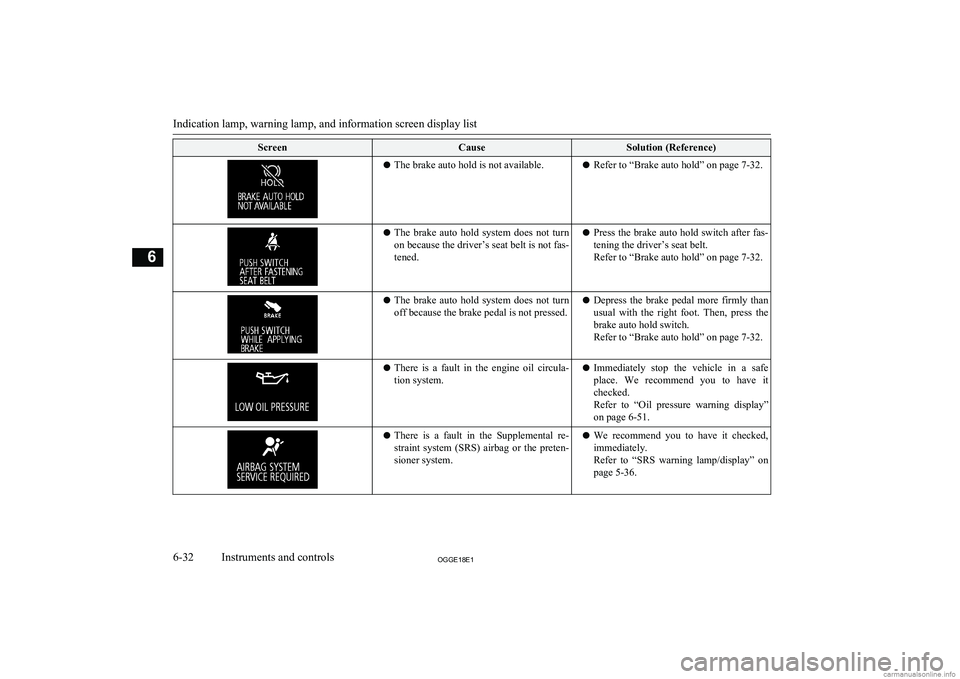
Refer to “Oil pressure warning display” on page 6-51.l There is a fault in the Supplemental re-
straint system (SRS) airbag or the preten-
sioner system.l We recommend you to have it checked,
immediately.
Refer to “SRS warning lamp/display” on
page 5-36.
Indication lamp, warning lamp, and information screen display list
6-32OGGE18E1Instruments and controls6
Page 417 of 538

Assist gripsE00732800298
The assist grips (located above the doors on the headliner) are not designed to support
body weight. They are intended for use only while seated in the vehicle.CAUTIONl Do not use the assist grips when getting into
or out of the vehicle. The assist grips could
detach causing you to fall.Coat hook
E00725601640
There is a coat hook on the rear seat assist
grip of the driver’s side.WARNINGl Do not put a hanger or any heavy or poin-
ted object on the coat hook. If the curtain
airbag was activated, any such item could
be propelled away with great force and could prevent the curtain airbag from in-
flating correctly. Hang clothes directly on the coat hook (without using a hanger).
Make sure there are no heavy or sharp objects in the pockets of clothes that you
hang on the coat hook.Luggage hooks
E00715700579
There are 4 hooks located on the side walls of
the luggage compartment.
Use the hooks for securing the luggage.CAUTIONl Do not pile up the luggage beyond the seat-
back height. Also, firmly secure the luggage. Otherwise, serious accidents could result due
to hindered rearward view or flying objects
during sudden braking.
Assist grips
8-85OGGE18E1For pleasant driving8
Page 430 of 538
NOTElSimply putting sealant and air into the tyre
using the tyre repair kit does not seal the
puncture hole. Air will leak through the puncture hole until the emergency repair procedure is completed (through step 19 or
step 20 of these instructions).
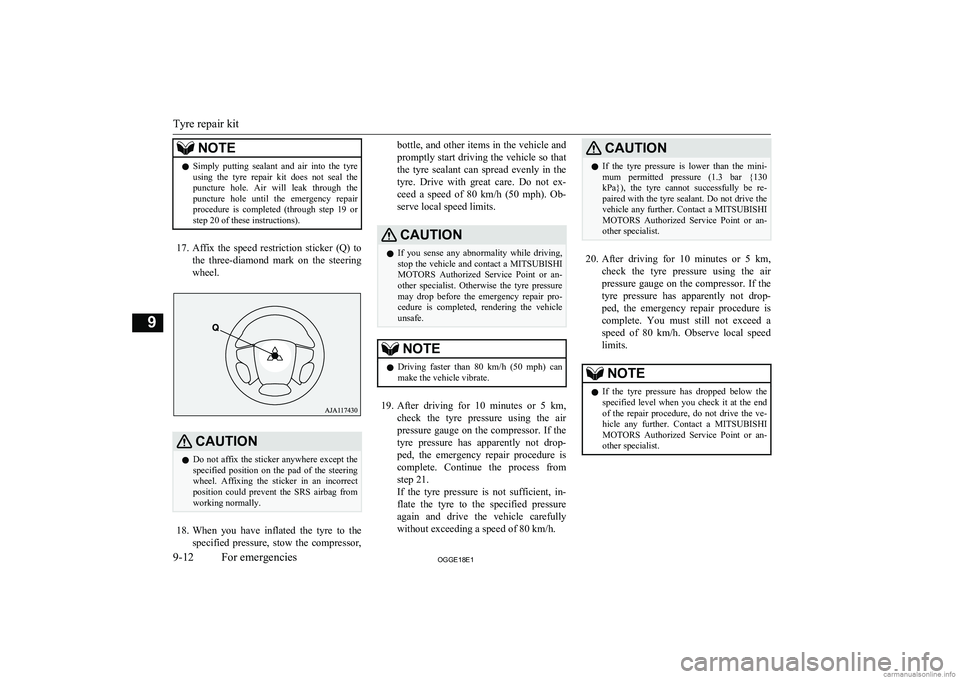
17. Affix the speed restriction sticker (Q) to
the three-diamond mark on the steering wheel.
CAUTIONl Do not affix the sticker anywhere except the
specified position on the pad of the steeringwheel. Affixing the sticker in an incorrect
position could prevent the SRS airbag from working normally.
18. When you have inflated the tyre to the
specified pressure, stow the compressor,
bottle, and other items in the vehicle and
promptly start driving the vehicle so that the tyre sealant can spread evenly in the
tyre. Drive with great care. Do not ex- ceed a speed of 80 km/h (50 mph). Ob-
serve local speed limits.CAUTIONl If you sense any abnormality while driving,
stop the vehicle and contact a MITSUBISHI
MOTORS Authorized Service Point or an-
other specialist. Otherwise the tyre pressure
may drop before the emergency repair pro- cedure is completed, rendering the vehicle
unsafe.NOTEl Driving faster than 80 km/h (50 mph)
can
make the vehicle vibrate.
19. After driving for 10 minutes or 5 km ,
check the tyre pressure using the air
pressure gauge on the compressor. If the
tyre pressure has apparently not drop- ped, the emergency repair procedure iscomplete. Continue the process from
step 21.
If the tyre pressure is not sufficient, in- flate the tyre to the specified pressure
again and drive the vehicle carefully
without exceeding a speed of 80 km/h.
CAUTIONl If the tyre pressure is lower than the mini-
mum permitted pressure (1.3 bar {130 kPa}), the tyre cannot successfully be re-
paired with the tyre sealant. Do not drive the vehicle any further. Contact a MITSUBISHI
MOTORS Authorized Service Point or an-
other specialist.
20. After driving for 10 minutes or 5 km ,
check the tyre pressure using the air
pressure gauge on the compressor. If the
tyre pressure has apparently not drop- ped, the emergency repair procedure iscomplete. You must still not exceed a speed of 80 km/h. Observe local speed
limits.
NOTEl If the tyre pressure has dropped below the
specified level when you check it at the end
of the repair procedure, do not drive the ve- hicle any further. Contact a MITSUBISHI
MOTORS Authorized Service Point or an-
other specialist.
Tyre repair kit
9-12OGGE18E1For emergencies9
Page 465 of 538
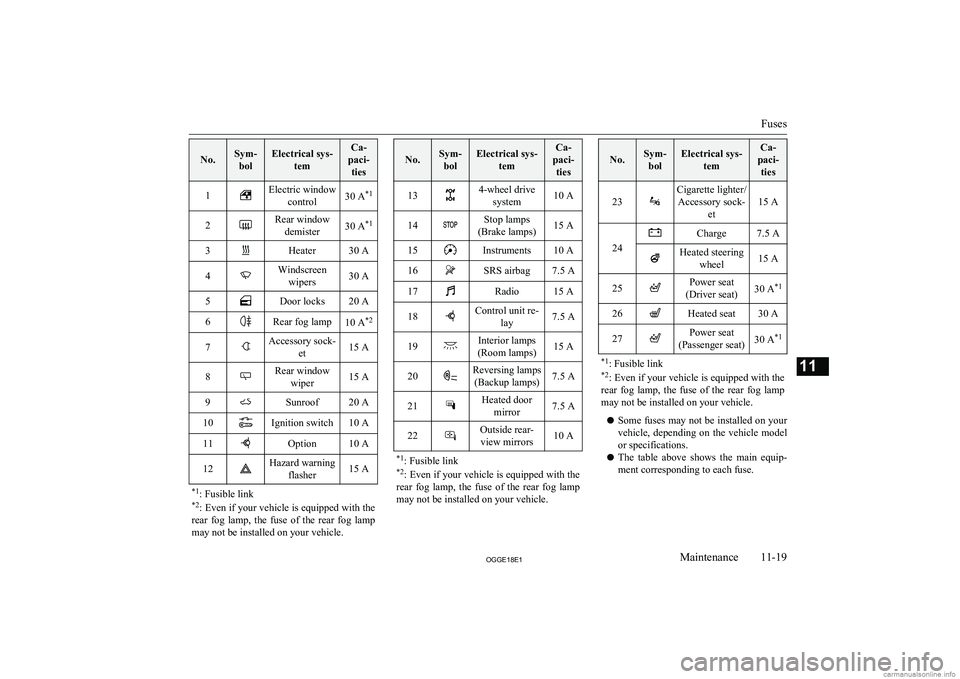
No.Sym-bolElectrical sys- temCa-
paci- ties1Electric window control30 A *12Rear window
demister30 A *13Heater30 A4Windscreen
wipers30 A5Door locks20 A6Rear fog lamp10 A *27Accessory sock-
et15 A8Rear windowwiper15 A9Sunroof20 A10Ignition switch10 A11Option10 A12Hazard warning flasher15 A*1: Fusible link
*2 : Even if your vehicle is equipped with the
rear fog lamp, the fuse of the rear fog lamp
may not be installed on your vehicle.
No.Sym- bolElectrical sys- temCa-
paci- ties134-wheel drive system10 A14Stop lamps
(Brake lamps)15 A15Instruments10 A16SRS airbag7.5 A17Radio15 A18Control unit re- lay7.5 A19Interior lamps
(Room lamps)15 A20Reversing lamps (Backup lamps)7.5 A21Heated door mirror7.5 A22Outside rear-view mirrors10 A*1 : Fusible link
*2 : Even if your vehicle is equipped with the
rear fog lamp, the fuse of the rear fog lamp
may not be installed on your vehicle.
No.Sym- bolElectrical sys- temCa-
paci- ties
23
Cigarette lighter/Accessory sock- et
15 A24
Charge7.5 AHeated steeringwheel15 A25Power seat
(Driver seat)30 A *126Heated seat30 A27Power seat
(Passenger seat)30 A *1*1
: Fusible link
*2 : Even if your vehicle is equipped with the
rear fog lamp, the fuse of the rear fog lamp
may not be installed on your vehicle.
l Some fuses may not be installed on your
vehicle, depending on the vehicle model
or specifications.
l The table above shows the main equip-
ment corresponding to each fuse.
Fuses
11-19OGGE18E1Maintenance11