airbag off MITSUBISHI OUTLANDER PHEV 2018 Owner's Manual (in English)
[x] Cancel search | Manufacturer: MITSUBISHI, Model Year: 2018, Model line: OUTLANDER PHEV, Model: MITSUBISHI OUTLANDER PHEV 2018Pages: 538, PDF Size: 25.01 MB
Page 4 of 538
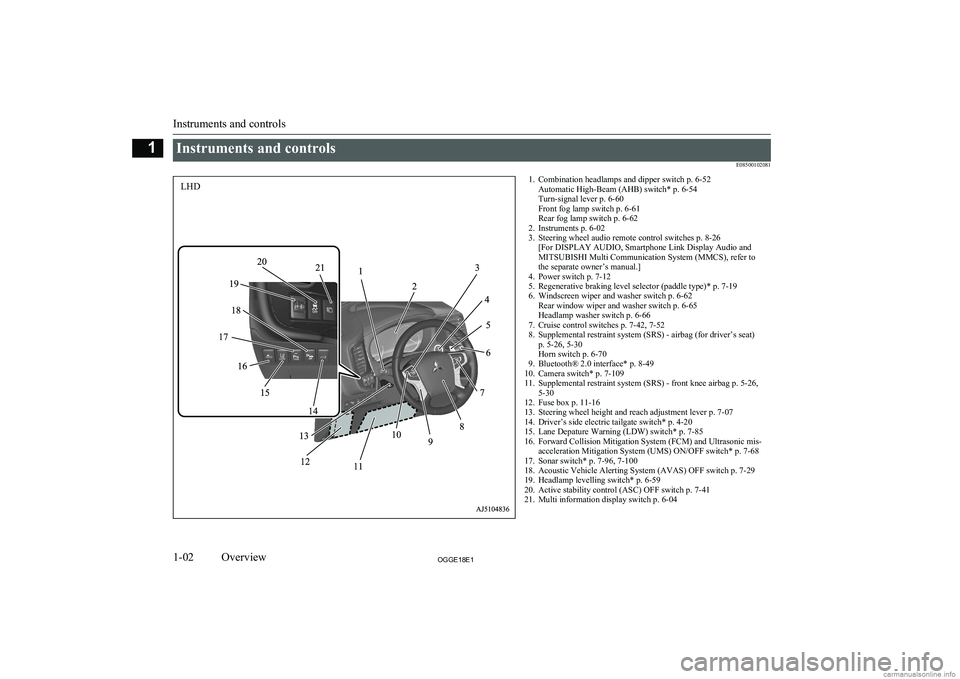
Instruments and controlsE085001020811. Combination headlamps and dipper switch p. 6-52Automatic High-Beam (AHB) switch* p. 6-54
Turn-signal lever p. 6-60
Front fog lamp switch p. 6-61
Rear fog lamp switch p. 6-62
2. Instruments p. 6-02
3. Steering wheel audio remote control switches p. 8-26 [For DISPLAY AUDIO, Smartphone Link Display Audio and
MITSUBISHI Multi Communication System (MMCS), refer to
the separate owner’s manual.]
4. Power switch p. 7-12
5. Regenerative braking level selector (paddle type)* p. 7-19
6. Windscreen wiper and washer switch p. 6-62 Rear window wiper and washer switch p. 6-65
Headlamp washer switch p. 6-66
7. Cruise control switches p. 7-42, 7-52
8. Supplemental restraint system (SRS) - airbag (for driver’s seat) p. 5-26, 5-30
Horn switch p. 6-70
9. Bluetooth® 2.0 interface* p. 8-49
10. Camera switch* p. 7-109
11. Supplemental restraint system (SRS) - front knee airbag p. 5-26, 5-30
12. Fuse box p. 11-16
13. Steering wheel height and reach adjustment lever p. 7-07
14. Driver’s side electric tailgate switch* p. 4-20
15. Lane Depature Warning (LDW) switch* p. 7-85
16. Forward Collision Mitigation System (FCM) and Ultrasonic mis- acceleration Mitigation System (UMS) ON/OFF switch* p. 7-68
17. Sonar switch* p. 7-96, 7-100
18. Acoustic Vehicle Alerting System (AVAS) OFF switch p. 7-29
19. Headlamp levelling switch* p. 6-59
20. Active stability control (ASC) OFF switch p. 7-41
21. Multi information display switch p. 6-04
Instruments and controls
1-02OGGE18E1Overview1LHD
Page 5 of 538
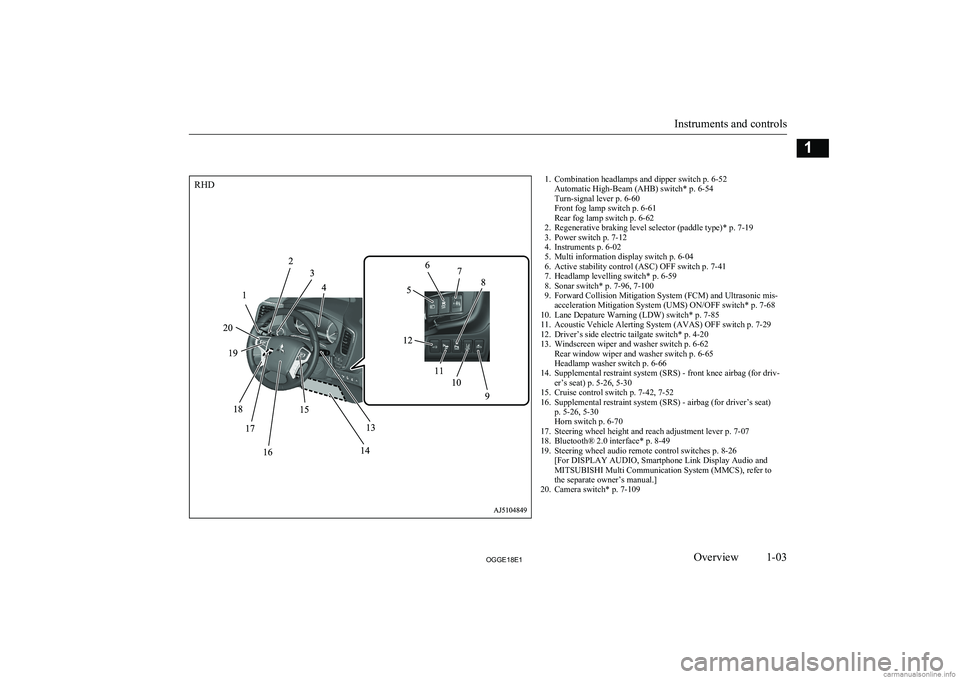
1. Combination headlamps and dipper switch p. 6-52Automatic High-Beam (AHB) switch* p. 6-54
Turn-signal lever p. 6-60
Front fog lamp switch p. 6-61
Rear fog lamp switch p. 6-62
2. Regenerative braking level selector (paddle type)* p. 7-19
3. Power switch p. 7-12
4. Instruments p. 6-02
5. Multi information display switch p. 6-04
6. Active stability control (ASC) OFF switch p. 7-41
7. Headlamp levelling switch* p. 6-59
8. Sonar switch* p. 7-96, 7-100
9. Forward Collision Mitigation System (FCM) and Ultrasonic mis- acceleration Mitigation System (UMS) ON/OFF switch* p. 7-68
10. Lane Depature Warning (LDW) switch* p. 7-85
11. Acoustic Vehicle Alerting System (AVAS) OFF switch p. 7-29
12. Driver’s side electric tailgate switch* p. 4-20
13. Windscreen wiper and washer switch p. 6-62 Rear window wiper and washer switch p. 6-65
Headlamp washer switch p. 6-66
14. Supplemental restraint system (SRS) - front knee airbag (for driv- er’s seat) p. 5-26, 5-30
15. Cruise control switch p. 7-42, 7-52
16. Supplemental restraint system (SRS) - airbag (for driver’s seat) p. 5-26, 5-30
Horn switch p. 6-70
17. Steering wheel height and reach adjustment lever p. 7-07
18. Bluetooth® 2.0 interface* p. 8-49
19. Steering wheel audio remote control switches p. 8-26 [For DISPLAY AUDIO, Smartphone Link Display Audio and
MITSUBISHI Multi Communication System (MMCS), refer to
the separate owner’s manual.]
20. Camera switch* p. 7-109
Instruments and controls
1-03OGGE18E1Overview1RHD
Page 124 of 538
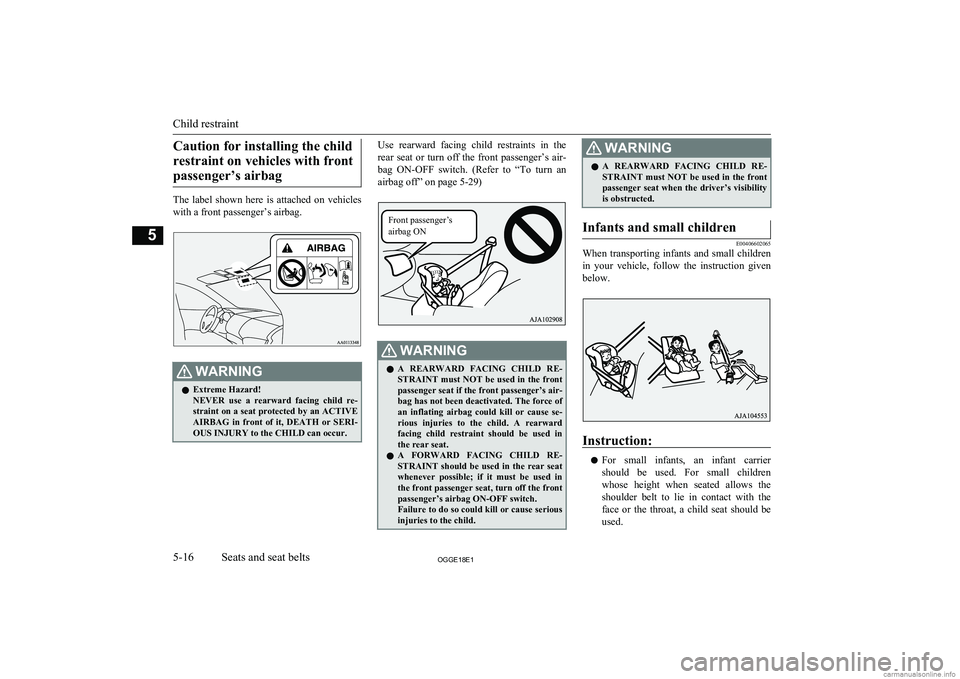
Caution for installing the childrestraint on vehicles with frontpassenger’s airbag
The label shown here is attached on vehicles
with a front passenger’s airbag.
WARNINGl Extreme Hazard!
NEVER use a rearward facing child re- straint on a seat protected by an ACTIVEAIRBAG in front of it, DEATH or SERI- OUS INJURY to the CHILD can occur.Use rearward facing child restraints in the
rear seat or turn off the front passenger’s air- bag ON-OFF switch. (Refer to “To turn an airbag off” on page 5-29)WARNINGl A REARWARD FACING CHILD RE-
STRAINT must NOT be used in the front passenger seat if the front passenger’s air-
bag has not been deactivated. The force of an inflating airbag could kill or cause se-
rious injuries to the child. A rearward facing child restraint should be used in
the rear seat.
l A FORWARD FACING CHILD RE-
STRAINT should be used in the rear seat
whenever possible; if it must be used in the front passenger seat, turn off the front
passenger’s airbag ON-OFF switch.
Failure to do so could kill or cause serious
injuries to the child.WARNINGl A REARWARD FACING CHILD RE-
STRAINT must NOT be used in the front passenger seat when the driver’s visibilityis obstructed.Infants and small children
E00406602065
When transporting infants and small children
in your vehicle, follow the instruction given below.
Instruction:
l For small infants, an infant carrier
should be used. For small children whose height when seated allows the shoulder belt to lie in contact with the
face or the throat, a child seat should be used.
Child restraint
5-16OGGE18E1Seats and seat belts5 Front passenger’s
airbag ON
Page 127 of 538
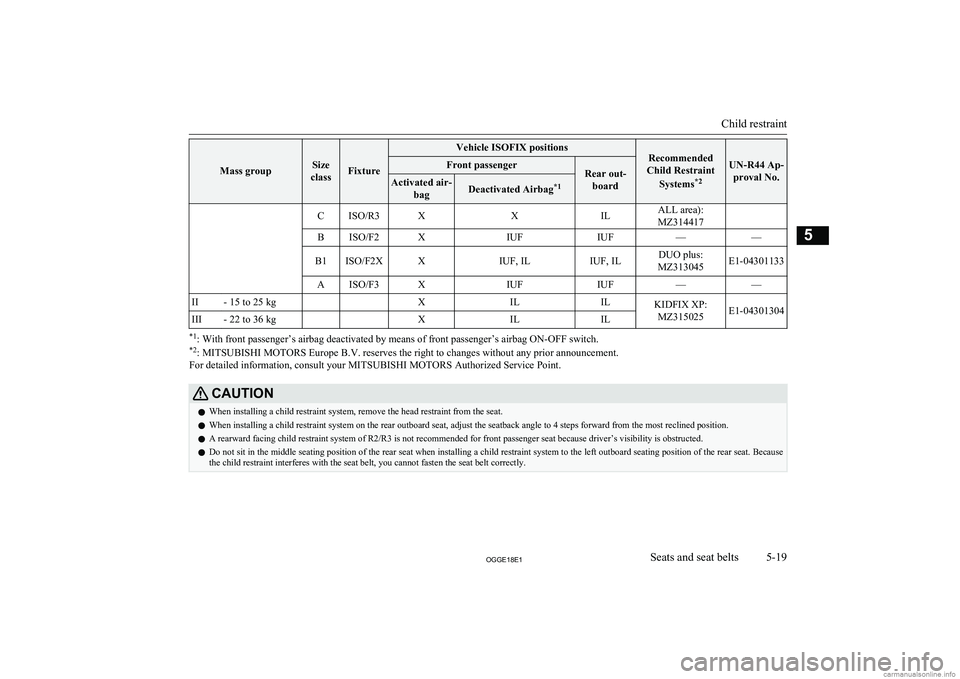
Mass groupSize
classFixture
Vehicle ISOFIX positionsRecommended
Child Restraint
Systems *2UN-R44 Ap-
proval No.
Front passengerRear out- boardActivated air- bagDeactivated Airbag *1CISO/R3XXILALL area):
MZ314417BISO/F2XIUFIUF——B1ISO/F2XXIUF, ILIUF, ILDUO plus:
MZ313045E1-04301133AISO/F3XIUFIUF——II- 15 to 25 kg XILILKIDFIX XP: MZ315025E1-04301304III- 22 to 36 kg XILIL
*1 : With front passenger’s airbag deactivated by means of front passenger’s airbag ON-OFF switch.
*2 : MITSUBISHI MOTORS Europe B.V. reserves the right to changes without any prior announcement.
For detailed information, consult your MITSUBISHI MOTORS Authorized Service Point.
CAUTIONl When installing a child restraint system, remove the head restraint from the seat.
l When installing a child restraint system on the rear outboard seat, adjust the seatback angle to 4 steps forward from the most reclined position.
l A rearward facing child restraint system of R2/R3 is not recommended for front passenger seat because driver’s visibility is obstructed.
l Do not sit in the middle seating position of the rear seat when installing a child restraint system to the left outboard seating position of the rear seat. Because
the child restraint interferes with the seat belt, you cannot fasten the seat belt correctly.
Child restraint
5-19OGGE18E1Seats and seat belts5
Page 129 of 538
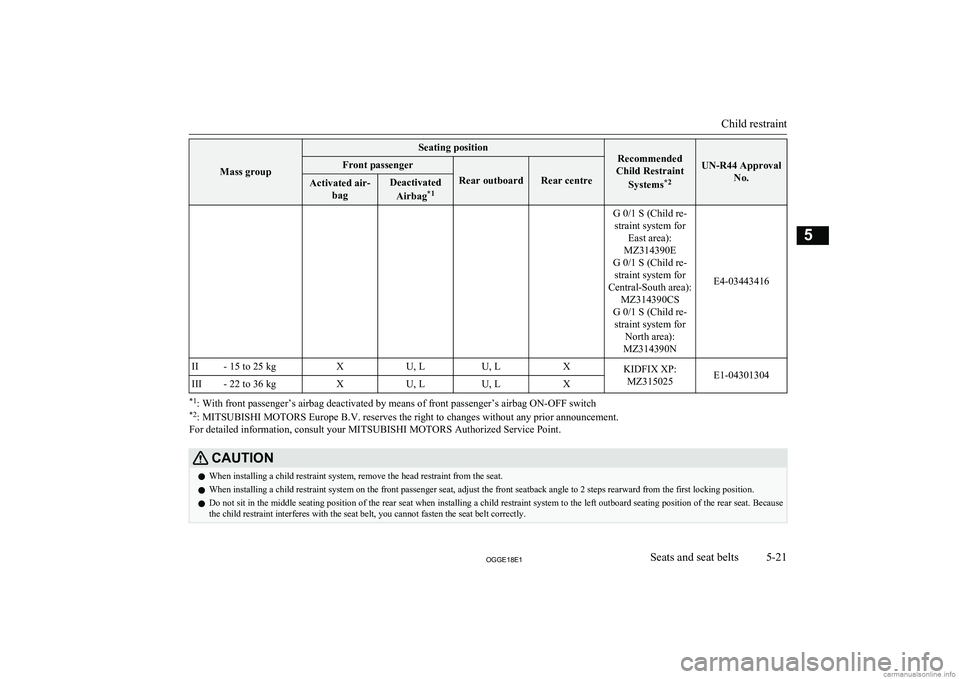
Mass group
Seating positionRecommended
Child Restraint
Systems *2UN-R44 Approval
No.
Front passenger
Rear outboardRear centre
Activated air-bagDeactivated
Airbag *1G 0/1 S (Child re-
straint system for East area):
MZ314390E
G 0/1 S (Child re- straint system for
Central-South area): MZ314390CS
G 0/1 S (Child re- straint system for North area):
MZ314390N
E4-03443416
II- 15 to 25 kgXU, LU, LXKIDFIX XP: MZ315025E1-04301304III- 22 to 36 kgXU, LU, LX
*1 : With front passenger’s airbag deactivated by means of front passenger’s airbag ON-OFF switch
*2 : MITSUBISHI MOTORS Europe B.V. reserves the right to changes without any prior announcement.
For detailed information, consult your MITSUBISHI MOTORS Authorized Service Point.
CAUTIONl When installing a child restraint system, remove the head restraint from the seat.
l When installing a child restraint system on the front passenger seat, adjust the front seatback angle to 2 steps rearward from the first locking position.
l Do not sit in the middle seating position of the rear seat when installing a child restraint system to the left outboard seating position of the rear seat. Because
the child restraint interferes with the seat belt, you cannot fasten the seat belt correctly.
Child restraint
5-21OGGE18E1Seats and seat belts5
Page 135 of 538
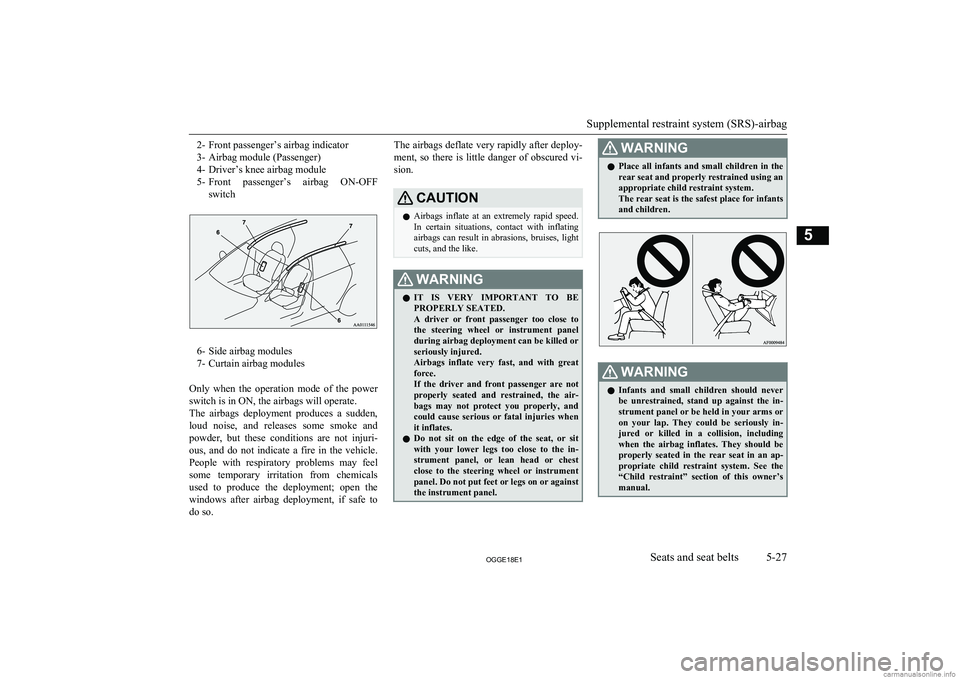
2- Front passenger’s airbag indicator
3- Airbag module (Passenger)
4- Driver’s knee airbag module
5- Front passenger’s airbag ON-OFF
switch
6- Side airbag modules
7- Curtain airbag modules
Only when the operation mode of the power switch is in ON, the airbags will operate.The airbags deployment produces a sudden,
loud noise, and releases some smoke and powder, but these conditions are not injuri- ous, and do not indicate a fire in the vehicle.
People with respiratory problems may feel
some temporary irritation from chemicals used to produce the deployment; open the
windows after airbag deployment, if safe to
do so.
The airbags deflate very rapidly after deploy-
ment, so there is little danger of obscured vi-sion.CAUTIONl Airbags inflate at an extremely rapid speed.
In certain situations, contact with inflatingairbags can result in abrasions, bruises, light
cuts, and the like.WARNINGl IT IS VERY IMPORTANT TO BE
PROPERLY SEATED.
A driver or front passenger too close to the steering wheel or instrument panel
during airbag deployment can be killed or seriously injured.
Airbags inflate very fast, and with great force.
If the driver and front passenger are not
properly seated and restrained, the air-
bags may not protect you properly, and could cause serious or fatal injuries whenit inflates.
l Do not sit on the edge of the seat, or sit
with your lower legs too close to the in-
strument panel, or lean head or chest close to the steering wheel or instrument panel. Do not put feet or legs on or againstthe instrument panel.WARNINGl Place all infants and small children in the
rear seat and properly restrained using an
appropriate child restraint system.
The rear seat is the safest place for infants
and children.WARNINGl Infants and small children should never
be unrestrained, stand up against the in-strument panel or be held in your arms or on your lap. They could be seriously in-jured or killed in a collision, including when the airbag inflates. They should be
properly seated in the rear seat in an ap- propriate child restraint system. See the
“Child restraint” section of this owner’s
manual.
Supplemental restraint system (SRS)-airbag
5-27OGGE18E1Seats and seat belts5
Page 136 of 538
WARNINGlOlder children should be seated in the
rear seat, properly wearing the seat belt,with an appropriate booster seat if nee- ded.Caution for installing the child
restraint on vehicles with a front passenger airbag
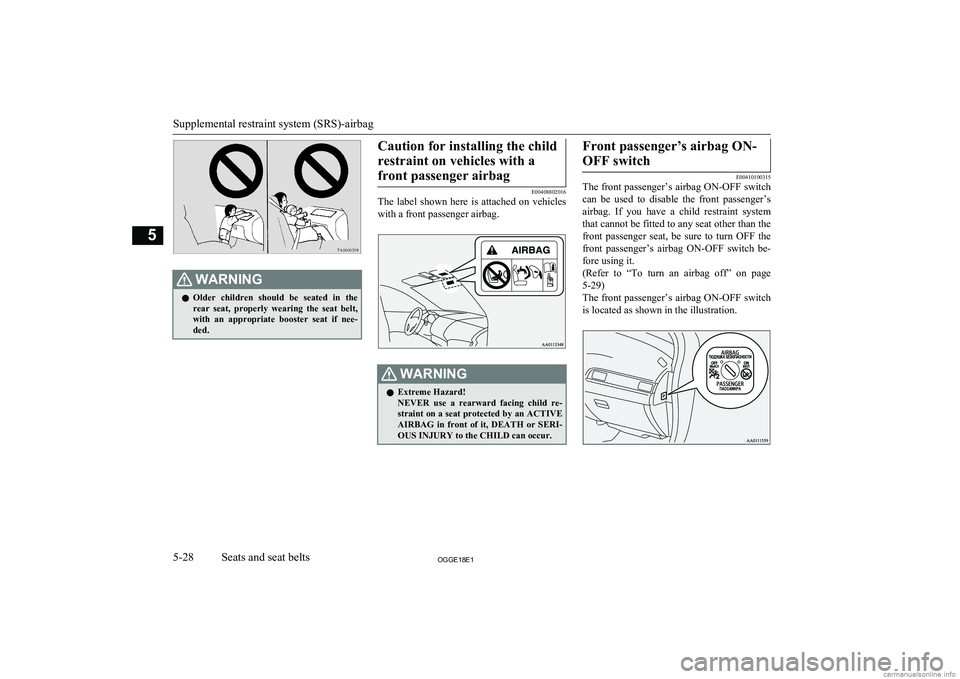
E00408802016
The label shown here is attached on vehicles
with a front passenger airbag.
WARNINGl Extreme Hazard!
NEVER use a rearward facing child re- straint on a seat protected by an ACTIVEAIRBAG in front of it, DEATH or SERI- OUS INJURY to the CHILD can occur.Front passenger’s airbag ON-
OFF switch
E00410100315
The front passenger’s airbag ON-OFF switch
can be used to disable the front passenger’s airbag. If you have a child restraint system
that cannot be fitted to any seat other than the front passenger seat, be sure to turn OFF the front passenger’s airbag ON-OFF switch be-
fore using it.
(Refer to “To turn an airbag off” on page
5-29)
The front passenger’s airbag ON-OFF switch
is located as shown in the illustration.Supplemental restraint system (SRS)-airbag
5-28OGGE18E1Seats and seat belts5
Page 137 of 538
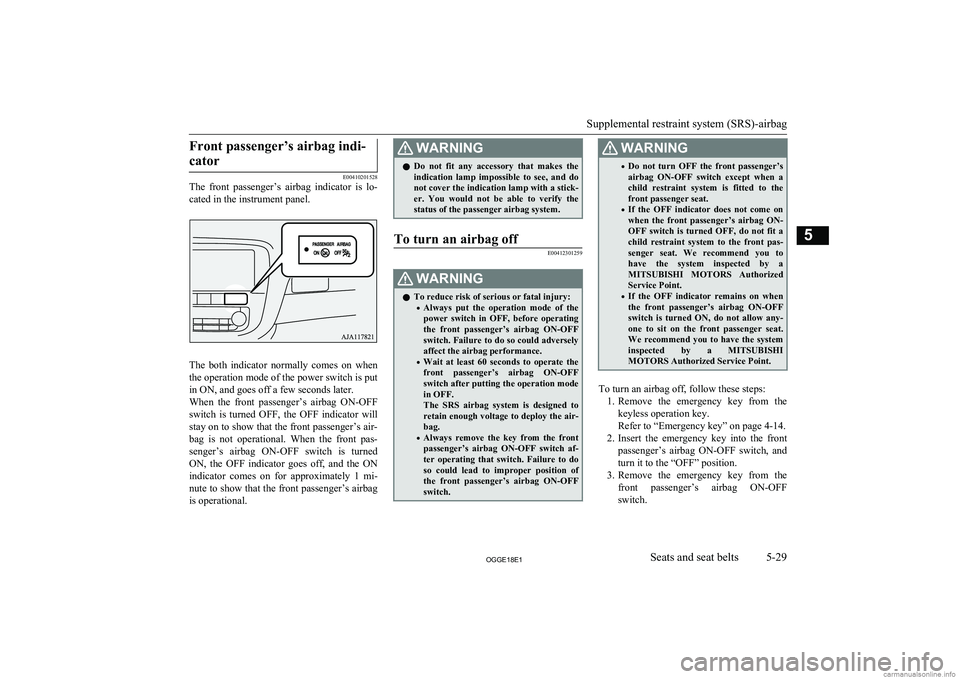
Front passenger’s airbag indi-cator
E00410201528
The front passenger’s airbag indicator is lo-
cated in the instrument panel.
The both indicator normally comes on when
the operation mode of the power switch is put
in ON, and goes off a few seconds later.
When the front passenger’s airbag ON-OFF switch is turned OFF, the OFF indicator will stay on to show that the front passenger’s air-
bag is not operational. When the front pas-
senger’s airbag ON-OFF switch is turned
ON, the OFF indicator goes off, and the ON indicator comes on for approximately 1 mi- nute to show that the front passenger’s airbagis operational.
WARNINGl Do not fit any accessory that makes the
indication lamp impossible to see, and do
not cover the indication lamp with a stick- er. You would not be able to verify thestatus of the passenger airbag system.To turn an airbag off
E00412301259WARNINGl To reduce risk of serious or fatal injury:
• Always put the operation mode of the
power switch in OFF, before operating
the front passenger’s airbag ON-OFF
switch. Failure to do so could adversely affect the airbag performance.
• Wait at least 60 seconds to operate the
front passenger’s airbag ON-OFF switch after putting the operation mode
in OFF.
The SRS airbag system is designed to retain enough voltage to deploy the air-
bag.
• Always remove the key from the front
passenger’s airbag ON-OFF switch af-ter operating that switch. Failure to do
so could lead to improper position of the front passenger’s airbag ON-OFF switch.WARNING• Do not turn OFF the front passenger’s
airbag ON-OFF switch except when a child restraint system is fitted to the
front passenger seat.
• If the OFF indicator does not come on
when the front passenger’s airbag ON- OFF switch is turned OFF, do not fit a
child restraint system to the front pas- senger seat. We recommend you to
have the system inspected by a
MITSUBISHI MOTORS Authorized
Service Point.
• If the OFF indicator remains on when
the front passenger’s airbag ON-OFF switch is turned ON, do not allow any- one to sit on the front passenger seat.
We recommend you to have the system inspected by a MITSUBISHI
MOTORS Authorized Service Point.
To turn an airbag off, follow these steps:
1. Remove the emergency key from the
keyless operation key.
Refer to “Emergency key” on page 4-14.
2. Insert the emergency key into the front
passenger’s airbag ON-OFF switch, and turn it to the “OFF” position.
3. Remove the emergency key from the
front passenger’s airbag ON-OFF switch.
Supplemental restraint system (SRS)-airbag
5-29OGGE18E1Seats and seat belts5
Page 138 of 538
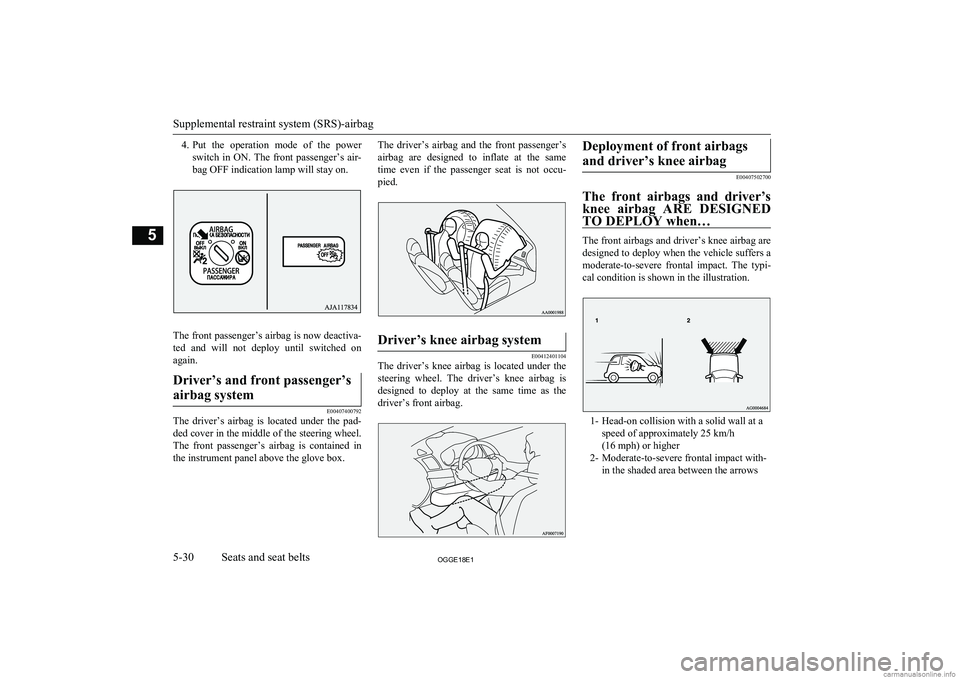
4.Put the operation mode of the power
switch in ON. The front passenger’s air- bag OFF indication lamp will stay on.
The front passenger’s airbag is now deactiva-ted and will not deploy until switched on
again.
Driver’s and front passenger’s
airbag system
E00407400792
The driver’s airbag is located under the pad- ded cover in the middle of the steering wheel. The front passenger’s airbag is contained in
the instrument panel above the glove box.
The driver’s airbag and the front passenger’s
airbag are designed to inflate at the same
time even if the passenger seat is not occu- pied.Driver’s knee airbag system
E00412401104
The driver’s knee airbag is located under the steering wheel. The driver’s knee airbag is
designed to deploy at the same time as the driver’s front airbag.
Deployment of front airbags
and driver’s knee airbag
E00407502700
The front airbags and driver’s knee airbag ARE DESIGNED
TO DEPLOY when…
The front airbags and driver’s knee airbag are
designed to deploy when the vehicle suffers a moderate-to-severe frontal impact. The typi-
cal condition is shown in the illustration.
1- Head-on collision with a solid wall at a speed of approximately 25 km/h
(16 mph) or higher
2- Moderate-to-severe frontal impact with- in the shaded area between the arrows
Supplemental restraint system (SRS)-airbag
5-30OGGE18E1Seats and seat belts5
Page 176 of 538
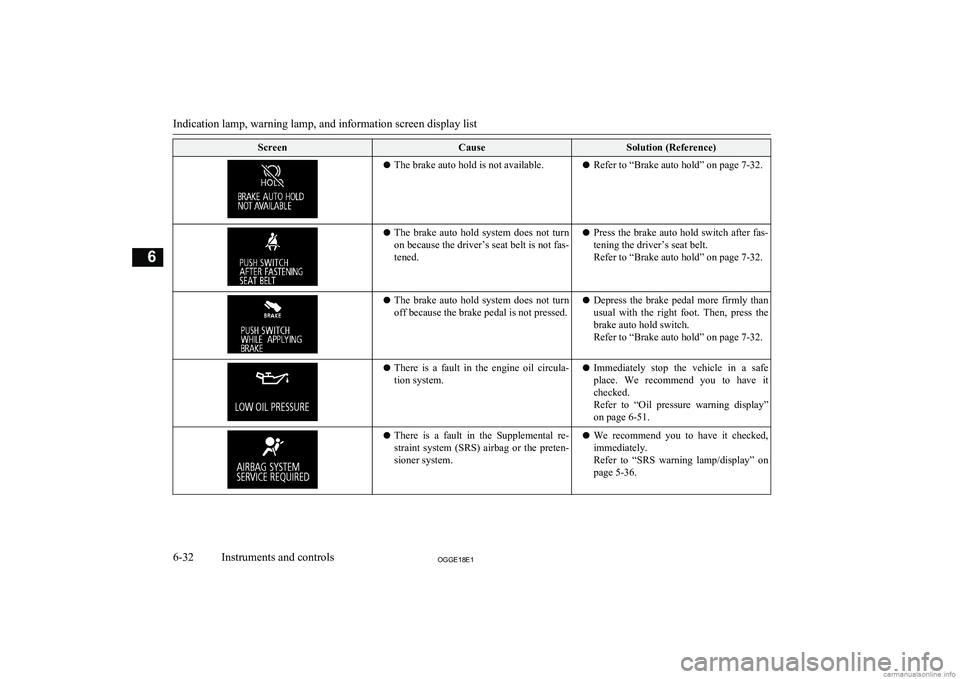
ScreenCauseSolution (Reference)lThe brake auto hold is not available.l Refer to “Brake auto hold” on page 7-32.lThe brake auto hold system does not turn
on because the driver’s seat belt is not fas-
tened.l Press the brake auto hold switch after fas-
tening the driver’s seat belt.
Refer to “Brake auto hold” on page 7-32.l The brake auto hold system does not turn
off because the brake pedal is not pressed.l Depress the brake pedal more firmly than
usual with the right foot. Then, press the
brake auto hold switch.
Refer to “Brake auto hold” on page 7-32.l There is a fault in the engine oil circula-
tion system.l Immediately stop the vehicle in a safe
place. We recommend you to have it checked.
Refer to “Oil pressure warning display” on page 6-51.l There is a fault in the Supplemental re-
straint system (SRS) airbag or the preten-
sioner system.l We recommend you to have it checked,
immediately.
Refer to “SRS warning lamp/display” on
page 5-36.
Indication lamp, warning lamp, and information screen display list
6-32OGGE18E1Instruments and controls6