brakes MITSUBISHI OUTLANDER PHEV 2018 Owner's Manual (in English)
[x] Cancel search | Manufacturer: MITSUBISHI, Model Year: 2018, Model line: OUTLANDER PHEV, Model: MITSUBISHI OUTLANDER PHEV 2018Pages: 538, PDF Size: 25.01 MB
Page 193 of 538
lThe vehicle speed exceeds 8 km/h
(5 mph) with the parking brake applied.CAUTIONl In the situations listed below, brake perform-
ance may be compromised or the vehicle may become unstable if brakes are applied
suddenly; consequently, avoid driving at
high speeds or applying the brakes suddenly. Furthermore, the vehicle should be brought
to a stop in a safe location and to have it
checked.
• The brake warning lamp does not illumi-
nate when the parking brake is applied ordoes not turn off when the parking brake is released.
• The ABS warning lamp and brake warn-
ing lamp illuminate at the same time.
For details, refer to “ABS warning lamp/
display” on page 7-37.
• The brake warning lamp remains illumi-
nated during driving.
l The vehicle should be brought to a halt in
the following manner when brake perform- ance has deteriorated.
• Depress the brake pedal harder than usual.
Even if the brake pedal moves down to
the very end of its possible stroke, keep it
pressed down hard.CAUTION• Should the brakes fail, use regenerative
braking to reduce your speed and keep
pulling the Electric parking brake switch.
(Refer to “Electric parking brake” on page
7-03.)
Depress the brake pedal to operate the
stop lamp to alert the vehicles behind you.Electric parking brake warn-
ing lamp (yellow)
E00568900100
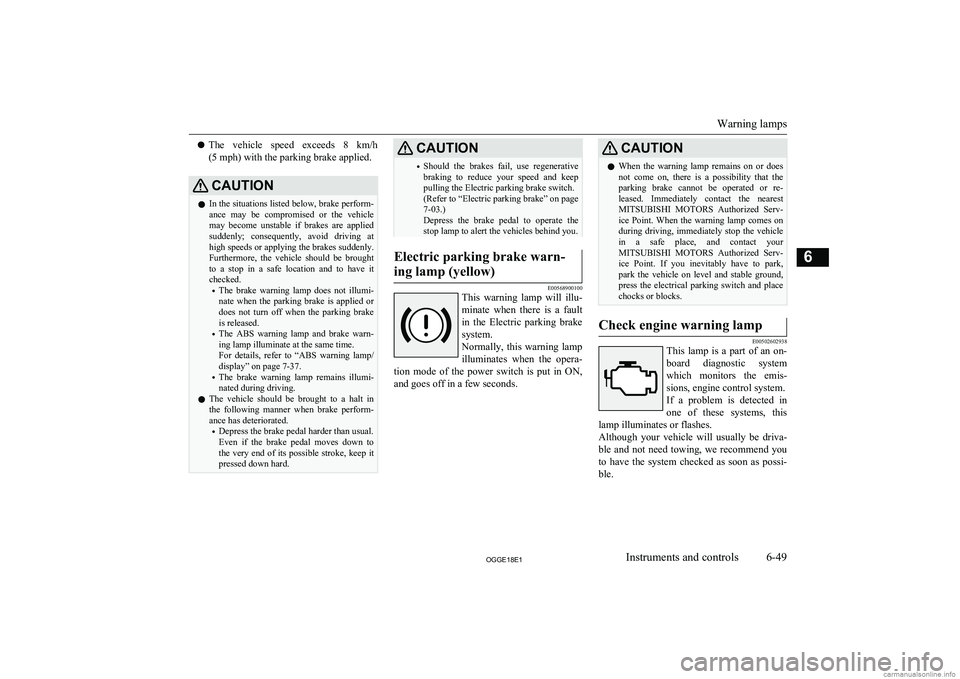
This warning lamp will illu-
minate when there is a fault in the Electric parking brake
system.
Normally, this warning lamp
illuminates when the opera-
tion mode of the power switch is put in ON,
and goes off in a few seconds.
CAUTIONl When the warning lamp remains on or does
not come on, there is a possibility that the
parking brake cannot be operated or re-
leased. Immediately contact the nearest MITSUBISHI MOTORS Authorized Serv-
ice Point. When the warning lamp comes on during driving, immediately stop the vehiclein a safe place, and contact your
MITSUBISHI MOTORS Authorized Serv-
ice Point. If you inevitably have to park, park the vehicle on level and stable ground,
press the electrical parking switch and place
chocks or blocks.Check engine warning lamp
E00502602938
This lamp is a part of an on-
board diagnostic system
which monitors the emis-
sions, engine control system. If a problem is detected in one of these systems, this
lamp illuminates or flashes.
Although your vehicle will usually be driva-
ble and not need towing, we recommend you
to have the system checked as soon as possi- ble.
Warning lamps
6-49OGGE18E1Instruments and controls6
Page 195 of 538
Regenerative brake warninglamp
E00537200048
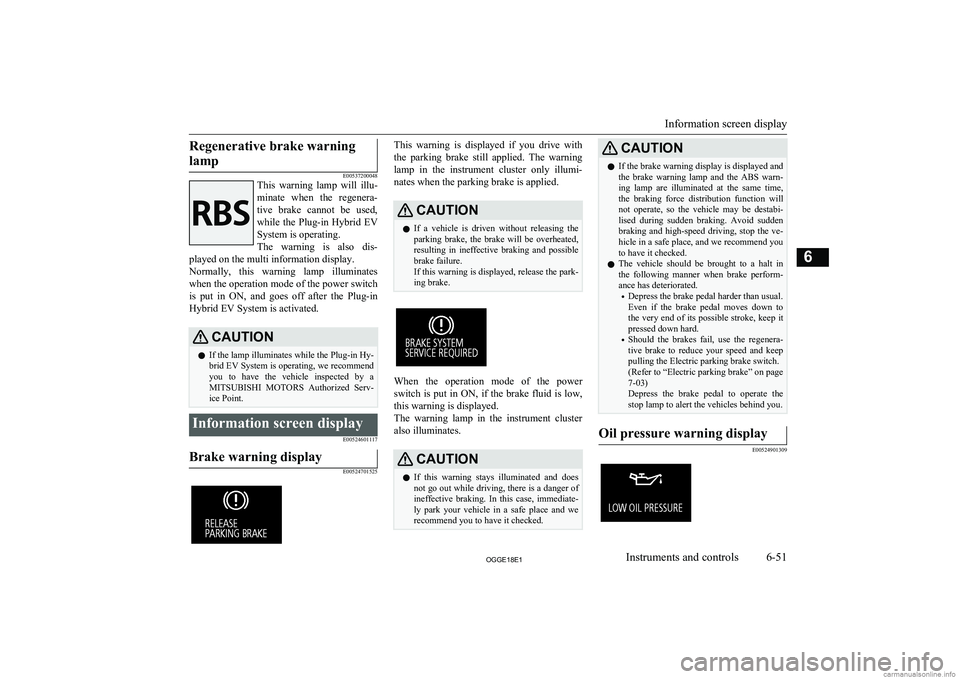
This warning lamp will illu-
minate when the regenera-
tive brake cannot be used,
while the Plug-in Hybrid EV System is operating.
The warning is also dis-
played on the multi information display.
Normally, this warning lamp illuminates
when the operation mode of the power switch is put in ON, and goes off after the Plug-in
Hybrid EV System is activated.
CAUTIONl If the lamp illuminates while the Plug-in Hy-
brid EV System is operating, we recommend
you to have the vehicle inspected by a MITSUBISHI MOTORS Authorized Serv-
ice Point.Information screen display
E00524601117Brake warning display
E00524701525
This warning is displayed if you drive withthe parking brake still applied. The warning lamp in the instrument cluster only illumi-
nates when the parking brake is applied.CAUTIONl If a vehicle is driven without releasing the
parking brake, the brake will be overheated, resulting in ineffective braking and possiblebrake failure.
If this warning is displayed, release the park-
ing brake.
When the operation mode of the power
switch is put in ON, if the brake fluid is low,
this warning is displayed.
The warning lamp in the instrument cluster
also illuminates.
CAUTIONl If this warning stays illuminated and does
not go out while driving, there is a danger of ineffective braking. In this case, immediate-
ly park your vehicle in a safe place and we recommend you to have it checked.CAUTIONl If the brake warning display is displayed and
the brake warning lamp and the ABS warn-
ing lamp are illuminated at the same time,
the braking force distribution function will not operate, so the vehicle may be destabi-
lised during sudden braking. Avoid sudden braking and high-speed driving, stop the ve-
hicle in a safe place, and we recommend you
to have it checked.
l The vehicle should be brought to a halt in
the following manner when brake perform- ance has deteriorated.
• Depress the brake pedal harder than usual.
Even if the brake pedal moves down to
the very end of its possible stroke, keep it
pressed down hard.
• Should the brakes fail, use the regenera-
tive brake to reduce your speed and keep
pulling the Electric parking brake switch.
(Refer to “Electric parking brake” on page
7-03)
Depress the brake pedal to operate the
stop lamp to alert the vehicles behind you.Oil pressure warning display
E00524901309
Information screen display
6-51OGGE18E1Instruments and controls6
Page 216 of 538
Economical drivingE00600102422
For economical driving, there are some tech- nical requirements that have to be met. Theprerequisite for low fuel consumption is a
properly adjusted engine. In order to achieve longer life of the vehicle and the most eco- nomical operation, we recommend you tohave the vehicle checked at regular intervals in accordance with the service standards.
Fuel economy and generation of exhaust gas
and noise are highly influenced by personal
driving habits as well as the particular operat- ing conditions. The following points shouldbe observed in order to minimize wear of
brakes, tyres and engine as well as to reduce
environmental pollution.
Starting and acceleration
Avoid driving when the accelerator pedal ispressed way down, such as for unnecessarily sudden starts, acceleration and deceleration.
Smoothly depress the accelerator pedal.
Observe the speed limit and keep the speed
as constant as possible while driving.
Idling
Parking for a long period with the ready indi-
cator illuminated will shorten the cruising
range.
Speed
The higher the vehicle speed, the more drive
battery is consumed. Avoid driving at full speed. Even a slight release of the accelerator
pedal will save a significant amount of drive battery.
Tyre inflation pressure
Check the tyre inflation pressures at regular intervals. Low tyre inflation pressure increa-ses road resistance and fuel consumption. In addition, low tyre pressures adversely affect
tyre wear and driving stability.
Cargo loads
Do not drive with unnecessary articles in the
luggage compartment. Especially during city
driving where frequent starting and stopping is necessary, the increased weight of the ve-
hicle will greatly affect fuel consumption. Al- so avoid driving with unnecessary luggage or carriers, etc., on the roof; the increased air re- sistance will increase fuel consumption.
Air conditioning
Too much cooling/heating can affect the cruising range, so maintain an appropriatetemperature to extend the cruising range.
Driving, alcohol and drugs
E00600200070
Driving after drinking alcohol is one of the
most frequent causes of accidents.
Your driving ability can be seriously im- paired even with blood alcohol levels far be-
low the legal minimum. If you have been drinking, don’t drive. Ride with a designated non-drinking driver, call a cab or a friend, or
use public transportation. Drinking coffee or
taking a cold shower will not make you so- ber.
Similarly, prescription and nonprescription
drugs affect your alertness, perception and re- action time. Consult with your doctor or
pharmacist before driving while under the in- fluence of any of these medications.WARNINGl NEVER DRINK AND DRIVE.
Your perceptions are less accurate, your
reflexes are slower and your judgment is impaired.Safe driving techniques
E00600301775
Driving safety and protection against injury
cannot be fully ensured. However, we recom- mend that you pay extra attention to the fol-
lowing:
Economical driving
7-02OGGE18E1Starting and driving7
Page 218 of 538
To apply
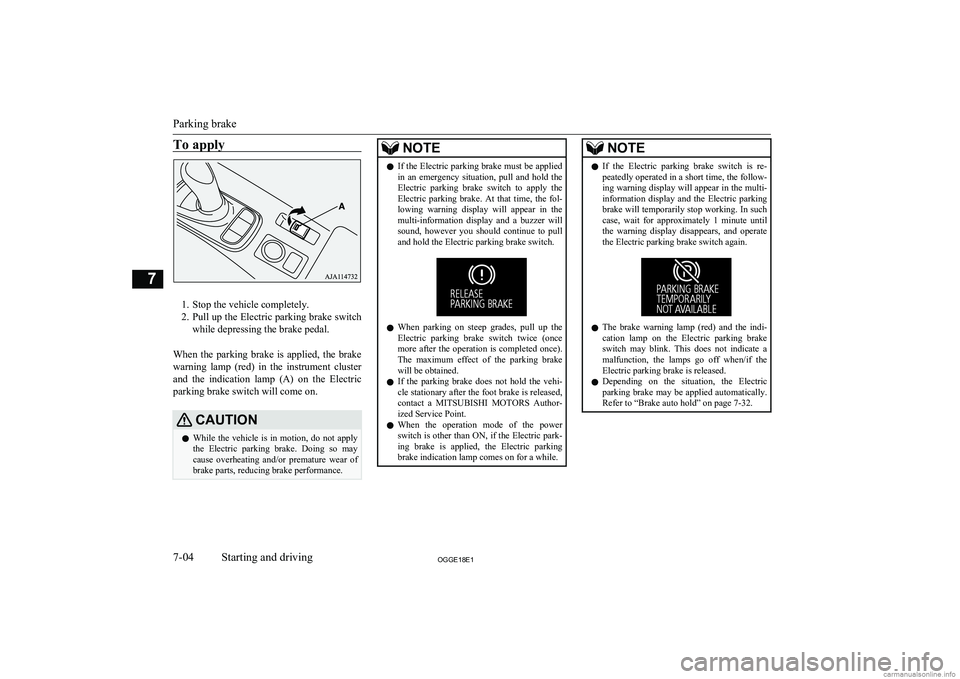
1. Stop the vehicle completely.
2. Pull up the Electric parking brake switch
while depressing the brake pedal.
When the parking brake is applied, the brake
warning lamp (red) in the instrument cluster and the indication lamp (A) on the Electric
parking brake switch will come on.
CAUTIONl While the vehicle is in motion, do not apply
the Electric parking brake. Doing so may cause overheating and/or premature wear of
brake parts, reducing brake performance.NOTEl If the Electric parking brake must be applied
in an emergency situation, pull and hold the
Electric parking brake switch to apply the
Electric parking brake. At that time, the fol- lowing warning display will appear in the
multi-information display and a buzzer will
sound, however you should continue to pull and hold the Electric parking brake switch.
l When parking on steep grades, pull up the
Electric parking brake switch twice (once
more after the operation is completed once).
The maximum effect of the parking brake will be obtained.
l If the parking brake does not hold the vehi-
cle stationary after the foot brake is released,
contact a MITSUBISHI MOTORS Author-
ized Service Point.
l When the operation mode of the power
switch is other than ON, if the Electric park- ing brake is applied, the Electric parking
brake indication lamp comes on for a while.
NOTEl If the Electric parking brake switch is re-
peatedly operated in a short time, the follow-
ing warning display will appear in the multi- information display and the Electric parkingbrake will temporarily stop working. In such
case, wait for approximately 1 minute until
the warning display disappears, and operate the Electric parking brake switch again.
l The brake warning lamp (red) and the indi-
cation lamp on the Electric parking brakeswitch may blink. This does not indicate a malfunction, the lamps go off when/if theElectric parking brake is released.
l Depending on the situation, the Electric
parking brake may be applied automatically.
Refer to “Brake auto hold” on page 7-32.
Parking brake
7-04OGGE18E1Starting and driving7
Page 238 of 538
NOTElWhen moving out of mud, sand or fresh
snow, pressing the accelerator pedal may not
allow the Plug-in Hybrid EV system output to increase. In such situations, switching to
“4WD LOCK” with the 4WD lock switch and temporarily turning off the Active Sta- bility Control (ASC) with the “ASC OFF”
switch will make it easier to move out your vehicle.
Refer to “Operation under adverse driving
conditions: If your vehicle becomes stuck in sand, mud or snow” on page 9-20.
Climbing/descending sharp
grades
Your vehicle may not provide sufficient hill
climbing ability and regenerative brake on steep slope. Avoid driving on steep slopes
even though the vehicle is a 4-wheel drive vehicle.
Inspection and maintenance
following rough roadoperation E00606701407
After operating the vehicle in rough road
conditions, be sure to perform the following inspection and maintenance procedures:
l Check that the vehicle has not been dam-
aged by rocks, gravel, etc.
l Carefully wash the vehicle with water.
Drive the vehicle slowly while lightly
depressing the brake pedal in order to dry out the brakes. If the brakes still do
not function properly, we recommend you to have the brakes checked as soon
as possible.
l Remove the insects, dried grass, etc.
clogging the radiator core.
l Check the inside of the vehicle. If water
entry is found, dry the carpet etc.
l Inspect the headlamps. If the headlamp
bulb is flooded with water, we recom-
mend you to have it drained.Cautions on handling of 4-
wheel drive vehicles E00606801844
Tyres and wheels
Since the driving torque can be applied to the
4 wheels, the driving performance of the ve- hicle when operating in 4-wheel drive is
greatly affected by the condition of the tyres.
Pay close attention to the tyres.
l Install only the specified tyres on all
wheels. Refer to “Tyres and wheels” on page 12-08.
l Be sure all 4 tyres and wheels are the
same size and type.
When it is necessary to replace any of
the tyres or wheels, replace all 4 tyres.
l All tyres should be rotated before the
wear difference between the front and
rear tyres is recognizable.
Good vehicle performance cannot be expec- ted if there is a difference in wear between tyres. Refer to “Tyre rotation” on page 11-11.
l Check the tyre inflation pressure regular-
ly.CAUTIONl Always use tyres of the same size, same
type, and same brand, and which have no wear differences. Using tyres of differentsize, type, brands or degree of wear, will in-
crease the differential oil temperature, result-
ing in possible damage to the driving sys-
tem. Further, the drive train will be subjec- ted to excessive loading possibly leading tooil leakage, component seizure, or other seri-
ous faults.
Inspection and maintenance following rough road operation
7-24OGGE18E1Starting and driving7
Page 244 of 538
CAUTIONlAlways confirm the indication lamp goes off
before driving.
If the indication lamp blinks, the operation
mode is put in OFF, and the operation mode is put in OFF once again. It is normal if the
indication lamp goes off. If the indication
lamp blinks again, have the vehicle inspec-
ted at a MITSUBISHI MOTORS Authorized Service Point as soon as possible.AVAS OFF switch
E00631701094
If the operation mode is put in ON, the
AVAS is automatically turned on.
The AVAS should be turned on while normal
driving.
When driving on the freeway etc., it is possi- ble to turn off the AVAS by pressing the
AVAS OFF switch.
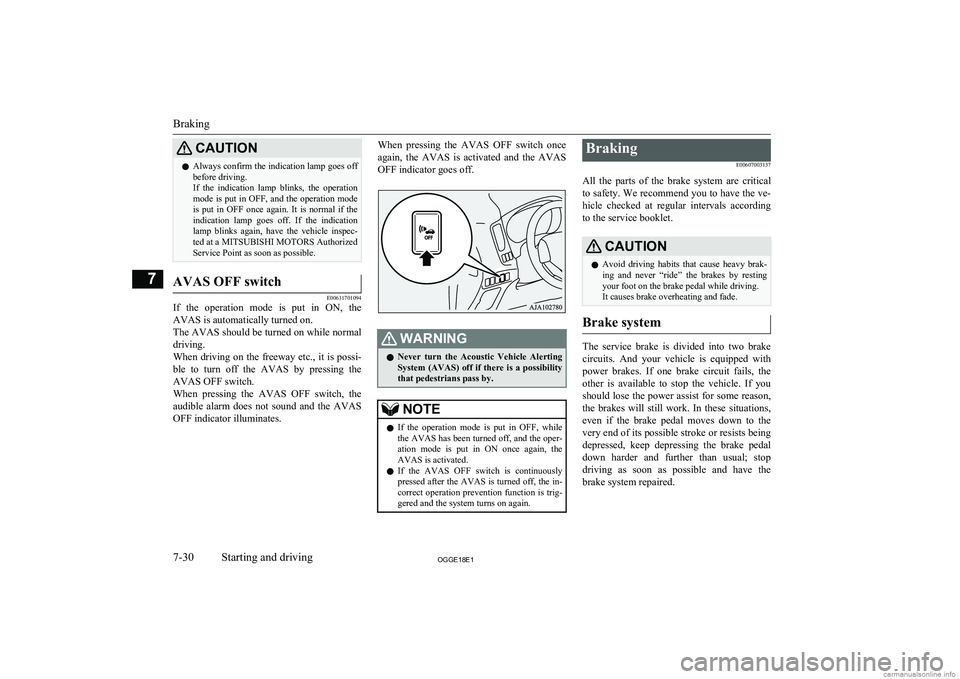
When pressing the AVAS OFF switch, the audible alarm does not sound and the AVAS
OFF indicator illuminates.
When pressing the AVAS OFF switch once
again, the AVAS is activated and the AVAS
OFF indicator goes off.WARNINGl Never turn the Acoustic Vehicle Alerting
System (AVAS) off if there is a possibility
that pedestrians pass by.NOTEl If the operation mode is put in OFF, while
the AVAS has been turned off, and the oper-
ation mode is put in ON once again, the
AVAS is activated.
l If the AVAS OFF switch is continuously
pressed after the AVAS is turned off, the in-
correct operation prevention function is trig-
gered and the system turns on again.Braking
E00607003137
All the parts of the brake system are critical
to safety. We recommend you to have the ve- hicle checked at regular intervals according
to the service booklet.CAUTIONl Avoid driving habits that cause heavy brak-
ing and never “ride” the brakes by resting
your foot on the brake pedal while driving.
It causes brake overheating and fade.
Brake system
The service brake is divided into two brake
circuits. And your vehicle is equipped with
power brakes. If one brake circuit fails, the other is available to stop the vehicle. If you
should lose the power assist for some reason, the brakes will still work. In these situations,
even if the brake pedal moves down to the very end of its possible stroke or resists being
depressed, keep depressing the brake pedal
down harder and further than usual; stop
driving as soon as possible and have the brake system repaired.
Braking
7-30OGGE18E1Starting and driving7
Page 245 of 538
WARNINGlDo not turn off the Plug-in Hybrid EV
System while your vehicle is in motion. If
you turn off the Plug-in Hybrid EV Sys- tem while driving, the power assistancefor the braking system will stop working
and your brakes will not work effectively.
l If the power assist is lost or if either brake
hydraulic system stops working properly,
have your vehicle checked immediately.
Warning display
The brake warning lamp illuminates to indi-
cate a fault in the braking system. A warning
is also displayed on the multi information display. Refer to “Brake warning lamp (red)”
on page 6-48 and “Brake warning display” on
page 6-51.
When brakes are wet
Check the brake system while driving at a
low speed immediately after starting, espe- cially when the brakes are wet, to confirmthey work normally.
A film of water can be formed on the brake
discs and prevent normal braking after driv-
ing in heavy rain or through large puddles, or after the vehicle is washed. If this occurs, dry
the brakes out by driving slowly while lightly depressing the brake pedal.
When driving downhillWARNINGl Do not leave any objects near the brake
pedal or let a floor mat slide under it; do- ing so could prevent the full pedal stroke
that would be necessary in an emergency. Make sure that the pedal can be operated freely at all times. Make sure that thefloor mat is securely held in place.CAUTIONl Put the selector lever to “B” position accord-
ing to the grade of a slope or the speed in along downward slope, and use the regenera-
tive brake together.
If you depress the brake pedal and slowing down is repeated frequently, the foot brake
may be overheated and effectiveness may worsen.CAUTIONl Effectiveness of the regenerative brake be-
comes weak when the drive battery is close
to full charge and loses its effect at the full
charge.
In this case, since the foot brake is effective,
use the foot brake and slow down your vehi-
cle speed beforehand.
The energy usage indicator stops swaying in the charge zone closer to full charge.
Refer to “Energy usage indicator” on page 6-02
In such case, drive at low speed in advance.
And if needed use the foot brake to slow
down the vehicle speed before the vehicle speed increases.
The regenerative brake comes to be effective if the drive battery remaining power is con-
sumed.
Brake pad
l Avoid hard braking situations.
New brakes need to be broken-in by
moderate use for the first 200 km
(124 miles).
l The disc brakes are provided with a
warning device which emits a shrieking
metallic sound while braking if the brake pads have reached their wear limit. Ifyou hear this sound, have the brake padsreplaced immediately.
Braking
7-31OGGE18E1Starting and driving7
Page 246 of 538
WARNINGlDriving with worn brake pads will make
it harder to stop, and can cause an acci-
dent.Brake auto hold
E00652000051
When the vehicle is stopped at traffic signalsetc., the vehicle can be held stationary with
the brake auto hold system even if you re-
lease your foot from the brake pedal. When the accelerator pedal is depressed, the brakes are released.
WARNINGl Do not overly rely on the brake auto hold
system. On a steep slope, depress the brake pedal firmly because the systemmay not hold the vehicle stationary.
l Never leave the vehicle while it is being
stopped by the brake auto hold system.
When leaving the vehicle, apply the park- ing brake and put the select position to
the “P” (PARK) position.
l Do not use the brake auto hold system
when driving on slippery roads. The sys- tem may not hold the vehicle stationary
and an accident could occur.NOTEl While operating the brake auto hold system,
you may hear an operation noise to increasebraking force when the system detected the
movement of the vehicle. This does not indi- cate a malfunction.
How to use brake auto hold
To turn on brake auto hold
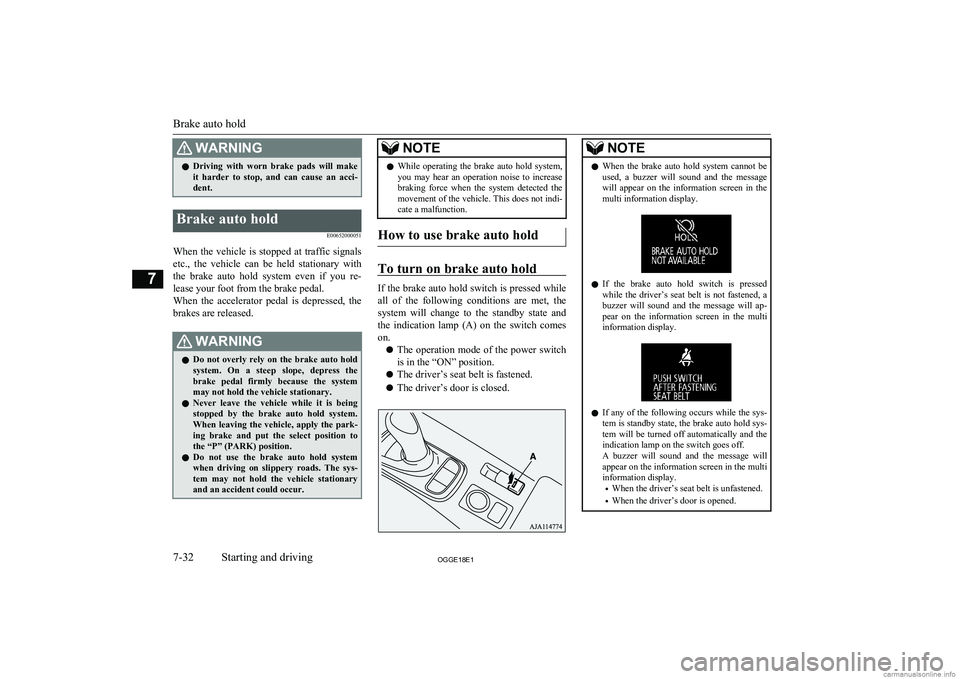
If the brake auto hold switch is pressed while
all of the following conditions are met, the system will change to the standby state and
the indication lamp (A) on the switch comes on.
l The operation mode of the power switch
is in the “ON” position.
l The driver’s seat belt is fastened.
l The driver’s door is closed.
NOTElWhen the brake auto hold system cannot be
used, a buzzer will sound and the message will appear on the information screen in the
multi information display.
l If the brake auto hold switch is pressed
while the driver’s seat belt is not fastened, a buzzer will sound and the message will ap-
pear on the information screen in the multi
information display.
l If any of the following occurs while the sys-
tem is standby state, the brake auto hold sys-
tem will be turned off automatically and the indication lamp on the switch goes off.
A buzzer will sound and the message will
appear on the information screen in the multi information display.
• When the driver’s seat belt is unfastened.
• When the driver’s door is opened.
Brake auto hold
7-32OGGE18E1Starting and driving7
Page 248 of 538
To start the vehicle
Depress the acceleration pedal with the select
position in any position other than “P” (PARK) or “N” (NEUTRAL).
The brakes are released, and the brake auto hold indication lamp in the instrument cluster
will go off.
To turn off brake auto hold
Press the brake auto hold switch to turn brake
auto hold off. The indication lamp on the switch goes off.
If you want to turn off the system while the brake auto hold indication lamp is illumina-
ted, press the switch while depressing the brake pedal.
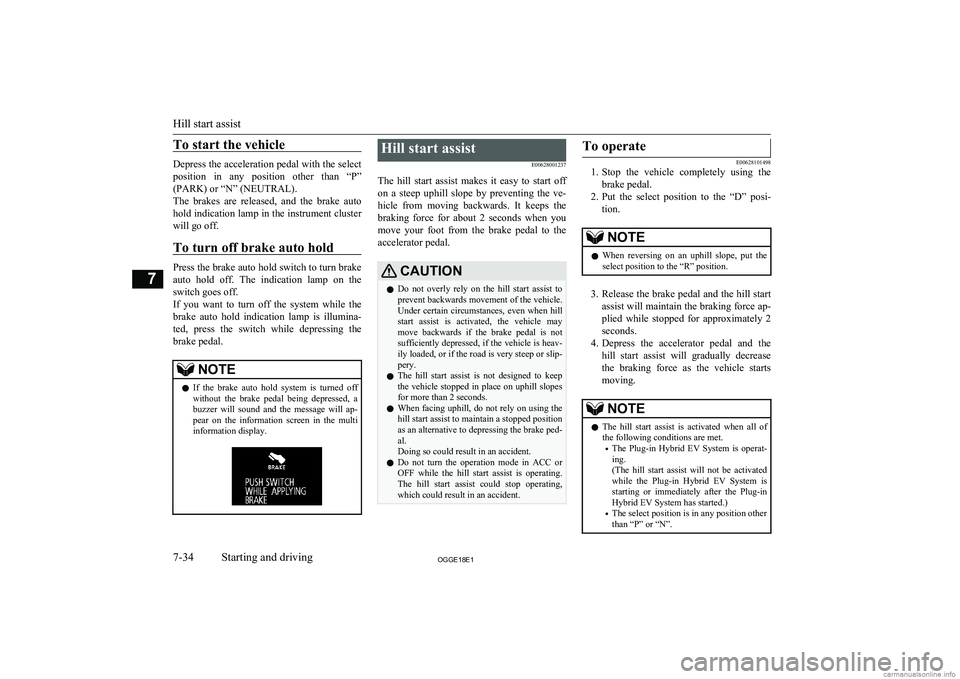
NOTEl If the brake auto hold system is turned off
without the brake pedal being depressed, abuzzer will sound and the message will ap-
pear on the information screen in the multi
information display.Hill start assist
E00628001237
The hill start assist makes it easy to start off on a steep uphill slope by preventing the ve-
hicle from moving backwards. It keeps the
braking force for about 2 seconds when you move your foot from the brake pedal to the
accelerator pedal.CAUTIONl Do not overly rely on the hill start assist to
prevent backwards movement of the vehicle. Under certain circumstances, even when hill
start assist is activated, the vehicle may
move backwards if the brake pedal is not sufficiently depressed, if the vehicle is heav-
ily loaded, or if the road is very steep or slip- pery.
l The hill start assist is not designed to keep
the vehicle stopped in place on uphill slopes for more than 2 seconds.
l When facing uphill, do not rely on using the
hill start assist to maintain a stopped position as an alternative to depressing the brake ped-
al.
Doing so could result in an accident.
l Do not turn the operation mode in ACC or
OFF while the hill start assist is operating.
The hill start assist could stop operating, which could result in an accident.To operate
E00628101498
1. Stop the vehicle completely using the
brake pedal.
2. Put the select position to the “D” posi-
tion.
NOTEl When reversing on an uphill slope, put the
select position to the “R” position.
3. Release the brake pedal and the hill start
assist will maintain the braking force ap-
plied while stopped for approximately 2 seconds.
4. Depress the accelerator pedal and the
hill start assist will gradually decrease the braking force as the vehicle startsmoving.
NOTEl The hill start assist is activated when all of
the following conditions are met.
• The Plug-in Hybrid EV System is operat-
ing.
(The hill start assist will not be activated
while the Plug-in Hybrid EV System is
starting or immediately after the Plug-in
Hybrid EV System has started.)
• The select position is in any position other
than “P” or “N”.
Hill start assist
7-34OGGE18E1Starting and driving7
Page 249 of 538
NOTE•The vehicle is completely stationary, with
the brake pedal depressed.
• The parking brake is released.
l The hill start assist will not operate if the ac-
celerator pedal is depressed before the brake pedal is released.
l The hill start assist also operates when re-
versing on an uphill slope.Warning display
E00628201369
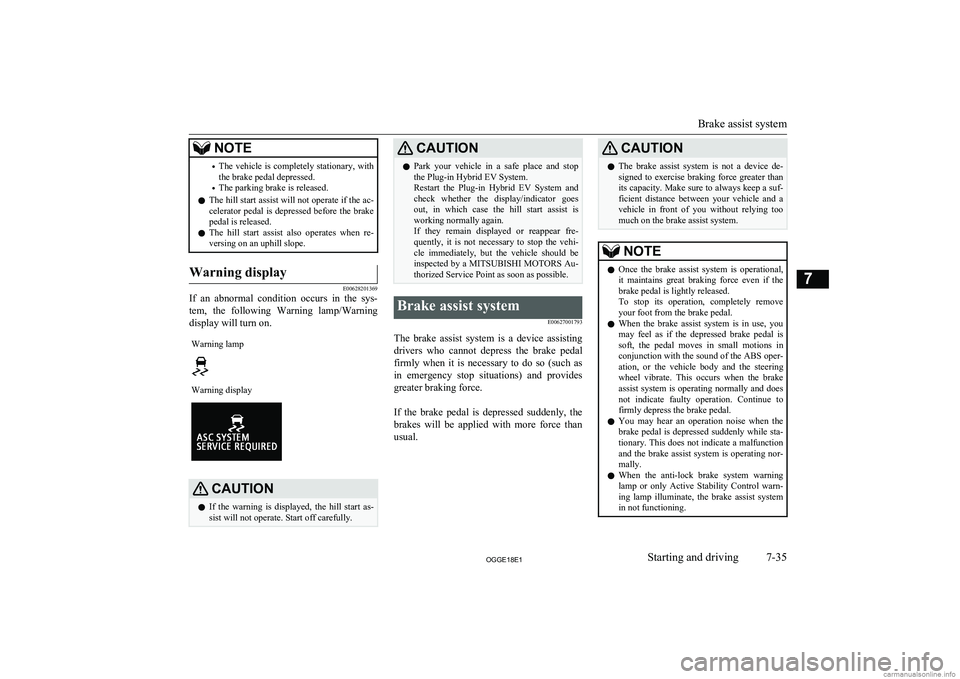
If an abnormal condition occurs in the sys-
tem, the following Warning lamp/Warning
display will turn on.
Warning lampWarning displayCAUTIONl If the warning is displayed, the hill start as-
sist will not operate. Start off carefully.CAUTIONl Park your vehicle in a safe place and stop
the Plug-in Hybrid EV System.
Restart the Plug-in Hybrid EV System and check whether the display/indicator goes out, in which case the hill start assist is
working normally again.
If they remain displayed or reappear fre- quently, it is not necessary to stop the vehi-cle immediately, but the vehicle should be
inspected by a MITSUBISHI MOTORS Au-
thorized Service Point as soon as possible.Brake assist system
E00627001793
The brake assist system is a device assistingdrivers who cannot depress the brake pedalfirmly when it is necessary to do so (such as
in emergency stop situations) and provides
greater braking force.
If the brake pedal is depressed suddenly, the brakes will be applied with more force than
usual.
CAUTIONl The brake assist system is not a device de-
signed to exercise braking force greater than its capacity. Make sure to always keep a suf-
ficient distance between your vehicle and a
vehicle in front of you without relying too much on the brake assist system.NOTEl Once the brake assist system is operational,
it maintains great braking force even if the
brake pedal is lightly released.
To stop its operation, completely remove
your foot from the brake pedal.
l When the brake assist system is in use, you
may feel as if the depressed brake pedal issoft, the pedal moves in small motions inconjunction with the sound of the ABS oper- ation, or the vehicle body and the steering
wheel vibrate. This occurs when the brake
assist system is operating normally and does not indicate faulty operation. Continue to
firmly depress the brake pedal.
l You may hear an operation noise when the
brake pedal is depressed suddenly while sta-
tionary. This does not indicate a malfunction
and the brake assist system is operating nor- mally.
l When the anti-lock brake system warning
lamp or only Active Stability Control warn- ing lamp illuminate, the brake assist system
in not functioning.
Brake assist system
7-35OGGE18E1Starting and driving7