engine MITSUBISHI OUTLANDER SPORT 2017 3.G Owners Manual
[x] Cancel search | Manufacturer: MITSUBISHI, Model Year: 2017, Model line: OUTLANDER SPORT, Model: MITSUBISHI OUTLANDER SPORT 2017 3.GPages: 399, PDF Size: 14.61 MB
Page 362 of 399
Fusible links
Vehicle care and maintenance 9-25
9
the windshield, side and rear window are also useful.
N00942700305
The fusible links will melt
to prevent a fire if
a large current attempts to flow through cer- tain electrical systems. In case of a melted fusible link, see yourauthorized Mitsubishi Motors dealer or arepair facility of your choice for inspection and replacement. For the fusible links, please refer to “Fuseload capacities” on page 9-26.
N00942800856
To prevent damage to the electrical systemfrom short-circuiting or overloading, eachindividual circuit is equipped with a fuse. The
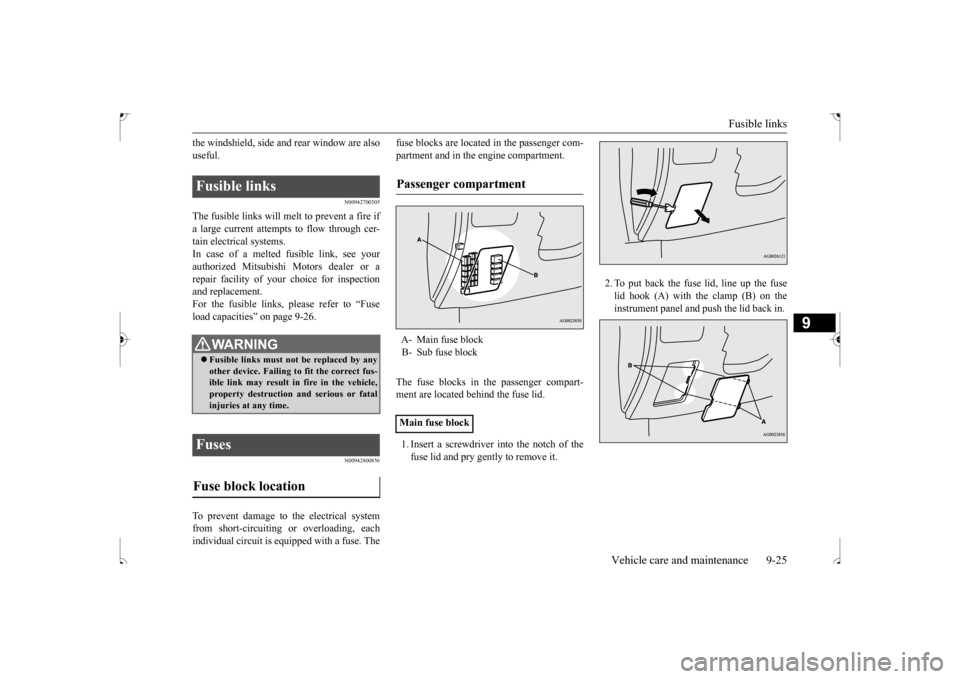
fuse blocks are located in the passenger com- partment and in the engine compartment. The fuse blocks in the passenger compart- ment are located behind the fuse lid. 1. Insert a screwdriver into the notch of the fuse lid and pry gently to remove it.
2. To put back the fuse lid, line up the fuse lid hook (A) with the clamp (B) on the instrument panel and push the lid back in.
Fusible links
WA R N I N G Fusible links must not be replaced by any other device. Failing to fit the correct fus- ible link may result in fire in the vehicle, property destruction and serious or fatalinjuries at any time.
Fuses Fuse block location
Passenger compartment A- Main fuse block B- Sub fuse block Main fuse block
BK0239500US.bo
ok 25 ページ 2016年5月13日 金曜日 午前8時53分
Page 363 of 399
Fuses 9-26 Vehicle care and maintenance
9
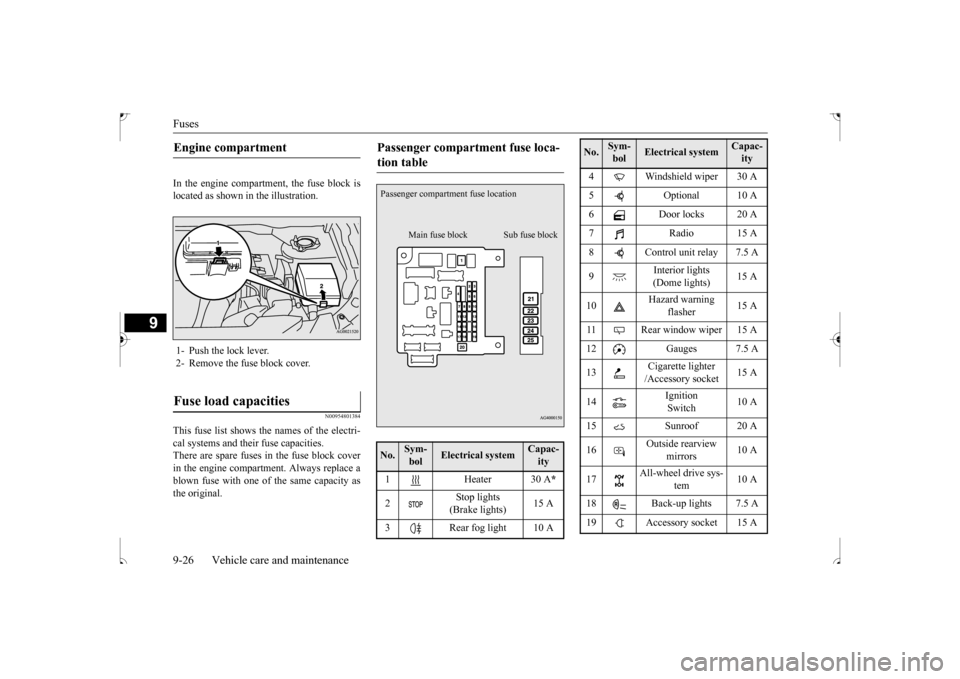
In the engine compartment, the fuse block is located as shown in the illustration.
N00954801384
This fuse list shows the names of the electri-cal systems and their fuse capacities. There are spare fuses in the fuse block cover in the engine compartment. Always replace ablown fuse with one of the same capacity as the original.Engine compartment 1- Push the lock lever. 2- Remove the fuse block cover.Fuse load capacities
Passenger compartment fuse loca- tion table No.
Sym- bol
Electrical system
Capac-ity
1 Heater 30 A
*
2
Stop lights (Brake lights)
15 A
3 Rear fog light 10 APassenger compartment fuse location
Main fuse block Sub fuse block
4 Windshield wiper 30 A 5 Optional 10 A 6 Door locks 20 A 7 Radio 15 A8 Control unit relay 7.5 A 9
Interior lights (Dome lights)
15 A
10
Hazard warning
flasher
15 A
11 Rear window wiper 15 A 12 Gauges 7.5 A 13
Cigarette lighter /Accessory socket
15 A
14
Ignition Switch
10 A
15 Sunroof 20 A16
Outside rearview
mirrors
10 A
17
All-wheel drive sys-
tem
10 A
18 Back-up lights 7.5 A 19 Accessory socket 15 ANo.
Sym- bol
Electrical system
Capac-ity
BK0239500US.bo
ok 26 ページ 2016年5月13日 金曜日 午前8時53分
Page 364 of 399
Fuses
Vehicle care and maintenance 9-27
9
* : Fusible link Some fuses may not be installed on your vehicle, depending on the vehicle model or specifications. The table above shows the main equip- ment corresponding to each fuse. 20
Power window con-
trol
30 A
*
21 Defogger 30 A
*
22 Heated door mirror 7.5 A 23
Passenger’s power
seat
25 (20) A
24 Driver’s power seat
25 (20) A
25 Heated seats 30 ANo.
Sym- bol
Electrical system
Capac-ity
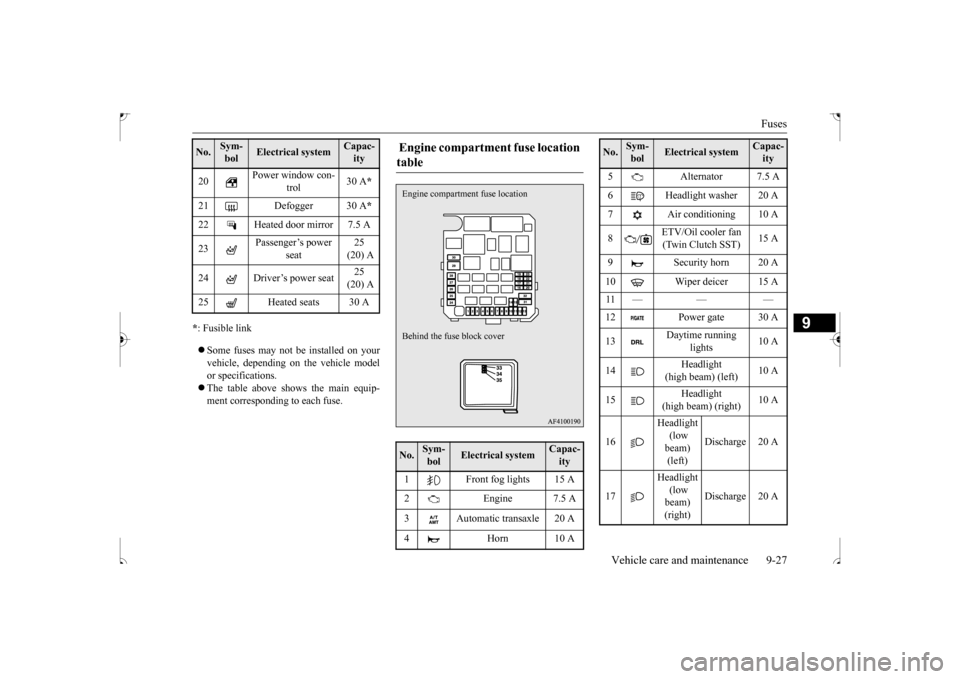
Engine compartment fuse location table No.
Sym- bol
Electrical system
Capac-ity
1 Front fog lights 15 A 2 Engine 7.5 A 3 Automatic transaxle 20 A 4 Horn 10 AEngine compartment
fuse location
Behind the fuse block cover
5 Alternator 7.5 A 6 Headlight washer 20 A 7 Air conditioning 10 A 8
ETV/Oil cooler fan (Twin Clutch SST)
15 A
9 Security horn 20 A 10 Wiper deicer 15 A 11 — — — 12 Power gate 30 A 13
Daytime running
lights
10 A
14
Headlight
(high beam) (left)
10 A
15
Headlight
(high beam) (right)
10 A
16
Headlight (low beam) (left)
Discharge 20 A
17
Headlight (low beam) (right)
Discharge 20 A
No.
Sym- bol
Electrical system
Capac-ity
BK0239500US.bo
ok 27 ページ 2016年5月13日 金曜日 午前8時53分
Page 365 of 399
Fuses 9-28 Vehicle care and maintenance
9
* : Fusible link Some fuses may not be installed on your vehicle, depending on the vehicle model or specifications. The table above shows the main equip- ment corresponding to each fuse.
There are no 7.5 A, 25 A or 30 A spare fuses. If a fuse of one of these capacities blows,replace it temporarily by borrowing one ofthe fuses indicated below. 7.5 A: 10 A spare fuse 25 A: 20 A spare fuse30 A: 30 A audio amplifier fuse Replace the borrowed fuse with a fuse that has the correct capacity as soon as possible.
N00954900128
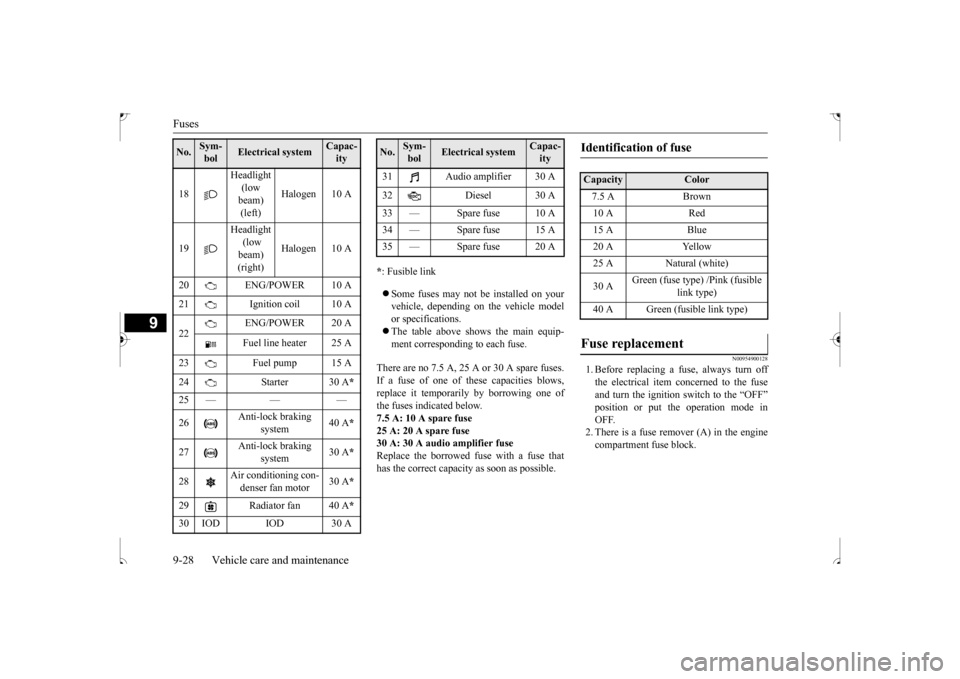
1. Before replacing a fuse, always turn off the electrical item concerned to the fuse and turn the ignition switch to the “OFF”position or put the operation mode in OFF. 2. There is a fuse remover (A) in the enginecompartment fuse block.
18
Headlight (low beam) (left)
Halogen 10 A
19
Headlight (low beam) (right)
Halogen 10 A
20 ENG/POWER 10 A 21 Ignition coil 10 A 22
ENG/POWER 20 A Fuel line heater 25 A
23 Fuel pump 15 A 24 Starter 30 A
*
25 — — — 26
Anti-lock braking
system
40 A
*
27
Anti-lock braking
system
30 A
*
28
Air conditioning con- denser fan motor
30 A
*
29 Radiator fan 40 A
*
30 IOD IOD 30 ANo.
Sym- bol
Electrical system
Capac-ity
31 Audio amplifier 30 A 32 Diesel 30 A 33 — Spare fuse 10 A 34 — Spare fuse 15 A35 — Spare fuse 20 ANo.
Sym- bol
Electrical system
Capac-ity
Identification of fuse Capacity
Color
7.5 A Brown10 A Red15 A Blue20 A Yellow25 A Natural (white) 30 A
Green (fuse type) /Pink (fusible
link type)
40 A Green (fusible link type)
Fuse replacement
BK0239500US.bo
ok 28 ページ 2016年5月13日 金曜日 午前8時53分
Page 379 of 399
Cleaning the outside of your vehicle 9-42 Vehicle care and maintenance
9
N00945800033
Industrial pollution, road tar, bird droppings, tree sap, insect remains, sea water and otherforeign matters can damage the finish on your vehicle. Generally, the longer any foreign materialstays on the finish, the worse the damage. Wash your vehicle as soon as possible when- ever the finish gets soiled.
N00945901682
Chemicals contained in the dirt and dust picked up from air, rain, snow, or road sur- faces can damage the paint and body of yourvehicle if left on. Frequent washing and waxing is the best way to protect your vehicle from this damage.Do not wash the vehicle in direct sunlight. Park the vehicle in the shade and spray it with water to remove dust. Next, using plenty ofclean water and a car washing mitt or sponge, wash the vehicle from top to bottom. Use a mild car washing soap if necessary.Rinse thoroughly and wipe dry with a cham- ois or soft cloth. After washing the vehicle, carefully clean the joints and flanges of thedoors, hood, etc., where dirt is likely to remain.
Salt and other chemicals spread on winter roads in some geographical areas can have adetrimental effect on the vehicle underbody. You should flush the underbody with a high pressure hose every time you wash the out-side of your vehicle. Take special care to remove mud or other debris which could trap and hold salt andmoisture. After washing your vehicle, wipe off all waterdrops from the rubber parts around thedoors to prevent the doors from freezing.
Foreign material Wa s h i n g
CAUTION When washing the underside of your vehicle or the wheels, wear a pair of gloves to pro- tect your hands. If your vehicle has rain sensor wipers, place the wiper switch lever in the “OFF” position to deactivate the rain sensor before washing the vehicle. Otherwise, the wipers will oper-ate in the presence of water spray on the windshield and may get damaged as a result. Never spray or splash water on the electrical parts in the engine compartment. This may damage them. Be careful also when washingthe underbody to ensure that water does not enter the engine compartment. Avoid automatic car washers that use rotat- ing brushes. These brushes may scratch the paint surface and make it dull.Scratches are more noticeable on darker col- ored vehicles. Some hot water washing equipment uses high pressure and heat to clean your vehicle. Because hot water can damage plastics partsand seep inside your vehicle, make sure you do the following when using such equip- ment:• Keep the washing nozzle at least 28 inches(70 cm) away from the vehicle body.• When washing around the door glass, holdthe nozzle at a distance of more than 28 inches (70 cm) and at a right angle to the glass surface.
Make sure to do the following when using an automatic car wash, with help from either this manual or the car wash operator, to avoid damaging your vehicle:• Fold the outside rearview mirrors.• Tape the wiper arm assembly.• If your vehicle is equipped with a rear spoiler or roof rails, check with the carwash operator before using the car wash.• If your vehicle is equipped with the rainsensor wipers, place the wiper switch lever in the “OFF” position to deactivate the rain sensor.
During cold weather
CAUTION
BK0239500US.bo
ok 42 ページ 2016年5月13日 金曜日 午前8時53分
Page 380 of 399
Cleaning the outside of your vehicle Vehicle care and maintenance 9-43
9
N00946000234
Wax your vehicle once or twice a year, or when water does not bead up on the paint. Use a soft cloth to put a small amount of wax on the painted surfaces. After the wax hasdried, polish with a dry soft cloth. Do not wax your vehicle in direct sunlight. You should wax when the painted surfacesare cool.
N00946100046
If painted surfaces have been severely dam- aged and lost their original luster and color tone, polish the surface lightly with a finepolishing compound. Avoid limiting your polishing to the damaged surface only; polish a somewhat wider area, moving the polishingcloth in one direction. After polishing, flush the compound from the surface and apply a coat of wax to regain a beautiful luster.
N00946200047
Small cracks and scratches in the paint coatshould be touched up as soon as possible withtouch-up paint to prevent corrosion. Check body areas facing the road or the tires carefully for damage to the paint caused byflying stones, etc. The paint code number for your vehicle can be found on the vehicle
information code plate in the engine compart- ment.
N00946300194
Use a sponge or chamois to clean these parts.If a vehicle wax sticks to a gray or black rough surface of the bumper, molding or lights, the surface may appear white in color.In this case, wipe it
off using lukewarm water
and a soft cloth or chamois.
NOTE
When the door is frozen, opening it by force may tear off or crack the rubber gasket installed around the door. Pour warm water to melt the ice. Be sure to thoroughly wipe off the water after opening the door. To pre-vent freezing of the weatherstripping on the doors, hood, etc., treat
with silicone lubri-
cant.
Waxing
CAUTION Waxes containing high abrasive compounds should not be used. These waxes remove rust and stain effectively from the paintwork, butare harmful to the finish of the paint, because they also remove paint/clearcoat. They are also harmful to other glossy sur-faces such as the grill
e, trim, moldings, etc.
Do not use gasoline, benzine, kerosene or paint thinners to remove road tar or other dirt from the vehicle surface. Do not put wax on the areas having black matte coating because it can cause uneven discoloration, patches, blurs, etc. If these get wax on them, wipe the wax off right awaywith a soft cloth and warm water.
Polishing Damaged paint
CAUTION
Cleaning plastic parts
CAUTION Do not use a scrubbing brush or other rough scrubber as these may damage the plastic surface. Do not use wax containing compounds (pol- ishing powder) which may damage the plas- tic surface. Do not let plastic parts get soiled with gaso- line, oil, brake fluids
, engine oils, greases,
paint thinner, and sulfuric acid (battery elec- trolyte), as such substances will cause stains, cracks, or discoloration.If any of these get on a plastic part, wipe them up with a soft cloth or chamois and a mild solution of soap and water. Then rinse them immediately with water.
BK0239500US.bo
ok 43 ページ 2016年5月13日 金曜日 午前8時53分
Page 381 of 399
Cleaning the outside of your vehicle 9-44 Vehicle care and maintenance
9
N00946400052
To prevent spots and corrosion of chrome parts, wash with water, dry thoroughly, andapply a nonabrasive automotive wax. If the chrome is severely damaged or pitted, use a commercially available chrome polish.
N00946500183
1. Remove dirt using a wet sponge. 2. Use a mild detergent on any dirt that can- not be removed easily with water.Rinse off the detergent after washing the wheel. 3. Dry the wheel thoroug
hly using a chamois
leather or a soft cloth.
N00946600054
The window glass can usually be cleanedusing only a sponge and water. Glass cleanercan be used to remove
wax, oil, grease, dead
insects, etc. After washing the glass, wipe it dry with a clean, dry, soft cloth.
N00946700068
Use a soft cloth and glass cleaner to remove grease, dead insects, etc., from the wiper blades.Replace the wiper blades when they no longer clean the windshield and rear window prop- erly.
N00947000071
Never spray or splash water on the electricalaccessories in the engine compartment. Thisputs the engine at risk of being damaged. Do not bring the circumferential parts, the plastic parts and so on into contact with sulfu-ric acid (battery electrolyte) which may crack, stain or discolor them. If they are in contact, wipe off with soft cloth,chamois or the like and an aqueous solution of neutral detergent then immediately rinse the affected parts with plenty of water.
Chrome parts Aluminum wheels
(if so equipped)
CAUTION Do not use a brush or other hard implement on the wheels. Do not use any cleaner that contains an abra- sive substance or is acidic or alkaline. Doing so could cause the coating on the wheels to peel or become discolored or stained. Do not directly apply hot water using a steam cleaner or by any other means. Contact with seawater or road salt used for de-icing can cause corrosion. Rinse off such substances as soon as possible.
Window glass Wiper blades Engine compartment
BK0239500US.bo
ok 44 ページ 2016年5月13日 金曜日 午前8時53分
Page 388 of 399
11
SpecificationsVehicle labeling ....
.................................................
........................ 11-2
Vehicle dimensions
................................................
........................ 11-3
Vehicle weights ...............
............................................................... 11-3
Engine specifications
.............................................
........................ 11-4
Battery .......................................
..................................................... 11-4
Tires and wheels .............
............................................................... 11-5
Capacity ....................................
..................................................... 11-5
BK0239500US.bo
ok 1 ページ 2016年5月13日 金曜日 午前8時53分
Page 389 of 399
Vehicle labeling 11-2 Specifications
11
N01147401879
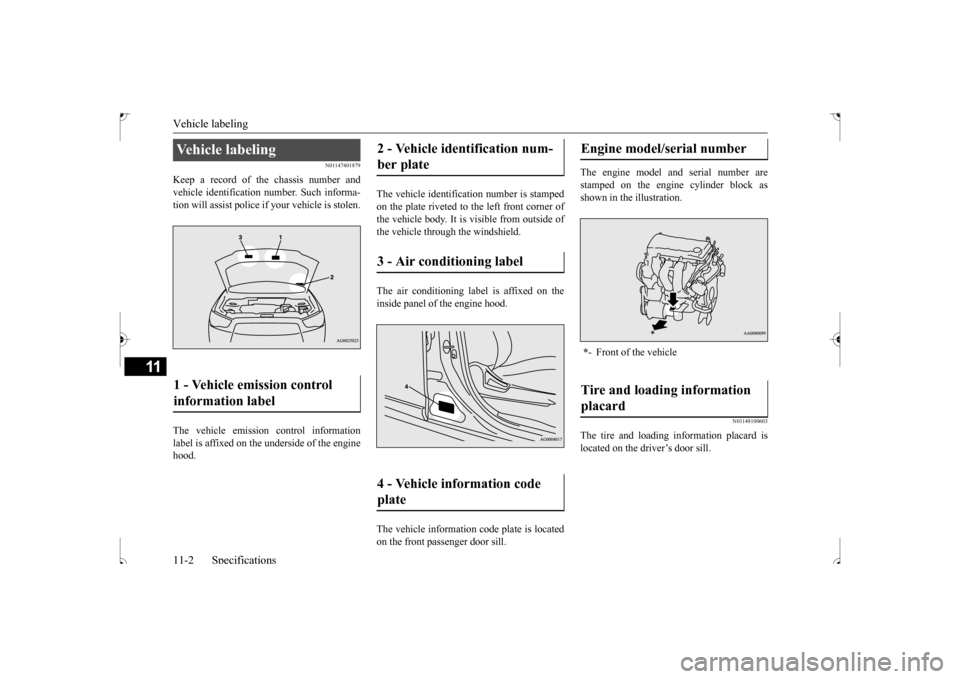
Keep a record of the chassis number and vehicle identification number. Such informa-tion will assist police if your vehicle is stolen. The vehicle emission control information label is affixed on the underside of the engine hood.
The vehicle identification number is stamped on the plate riveted to the left front corner of the vehicle body. It is visible from outside of the vehicle through the windshield. The air conditioning label is affixed on the inside panel of the engine hood. The vehicle information code plate is located on the front passenger door sill.
The engine model and serial number are stamped on the engine cylinder block as shown in the illustration.
N01148100603
The tire and loading information placard is located on the driver’s door sill.
Vehicle labeling 1 - Vehicle emission control information label
2 - Vehicle identification num-ber plate 3 - Air conditioning label 4 - Vehicle information code plate
Engine model/serial number * - Front of the vehicleTire and loading information placard
BK0239500US.bo
ok 2 ページ 2016年5月13日 金曜日 午前8時53分
Page 391 of 399
Engine specifications 11-4 Specifications
11
GVWR: maximum total weight (load) limit specified for the vehicle GAWR: maximum weight (load) limit sp
ecified for the front or rear axle
Seating capacity: the maximum number of occupants
N01147701537
N01147801336
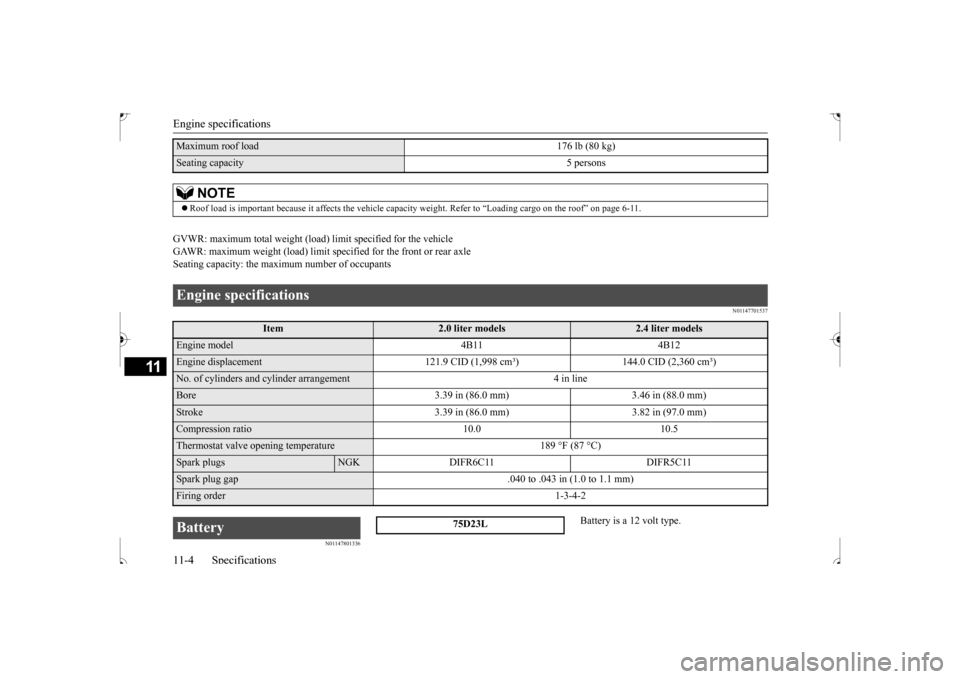
Battery is a 12 volt type.
Maximum roof load 176 lb (80 kg)Seating capacity 5 persons
NOTE
Roof load is important because it affects the vehicle capacity
weight. Refer to “Loading cargo on the roof” on page 6-11.
Engine specifications
Item
2.0 liter models
2.4 liter models
Engine model 4B11 4B12Engine displacement 121.9 CID (1,998 cm³) 144.0 CID (2,360 cm³)No. of cylinders and cylinder arrangement 4 in lineBore 3.39 in (86.0 mm) 3.46 in (88.0 mm)Stroke 3.39 in (86.0 mm) 3.82 in (97.0 mm)Compression ratio 10.0 10.5Thermostat valve opening temperature 189 °F (87 °C)Spark plugs
NGK DIFR6C11 DIFR5C11
Spark plug gap .040 to .043 in (1.0 to 1.1 mm)Firing order
1-3-4-2
Battery
75D23L
BK0239500US.bo
ok 4 ページ 2016年5月13日 金曜日 午前8時53分