engine MITSUBISHI OUTLANDER SPORT 2017 3.G User Guide
[x] Cancel search | Manufacturer: MITSUBISHI, Model Year: 2017, Model line: OUTLANDER SPORT, Model: MITSUBISHI OUTLANDER SPORT 2017 3.GPages: 399, PDF Size: 14.61 MB
Page 19 of 399
Filling the fuel tank 3-4 General information
3
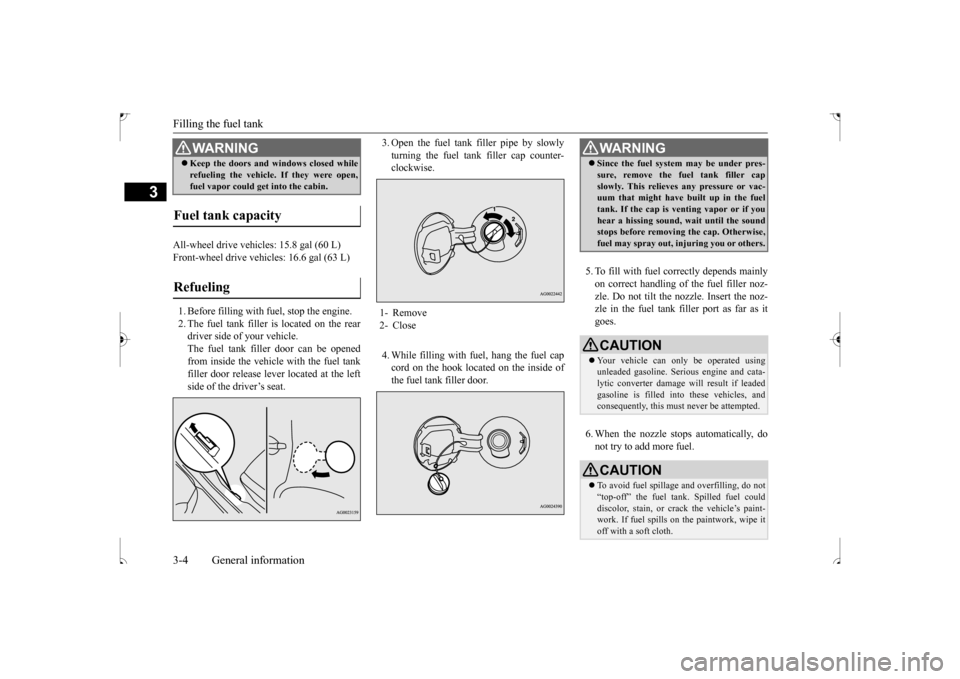
All-wheel drive vehicles: 15.8 gal (60 L) Front-wheel drive vehicles: 16.6 gal (63 L) 1. Before filling with fuel, stop the engine. 2. The fuel tank filler is located on the rear driver side of your vehicle. The fuel tank filler door can be openedfrom inside the vehicle with the fuel tank filler door release le
ver located at the left
side of the driver’s seat.
3. Open the fuel tank filler pipe by slowly turning the fuel tank filler cap counter- clockwise. 4. While filling with fuel, hang the fuel cap cord on the hook located on the inside of the fuel tank filler door.
5. To fill with fuel correctly depends mainly on correct handling of the fuel filler noz-zle. Do not tilt the nozzle. Insert the noz- zle in the fuel tank filler port as far as it goes. 6. When the nozzle stops automatically, do not try to add more fuel.
Keep the doors and windows closed while refueling the vehicle. If they were open, fuel vapor could get into the cabin.
Fuel tank capacity Refueling
WA R N I N G
1- Remove 2- Close
WA R N I N G Since the fuel system may be under pres- sure, remove the fuel tank filler cap slowly. This relieves any pressure or vac- uum that might have built up in the fuel tank. If the cap is venting vapor or if youhear a hissing sound, wait until the sound stops before removing the cap. Otherwise, fuel may spray out, injuring you or others.CAUTION Your vehicle can only be operated using unleaded gasoline. Serious engine and cata-lytic converter damage will result if leaded gasoline is filled into these vehicles, and consequently, this must never be attempted.CAUTION To avoid fuel spillage
and overfilling, do not
“top-off” the fuel tank. Spilled fuel could discolor, stain, or crack the vehicle’s paint- work. If fuel spills on the paintwork, wipe itoff with a soft cloth.
BK0239500US.bo
ok 4 ページ 2016年5月13日 金曜日 午前8時53分
Page 20 of 399
Modifications to and racing of your vehicle
General information 3-5
3
7. To close, turn the fuel tank filler pipe cap slowly clockwise until you hear clicking sounds, then gently push the fuel tank filler door closed.
N00301600149
This vehicle should not be modified withnon-Mitsubishi Motors genuine parts.Mitsubishi Motors designs and manufactures high quality vehicles
with an emphasis on
safety and durability. Modifications usingnon-Mitsubishi Motors genuine parts may affect the performance, safety and/or durabil- ity of your vehicle, and may violate applica-ble state and/or federal regulations. DAMAGE OR PERFORMANCE PROB- LEMS RESULTING FROM MODIFICA- TIONS TO OR RACING OF YOUR VEHICLE ARE NOT COVEREDUNDER WARRANTY. Examples of modifications to your vehicle that can cause damage or performance prob- lems include the following: Failure to use Mitsubishi Motors genuine parts Failure to use required fuel and fluids Failure to use proper size tires and wheels Modification of the fuel, intake, exhaust, emission, suspension, engine, drive train or electrical wiring systems
Modification of any onboard com- puter/control module, including repro- gramming, or replacing/adding chips to any onboard computer/control module
Review the Warranty and Maintenance Man- ual for further details regarding warranty cov- erage.
N00301701222
The installation of accessories, optional parts, etc., should only be carried out within the limits prescribed by law, and in accordance with the guidelines and warn-ings contained within the documents accompanying this vehicle.
WA R N I N G Make sure the fuel tank filler cap is securely closed. If the fuel cap were loose, fuel could leak, resulting in a fire.CAUTION If you need to replace the fuel tank filler cap, use only the cap specified for your model vehicle.NOTE
If the fuel tank filler cap
is not tight while
driving, the engine malfunction indicator (“SERVICE ENGINE SOON” or “Checkengine light”) may come on when the onboard diagnostic (OBD) system performs a self check. Always tighten the fuel tank filler cap until you hear at least 3 clicks.The indicator will go off after driving several times. If the indicator does not go off, con- tact your authorized Mitsubishi Motorsdealer or a repair f
acility of your choice as
soon as possible.
Modifications to and racing of your vehicle
Installation of accessories
CAUTION Before any electrical or electronic accesso- ries are installed, consult an authorized Mitsubishi Motors dealer. Your vehicle is equipped with a diagnosis connector (data link connector) for checkingand servicing the electronic control system. Mitsubishi Motors does not recommend con- necting a device other than the Scan Tool forinspections and service to this connector because an unexpected problem could result. In addition, malfunctions caused by connect-ing a device other than the Scan Tool may not be covered under warranty.
BK0239500US.bo
ok 5 ページ 2016年5月13日 金曜日 午前8時53分
Page 25 of 399
Front seats 4-4 Seat and restraint systems
4
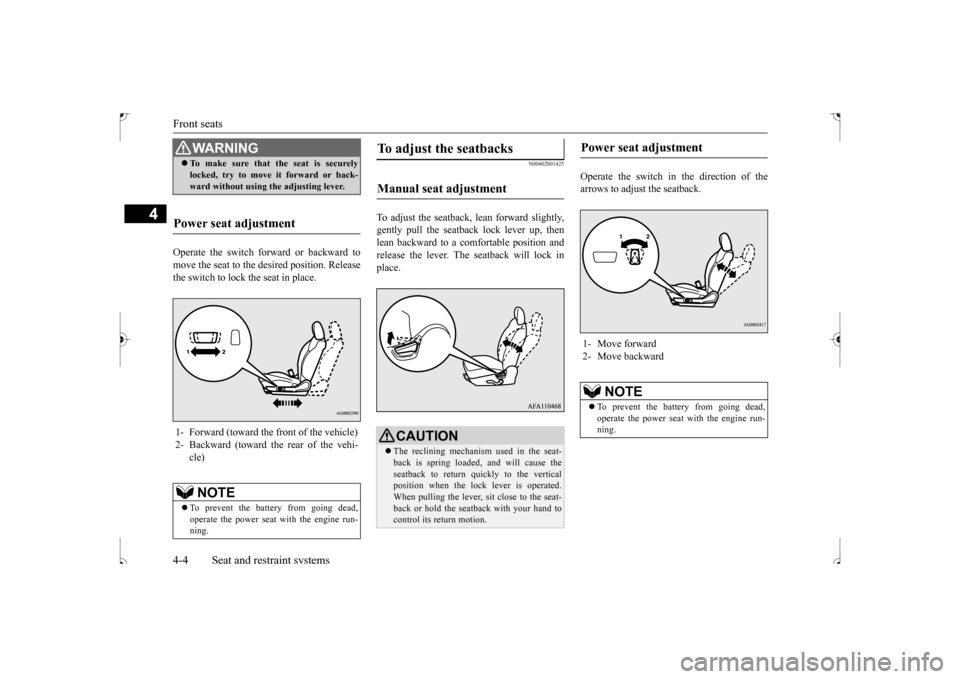
Operate the switch forward or backward to move the seat to the desired position. Releasethe switch to lock the seat in place.
N00402001425
To adjust the seatback,
lean forward slightly,
gently pull the seatb
ack lock lever up, then
lean backward to a comfortable position and release the lever. The seatback will lock in place.
Operate the switch in the direction of the arrows to adjust the seatback.
WA R N I N G To make sure that the seat is securely locked, try to move it forward or back- ward without using the adjusting lever.
Power seat adjustment 1- Forward (toward the front of the vehicle) 2- Backward (toward the rear of the vehi-
cle)NOTE
To prevent the battery from going dead, operate the power seat with the engine run- ning.
To adjust the seatbacks Manual seat adjustment
CAUTION The reclining mechanism used in the seat- back is spring loaded, and will cause the seatback to return quickly to the vertical position when the lock lever is operated.When pulling the lever, sit close to the seat- back or hold the seatback with your hand to control its return motion.
Power seat adjustment 1- Move forward 2- Move backward
NOTE
To prevent the battery from going dead, operate the power seat with the engine run- ning.
BK0239500US.bo
ok 4 ページ 2016年5月13日 金曜日 午前8時53分
Page 26 of 399
Front seats
Seat and restraint systems 4-5
4
N00402101282
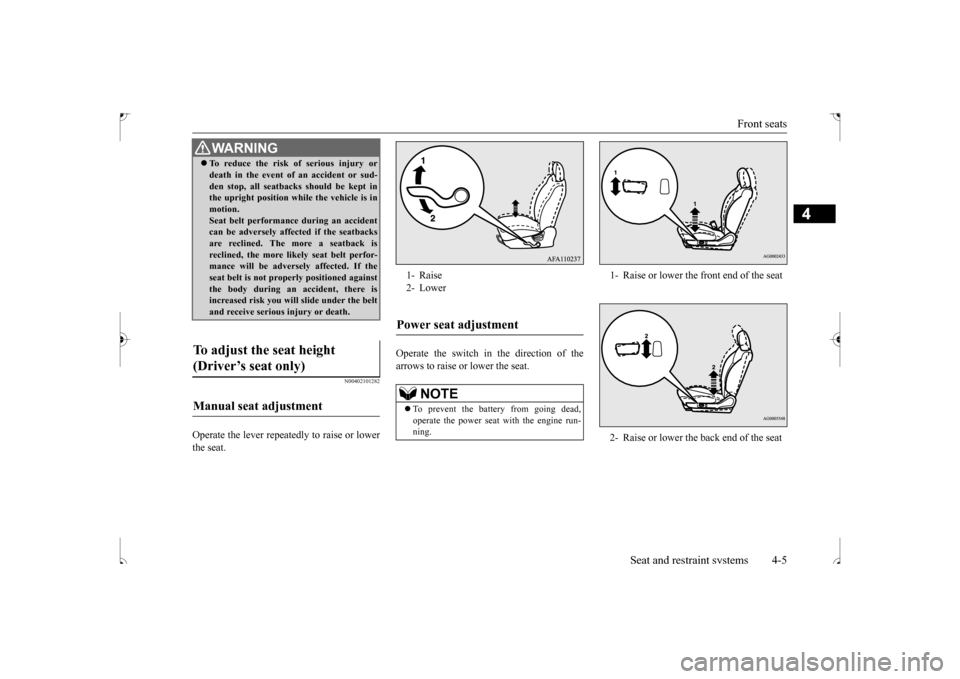
Operate the lever repeatedly to raise or lower the seat.
Operate the switch in the direction of the arrows to raise or lower the seat.
WA R N I N G To reduce the risk of serious injury or death in the event of an accident or sud- den stop, all seatbacks should be kept in the upright position while the vehicle is in motion.Seat belt performance during an accident can be adversely affected if the seatbacks are reclined. The more a seatback isreclined, the more likely seat belt perfor- mance will be adversely affected. If the seat belt is not properly positioned againstthe body during an accident, there is increased risk you will slide under the belt and receive serious injury or death.
To adjust the seat height (Driver’s seat only) Manual seat adjustment
1- Raise 2- LowerPower seat adjustment
NOTE
To prevent the battery from going dead, operate the power seat with the engine run-ning.
1- Raise or lower the front end of the seat 2- Raise or lower the back end of the seat
BK0239500US.bo
ok 5 ページ 2016年5月13日 金曜日 午前8時53分
Page 37 of 399
Seat belts 4-16 Seat and restraint systems
4
N00418400342
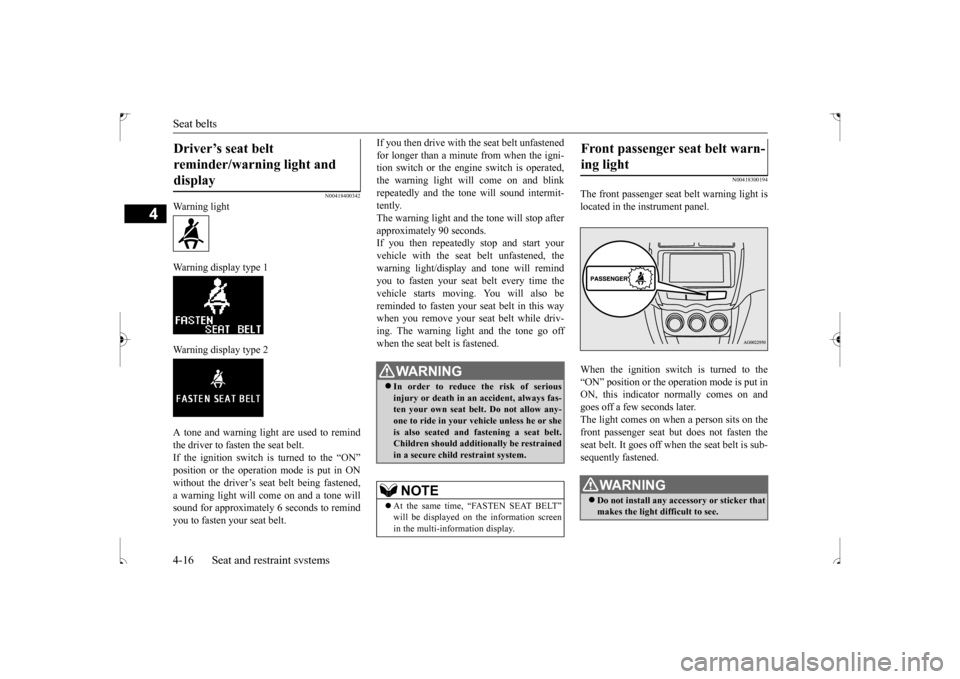
Warning light Warning display type 1 Warning display type 2 A tone and warning light are used to remind the driver to fasten the seat belt.If the ignition switch is turned to the “ON” position or the operation mode is put in ON without the driver’s seat belt being fastened,a warning light will come on and a tone will sound for approximately 6 seconds to remind you to fasten your seat belt.
If you then drive with the seat belt unfastened for longer than a minute from when the igni- tion switch or the engine switch is operated, the warning light will come on and blinkrepeatedly and the tone will sound intermit- tently. The warning light and the tone will stop afterapproximately 90 seconds. If you then repeatedly stop and start your vehicle with the seat belt unfastened, thewarning light/display and tone will remindyou to fasten your seat belt every time the vehicle starts moving. You will also be reminded to fasten your seat belt in this waywhen you remove your seat belt while driv- ing. The warning light and the tone go off when the seat belt is fastened.
N00418300194
The front passenger seat belt warning light islocated in the instrument panel. When the ignition switch is turned to the “ON” position or the operation mode is put inON, this indicator normally comes on andgoes off a few seconds later. The light comes on when a person sits on the front passenger seat but does not fasten theseat belt. It goes off when the seat belt is sub- sequently fastened.
Driver’s seat belt reminder/warning light and display
WA R N I N G In order to reduce the risk of serious injury or death in an accident, always fas- ten your own seat belt. Do not allow any-one to ride in your vehicle unless he or she is also seated and fastening a seat belt. Children should additionally be restrained in a secure child restraint system.NOTE
At the same time, “FASTEN SEAT BELT” will be displayed on the information screen in the multi-information display.
Front passenger seat belt warn- ing light
WA R N I N G Do not install any accessory or sticker that makes the light difficult to see.
BK0239500US.bo
ok 16 ページ 2016年5月13日 金曜日 午前8時53分
Page 64 of 399
5
Features and controlsBreak-in recommendation
s ..............................................................5-3
Keys ..........................................
.......................................................5-3
Electronic immobilizer (Anti-thef
t starting system) ........................5-4
Keyless entry system (if so equipped) ..............................................5-7Free-hand Advanced Security Transmitter (F.A.S.T.-key) (if so equipped)
.................................................
........................5-12
Door locks .......................
...............................................................5-28
Power door locks ............
...............................................................5-30
Child safety locks for r
ear door .....................................................5-31
Liftgate ......................................
.....................................................5-32
Inside liftgate releas
e .............................................
........................5-33
Theft-alarm system
................................................
........................5-34
Power window control
...........................................
........................5-37
Sunshade (if so equi
pped)..............................................................5-39
Parking brake ..................
...............................................................5-40
Steering wheel height and reach adjustment ..................................5-41Inside rearview mirro
r ...........................................
........................5-42
Outside rearview mirr
ors ...............................................................5-44
Ignition switch ......
.................................................
........................5-46
Starting the engine
.................................................
........................5-47
Manual transaxle (if so equipped) .................................................5-49 Continuously variable transmission
(CVT) (if so equipped).........5-51
Electronically controlled 4WD system (if so equipped)................5-584-wheel drive operation
.........................................
........................5-60
Inspection and maintenance following rough road operation ........5-63 Cautions on the handling of 4-wheel drive vehicles ......................5-63Service brake ..................
...............................................................5-64
Hill start assist .......
.................................................
........................5-65
Brake assist system
...............................................
......................... 5-66
Anti-lock braking syst
em .....................................
......................... 5-67
Electric power steering syst
em (EPS) ........................................... 5-69
Active stability control
(ASC) ....................
................................... 5-70
Cruise control (if so eq
uipped) ...................................................... 5-73
Tire pressure monitoring
system ................................................... 5-77
Rear-view camera (if so eq
uipped) ................................................ 5-81
Instrument cluster
.................................................
......................... 5-83
Multi-information disp
lay ....................................
......................... 5-85
Indicator light, warning light, and information screen disp
lay list ................................................. 5-106
Indicators .................................
.................................................... 5-119
Warning lights ................
.................................................
............. 5-120
Information screen disp
lay ...................................
....................... 5-121
Combination headlights and dimmer switch ............................... 5-123 Headlight leveling switch (if so equipped).................................. 5-129Turn signal lever ..
.................................................
....................... 5-129
Hazard warning flasher
switch .................................................... 5-130
Front fog light switch (if
so equipped) ........................................ 5-130
Wiper and washer swit
ch ......................................
....................... 5-130
Electric rear window def
ogger switch ......................................... 5-136
Horn switch .............................
.................................................... 5-136
Link System (if so equi
pped) .....................
................................. 5-137
Bluetooth
® 2.0 interface (if so
equipped)..................................... 5-137
USB input terminal (if so
equipped) ........................................... 5-160
Sun visors ......................
.................................................
............. 5-163
12 V power outlets .........
.................................................
............. 5-164
HomeLink
® Wireless Control System (if so equipped) ............... 5-165
BK0239500US.bo
ok 1 ページ 2016年5月13日 金曜日 午前8時53分
Page 66 of 399
Break-in recommendations
Features and controls 5-3
5
N00508700330
Advanced automobile manufacturing tech- niques permit you to operate your new vehi-cle without requiring a long break-in period of low-speed driving. However, you can add to the future perfor-mance and economy of your vehicle by observing the following precautions during the first 300 miles (500 km).Drive your vehicle at moderate speeds duringthe break-in period. Avoid revving the engine. Avoid rough driving such as sudden starts, sudden acceleration, prolonged high-speed driving and sudden braking. These would have a detrimental effect on the engine and also cause increased fuel andoil consumption, which could result in malfunction of the engine components. Be particularly careful to avoid full accelera-tion while in low shift position (low gears). Do not overload the vehicle. Stay within the seating capacity. (Refer to “Cargo load precautions” on page 6-10.) Do not use this vehicle for trailer towing.
N00508801660
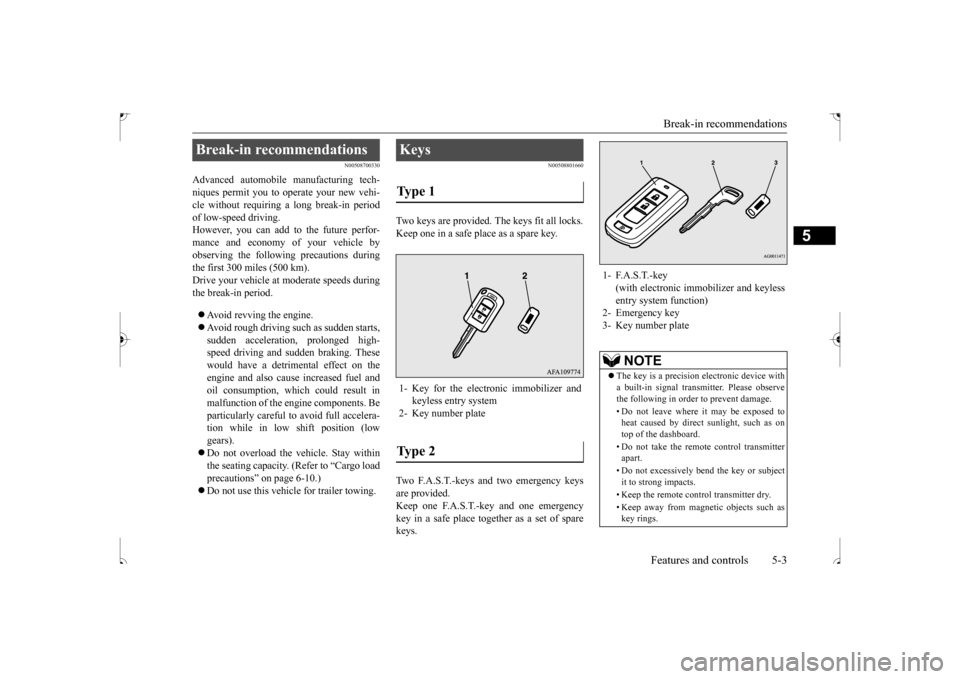
Two keys are provided. The keys fit all locks. Keep one in a safe place as a spare key. Two F.A.S.T.-keys and two emergency keys are provided. Keep one F.A.S.T.-key and one emergencykey in a safe place together as a set of spare keys.
Break-in recommendations
Keys Type 1 1- Key for the electronic immobilizer and
keyless entry system
2- Key number plateType 2
1- F.A.S.T.-key
(with electronic immob
ilizer and keyless
entry system function)
2- Emergency key 3- Key number plate
NOTE
The key is a precision electronic device with a built-in signal transmitter. Please observe the following in order to prevent damage. • Do not leave where it may be exposed to heat caused by direct sunlight, such as ontop of the dashboard. • Do not take the remote control transmitter apart. • Do not excessively bend the key or subject it to strong impacts. • Keep the remote control transmitter dry.• Keep away from magnetic objects such as key rings.
BK0239500US.bo
ok 3 ページ 2016年5月13日 金曜日 午前8時53分
Page 67 of 399
![MITSUBISHI OUTLANDER SPORT 2017 3.G User Guide Electronic immobilizer (Anti-theft starting system) 5-4 Features and controls
5
N00509101862
[For vehicles equipped with the Free-hand Advanced Security Transmitter (F.A.S.T.- key)] For information on](/img/19/7550/w960_7550-66.png "MITSUBISHI OUTLANDER SPORT 2017 3.G User Guide Electronic immobilizer (Anti-theft starting system) 5-4 Features and controls
5
N00509101862
[For vehicles equipped with the Free-hand Advanced Security Transmitter (F.A.S.T.- key)] For information on")
Electronic immobilizer (Anti-theft starting system) 5-4 Features and controls
5
N00509101862
[For vehicles equipped with the Free-hand Advanced Security Transmitter (F.A.S.T.- key)] For information on operations for vehiclesequipped with the Free-hand Advanced Secu- rity Transmitter (F.A.S.T.-key), refer to “Free-hand Advanced Security Transmitter(F.A.S.T.-key): Electronic immobilizer (Anti- theft starting system)” on page 5-23. [Except for vehicles equipped with the Free- hand Advanced Security Transmitter(F.A.S.T.-key)] The electronic immobilizer is designed to sig- nificantly reduce the possibility of vehicletheft. The purpose of the system is to immo- bilize the vehicle if an invalid start is
attempted. A valid start attempt can only be achieved (subject to certain conditions) using a key “registered” to the immobilizer system. All of the keys provided with your new vehi-cle have been programmed to the vehicle’s electronics.
• Keep away from devices that produce mag- netism, such as audio systems, computers and televisions. • Keep away from devices that emit strong electromagnetic waves, such as cellular phones, wireless devices and high fre- quency equipment (including medicaldevices). • Do not clean with ultrasonic cleaners.• Do not leave the key where it may be exposed to high temperature or high humid-ity.
If you lose your key, to prevent the theft of the vehicle immediately contact an autho- rized Mitsubishi Motors dealer. If you notify an authorized MitsubishiMotors dealer of the key number, they can make a new key. The key number is stamped on the key number plate. Keep the key num-ber plate in a safe place separate from the key itself. No keys other than those registered in advance can be used to start the engine. Refer to “Electronic immobilizer (Anti-theftstarting system)” on page 5-4. Refer to “Free-hand Advanced Security Transmitter (F.A.S.T.-key): “Electronic immobilizer (Anti-theft starting system)” on page 5-23.NOTE
When the theft-alarm is in the system opera- tional status, the alarm operates if a door or liftgate is opened after using the key, the door lock knob or the power door lock switch to unlock the vehicle. The system does not enter the preparation status if the keyless entry system or theF.A.S.T.-key was not used to lock the vehi- cle.
Electronic immobilizer (Anti-theft starting system)
NOTE
NOTE
In the following cases, the vehicle may not be able to recognize the registered ID code from the key. This means the engine will not start even when the key is turned to the“START” position. • When the key contacts a key ring or other metallic or magnetic object
BK0239500US.bo
ok 4 ページ 2016年5月13日 金曜日 午前8時53分
Page 68 of 399
Electronic immobilizer (Ant
i-theft starting system)
Features and controls 5-5
5
Only keys that have been programmed to the vehicle’s electronics can be used to start the vehicle. If you lose the key, you can order a key from your authorized Mitsubishi Motors dealer byreferring to the key number. To prevent vehicle theft, the ID code for the vehicle keys must be changed.
Take your vehicle and all remaining keys to your authorized Mitsubishi Motors dealer to have your ID code changed. To add a key, you must already have 2 regis- tered keys. You need to register the ID code to the vehicle.Registering the ID code can be done by your-self (except for vehicles sold in Canada), or by your authorized Mitsubishi Motors dealer. For you to register the ID code yourself, fol-low the “Customer key programming” proce- dure below. If you choose to have your authorizedMitsubishi Motors dealer register the ID code, take your vehicle and all remaining keys to your authorized Mitsubishi Motorsdealer.
• When the key grip contacts metal of another key • When the key contacts or is close to other immobilizer keys (including keys of othervehicles)
In cases like the above, move the offending object(s) away from the key and turn the key back to the “ACC” or “OFF” position. Then try to start the engine again. If the enginedoes not start, contact an authorized Mitsubishi Motors dealer. The key may not operate properly when it is near an object or facility that emits strong electromagnetic waves.NOTE
Electronic immobilizer is not compatible with commercially available remote starting systems. Use of commercially available remote starting systems may result in vehicle starting problems and a lo
ss of security pro-
tection. A system failure is suspected when the igni- tion switch is turned to the “START” posi- tion, and the engine does not start. In such a case, contact an authorized MitsubishiMotors dealer.CAUTION Do not make any alterations or additions to the immobilizer system. Alterations or addi- tions could cause failure of the immobilizer.
Replacement keys
NOTE
Additional keys
NOTE
You are provided with 2 keys, but you may register up to 8 keys.
BK0239500US.bo
ok 5 ページ 2016年5月13日 金曜日 午前8時53分
Page 75 of 399
Free-hand Advanced Security Transmitte
r (F.A.S.T.-key) (if so equipped)
5-12 Features and controls
5
N00503100111
The Free-hand Advanced Security Transmit- ter (F.A.S.T.-key) enables the doors and the liftgate to be locked and unlocked, the engine to be started and the operation mode to bechanged simply by carrying it.The F.A.S.T.-key can also be used as the remote control transmitter of the keyless entry system.Refer to “Free-hand Advanced Security Transmitter (F.A.S.T.-key): Keyless entry system” on page 5-25.
The operations possible with the F.A.S.T.- key can be modified as stated below. (Keyless entry operations are possible.)For details, contact an authorized Mitsubishi Motors dealer. • Enabling only the locking and unlockingof the doors and the liftgate • Enabling only the starting of the engine • Deactivating the F.A.S.T.-key
Free-hand Advanced Secu- rity Transmitter (F.A.S.T.-key)
(if so equipped)
The F.A.S.T.-key must be carried by the driver. The F.A.S.T.-key is required for vehicle operations such as locking and unlocking the doors and the liftgate, starting the engine, and changing the operation mode. When leaving the vehi-cle, make sure you are carrying the F.A.S.T.-key and then lock the vehicle.
WA R N I N G Individuals who use implantable pace- makers or implantable cardiovascular- defibrillators should keep away from the external and internal
transmitters. The
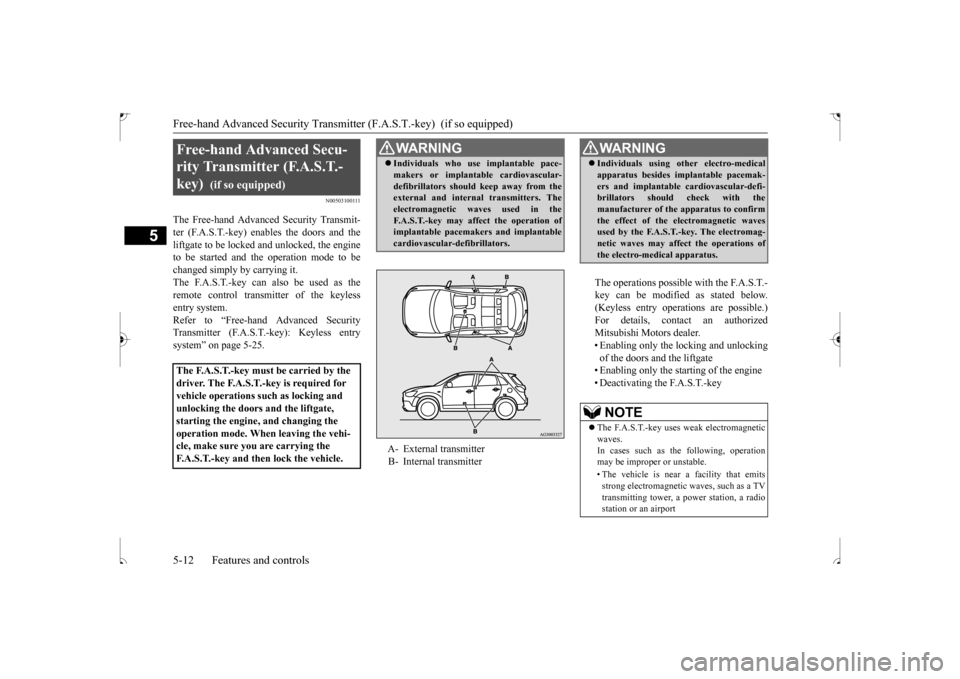
electromagnetic waves used in theF.A.S.T.-key may affect the operation of implantable pacemakers and implantable cardiovascular-defibrillators.A- External transmitter B- Internal transmitter
WA R N I N G Individuals using other electro-medical apparatus besides implantable pacemak- ers and implantable cardiovascular-defi- brillators should check with the manufacturer of the apparatus to confirmthe effect of the electromagnetic waves used by the F.A.S.T.-key. The electromag- netic waves may affect the operations ofthe electro-medical apparatus.NOTE
The F.A.S.T.-key uses weak electromagnetic waves. In cases such as the following, operation may be improper or unstable. • The vehicle is near a facility that emits strong electromagnetic waves, such as a TV transmitting tower, a power station, a radiostation or an airport
BK0239500US.bo
ok 12 ページ 2016年5月13日 金曜日 午前8時53分