light MITSUBISHI OUTLANDER SPORT 2017 3.G User Guide
[x] Cancel search | Manufacturer: MITSUBISHI, Model Year: 2017, Model line: OUTLANDER SPORT, Model: MITSUBISHI OUTLANDER SPORT 2017 3.GPages: 399, PDF Size: 14.61 MB
Page 20 of 399
Modifications to and racing of your vehicle
General information 3-5
3
7. To close, turn the fuel tank filler pipe cap slowly clockwise until you hear clicking sounds, then gently push the fuel tank filler door closed.
N00301600149
This vehicle should not be modified withnon-Mitsubishi Motors genuine parts.Mitsubishi Motors designs and manufactures high quality vehicles
with an emphasis on
safety and durability. Modifications usingnon-Mitsubishi Motors genuine parts may affect the performance, safety and/or durabil- ity of your vehicle, and may violate applica-ble state and/or federal regulations. DAMAGE OR PERFORMANCE PROB- LEMS RESULTING FROM MODIFICA- TIONS TO OR RACING OF YOUR VEHICLE ARE NOT COVEREDUNDER WARRANTY. Examples of modifications to your vehicle that can cause damage or performance prob- lems include the following: Failure to use Mitsubishi Motors genuine parts Failure to use required fuel and fluids Failure to use proper size tires and wheels Modification of the fuel, intake, exhaust, emission, suspension, engine, drive train or electrical wiring systems
Modification of any onboard com- puter/control module, including repro- gramming, or replacing/adding chips to any onboard computer/control module
Review the Warranty and Maintenance Man- ual for further details regarding warranty cov- erage.
N00301701222
The installation of accessories, optional parts, etc., should only be carried out within the limits prescribed by law, and in accordance with the guidelines and warn-ings contained within the documents accompanying this vehicle.
WA R N I N G Make sure the fuel tank filler cap is securely closed. If the fuel cap were loose, fuel could leak, resulting in a fire.CAUTION If you need to replace the fuel tank filler cap, use only the cap specified for your model vehicle.NOTE
If the fuel tank filler cap
is not tight while
driving, the engine malfunction indicator (“SERVICE ENGINE SOON” or “Checkengine light”) may come on when the onboard diagnostic (OBD) system performs a self check. Always tighten the fuel tank filler cap until you hear at least 3 clicks.The indicator will go off after driving several times. If the indicator does not go off, con- tact your authorized Mitsubishi Motorsdealer or a repair f
acility of your choice as
soon as possible.
Modifications to and racing of your vehicle
Installation of accessories
CAUTION Before any electrical or electronic accesso- ries are installed, consult an authorized Mitsubishi Motors dealer. Your vehicle is equipped with a diagnosis connector (data link connector) for checkingand servicing the electronic control system. Mitsubishi Motors does not recommend con- necting a device other than the Scan Tool forinspections and service to this connector because an unexpected problem could result. In addition, malfunctions caused by connect-ing a device other than the Scan Tool may not be covered under warranty.
BK0239500US.bo
ok 5 ページ 2016年5月13日 金曜日 午前8時53分
Page 25 of 399
Front seats 4-4 Seat and restraint systems
4
Operate the switch forward or backward to move the seat to the desired position. Releasethe switch to lock the seat in place.
N00402001425
To adjust the seatback,
lean forward slightly,
gently pull the seatb
ack lock lever up, then
lean backward to a comfortable position and release the lever. The seatback will lock in place.
Operate the switch in the direction of the arrows to adjust the seatback.
WA R N I N G To make sure that the seat is securely locked, try to move it forward or back- ward without using the adjusting lever.
Power seat adjustment 1- Forward (toward the front of the vehicle) 2- Backward (toward the rear of the vehi-
cle)NOTE
To prevent the battery from going dead, operate the power seat with the engine run- ning.
To adjust the seatbacks Manual seat adjustment
CAUTION The reclining mechanism used in the seat- back is spring loaded, and will cause the seatback to return quickly to the vertical position when the lock lever is operated.When pulling the lever, sit close to the seat- back or hold the seatback with your hand to control its return motion.
Power seat adjustment 1- Move forward 2- Move backward
NOTE
To prevent the battery from going dead, operate the power seat with the engine run- ning.
BK0239500US.bo
ok 4 ページ 2016年5月13日 金曜日 午前8時53分
Page 27 of 399
Front seats 4-6 Seat and restraint systems
4
N00402300069
The lid on the floor console box can be moved forward and backward and used as an arm rest.
N00435601405
The heated seats can be operated by pushingthe switch when the ignition switch or theoperation mode is in ON. The indicator light (A) will illuminate while
the heater is on.
3- Raise or lower the entire seatArm rest
(if so equipped)
Heated seat
(if so equipped)
1 (HI) - Heater high (for quick heating) 2 - Heater off3 (LO) - Heater low (to keep the seat warm)
WA R N I N G Persons who are unable to feel tempera- ture change or skin pain due to age, ill- ness, injury, medication, alcohol use, fatigue or other physical conditions or who have sensitive skin may suffer burnswhen using the heated seat even at low temperatures. To reduce the risk of burns, people with such conditions must use carewhen using the heated seat.CAUTION Switch off the heated seats when not in use. Operate the heaters at the “HI” position forquick heating. After the seat has become warm, set the heater switch to the “LO” posi- tion to keep it warm. Slight variations in theseat temperature may be felt while using the heated seats. This is caused by the operation of the heater’s internal thermostat and doesnot indicate a malfunction. Do not place heavy objects on the seat or stick pins, needles, or other pointed objects into the seat. Do not place a blanket,
cushion, or other
insulating material on the seat while using the heater; doing so can cause the heater ele- ment to overheat. When cleaning the seat, do not use benzine, kerosene, gasoline, alcohol, or other organic solvents; doing so can cause damage notonly to the surface of th
e seat, but also to the
heater.
BK0239500US.bo
ok 6 ページ 2016年5月13日 金曜日 午前8時53分
Page 31 of 399
Extending a luggage compartment 4-10 Seat and restraint systems
4
N00417801069
The passenger and luggage compartments can be joined by folding the seatback forward. This is useful for carrying long objects.The seatbacks can be folded with the rear seat release button.
Push the rear seat release button (A) to fold the seatback forward.The rear outboard seat belt can be separated from the seat belt guide (B) to help prevent damage to the seat belt while the seatback isfolded.
1. If the outboard seat belt has been sepa- rated from the seat belt guide (B), insert it back into the seat belt guide.2. Tilt the seatback up until it is locked prop- erly in position. 3. Make sure the seatback is locked securely in place and the seat belt is passed through the seat belt guide (B).
When adjusting the seats, be careful not to catch your hand or leg. Personal injury could result.NOTE
When the seatback of a front seat is reclined, return it to the upright position before driv- ing.
Folding the rear seatbacks for- ward
NOTE
You can separately fold the right and left side of the seatback.CAUTION
To fold the seatbacks
CAUTION Before folding the driver’s side rear seat- back, detach the center seat belt from the detachable anchor and retract the center seat belt all the way to the rear trim to preventdamage to the seat belt caused by an object in the luggage compartment. For details, refer to page 4-14.
To return the seatbacks
WA R N I N G After returning the seatbacks to their upright positions, make sure that the rear seat belts are in front of the seatbacks, andnot caught behind the seatbacks.NOTE
If the seat belt locks up and cannot be pulled out, pull it once with force and let it retractall the way. Then, pull the belt out slowly once again.WA R N I N G If the red part (C) on the back of the rear seat release button can be seen, the seat- back is not locked firmly in place. Pushand pull lightly on the
seatback to lock it
firmly in place.
BK0239500US.bo
ok 10 ページ 2016年5月13日 金曜日 午前8時53分
Page 37 of 399
Seat belts 4-16 Seat and restraint systems
4
N00418400342
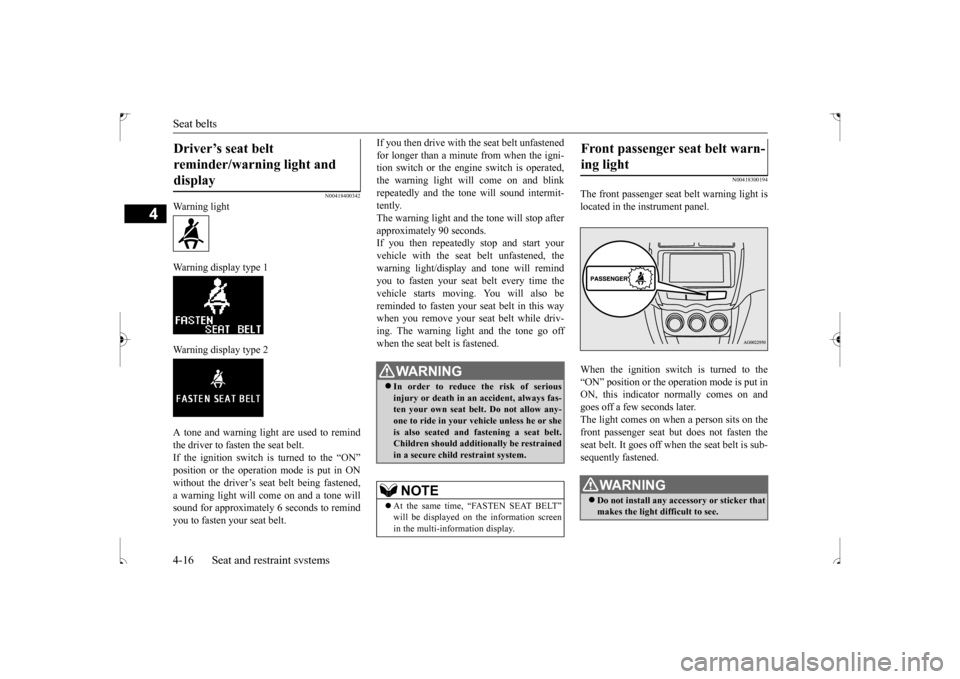
Warning light Warning display type 1 Warning display type 2 A tone and warning light are used to remind the driver to fasten the seat belt.If the ignition switch is turned to the “ON” position or the operation mode is put in ON without the driver’s seat belt being fastened,a warning light will come on and a tone will sound for approximately 6 seconds to remind you to fasten your seat belt.
If you then drive with the seat belt unfastened for longer than a minute from when the igni- tion switch or the engine switch is operated, the warning light will come on and blinkrepeatedly and the tone will sound intermit- tently. The warning light and the tone will stop afterapproximately 90 seconds. If you then repeatedly stop and start your vehicle with the seat belt unfastened, thewarning light/display and tone will remindyou to fasten your seat belt every time the vehicle starts moving. You will also be reminded to fasten your seat belt in this waywhen you remove your seat belt while driv- ing. The warning light and the tone go off when the seat belt is fastened.
N00418300194
The front passenger seat belt warning light islocated in the instrument panel. When the ignition switch is turned to the “ON” position or the operation mode is put inON, this indicator normally comes on andgoes off a few seconds later. The light comes on when a person sits on the front passenger seat but does not fasten theseat belt. It goes off when the seat belt is sub- sequently fastened.
Driver’s seat belt reminder/warning light and display
WA R N I N G In order to reduce the risk of serious injury or death in an accident, always fas- ten your own seat belt. Do not allow any-one to ride in your vehicle unless he or she is also seated and fastening a seat belt. Children should additionally be restrained in a secure child restraint system.NOTE
At the same time, “FASTEN SEAT BELT” will be displayed on the information screen in the multi-information display.
Front passenger seat belt warn- ing light
WA R N I N G Do not install any accessory or sticker that makes the light difficult to see.
BK0239500US.bo
ok 16 ページ 2016年5月13日 金曜日 午前8時53分
Page 39 of 399
Seat belt pre-tensioner and force limiter systems 4-18 Seat and restraint systems
4
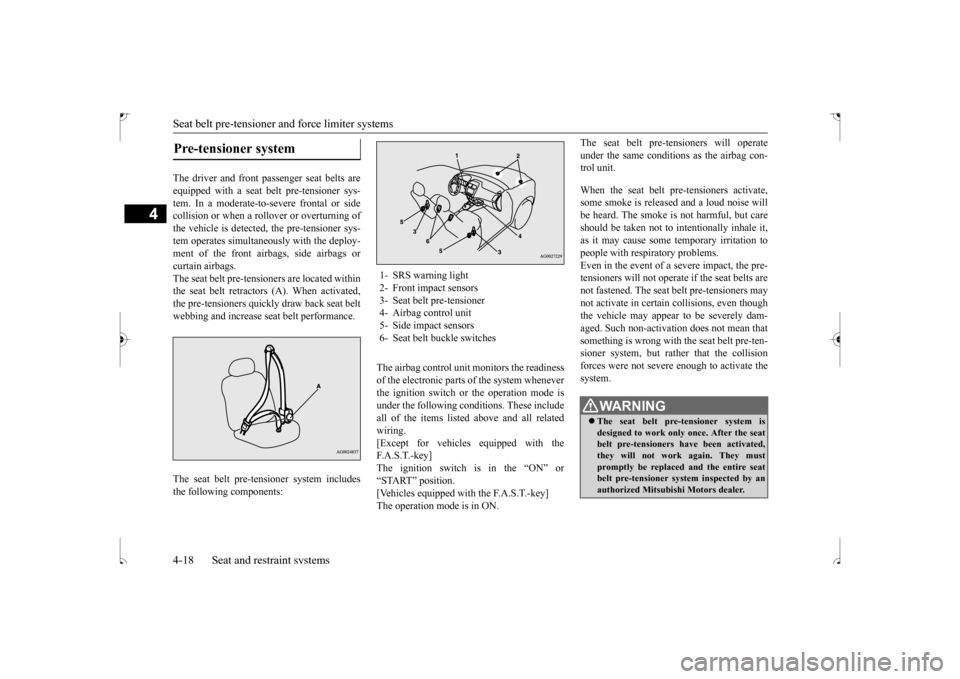
The driver and front passenger seat belts are equipped with a seat belt pre-tensioner sys-tem. In a moderate-to-severe frontal or side collision or when a rollover or overturning of the vehicle is detected, the pre-tensioner sys-tem operates simultaneously with the deploy- ment of the front airbags, side airbags or curtain airbags.The seat belt pre-tensioners are located withinthe seat belt retractors (A). When activated, the pre-tensioners quickly draw back seat belt webbing and increase seat belt performance. The seat belt pre-tensioner system includes the following components:
The airbag control unit monitors the readiness of the electronic parts of the system wheneverthe ignition switch or the operation mode isunder the following conditions. These include all of the items listed above and all related wiring.[Except for vehicles equipped with the F. A . S . T. - k e y ] The ignition switch is in the “ON” or“START” position. [Vehicles equipped with the F.A.S.T.-key] The operation mode is in ON.
The seat belt pre-tensioners will operate under the same conditions as the airbag con- trol unit. When the seat belt pre-tensioners activate, some smoke is released and a loud noise willbe heard. The smoke is not harmful, but care should be taken not to intentionally inhale it, as it may cause some temporary irritation topeople with respiratory problems. Even in the event of a severe impact, the pre- tensioners will not operate if the seat belts arenot fastened. The seat belt pre-tensioners maynot activate in certain collisions, even though the vehicle may appear to be severely dam- aged. Such non-activation does not mean thatsomething is wrong with the seat belt pre-ten- sioner system, but rather that the collision forces were not severe enough to activate thesystem.
Pre-tensioner system
1- SRS warning light2- Front impact sensors3- Seat belt pre-tensioner 4- Airbag control unit 5- Side impact sensors6- Seat belt buckle switches
WA R N I N G The seat belt pre-tensioner system is designed to work only once. After the seat belt pre-tensioners have been activated, they will not work again. They must promptly be replaced and the entire seat belt pre-tensioner system inspected by anauthorized Mitsubishi Motors dealer.
BK0239500US.bo
ok 18 ページ 2016年5月13日 金曜日 午前8時53分
Page 40 of 399
Child restraint systems
Seat and restraint systems 4-19
4
N00408700081
This warning light tells you if there is a prob- lem involving the SRS airbags and the seatbelt pre-tensioner system. Refer to “SRS warning light/display” on page 4-32.
N00408900126
In the event of an accident, the seat belt force limiter system will help reduce the force applied to the driver and front seat passenger.
N00407101724
When transporting infants or small childrenin your vehicle, an appropriate child restraint system must always be used. This is requiredby law in the U.S. and Canada. Child restraint systems specifically designed for infants and small children are offered byseveral manufacturers. Choose only a child restraint system with a label certifying that it complies with Federal Motor Vehicle SafetyStandard 213 (FMVSS 213) or Motor Vehicle Restraint Systems and Booster Seats Safety Regulations (RSSR). Look for the manufac-turer’s statement of compliance on the box and child restraint system itself.
The child restraint system should be appropri- ate for your child’s weight and height, and should properly fit your vehicle’s seat. For detailed information, refer to the instruc-tion manual accompanying the child restraint system. All children should be properly restrained in a restraint device that offers the maximum protection for their size and age.Be sure to check local, state, or provincial requirements for child size and age that may vary from the recommendations listed below. Children less than 1 year old and who weigh 22 pounds (10 kg) or less MUST ride in a rear-facing child safety seat that MUST ONLY be used in the rear seat. Children older than 1
year of age and who
weigh less than 40 pounds (18 kg) or who are less than 40 inches (100 cm) tallMUST be in a forward-facing restraint that MUST ONLY be used in the rear seat.
Children who weigh more than 40 pounds (18 kg) or who are more than 40 inches (100 cm) tall, regardless of age, should use a suitable child seat or a booster seatin the rear seat until the vehicle’s lap-and- shoulder belt fits them properly.
SRS warning Force limiter system Child restraint systems
Guidelines for child restraint system selection
WA R N I N G All children must be seated in the rear seat, and properly restrained. Accident statistics show that children of all sizes and ages are safer when properlyrestrained in the rear seat, rather than in the front seat. Any child who is too large to use a child restraint system should ride in the rear seat and wear the lap-and-shoulder beltproperly. The shoulder belt must be posi- tioned over the shoulder and across the chest, not across their neck, and with thelap belt positioned low on the child’s hips, not across their stomach. If necessary, a booster seat should be used to help achievea proper seat belt fit. Follow the booster seat manufacturer’s instructions. Only use a booster seat that is certified as comply-ing with Federal Motor Vehicle Safety Standards or Motor Vehicle Restraint Systems and Booster Seats Safety Regula- tions.
BK0239500US.bo
ok 19 ページ 2016年5月13日 金曜日 午前8時53分
Page 47 of 399
Maintenance and inspection of seat belts 4-26 Seat and restraint systems
4
N00407001374
Regularly check your seat belt buckles and their release mechanisms for positive engage-ment and release of the latch plate. Check the retractors for automatic locking when in the Automatic Locking Retractor function. The entire seat belt assembly should be replaced if the webbing shows any obviouscuts, tears, increase in thickness in any sec- tion of the webbing from broken fibers, or severe fading from sunlight. All of these con-ditions indicate a weakening of the belt, which may adversely affect seat belt perfor- mance in an accident.
N00407701762
This vehicle is equipped with a SupplementalRestraint System (SRS), which includes air-bags for the driver and passengers. The SRS front airbags are designed to supple- ment the primary protection of the driver and front passenger seat belt systems by provid-ing those occupants with protection against head and chest injuries in certain moderate to severe frontal collisions. The SRS front air-bags, together with sensors at the front of the vehicle and sensors attached to the front seats, form an advanced airbag system. The SRS driver’s knee airbag is designed to supplement the primary protection of the
driver’s seat belt system. It can reduce the forward movement of the driver’s lower legs and provide increased overall body protection in certain moderate to severe frontal colli-sions. The SRS side airbags and the curtain airbags are also designed to supplement the seat belts. The SRS side airbags provide the driver andfront passenger with protection against chest injuries by deploying the bag on the side impacted in moderate to severe side impactcollisions. The SRS curtain airbags providethe driver and the passengers on the front seat and the rear outboard seats with protection against head injuries by deploying the curtainairbag on the side impacted in moderate to severe side impact collisions and by deploy- ing both curtain airbags when a rollover isdetected. The curtain airbags are also designed to help reduce the risk of complete and partial ejection from the vehicle throughside windows in both side impact and roll- over type accidents. The SRS airbags are NOT
a substitute for use
of the seat belts. For maximum protection inall types of accidents, seat belts must ALWAYS be worn by everyone who drives or rides in this vehicl
e (with infants and small
children in an appropriate child restraint sys- tem in the rear seat, and older children buck- led in the rear seat). Refer to “Child restraint
Maintenance and inspection of seat belts
WA R N I N G Do not attempt to repair or replace any part of the seat belt assemblies. This work should be done by an authorizedMitsubishi Motors dealer. Failure to have an authorized Mitsubishi Motors dealer perform the work could reduce the effec- tiveness of the belts and could result in a serious injury or death in an accident.
Never use an organic solvent to clean the seat belt webbing. Do not attempt to bleach or re-dye the seat belt webbing. These may weaken the seat belt webbing, increasing risk of injury or death in anaccident. Clean seat belt webbing only with mild soap or detergent solution and rinse itwith lukewarm water, and dry the seat belt webbing completely before retracting it.
Supplemental Restraint Sys- tem (SRS) - airbag
WA R N I N G
BK0239500US.bo
ok 26 ページ 2016年5月13日 金曜日 午前8時53分
Page 50 of 399
Supplemental Restraint System (SRS) - airbag
Seat and restraint systems 4-29
4
N00407800450
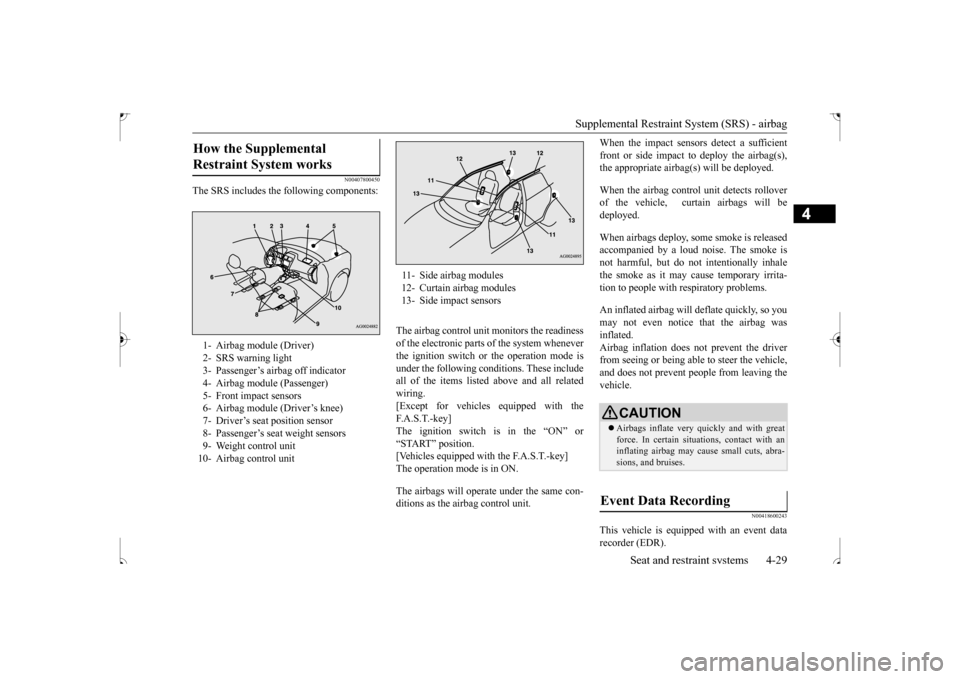
The SRS includes the following components:
The airbag control unit monitors the readiness of the electronic parts of the system whenever the ignition switch or the operation mode is under the following conditions. These includeall of the items listed above and all relatedwiring. [Except for vehicles equipped with the F. A . S . T. - k e y ] The ignition switch is in the “ON” or “START” position. [Vehicles equipped with the F.A.S.T.-key]The operation mode is in ON. The airbags will operate under the same con- ditions as the airbag control unit.
When the impact sensors detect a sufficient front or side impact to deploy the airbag(s), the appropriate airbag(s) will be deployed. When the airbag control unit detects rollover of the vehicle, curtain airbags will bedeployed. When airbags deploy, some smoke is released accompanied by a loud noise. The smoke is not harmful, but do not intentionally inhalethe smoke as it may cause temporary irrita-tion to people with respiratory problems. An inflated airbag will deflate quickly, so you may not even notice that the airbag was inflated.Airbag inflation does not prevent the driver from seeing or being able to steer the vehicle, and does not prevent people from leaving thevehicle.
N00418600243
This vehicle is equipped with an event datarecorder (EDR).
How the Supplemental Restraint System works 1- Airbag module (Driver) 2- SRS warning light3- Passenger’s airbag off indicator4- Airbag module (Passenger) 5- Front impact sensors 6- Airbag module (Driver’s knee)7- Driver’s seat position sensor 8- Passenger’s seat weight sensors 9- Weight control unit10- Airbag control unit
11- Side airbag modules12- Curtain airbag modules13- Side impact sensors
CAUTION Airbags inflate very quickly and with great force. In certain situations, contact with an inflating airbag may cause small cuts, abra- sions, and bruises.
Event Data Recording
BK0239500US.bo
ok 29 ページ 2016年5月13日 金曜日 午前8時53分
Page 51 of 399
Supplemental Restraint System (SRS) - airbag 4-30 Seat and restraint systems
4
The main purpose of an EDR is to record, in certain crash or near crash-like situations, such as an airbag deployment or hitting a road obstacle, data that will assist in under-standing how a vehicle’s systems performed. The EDR is designed to record data related to vehicle dynamics and safety systems for ashort period of time, typically 30 seconds or less. The EDR in this vehicle is designed to record such data as: How various systems in your vehicle were operating; Whether or not the driver and passenger safety belts were buckled/fastened; How far (if at all) the driver was depress- ing the accelerator and/or brake pedal; and, How fast the vehicle was traveling.
These data can help provide a better under- standing of the circumstances in which crashes and injuries occur.
To read data recorded by an EDR, special equipment is required, and access to the vehi- cle or the EDR is needed. In addition to the vehicle manufacturer, other parties, such aslaw enforcement, that have the special equip- ment, can read the information if they have access to the vehicle or the EDR.
N00417900177
The driver’s seat position sensor is attachedto the seat rail and provides the airbag controlunit with information on the seat’s fore-aft position. The airbag control unit controls deployment of the driver’s front airbag inaccordance with the information it receives from this sensor. If there is a problem involving the driver’sseat position sensor, the SRS warning light in the instrument panel will come on. Refer to
“SRS warning light/display” on page 4-32.
N00418000322
The passenger’s seat weight sensors are attached to the seat rails and provide the air- bag control unit with information regarding the weight on the front passenger seat. Theairbag control unit controls deployment of the passenger’s front airbag in accordance with the information it receives from this sensor.
NOTE
EDR data are recorded by your vehicle only if a non-trivial crash situation occurs; no data are recorded by the EDR under normal driv- ing conditions and no personal data (e.g., name, gender, age, and crash location) arerecorded. However, other parties, such as law enforcement, could combine the EDR data with the type of personally identifyingdata routinely acquired during a crash inves- tigation.
Driver’s seat position sensor
WA R N I N G If the SRS warning light or warning dis- play comes on, have the vehicle inspectedby an authorized Mitsubishi Motors dealer as soon as possible. Please observe the following instructions to ensure that the driver’s seat position sensor can operate correctly.• Adjust the seat to the correct position,and sit well back against the seatback.Refer to “Front seats” on page 4-3.• Do not recline the seatback more thannecessary when driving.• Do not place metallic objects or luggageunder the front seat.
If the vehicle is involved in a severe impact, have the SRS sensors inspected by an authorized Mitsubishi Motors dealer as soon as possible.
Passenger’s seat weight sensors
BK0239500US.bo
ok 30 ページ 2016年5月13日 金曜日 午前8時53分