ABS MITSUBISHI OUTLANDER SPORT 2017 3.G Owners Manual
[x] Cancel search | Manufacturer: MITSUBISHI, Model Year: 2017, Model line: OUTLANDER SPORT, Model: MITSUBISHI OUTLANDER SPORT 2017 3.GPages: 399, PDF Size: 14.61 MB
Page 55 of 399
Supplemental Restraint System (SRS) - airbag 4-34 Seat and restraint systems
4
N00408000592
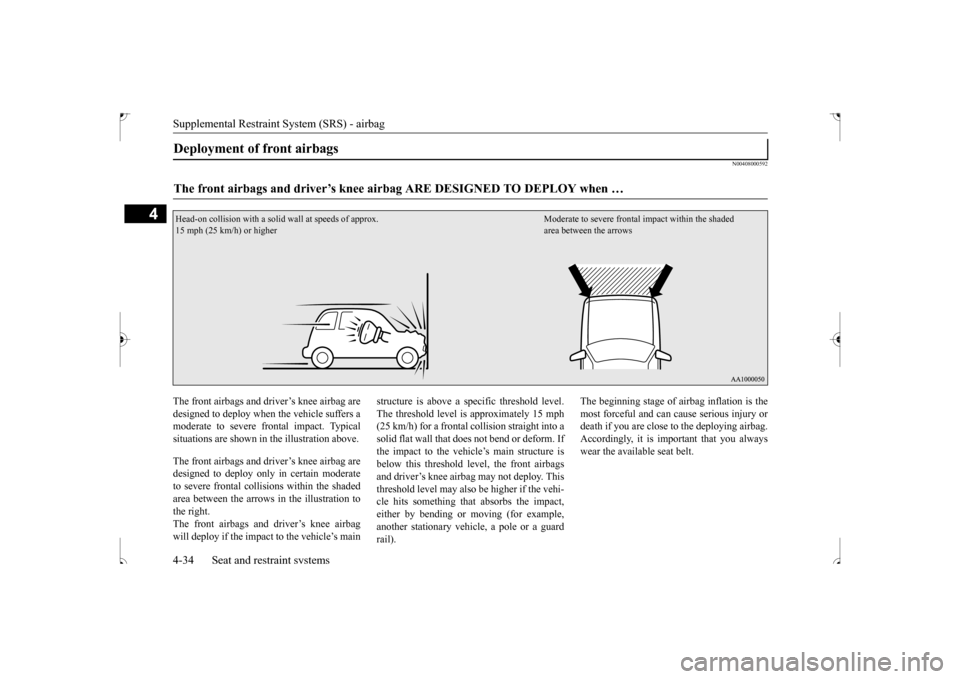
The front airbags and driver’s knee airbag are designed to deploy when the vehicle suffers a moderate to severe frontal impact. Typical situations are shown in the illustration above. The front airbags and driver’s knee airbag are designed to deploy only in certain moderate to severe frontal collisions within the shaded area between the arrows in the illustration tothe right. The front airbags and driver’s knee airbag will deploy if the impact to the vehicle’s main
structure is above a specific threshold level. The threshold level is approximately 15 mph (25 km/h) for a frontal collision straight into a solid flat wall that does not bend or deform. Ifthe impact to the vehicle’s main structure is below this threshold level, the front airbags and driver’s knee airbag
may not deploy. This
threshold level may also be higher if the vehi- cle hits something that absorbs the impact, either by bending or moving (for example,another stationary vehicle, a pole or a guardrail).
The beginning stage of airbag inflation is the most forceful and can cause serious injury or death if you are close to
the deploying airbag.
Accordingly, it is important that you alwayswear the available seat belt.
Deployment of front airbags The front airbags and driver’s knee airb
ag ARE DESIGNED TO DEPLOY when …
Head-on collision with a solid
wall at speeds of approx.
15 mph (25 k
m/h) or higher
Moderate to severe frontal impact within the shaded area between the arrows
BK0239500US.bo
ok 34 ページ 2016年5月13日 金曜日 午前8時53分
Page 56 of 399
Supplemental Restraint System (SRS) - airbag
Seat and restraint systems 4-35
4
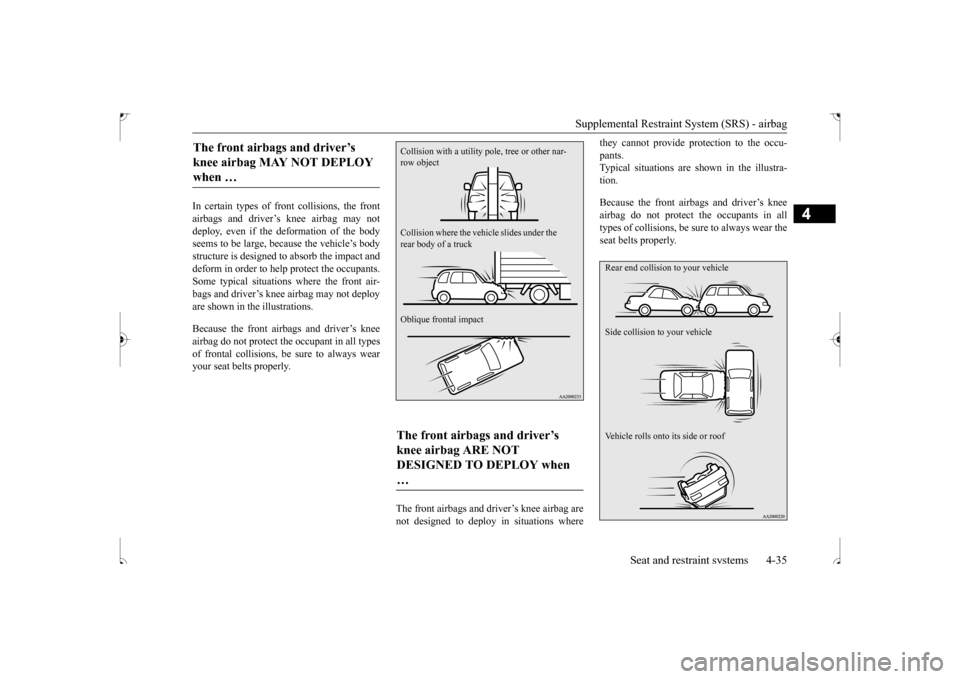
In certain types of front collisions, the front airbags and driver’s knee airbag may not deploy, even if the deformation of the body seems to be large, because the vehicle’s bodystructure is designed to absorb the impact and deform in order to help protect the occupants. Some typical situations where the front air-bags and driver’s knee airbag may not deployare shown in the illustrations. Because the front airbags and driver’s knee airbag do not protect the occupant in all types of frontal collisions, be sure to always wearyour seat belts properly.
The front airbags and driver’s knee airbag are not designed to deploy in situations where
they cannot provide protection to the occu- pants. Typical situations are shown in the illustra- tion. Because the front airbags and driver’s knee airbag do not protect the occupants in all types of collisions, be sure to always wear the seat belts properly.
The front airbags and driver’s knee airbag MAY NOT DEPLOY when …
The front airbags and driver’s knee airbag ARE NOT DESIGNED TO DEPLOY when … Collision with a utility pole, tree or other nar- row object Collision where the vehicle slides under the rear body of a truck Oblique frontal impact
Rear end collision to your vehicle Side collision to your vehicle Vehicle rolls onto its side or roof
BK0239500US.bo
ok 35 ページ 2016年5月13日 金曜日 午前8時53分
Page 60 of 399
Supplemental Restraint System (SRS) - airbag
Seat and restraint systems 4-39
4
N00408200493
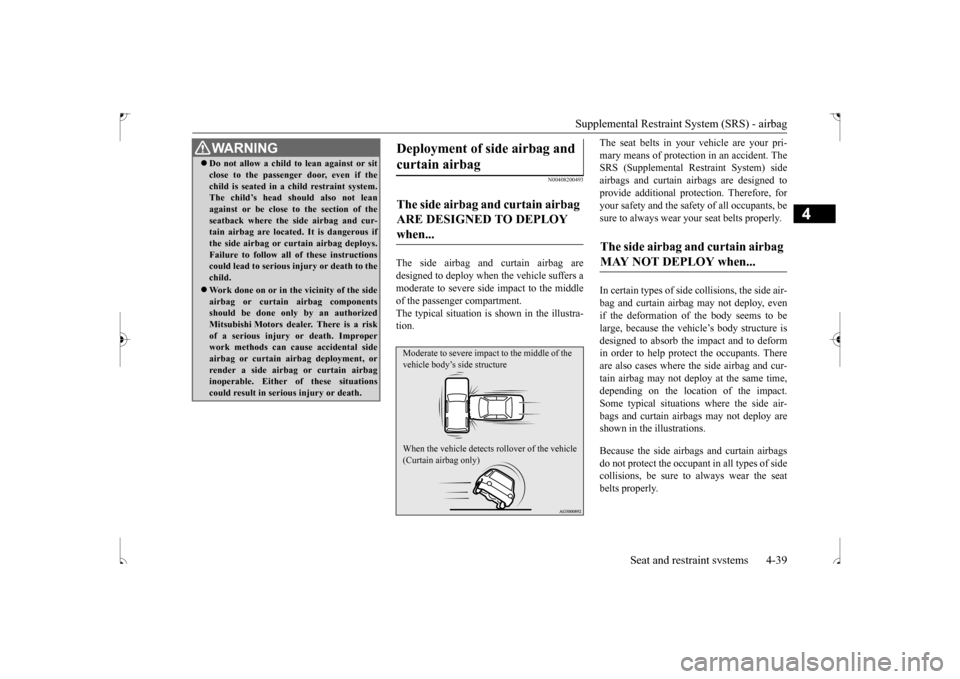
The side airbag and curtain airbag are designed to deploy when the vehicle suffers a moderate to severe side impact to the middleof the passenger compartment.The typical situation is shown in the illustra- tion.
The seat belts in your vehicle are your pri- mary means of protection in an accident. The SRS (Supplemental Restraint System) side airbags and curtain airbags are designed toprovide additional protection. Therefore, for your safety and the safety of all occupants, be sure to always wear your seat belts properly. In certain types of side collisions, the side air- bag and curtain airbag may not deploy, even if the deformation of the body seems to be large, because the vehicle’s body structure isdesigned to absorb the impact and to deform in order to help protect the occupants. There are also cases where the side airbag and cur-tain airbag may not deploy at the same time, depending on the location of the impact. Some typical situations where the side air-bags and curtain airbags may not deploy are shown in the illustrations. Because the side airbags and curtain airbags do not protect the occupant in all types of sidecollisions, be sure to always wear the seat belts properly.
Do not allow a child to lean against or sit close to the passenger door, even if the child is seated in a child restraint system. The child’s head should also not lean against or be close to the section of theseatback where the side airbag and cur- tain airbag are located.
It is dangerous if
the side airbag or curtain airbag deploys.Failure to follow all of these instructions could lead to serious injury or death to the child. Work done on or in the vicinity of the side airbag or curtain airbag componentsshould be done only by an authorized Mitsubishi Motors dealer. There is a risk of a serious injury or death. Improperwork methods can cause accidental side airbag or curtain airbag deployment, or render a side airbag or curtain airbaginoperable. Either of these situations could result in serious injury or death.WA R N I N G
Deployment of side airbag and curtain airbag The side airbag and curtain airbag ARE DESIGNED TO DEPLOY when... Moderate to severe impa
ct to the middle of the
vehicle body’s side structure When the vehicle detects
rollover of the vehicle
(Curtain airbag only)
The side airbag and curtain airbag MAY NOT DEPLOY when...
BK0239500US.bo
ok 39 ページ 2016年5月13日 金曜日 午前8時53分
Page 125 of 399
4-wheel drive operation 5-62 Features and controls
5
Set the drive mode-selector to “4WD LOCK” and then gradually depress the accelerator pedal for a smooth start. Keep the pressure on the accelerator pedal as constant as possible,and drive at low speed.
Your vehicle may not provide sufficient hill climbing ability and engine braking on steepslope. Avoid driving on steep slopes even
though the vehicle is an 4-wheel drive vehi- cle.
N00537800098
If the electrical circuits become wet, furtheroperation of the vehicle will be impossible; therefore, avoid driving through water unless absolutely necessary. If driving through wateris unavoidable, use the following procedure: Check the depth of the water and the terrain before attempting to drive through it. Drive slowly to avoid creating excessive water splashing.
Driving on sandy or muddy roads
CAUTION Do not force the vehicle or drive recklessly on sandy surfaces. In comparison with nor- mal road surfaces, the engine and otherdrive-system components are put under excessive strain when driving on such a sur- face. This could lead to accidents. If any of the following conditions occur while the vehicle is being driven, immedi-ately park your vehicle in a safe place and follow these procedures:• If the engine coolant temperature display
flashes on the information screen in the multi-information display or the engine power drops suddenly. Refer to “Engine overheating” on page 8-4.• If the “ ” warning display and “SLOW DOWN” or the “ ” warning display and “SERVICE REQUIRED” appear on the information screen in the multi-information display.Refer to “Warning display” on page 5-54.
WA R N I N G When attempting to rock your vehicle out of a stuck position, be sure that the area around the vehicle is clear of people and physical objects. The rocking motion may cause the vehicle to
suddenly launch for-
ward/backward, causing injury or dam- age to nearby people or objects.NOTE
Avoid sudden braking, sudden acceleration and sharp turning; such operations could result in the vehicle becoming stuck. If the vehicle becomes stuck in sandy or muddy roads, it can often be moved with a rocking motion. Move the gearshift leveralternately between the 1st and “R” (Reverse) positions (M/T), the “D” (DRIVE) and “R” (REVERSE) positions (CVT), whilepressing lightly on the accelerator pedal. Driving on rough road can cause rust on the vehicle; wash the vehicle thoroughly as soon as possible after such use.
Climbing/descending sharp grades
Driving through water
CAUTION Never drive through water that is deep enough to cover wheel hubs, axles or exhaust pipe. Do not change the gearshift lever posi-tion (M/T) or the selector lever position (CVT) while driving through water. Frequent driving through water canadversely affect the life span of the vehicle; consult an authorized Mitsubishi Motors dealer or a repair facility of your choice and take the necessary measures to prepare, inspect, and repair the vehicle.
BK0239500US.bo
ok 62 ページ 2016年5月13日 金曜日 午前8時53分
Page 131 of 399
Anti-lock braking system 5-68 Features and controls
5
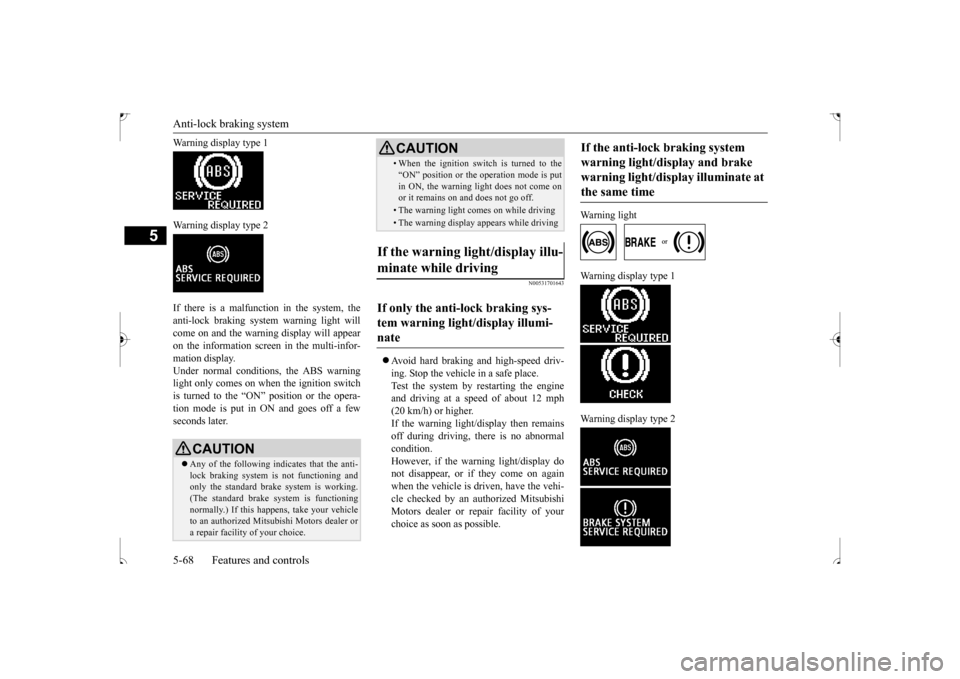
Warning display type 1 Warning display type 2 If there is a malfunction in the system, the anti-lock braking system warning light willcome on and the warning display will appear on the information screen in the multi-infor- mation display.Under normal conditions, the ABS warning light only comes on when the ignition switch is turned to the “ON” position or the opera-tion mode is put in ON and goes off a few seconds later.
N00531701643
Avoid hard braking and high-speed driv- ing. Stop the vehicle in a safe place. Test the system by restarting the engine and driving at a speed
of about 12 mph
(20 km/h) or higher. If the warning light/display then remains off during driving, there is no abnormalcondition. However, if the warning light/display do not disappear, or if they come on againwhen the vehicle is driven, have the vehi- cle checked by an authorized Mitsubishi Motors dealer or repair facility of yourchoice as soon as possible.
Warning light
Warning display type 1 Warning display type 2
CAUTION Any of the following indicates that the anti- lock braking system is not functioning and only the standard brake system is working. (The standard brake system is functioningnormally.) If this happens, take your vehicle to an authorized Mitsubishi Motors dealer or a repair facility of your choice.
• When the ignition switch is turned to the “ON” position or the operation mode is put in ON, the warning light does not come on or it remains on and does not go off.• The warning light comes on while driving• The warning display appears while driving
If the warning light/display illu- minate while driving If only the anti-lock braking sys- tem warning light/display illumi-nate
CAUTION
If the anti-lock braking system warning light/display and brake warning light/display illuminate at the same time
BK0239500US.bo
ok 68 ページ 2016年5月13日 金曜日 午前8時53分
Page 255 of 399
Trailer towing 6-12 Driving safety
6
N00630600085
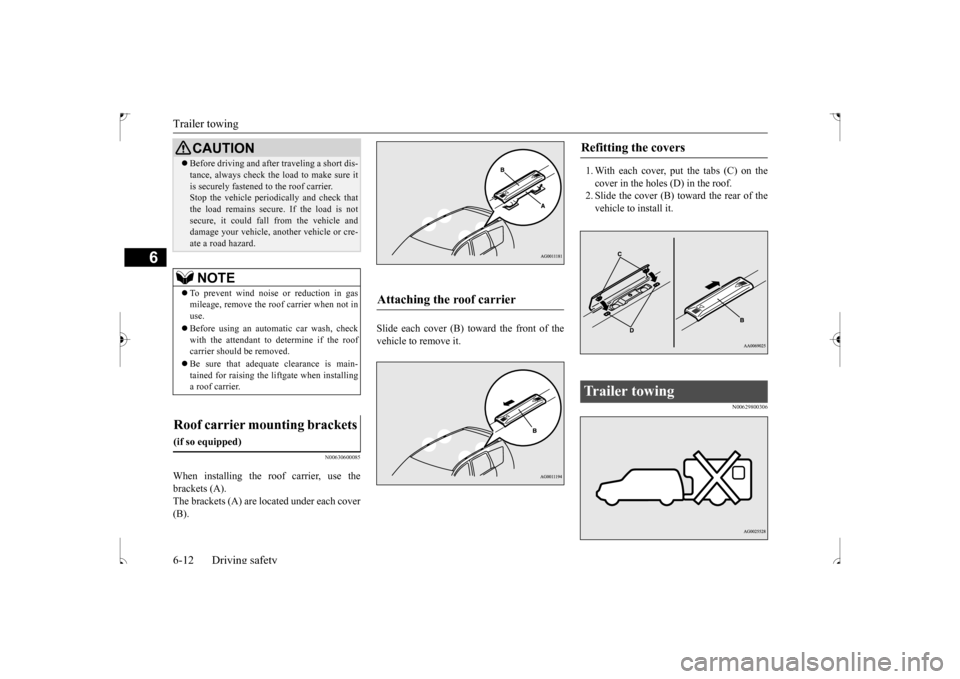
When installing the roof carrier, use the brackets (A). The brackets (A) are located under each cover(B).
Slide each cover (B) toward the front of the vehicle to remove it.
1. With each cover, put the tabs (C) on the cover in the holes (D) in the roof. 2. Slide the cover (B) toward the rear of thevehicle to install it.
N00629800306
Before driving and after traveling a short dis- tance, always check the load to make sure it is securely fastened to the roof carrier. Stop the vehicle periodically and check that the load remains secure. If the load is notsecure, it could fall from the vehicle and damage your vehicle, another vehicle or cre- ate a road hazard.NOTE
To prevent wind noise or reduction in gas mileage, remove the roof carrier when not in use. Before using an automatic car wash, check with the attendant to determine if the roof carrier should be removed. Be sure that adequate clearance is main- tained for raising the liftgate when installinga roof carrier.
Roof carrier mounting brackets
(if so equipped)
CAUTION
Attaching the roof carrier
Refitting the covers
Trailer towing
BK0239500US.bo
ok 12 ページ 2016年5月13日 金曜日 午前8時53分
Page 332 of 399
How to change a tire
For emergencies 8-11
8
N00850000162
Reverse the removing procedure when stor- ing the flat tire or spare tire, jack, bar and wheel nut wrench. Refer to “To remove the spare tire” on page8-7 and “Jack and tools” on page 8-5.
N00849400195
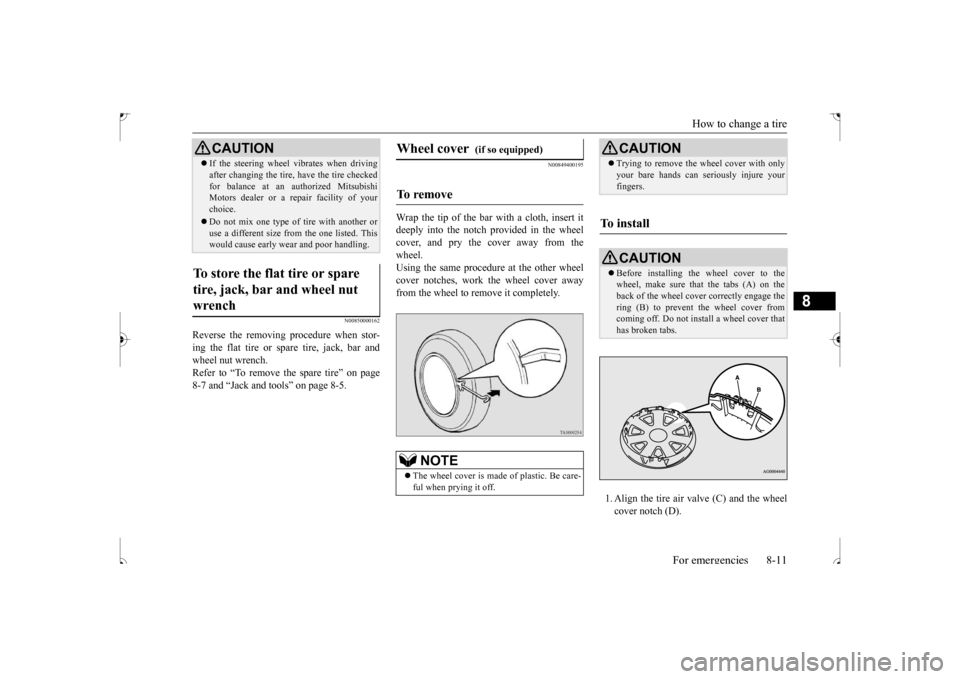
Wrap the tip of the bar with a cloth, insert itdeeply into the notch provided in the wheelcover, and pry the cover away from the wheel. Using the same procedure at the other wheelcover notches, work the wheel cover awayfrom the wheel to remove it completely.
1. Align the tire air valve (C) and the wheel cover notch (D).
If the steering wheel vibrates when driving after changing the tire, have the tire checked for balance at an authorized Mitsubishi Motors dealer or a repair facility of your choice. Do not mix one type of tire with another or use a different size from the one listed. Thiswould cause early wear and poor handling.
To store the flat tire or spare tire, jack, bar and wheel nut wrench
CAUTION
Wheel cover
(if so equipped)
To remove
NOTE
The wheel cover is made of plastic. Be care- ful when prying it off.
CAUTION Trying to remove the wheel cover with only your bare hands can seriously injure your fingers.
To install
CAUTION Before installing the wheel cover to the wheel, make sure that the tabs (A) on theback of the wheel cover correctly engage the ring (B) to prevent the wheel cover from coming off. Do not install a wheel cover thathas broken tabs.
BK0239500US.bo
ok 11 ページ 2016年5月13日 金曜日 午前8時53分
Page 335 of 399
Operation under adverse driving conditions 8-14 For emergencies
8
Release the parking brake. Place the gearshift lever in the “N” (Neutral) position (manual transaxle) or the selector lever in the “N” (NEUTRAL) position(CVT).
N00837200675
If your vehicle becomes stuck in snow, sand,or mud, it can often be
moved by a rocking
motion. Rock your vehicle back and forth to free it.Do not rev the engine or spin the wheels. Constant efforts to free a stuck vehicle can cause overheating and transaxle failure. Letthe engine idle for a few minutes to cool the transaxle before trying again. If your vehicle is still stuck after several rock-ing attempts, call for help.
When driving on a road covered with snow or ice, use snow tires. Tire chains cannot be used on your vehicle. Theremay be state or local regulations about using snow tires. Always check the regu- lations in your local area before usingthem. Refer to “Snow tires” on page 9-20 and “Tire chains” on page 9-21. Drive slowly. Do not make sudden starts or stops, sharp turns, or slam on thebrakes. Allow extra distance between your vehi- cle and the vehicle in front of you, andavoid sudden braking. If a skid occurs when the accelerator pedal is depressed, take your foot off thepedal. Steer gently in the direction of the skid. Your vehicle is equipped with an anti- lock braking system (ABS). Hold the brake pedal down firmly and keep it depressed. Do not pump the brake pedalwhich will result in reduced braking per- formance. After parking on snowy or icy road, it may be difficult to move your vehicle due to freeze-up of the brake. Depress the accelerator pedal little by little to movethe vehicle after confirming safety of the vehicle.
Towing a front-wheel drive vehicle with front wheels off the ground (Type C) Operation under adverse driving conditions If your vehicle becomes stuck in sand, mud or snow
WA R N I N G When trying to rock your vehicle out of a stuck position, make sure that there are no people nearby. The rocking motion can make your vehicle suddenly lurch forward or backward, and injure any bystanders.
On wet roads
CAUTION Avoid flooded roads. Water is often deeper than it looks, and you could be seriously hurt by driving into flood water. When driving in rain, on water-covered roads, or through a car wash, water could getinto the brake discs and make them fail tem- porarily. In such cases, lightly press the brake pedal to see if they are working prop-erly. If they are not, press the pedal lightly several times while driving to dry the brake pads or linings, then check them again. When driving in rain, a layer of water may form between the tires and the road surface(hydroplaning). This loosens your tires’ grip on the road, making it difficult to steer or brake properly. When driving on a wet road:• Drive your vehicle at a safe speed.• Do not drive on worn tires.• Always keep the tires at the correct infla- tion pressures.
On snowy or icy roads
BK0239500US.bo
ok 14 ページ 2016年5月13日 金曜日 午前8時53分
Page 352 of 399
Tires
Vehicle care and maintenance 9-15
9
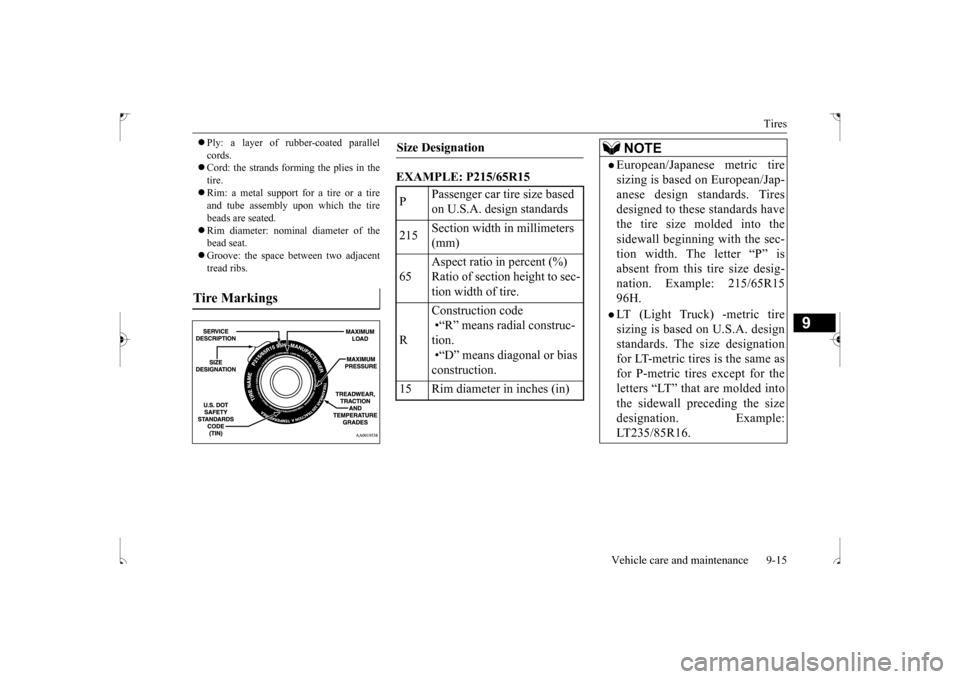
Ply: a layer of rubber-coated parallel cords. Cord: the strands forming the plies in the tire. Rim: a metal support for a tire or a tire and tube assembly upon which the tire beads are seated. Rim diameter: nominal diameter of the bead seat. Groove: the space between two adjacent tread ribs.
EXAMPLE: P215/65R15
Tire Markings
Size Designation P
Passenger car tire size based on U.S.A. design standards
215
Section width in millimeters (mm)
65
Aspect ratio in percent (%) Ratio of section height to sec- tion width of tire.
R
Construction code •“R” means radial construc-tion. •“D” means diagonal or bias construction.
15 Rim diameter in inches (in)
NOTE
European/Japanese metric tire sizing is based on European/Jap- anese design standards. Tiresdesigned to these standards have the tire size molded into the sidewall beginning with the sec-tion width. The letter “P” is absent from this tire size desig- nation. Example: 215/65R1596H.LT (Light Truck) -metric tiresizing is based on U.S.A. design standards. The size designation for LT-metric tires is the same asfor P-metric tires except for the letters “LT” that are molded into the sidewall preceding the sizedesignation. Example: LT235/85R16.
BK0239500US.bo
ok 15 ページ 2016年5月13日 金曜日 午前8時53分
Page 385 of 399
Important facts to know in case of an accident 10-4 Customer assistance/Reporting Safety Defects
10
call (671)649-3673 or write to: To contact Triple J Motors call (670)234-7133 or write to: To contact Pacific Marketing Inc. call 684(699)9140 or write to:
N01047300098
We hope you will never be involved in an accident, but there is always that potentialdanger. So, please be sure to buckle up and drive safely. Remain calm. Check for injuries. Report all injuries to the police, and, if necessary, call for an ambulance. Record all the details of the accident. This will provide you with accurate records of the accident for discussions with your insurance company and other personswho may be acting on your behalf. Understand your repair estimate before approving repairs. Choosing the repair
shop and the brands
of parts that they use on your vehicle isyour decision.
Ask for genuine Mitsubishi Motors parts. Many times, to save money, your insur- ance company will recommend imitation parts that do not meet the original specifi-cations of fit, finish, corrosion resistance or workmanship.
The strength and integrity built into your Mitsubishi vehicle is the result of a specific design referred to as “Energy Management”.Individual body parts are designed to act as one unit in the event of an accident. Shock waves are absorbed by protective panels orare channeled around the passenger compart- ment. This important feature is possible because high tensile steel is used inMitsubishi panels and structural parts, some- thing that cannot be guaranteed by the manu- facturers of imitation parts. All GenuineMitsubishi body panels and support brackets are designed and constructed as important protection features in the event of an acci-dent. By replacing body parts with imitations, your vehicle may no longer meet original equipment specifications.
Triple J Enterprises, Inc. P.O. Box 6066 TAMUNING GUAM 96931For vehicles sold in Saipan Triple J Motors P.O. Box 500487 SAIPAN, MP96950-0487For vehicles sold in American Samoa Pacific Marketing, Inc. P.O. Box 698 PAGO PAGO, AMERICAN SAMOA AS, 96799
Important facts to know in case of an accident In the event of an accident Key information to discuss with your insurance company
Mitsubishi Motors built-in pro- tection
BK0239500US.bo
ok 4 ページ 2016年5月13日 金曜日 午前8時53分