park assist MITSUBISHI OUTLANDER SPORT 2017 3.G Owners Manual
[x] Cancel search | Manufacturer: MITSUBISHI, Model Year: 2017, Model line: OUTLANDER SPORT, Model: MITSUBISHI OUTLANDER SPORT 2017 3.GPages: 399, PDF Size: 14.61 MB
Page 10 of 399
2-1
2
If this warning light comes on or
flashes while you’re driving...
Quick index
N00200702175
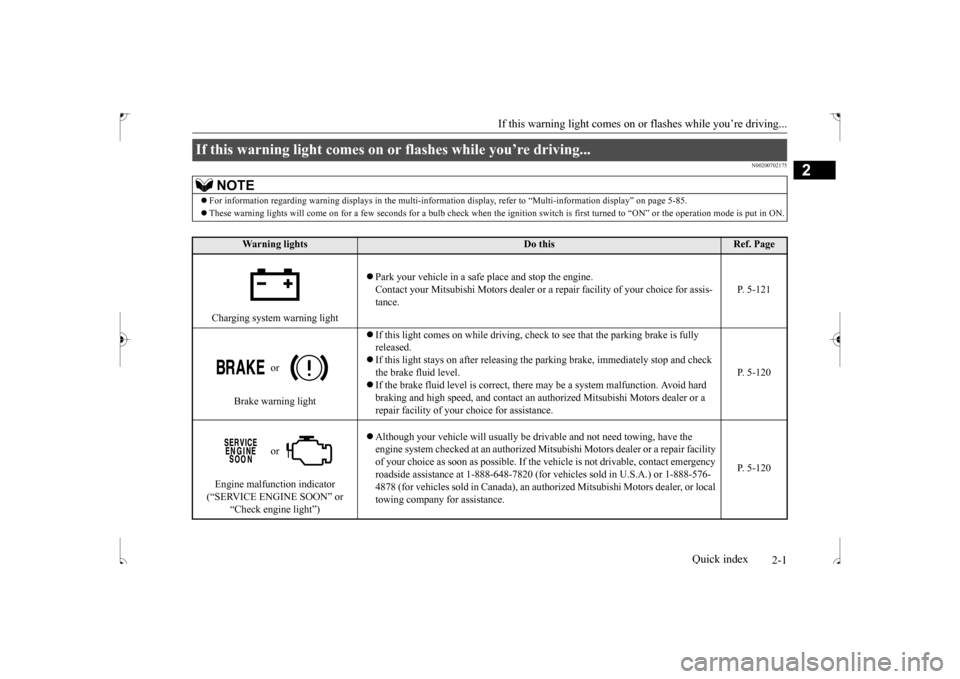
If this warning light comes on or flashes while you’re driving...
NOTE
For information regarding warning displays in the multi-informat
ion display, refer to “Multi-information display” on page 5-85.
These warning lights will come on for a few seconds for a bulb check
when the ignition switch is first turned to “ON” or the op
eration mode is put in ON.
Wa r n i n g l i g h t s
Do this
Ref. Page
Charging system warning light
Park your vehicle in a safe place and stop the engine. Contact your Mitsubishi Motors dealer or
a repair facility of your choice for assis-
tance.
P. 5-121
or
Brake warning light
If this light comes on while driving, check to see that the parking brake is fully released. If this light stays on after releasing the parking brake, immediately stop and check the brake fluid level. If the brake fluid level is correct, there may be a system malfunction. Avoid hard braking and high speed, and contact an aut
horized Mitsubishi Mo
tors dealer or a
repair facility of your choice for assistance.
P. 5-120
or
Engine malfunction indicator (“SERVICE ENGINE SOON” or
“Check engine light”)
Although your vehicle will usually be drivable and not need towing, have the engine system checked at an authorized Mits
ubishi Motors dealer or a repair facility
of your choice as soon as possible. If the
vehicle is not drivable, contact emergency
roadside assistance at 1-888-648-7820 (for ve
hicles sold in U.S.A.) or 1-888-576-
4878 (for vehicles sold in Canada), an auth
orized Mitsubishi Moto
rs dealer, or local
towing company for assistance.
P. 5-120
BK0239500US.bo
ok 1 ページ 2016年5月13日 金曜日 午前8時53分
Page 18 of 399
Filling the fuel tank
General information 3-3
3
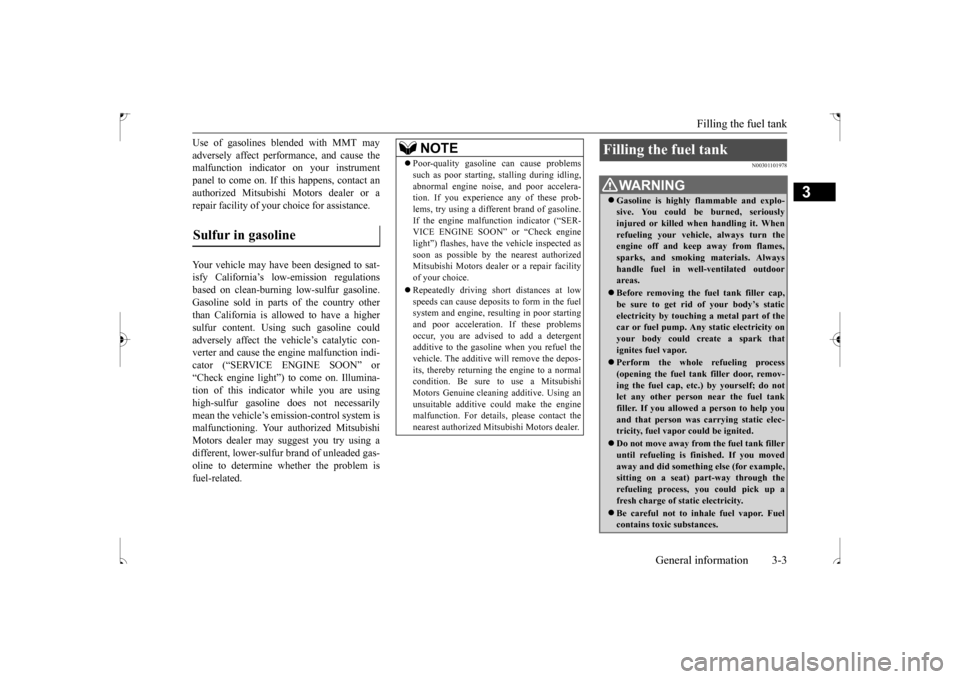
Use of gasolines blended with MMT may adversely affect performance, and cause the malfunction indicator on your instrument panel to come on. If this happens, contact anauthorized Mitsubishi Motors dealer or a repair facility of your choice for assistance. Your vehicle may have been designed to sat- isfy California’s low-emission regulations based on clean-burning low-sulfur gasoline. Gasoline sold in parts of the country otherthan California is allowed to have a higher sulfur content. Using such gasoline could adversely affect the vehicle’s catalytic con-verter and cause the engine malfunction indi- cator (“SERVICE ENGINE SOON” or “Check engine light”) to come on. Illumina-tion of this indicator while you are using high-sulfur gasoline does not necessarily mean the vehicle’s emission-control system ismalfunctioning. Your authorized Mitsubishi Motors dealer may suggest you try using a different, lower-sulfur brand of unleaded gas-oline to determine whether the problem is fuel-related.
N00301101978
Sulfur in gasoline
NOTE
Poor-quality gasoline can cause problems such as poor starting,
stalling during idling,
abnormal engine noise, and poor accelera- tion. If you experience any of these prob- lems, try using a different brand of gasoline.If the engine malfunction indicator (“SER- VICE ENGINE SOON” or “Check engine light”) flashes, have the vehicle inspected assoon as possible by the nearest authorized Mitsubishi Motors dealer or a repair facility of your choice. Repeatedly driving short distances at low speeds can cause deposits to form in the fuelsystem and engine, resulting in poor starting and poor acceleration. If these problems occur, you are advised to add a detergentadditive to the gasoline when you refuel the vehicle. The additive will remove the depos- its, thereby returning the engine to a normalcondition. Be sure to use a Mitsubishi Motors Genuine cleaning additive. Using an unsuitable additive could make the enginemalfunction. For details, please contact the nearest authorized Mitsubishi Motors dealer.
Filling the fuel tank
WA R N I N G Gasoline is highly flammable and explo- sive. You could be burned, seriously injured or killed when handling it. When refueling your vehicle, always turn theengine off and keep away from flames, sparks, and smoking materials. Always handle fuel in well-ventilated outdoorareas. Before removing the fuel tank filler cap, be sure to get rid of your body’s static electricity by touching a metal part of the car or fuel pump. Any static electricity onyour body could create a spark that ignites fuel vapor. Perform the whole refueling process (opening the fuel tank filler door, remov- ing the fuel cap, etc.) by yourself; do notlet any other person near the fuel tank filler. If you allowed a person to help you and that person was carrying static elec-tricity, fuel vapor could be ignited. Do not move away from the fuel tank filler until refueling is finished. If you moved away and did something else (for example, sitting on a seat) part-way through the refueling process, you could pick up a fresh charge of static electricity. Be careful not to inhale fuel vapor. Fuel contains toxic substances.
BK0239500US.bo
ok 3 ページ 2016年5月13日 金曜日 午前8時53分
Page 64 of 399
5
Features and controlsBreak-in recommendation
s ..............................................................5-3
Keys ..........................................
.......................................................5-3
Electronic immobilizer (Anti-thef
t starting system) ........................5-4
Keyless entry system (if so equipped) ..............................................5-7Free-hand Advanced Security Transmitter (F.A.S.T.-key) (if so equipped)
.................................................
........................5-12
Door locks .......................
...............................................................5-28
Power door locks ............
...............................................................5-30
Child safety locks for r
ear door .....................................................5-31
Liftgate ......................................
.....................................................5-32
Inside liftgate releas
e .............................................
........................5-33
Theft-alarm system
................................................
........................5-34
Power window control
...........................................
........................5-37
Sunshade (if so equi
pped)..............................................................5-39
Parking brake ..................
...............................................................5-40
Steering wheel height and reach adjustment ..................................5-41Inside rearview mirro
r ...........................................
........................5-42
Outside rearview mirr
ors ...............................................................5-44
Ignition switch ......
.................................................
........................5-46
Starting the engine
.................................................
........................5-47
Manual transaxle (if so equipped) .................................................5-49 Continuously variable transmission
(CVT) (if so equipped).........5-51
Electronically controlled 4WD system (if so equipped)................5-584-wheel drive operation
.........................................
........................5-60
Inspection and maintenance following rough road operation ........5-63 Cautions on the handling of 4-wheel drive vehicles ......................5-63Service brake ..................
...............................................................5-64
Hill start assist .......
.................................................
........................5-65
Brake assist system
...............................................
......................... 5-66
Anti-lock braking syst
em .....................................
......................... 5-67
Electric power steering syst
em (EPS) ........................................... 5-69
Active stability control
(ASC) ....................
................................... 5-70
Cruise control (if so eq
uipped) ...................................................... 5-73
Tire pressure monitoring
system ................................................... 5-77
Rear-view camera (if so eq
uipped) ................................................ 5-81
Instrument cluster
.................................................
......................... 5-83
Multi-information disp
lay ....................................
......................... 5-85
Indicator light, warning light, and information screen disp
lay list ................................................. 5-106
Indicators .................................
.................................................... 5-119
Warning lights ................
.................................................
............. 5-120
Information screen disp
lay ...................................
....................... 5-121
Combination headlights and dimmer switch ............................... 5-123 Headlight leveling switch (if so equipped).................................. 5-129Turn signal lever ..
.................................................
....................... 5-129
Hazard warning flasher
switch .................................................... 5-130
Front fog light switch (if
so equipped) ........................................ 5-130
Wiper and washer swit
ch ......................................
....................... 5-130
Electric rear window def
ogger switch ......................................... 5-136
Horn switch .............................
.................................................... 5-136
Link System (if so equi
pped) .....................
................................. 5-137
Bluetooth
® 2.0 interface (if so
equipped)..................................... 5-137
USB input terminal (if so
equipped) ........................................... 5-160
Sun visors ......................
.................................................
............. 5-163
12 V power outlets .........
.................................................
............. 5-164
HomeLink
® Wireless Control System (if so equipped) ............... 5-165
BK0239500US.bo
ok 1 ページ 2016年5月13日 金曜日 午前8時53分
Page 84 of 399

Free-hand Advanced Security Transmitt
er (F.A.S.T.-key) (if so equipped)
Features and controls 5-21
5
To prevent battery drain, wait a few seconds between attempts to restart the engine. 1. Make sure all occupants are properly seated with seat belts fastened. 2. Make sure the parking brake is applied.3. Press and hold the brake pedal down firmly with your right foot. 4. Press and hold the clutch pedal all the way down (manual transaxle). 5. On vehicles equipped with manual trans- axle, place the gearshift lever in the “N”(Neutral) position. On vehicles equipped with continuously variable transmission (CVT), make surethe selector lever is in the “P” (PARK) position.
6. Press the engine switch. 7. Confirm that all warning lights and warn- ing displays are functioning properly.
After several attempts, you may experience that the engine still does not start. 1. Make sure that all electric devices, such as lights, air conditioning blower and rear window defogger, are turned off.
2. While depressing the brake pedal {contin- uously variable transmission (CVT)} or the clutch pedal (manual transaxle), press the accelerator pedal halfway and hold itthere, then crank the engine. Release the accelerator pedal, immediately after the engine starts.3. If the engine still will not start, the engine could be flooded with too much gasoline. While depressing the brake pedal (CVT)or the clutch pedal (manual transaxle),push the accelerator pedal all the way down and hold it there, then press the engine switch to crank the engine. If theengine does not start after 5 to 6 seconds, push the engine switch to stop cranking the engine, and release the acceleratorpedal. Put the operation mode in OFF. Wait a few seconds, and then press the engine switch to crank the engine againwhile depressing the brake pedal (CVT) or the clutch pedal (manual transaxle), but do not push the accelerator pedal. If theengine fails to start, repeat these proce- dures. If the engine still will not start, con- tact your local Mitsubishi Motors dealeror a repair facility of your choice for assistance.
Startability of continuously variable trans- mission (CVT) vehicles with an ambienttemperature of
-22 °F (-30 °C) or lower
NOTE
After the engine has not started for a while, the brake pedal effort needed to start the engine may become greater. If this occurs,depress the brake pedal more firmly than usual.
NOTE
On vehicles equipped with continuously variable transmission (CVT), the engine can only be started when the selector lever is in the “P” (PARK) or “N” (NEUTRAL) posi- tion.For safety reasons, the engine should be started when the selector lever is in the “P” (PARK) position in which the driving wheelslock.NOTE
Minor noises may be heard on engine start- up. These will disappear as the engine warmsup.
When the engine is hard to start
BK0239500US.bo
ok 21 ページ 2016年5月13日 金曜日 午前8時53分
Page 112 of 399
Manual transaxle (if so equipped)
Features and controls 5-49
5
7. Turn the ignition switch to the “ON” posi- tion and make certain that all warning lights are functioning properly before starting the engine.8. Turn the ignition switch to the “START” position without pressing the accelerator pedal. Release the key when the enginestarts.
After several attempts, you may experience that the engine still does not start. 1. Make sure that all electric devices, such as lights, air conditioning blower and rear window defogger, are turned off. 2. While depressing the brake pedal {contin-uously variable transmission (CVT)} or the clutch pedal (manual transaxle), press the accelerator pedal halfway and hold itthere, then crank the engine. Release the accelerator pedal, immediately after the engine starts.
3. If the engine still will not start, the engine could be flooded with too much gasoline. While depressing the brake pedal (CVT) or the clutch pedal (manual transaxle),push the accelerator pedal all the way down and hold it there, then crank the engine for 5 to 6 seconds. Return the igni-tion switch to the “OFF” position and release the accelerator pedal. Wait a few seconds, and then crank the engine againfor 5 to 6 seconds while depressing thebrake pedal (CVT) or the clutch pedal (manual transaxle), but do not push the accelerator pedal. Release the ignition keyif the engine starts. If the engine fails to start, repeat these procedures. If the engine still will not start, contact yourlocal Mitsubishi Motors dealer or a repair facility of your choice for assistance.
When the ambient temperature is -22 °F (-30 °C) or lower, it may not be possible to start from a standstill even with the selector leverin the “D” (DRIVE) or “R” (REVERSE) position.
This occurs because the transaxle has not warmed up sufficiently; it does not indicate a problem. If this occurs, place the selector lever in the “P” (PARK) position and let theengine idle for at least 10 minutes. The transaxle will warm up, and you will be able to start normally.Do not leave the vehicle during warm-up operation.
N00512701194
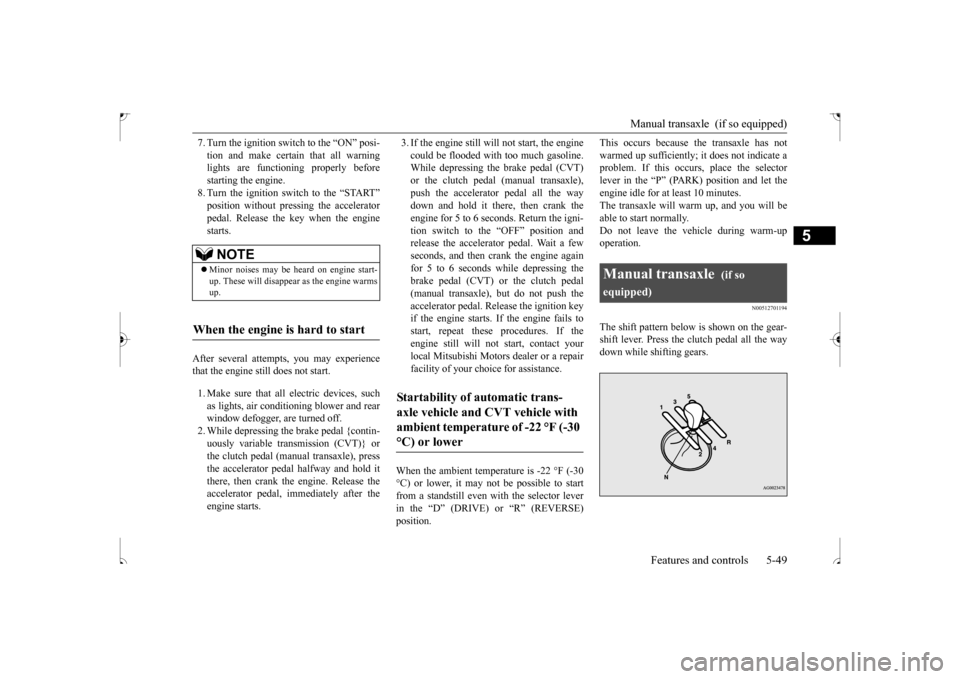
The shift pattern below is shown on the gear-shift lever. Press the clutch pedal all the way down while shifting gears.
NOTE
Minor noises may be heard on engine start- up. These will disappear as the engine warmsup.
When the engine is hard to start
Startability of automatic trans- axle vehicle and CVT vehicle with ambient temperature of -22 °F (-30 °C) or lower
Manual transaxle
(if so
equipped)
BK0239500US.bo
ok 49 ページ 2016年5月13日 金曜日 午前8時53分
Page 129 of 399
Brake assist system 5-66 Features and controls
5
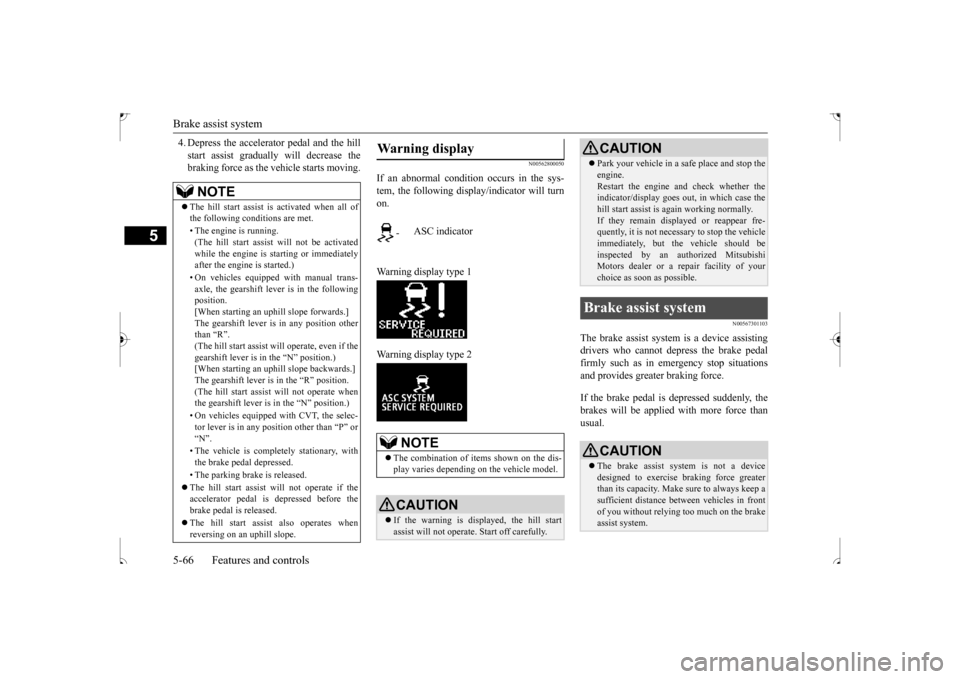
4. Depress the accelerator pedal and the hill start assist gradually will decrease the braking force as the vehicle starts moving.
N00562800050
If an abnormal condition occurs in the sys- tem, the following display/indicator will turnon. Warning display type 1 Warning display type 2
N00567301103
The brake assist system
is a device assisting
drivers who cannot depress the brake pedalfirmly such as in emergency stop situations and provides greater braking force. If the brake pedal is depressed suddenly, the brakes will be applied with more force thanusual.
NOTE
The hill start assist is activated when all of the following conditions are met. • The engine is running. (The hill start assist will not be activated while the engine is starting or immediatelyafter the engine is started.) • On vehicles equipped with manual trans- axle, the gearshift lever is in the following position. [When starting an uphill slope forwards.]The gearshift lever is in any position other than “R”. (The hill start assist
will operate, even if the
gearshift lever is in the “N” position.) [When starting an uphill slope backwards.] The gearshift lever is in the “R” position.(The hill start assist will not operate when the gearshift lever is in the “N” position.) • On vehicles equipped with CVT, the selec- tor lever is in any position other than “P” or “N”. • The vehicle is completely stationary, with the brake pedal depressed. • The parking brake is released. The hill start assist will not operate if the accelerator pedal is depressed before thebrake pedal is released. The hill start assist also operates when reversing on an uphill slope.
Warning display
-
ASC indicator
NOTE
The combination of items shown on the dis- play varies depending on the vehicle model.CAUTION If the warning is displayed, the hill start assist will not operate. Start off carefully.
Park your vehicle in a safe place and stop the engine. Restart the engine and check whether the indicator/display goes out, in which case the hill start assist is again working normally. If they remain displayed or reappear fre- quently, it is not necessary to stop the vehicle immediately, but the vehicle should beinspected by an authorized Mitsubishi Motors dealer or a repair facility of your choice as soon as possible.
Brake assist system
CAUTION The brake assist system is not a device designed to exercise braking force greater than its capacity. Make sure to always keep asufficient distance between vehicles in front of you without relying too much on the brake assist system.CAUTION
BK0239500US.bo
ok 66 ページ 2016年5月13日 金曜日 午前8時53分
Page 132 of 399
Electric power steering system (EPS)
Features and controls 5-69
5
The anti-lock braking system and brake force distribution function may not work, so hard braking could make the vehicle unstable. Avoid hard braking and high-speed driving.Stop the vehicle in a safe place and contact an authorized Mitsubishi Motors dealer or repair facility of your choice.
N00529200077
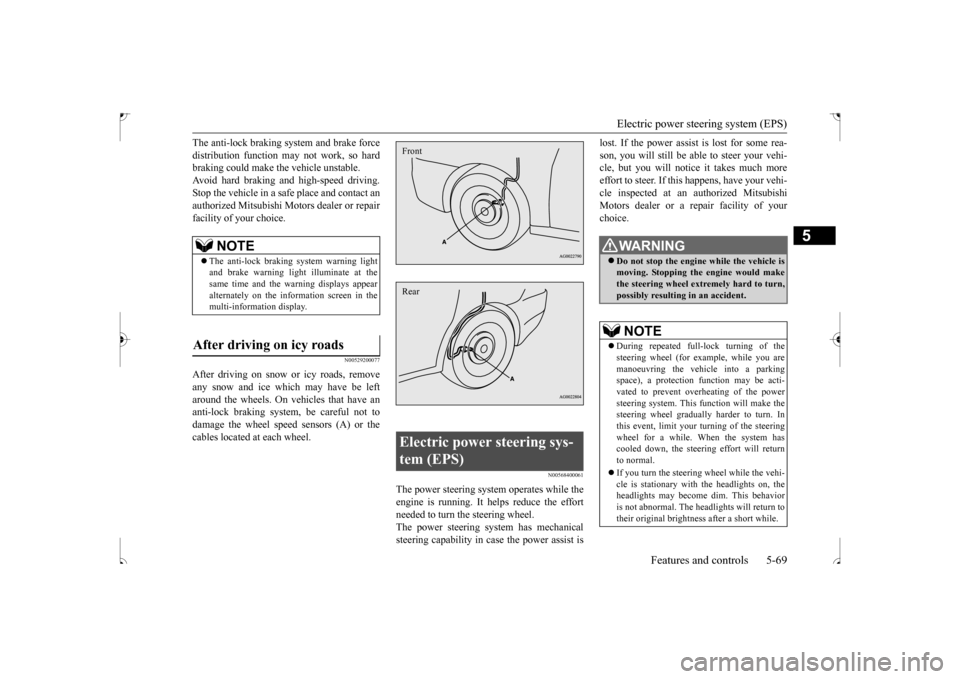
After driving on snow or icy roads, removeany snow and ice which may have be left around the wheels. On vehicles that have an anti-lock braking system, be careful not todamage the wheel speed sensors (A) or the cables located at each wheel.
N00568400061
The power steering system operates while the engine is running. It helps reduce the effortneeded to turn the steering wheel. The power steering system has mechanical steering capability in case the power assist is
lost. If the power assist is lost for some rea- son, you will still be able to steer your vehi- cle, but you will notice it takes much more effort to steer. If this happens, have your vehi-cle inspected at an authorized Mitsubishi Motors dealer or a repair facility of your choice.
NOTE
The anti-lock braking system warning light and brake warning light
illuminate at the
same time and the warning displays appear alternately on the information screen in the multi-information display.
After driving on icy roads
Electric power steering sys- tem (EPS) FrontRear
WA R N I N G Do not stop the engine while the vehicle is moving. Stopping the engine would makethe steering wheel extremely hard to turn, possibly resulting in an accident.NOTE
During repeated full-lock turning of the steering wheel (for example, while you are manoeuvring the vehicle into a parking space), a protection function may be acti-vated to prevent overheating of the power steering system. This function will make the steering wheel gradually harder to turn. Inthis event, limit your turning of the steering wheel for a while. When the system has cooled down, the steering effort will return to normal. If you turn the steering wheel while the vehi- cle is stationary with the headlights on, the headlights may become dim. This behavioris not abnormal. The headlights will return to their original brightness after a short while.
BK0239500US.bo
ok 69 ページ 2016年5月13日 金曜日 午前8時53分
Page 147 of 399
Instrument cluster 5-84 Features and controls
5
N00519100259
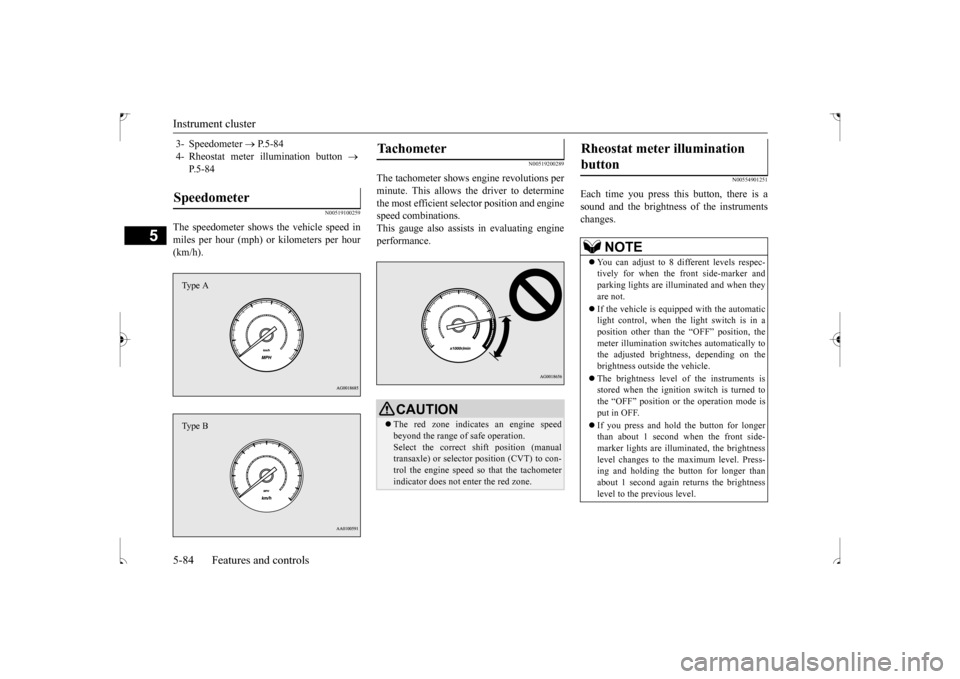
The speedometer shows the vehicle speed in miles per hour (mph) or kilometers per hour (km/h).
N00519200289
The tachometer shows engine revolutions perminute. This allows the driver to determinethe most efficient selector position and engine speed combinations. This gauge also assists in evaluating engineperformance.
N00554901251
Each time you press this button, there is asound and the brightness of the instruments changes.
3- Speedometer
P.5-84
4- Rheostat meter illumination button
P.5-84
Speedometer Type AType B
Tachometer
CAUTION The red zone indicates an engine speed beyond the range of safe operation. Select the correct shift position (manual transaxle) or selector position (CVT) to con-trol the engine speed so that the tachometer indicator does not enter the red zone.
Rheostat meter illumination button
NOTE
You can adjust to 8 different levels respec- tively for when the front side-marker and parking lights are illuminated and when they are not. If the vehicle is equipped with the automatic light control, when the light switch is in aposition other than the “OFF” position, the meter illumination switches automatically to the adjusted brightness, depending on thebrightness outside the vehicle. The brightness level of the instruments is stored when the ignition switch is turned to the “OFF” position or the operation mode is put in OFF. If you press and hold the button for longer than about 1 second when the front side-marker lights are illuminated, the brightness level changes to the maximum level. Press- ing and holding the button for longer than about 1 second again returns the brightness level to the previous level.
BK0239500US.bo
ok 84 ページ 2016年5月13日 金曜日 午前8時53分
Page 162 of 399
Multi-information display
Features and controls 5-99
5
N00555700132
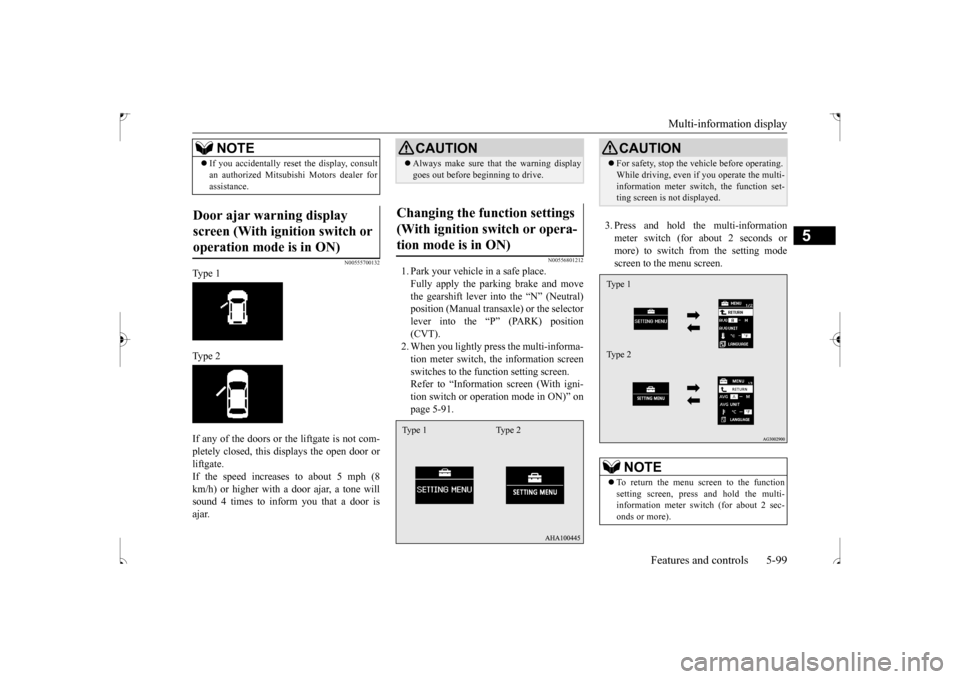
Type 1 Type 2 If any of the doors or the liftgate is not com- pletely closed, this displays the open door or liftgate. If the speed increases to about 5 mph (8km/h) or higher with
a door ajar, a tone will
sound 4 times to inform you that a door is ajar.
N00556801212
1. Park your vehicle in a safe place.Fully apply the parking brake and movethe gearshift lever into the “N” (Neutral) position (Manual transaxle) or the selector lever into the “P” (PARK) position(CVT). 2. When you lightly press the multi-informa- tion meter switch, the information screenswitches to the function setting screen. Refer to “Information screen (With igni- tion switch or operation mode in ON)” onpage 5-91.
3. Press and hold the multi-information meter switch (for about 2 seconds or more) to switch from the setting modescreen to the menu screen.
If you accidentally reset the display, consult an authorized Mitsubishi Motors dealer for assistance.
Door ajar warning display screen (With ignition switch or operation mode is in ON)
NOTE
CAUTION Always make sure that the warning display goes out before beginning to drive.
Changing the function settings (With ignition switch or opera-tion mode is in ON) Type 1 Type 2
CAUTION For safety, stop the vehicle before operating. While driving, even if you operate the multi- information meter switch, the function set- ting screen is not displayed.NOTE
To return the menu screen to the function setting screen, press and hold the multi-information meter switch (for about 2 sec- onds or more).Type 1 Type 2
BK0239500US.bo
ok 99 ページ 2016年5月13日 金曜日 午前8時53分
Page 175 of 399
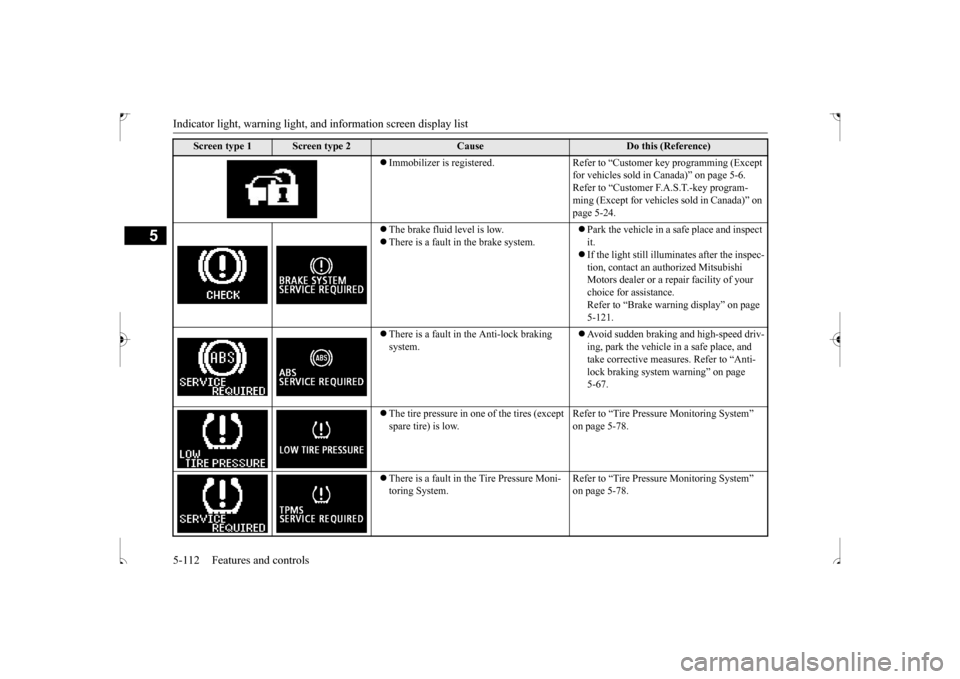
Indicator light, warning light, an
d information screen display list
5-112 Features and controls
5
Immobilizer is registered. Refer to “Customer key programming (Except
for vehicles sold in Canada)” on page 5-6. Refer to “Customer F.A.S.T.-key program-ming (Except for vehicles sold in Canada)” on page 5-24.
The brake fluid level is low. There is a fault in the brake system.
Park the vehicle in a safe place and inspect it. If the light still illuminates after the inspec- tion, contact an authorized Mitsubishi Motors dealer or a repair facility of your choice for assistance. Refer to “Brake warning display” on page 5-121.
There is a fault in the Anti-lock braking system.
Avoid sudden braking and high-speed driv- ing, park the vehicle in a safe place, and take corrective measures. Refer to “Anti- lock braking system warning” on page 5-67.
The tire pressure in one of the tires (except spare tire) is low.
Refer to “Tire Pressure Monitoring System” on page 5-78.
There is a fault in the Tire Pressure Moni- toring System.
Refer to “Tire Pressure Monitoring System” on page 5-78.
Screen type 1
Screen type 2
Cause
Do this (Reference)
BK0239500US.book
112 ページ 2016年5月13日 金曜日 午前8時53分