height MITSUBISHI PAJERO 1996 2.G Owners Manual
[x] Cancel search | Manufacturer: MITSUBISHI, Model Year: 1996, Model line: PAJERO, Model: MITSUBISHI PAJERO 1996 2.GPages: 302, PDF Size: 48.23 MB
Page 36 of 302
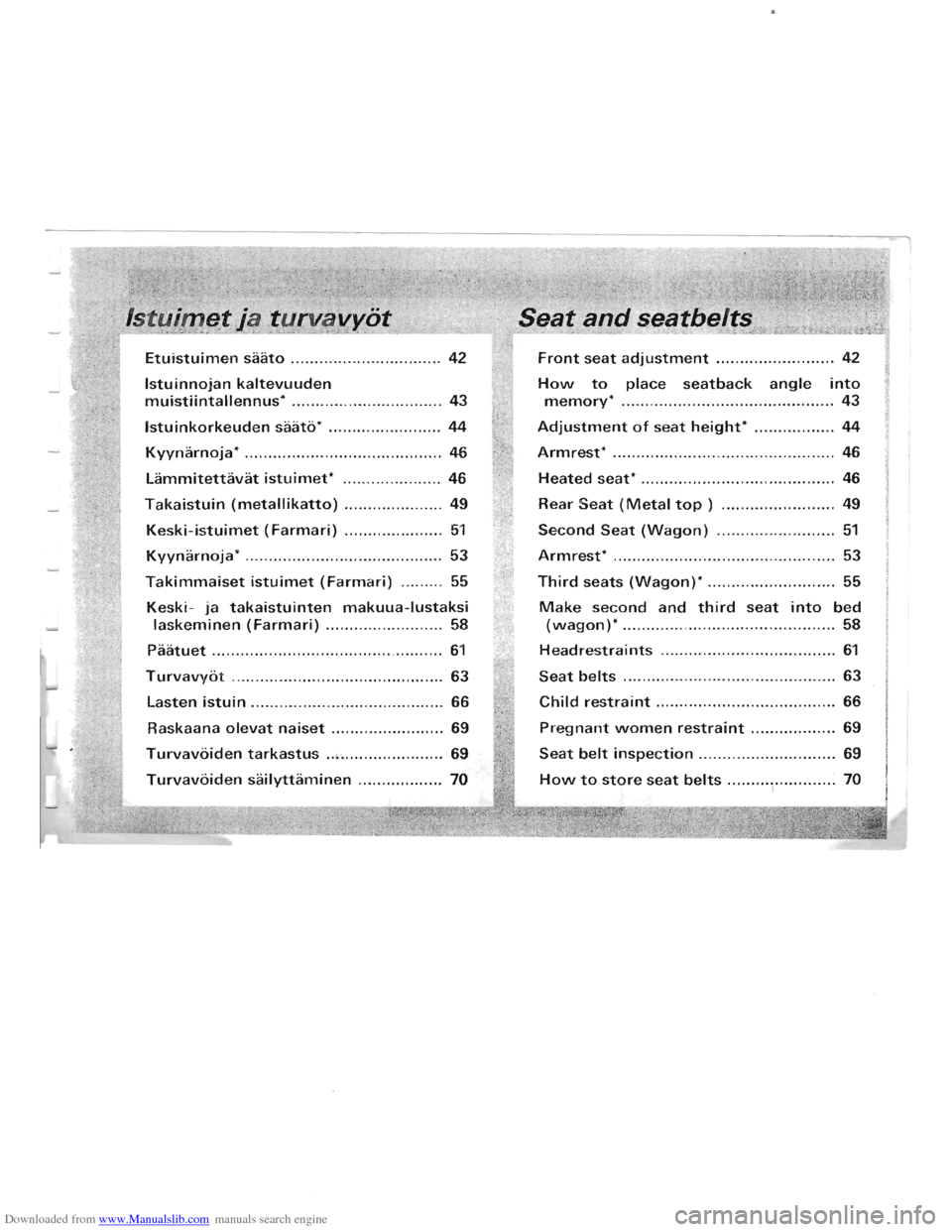
Downloaded from www.Manualslib.com manuals search engine Etuistuimen saato ................................ 42 Front seat adjustment ......................... 42
Istuinnojan kaltevuuden How to place seat back angle into
muistiintallennus* ................................ 43 memory* ............................................. 43
Istuinkorkeuden saato* ........................ 44 Adjustment of seat height* ................. 44
Kyynarnoja* .......................................... 46 Armrest* ............................................... 46
lammitettavat istuimet* ..................... 46 Heated seat* ......................................... 46
Takaistuin (metallikatto) ..................... 49 Rear Seat (Metal top) ........................ 49
Keski-istuimet (Farmari) ..................... 51 Second Seat (Wagon) ......................... 51
Kyynarnoja* .......................................... 53 Armrest* ............................................... 53
Takimmaiset istuimet (Farmari) ......... 55 Third seats (Wagon)* ........................... 55
Keski-ja takaistuinten makuua-Iustaksi Make second and third seat into bed
laskeminen (Farmari) ......................... 58 (wagon)* ............................................. 58
Paatuet ................................................. 61 Headrestraints ..................................... 61
T u rvavyot ............................................. 63 Seat belts ............................................. 63
lasten istuin ......................................... 66 Child restraint ...................................... 66
Raskaana olevat naiset ........................ 69 Pregnant women restraint .................. 69
Turvavoiden tarkastus ... '-. ..................... 69 Seat belt inspection ............................. 69
Turvavoiden sailyttaminen .................. 70 How to store seat belts ......... , ............ : 70
Page 39 of 302
Downloaded from www.Manualslib.com manuals search engine ISTUIMET JA TURVAVVOT SEAT AND SEAT BELTS '
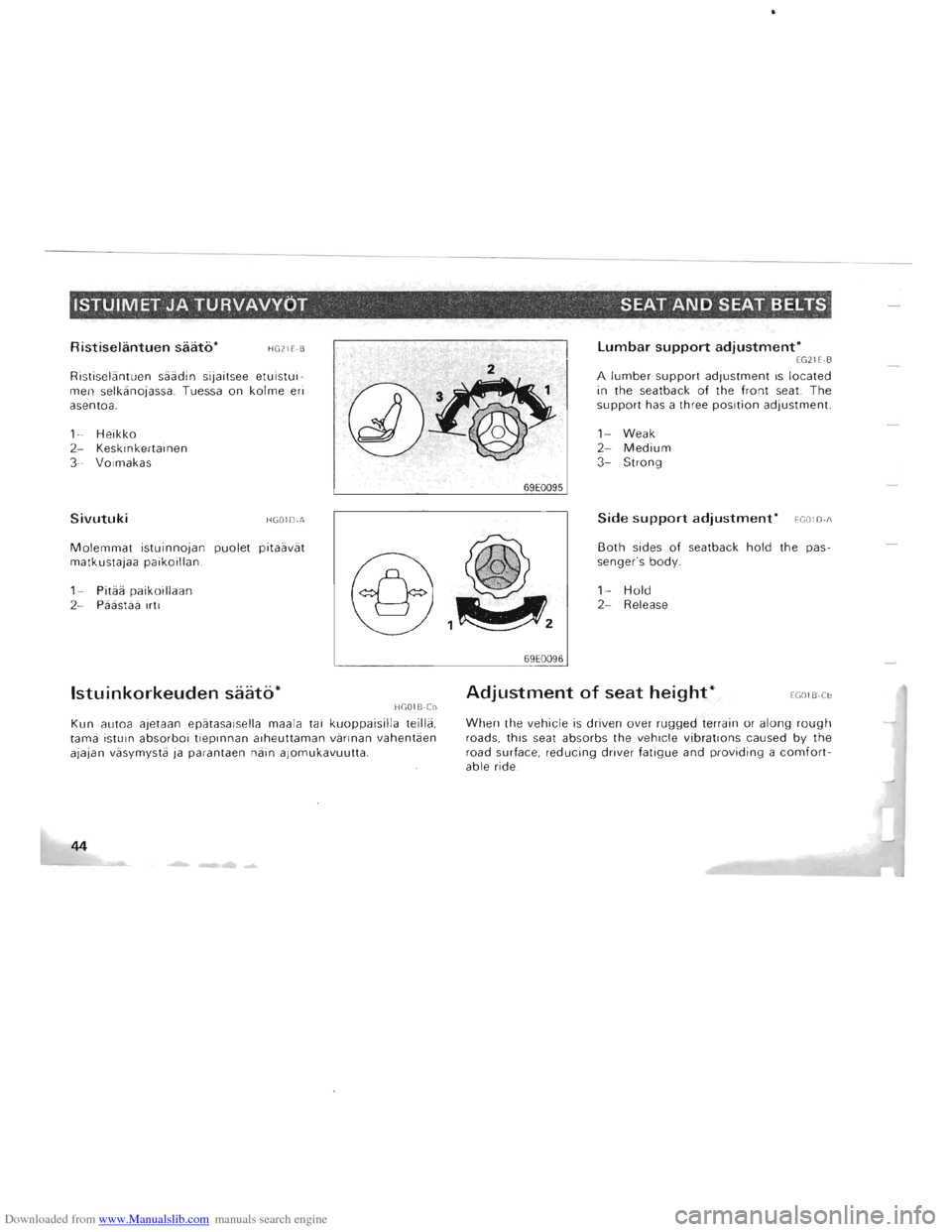
Ristiselantuen saato* HG2l E-B
Ristiselantuen saadin sijaitsee etuistuimen selkanojassa_ Tuessa on kolme eri
asentoa_
1 -
Heikko 2-Keskinkertainen 3-Voimakas
Sivutuki HG01f)-A
Molemmat istuinnojan puolet pitaavat
matkustajaa paikoillan_
1 -Pitaa paikoillaan 2-Paastaa irti
Istuinkorkeuden saato* HGOl B-Cb
Kun autoa ajetaan epatasaisella maala tai kuoppaisilla teilla,
tama istuin absorboi tiepinnan aiheuttaman varinan vahentaen
ajajan vasymysta ja parantaen nain ajomukavuutta_
44
69E0095
1~2
69E0096
Lumbar support adjustment* EG2l E-B
A lumber support adjustment is located in the seatback of the front seat. The support has a three position adjustment.
1 - Weak
2-Medium 3 -Strong
Side support adjustment* EG010 -A
Both sides of seatback hold the pas
senger's body.
1 -
Hold 2-Release
Adjustment of seat height* EG018-Cb
When the vehicle is driven over rugged terrain or along rough
roads. this seat absorbs the vehicle vibrations caused by the road surface . reducing driver fatigue and providing a comfort
able ride.
Page 40 of 302
Downloaded from www.Manualslib.com manuals search engine IS'TOiMET'~'A TURVAVv6i".· " ,'. ,', '.' ' .,' ,-,' SEAT'AND SEAT BELTS' " '.
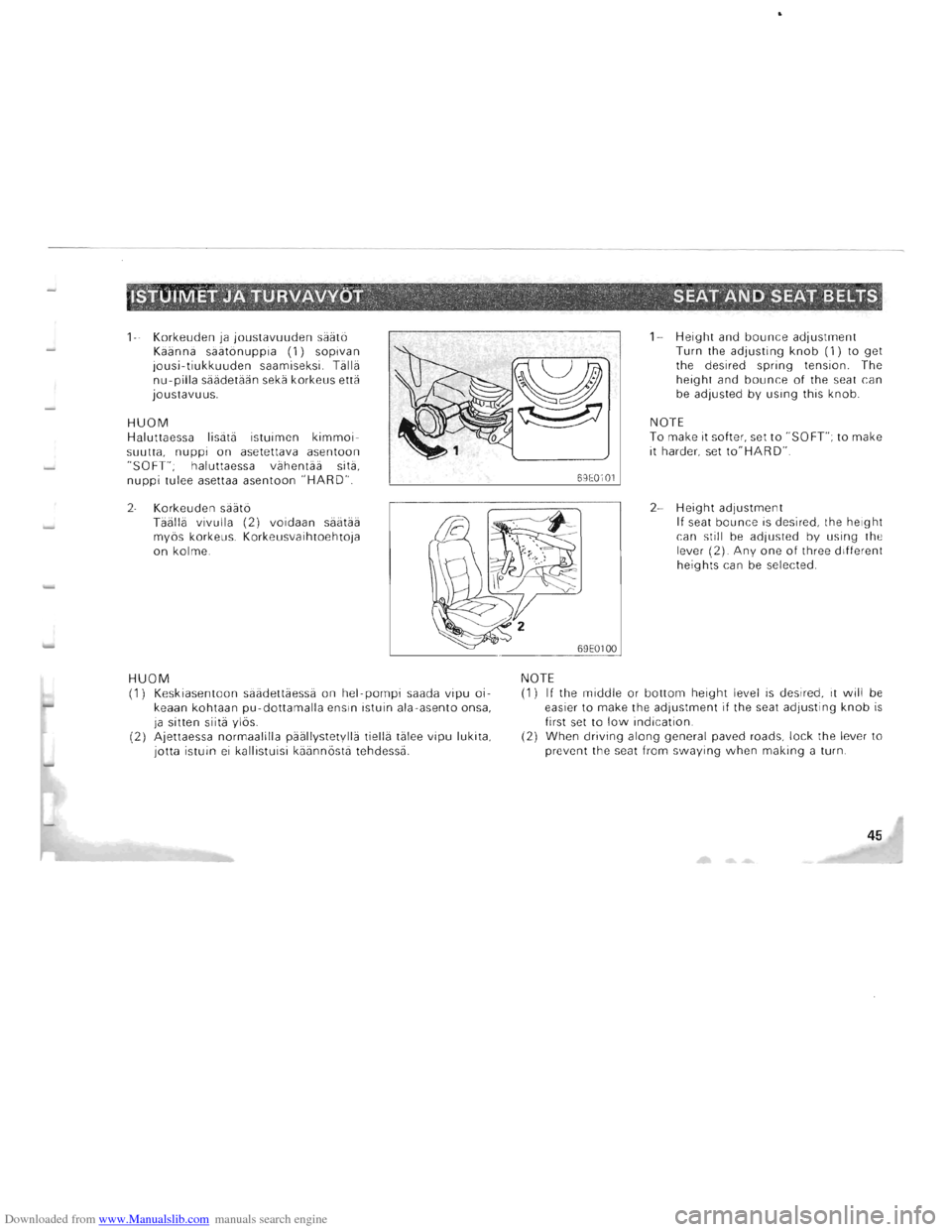
1-Korkeuden ja joustavuuden saata
Kaanna saatanuppia (1) sopivan jousi-tiukkuuden saamiseksi. Talla nu-pilla saadetaan seka korkeus etta joustavuus.
HUOM Haluttaessa lisata istuimen kimmoi
suutta, nuppi on asetettava asentoon "SOFT"; haluttaessa vahentaa sita, nuppi tulee asettaa asentoon "HARD".
2-Korkeuden saata
Taalla vivulla (2) voidaan saataa
myas korkeus. Korkeusvaihtoehtoja
on kolme.
HUOM (1) Keskiasentoon saadettaessa on hel-pompi saada vipu oikeaan kohtaan pu-dottamalla ensin istuin ala-asento onsa,
ja sitten siita ylas.
(2) Ajettaessa normaalilla paallystetylla tiella talee vipu lukita , jotta istuin ei kallistuisi kaannasta tehdessa.
69E0101
NOTE
1-Height and bounce adjustment
Turn the adjusting knob (1) to get the desired spring tension. The height and bounce of the seat can
be adjusted by using this knob_
NOTE To make it softer, set to "SOFT"; to make
it harder, set to" HAR D".
2-Height adjustment If seat bounce is desired, the height can still be adjusted by using the
lev er (2) . Anyone of three different
heights can be selected.
(1) If the middle or bottom height leve l is desired , it will be easier to make the adjustment if the seat adjusting knob is first set to low indication. (2) When driving along general paved roads, lock the lever to
prevent the seat from swaying when making a turn.
45
Page 56 of 302
Downloaded from www.Manualslib.com manuals search engine --------------
ISTUIMET JA TURVAVYDT' , .' '. ," . . SEAT AND' SEAT BELTS ' , !.' , . " , , ." ~ . . ~.
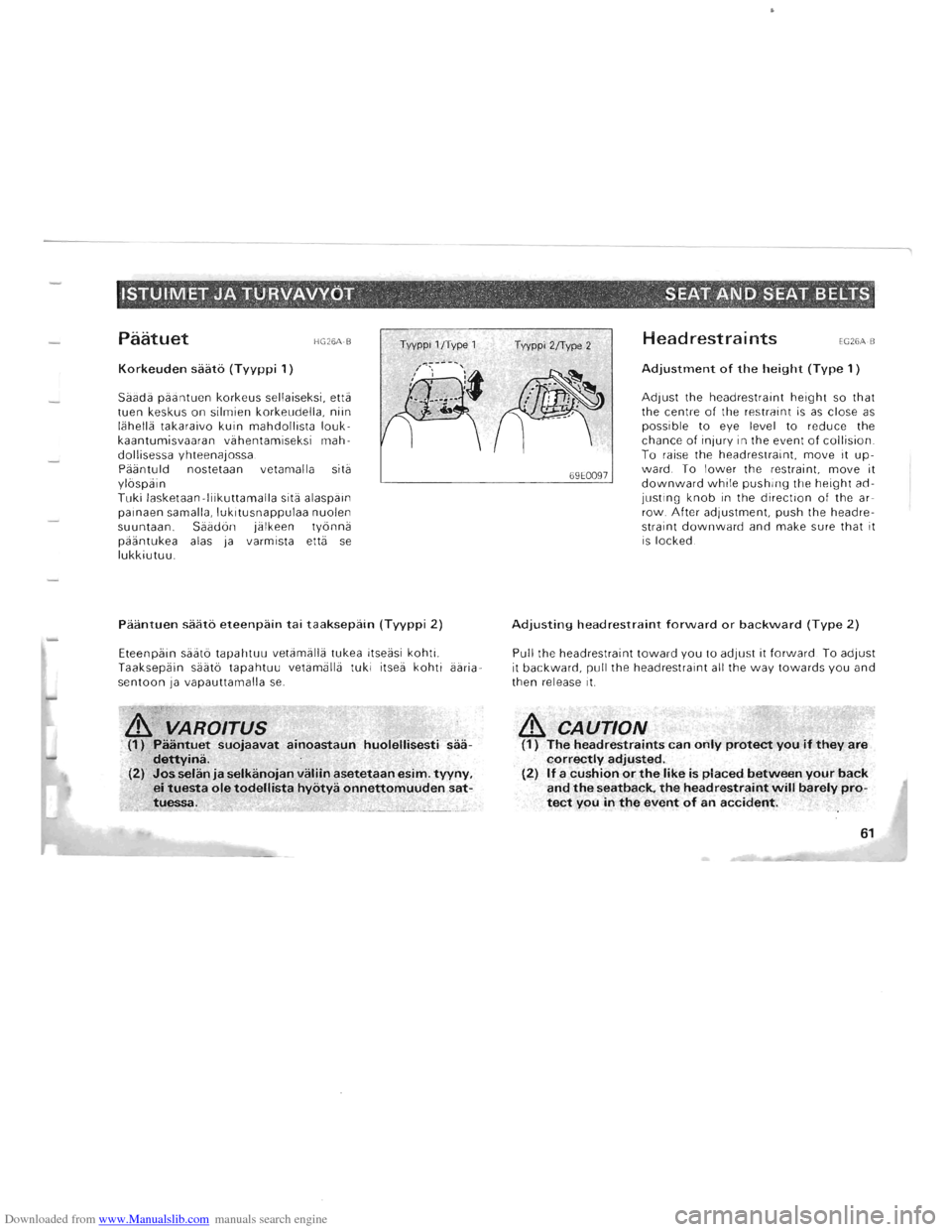
Paatuet
Korkeuden saato (Tyyppi 1 )
Saada paantuen korkeus sellaiseksi, etta
tuen keskus on silmien korkeudella , niin
lahella takaraivo kuin mahdollista
loukkaantumisvaaran vahentamiseksi mah
dollisessa yhteenajossa .
Paantuld nostetaan vetamalla sita
ylaspain
Tuki lasketaan -liikuttamalla sita alaspain
painaen samalla,
lukitusnappulaa nuolen
suuntaan. Saadan jalkeen tyanna
paantukea alas ja varmista etta se lukkiutuu.
Tyyppi l/Type 1
Paantuen saato eteenpain tai taaksepain (Tyyppi 2)
Eteenpain saata tapahtuu vetamalla tukea itseasi kohti.
Taaksepain saata tapahtuu vetamalla tuki itsea kohti aariasentoon ja vapauttamalla se.
, ... ", /" 7 .-:wqtrt~.'~
g;::. ,'VA ROITUS
. (1). ·Paantuet suojaavat ainoastaun huolellisesti saa
'," d~~ina. (2), Jos'selan ja selkanojan vi!lliin asetetaan esim. tyyny, , ei tuesta ole todellista hyotya onnettomuuden sat-
." •. 'tuessa. ' " ... _ ... .'._ .. _ ... _____ ....
T yyppi 2fT ype 2
69E0097
Headrestraints EG26A·B
Adjustment of the height (Type 1 )
Adjust the headrestraint height so that
the centre of the restraint is as close as possible to eye level to reduce the
chance of injury in the event of collision.
To raise the headrestraint move it up
ward. To lower the restraint move it downward while pushing the height ad
justing knob in the direction of the arrow. After adjustment push the headr e
straint downward and make sure that it is locked.
Adjusting headrestraint forward or backward (Type 2)
Pull the headrestraint toward you to adjust it forward. To adjust
it backward, pull the headrestraint all the way towards you and
then release it.
& CAUTION . , .
(1) The head restraints can only protect you if they are correctly adjusted. (2) If a cushion or the like is placed between your back and the seatback. the head restraint will barely pro-tect you in the event of an accident. .
61
Page 57 of 302
Downloaded from www.Manualslib.com manuals search engine I$T.UIMET,JA TURVAVVDT , ' SEAT AND,SEAT BELTS
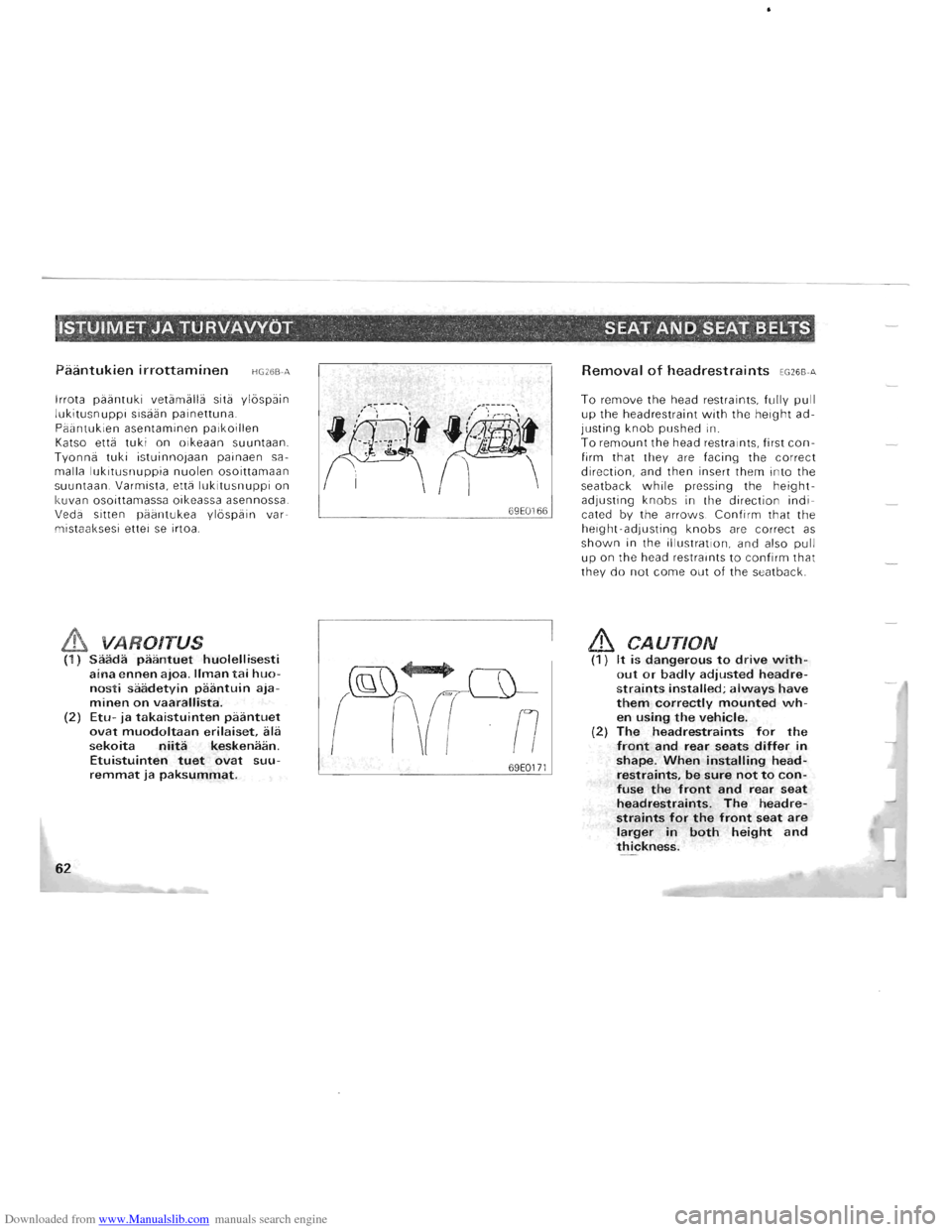
Paantukien irrottaminen HG26B -A
Irrota paantuki vetamalla sita ylospa in lukitusnuppi sisaan painettuna.
Paantukien asentaminen paikoillen Katso etta tuki on oikeaan suuntaan , Tyonna tuki istuinnojaan painaen sa
malla lukitusnuppia nuolen osoittamaan suuntaan . Varmista, etta lukitusnuppi on
k uvan osoittamassa oikeassa asennossa .
Veda sitten
paantukea ylospain var
mistaaksesi ettei se irtoa.
& VAROITUS (1) Saada paantuet huolellisesti aina ennen ajoa, IIman tai huonosti saadetyin paantuin ajaminen on vaarallista,
(2) Etu-ja takaistuinten paantuet ovat muodoltaan erilaiset, ala sekoita nllta keskenaan . Etuistuinten tuet ovat suuremmat ja paksummat.
62
69E0166
69E0171
Removal of headrestraints EG26B-A
To remove the head restraints, fully pull up the headrestraint with the height adjusting knob pushed in_
To remount the head restraints, first con
firm that they are facing the correct direction, and then insert them into the seatback while pressing the height
adjusting knobs in the direction indicate d by the arrows. Confirm that the h eight-adjusti ng knobs are correct as shown in the illustration, and also pull up on the head restraints to confirm that they do not come out of the seatback.
& CAUTION (1) It is dangerous to drive without or badly adjusted headrestraints installed; always have them correctly mounted when using the vehicle. (2) The headrestraints for the front and rear seats differ in
shape.
When installing headrestraints, be sure not to confuse the front and rear seat headrestraints. The headrestraints for the front seat are larger in both height and
thickness.
Page 61 of 302
Downloaded from www.Manualslib.com manuals search engine Saadettava turvavyon
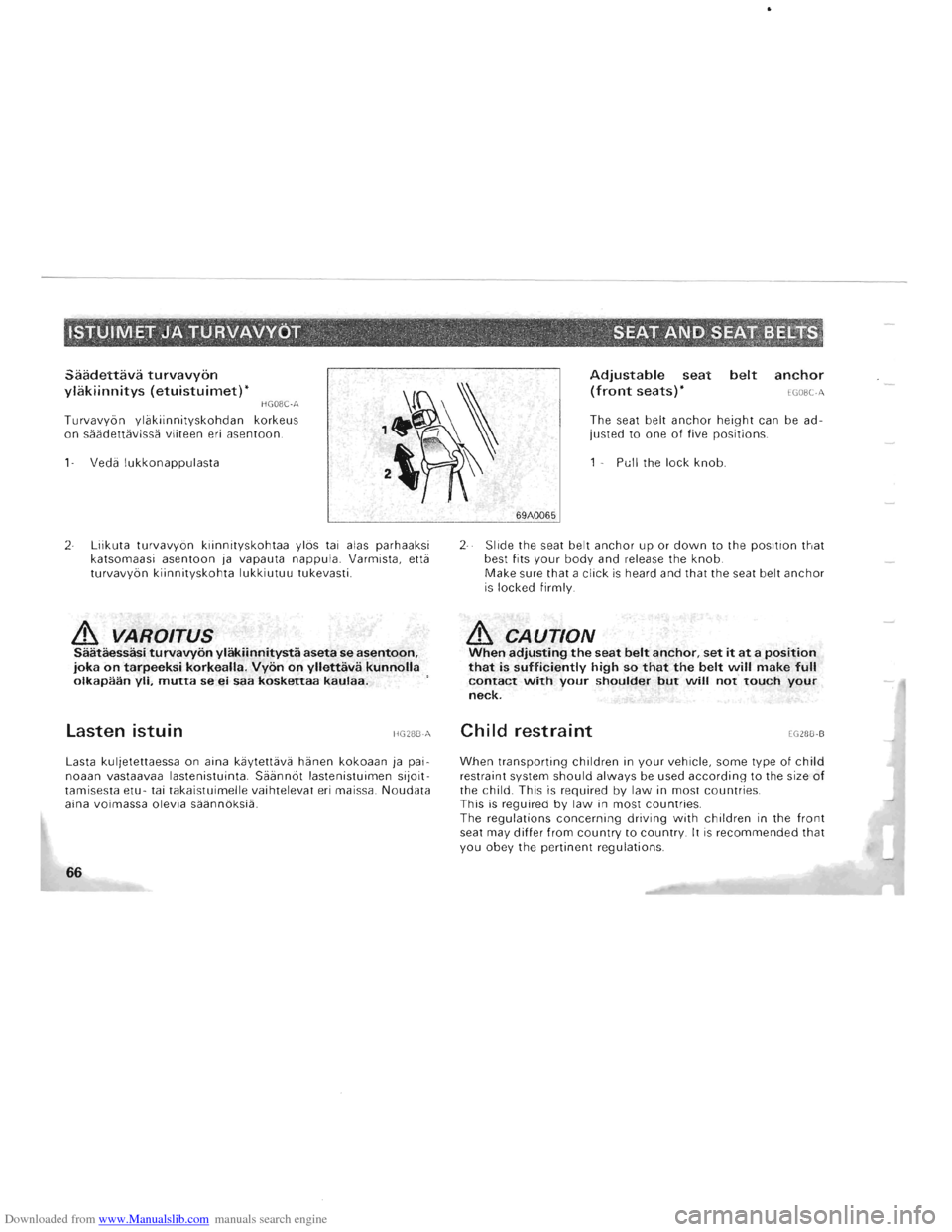
ylakiinnitys (etuistuimet)* HG08C·A
Turvavybn ylakiinnityskohdan korkeus
on saadettavissa viiteen eri asentoon.
1 - Veda
lukkonappulasta
2-Liikuta turvavybn kiinnityskohtaa ylbs tai alas parhaaksi
katsomaasi asentoon ja vapauta nappula. Varmista, etta
turvavybn kiinnityskohta lukkiutuu tukevasti.
& VAROITUS Saataessasi turvavyon ylakiinnitysta aseta se asentoon.
joka on tarpeeksi korkealla. Vyon on yllettava kunnolla
olkapaan yli. mutta se ei saa koskettaa kaulaa.
lasten istuin HG28B·A
Lasta kuljetettaessa on aina kaytettavii hanen kokoaan ja pai
noaan vastaavaa lastenistuinta . Saannbt lastenistuimen sijoittamisesta etu-tai takaistuimelle vaihtelevat eri maissa. Noudata
aina voimassa olevia saannbksia .
66
69A0065
Adjustable seat belt anchor
(front seats)* EG08C·A
The seat belt anchor height can be adjusted to one of five positions.
1 - Pull the
lock knob.
2-Slide the seat belt anchor up or down to the position that best fits your body and release the knob.
Make sure that a click is heard and that the seat belt anchor is locked firmly.
& CAUTION When adjusting the seat belt anchor. set it at a position that is sufficiently high so that the belt will make full contact with your shoulder but will not touch your neck.
Child restraint EG28B·B
W.hen transporting children in your vehicle, some type of child restraint system should always be used according to the size of the child. This is required by law in most countries.
This is reguired by law in most countries.
The regulations concerning driving with children in the front seat may differ from country to country. It is recommended that you obey the pertinent regulations.
Page 62 of 302
Downloaded from www.Manualslib.com manuals search engine VA ROITUS (1) Onnettomuustilastojen mukaan lasten on turvallisempaa istua takana kuin edessa, Siksi Mitsubishi Motors Corporation suosittelle lasten kuljettamista takaistuimella. (2) Aikuisen syli ei ole missaan tapauksessa lapsenistuimen korvike. Huolehdi lapsesi turvallisuudesta hankkimalla hanelle oikein mitoitettu istuin.
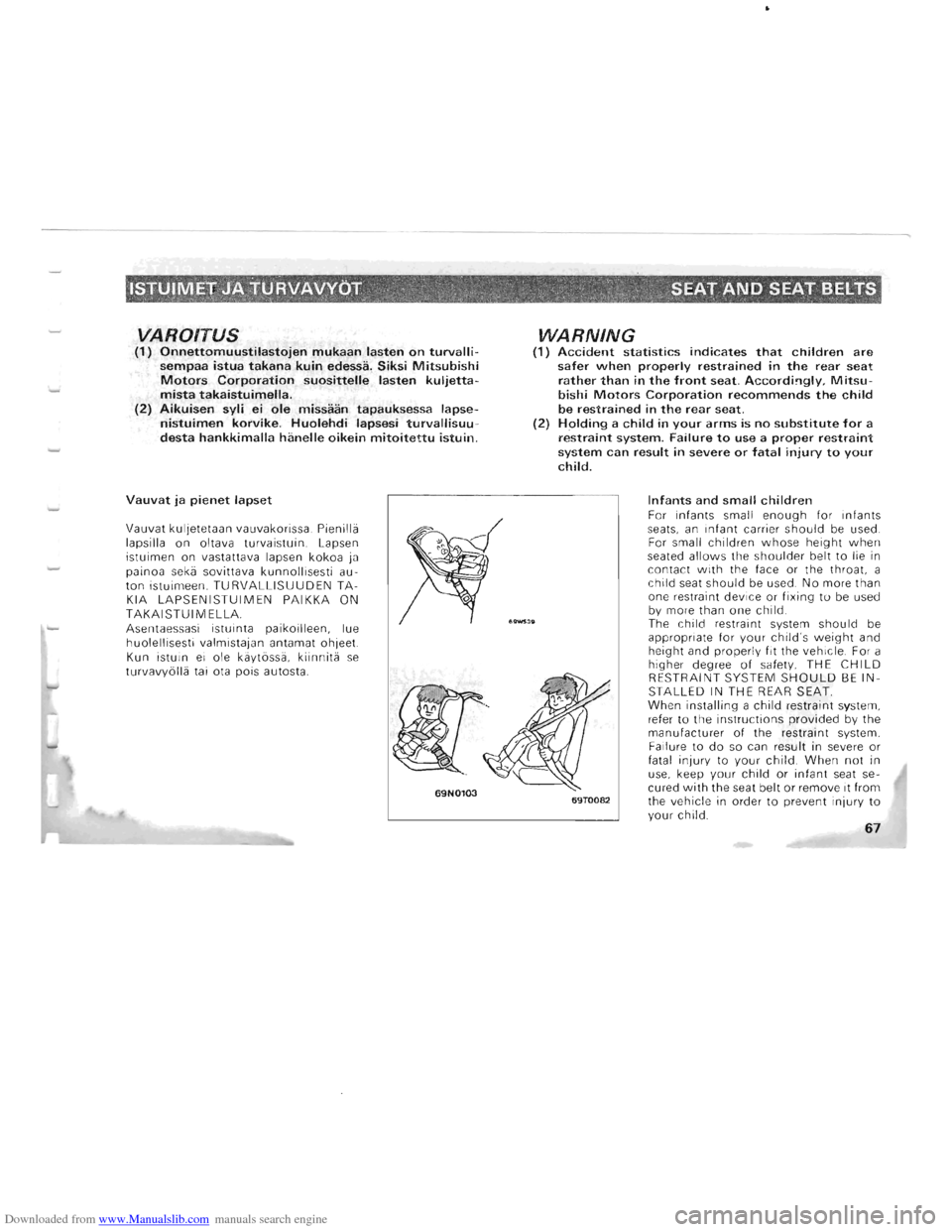
Vauvat ja pienet lapset
Vauvat kuljetetaan vauvakorissa. Pienilla
lapsilla on oltava turvaistuin. Lapsen
istuimen on vastattava lapsen kokoa ja
painoa seka sovittava kunnollisesti au
ton istuimeen. TURVALLlSUUDEN TAKIA LAPSENISTUIMEN PAIKKA ON TAKAISTUIMELLA. Asentaessasi istuinta paikoilleen . lue
huolellisesti valmistajan antamat ohjeet.
Kun istuin
ei ole kaytossa, kiinnita se turvavyolla tai ota po is autosta.
WARNING (1) Accident statistics indicates that children are safer when properly restrained in the rear seat rather than in the front seat. Accordingly, Mitsubishi Motors Corporation recommends the child be restrained in the rear seat.
(2) Holding a child in your arms is no substitute for a restraint system. Failure to use a proper restraint system can result in severe or fatal injury to your child.
69TO082
Infants and small children
For infants small enough for infants
seats, an infant carrier should be used.
For small children whose height when seated allows the shoulder belt to lie in contact with the face or the throat. a
child seat should be used . No more than
one restraint device or fixing to be used
by more than one child.
Th e child restraint system should be
appropriate
for your child's weight and
height and properly fit the vehicle . For a
higher degree of safety, TH E CH I LD
RESTRAINT SYSTEM SHOULD BE INSTALLED IN THE REAR SEAT.
When installing a child restraint system,
refer
to the instructions provided by the
manufacturer of the restraint system.
Failure to
do so can result in severe or
fatal injury to your child. When not in
use , keep your child or infant seat se
cured with the seat belt or remove it from the vehicle in order to prevent injury to
your child. 67
Page 74 of 302
Downloaded from www.Manualslib.com manuals search engine MITTAR'ISTO JA HALLINTALAITTEET " INSTRUMENTS & CONTROLS , . ~. "
Korkeusm itta ri * HDllBC
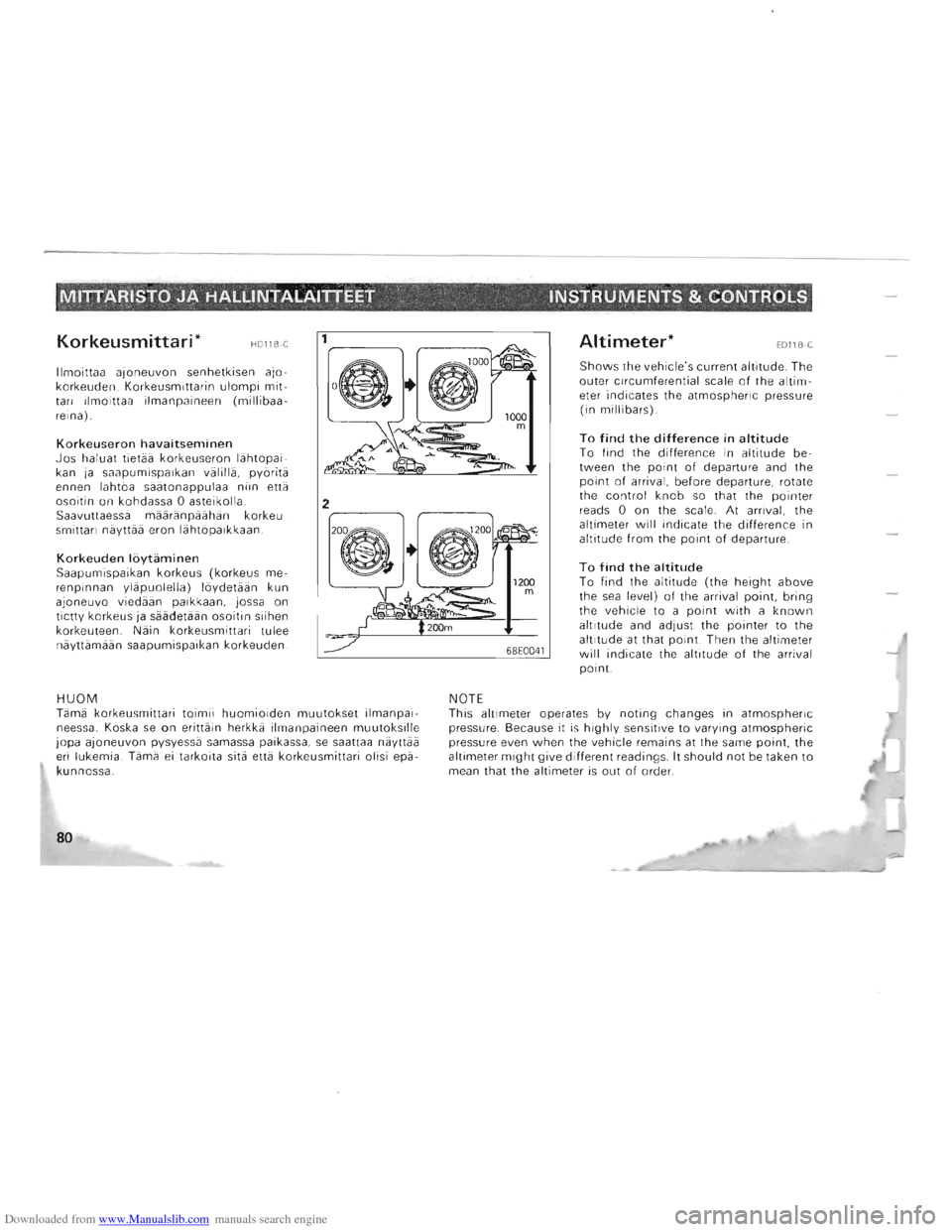
IImoittaa ajoneuvon senhetkisen ajo
korkeuden . Korkeusmittarin ulompi mit
tari ilmoittaa ilmanpaineen (millibaa
reina).
Korkeuseron havaitseminen Jos haluat tietaa korkeuseron lahtopai
kan ja saapumispaikan valilla, pyorita
ennen lahtoa saatonappulaa niin etta
osoitin on kohdassa 0 asteikolla .
Saavuttaessa maaranpaahan kork eu
smittari naytt
aa eron lahtopaikkaan .
Korkeuden loytaminen Saapumispaikan korkeus (korkeus me
renpinnan ylapuolella) loydetaan kun
ajoneuvo viedaan paikkaan, jossa on
tictty korkeus ja saadetaan osoitin siihen
korkeuteen . Nain korkeusmittari tulee
nayttamaan saapumispaikan korkeuden.
HUOM
2 ;-------..
rama korkeusmittari toimii huomioiden muutokset ilmanpai
neessa . Koska se on erittain herkka ilmanpaineen muutoksille jopa ajoneuvon pysyessa samassa paikassa, se saattaa nayttaa eri lukemia . rama ei tarkoita sita etta korkeusmittari olisi epa
kunnossa .
80
NOTE
Altimeter* EDllB-C
Shows the vehicle's current altitude. The outer circumferential scale of the altim
eter indicates the atmospheric pressure
( in millibars) .
To find the difference in altitude To find the difference in altitude between the point of departure and the point of arrival. before departure , rotat e
the control knob so that the pointer reads 0 on the scale . At arrival. the
altimeter will indicate the difference in altitude from the point of departure.
To find the altitude To find the altitude (the height above
the sea level) of the arrival point. bring the vehicle to a point with a known altitude and adjust the pointer to the altitude at that point. Then the altimeter will indicate the altitude of the arrival
point.
This altimeter operates by
noting changes in atmospheric pressure. Because it is highly sensitive to varying atmospheric pressure even when the vehicle remains at the same point. the
altimeter might give different readings. It should not be taken to mean that the altimeter is out of order.
Page 102 of 302

Downloaded from www.Manualslib.com manuals search engine /faynnistys ja ajo
Sisaanajo5uosituksia ••••••••••••••••••\
••••••••••••••••••\
•••••••• 108 Polttoaineen kaytto (bensiinkayttoiset ajoneuvot) ••••••••••••••• •• 110 Katalysaattori ••••••••••••••••••\
••••••••••••••••••\
••••••••.••••• 112 Taloudellinen ajo ••••••••••••••••••\
••••••••••••••••• 0 •••••••••••• 113 Paravaunun hinaanline n ••••••••••••••••••\
••••••••••••••••••\
•••••• 114 Virtalukko •••••••••••••••••••••••••••••\
•••••••••••••••••••••••• 117 Ohjauspyodin lukitseminen ja lukon avaaminen •••••••••••••••••••• 118 Moottorin kaynnistaminen ••••••••••••••••••••••••••••••••••••••• 119 Dieselkayttoiset ajoneuvot • • • • •• •••••• • •• •• • •• •• ••••• ••• •• • • • ••• '21 Macttorin kierrosluvun saatonuppi' ••••••••••••••••••\
•••••••••••• 122 Kasivalintainen vaihteisto ••.••••••••••••••••\
••••••••••••••••••\
••• 123 Vaihtaminen ••••••••••••••••••\
•••••••••••••••••••••••••••••\
•••• 124 Automaattivaihteisto •••••••••••••••••••••••••\
••••••••••••••••••• 127 V alitsimen asennot ••••••••••••••••••\
••••••••••••••••••\
•••••••••• 128 Ylivaihteen saatokytkin ••••••••••••••••••\
••••••••••••••••••\
•••••• '29 Ohituskiihdytys ••••••••••••••••••\
••••••••••••••••••\
••••••••••••• 132 Pysahtyminen ••••••••••••••••••\
••••••••••••••••••\
•••••••••••••• 132 Pysak6iminen •••• • • • • • • • • • • • • . • • • • • • • • • • • • • • • • • • • • • • • • • • • • • • • •• 132 Saadettav3super·nelipyoraveto· • ••••••••••••••••••••••••••••••••• 133 Vaihtovivun asento ja 2 /4 -nelipyoravedon merkkivalo ••••••••••••••• 134 Jakovaihteiston vivun kflytto ••••••••••••••••••••••••••••••••••••\
• 136 Osa-aikainen nelipyoraveto ••••••••••••••••••\
••••••••••••••••••••• 139 Vaihtovivun asento ja 2/4 -pyoravedon ll1erkkivalo •••••••••••••••••• 140 Jakovaihteiston vivun kaytto (Ka sisaatoisilla na p alukoilla varustetut ajoneuvot) •••.••••.••.•••••••••\
•• , ••••••• , •. , ••••••••• 142 Vivun kayto (Automaattisilla napalukoilla varustetut ajoneuvot) •••.. 143 Napaluko t' ••••••••••••.••• •••••••• •••••••••••••••••••••••••• ' •• 144 Automaattiset napalukot ••••••••••••••••••••••••••••••••••••••••• 145 Takatasauspyoraston lukko ••••••••••••••••••\
••••••••••••••••••\
••• 148 Esimerkkeja takatasaupyoraston lukon tehokkaasta kaytosta •••••••• . 152 Esimerkkeja takatasauspyoniston luko n virheellisesta kayt6sta ••••••• 153 Oikea nelipy6 ravetoajo ••••••••••••••••••\
••••••••••••••••••\
•••••.• 155 Pysak6intijarru ••••••••••••••••••\
••••••••••••••••••\
••••••••••••• 160 Pysak6inti ••••••••••••••••••\
••••••••••••••••••\
••••••••••••••••• 161
Jarrutus •••••••••••••••••••••••••••\
••••••••••••••••••\
•••••••••• 162 lukkiutumisen estava jarrujarjes telma (A.B.S)' •••••••••••••••••••• 165 Ohjauspy6ran korkeude n saato .................................... 170 Ohjaustehostinjarjestelnla ••••••••••••••••••••••••••••••••••••••• 170 T austapeili •••••.••••• ,.......................................... 171
S ahkbtoimiset taustapeilit ••••••••••••••••••\
••••.•••••••••••••••• 171 Automaattinen nopeuden sa~lto ••••••••••••••••••••••••••••••••••\
172 3 muodo n saadettava iskunvainlennin' •••••••••••••••••••••••••••• 178
Starting and driving
Running-in recomnlendations ••••••••••••••••••\
••••••••••••••••••\
109 Fuel usage (Petrol powered vehicles) .............................. 110 Catalytic converter ••••••••••••••••••\
••••••••••••••••••\
•••••••••• 112 Econolnical driving ••••••••••••••••••\
•••••••••••••••••••••••••••• 11 3
Traile r towing •••••••••• •••••••••••••••••••••••••••\
••••••••••••• 114 Ignition switch •••••••• •••••••••••••••••••••••••••••••••••••••••• 117 How to loc k and unlock the s teering wheel •••.••••••••••••••••••• 118 Starting the engine ••••••••••••••••••••••••••••••••••••••••••••• 119 Diese l-powered vehicles •••••••• ' •••••••••••••••••••••••••••••••• 1 21 Engine rpm adjustment knob' ••••••••••••••••••\
••••••••••••••.•• 1 22 Manual transnlission ............................................. 123 Changing gears ••••••••••••••••••••••••••••••••••.•• •••••••••••• 124 Automatic transmission •••••••.••••••••••••••••••••••\
•••••••••••• 127 Selector positions ••••••••••••••••••••••••••••••••••••••••••••• •• 128 Overdrive control switch •••••••••••••• •• •••••.•••• •••••••••••••• 129 Passing acceleration •••••••••••••••••••••••••••••••••••\
•••••••••• 132 Waiting •••••••••••••••••••••••••••••••••••••••••••••••••••••••• 1 32
P arking ••••••••••••••••••••\
•••••••••••••••••••••••••••••••••••• 132 Super se lect 4WD' •••••••••••••••••••••••••••••••••••••••••••••• 133 Shift lever position and 2WO/4WO operation indication lamp ••••••• 135 Transfer shift lever operation •.••••.•••..••• ,...... .. ............ 136 Part tinlC 4WO' ••••• " •••••••••••••••••• ••••••••••••••••••••••• 139 Shift lever position and 2WO/4WO operation indication lamp ••••••• 141 Transfer shift lever operation (Vehicle s equipped with manual free-wheeling hubs) . ' •.•••.• ', ...••..• , ••••••••••••••••••\
••••••• 142 lever operation (vehic les equipped with automatiC free- w he eling hubs) " ••••• , ••.•••......•. " .•••• ' •••••••••••••••• 143 Free-wheeling hubs' •••••••••••..••• ' ••••••.••••••••••••\
••••••••• 144 Automatic free-w heeling hubs •••• , .••.• , •••••••••••••••• ••.••• •• 145 Rea r differential lock' ••••••••••••••••••••••••••••••• , ••••••• •••• 148 Examples of effective use of the re ar differential lock ••••••••••••••. 152 Examples of incorrect u se of the rear differential lock •••••••••••••• 153 Correct four-wheel drive operation ••••••••••••••••••\
•••••••••••• 155 Parking brake ••••••••••• ••••••••• ' ••••••••••••••••••\
•••••••••••• 160 Parking •••••••••••••••••••••••••••••••••••••••••••••••••••••••• 161 Braking ••••••••••••••••••\
••••••••••••••••••\
••••••••••••••••••\
•• 162 Anti-skid brake systenl (A.B .S .)' ••••••••••••••••••\
••••••••••••••• 165 Steering wheel height adjustmen t ................................. 170 Power steering sy ste m ' •...•..••.•••••••••.•.••••••••••••••••••• 170 Inside rear-view mirror •••••.•••••••••••••••••••••••••••••••••••• 171 Electric remote-controlled outside rear-view mirro rs' ••••••••••••••• 171 Auto-s peed (cruise) control' ••••••••••••••••••\
••••••••••••••••••\
• 172
3 -mode variable shock absorber' •••••••••••••••••••••.•••\
••••• ••• 178
Page 289 of 302
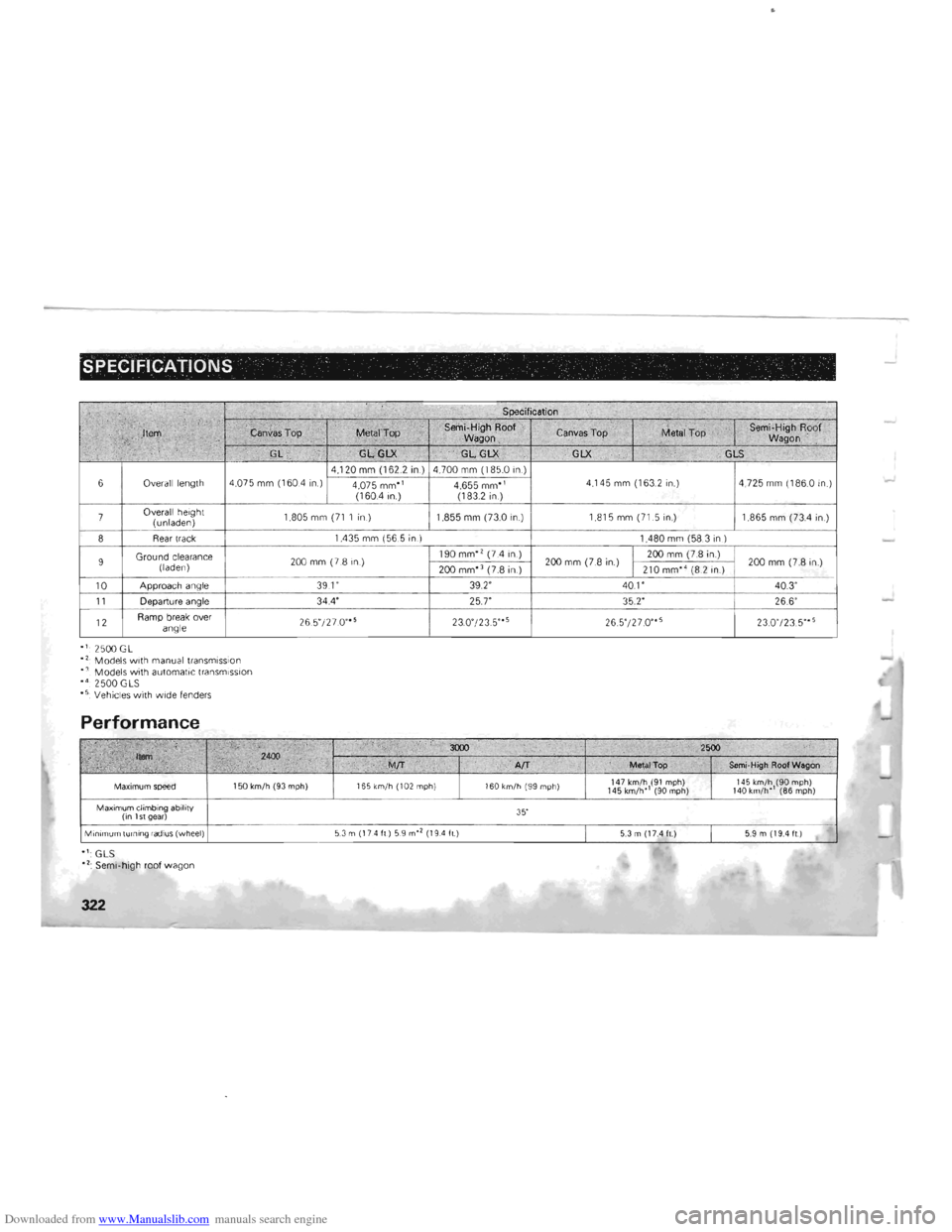
Downloaded from www.Manualslib.com manuals search engine SPECIFICATIONS
4,120 mm (162,2 in ,) 6 Overall length 4,075 mm (160.4 in.) 4,075 mm'l
7 Overall height (unladen)
8 Rear track
9 Ground clearance
(laden)
10 Approach angle
11 Departure angle
12 Ramp break over
angle
.\. 2500 GL .,. Models with manual transmiss ion .3: Models with automatic transmission .4: 2500 GLS .': Vehicles with wide fenders
Performance
.\. GLS .': Semi-high roof wagon
322
(160.4 in,)
1 ,805 mm (71 1 in)
1.435 mm (56 .5 in .)
200 mm (7.8 in.)
39, 1 '
34.4 '
26,5' /27,0'"
.' .
"S~m'i.High:Rd6(,:: Wagon " '
4)00 mm (1850 in)
4,655 mm'l 4,145 mm (163 .2 in .) 4 ,725 m m (186 .0 in) (183 ,2 in)
1 ,855 mm (730 in.) 1,815 mm (71, 5 in ,) 1 ,865 mm (73.4 in ,)
1 A80 mm (58.3 in)
190 mm" (7.4 in.) 200 mm (7.8 in ,) I 200 mm (7.8 in .)
200 mm " (78 in.) I 210 mm" (82 in ,) 200 mm (7.8 in ,)
39. 2 ' 40.1 '
40 .3'
25.7' 35.2' 26.6'
23.0'/23 .5'" 265'/27.0'" 230'/23,5" ,