ESP MITSUBISHI SHOGUN 2017 Owner's Manual (in English)
[x] Cancel search | Manufacturer: MITSUBISHI, Model Year: 2017, Model line: SHOGUN, Model: MITSUBISHI SHOGUN 2017Pages: 394, PDF Size: 19 MB
Page 2 of 394
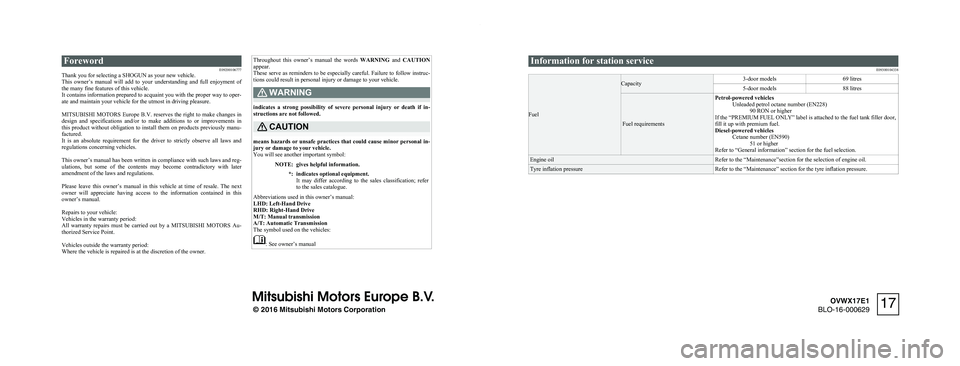
ForewordE09200106777
Thank you for selecting a SHOGUN as your new vehicle.
This owner’s manual will add to your understanding and full enjoyment of
the many fine features of this vehicle.
It contains information prepared to acquaint you with the proper way to oper-
ate and maintain your vehicle for the utmost in driving pleasure.
MITSUBISHI MOTORS Europe B.V. reserves the right to make changes in
design and specifications and/or to make additions to or improvements in
this product without obligation to install them on products previously manu- factured.
It is an absolute requirement for the driver to strictly observe all laws and
regulations concerning vehicles.
This owner’s manual has been written in compliance with such laws and reg- ulations, but some of the contents may become contradictory with later amendment of the laws and regulations.
Please leave this owner’s manual in this vehicle at time of resale. The next
owner will appreciate having access to the information contained in this
owner’s manual.
Repairs to your vehicle:
Vehicles in the warranty period:
All warranty repairs must be carried out by a MITSUBISHI MOTORS Au-
thorized Service Point.
Vehicles outside the warranty period:
Where the vehicle is repaired is at the discretion of the owner.
Throughout this owner’s manual the words WARNING and CAUTION
appear.
These serve as reminders to be especially careful. Failure to follow instruc-
tions could result in personal injury or damage to your vehicle.WARNING
indicates a strong possibility of severe personal injury or death if in- structions are not followed.
CAUTION
means hazards or unsafe practices that could cause minor personal in-
jury or damage to your vehicle.
You will see another important symbol:
NOTE:gives helpful information.*:indicates optional equipment.
It may differ according to the sales classification; refer to the sales catalogue.
Abbreviations used in this owner’s manual:
LHD: Left-Hand Drive
RHD: Right-Hand Drive
M/T: Manual transmission
A/T: Automatic Transmission
The symbol used on the vehicles:
: See owner’s manual
Information for station service
E09300104338
Fuel
Capacity3-door models69 litres5-door models88 litres
Fuel requirements
Petrol-powered vehiclesUnleaded petrol octane number (EN228)90 RON or higher
If the “PREMIUM FUEL ONLY” label is attached to the fuel tank filler door,
fill it up with premium fuel.
Diesel-powered vehicles Cetane number (EN590)51 or higher
Refer to “General information” section for the fuel selection.Engine oilRefer to the “Maintenance”section for the selection of engine oil.Tyre inflation pressureRefer to the “Maintenance” section for the tyre inflation pressure.
© 2016 Mitsubishi Motors Corporation
17
OVWX17E1
BLO-16-000629
Page 17 of 394
lWhen fitting accessories, ensure that
maximum gross vehicle weight and maximum axle weight are not exceeded.
Important points!
Due to large number of accessory and re- placement parts of different manufactures
available in the market, it is not possible, not
only for MITSUBISHI MOTORS , but also
for a MITSUBISHI MOTORS Authorized
Service Point, to check whether the attach- ment or installation of such parts affects theoverall safety of your MITSUBISHI-vehicle.
Even when such parts are officially author-
ized, for example by a “general operators permit” (an appraisal for the part) or throughthe execution of the part in an officially ap-
proved manner of construction, or when a single operation permit following the attach-
ment or installation of such parts, it cannot be deduced from that alone, that the driving
safety of your vehicles has not been affected.
Consider also that there basically exists no li- ability on the part of the appraiser or the offi-
cial. Only in the case of parts ( MITSUBISHI
MOTORS original replacement or exchange
parts as well as MITSUBISHI MOTORS
genuine accessories) that are recommended and released by a MITSUBISHI MOTORS
Authorized Service Point and that are attach- ed or installed by a MITSUBISHI MOTORS
Authorized Service Point can you assume, that optimal safety has been provided. Thesame also pertains to modifications of
MITSUBISHI vehicles with respect to the
production specifications. For your own safe-
ty, in such cases, you should only undertake
modifications according to the recommenda-
tions of a MITSUBISHI MOTORS Author-
ized Service Point.Modification/alterations to
the electrical or fuel systems E00200400254
MITSUBISHI MOTORS has always manu-
factured safe, high quality vehicles. In order to maintain this safety and quality, it is im-
portant that any accessory that is to be fitted, or any modifications carried out which in-
volve the electrical or fuel systems, should be carried out in accordance with MITSUBISHI
MOTORS guidelines.
CAUTIONl If the wiring interferes with any part of the
vehicle bodywork or improper installation methods are used, i.e. protective fuses not
installed, etc.), electronic devices may be ad- versely affected, possibly resulting in an
electrical fire or other failures that may cause an accident.Genuine parts
E00200500617
MITSUBISHI MOTORS has gone to great
lengths to bring you a superbly crafted auto-
mobile offering the highest quality and de- pendability.
Use MITSUBISHI MOTORS genuine parts,
designed and manufactured to maintain your MITSUBISHI MOTORS automobile at top
performance. MITSUBISHI MOTORS genu-
ine parts are identified by this mark and are available at all MITSUBISHI MOTORS Au-
thorized Service Points.
Modification/alterations to the electrical or fuel systems
2-05OVWX17E1General information2
Page 23 of 394
NOTElIf the remote control switch is operated at
the correct distance from the vehicle, but thedoors (including the backdoor) are not
locked/unlocked in response, the battery may be exhausted.
For further information, please consult your
MITSUBISHI MOTORS Authorized Serv-
ice Point.
If you replace the battery yourself, refer to “Procedure for replacing the remote control
switch battery” on page 3-05.
l If your remote control switch is lost or dam-
aged, please contact your MITSUBISHI
MOTORS Authorized Service Point for a re-
placement remote control switch.
l If you wish to add a remote control switch,
we recommend you to contact your
MITSUBISHI MOTORS Authorized Serv-
ice Point.
A maximum of 4 remote control switches
are available for your vehicle.Procedure for replacing the re-
mote control switch battery
E00309501298
WARNINGl Danger of explosion if battery is incor-
rectly replaced.
Replace only with the same battery or an equivalent type.CAUTIONl Never disassemble or remove any inside
parts of the keyless entry key other than de-
scribed below.
Because there is a possibility that it may be-
come impossible to reassemble.
l When the remote control switch case is
opened, be careful to keep water, dust, etc. out.NOTEl You may purchase a replacement battery at
an electric appliance store.
l A
MITSUBISHI MOTORS Authorized
Service Point can replace the battery for you
if you prefer.
1. Before replacing the battery, remove
static electricity from your body by touching a metal part such as doorknob
of the room.
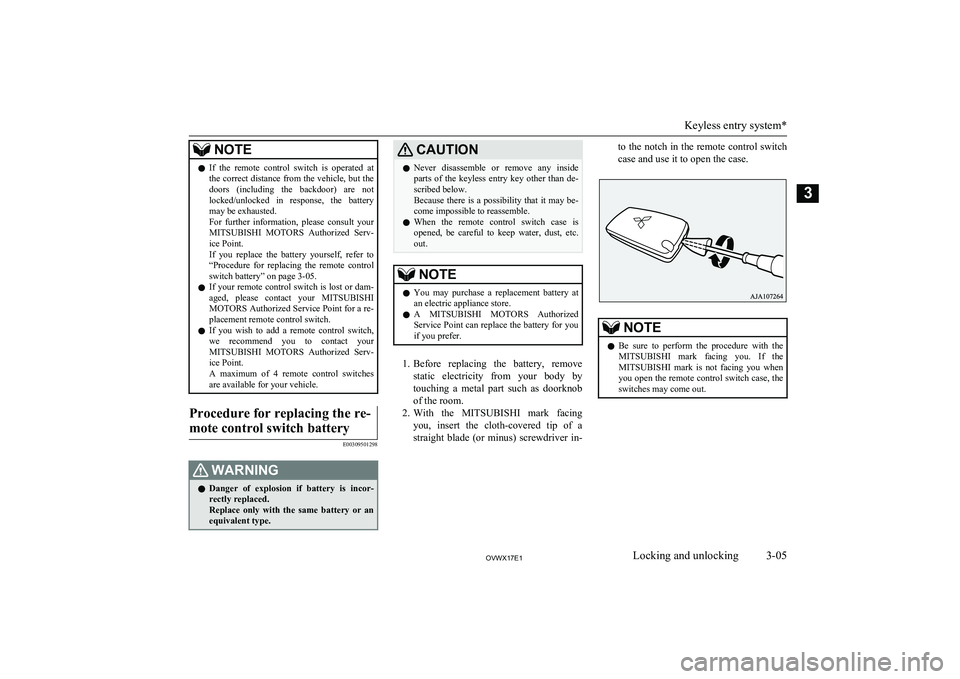
2. With the MITSUBISHI mark facing
you, insert the cloth-covered tip of a
straight blade (or minus) screwdriver in-
to the notch in the remote control switch case and use it to open the case.NOTEl Be sure to perform the procedure with the
MITSUBISHI mark facing you. If the
MITSUBISHI mark is not facing you when
you open the remote control switch case, the switches may come out.
Keyless entry system*
3-05OVWX17E1Locking and unlocking3
Page 34 of 394
1.The alarm will be activated for approxi-
mately 30 seconds. The turn-signal
lamps will flash, and the siren will sound intermittently.
2. The alarm will resume if unlawful ac-
tions are taken again, even if the alarm has stopped.
NOTEl The interior lamp will not come on while the
alarm is sounding.Cancelling the alarm
E00302000356
It is possible to halt the activation of an alarm
using the following methods:
l Pressing the LOCK or UNLOCK switch
on the keyless entry switch.
(After pressing the LOCK switch, the vehicle will lock if all the doors (includ-
ing the backdoor) are closed, after which
the system preparation mode will once again go into effect.)
l Turning the ignition switch to the “ON”
or “ACC” position.NOTEl When the ignition switch is turned to the
“ON” position, the buzzer sounds 4 times.This operation indicates that the alarm was
activated while the vehicle was parked.
Please check the inside of the vehicle to con-
firm that nothing was stolen.
l Even if the battery is disconnected, the alarm
activation memory will not be erased.Electric window control
E00302200185
The electric windows can only be operatedwith the ignition switch in the “ON” position.
Electric window control switch
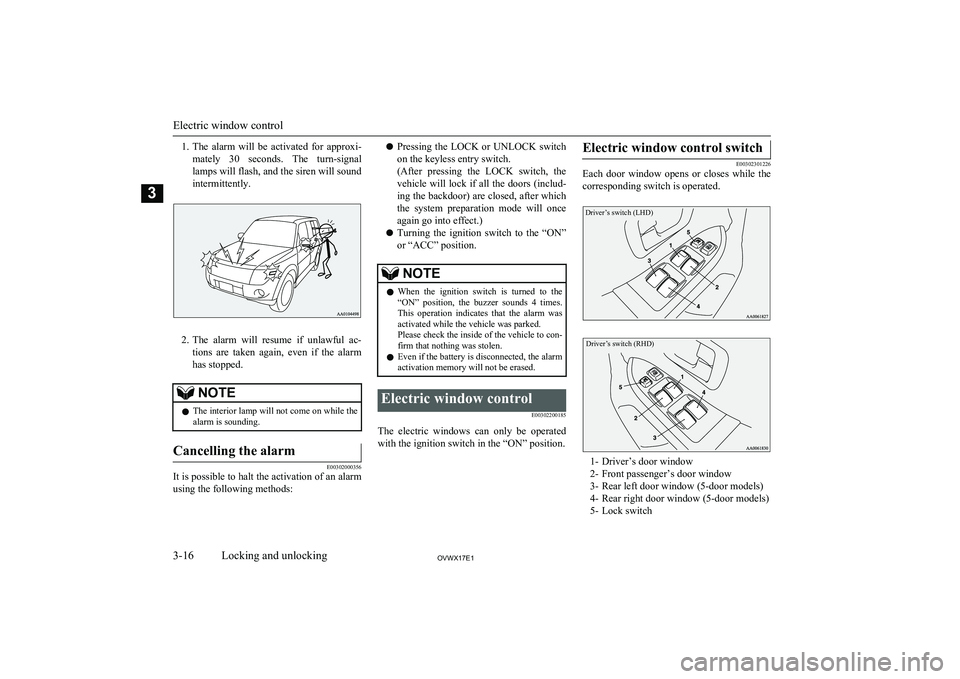
E00302301226
Each door window opens or closes while the
corresponding switch is operated.
Driver’s switch (LHD)Driver’s switch (RHD)
1- Driver’s door window
2- Front passenger’s door window
3- Rear left door window (5-door models)
4- Rear right door window (5-door models) 5- Lock switch
Electric window control
3-16OVWX17E1Locking and unlocking3
Page 35 of 394
WARNINGlBefore operating the electric window con-
trol, make sure that nothing can get trap-
ped (head, hand, finger, etc.).
l Never leave the vehicle without removing
the key.
l Never leave a child (or other person who
might not be capable of safe operation of
the electric window control) in the vehicle alone.
l The child may tamper with the switch at
the risk of its hands or head being trap- ped in the window.NOTEl Repeated operation with the engine stopped
will run down the battery. Operate the win-
dow switches only while the engine is run- ning.
Driver’s switches
The driver’s switches can be used to operate
all door windows.
A window can be opened or closed by oper- ating the corresponding switch.
Press the switch down to open the window, and pull up the switch to close it.
If the switch for the driver’s window is fully
pressed down/pulled up, the door window au-
tomatically opens/closes completely.
If you want to stop the window movement, operate the switch lightly.
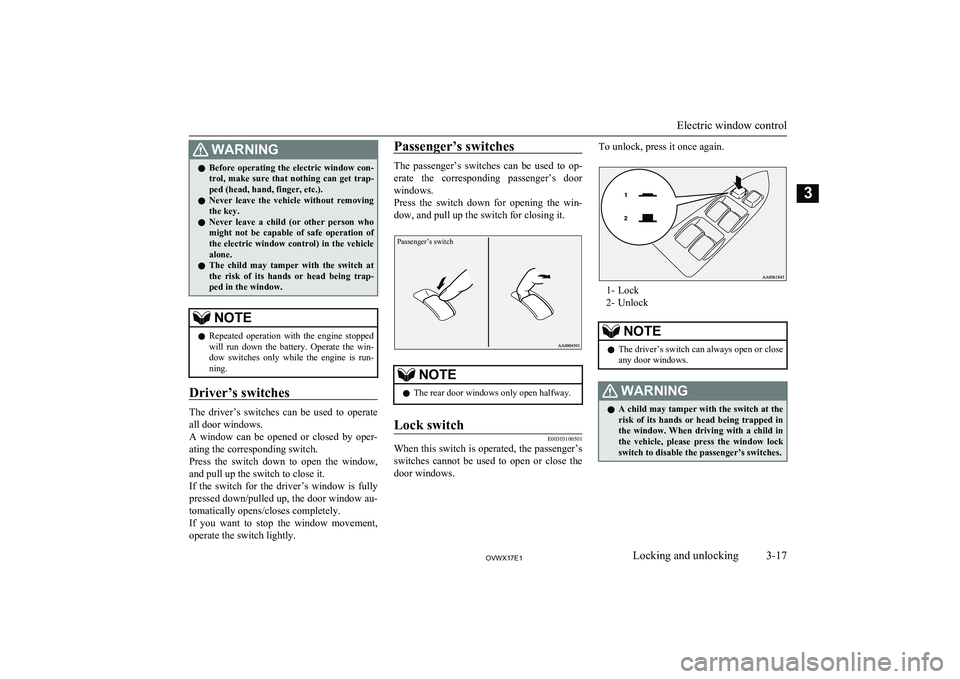
Passenger’s switches
The passenger’s switches can be used to op-
erate the corresponding passenger’s door
windows.
Press the switch down for opening the win- dow, and pull up the switch for closing it.
Passenger’s switch
NOTEl The rear door windows only open halfway.Lock switch
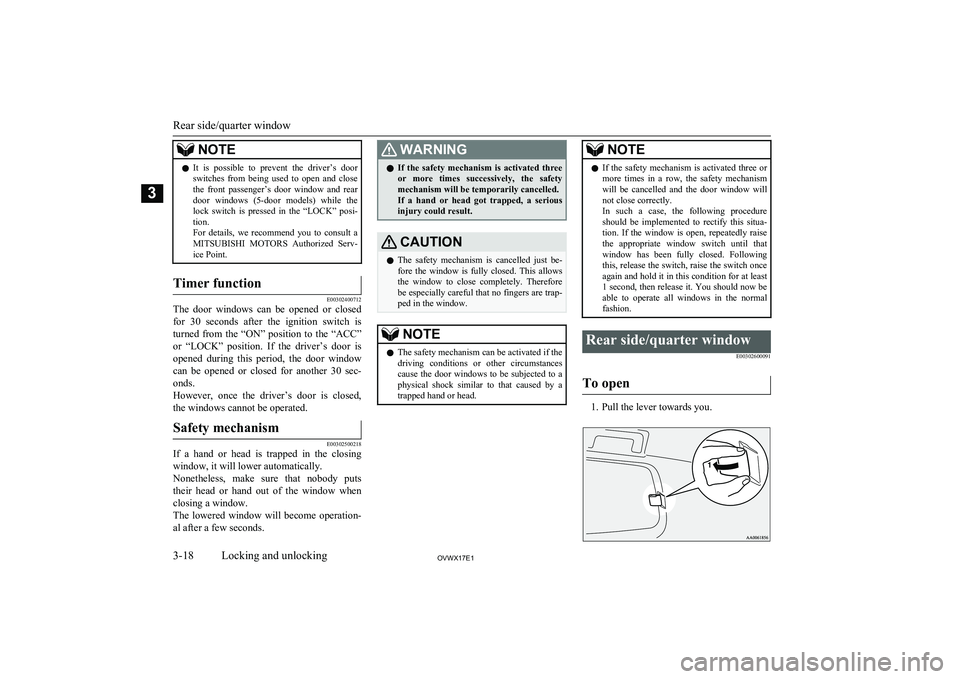
E00303100501
When this switch is operated, the passenger’s
switches cannot be used to open or close the door windows.
To unlock, press it once again.
1- Lock
2- Unlock
NOTEl The driver’s switch can always open or close
any door windows.WARNINGl A child may tamper with the switch at the
risk of its hands or head being trapped in
the window. When driving with a child in the vehicle, please press the window lockswitch to disable the passenger’s switches.
Electric window control
3-17OVWX17E1Locking and unlocking3
Page 36 of 394
NOTElIt is possible to prevent the driver’s door
switches from being used to open and closethe front passenger’s door window and rear
door windows (5-door models) while the
lock switch is pressed in the “LOCK” posi- tion.
For details, we recommend you to consult a
MITSUBISHI MOTORS Authorized Serv-
ice Point.Timer function
E00302400712
The door windows can be opened or closed
for 30 seconds after the ignition switch is turned from the “ON” position to the “ACC” or “LOCK” position. If the driver’s door is
opened during this period, the door window
can be opened or closed for another 30 sec- onds.
However, once the driver’s door is closed,
the windows cannot be operated.
Safety mechanism
E00302500218
If a hand or head is trapped in the closing window, it will lower automatically.
Nonetheless, make sure that nobody puts
their head or hand out of the window when
closing a window.
The lowered window will become operation-
al after a few seconds.
WARNINGl If the safety mechanism is activated three
or more times successively, the safety
mechanism will be temporarily cancelled.
If a hand or head got trapped, a serious injury could result.CAUTIONl The safety mechanism is cancelled just be-
fore the window is fully closed. This allows the window to close completely. Therefore be especially careful that no fingers are trap-
ped in the window.NOTEl The safety mechanism can be activated if the
driving conditions or other circumstancescause the door windows to be subjected to a
physical shock similar to that caused by a trapped hand or head.NOTEl If the safety mechanism is activated three or
more times in a row, the safety mechanism
will be cancelled and the door window will not close correctly.
In such a case, the following procedure
should be implemented to rectify this situa- tion. If the window is open, repeatedly raise
the appropriate window switch until that window has been fully closed. Following
this, release the switch, raise the switch once again and hold it in this condition for at least
1 second, then release it. You should now be
able to operate all windows in the normal fashion.Rear side/quarter window
E00302600091
To open
1. Pull the lever towards you.
Rear side/quarter window
3-18OVWX17E1Locking and unlocking3
Page 38 of 394
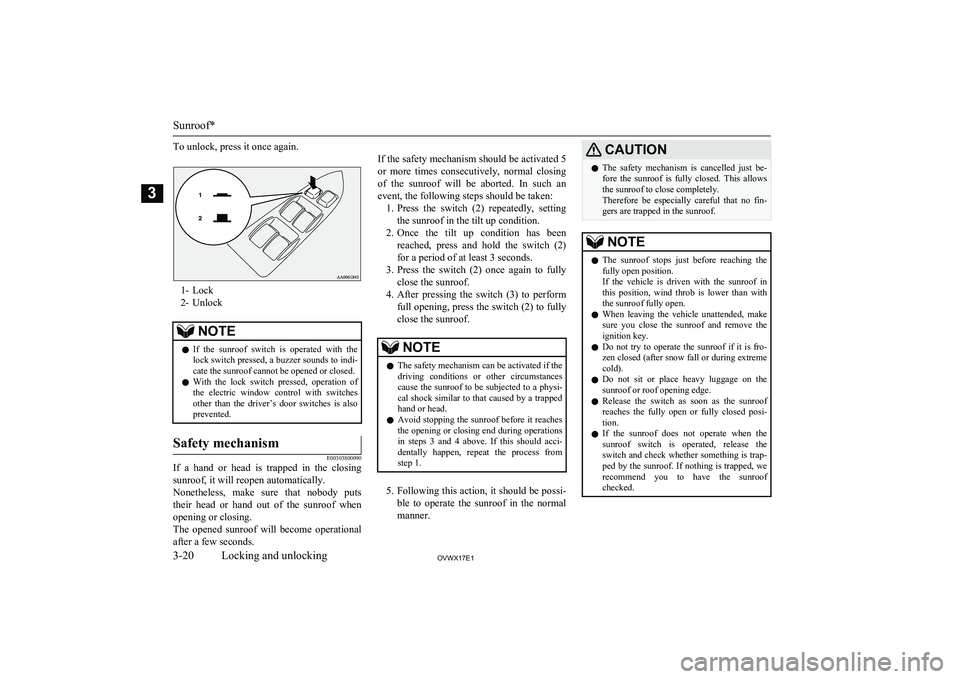
To unlock, press it once again.
1- Lock
2- Unlock
NOTEl If the sunroof switch is operated with the
lock switch pressed, a buzzer sounds to indi-cate the sunroof cannot be opened or closed.
l With the lock switch pressed, operation of
the electric window control with switches
other than the driver’s door switches is also prevented.Safety mechanism
E00303800090
If a hand or head is trapped in the closing
sunroof, it will reopen automatically.Nonetheless, make sure that nobody puts
their head or hand out of the sunroof when
opening or closing.
The opened sunroof will become operational after a few seconds.
If the safety mechanism should be activated 5
or more times consecutively, normal closing of the sunroof will be aborted. In such an
event, the following steps should be taken: 1. Press the switch (2) repeatedly, setting
the sunroof in the tilt up condition.
2. Once the tilt up condition has been
reached, press and hold the switch (2) for a period of at least 3 seconds.
3. Press the switch (2) once again to fully
close the sunroof.
4. After pressing the switch (3) to perform
full opening, press the switch (2) to fully
close the sunroof.NOTEl The safety mechanism can be activated if the
driving conditions or other circumstancescause the sunroof to be subjected to a physi-
cal shock similar to that caused by a trapped hand or head.
l Avoid stopping the sunroof before it reaches
the opening or closing end during operations
in steps 3 and 4 above. If this should acci- dentally happen, repeat the process fromstep 1.
5. Following this action, it should be possi-
ble to operate the sunroof in the normal manner.
CAUTIONl The safety mechanism is cancelled just be-
fore the sunroof is fully closed. This allows the sunroof to close completely.
Therefore be especially careful that no fin-
gers are trapped in the sunroof.NOTEl The sunroof stops just before reaching the
fully open position.
If the vehicle is driven with the sunroof in
this position, wind throb is lower than with the sunroof fully open.
l When leaving the vehicle unattended, make
sure you close the sunroof and remove the ignition key.
l Do not try to operate the sunroof if it is fro-
zen closed (after snow fall or during extreme cold).
l Do not sit or place heavy luggage on the
sunroof or roof opening edge.
l Release the switch as soon as the sunroof
reaches the fully open or fully closed posi-
tion.
l If the sunroof does not operate when the
sunroof switch is operated, release the
switch and check whether something is trap-
ped by the sunroof. If nothing is trapped, we recommend you to have the sunroof checked.
Sunroof*
3-20OVWX17E1Locking and unlocking3
Page 53 of 394
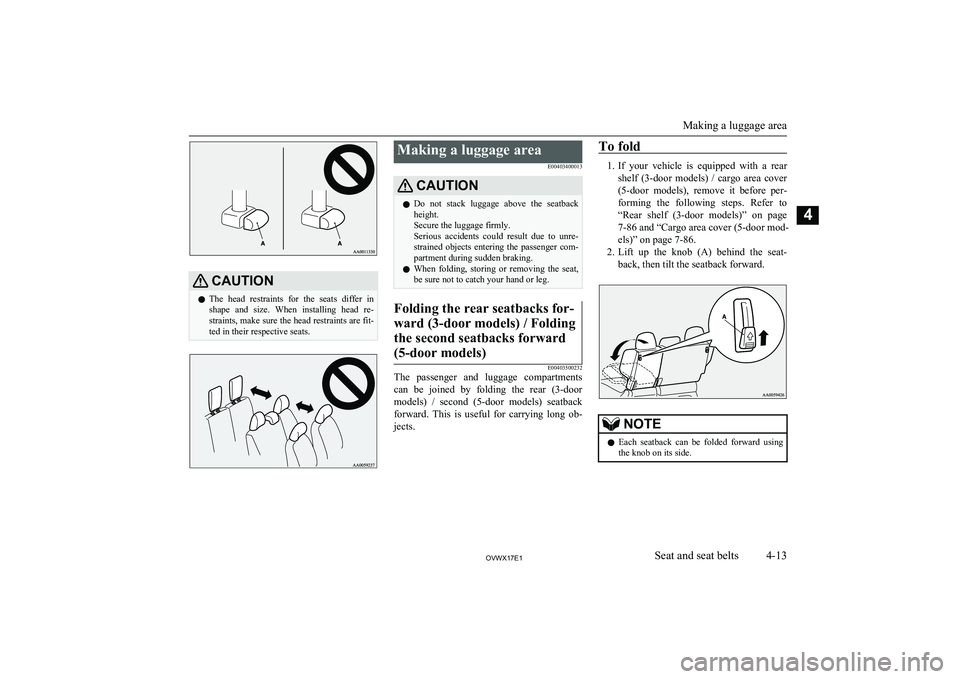
CAUTIONlThe head restraints for the seats differ in
shape and size. When installing head re- straints, make sure the head restraints are fit- ted in their respective seats.Making a luggage area
E00403400013CAUTIONlDo not stack luggage above the seatback
height.
Secure the luggage firmly.
Serious accidents could result due to unre- strained objects entering the passenger com-
partment during sudden braking.
l When folding, storing or removing the seat,
be sure not to catch your hand or leg.Folding the rear seatbacks for-
ward (3-door models) / Folding the second seatbacks forward(5-door models)
E00403500232
The passenger and luggage compartments can be joined by folding the rear (3-door
models) / second (5-door models) seatback forward. This is useful for carrying long ob-
jects.
To fold
1. If your vehicle is equipped with a rear
shelf (3-door models) / cargo area cover
(5-door models), remove it before per- forming the following steps. Refer to“Rear shelf (3-door models)” on page
7-86 and “Cargo area cover (5-door mod-
els)” on page 7-86.
2. Lift up the knob (A) behind the seat-
back, then tilt the seatback forward.
NOTEl Each seatback can be folded forward using
the knob on its side.
Making a luggage area
4-13OVWX17E1Seat and seat belts4
Page 62 of 394
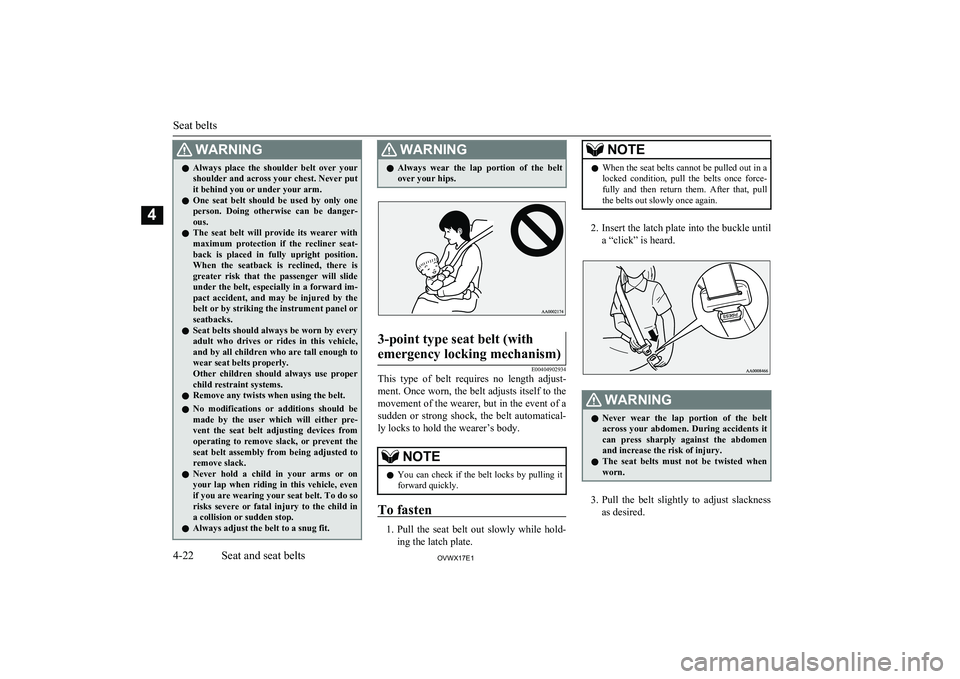
WARNINGlAlways place the shoulder belt over your
shoulder and across your chest. Never put it behind you or under your arm.
l One seat belt should be used by only one
person. Doing otherwise can be danger-
ous.
l The seat belt will provide its wearer with
maximum protection if the recliner seat- back is placed in fully upright position.
When the seatback is reclined, there is
greater risk that the passenger will slide under the belt, especially in a forward im-
pact accident, and may be injured by the
belt or by striking the instrument panel or seatbacks.
l Seat belts should always be worn by every
adult who drives or rides in this vehicle, and by all children who are tall enough towear seat belts properly.
Other children should always use proper child restraint systems.
l Remove any twists when using the belt.
l No modifications or additions should be
made by the user which will either pre- vent the seat belt adjusting devices fromoperating to remove slack, or prevent the
seat belt assembly from being adjusted to
remove slack.
l Never hold a child in your arms or on
your lap when riding in this vehicle, even
if you are wearing your seat belt. To do so risks severe or fatal injury to the child in
a collision or sudden stop.
l Always adjust the belt to a snug fit.WARNINGlAlways wear the lap portion of the belt
over your hips.3-point type seat belt (with
emergency locking mechanism)
E00404902934
This type of belt requires no length adjust- ment. Once worn, the belt adjusts itself to the
movement of the wearer, but in the event of a sudden or strong shock, the belt automatical-
ly locks to hold the wearer’s body.
NOTEl You can check if the belt locks by pulling it
forward quickly.
To fasten
1. Pull the seat belt out slowly while hold-
ing the latch plate.
NOTEl When the seat belts cannot be pulled out in a
locked condition, pull the belts once force-
fully and then return them. After that, pull
the belts out slowly once again.
2. Insert the latch plate into the buckle until
a “click” is heard.
WARNINGl Never wear the lap portion of the belt
across your abdomen. During accidents it
can press sharply against the abdomen and increase the risk of injury.
l The seat belts must not be twisted when
worn.
3. Pull the belt slightly to adjust slackness
as desired.
Seat belts
4-22OVWX17E1Seat and seat belts4
Page 77 of 394
The SRS driver’s and front passenger’s air-bags are designed to supplement the primary
protection of the driver and front passenger
side seat belt systems by providing those oc- cupants with protection against head and
chest injuries in certain moderate-to-severe
frontal collisions.
The SRS driver’s and front passenger’s air- bags employ a dual stage airbag system. The
SRS driver’s and front passenger’s airbag is controlled by the impact sensors (at the front
of the vehicle) and the control unit (near the centre of the vehicle at floor level).
The SRS side airbag (if so equipped) is de-
signed to supplement properly worn seat belts and provide the driver and front passen-
ger with protection against chest injury in certain moderate-to-severe side impact colli- sions.
The SRS curtain airbags (if so equipped) are
designed to supplement properly worn seat belts and provide the driver and passenger with protection against head injuries in cer-
tain moderate-to-severe side impact colli- sions.
The SRS is NOT a substitute for the seat
belts; for maximum protection in all types of crashes and accidents, seat belts should AL-
WAYS be worn by everyone who drives or rides in this vehicle.How the Supplemental Re-
straint System works
E00407302939
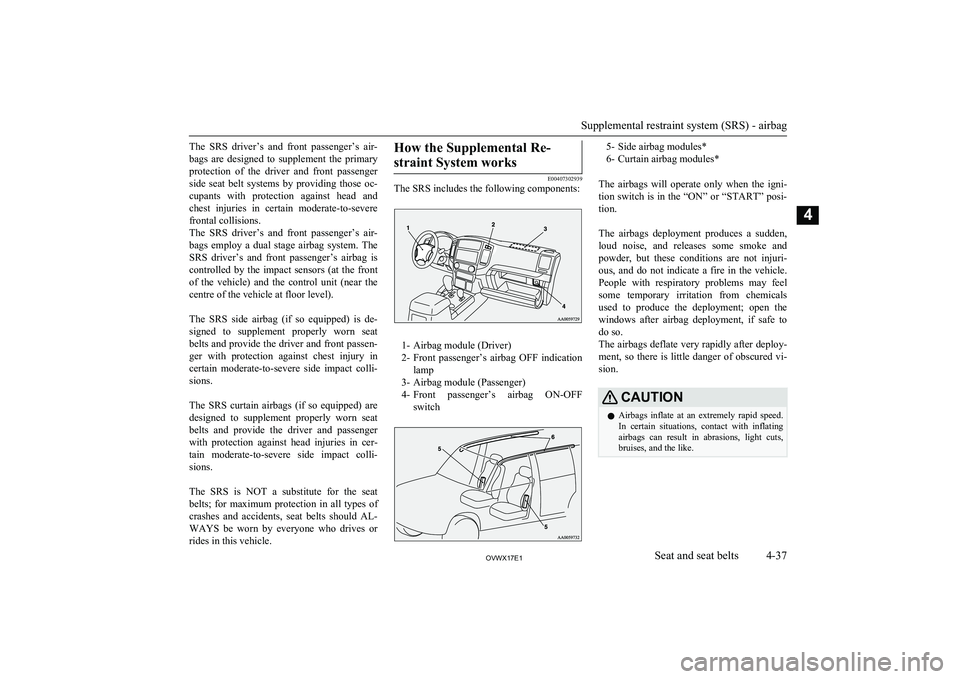
The SRS includes the following components:
1- Airbag module (Driver)
2- Front passenger’s airbag OFF indication
lamp
3- Airbag module (Passenger)
4- Front passenger’s airbag ON-OFF
switch
5- Side airbag modules*
6- Curtain airbag modules*
The airbags will operate only when the igni- tion switch is in the “ON” or “START” posi-
tion.
The airbags deployment produces a sudden, loud noise, and releases some smoke and
powder, but these conditions are not injuri- ous, and do not indicate a fire in the vehicle.
People with respiratory problems may feel some temporary irritation from chemicals
used to produce the deployment; open the
windows after airbag deployment, if safe to
do so.
The airbags deflate very rapidly after deploy- ment, so there is little danger of obscured vi-sion.CAUTIONl Airbags inflate at an extremely rapid speed.
In certain situations, contact with inflating
airbags can result in abrasions, light cuts, bruises, and the like.
Supplemental restraint system (SRS) - airbag
4-37OVWX17E1Seat and seat belts4