check engine MITSUBISHI SPYDER 1990 Service Repair Manual
[x] Cancel search | Manufacturer: MITSUBISHI, Model Year: 1990, Model line: SPYDER, Model: MITSUBISHI SPYDER 1990Pages: 2103, PDF Size: 68.98 MB
Page 1070 of 2103
AUTOMATIC TRANSAXLE
ENGINE (TURBO) AND ENGINE> On-vehicle Service
Revision
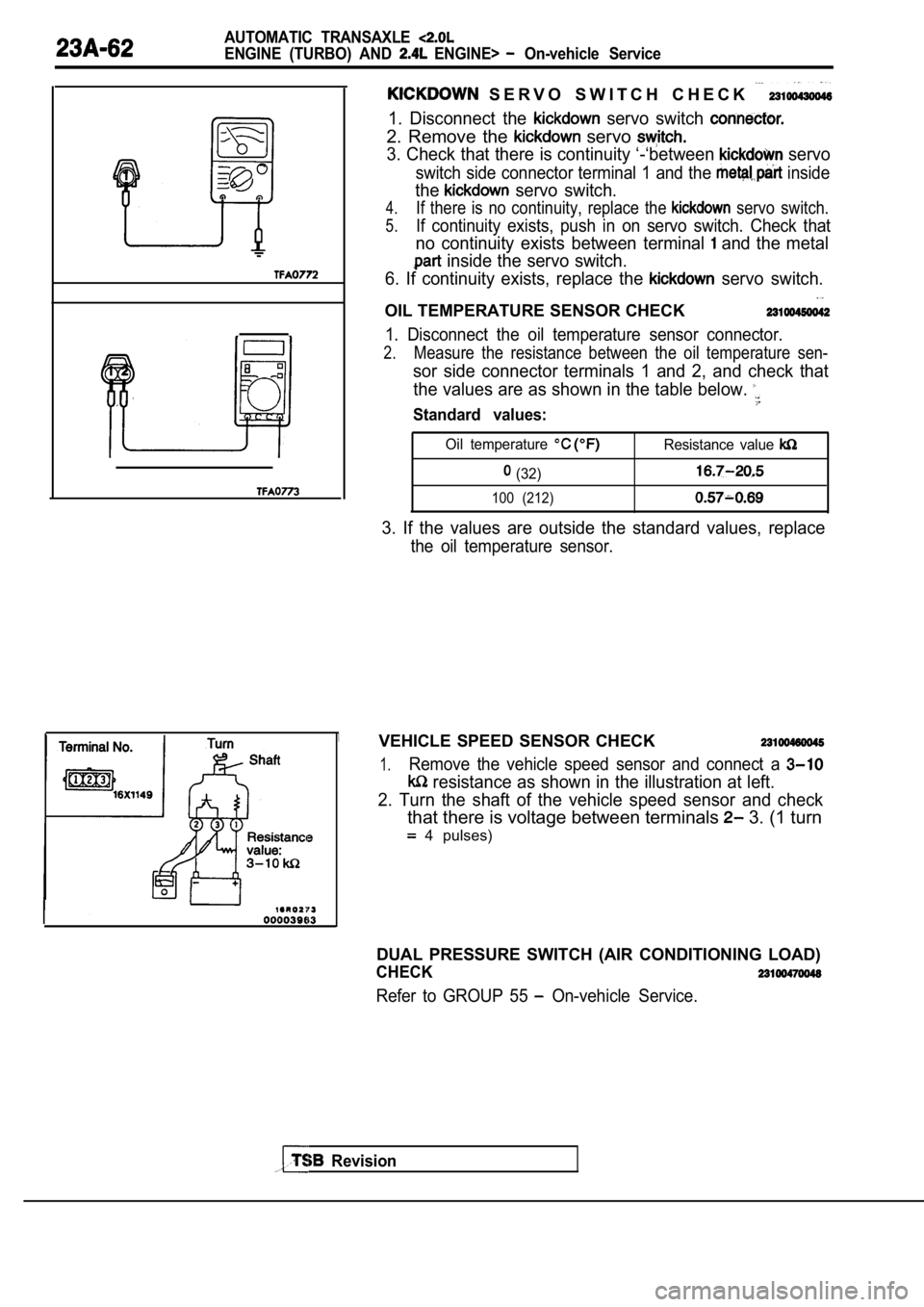
S E R V O S W I T C H C H E C K
1. Disconnect the servo switch
2. Remove the servo
3. Check that there is continuity ‘-‘between servo
switch side connector terminal 1 and the inside
the servo switch.
4.If there is no continuity, replace the servo switch.
5.If continuity exists, push in on servo switch. Check that
no continuity exists between terminal and the metal
inside the servo switch.
6. If continuity exists, replace the
servo switch.
OIL TEMPERATURE SENSOR CHECK
1. Disconnect the oil temperature sensor connector.
2.Measure the resistance between the oil temperature sen-
sor side connector terminals 1 and 2, and check that
the values are as shown in the table below.
Standard values:
Oil temperature Resistance value
(32)
100 (212)
3. If the values are outside the standard values, r eplace
the oil temperature sensor.
VEHICLE SPEED SENSOR CHECK
1.Remove the vehicle speed sensor and connect a
resistance as shown in the illustration at left.
2. Turn the shaft of the vehicle speed sensor and c heck
that there is voltage between terminals 3. (1 turn
4 pulses)
DUAL PRESSURE SWITCH (AIR CONDITIONING LOAD)
CHECK
Refer to GROUP 55 On-vehicle Service.
Page 1071 of 2103
AUTOMATIC TRANSAXLE
ENGINE (TURBO) AND ENGINE> On-vehicle Service
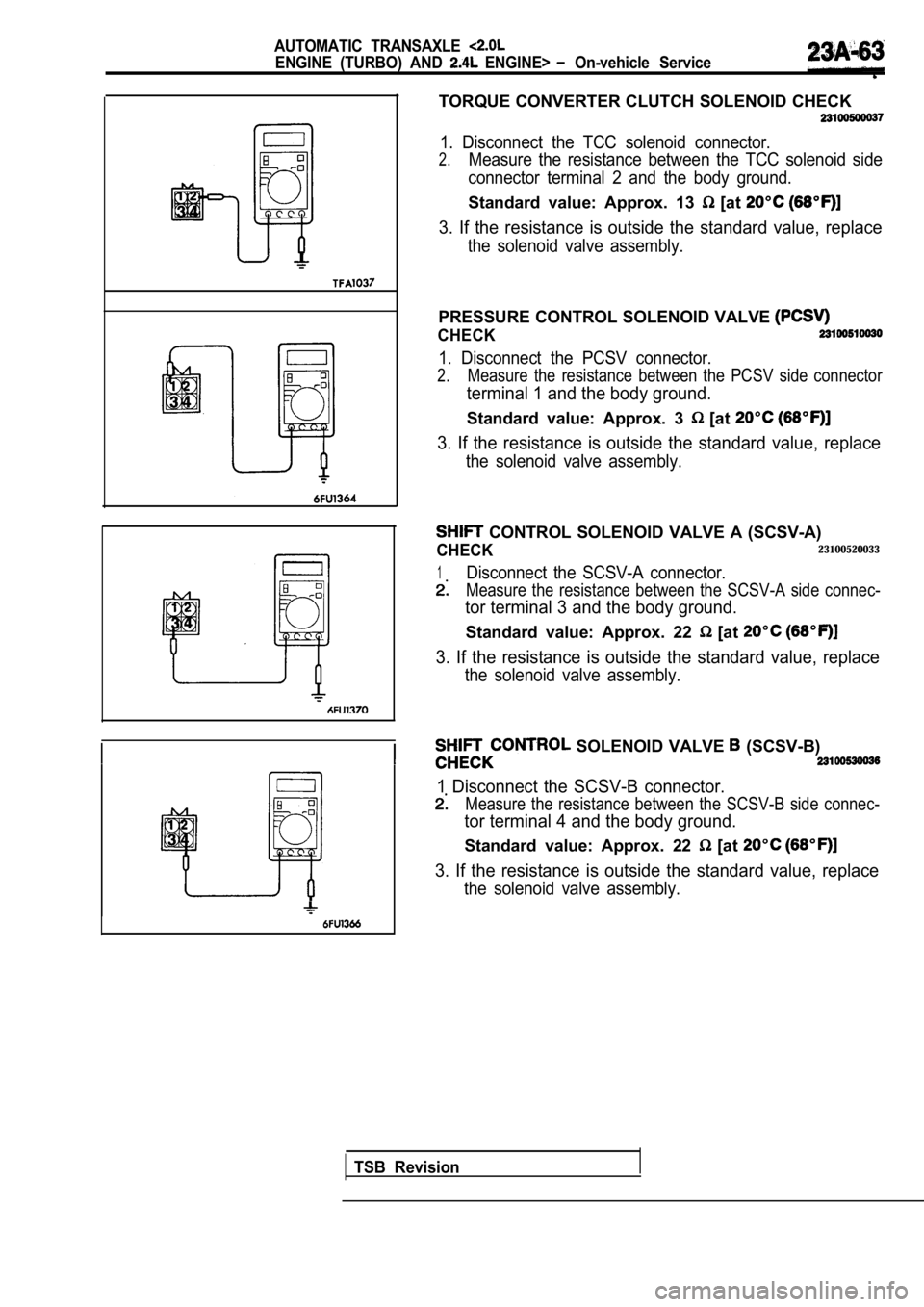
TORQUE CONVERTER CLUTCH SOLENOID CHECK
1. Disconnect the TCC solenoid connector.
2.Measure the resistance between the TCC solenoid side
connector terminal 2 and the body ground.
Standard value: Approx. 13 [at
3. If the resistance is outside the standard value, replace
the solenoid valve assembly.
PRESSURE CONTROL SOLENOID VALVE
CHECK
1. Disconnect the PCSV connector.
2.Measure the resistance between the PCSV side connec tor
terminal 1 and the body ground.
Standard value: Approx. 3 [at
3. If the resistance is outside the standard value, replace
the solenoid valve assembly.
CONTROL SOLENOID VALVE A (SCSV-A)
CHECK23100520033
1Disconnect the SCSV-A connector.
Measure the resistance between the SCSV-A side conn ec-
tor terminal 3 and the body ground.
Standard value: Approx. 22 [at
3. If the resistance is outside the standard value, replace
the solenoid valve assembly.
SOLENOID VALVE (SCSV-B)
1 Disconnect the SCSV-B connector.
Measure the resistance between the SCSV-B side conn ec-
tor terminal 4 and the body ground.
Standard value: Approx. 22 [at
3. If the resistance is outside the standard value, replace
the solenoid valve assembly.
TSB Revision
Page 1072 of 2103
AUTOMATIC TRANSAXLE
ENGINE (TURBO) AND On-vehicle Service
Stall test consists of determining maximum engine speed
obtained at full throttle in positions. This test
checks torque converter overrunning clutch operation,
and holding ability of transmission clutches and
brake.
Caution
During this test, make sure no stands in front
of, or behind, vehicle.
1.Check the transmission fluid level, fluid temperatu re and
coolant temperature.
lFluid level: At “HOT” position on dipstick
l Fluid temperature:
lEngine coolant temperature:
2. Apply chocks to both rear wheels.
3.
engine tachometer.
4. Apply parking and service brakes fully.
5 . S t a r t e n g i n e .
6. With selector lever in position, depress accelerator
pedal fully to read engine
rpm. Do not hold
throttle wide open any longer than is necessary to obtain
maximum engine rpm reading, and never longer
5 seconds at a time. If more than one stall test is required,
operate at approximately 1,000 in neutral
for 2 minutes to cool transmission fluid between te sts.
Standard value:
TSB Revision
2,100 2,600
3 , 3 0 0 3 , 6 0 0
7.Place selector lever to position and perform test
by the same procedures above.
Stall Speed Above Specification in
If stall speed is higher than Specification, rear c lutch or overrun-
ning clutch is slipping. In this case, perform hydrau-
lic test to locate cause of slippage.
Stall Above Specification in “R”
If stall speed is higher than front clutch of trans-
axle or low-reverse brake is In this perform
hydraulic test to locate cause of slippage.
Stall Speed Above Specification and “R”
If stall speed is lower than insufficient engine
output or faulty torque converter is Check for en-
gine misfiring, ignition timing, valve clearance etc. If these
are good, torque converter is faulty..
Page 1073 of 2103
AUTOMATIC TRANSAXLE
ENGINE (TURBO) AND ENGINE> On-vehicle
8. Torque
pressure
brakepressure
Reducingpressure
Low-reverse
4. Front clutchpressure
‘5. clutch8. Torque converter
pressurepressureI
brake
6. End clutch
23199999949
1.
2.
3.
4.
5.
6.
7.
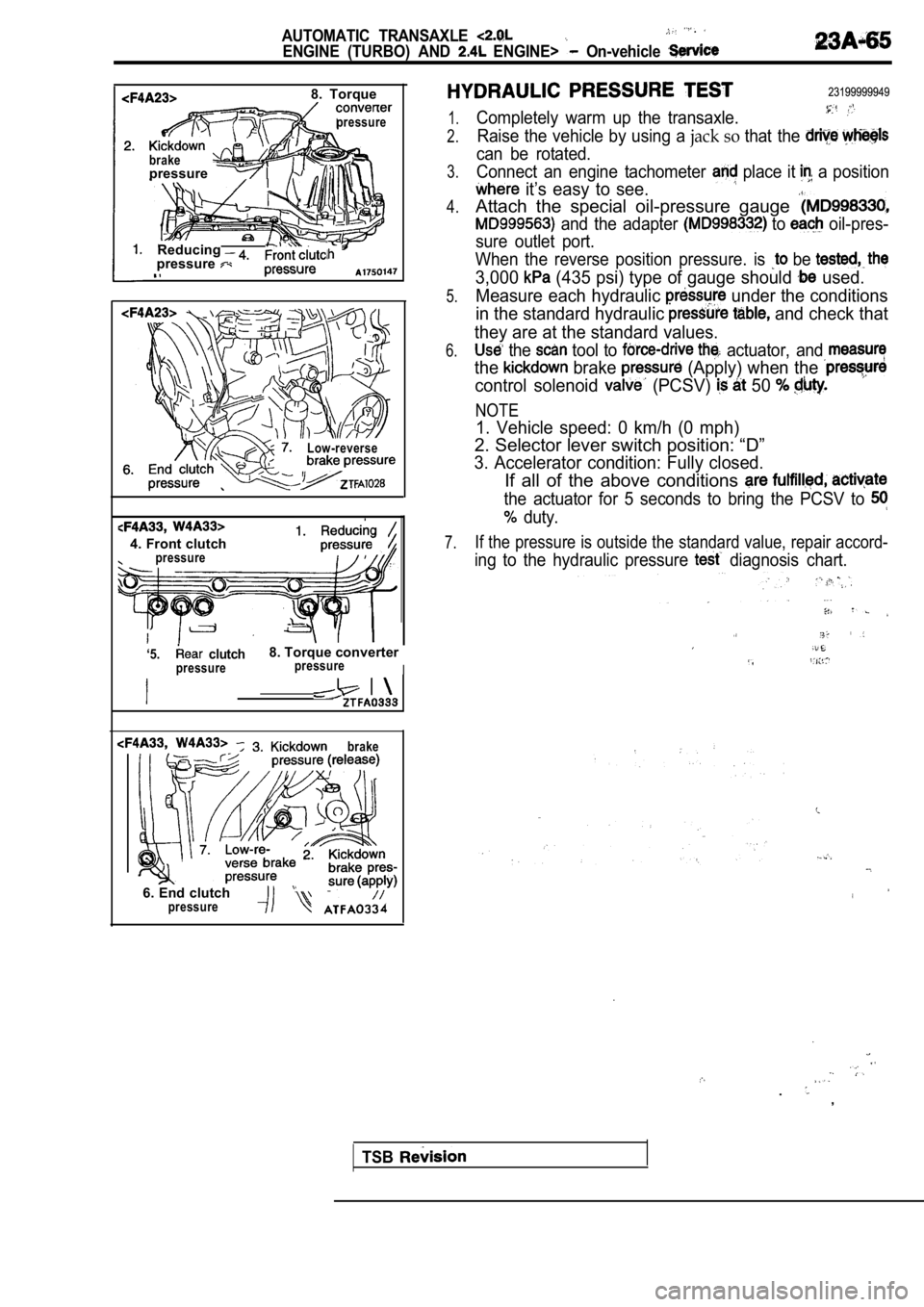
Completely warm up the transaxle.
Raise the vehicle by using a jack so that the
can be rotated.
Connect an engine tachometer
place it a position
it’s easy to see.
Attach the special oil-pressure gauge
and the adapter to oil-pres-
sure outlet port.
When the reverse position pressure. is
be
3,000 (435 psi) type of gauge should used.
Measure each hydraulic
under the conditions
in the standard hydraulic
and check that
they are at the standard values.
the tool to actuator, and
the brake (Apply) when the
control solenoid (PCSV) 50
NOTE
1. Vehicle speed: 0 km/h (0 mph)
2. Selector lever switch position: “D”
3. Accelerator condition: Fully closed.
If all of the above conditions
the actuator for 5 seconds to bring the PCSV to
duty.
If the pressure is outside the standard value, repa ir accord-
ing to the hydraulic pressure diagnosis chart.
.
.
,
pressure
TSB
Page 1079 of 2103
AUTOMATIC TRANSAXLE
ENGINE (TURBO) AND ENGINE> On-vehicle Service
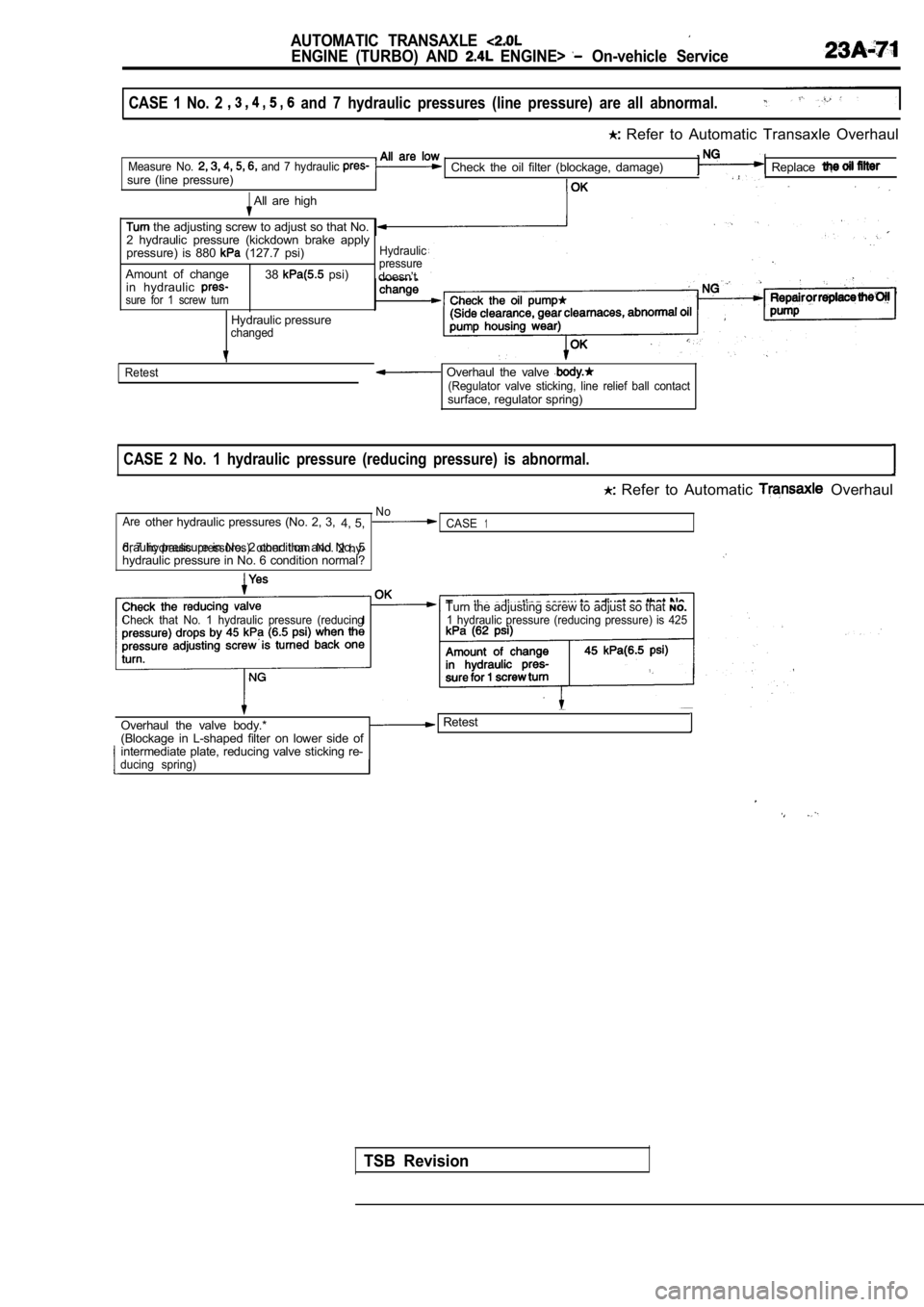
CASE 1 No. 2 and 7 hydraulic pressures (line pressure) are all abnormal.
Refer to Automatic Transaxle Overhaul
Measure No. and 7 hydraulic sure (line pressure)Check the oil filter (blockage, damage)Replace
All are high
the adjusting screw to adjust so that No.
2 hydraulic pressure (kickdown brake apply
pressure) is 880
(127.7 psi)Hydraulic
38 psi)pressureAmount of change doesn’t
in hydraulic
sure for 1 screw turn
Hydraulic pressurechanged
Retest
Overhaul the valve (Regulator valve sticking, line relief ball contactsurface, regulator spring)
CASE 2 No. 1 hydraulic pressure (reducing pressure) is abnormal.
Refer to Automatic Overhaul
No
Areother hydraulic pressures (No. 2, 3, 4, 5,CASE1
6, 7hydraulic pressures) other than No.2 hy-
draulic pressure in No. 2 condition and No. 5hydraulic pressure in No. 6 condition normal?
Check that No. 1 hydraulic pressure (reducingTurn the adjusting screw to adjust so that
NO.1 hydraulic pressure (reducing pressure) is 425
Overhaul the valve body.* Retest
(Blockage in L-shaped filter on lower side of
intermediate plate, reducing valve sticking re-
ducing spring)
TSB Revision
Page 1080 of 2103
AUTOMATIC: TRANSAXLE
ENGINE AND On-vehicle Service
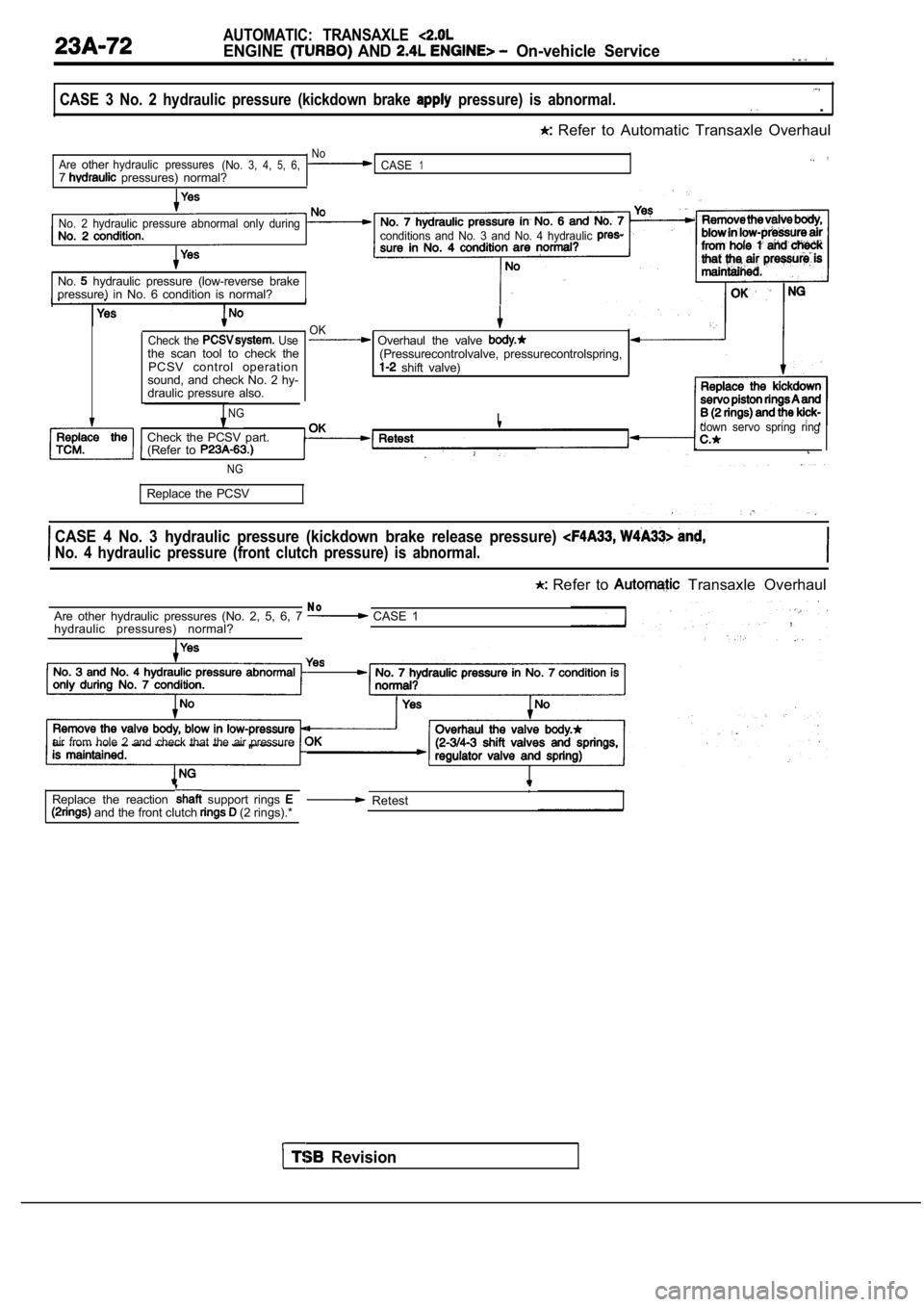
CASE 3 No. 2 hydraulic pressure (kickdown brake pressure) is abnormal. .
Refer to Automatic Transaxle Overhaul
NoAreotherhydraulic pressures(No.3, 4,5,6,CASE17 pressures) normal?
No. 2 hydraulic pressure abnormal only during
conditions and No. 3 and No. 4 hydraulic
No. hydraulic pressure (low-reverse brake
pressure) in No. 6 condition is normal?
Check the Usethe scan tool to check the
PCSV control operation
sound, and check No. 2 hy-
draulic pressure also.
NG
OK Overhaul the valve (Pressurecontrolvalve, pressurecontrolspring, shift valve)
I
Check the PCSV part.
(Refer to
,down servo spring ring
NG
Replace the PCSV
CASE 4 No. 3 hydraulic pressure (kickdown brake rel ease pressure)
No. 4 hydraulic pressure (front clutch pressure) is abnormal.
Refer to Transaxle Overhaul
N oAre other hydraulic pressures (No. 2, 5, 6, 7 CASE 1
hydraulic pressures) normal?
air from hole 2 and check that the air pressure
and the front clutch (2 rings).*
Replace the reaction support rings , Retest
Revision
Page 1082 of 2103
AUTOMATIC TRANSAXLE
ENGINE (TURBO) AND ENGINE> On-vehicle
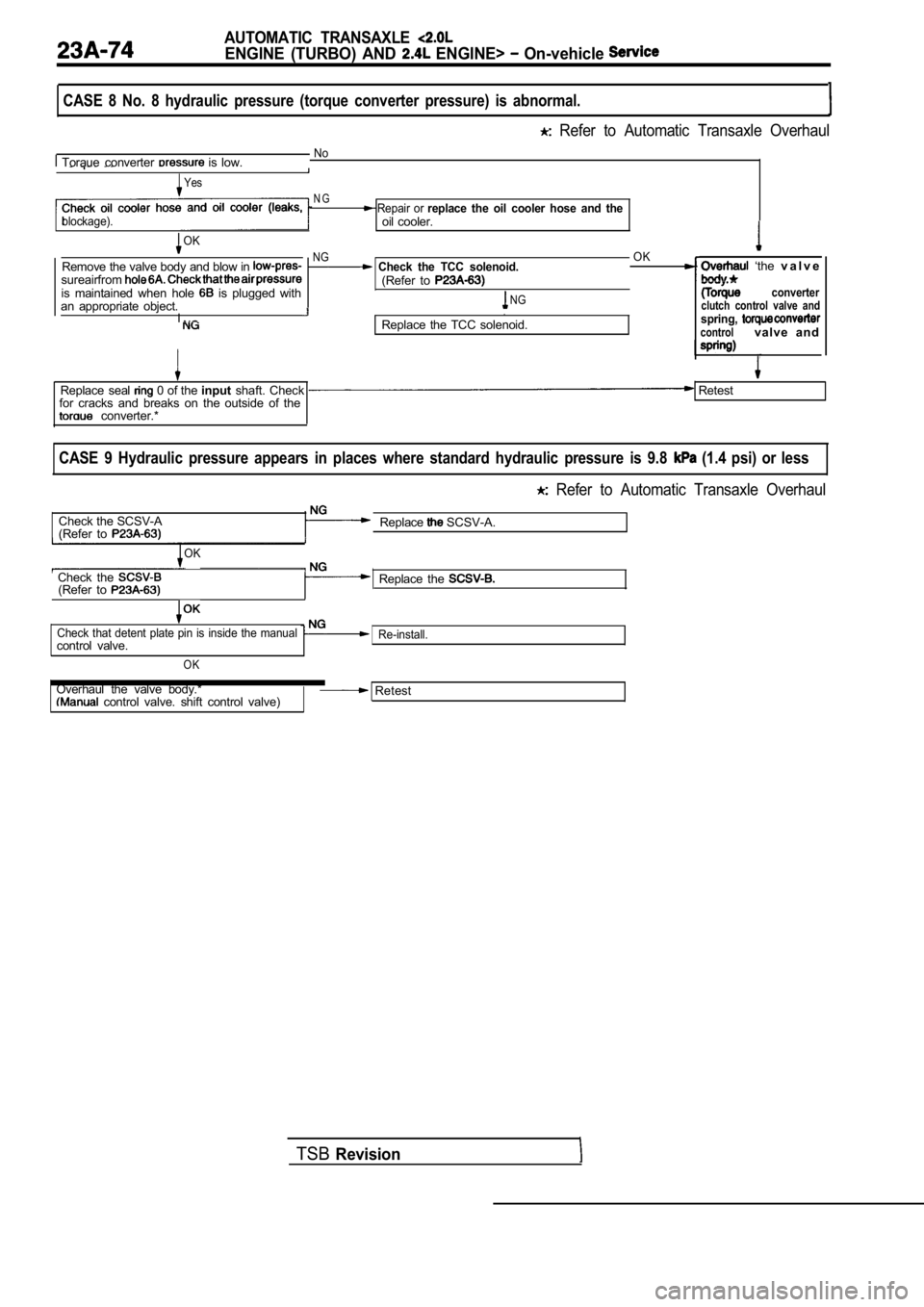
CASE 8 No. 8 hydraulic pressure (torque converter pressure) is abnormal.
Refer to Automatic Transaxle Overhaul
blockage).
Yes
N G Repair or replace the oil cooler hose and theoil cooler.
Toraue converter is low.No
OK
Remove the valve body and blow in sureairfromis maintained when hole is plugged with
an appropriate object.
NG Check the TCC solenoid.(Refer to
NG
I
OK
.
Replace the TCC solenoid.
‘the v a l v e
converterclutch control valve andspring,controlv a l v e a n d
Replace seal 0 of the inputshaft. Check Retest
for cracks and breaks on the outside of the
converter.*
CASE 9 Hydraulic pressure appears in places where s tandard hydraulic pressure is 9.8 (1.4 psi) or less
Refer to Automatic Transaxle Overhaul
Check the SCSV-A
(Refer to Replace SCSV-A.
OK
Check the Replace the (Refer to
Check that detent plate pin is inside the manualcontrol valve.
OK
Re-install.
Overhaul the valve body.* control valve. shift control valve) Retest
TSBRevision
Page 1096 of 2103
AUTOMATIC TRANSAXLE
ENGINE (TURBO) AND ENGINE> On-vehicle Service
Adjustment screw
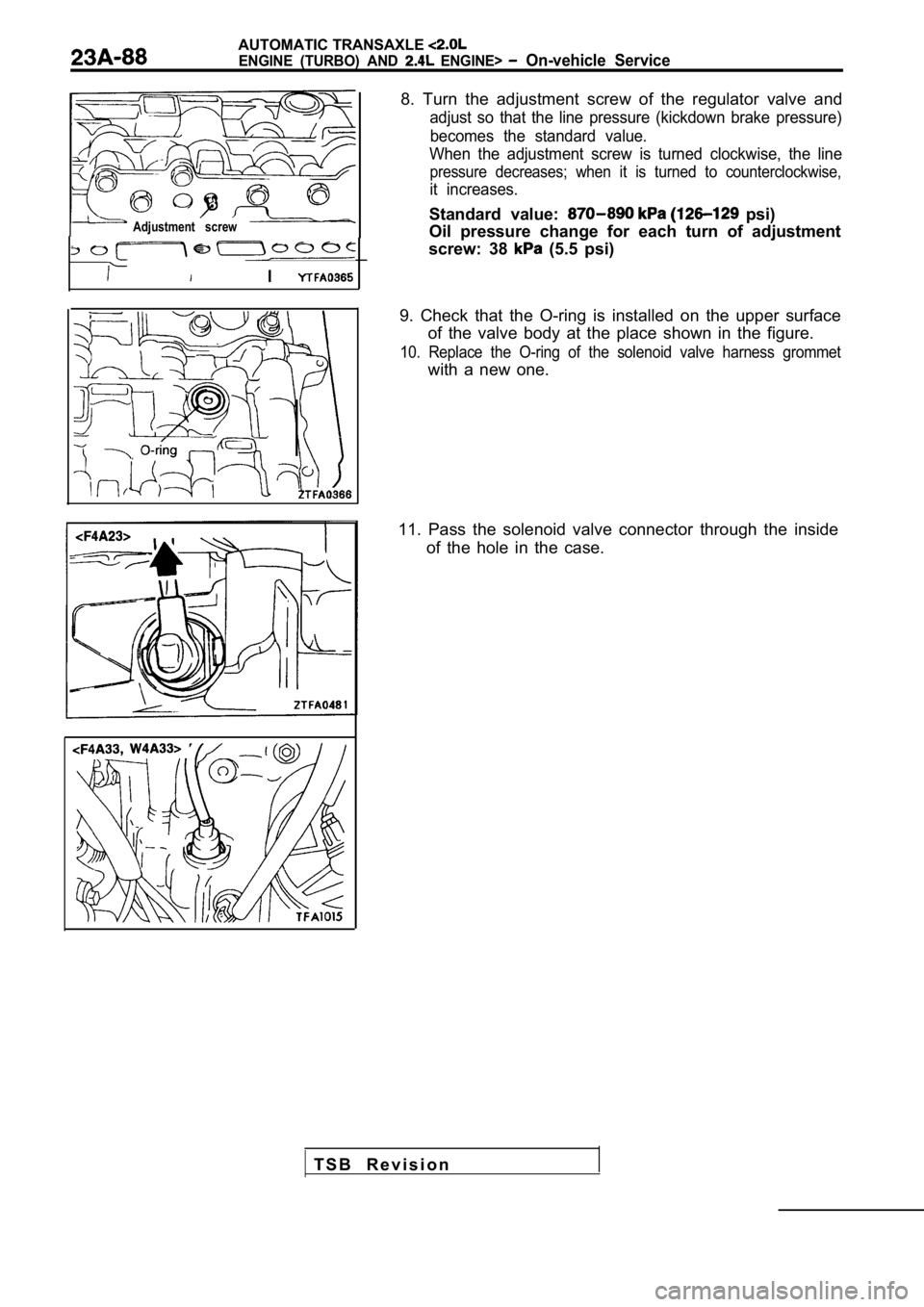
I
8. Turn the adjustment screw of the regulator valve and
adjust so that the line pressure (kickdown brake pressure)
becomes the standard value.
When the adjustment screw is turned clockwise, the line
pressure decreases; when it is turned to counterclockwise,
it increases.
Standard value: psi)
Oil pressure change for each turn of adjustment
screw: 38
(5.5 psi)
9. Check that the O-ring is installed on the upper surface
of the valve body at the place shown in the figure.
10. Replace the O-ring of the solenoid valve harnes s grommet
with a new one.
11. Pass the solenoid valve connector through the i nside
of the hole in the case.
T S B R e v i s i o n
Page 1098 of 2103
AUTOMATIC TRANSAXLE
ENGINE (TURBO) AND ENGINE> On-vehicle
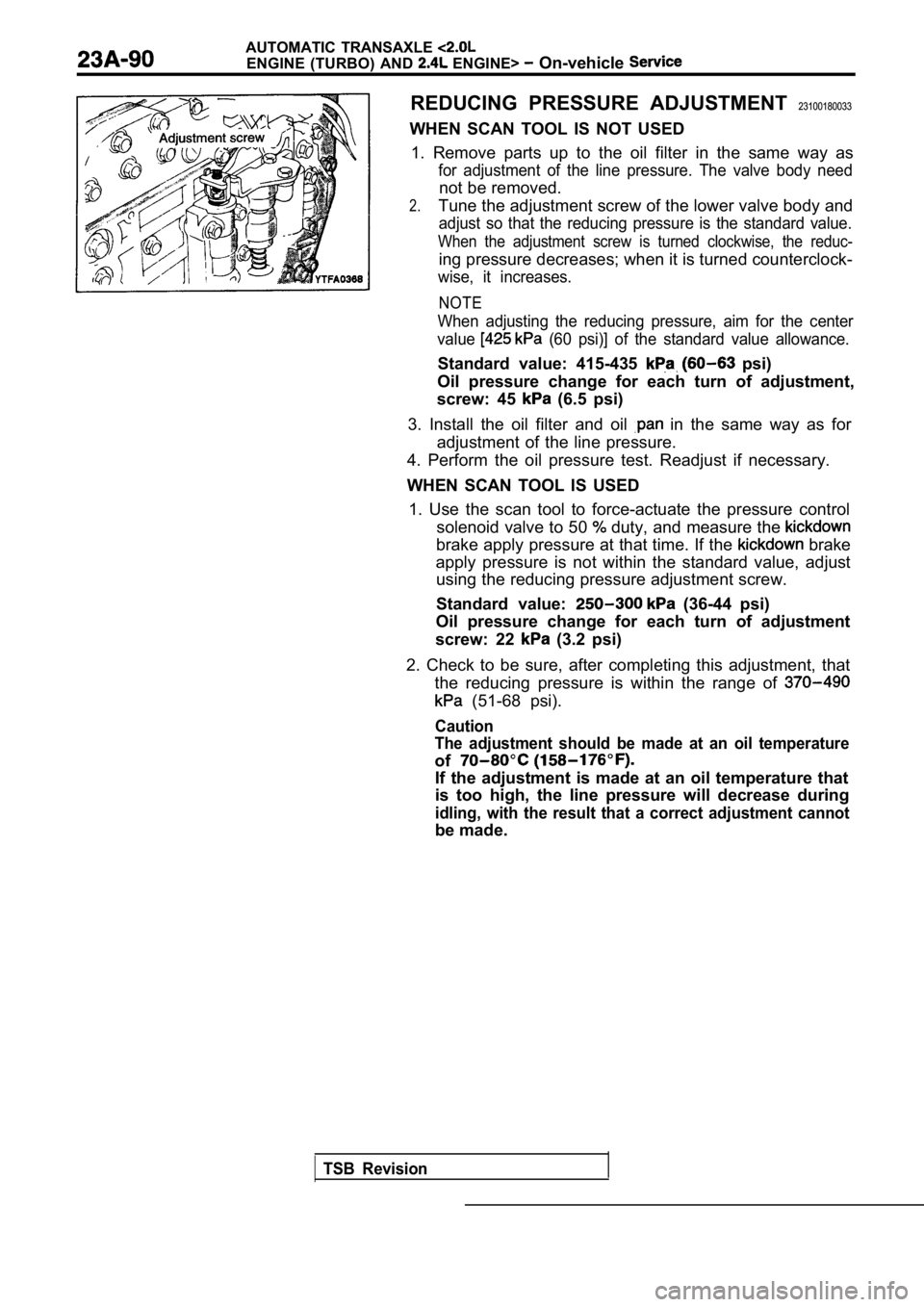
REDUCING PRESSURE ADJUSTMENT 23100180033
WHEN SCAN TOOL IS NOT USED 1. Remove parts up to the oil filter in the same wa y as
for adjustment of the line pressure. The valve body need
not be removed.
2.Tune the adjustment screw of the lower valve body a nd
adjust so that the reducing pressure is the standard value.
When the adjustment screw is turned clockwise, the reduc-
ing pressure decreases; when it is turned counterclock-
wise, it increases.
NOTE
When adjusting the reducing pressure, aim for the c enter
value
(60 psi)] of the standard value allowance.
Standard value: 415-435 psi)
Oil pressure change for each turn of adjustment,
screw: 45
(6.5 psi)
3. Install the oil filter and oil
in the same way as for
adjustment of the line pressure.
4. Perform the oil pressure test. Readjust if neces sary.
WHEN SCAN TOOL IS USED 1. Use the scan tool to force-actuate the pressure control
solenoid valve to 50
duty, and measure the
brake apply pressure at that time. If the brake
apply pressure is not within the standard value, ad just
using the reducing pressure adjustment screw.
Standard value:
(36-44 psi)
Oil pressure change for each turn of adjustment
screw: 22
(3.2 psi)
2. Check to be sure, after completing this adjustme nt, that
the reducing pressure is within the range of
(51-68 psi).
Caution
The adjustment should be made at an oil temperature
of
If the adjustment is made at an oil temperature tha t
is too high, the line pressure will decrease during
idling, with the result that a correct adjustment c annot
be made.
TSB Revision
Page 1099 of 2103
ENGINE (TURBO) AND ENGINE>
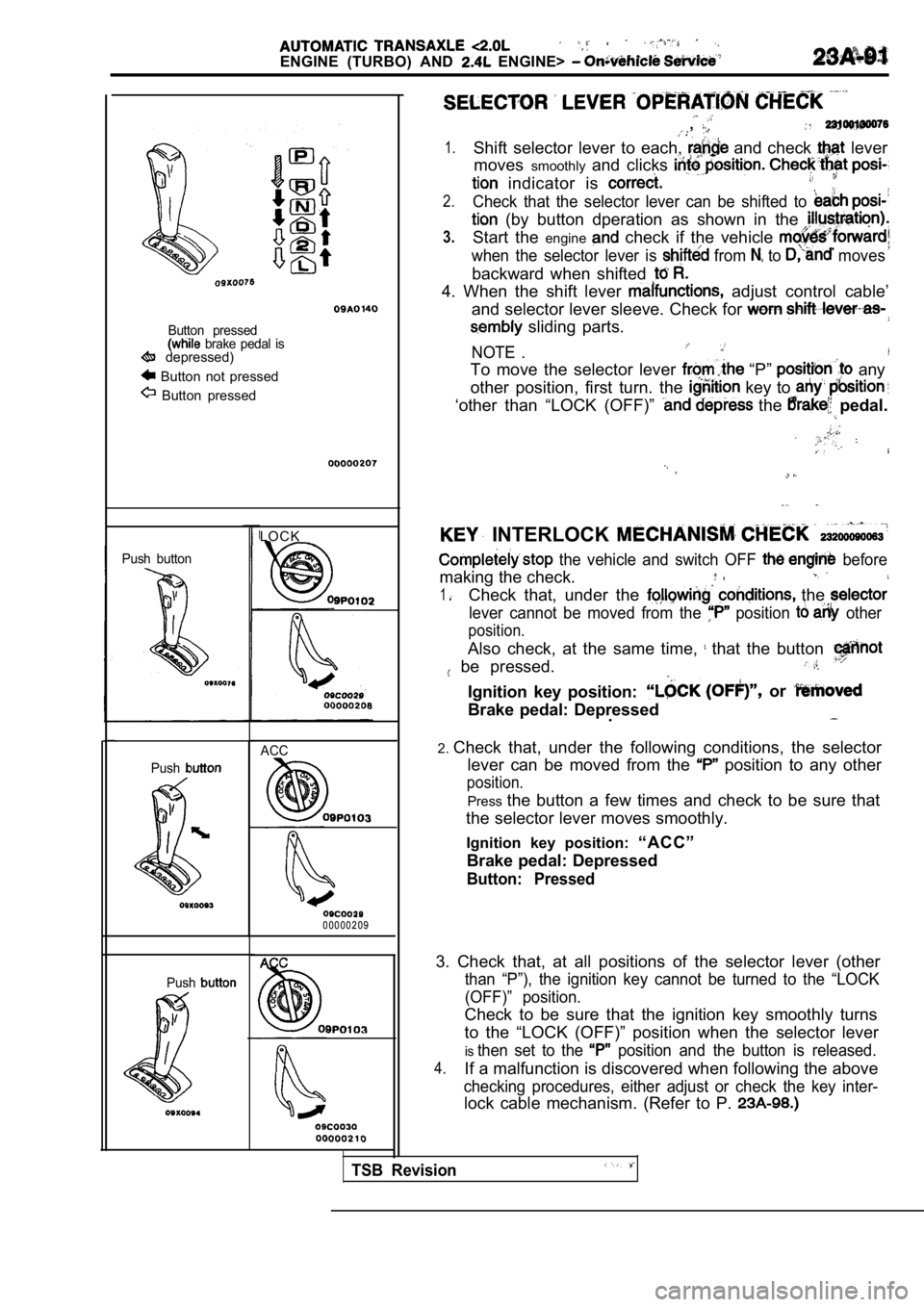
Button pressed brake pedal is depressed)
Button not pressed
Button pressed
Push buttonPush
Push
LOCK
ACC
0 0 0 0 0 2 0 9
,
1.Shift selector lever to each, and check lever
moves smoothly and clicks
indicator is
2.Check that the selector lever can be shifted to
(by button dperation as shown in the
3.Start the engine check if the vehicle
when the selector lever is from to moves
backward when shifted
4. When the shift lever adjust control cable’
and selector lever sleeve. Check for
sliding parts.
NOTE .
To move the selector lever “P” any
other position, first turn. the
key to
‘other than “LOCK (OFF)” the pedal.
. .
INTERLOCK
the vehicle and switch OFF before
making the check.
1Check that, under the the
lever cannot be moved from the position other
position.
Also check, at the same time, that the button
be pressed.
Ignition key position: or
Brake pedal: Depressed .
2.Check that, under the following conditions, the sel ector
lever can be moved from the
position to any other
position.
Press the button a few times and check to be sure that
the selector lever moves smoothly.
Ignition key position: “ACC”
Brake pedal: Depressed
Button: Pressed
TSB Revision
3. Check that, at all positions of the selector lev er (other
than “P”), the ignition key cannot be turned to the “LOCK
(OFF)” position.
Check to be sure that the ignition key smoothly tur ns
to the “LOCK (OFF)” position when the selector leve r
isthen set to the position and the button is released.
4.If a malfunction is discovered when following the above
checking procedures, either adjust or check the key inter-
lock cable mechanism. (Refer to P.