check engine MITSUBISHI SPYDER 1990 Service Repair Manual
[x] Cancel search | Manufacturer: MITSUBISHI, Model Year: 1990, Model line: SPYDER, Model: MITSUBISHI SPYDER 1990Pages: 2103, PDF Size: 68.98 MB
Page 1176 of 2103
AUTOMATIC TRANSAXLE
ENGINE On-vehicle Service
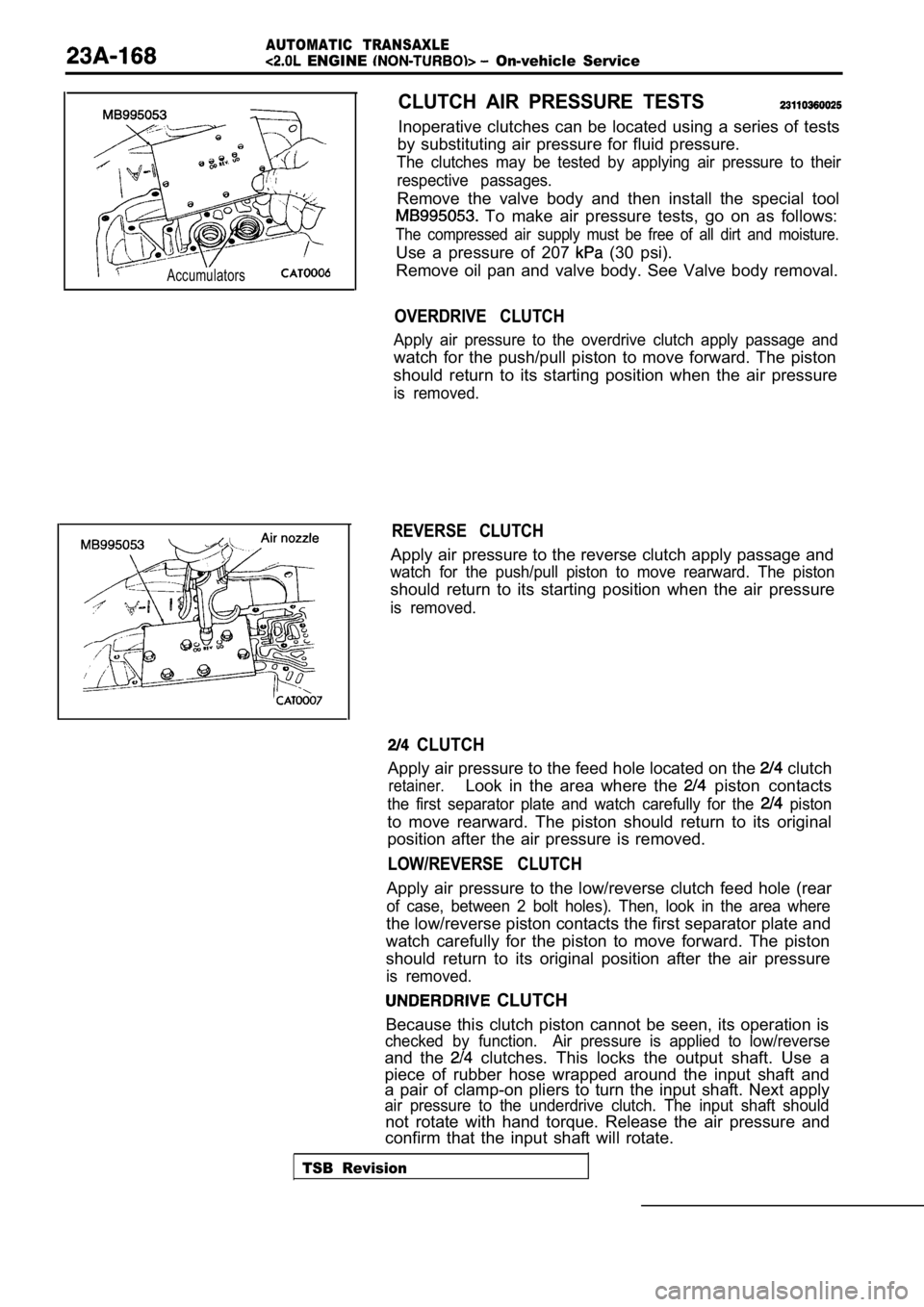
Accumulators
CLUTCH AIR PRESSURE TESTS
Inoperative clutches can be located using a series of tests
by substituting air pressure for fluid pressure.
The clutches may be tested by applying air pressure to their
respective passages.
Remove the valve body and then install the special tool
To make air pressure tests, go on as follows:
The compressed air supply must be free of all dirt and moisture.
Use a pressure of 207 (30 psi).
Remove oil pan and valve body. See Valve body remov al.
OVERDRIVE CLUTCH
Apply air pressure to the overdrive clutch apply passage and
watch for the push/pull piston to move forward. The piston
should return to its starting position when the air pressure
is removed.
REVERSE CLUTCH
Apply air pressure to the reverse clutch apply pass age and
watch for the push/pull piston to move rearward. Th e piston
should return to its starting position when the air pressure
is removed.
CLUTCH
Apply air pressure to the feed hole located on the clutch
retainer.Look in the area where the piston contacts
the first separator plate and watch carefully for the piston
to move rearward. The piston should return to its o riginal
position after the air pressure is removed.
LOW/REVERSE CLUTCH
Apply air pressure to the low/reverse clutch feed h ole (rear
of case, between 2 bolt holes). Then, look in the a rea where
the low/reverse piston contacts the first separator plate and
watch carefully for the piston to move forward. The piston
should return to its original position after the ai r pressure
is removed.
CLUTCH
Because this clutch piston cannot be seen, its oper ation is
checked by function. Air pressure is applied to low/ reverse
and the clutches. This locks the output shaft. Use a
piece of rubber hose wrapped around the input shaft and
a pair of clamp-on pliers to turn the input shaft. Next apply
air pressure to the underdrive clutch. The input sh aft should
not rotate with hand torque. Release the air pressu re and
confirm that the input shaft will rotate.
TSB Revision
Page 1177 of 2103
AUTOMATIC TRANSAXLE
ENGINE (NON-TURBO)> On-vehicle .
FLUID LEAKAGE-TORQUE CONVERTER
HOUSING AREA CHECK
(1) Check for source of leakage.Since fluid leakage at or around the torque convert er
area may originate from an engine oil leak, the area should
be examined closely, Factory fill fluid is dyed red and,
therefore, can be distinguished from engine oil.
(2) Before removing the transaxle, perform the foll owing
checks:
When leakage is determined to originate from the tr ans-
axle, check fluid level before removal of the transaxle
and torque converter.
High oil level can result in oil leakage out the vent in
the manual shaft. If the fluid level is high, adjust to
proper level.
After fluid is at the proper level, check for leakage. If
a leak
perform the following operation on the
to determine if it is the torque converter or tran saxle
that is, leaking.
TORQUE CONVERTER LEAKAGE
Possible sources of torque converter leakage are:
(2) Torque converter weld leaks at the out side (pe ripheral)
weld. Torque converter hub weld.
(3) Hub
inside and not visible. Do not attempt to
repair.
Replace torque converter.
If the torque converter must be replaced, refer to Torque
Converter Clutch Break-in Procedure in this section . This
procedure’ will reset the transaxle control module break-in
status. Failure to perform this procedure may cause transaxle
shutter.
Clutch
HYDRAULIC PRESSURE TESTS
Pressure testing is a very important step in the diagnostic
procedure. These tests usually reveal the cause of most
transaxle problems.
Before performing pressure tests, be certain that fluid level
and condition, and shift cable adjustments have bee n checked
and approved.Fluid must be at operating temperature
(150 to
1. Install an engine tachometer.
2.Raise vehicle on hoist which allows front wheels to
turn,
and position tachometer so it can be read.
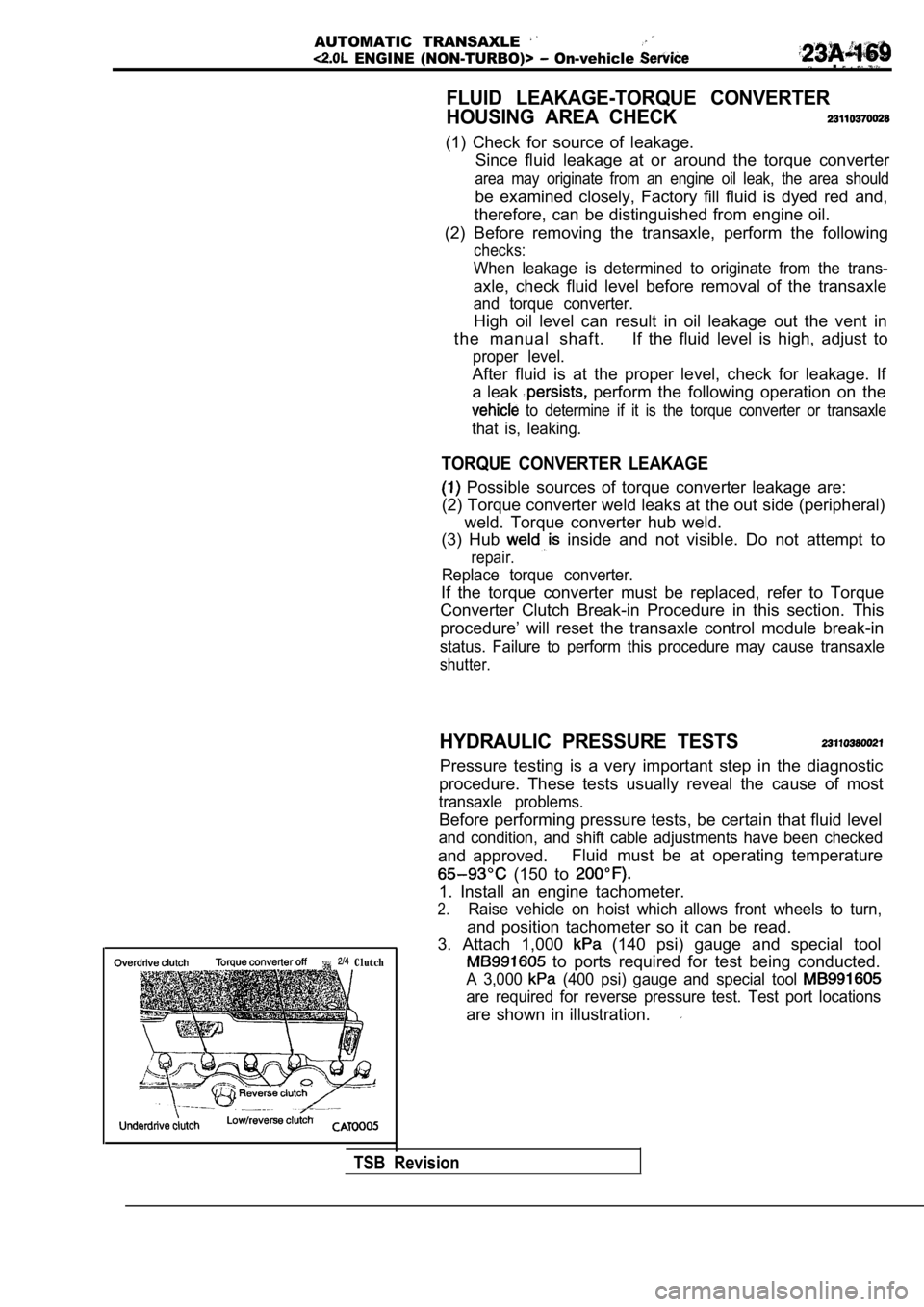
3. Attach 1,000
(140 psi) gauge and special tool
to ports required for test being conducted.
A 3,000 (400 psi) gauge and special tool
are required for reverse pressure test. Test port l ocations
are shown in illustration.
TSB Revision
Page 1178 of 2103
AUTOMATIC TRANSAXLE ENGINE (NON-TURBO)> On-vehicle Service
TSB
Revision
TEST ONE-SELECTOR IN LOW GEAR
(1) Attach pressure gauge to the low/reverse clutch tap.
(2) Move selector lever to the
position.
(3) Allow vehicle wheels to turn and increase throt tle opening
to achieve an indicted vehicle speed of 32 km/h (20 mph).
(4) Low/reverse clutch pressure should read 793 to 1,000
(115 to 145 psi).
(5) This test checks pump output, pressure regulati on and
condition of the low/reverse clutch hydraulic circu it and
shift schedule.
TEST TWO-SELECTOR IN DRIVE GEAR
(1) Attach pressure gauge to the underdrive clutch tap.
(2) Move selector lever to the 2 position.
(3) Allow vehicle wheels to turn and increase throt tle opening
to achieve an indicated vehicle speed of 48 km/h (3 0
(4) Underdrive clutch pressure should read 758 to 1,000
(110 to 145 psi).
(5) This test checks the underdrive clutch hydrauli c circuit
as, well as the shift schedule.
TEST THREE-OVERDRIVE CLUTCH CHECK
(1) Attach pressure gauge to the overdrive clutch t ap.
(2) Move selector lever to the
position.
(3) Allow vehicle wheels to turn and increase throt tle opening
to achieve an indicated vehicle speed of 32 km/h (2 0
(4) Overdrive clutch pressure should read 517 to 655
(75 to 95 psi).
(5) Move selector lever to the 2 position and incre ase indi-
cated vehicle speed of 48 km/h (30 mph).
(6) The vehicle should be in second gear and overdr ive clutch
pressure should be less than 35 (5 psi).
(7) This test checks the overdrive clutch hydraulic circuit as
well as the shift schedule.
Page 1180 of 2103
AUTOMATIC TRANSAXLE
ENGINE (NON-TURBO)> On-vehicle Service
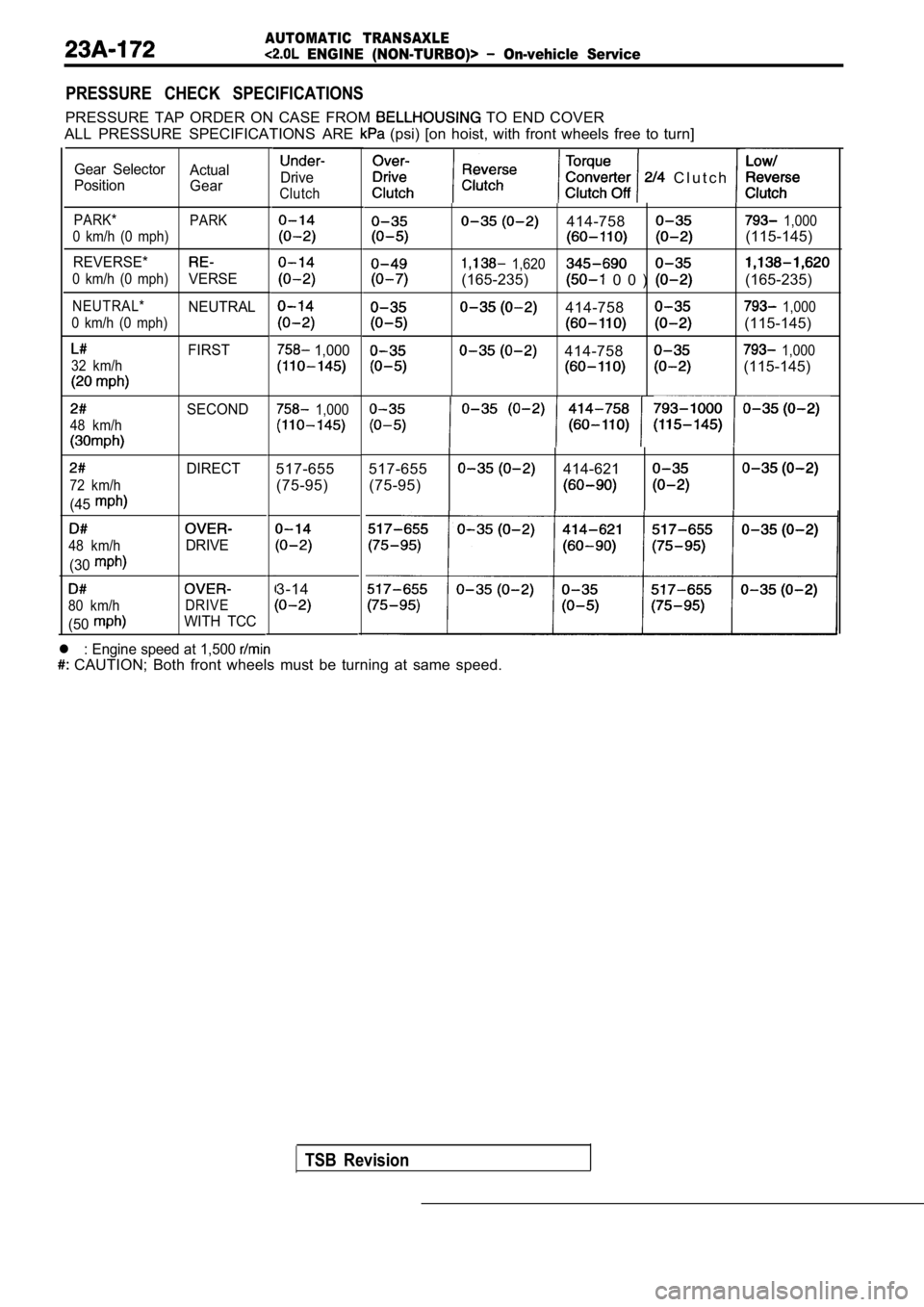
PRESSURE CHECK SPECIFICATIONS
PRESSURE TAP ORDER ON CASE FROM TO END COVER
ALL PRESSURE SPECIFICATIONS ARE
(psi) [on hoist, with front wheels free to turn]
Gear Selector Actual
Position Gear
PARK* PARK
0 km/h (0 mph)
REVERSE*
0 km/h (0 mph)VERSE
NEUTRAL*NEUTRAL
0 km/h (0 mph)
FIRST
32 km/h
48 km/h
SECOND
72 km/h
(45
DIRECT
48 km/h
(30
DRIVE
80 km/h
(50
DRIVE
WITH TCC
Drive
Clutch
1,000
C l u t c h
414-758 1,000
(115-145)
1,620
(165-235) 0 0 ) (165-235)
414-758 1,000
(115-145)
414-758 1,000
(115-145)
1,000
517-655 517-655414-621
(75-95) (75-95)
3-14
l : Engine speed at 1,500
CAUTION; Both front wheels must be turning at same speed.
TSB Revision
Page 1196 of 2103
AUTOMATIC TRANSAXLE
ENGINE Transaxle Control
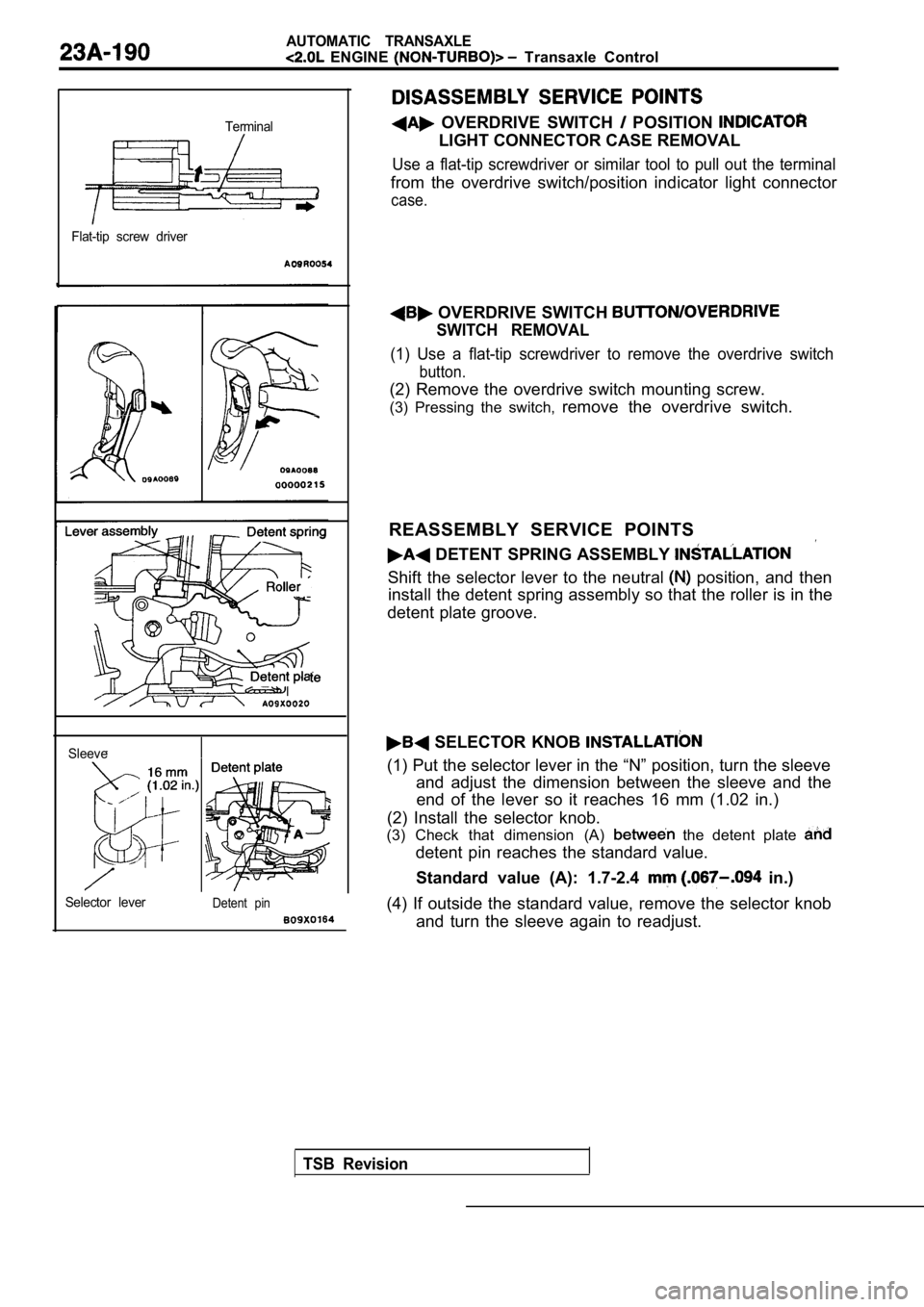
Terminal
Flat-tip screw driver
TSB Revision
Sleeve
Selector lever
Detent pin
OVERDRIVE SWITCH POSITION
LIGHT CONNECTOR CASE REMOVAL
Use a flat-tip screwdriver or similar tool to pull out the terminal
from the overdrive switch/position indicator light connector
case.
OVERDRIVE SWITCH
SWITCH REMOVAL
(1) Use a flat-tip screwdriver to remove the overdr ive switch
button.
(2) Remove the overdrive switch mounting screw.
(3) Pressing the switch, remove the overdrive switch.
REASSEMBLY SERVICE POINTS
DETENT SPRING ASSEMBLY
Shift the selector lever to the neutral position, and then
install the detent spring assembly so that the roll er is in the
detent plate groove.
SELECTOR KNOB
(1) Put the selector lever in the “N” position, tur n the sleeve
and adjust the dimension between the sleeve and the end of the lever so it reaches 16 mm (1.02 in.)
(2) Install the selector knob.
(3) Check that dimension (A)
the detent plate
detent pin reaches the standard value.
Standard value (A): 1.7-2.4
in.)
(4) If outside the standard value, remove the selec tor knob
and turn the sleeve again to readjust.
Page 1197 of 2103
ENGINE
l
lCheck the bushing wear l
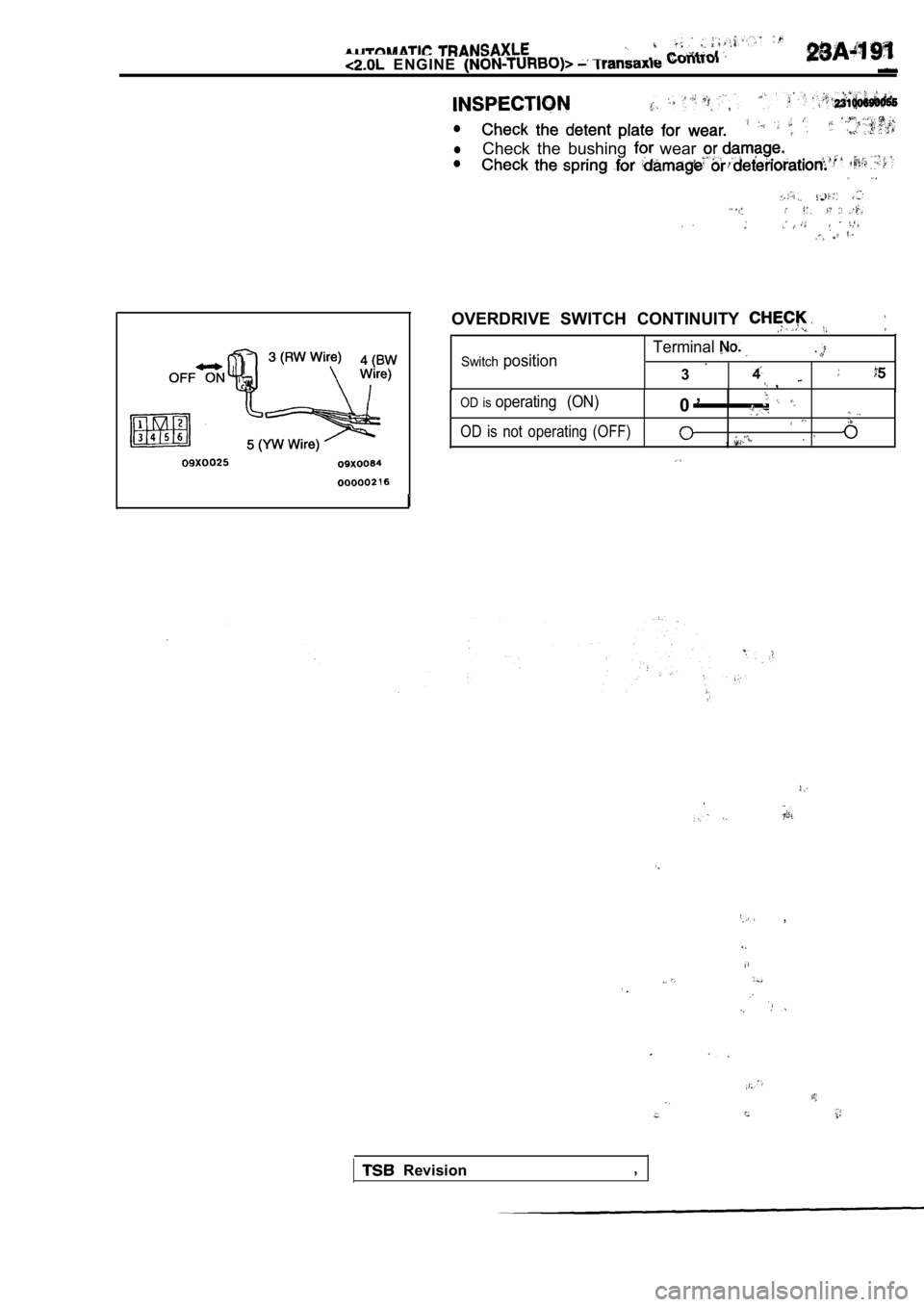
OVERDRIVE SWITCH CONTINUITY
SwitchpositionTerminal.
3 ,
OD is operating (ON)
OD is not operating (OFF)
0 ’
,
,
Revision
,
Page 1200 of 2103
AUTOMATIC TRANSAXLE
ENGINE (NON-TURBO)> Transaxle Assembly
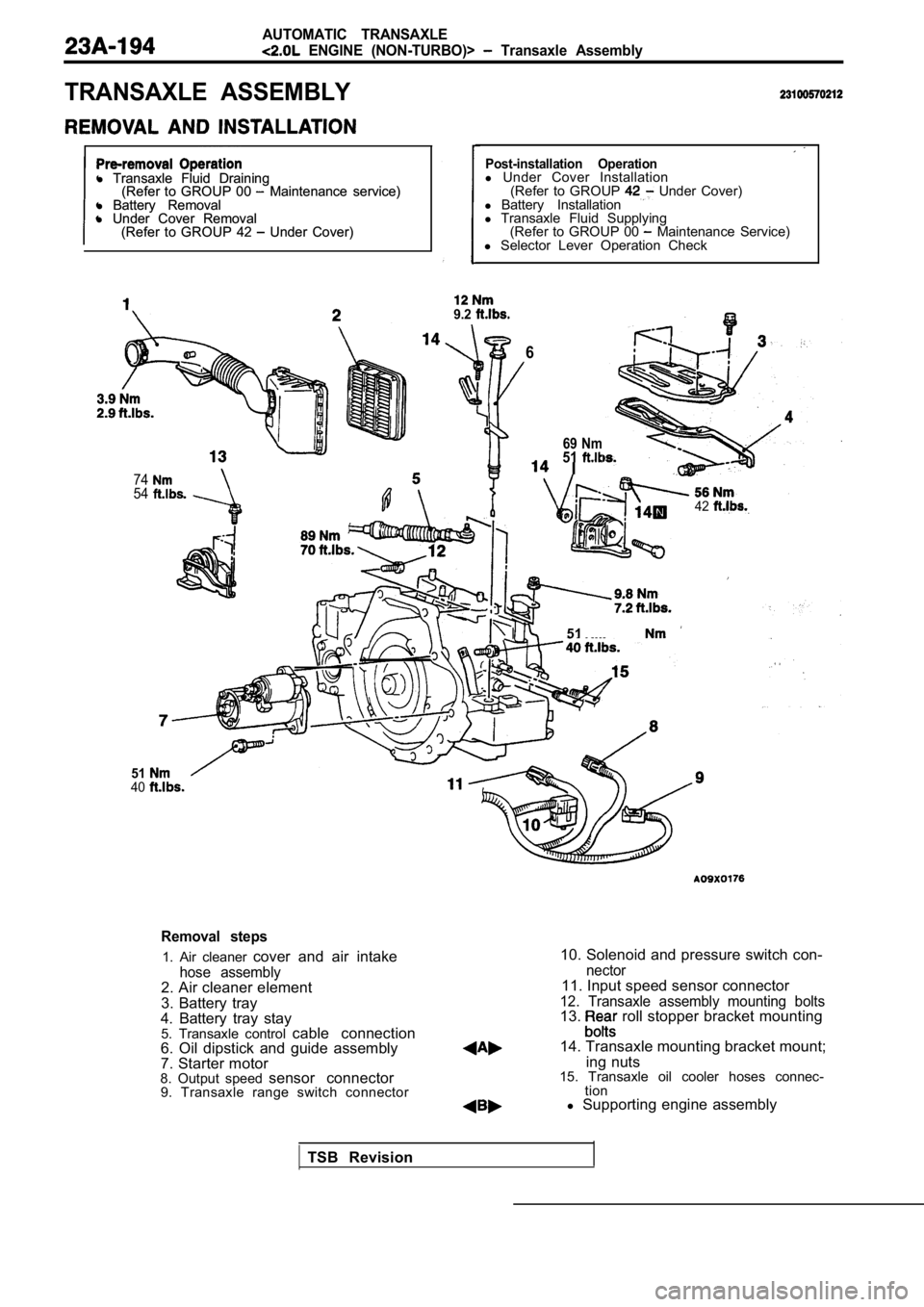
TRANSAXLE ASSEMBLY
l Transaxle Fluid Draining
l Transaxle Fluid Draining
(Refer to GROUP 00 Maintenance service)
(Refer to GROUP 00 Maintenance service)
l Battery Removal
l Battery Removal
l Under Cover Removal
l Under Cover Removal
(Refer to GROUP 42
Under Cover)
(Refer to GROUP 42 Under Cover)
7454
Post-installation Operationl Under Cover Installation
(Refer to GROUP Under Cover)
l Battery Installation
l Transaxle Fluid Supplying
(Refer to GROUP 00
Maintenance Service)
l Selector Lever Operation Check
9.2
6
5140
69 Nm51 I
42
51
Removal steps
1. Air cleaner cover and air intake
hose assembly2. Air cleaner element
3. Battery tray
4. Battery tray stay 5. Transaxle control cable connection
6. Oil dipstick and guide assembly
7. Starter motor
8. Output speed sensor connector
9. Transaxle range switch connector
10. Solenoid and pressure switch con-
nector11. Input speed sensor connector
12. Transaxle assembly mounting bolts13. roll stopper bracket mounting
14. Transaxle mounting bracket mount; ing nuts
15. Transaxle oil cooler hoses connec- tion
l Supporting engine assembly
TSB Revision
Page 1204 of 2103
AUTOMATIC TRANSAXLE
ENGINE (NON-TURBO)> -Transaxle Oil Cooler
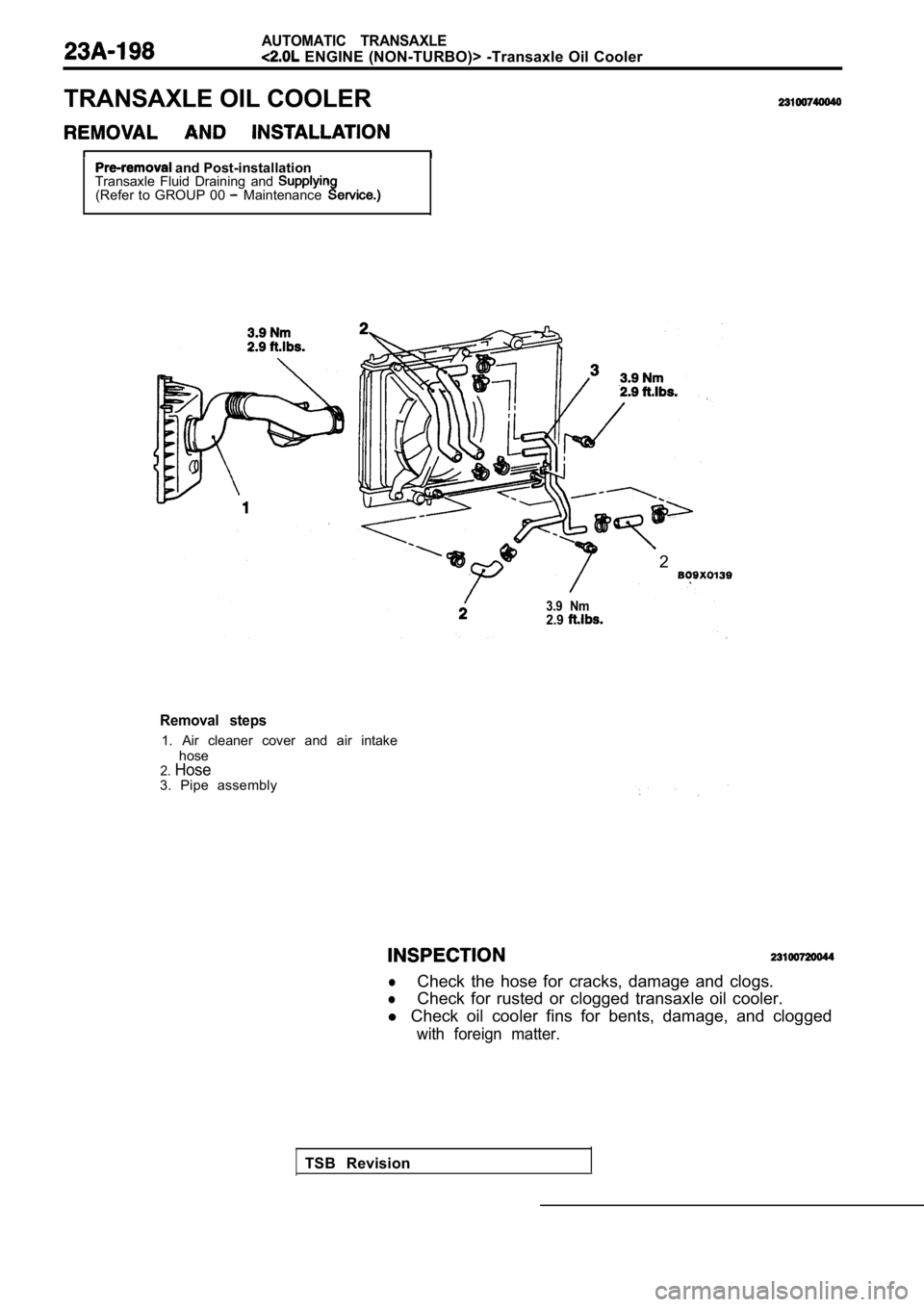
TRANSAXLE OIL COOLER
and Post-installation
Transaxle Fluid Draining and
(Refer to GROUP 00 Maintenance
2
3.9 Nm2.9
Removal steps
1. Air cleaner cover and air intake
hose
2.Hose3. Pipe assembly
lCheck the hose for cracks, damage and clogs.
lCheck for rusted or clogged transaxle oil cooler.
l Check oil cooler fins for bents, damage, and clogge d
with foreign matter.
TSB Revision
Page 1521 of 2103
B.J.
FRONT AXLE Drive Shaft
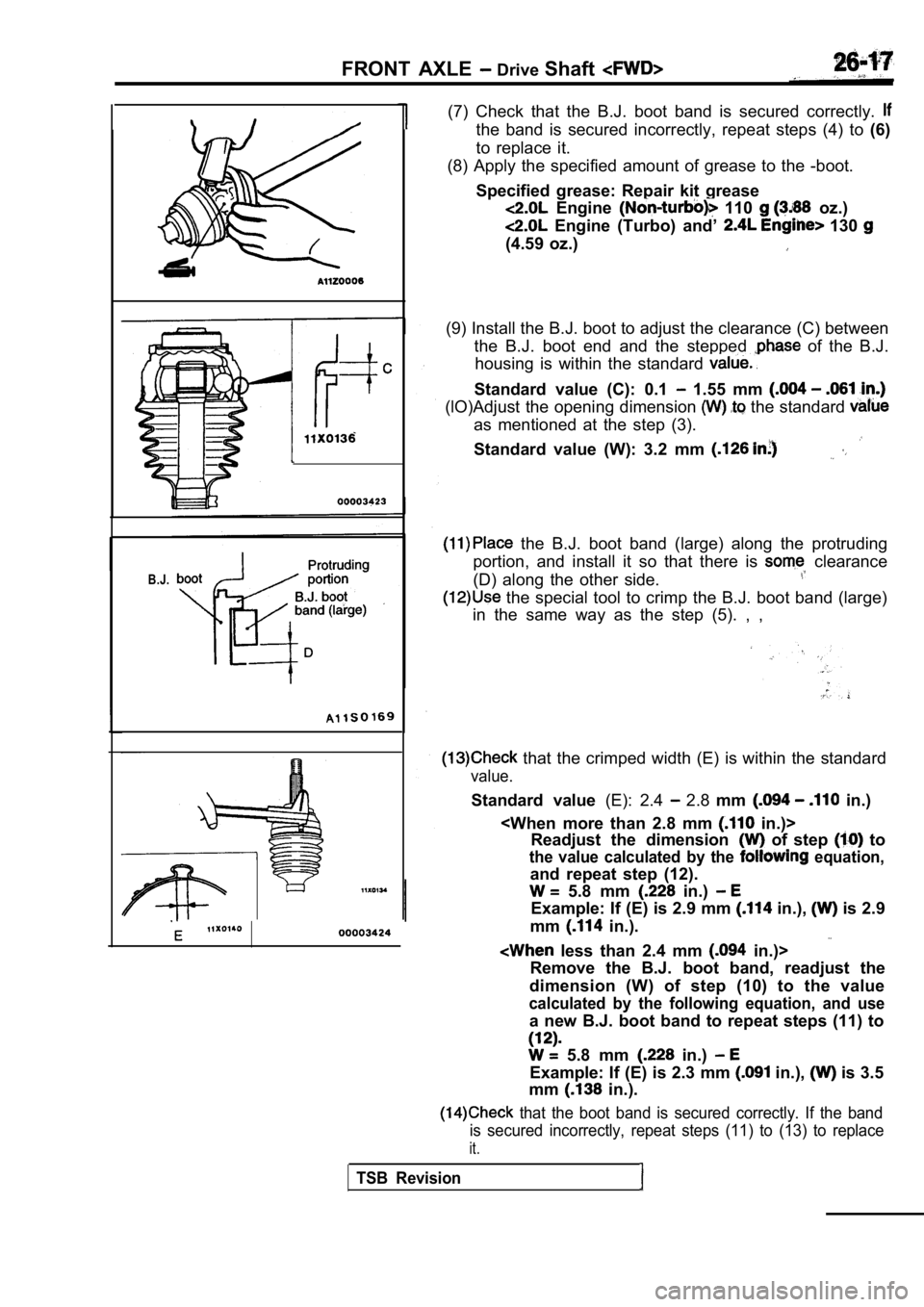
(7) Check that the B.J. boot band is secured correc tly.
the band is secured incorrectly, repeat steps (4) to (6)
to replace it.
(8) Apply the specified amount of grease to the -bo ot.
Specified grease: Repair kit grease
Engine 110 oz.)
Engine (Turbo) and’ 130
(4.59 oz.)
(9) Install the B.J. boot to adjust the clearance ( C) between
the B.J. boot end and the stepped
of the B.J.
housing is within the standard
Standard value (C): 0.1 1.55 mm
(lO)Adjust the opening dimension the standard
as mentioned at the step (3).
Standard value (W): 3.2 mm
the B.J. boot band (large) along the protruding
portion, and install it so that there is
clearance
(D) along the other side.
the special tool to crimp the B.J. boot band (larg e)
in the same way as the step (5). , ,
that the crimped width (E) is within the standard
value.
Standard value (E): 2.4 2.8 mm in.)
Readjust the dimension
of step to
the value calculated by the equation,
and repeat step (12).
5.8 mm in.)
Example: If (E) is 2.9 mm in.), is 2.9
mm
in.).
less than 2.4 mm in.)>
Remove the B.J. boot band, readjust the
dimension (W) of step (10) to the value
calculated by the following equation, and use
a new B.J. boot band to repeat steps (11) to
5.8 mm in.)
Example: If (E) is 2.3 mm in.), is 3.5
mm
in.).
that the boot band is secured correctly. If the ba nd
is secured incorrectly, repeat steps (11) to (13) t o replace
it.
TSB Revision
Page 1522 of 2103
FRONT AXLE Drive Shaft
B.J.Dynamicbamper
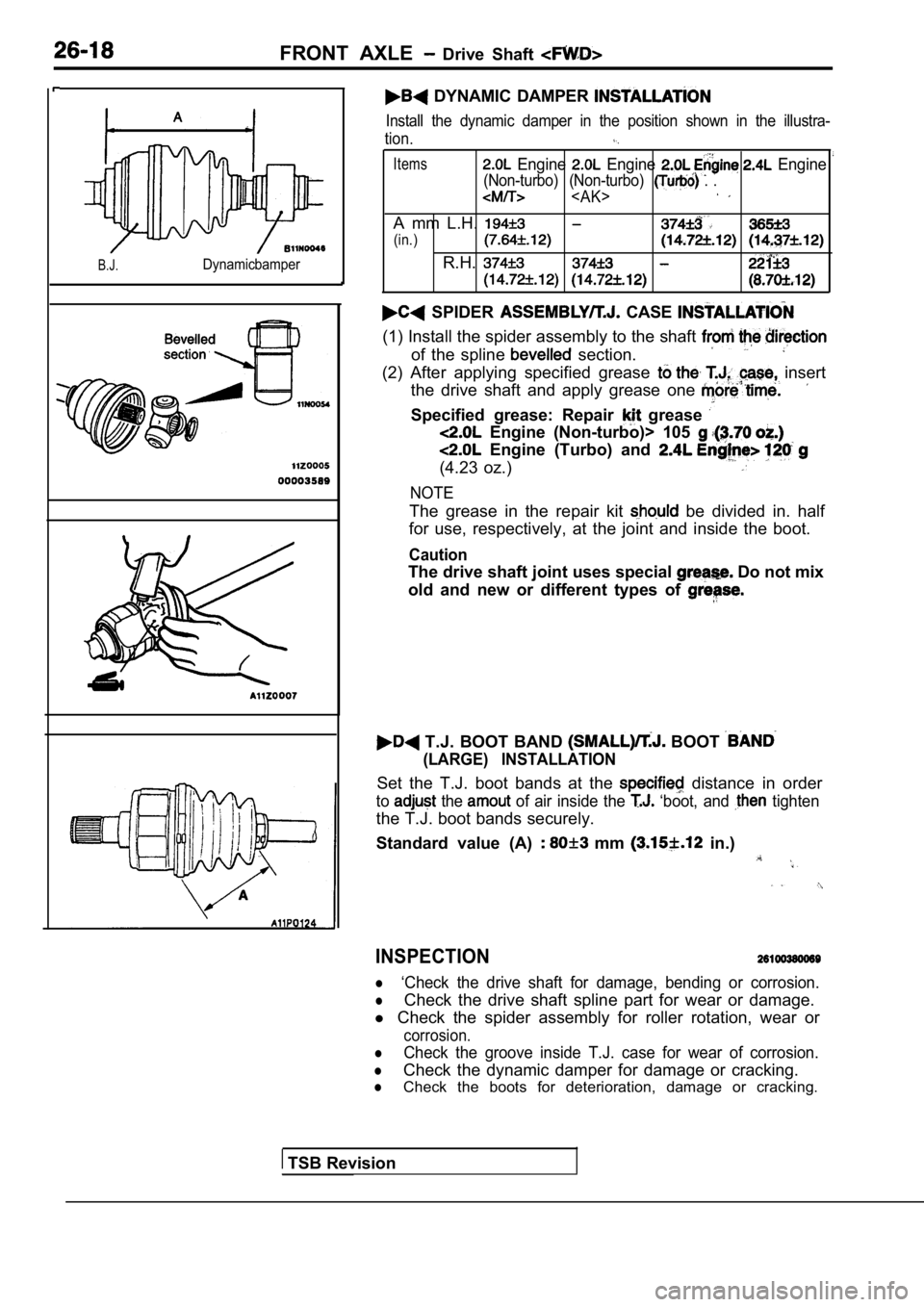
DYNAMIC DAMPER
Install the dynamic damper in the position shown in the illustra-
tion.
Items Engine Engine Engine
(Non-turbo) (Non-turbo) . .
A mm L.H.
(in.)
R.H.
SPIDER CASE
(1) Install the spider assembly to the shaft
of the spline section.
(2) After applying specified grease insert
the drive shaft and apply grease one
Specified grease: Repair grease
Engine (Non-turbo)> 105
Engine (Turbo) and
(4.23 oz.)
NOTE
The grease in the repair kit be divided in. half
for use, respectively, at the joint and inside the boot.
Caution
The drive shaft joint uses special Do not mix
old and new or different types of
T.J. BOOT BAND BOOT
(LARGE) INSTALLATION
Set the T.J. boot bands at the distance in order
to the of air inside the ‘boot, and tighten
the T.J. boot bands securely.
Standard value (A)
mm in.)
INSPECTION
l‘Check the drive shaft for damage, bending or corro sion.
lCheck the drive shaft spline part for wear or damage.
l Check the spider assembly for roller rotation, wear or
corrosion.
lCheck the groove inside T.J. case for wear of corro sion.
lCheck the dynamic damper for damage or cracking.
lCheck the boots for deterioration, damage or cracking.
TSB Revision