Automatic transmission lever MITSUBISHI TRITON 2011 User Guide
[x] Cancel search | Manufacturer: MITSUBISHI, Model Year: 2011, Model line: TRITON, Model: MITSUBISHI TRITON 2011Pages: 369, PDF Size: 26.15 MB
Page 147 of 369
WARNING
l If the lock button is always pushed to op-
erate the selector lever, the lever may be
accidentally shifted into the “P” (PARK)
or “R” (REVERSE) position. Be sure not
to push the lock button when performing
the operations indicated by in the illus-
tration.
l Always depress the brake
pedal
when
shifting the selector lever into a gear
from the “P” (PARK) or “N” (NEU-
TRAL) position.
When beginning to drive, do not shift the
selector lever from the “P” (PARK) or
“N” (NEUTRAL) position while depress-
ing the accelerator pedal, doing so is dan-
gerous because the vehicle will “jump” for-
ward or backward. Selector lever position indicator
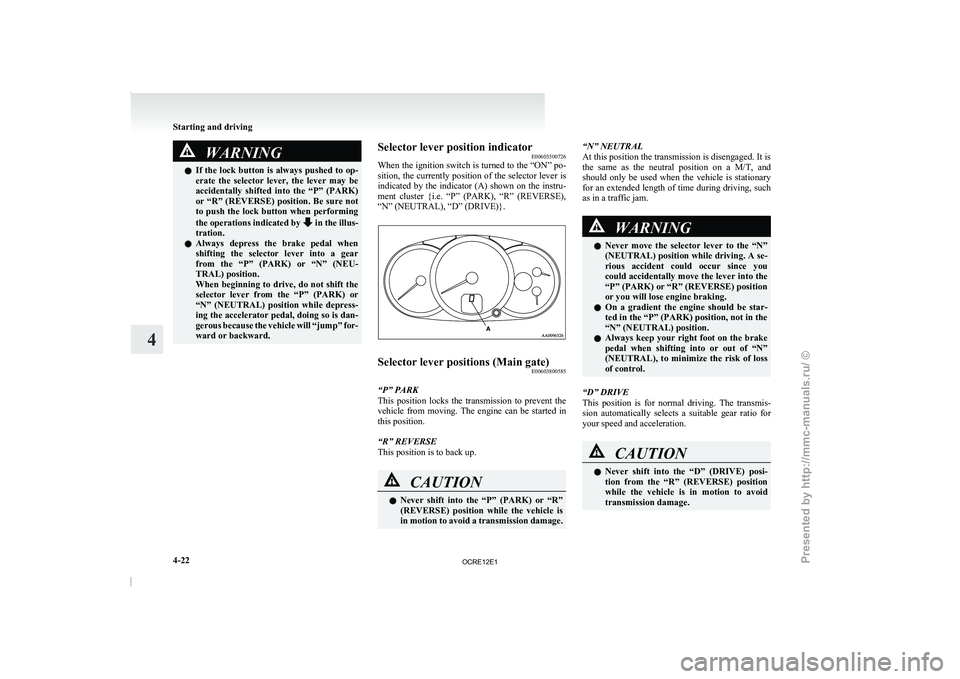
E00603500726
When the
ignition switch
is
turned to the “ON” po-
sition, the currently position of the selector lever is
indicated by the indicator (A) shown on the instru-
ment cluster {i.e. “P” (PARK), “R” (REVERSE),
“N” (NEUTRAL), “D” (DRIVE)}. Selector lever positions (Main gate)
E00603800585
“P” PARK
This position locks the transmission
to prevent the
vehicle from moving. The engine can be started in
this position.
“R” REVERSE
This position is to back up. CAUTION
l
Never shift into the
“P”
(PARK) or “R”
(REVERSE) position while the vehicle is
in motion to avoid a transmission damage. “N” NEUTRAL
At this position the transmission is disengaged. It is
the
same as the neutral
position on a M/T, and
should only be used when the vehicle is stationary
for an extended length of time during driving, such
as in a traffic jam. WARNING
l Never move the selector
lever
to the “N”
(NEUTRAL) position while driving. A se-
rious accident could occur since you
could accidentally move the lever into the
“P” (PARK) or “R” (REVERSE) position
or you will lose engine braking.
l On a gradient the engine should be star-
ted in the “P” (PARK) position, not in the
“N” (NEUTRAL) position.
l Always keep your right foot on the brake
pedal when shifting into or out of “N”
(NEUTRAL), to minimize the risk of loss
of control.
“D” DRIVE
This position is for normal
driving. The transmis-
sion automatically selects a suitable gear ratio for
your speed and acceleration. CAUTION
l
Never shift into the “D”
(DRIVE) posi-
tion from the “R” (REVERSE) position
while the vehicle is in motion to avoid
transmission damage. Starting and driving
4-22
4
OCRE12E1
Presented by http://mmc-manuals.ru/ \251
Page 149 of 369
When a malfunction occurs in the au-
tomatic transmission
E00615100152
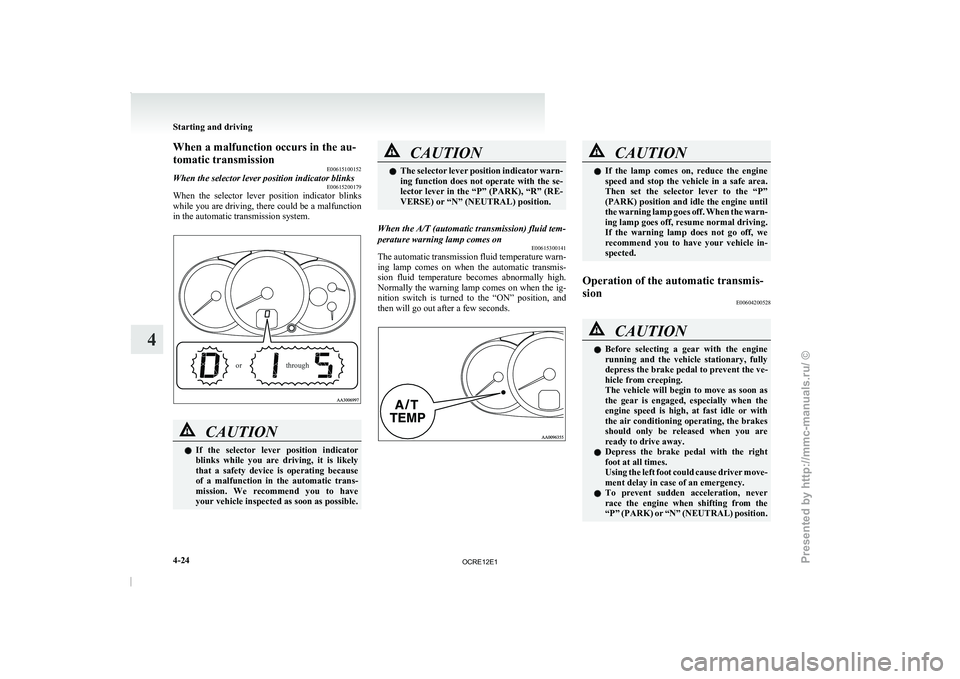
When the selector lever position indicator blinks E00615200179
When the selector lever position indicator blinks
while you are driving, there
could be a malfunction
in the automatic transmission system.
through
or CAUTION
l
If the selector lever
position
indicator
blinks while you are driving, it is likely
that a safety device is operating because
of a malfunction in the automatic trans-
mission. We recommend you to have
your vehicle inspected as soon as possible. CAUTION
l
The selector lever position indicator
warn-
ing function does not operate with the se-
lector lever in the “P” (PARK), “R” (RE-
VERSE) or “N” (NEUTRAL) position.
When the A/T (automatic transmission) fluid tem-
perature warning lamp comes on E00615300141
The automatic transmission fluid temperature warn-
ing lamp comes
on when
the automatic transmis-
sion fluid temperature becomes abnormally high.
Normally the warning lamp comes on when the ig-
nition switch is turned to the “ON” position, and
then will go out after a few seconds. CAUTION
l
If the lamp comes on,
reduce the engine
speed and stop the vehicle in a safe area.
Then set the selector lever to the “P”
(PARK) position and idle the engine until
the warning lamp goes off. When the warn-
ing lamp goes off, resume normal driving.
If the warning lamp does not go off, we
recommend you to have your vehicle in-
spected.
Operation of the automatic transmis-
sion E00604200528 CAUTION
l
Before selecting a gear with
the engine
running and the vehicle stationary, fully
depress the brake pedal to prevent the ve-
hicle from creeping.
The vehicle will begin to move as soon as
the gear is engaged, especially when the
engine speed is high, at fast idle or with
the air conditioning operating, the brakes
should only be released when you are
ready to drive away.
l Depress the brake pedal with the right
foot at all times.
Using the left foot could cause driver move-
ment delay in case of an emergency.
l To prevent sudden acceleration, never
race the engine when shifting from the
“P” (PARK) or “N” (NEUTRAL) position. Starting and driving
4-24
4
OCRE12E1
Presented by http://mmc-manuals.ru/ \251
Page 150 of 369
CAUTION
l
Operating the accelerator pedal while the
other foot is resting on the brake pedal
will affect braking efficiency and may
cause premature wear of brake pads.
l Use the selector lever in the correct shift
position in accordance with driving condi-
tions.
Never coast downhill backward with the
driving shift position {“D” (DRIVE) or
sports mode} or coast forward with the
“R” (REVERSE) position.
The engine stops and the brake pedal ef-
fort or the steering wheel handling weight
increasing could lead to an accident.
l Do not race the engine with brake pedal
pressed when the vehicle is stationary.
This can damage the automatic transmis-
sion.
Passing acceleration E00604500329
To gain extra acceleration in “D” (DRIVE) posi-
tion, push the
accelerator to
the floor. The automat-
ic transmission will automatically downshift.
NOTE
l In “Sports mode”, downshifts do not take
place when the accelerator is depressed all
the way to the floor.
Waiting E00604600304
For short waiting periods, such as at traffic signals,
the vehicle can be left
in gear and held stationary
with the service brake. For longer waiting periods with the engine running,
place the selector lever
in
the “N” (NEUTRAL) po-
sition.. CAUTION
l
Never hold the vehicle
stationary
on a hill
using the accelerator pedal (without us-
ing the brake pedal). Always apply the
parking brake and/or service brakes.
l Unexpected acceleration may occur if the
selector lever is in a position other than
“P” (PARK) or “N” (NEUTRAL). Prior
to moving off after having stopped the ve-
hicle, make sure that the selector lever is
in the “D” (DRIVE) position.
Parking E00604700262
To park the vehicle, first bring it to a complete
stop, fully engage
the parking
brake, and then
move the selector lever to the “P” (PARK) position.
If you are going to leave the vehicle unattended, al-
ways switch off the engine and remove the ignition
key. NOTE
l On
a slope, be sure
to apply the parking
brake before moving the selector lever to the
“P” (PARK) position. If you move the selec-
tor lever to the “P” (PARK) position before
applying the parking brake, it may be diffi-
cult to disengage the selector lever from the
“P” (PARK) position when next you drive
the vehicle, requiring application of a strong
force to the selector lever to move from the
“P” (PARK) position.
When the automatic transmission makes no speed
change E00604800683
If the transmission does not change speeds while
driving, or your vehicle
does
not pick up enough
speed when starting on an uphill slope, it may be
that there is something unusual happening in the
transmission, causing a safety device to activate.
We recommend you to have your checked as soon
as possible. 1. If your vehicle has difficulty moving uphill,
shift the selector lever into 2 nd
gear of the
“Sports mode”.
This method might not work depending on
the type of transmission malfunction.
2. Once the vehicle is moving on a level road, move the selector lever back to “D” (DRIVE).
NOTE l When the selector lever position indicator in
the instrument panel blinks, it means that
there is an abnormal condition in the trans-
mission. Refer to “When the selector lever po-
sition indicator blinks” on page 4-19. Starting and driving
4-25 4
OCRE12E1
Presented by http://mmc-manuals.ru/ \251
Page 151 of 369
Easy select 4WD*
E00614700119
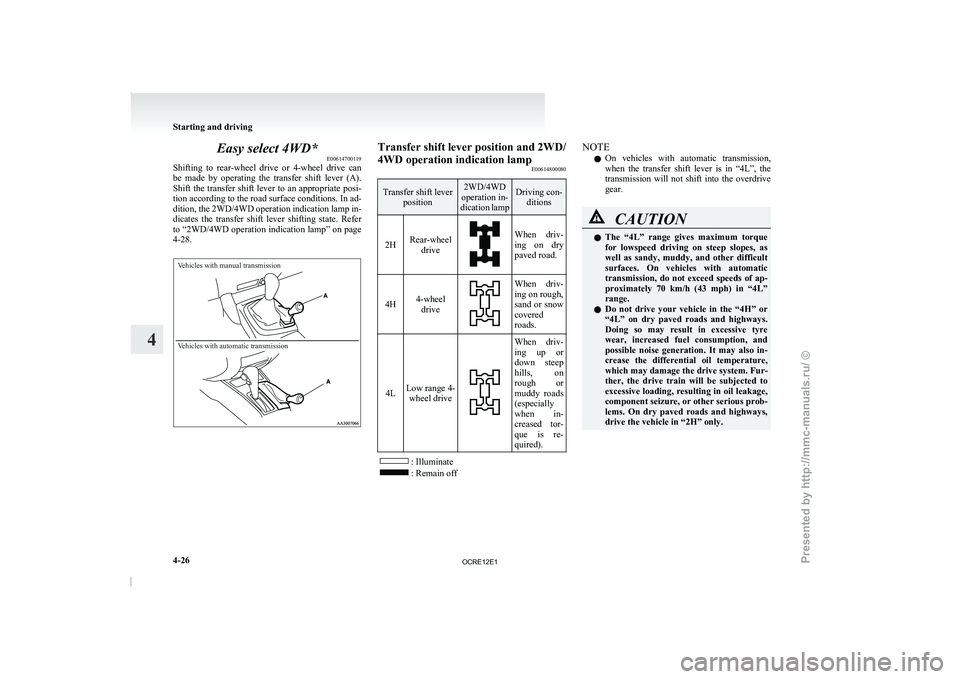
Shifting to rear-wheel drive or
4-wheel drive can
be made by operating the transfer shift lever (A).
Shift the transfer shift lever to an appropriate posi-
tion according to the road surface conditions. In ad-
dition, the 2WD/4WD operation indication lamp in-
dicates the transfer shift lever shifting state. Refer
to “2WD/4WD operation indication lamp” on page
4-28.
Vehicles with manual transmission
Vehicles with automatic transmission Transfer shift lever position and 2WD/
4WD operation indication lamp
E00614800080 Transfer shift lever
position 2WD/4WD
operation in-
dication lamp Driving con-
ditions
2H Rear-wheel
drive When driv-
ing on dry
paved road.
4H 4-wheel
drive When driv-
ing on rough,
sand or snow
covered
roads.
4L Low range 4-
wheel drive When driv-
ing up or
down steep
hills,
on
rough
or
muddy roads
(especially
when in-
creased tor-
que is re-
quired). : Illuminate
: Remain offNOTE
l On vehicles with automatic
transmission,
when
the transfer shift lever is in “4L”, the
transmission will not shift into the overdrive
gear. CAUTION
l
The “4L” range gives
maximum
torque
for lowspeed driving on steep slopes, as
well as sandy, muddy, and other difficult
surfaces. On vehicles with automatic
transmission, do not exceed speeds of ap-
proximately 70 km/h (43 mph) in “4L”
range.
l Do not drive your vehicle in the “4H” or
“4L” on dry paved roads and highways.
Doing so may result in excessive tyre
wear, increased fuel consumption, and
possible noise generation. It may also in-
crease the differential oil temperature,
which may damage the drive system. Fur-
ther, the drive train will be subjected to
excessive loading, resulting in oil leakage,
component seizure, or other serious prob-
lems. On dry paved roads and highways,
drive the vehicle in “2H” only. Starting and driving
4-26
4
OCRE12E1
Presented by http://mmc-manuals.ru/ \251
Page 152 of 369
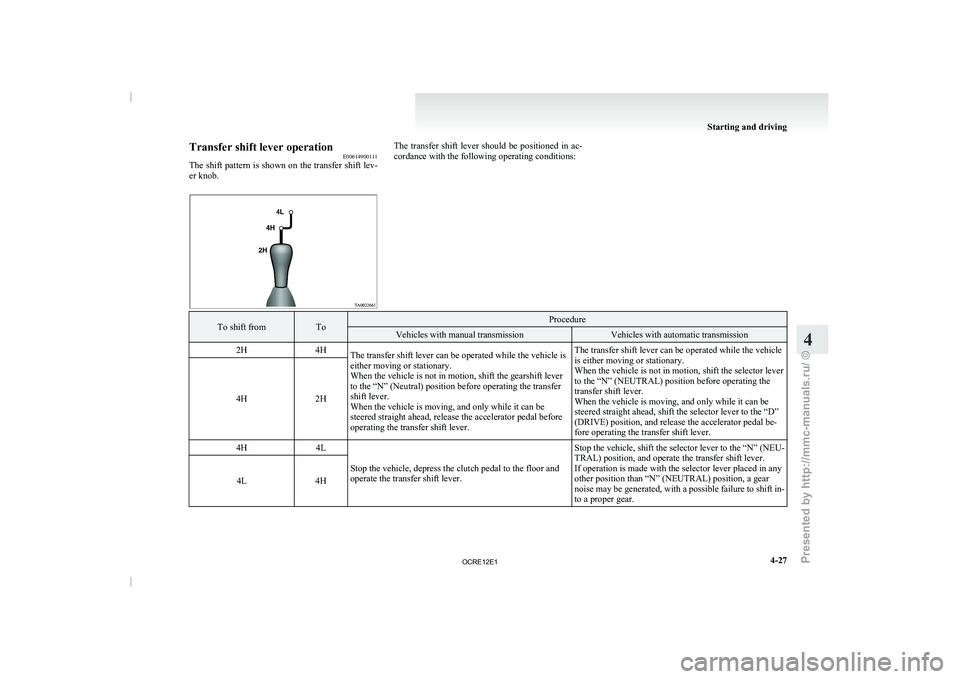
Transfer shift lever operation
E00614900111
The shift pattern is shown
on the transfer shift lev-
er knob. The transfer shift lever should be positioned in ac-
cordance with the following operating conditions:
To shift from To Procedure
Vehicles with manual transmission Vehicles with automatic transmission
2H 4H
The transfer shift lever can be operated while the vehicle is
either moving or stationary.
When the vehicle is not in motion, shift the gearshift lever
to the “N” (Neutral) position before operating the transfer
shift lever.
When the vehicle is moving, and only while it can be
steered straight ahead, release the accelerator pedal before
operating the transfer shift lever. The transfer shift lever can be operated while the vehicle
is either moving or stationary.
When the vehicle is not in motion, shift the selector lever
to the “N” (NEUTRAL) position before operating the
transfer shift lever.
When the vehicle is moving, and only while it can be
steered straight ahead, shift the selector lever to the “D”
(DRIVE) position, and release the accelerator pedal be-
fore operating the transfer shift lever.
4H
2H
4H 4L
Stop the vehicle, depress the clutch pedal to the floor and
operate the transfer shift lever. Stop the vehicle, shift the selector lever to the “N” (NEU-
TRAL) position, and operate the transfer shift lever.
If operation is made with the selector lever placed in any
other position than “N” (NEUTRAL) position, a gear
noise may be generated,
with
a possible failure to shift in-
to a proper gear.
4L
4H Starting and driving
4-27 4
OCRE12E1
Presented by http://mmc-manuals.ru/ \251
Page 155 of 369
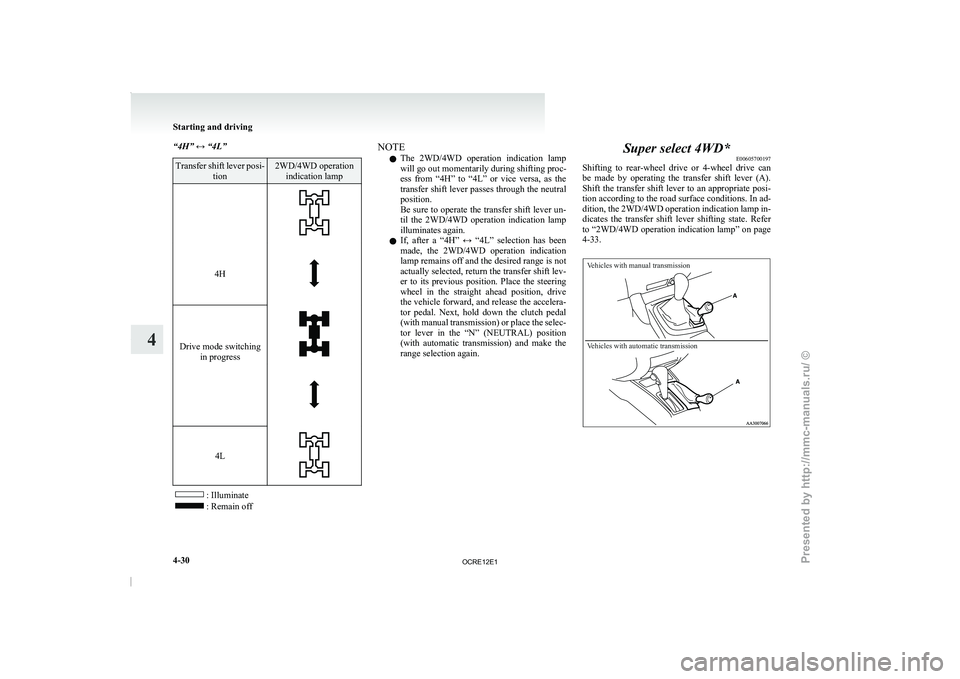
“4H” ↔ “4L”
Transfer shift lever posi-
tion 2WD/4WD operation
indication lamp
4H
Drive mode switching
in progress
4L
: Illuminate
: Remain off NOTE
l The
2WD/4WD operation indication lamp
will go out momentarily during shifting proc-
ess
from “4H” to “4L” or vice versa, as the
transfer shift lever passes through the neutral
position.
Be sure to operate the transfer shift lever un-
til the 2WD/4WD operation indication lamp
illuminates again.
l If, after a “4H” ↔ “4L” selection has been
made, the 2WD/4WD operation indication
lamp remains off and the desired range is not
actually selected, return the transfer shift lev-
er to its previous position. Place the steering
wheel in the straight ahead position, drive
the vehicle forward, and release the accelera-
tor pedal. Next, hold down the clutch pedal
(with manual transmission) or place the selec-
tor lever in the “N” (NEUTRAL) position
(with automatic transmission) and make the
range selection again. Super select 4WD*
E00605700197
Shifting to rear-wheel drive
or
4-wheel drive can
be made by operating the transfer shift lever (A).
Shift the transfer shift lever to an appropriate posi-
tion according to the road surface conditions. In ad-
dition, the 2WD/4WD operation indication lamp in-
dicates the transfer shift lever shifting state. Refer
to “2WD/4WD operation indication lamp” on page
4-33.
Vehicles with manual transmission
Vehicles with automatic transmission Starting and driving
4-30
4
OCRE12E1
Presented by http://mmc-manuals.ru/ \251
Page 156 of 369
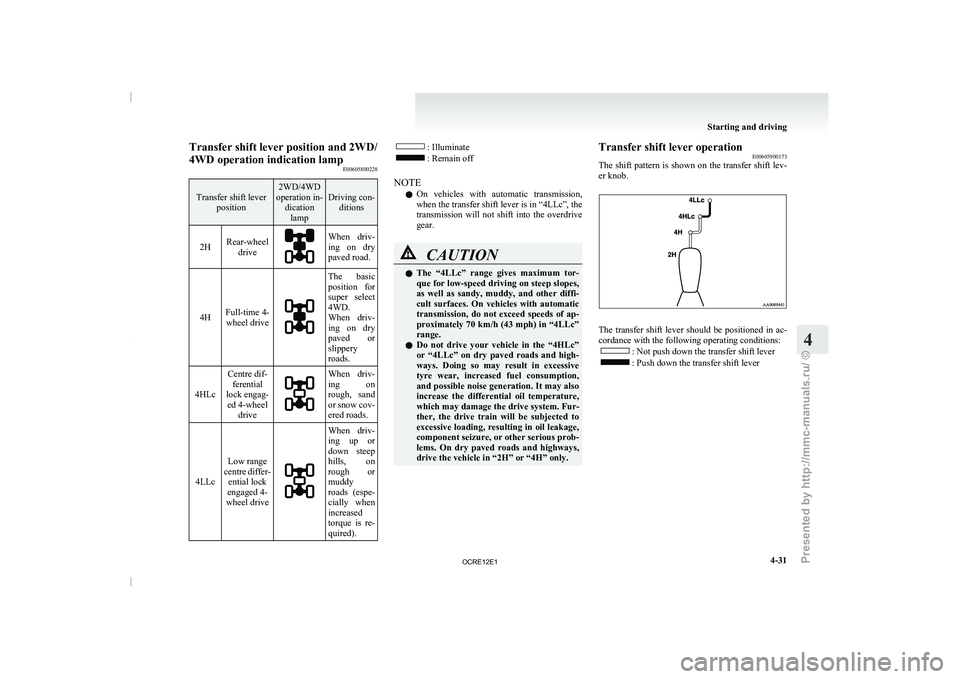
Transfer shift lever position and 2WD/
4WD operation indication lamp
E00605800228Transfer shift lever
position 2WD/4WD
operation in- dicationlamp Driving con-
ditions
2H Rear-wheel
drive When driv-
ing on dry
paved road.
4H Full-time 4-
wheel drive The basic
position for
super select
4WD.
When driv-
ing
on
dry
paved or
slippery
roads.
4HLc Centre dif-
ferential
lock engag- ed 4-wheel drive When driv-
ing on
rough, sand
or snow
cov-
ered roads.
4LLc Low range
centre
differ-
ential lock
engaged 4-
wheel drive When driv-
ing up or
down steep
hills,
on
rough
or
muddy
roads (espe-
cially when
increased
torque is re-
quired). : Illuminate
: Remain off
NOTE l On
vehicles with automatic transmission,
when the transfer shift lever is in “4LLc”, the
transmission
will not shift into the overdrive
gear. CAUTION
l
The “4LLc” range gives
maximum
tor-
que for low-speed driving on steep slopes,
as well as sandy, muddy, and other diffi-
cult surfaces. On vehicles with automatic
transmission, do not exceed speeds of ap-
proximately 70 km/h (43 mph) in “4LLc”
range.
l Do not drive your vehicle in the “4HLc”
or “4LLc” on dry paved roads and high-
ways. Doing so may result in excessive
tyre wear, increased fuel consumption,
and possible noise generation. It may also
increase the differential oil temperature,
which may damage the drive system. Fur-
ther, the drive train will be subjected to
excessive loading, resulting in oil leakage,
component seizure, or other serious prob-
lems. On dry paved roads and highways,
drive the vehicle in “2H” or “4H” only. Transfer shift lever operation
E00605900173
The shift pattern is shown
on the transfer shift lev-
er knob. The transfer shift lever should be positioned in ac-
cordance with the following operating conditions:
: Not push down the transfer shift lever
: Push down the transfer shift lever Starting and driving
4-31 4
OCRE12E1
Presented by http://mmc-manuals.ru/ \251
Page 157 of 369
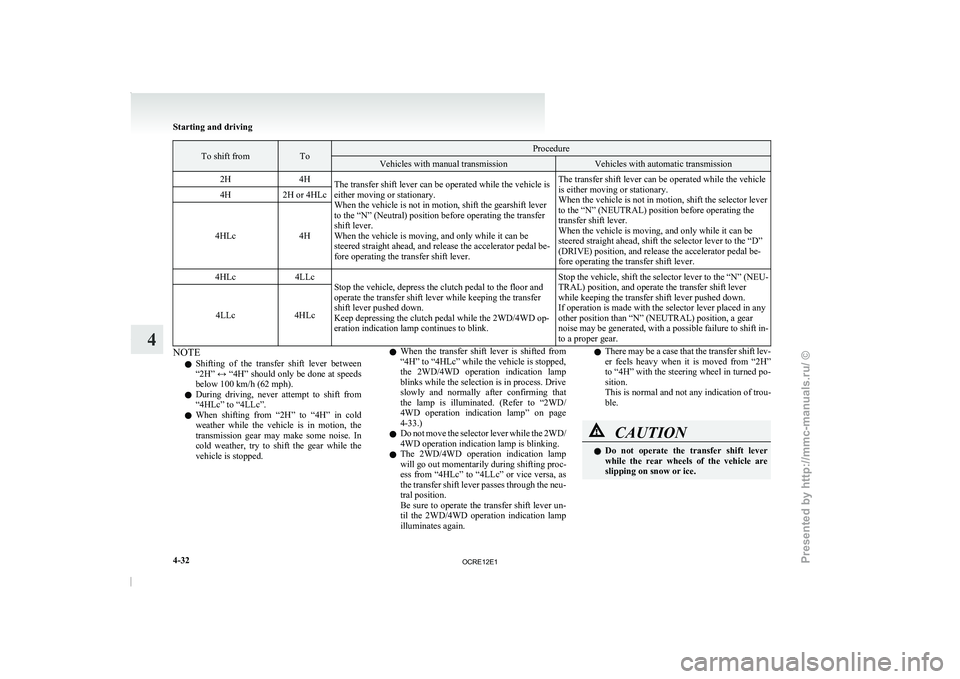
To shift from To Procedure
Vehicles with manual transmission Vehicles with automatic transmission
2H 4H
The transfer shift lever can be operated while the vehicle is
either moving or stationary.
When the vehicle is not in motion, shift the gearshift lever
to the “N” (Neutral) position before operating the transfer
shift lever.
When the vehicle is moving, and only while it can be
steered straight ahead, and release the accelerator pedal be-
fore operating the transfer shift lever. The transfer shift lever can be operated while the vehicle
is either moving or stationary.
When the vehicle is not in motion, shift the selector lever
to the “N” (NEUTRAL) position before operating the
transfer shift lever.
When the vehicle is moving, and only while it can be
steered straight ahead, shift the selector lever to the “D”
(DRIVE) position, and release the accelerator pedal be-
fore operating the transfer shift lever.
4H
2H or 4HLc
4HLc 4H
4HLc 4LLc
Stop the vehicle, depress the clutch pedal to the floor and
operate the transfer shift lever while keeping the transfer
shift lever pushed down.
Keep depressing the clutch pedal while the 2WD/4WD op-
eration indication lamp continues to blink. Stop the vehicle, shift the selector lever to the “N” (NEU-
TRAL) position, and operate the transfer shift lever
while keeping the transfer shift lever pushed down.
If operation is made with the selector lever placed in any
other position than “N” (NEUTRAL) position, a gear
noise may be generated, with
a possible failure to shift in-
to a proper gear.
4LLc
4HLcNOTE
l Shifting
of the transfer shift
lever between
“2H” ↔ “4H” should only be done at speeds
below 100 km/h (62 mph).
l During driving, never attempt to shift from
“4HLc” to “4LLc”.
l When shifting from “2H” to “4H” in cold
weather while the vehicle is in motion, the
transmission gear may make some noise. In
cold weather, try to shift the gear while the
vehicle is stopped. l
When
the transfer shift
lever is shifted from
“4H” to “4HLc” while the vehicle is stopped,
the 2WD/4WD operation indication lamp
blinks while the selection is in process. Drive
slowly and normally after confirming that
the lamp is illuminated. (Refer to “2WD/
4WD operation indication lamp” on page
4-33.)
l Do not move the selector lever while the 2WD/
4WD operation indication lamp is blinking.
l The 2WD/4WD operation indication lamp
will go out momentarily during shifting proc-
ess from “4HLc” to “4LLc” or vice versa, as
the transfer shift lever passes through the neu-
tral position.
Be sure to operate the transfer shift lever un-
til the 2WD/4WD operation indication lamp
illuminates again. l
There may be a case that the transfer shift lev-
er feels heavy when it is moved from “2H”
to “4H” with the steering wheel in turned po-
sition.
This is normal and not any indication of trou-
ble. CAUTION
l
Do not operate the
transfer
shift lever
while the rear wheels of the vehicle are
slipping on snow or ice. Starting and driving
4-32
4
OCRE12E1
Presented by http://mmc-manuals.ru/ \251
Page 164 of 369
4-wheel drive operation
E00606600920
By selecting 4-wheel drive, both
axles of the vehi-
cle are rigidly connected with each other. This im-
proves the traction characteristics. When turning
sharp corners or moving forward and backward re-
peatedly, however, the drive line is stressed, which
is felt as a braking effect. A 4-wheel drive vehicle
can accelerate more quickly and smoothly.
However, note that the braking distance is not short-
er than that of a rear-wheel drive vehicle.
When using 4-wheel drive on rough roads (snow,
mud, sand, etc.), it is important to operate the vehi-
cle correctly.
NOTE
l The driving posture should be more upright
and closer to the wheel than usual; adjust the
seat to a good position for easy steering and
pedal operation. Be sure to wear the seat belt.
l After driving on rough roads, check each
part of the vehicle and wash it thoroughly
with water. Refer to the “Vehicle care” sec-
tion and “Inspection and maintenance follow-
ing rough road operation” on page 4-41.
Driving on dry paved road and highway
Select “2H” position (easy select 4WD), “2H” or
“4H” position (super select 4WD) to drive on the
dry paved road. Especially on dry highway, never
select the “4H” or “4L” position (easy select
4WD), “4HLc” or “4LLc” position (super select
4WD). CAUTION
l
Selecting “4H” or “4L” position
(easy se-
lect 4WD), “4HLc” or “4LLc” position (su-
per select 4WD) to drive on dry paved
road will increase the fuel consumption
with possible noise generation and early
tyre wear.
It may also increase the differential oil
temperature, resulting in possible dam-
age to the driving system.
Further, the drive train will be subjected
to excessive loading, possibly leading to
oil leakage, component seizure, or other
serious faults.
Driving on snowy or icy roads
Set the transfer shift lever
to “4H” or “4L” position
(easy select 4WD), “4H” or “4HLc” position (su-
per select 4WD) in accordance with the road condi-
tions, and then gradually depress the accelerator ped-
al for a smooth start.
NOTE
l The use of snow tyres and/or tyre chains is
recommended.
l Maintain a safe distance between vehicles,
avoid sudden braking, and use engine brak-
ing (downshifting). CAUTION
l
Avoid sudden braking, sudden accelera-
tion,
and sharp turning; such operations
could cause skidding and spinouts. Driving on sandy or muddy roads
Set the transfer shift
lever
to “4H” or “4L” position
(easy select 4WD), “4HLc” or “4LLc” position (su-
per select 4WD) and then gradually depress the ac-
celerator pedal for a smooth start. Keep the pres-
sure on the accelerator pedal as constant as possi-
ble, and drive at low speed. CAUTION
l
Do not force the
vehicle
or drive reckless-
ly on sandy surfaces. In comparison with
normal road surfaces, the engine and oth-
er drive-system components are put un-
der excessive strain when driving on such
a surface, and this could lead to accidents.
l If any of following conditions occur while
the vehicle is being driven, immediately
park your vehicle in a safe place and fol-
low these procedures:
• The needle in the temperature gaugeapproaches the overheating zone.
Refer to “Engine overheating” on
page 6-04.
• Automatic transmission fluid temper- ature warning lamp comes on.
Refer to “When the A/T (automatic
transmission) fluid temperature warn-
ing lamp comes on” on pages 4-19,
4-24. Starting and driving
4-39 4
OCRE12E1
Presented by http://mmc-manuals.ru/ \251
Page 175 of 369
Cruise control*
E00609100779
Cruise control is an automatic
speed control system
that keeps a set speed. It can be activated at about
40 km/h (25 mph) or more. CAUTION
l
When you do not
wish
to drive at a set
speed, turn off the cruise control for safety.
l Do not use cruise control when driving
conditions will not allow you to stay at
the same speed, such as in heavy traffic
or on roads that are winding, icy, snow-
covered, wet, slippery, on a steep down-
hill slope.
l On vehicles with manual transmission, do
not move the gearshift lever to the “N”
(Neutral) position while driving at a set
speed without depressing the clutch ped-
al. The engine will run too fast and might
be damaged.
NOTE l Cruise
control may not be
able to keep your
speed on uphills or downhills.
l Your speed may decrease on a steep uphill.
You may use the accelerator pedal if you
want to stay at your set speed.
l Your speed may increase to more than the
set speed on a steep downhill. You must use
the brake to control your speed. As a result,
the set speed driving is deactivated. Cruise control switches
E00624100103 A- “ON OFF” switch
Used to turn on and off the cruise control.
B- “COAST SET” switch
Used to reduce the
set
speed and to set the desired
speed.
C- “ACC RES” switch
Used to increase the set speed and to return to the
original set speed.
D- “CANCEL” switch
Used to deactivate the set speed driving.
NOTE
l When operating the cruise control switches,
press the cruise control switches correctly.
The set speed driving may be deactivated au-
tomatically if two or more switches of the
cruise control are pressed at the same time. To activate
E00609300771
1. With the ignition
switch in
the “ON” posi-
tion, press the “ON OFF” switch (A) to turn
on the cruise control. The “CRUISE” indica-
tion lamp in the meter cluster will come on. NOTE
l If
the cruise control is
on when the ignition
switch is turned to the “LOCK” or “ACC” po-
sition, cruise control will be on automatically
the next time you start the engine.
The “CRUISE” indication lamp will also be
on.
l If the battery voltage is insufficient, the mem-
ory data for the cruise control may be erased.
As a result, the “CRUISE” indication lamp
may not come on when you restart the engine.
If this happens, press the “ON OFF” switch
once again to turn on the cruise control. Starting and driving
4-50
4
OCRE12E1
Presented by http://mmc-manuals.ru/ \251