height MITSUBISHI TRITON 2011 User Guide
[x] Cancel search | Manufacturer: MITSUBISHI, Model Year: 2011, Model line: TRITON, Model: MITSUBISHI TRITON 2011Pages: 369, PDF Size: 26.15 MB
Page 65 of 369
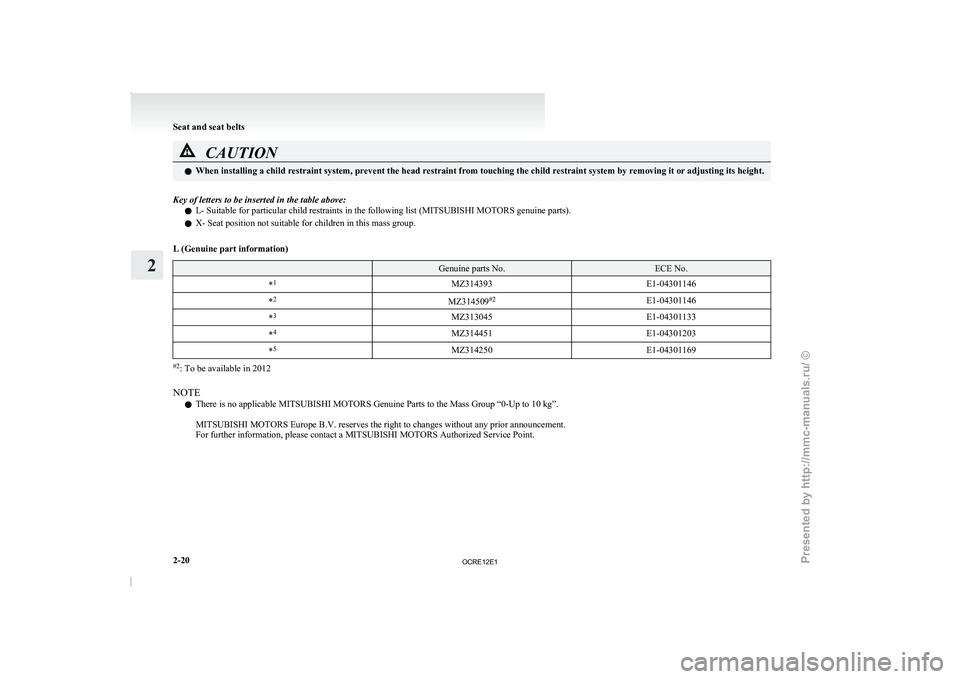
CAUTION
l
When installing a child restraint system, prevent the head restraint from touching the child restraint system by removing it or adjusting its height.
Key of letters to be inserted in the table above: l L- Suitable for particular child restraints in the following list (
MITSUBISHI MOTORS genuine parts).
l X- Seat position not suitable for children in this mass group.
L (Genuine part information) Genuine parts No. ECE No.
* 1
MZ314393 E1-04301146
* 2
MZ314509#2
E1-04301146
* 3
MZ313045 E1-04301133
* 4
MZ314451 E1-04301203
* 5
MZ314250 E1-04301169#2
: To be available in 2012
NOTE l There is no applicable
MITSUBISHI MOTORS
Genuine Parts to the Mass Group “0-Up to 10 kg”.
MITSUBISHI MOTORS Europe B.V. reserves the right to changes without any prior announcement.
For further information, please contact a MITSUBISHI MOTORS
Authorized Service Point.Seat and seat belts
2-20
2
OCRE12E1
Presented by http://mmc-manuals.ru/ \251
Page 66 of 369
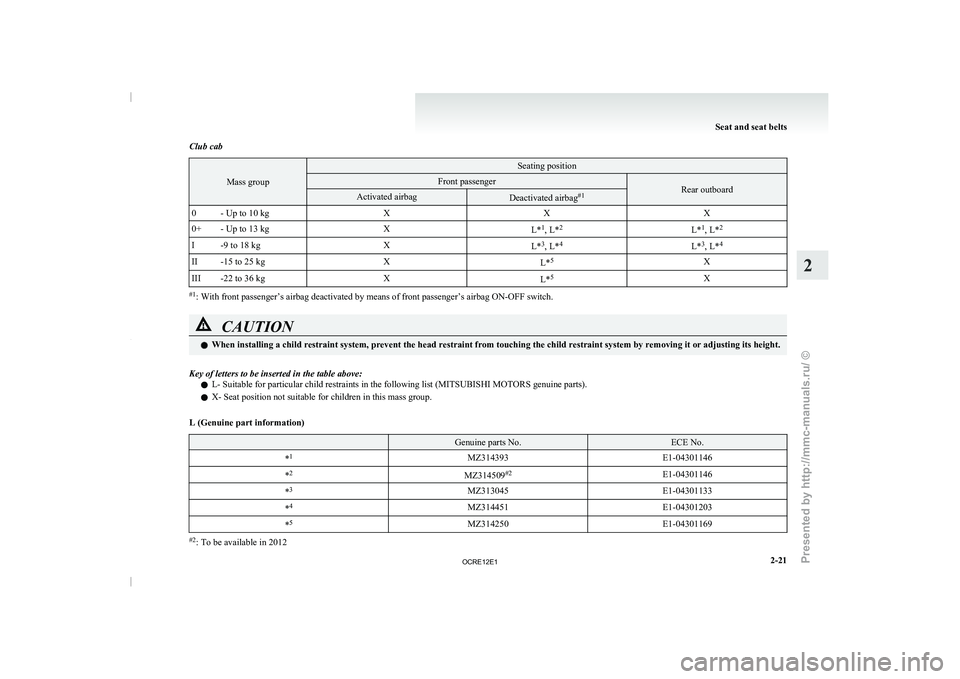
Club cab
Mass group Seating position
Front passenger
Rear outboard
Activated airbag
Deactivated airbag
#1
0 - Up to 10 kg XXX
0+ - Up to 13 kg X
L*1
, L* 2
L*1
, L* 2
I -9 to 18 kg X
L*3
, L* 4
L*3
, L* 4
II -15 to 25 kg X
L*5
X
III -22 to 36 kg X
L*5
X#1
: With front passenger’s airbag deactivated by means of front passenger’s airbag ON-OFF switch.CAUTION
l
When installing a child restraint system, prevent the head restraint from touching the child restraint system by removing it or adjusting its height.
Key of letters to be inserted in the table above: l L- Suitable for particular child restraints in the following list (
MITSUBISHI MOTORS genuine parts).
l X- Seat position not suitable for children in this mass group.
L (Genuine part information) Genuine parts No. ECE No.
* 1
MZ314393 E1-04301146
* 2
MZ314509#2
E1-04301146
* 3
MZ313045 E1-04301133
* 4
MZ314451 E1-04301203
* 5
MZ314250 E1-04301169#2
: To be available in 2012 Seat and seat belts
2-21 2
OCRE12E1
Presented by http://mmc-manuals.ru/ \251
Page 67 of 369
NOTE
l There is no applicable
MITSUBISHI MOTORS Genuine Parts to the Mass Group “0-Up to 10 kg”.
MITSUBISHI MOTORS Europe B.V. reserves the right to changes without any prior announcement.
For further information, please contact a MITSUBISHI MOTORS
Authorized Service Point.
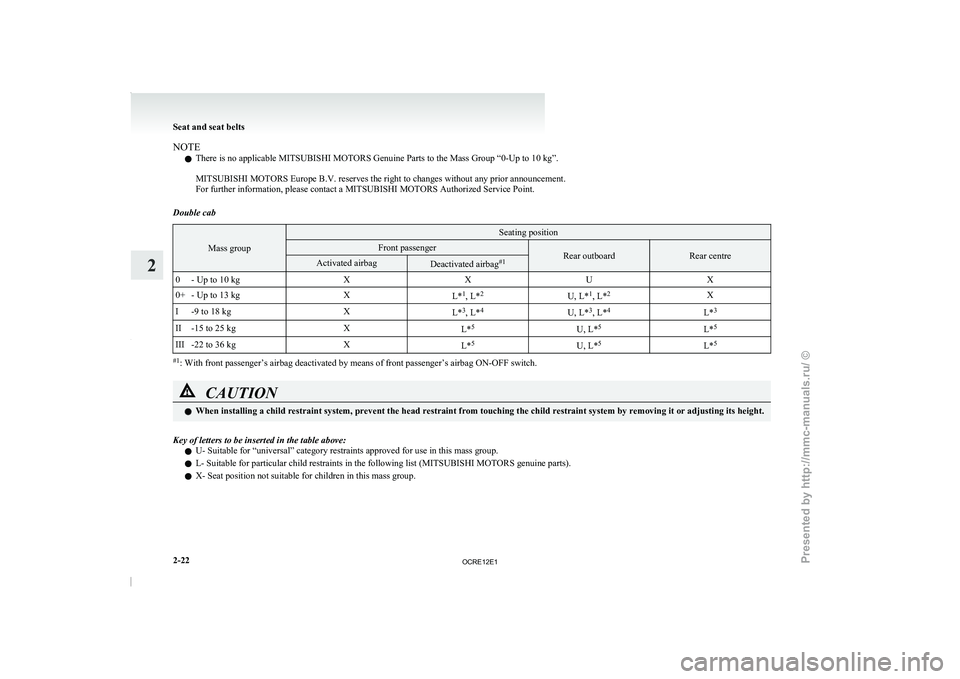
Double cab Mass group Seating position
Front passenger
Rear outboard Rear centre
Activated airbag
Deactivated airbag
#1
0 - Up to 10 kg XXUX
0+ - Up to 13 kg X
L*1
, L* 2
U, L*1
, L* 2
X
I -9 to 18 kg X
L*3
, L* 4
U, L*3
, L* 4
L*3
II -15 to 25 kg X
L*5
U, L*5
L*5
III -22 to 36 kg X
L*5
U, L*5
L*5 #1
: With front passenger’s airbag deactivated by means of front passenger’s airbag ON-OFF switch.CAUTION
l
When installing a child restraint system, prevent the head restraint from touching the child restraint system by removing it or adjusting its height.
Key of letters to be inserted in the table above: l U- Suitable for “universal” category restraints approved for use in this mass group.
l L- Suitable for particular child restraints in the following list (
MITSUBISHI MOTORS genuine parts).
l X- Seat position not suitable for children in this mass group. Seat and seat belts
2-22
2
OCRE12E1
Presented by http://mmc-manuals.ru/ \251
Page 126 of 369
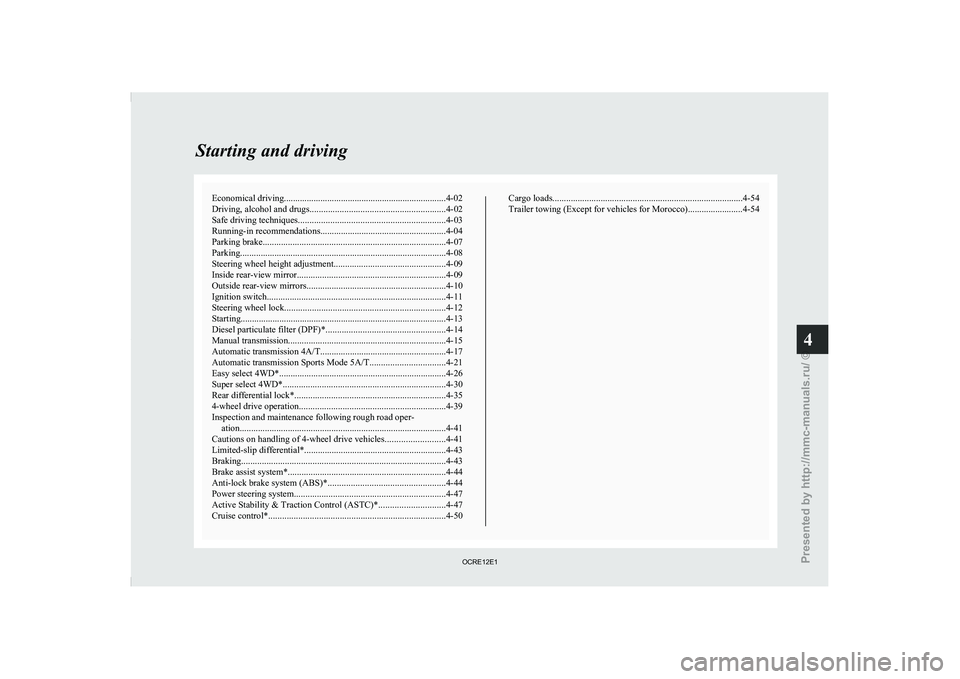
Economical driving.......................................................................4-02
Driving, alcohol and drugs
........................................................... 4-02
Safe driving techniques ................................................................ 4-03
Running-in recommendations.......................................................4-04 Parking brake................................................................................ 4-07
Parking .......................................................................................... 4-08
Steering wheel height adjustment .................................................4-09
Inside rear-view mirror ................................................................. 4-09
Outside rear-view mirrors ............................................................. 4-10
Ignition switch .............................................................................. 4-11
Steering wheel lock ...................................................................... 4-12
Starting.......................................................................................... 4-13
Diesel particulate filter (DPF)* .................................................... 4-14
Manual transmission ..................................................................... 4-15
Automatic transmission
4A/T....................................................... 4-17
Automatic transmission Sports Mode 5A/T .................................4-21
Easy select 4WD* ......................................................................... 4-26
Super select 4WD* ....................................................................... 4-30
Rear differential lock* .................................................................. 4-35
4-wheel drive operation ................................................................ 4-39
Inspection and maintenance following rough road oper- ation.......................................................................................... 4-41
Cautions on handling of 4-wheel drive vehicles ..........................4-41
Limited-slip differential* .............................................................. 4-43
Braking......................................................................................... 4-43
Brake assist system*..................................................................... 4-44
Anti-lock brake system (ABS)* ................................................... 4-44
Power steering system.................................................................. 4-47
Active Stability & Traction Control (ASTC)* .............................4-47
Cruise control* ............................................................................. 4-50 Cargo loads...................................................................................
4-54
Trailer towing (Except for vehicles for Morocco)........................4-54 Starting and driving
4
OCRE12E1
Presented by http://mmc-manuals.ru/ \251
Page 134 of 369
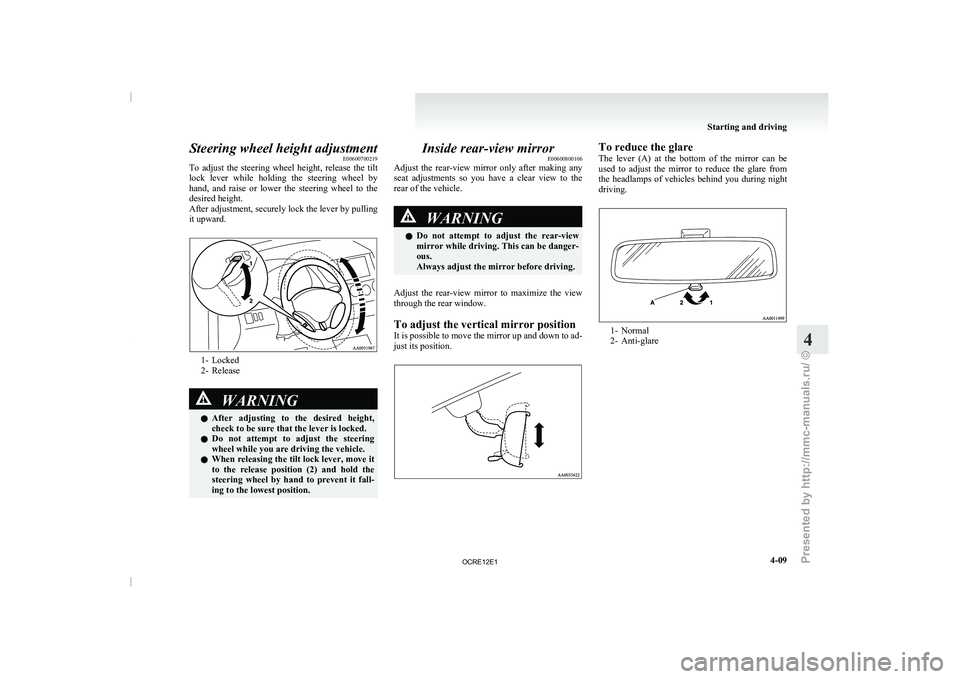
Steering wheel height adjustment
E00600700219
To adjust the steering wheel
height, release the tilt
lock lever while holding the steering wheel by
hand, and raise or lower the steering wheel to the
desired height.
After adjustment, securely lock the lever by pulling
it upward. 1- Locked
2- Release
WARNING
l After adjusting to the
desired
height,
check to be sure that the lever is locked.
l Do not attempt to adjust the steering
wheel while you are driving the vehicle.
l When releasing the tilt lock lever, move it
to the release position (2) and hold the
steering wheel by hand to prevent it fall-
ing to the lowest position. Inside rear-view mirror
E00600800106
Adjust the rear-view mirror only
after making any
seat adjustments so you have a clear view to the
rear of the vehicle. WARNING
l Do not attempt to
adjust
the rear-view
mirror while driving. This can be danger-
ous.
Always adjust the mirror before driving.
Adjust the rear-view mirror to maximize the view
through the rear window.
To adjust the vertical mirror position
It is possible
to move
the mirror up and down to ad-
just its position. To reduce the glare
The lever (A) at
the
bottom of the mirror can be
used to adjust the mirror to reduce the glare from
the headlamps of vehicles behind you during night
driving. 1- Normal
2- Anti-glare Starting and driving
4-09 4
OCRE12E1
Presented by http://mmc-manuals.ru/ \251
Page 169 of 369
WARNING
l Do not leave any objects near the brake
pedal or let a floor mat slide under it; do-
ing so could prevent the full pedal stroke
that would be necessary in an emergency.
Make sure that the pedal can be operated
freely at all times. Make sure the floor
mat is securely held in place.
Brake pads and linings l Avoid hard braking situations.
New
brakes need to be
broken-in by moder-
ate use for the first 200 km (124 miles).
l The disc brakes are provided with a warning
device which emits a shrieking metallic
sound while braking if the brake pads have
reached their wear limit.
If you hear this sound, have the brake pads re-
placed immediately. WARNING
l Driving with worn brake
pads
will make
it harder to stop, and can cause an acci-
dent. Brake assist system*
E00627000392
The brake assist system is a device assisting drivers
who cannot depress the brake
pedal firmly when it
is necessary to do so (such as in emergency stop sit-
uations) and provides greater braking force.
If the brake pedal is depressed suddenly, the brakes
will be applied with more force than usual. CAUTION
l
The brake assist system
is
not a device de-
signed to exercise braking force greater
than its capacity. Make sure to always
keep a sufficient distance between vehi-
cles in front of you without relying too
much on the brake assist system.
NOTE l Once
the brake assist system
is operational,
it maintains great braking force even if the
brake pedal is lightly released.
To stop its operation, completely remove
your foot from the brake pedal.
l When the brake assist system is in use while
driving, you may feel the brake pedal at-
tempt to resist, the pedal moves in small mo-
tions in conjunction with the operation noise,
or the vehicle body and the steering wheel vi-
brate. This occurs when the brake assist sys-
tem is operating normally and does not indi-
cate faulty operation. Continue to firmly de-
press the brake pedal.
l When the active stability & traction control
(ASTC) indication lamp is illuminated, the
brake assist system may not function. Anti-lock brake system (ABS)*
E00607100775
Environmental conditions can have
an
effect on
braking. During sudden braking when there is
snow, ice, oil, water etc. on the road surface, a skid
may occur. In this situation, steering control and
braking effectiveness is reduced and the stopping
distance is increased. The vehicle may also go into
an uncontrolled spin.
The ABS helps prevent the wheels from locking dur-
ing braking, thus maintaining directional stability,
ensuring controllability and providing optimum
braking force.
Driving hints
l With ABS fitted, steering during sudden brak-
ing (when the ABS functions) differs slightly
from when the brakes are not being applied.
Steer the vehicle carefully in these conditions.
l Always maintain the same distance from the
vehicle in front of you as you would for a ve-
hicle not equipped with ABS.
Compared with vehicles not fitted with ABS,
your vehicle may require a longer stopping
distance in the following cases:
• Driving on gravel or snow-covered roads.
• Driving with tyre chains installed.
• Driving on roads where the road surfaceis pitted or has other differences in sur-
face height.
• Driving on bumpy roads or other poor driv- ing surfaces. Starting and driving
4-44
4
OCRE12E1
Presented by http://mmc-manuals.ru/ \251
Page 312 of 369
![MITSUBISHI TRITON 2011 User Guide Before fitting tyre chains, we recommend you to
consult a MITSUBISHI MOTORS
Authorized Serv-
ice Point. The max. chain height is as follows. Tyre size Wheel size Max. chain
height [mm] 195R15C](/img/19/58153/w960_58153-311.png "MITSUBISHI TRITON 2011 User Guide Before fitting tyre chains, we recommend you to
consult a MITSUBISHI MOTORS
Authorized Serv-
ice Point. The max. chain height is as follows. Tyre size Wheel size Max. chain
height [mm] 195R15C")
Before fitting tyre chains, we recommend you to
consult a MITSUBISHI MOTORS
Authorized Serv-
ice Point. The max. chain height is as follows. Tyre size Wheel size Max. chain
height [mm] 195R15C,
215/70R15C *
15x6.0 JJ
22205R16C 16x6.0 JJ
205/80R16 16x6.0 JJ
245/70R16 16x7.0 J
245/65R17 17x7.5 J
* : 215/70R15C size should only
be used as snow
tyres. The speed limit for tyre chain is 50 km/h (30 mph)
and remove the
tyre
chains as soon as possible on
snow free roads. WARNING
l DO NOT use a
jack
when fitting the
chains, as in thsee conditions, the tyres
may slip on the icy road causing the vehi-
cle to slip off the jack. CAUTION
l
Practice fitting the chains
before
you
need them.
Don’t expect help from other people in
the cold.
l Choose a clear straight stretch of road
where you can pull over and still be seen
while you are fitting the chains. CAUTION
l
Do not fit chains before
you need them.
This will wear out your tyres and the
road surface.
l After driving around 100-300 metres,
stop and retighten the chains.
l Drive carefully and do not exceed
50 km/h (30 mph). Remember, fitting
chains is not going to stop accidents from
happening.
l When tyre chains are installed, take care
that they do not damage the disc wheel or
body.
l An aluminium wheel can be damaged by
a tyre chain while driving. When fitting a
tyre chain on an aluminium wheel, take
care that any part of the chain and fitting
cannot be brought into contact with the
wheel.
l When installing or removing the tyre
chains, take care that hands and other
parts of your body are not injured by the
sharp edges of the vehicle body.
l Install the chains only on the rear tyres
and tighten them as tightly as possible
with the ends securely fastened.
NOTE l The
laws and regulations concerning
the use
of tyre chains vary. Find out and follow the
laws and regulations of the area you're driv-
ing in.
In most countries, it is prohibited by law to
use tyre chains on roads without snow. Clutch pedal free play*
E01002200222
Press down the clutch pedal
with your fingers until
initial resistance is felt.
This distance should be within the specified range. A- Free play: 3 to 8 mm
If the clutch pedal free
play is not within the stand-
ard range, we recommend you to have it checked. Maintenance
8-15 8
OCRE12E1
Presented by http://mmc-manuals.ru/ \251
Page 335 of 369
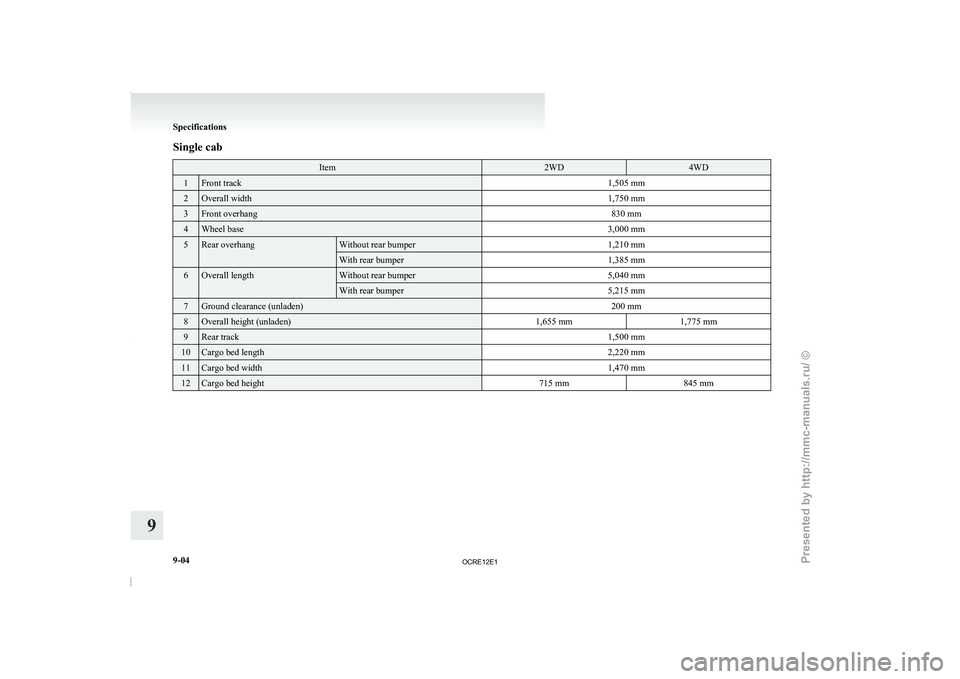
Single cab
Item 2WD 4WD
1 Front track
1,505 mm2 Overall width
1,750 mm3 Front overhang
830 mm4 Wheel base
3,000 mm5 Rear overhang Without rear bumper
1,210 mmWith rear bumper
1,385 mm6 Overall length Without rear bumper
5,040 mmWith rear bumper
5,215 mm7 Ground clearance (unladen)
200 mm8 Overall height (unladen)
1,655 mm1,775 mm9 Rear track
1,500 mm10 Cargo bed length
2,220 mm11 Cargo bed width
1,470 mm12 Cargo bed height
715 mm845 mmSpecifications
9-04
9
OCRE12E1
Presented by http://mmc-manuals.ru/ \251
Page 337 of 369
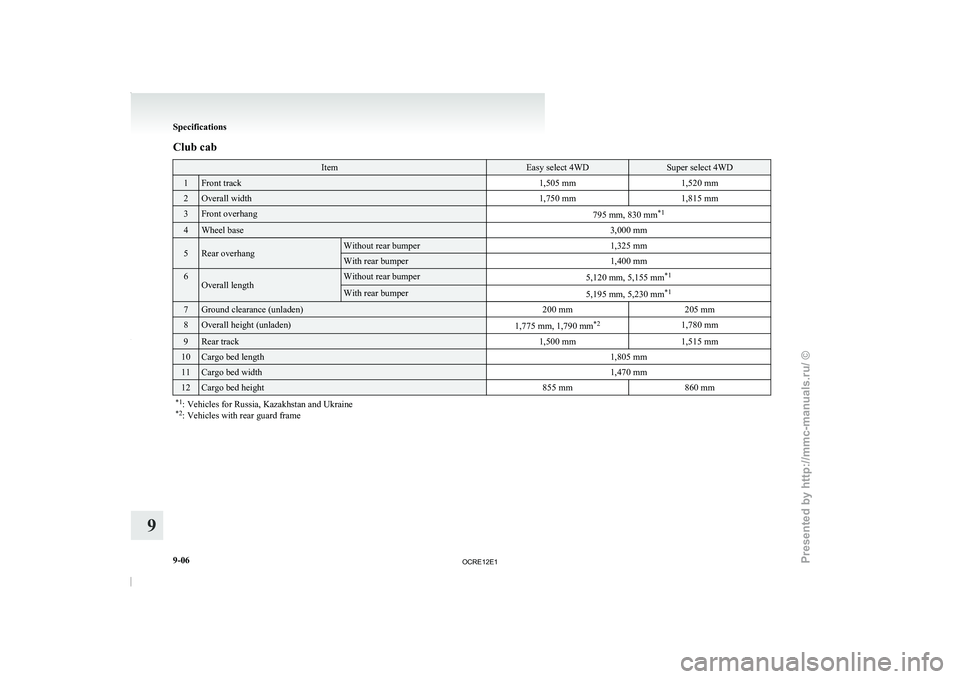
Club cab
Item Easy select 4WD Super select 4WD
1 Front track
1,505 mm1,520 mm2 Overall width
1,750 mm1,815 mm3 Front overhang
795 mm, 830 mm*14 Wheel base
3,000 mm5 Rear overhang Without rear bumper
1,325 mmWith rear bumper
1,400 mm6
Overall length Without rear bumper
5,120 mm, 5,155 mm*1 With rear bumper
5,195 mm, 5,230 mm*17 Ground clearance (unladen)
200 mm205 mm8 Overall height (unladen)
1,775 mm, 1,790 mm*2
1,780 mm9 Rear track
1,500 mm1,515 mm10 Cargo bed length
1,805 mm11 Cargo bed width
1,470 mm12 Cargo bed height
855 mm860 mm
*1 : Vehicles for Russia, Kazakhstan and Ukraine
*2 : Vehicles with rear guard frame Specifications
9-06
9
OCRE12E1
Presented by http://mmc-manuals.ru/ \251
Page 339 of 369
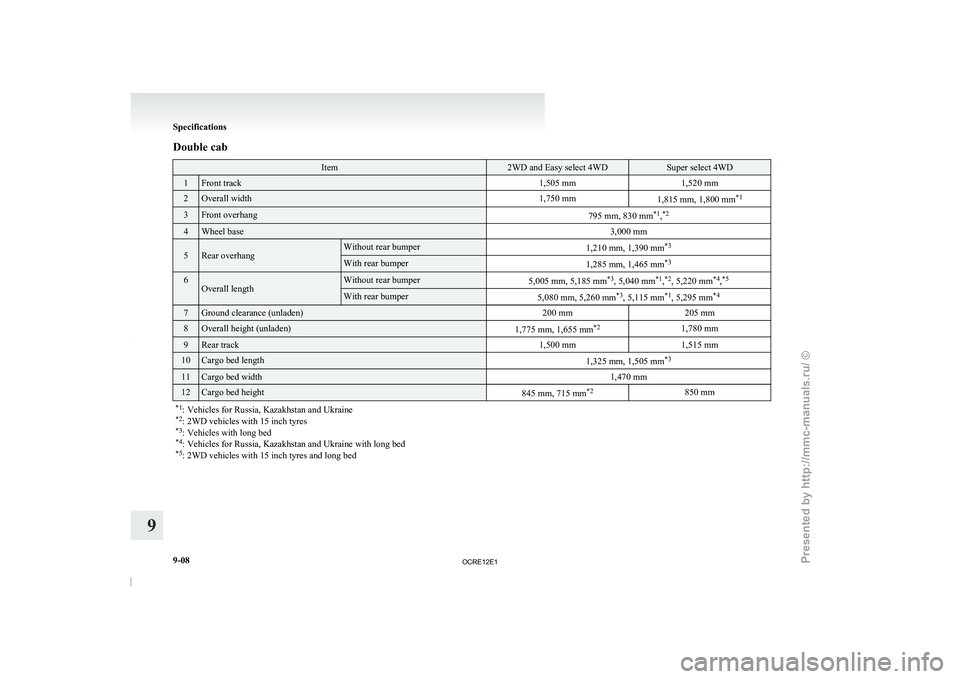
Double cab
Item 2WD and Easy select 4WD Super select 4WD
1 Front track
1,505 mm1,520 mm2 Overall width
1,750 mm
1,815 mm, 1,800 mm*13 Front overhang
795 mm, 830 mm*1
,*2 4 Wheel base
3,000 mm5 Rear overhang Without rear bumper
1,210 mm, 1,390 mm*3 With rear bumper
1,285 mm, 1,465 mm*36
Overall length Without rear bumper
5,005 mm, 5,185 mm*3
, 5,040 mm *1
,*2
, 5,220 mm *4
,*5 With rear bumper
5,080 mm, 5,260 mm*3
, 5,115 mm *1
, 5,295 mm *4 7 Ground clearance (unladen)
200 mm205 mm8 Overall height (unladen)
1,775 mm, 1,655 mm*2
1,780 mm9 Rear track
1,500 mm1,515 mm10 Cargo bed length
1,325 mm, 1,505 mm*311 Cargo bed width
1,470 mm12 Cargo bed height
845 mm, 715 mm*2
850 mm
*1 : Vehicles for Russia, Kazakhstan and Ukraine
*2 : 2WD vehicles with 15 inch tyres
*3 : Vehicles with long bed
*4 : Vehicles for Russia, Kazakhstan and Ukraine with long bed
*5 : 2WD vehicles with 15 inch tyres and long bed Specifications
9-08
9
OCRE12E1
Presented by http://mmc-manuals.ru/ \251