seats MITSUBISHI TRITON 2011 User Guide
[x] Cancel search | Manufacturer: MITSUBISHI, Model Year: 2011, Model line: TRITON, Model: MITSUBISHI TRITON 2011Pages: 369, PDF Size: 26.15 MB
Page 51 of 369
When the lever or pedal is used, the seatback will
tilt forward and at the
same time the entire seat will
move forward. To return the seat, slide the entire
seat rearward and then raise the seatback rearward
to lock the seat in position. WARNING
l Do not drive the vehicle with the seatback
folded forward. The seat
is
not retained
position if it is not kept in an upright posi-
tion, so serious injuries could be suffered
in the event of hard braking or a collision. CAUTION
l
The reclining mechanism of the
seatback
is spring loaded, causing it to return to
the vertical position when the lock lever
is operated. When using the lever, sit
close to the seatback or hold it with your
hand.
l Use a foot to operate the pedal (2).
Folding the seatback forward (Single
cab, passenger’s seat)* E00410400031
To access the onboard tool kit, fold forward the seat-
back of the passenger’s seat.
Refer to “Tools, jack and
jack handle” on page
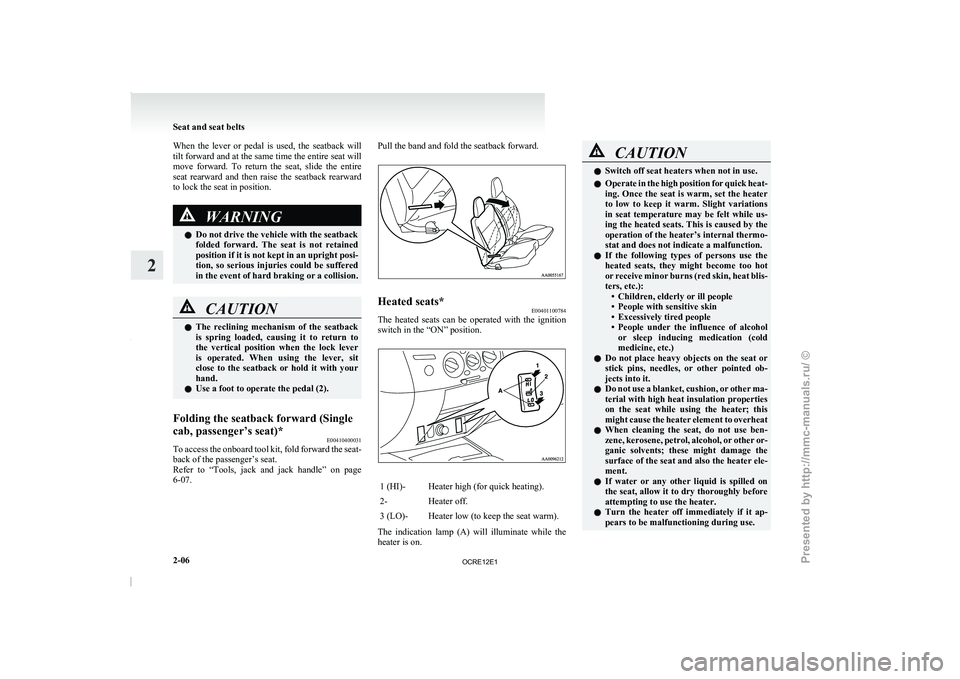
6-07. Pull the band and fold the seatback forward.
Heated seats*
E00401100784
The heated seats can be operated with the ignition
switch in the “ON” position. 1 (HI)- Heater high (for quick heating).
2- Heater off.
3 (LO)- Heater low (to keep the seat warm).
The indication lamp (A) will illuminate while the
heater is on. CAUTION
l
Switch off seat heaters when not in use.
l Operate in the high position
for quick heat-
ing. Once the seat is warm, set the heater
to low to keep it warm. Slight variations
in seat temperature may be felt while us-
ing the heated seats. This is caused by the
operation of the heater’s internal thermo-
stat and does not indicate a malfunction.
l If the following types of persons use the
heated seats, they might become too hot
or receive minor burns (red skin, heat blis-
ters, etc.):
• Children, elderly or ill people
• People with sensitive skin
• Excessively tired people
• People under the influence of alcoholor sleep inducing medication (cold
medicine, etc.)
l Do not place heavy objects on the seat or
stick pins, needles, or other pointed ob-
jects into it.
l Do not use a blanket, cushion, or other ma-
terial with high heat insulation properties
on the seat while using the heater; this
might cause the heater element to overheat
l When cleaning the seat, do not use ben-
zene, kerosene, petrol, alcohol, or other or-
ganic solvents; these might damage the
surface of the seat and also the heater ele-
ment.
l If water or any other liquid is spilled on
the seat, allow it to dry thoroughly before
attempting to use the heater.
l Turn the heater off immediately if it ap-
pears to be malfunctioning during use. Seat and seat belts
2-06
2
OCRE12E1
Presented by http://mmc-manuals.ru/ \251
Page 54 of 369
CAUTION
l
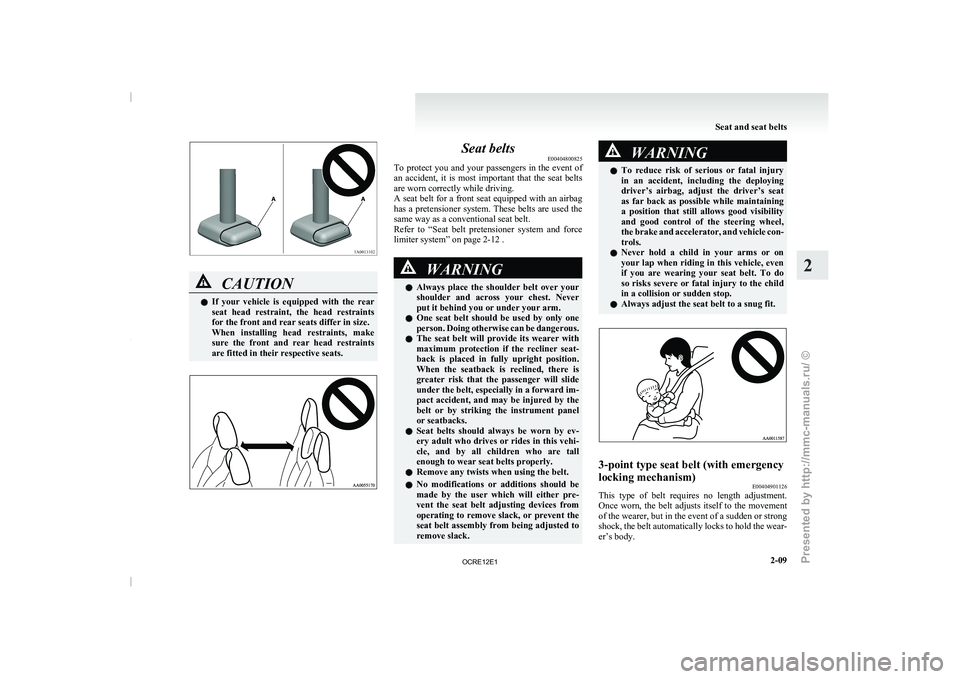
If your vehicle is
equipped with the rear
seat head restraint, the head restraints
for the front and rear seats differ in size.
When installing head restraints, make
sure the front and rear head restraints
are fitted in their respective seats. Seat belts
E00404800825
To protect you and your
passengers in the event of
an accident, it is most important that the seat belts
are worn correctly while driving.
A seat belt for a front seat equipped with an airbag
has a pretensioner system. These belts are used the
same way as a conventional seat belt.
Refer to “Seat belt pretensioner system and force
limiter system” on page 2-12 . WARNING
l Always place the shoulder
belt
over your
shoulder and across your chest. Never
put it behind you or under your arm.
l One seat belt should be used by only one
person. Doing otherwise can be dangerous.
l The seat belt will provide its wearer with
maximum protection if the recliner seat-
back is placed in fully upright position.
When the seatback is reclined, there is
greater risk that the passenger will slide
under the belt, especially in a forward im-
pact accident, and may be injured by the
belt or by striking the instrument panel
or seatbacks.
l Seat belts should always be worn by ev-
ery adult who drives or rides in this vehi-
cle, and by all children who are tall
enough to wear seat belts properly.
l Remove any twists when using the belt.
l No modifications or additions should be
made by the user which will either pre-
vent the seat belt adjusting devices from
operating to remove slack, or prevent the
seat belt assembly from being adjusted to
remove slack. WARNING
l To reduce risk of serious
or fatal injury
in an accident, including the deploying
driver’s airbag, adjust the driver’s seat
as far back as possible while maintaining
a position that still allows good visibility
and good control of the steering wheel,
the brake and accelerator, and vehicle con-
trols.
l Never hold a child in your arms or on
your lap when riding in this vehicle, even
if you are wearing your seat belt. To do
so risks severe or fatal injury to the child
in a collision or sudden stop.
l Always adjust the seat belt to a snug fit. 3-point type seat belt (with emergency
locking mechanism)
E00404901126
This type of belt requires no length adjustment.
Once worn, the belt adjusts
itself to the movement
of the wearer, but in the event of a sudden or strong
shock, the belt automatically locks to hold the wear-
er’s body. Seat and seat belts
2-09 2
OCRE12E1
Presented by http://mmc-manuals.ru/ \251
Page 56 of 369
WARNING
l In order to reduce the risk of serious or fa-
tal injury in an accident, always wear
your own seat belt. Do not allow anyone
to ride in your vehicle unless he or she is
also seated and wearing a seat belt. Chil-
dren should additionally be restrained in
a secure child restraint system.
NOTE l When
luggage is placed on
the front passen-
ger seat, a sensor in the seat cushion may, de-
pending on the weight and position of the lug-
gage, cause the warning tone to sound and
the warning lamp to come on (Double cab).
Adjustable seat belt anchor (front
seats)* E00405000299
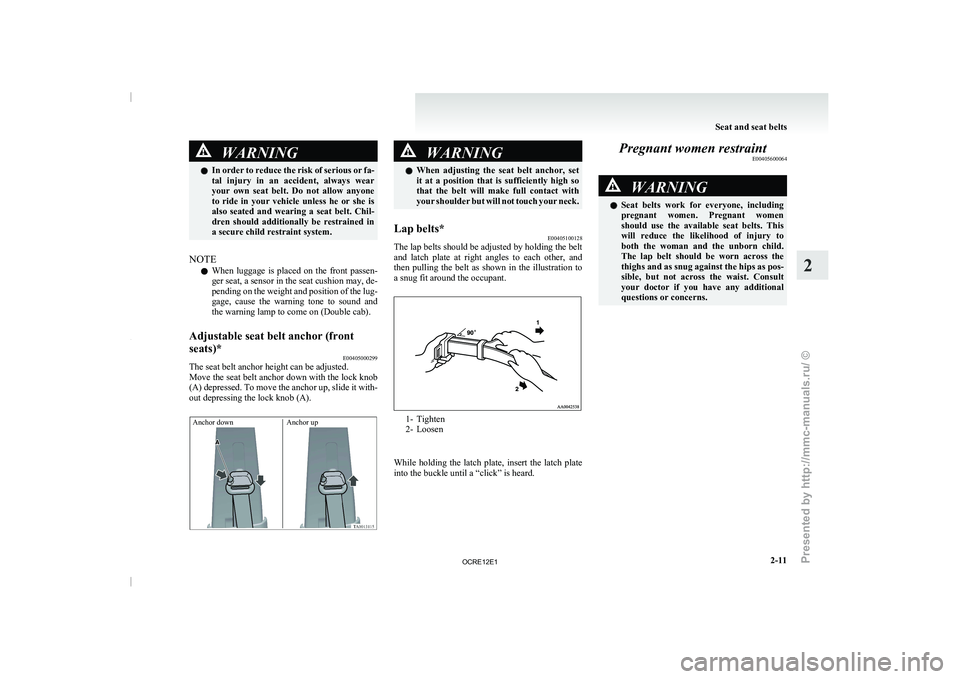
The seat belt anchor height can be adjusted.
Move the seat belt anchor
down with the lock knob
(A) depressed. To move the anchor up, slide it with-
out depressing the lock knob (A).
Anchor down Anchor up WARNING
l When adjusting the seat belt
anchor, set
it at a position that is sufficiently high so
that the belt will make full contact with
your shoulder but will not touch your neck.
Lap belts* E00405100128
The lap belts should be adjusted by holding the belt
and latch plate
at right
angles to each other, and
then pulling the belt as shown in the illustration to
a snug fit around the occupant. 1- Tighten
2- Loosen
While holding the latch
plate, insert the latch plate
into the buckle until a “click” is heard. Pregnant women restraint
E00405600064 WARNING
l Seat belts work for
everyone,
including
pregnant women. Pregnant women
should use the available seat belts. This
will reduce the likelihood of injury to
both the woman and the unborn child.
The lap belt should be worn across the
thighs and as snug against the hips as pos-
sible, but not across the waist. Consult
your doctor if you have any additional
questions or concerns. Seat and seat belts
2-11 2
OCRE12E1
Presented by http://mmc-manuals.ru/ \251
Page 70 of 369
Installing a child restraint system to
the lower anchorage (ISOFIX child re-
straint mountings)*
E00408900114
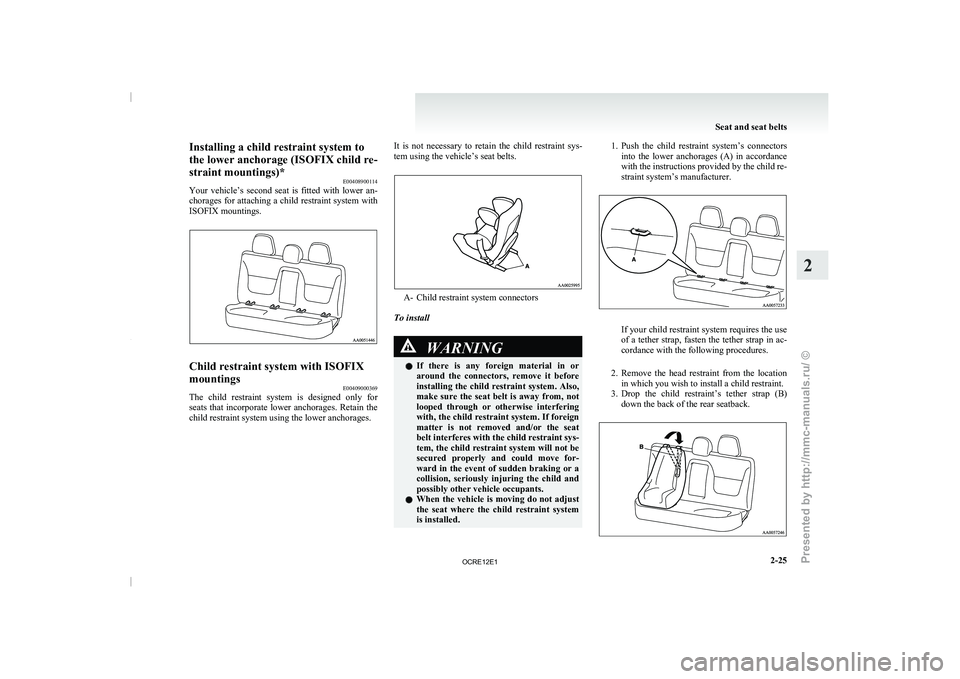
Your vehicle’s second seat is
fitted with lower an-
chorages for attaching a child restraint system with
ISOFIX mountings. Child restraint system with ISOFIX
mountings
E00409000369
The child restraint system is designed only for
seats that incorporate lower anchorages.
Retain the
child restraint system using the lower anchorages. It is not necessary to retain the child restraint sys-
tem using the vehicle’s seat belts. A- Child restraint system connectors
To install WARNING
l If there is any
foreign
material in or
around the connectors, remove it before
installing the child restraint system. Also,
make sure the seat belt is away from, not
looped through or otherwise interfering
with, the child restraint system. If foreign
matter is not removed and/or the seat
belt interferes with the child restraint sys-
tem, the child restraint system will not be
secured properly and could move for-
ward in the event of sudden braking or a
collision, seriously injuring the child and
possibly other vehicle occupants.
l When the vehicle is moving do not adjust
the seat where the child restraint system
is installed. 1. Push the child restraint system’s connectors
into the lower anchorages
(A) in accordance
with the instructions provided by the child re-
straint system’s manufacturer. If your child restraint system requires the use
of a tether strap,
fasten
the tether strap in ac-
cordance with the following procedures.
2. Remove the head restraint from the location in which you wish to install a child restraint.
3. Drop the child restraint’s tether strap (B) down the back of the rear seatback. Seat and seat belts
2-25 2
OCRE12E1
Presented by http://mmc-manuals.ru/ \251
Page 82 of 369
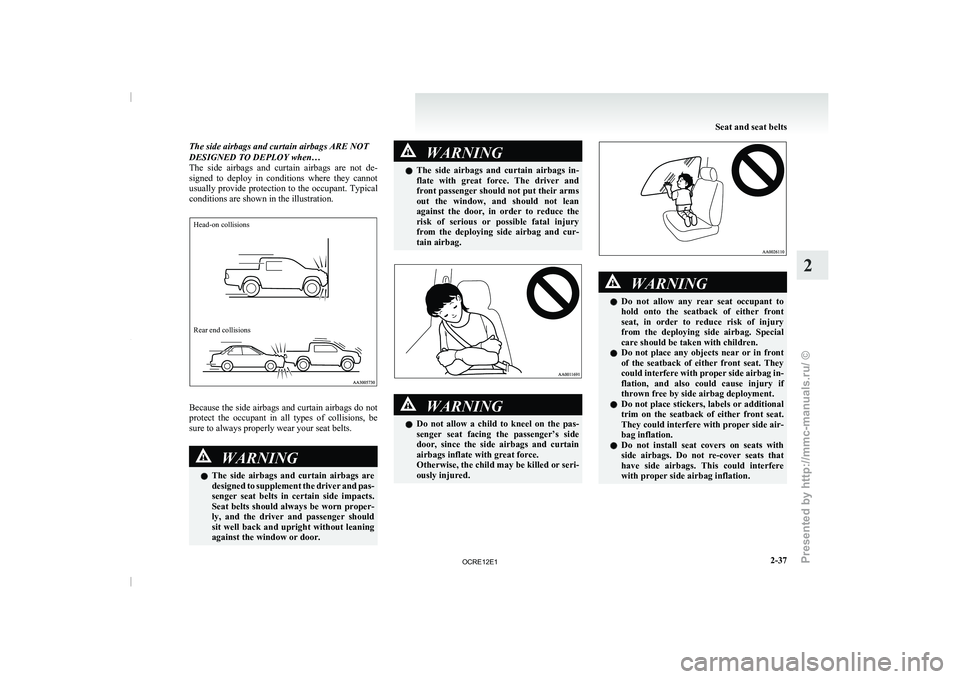
The side airbags and curtain airbags ARE NOT
DESIGNED TO DEPLOY when…
The side airbags and curtain
airbags are not de-
signed to deploy in conditions where they cannot
usually provide protection to the occupant. Typical
conditions are shown in the illustration.
Head-on collisions
Rear end collisions Because the side airbags and curtain airbags do not
protect the occupant in
all
types of collisions, be
sure to always properly wear your seat belts. WARNING
l The side airbags and
curtain
airbags are
designed to supplement the driver and pas-
senger seat belts in certain side impacts.
Seat belts should always be worn proper-
ly, and the driver and passenger should
sit well back and upright without leaning
against the window or door. WARNING
l The side airbags and curtain
airbags in-
flate with great force. The driver and
front passenger should not put their arms
out the window, and should not lean
against the door, in order to reduce the
risk of serious or possible fatal injury
from the deploying side airbag and cur-
tain airbag. WARNING
l Do not allow a
child
to kneel on the pas-
senger seat facing the passenger’s side
door, since the side airbags and curtain
airbags inflate with great force.
Otherwise, the child may be killed or seri-
ously injured. WARNING
l Do not allow any
rear
seat occupant to
hold onto the seatback of either front
seat, in order to reduce risk of injury
from the deploying side airbag. Special
care should be taken with children.
l Do not place any objects near or in front
of the seatback of either front seat. They
could interfere with proper side airbag in-
flation, and also could cause injury if
thrown free by side airbag deployment.
l Do not place stickers, labels or additional
trim on the seatback of either front seat.
They could interfere with proper side air-
bag inflation.
l Do not install seat covers on seats with
side airbags. Do not re-cover seats that
have side airbags. This could interfere
with proper side airbag inflation. Seat and seat belts
2-37 2
OCRE12E1
Presented by http://mmc-manuals.ru/ \251
Page 84 of 369
WARNING
• The SRS warning lamp does not illu- minate when you start the vehicle.
• The SRS warning
lamp does not go
out after several seconds.
• The SRS warning lamp illuminates while driving.
SRS servicing E00407901244WARNING
l We recommend any maintenance
per-
formed
on or near the components of the
SRS to be performed by a MITSUBISHI
MOTORS Authorized Service Point.
Improper work on the SRS components
or wiring could result in inadvertent de-
ployment of the airbags, or could render
the SRS inoperative; either situation
could result in serious injury.
l Do not modify your steering wheel, seat
belt retractor or any other SRS compo-
nents. For example, replacement of the
steering wheel, or modifications to the
front bumper or body structure can ad-
versely affect SRS performance and lead
to possible injury.
l If your vehicle has sustained any damage,
we recommend you to have the SRS in-
spected to ensure it is in proper working
order. WARNING
l On vehicles equipped with side
airbags,
do not modify your front seats, centre pil-
lar and centre console.
It can adversely affect SRS performance
and lead to possible injury.
Also, if you have found any tear or open
seam in the seat fabric at the portion near
the side airbag, we recommend you to
have the seat inspected.
l On vehicles with the curtain airbags, if
you have found any scratch, crack or dam-
age to the portion of the front and rear pil-
lars and roof side rail, we recommend
you to have the SRS inspected by a
MITSUBISHI MOTORS Authorized
Service Point.
NOTE l When
you transfer ownership of
the vehicle
to some other person, we urge you to alert
the new owner that it is equipped with the
SRS and refer the new owner to the applica-
ble section in this owner’s manual.
l If you junk or scrap the vehicle, we urge you
to first take the vehicle to a MITSUBISHI
MOTORS Authorized Service Point so that
the SRS can be rendered safe. Seat and seat belts
2-39 2
OCRE12E1
Presented by http://mmc-manuals.ru/ \251
Page 261 of 369
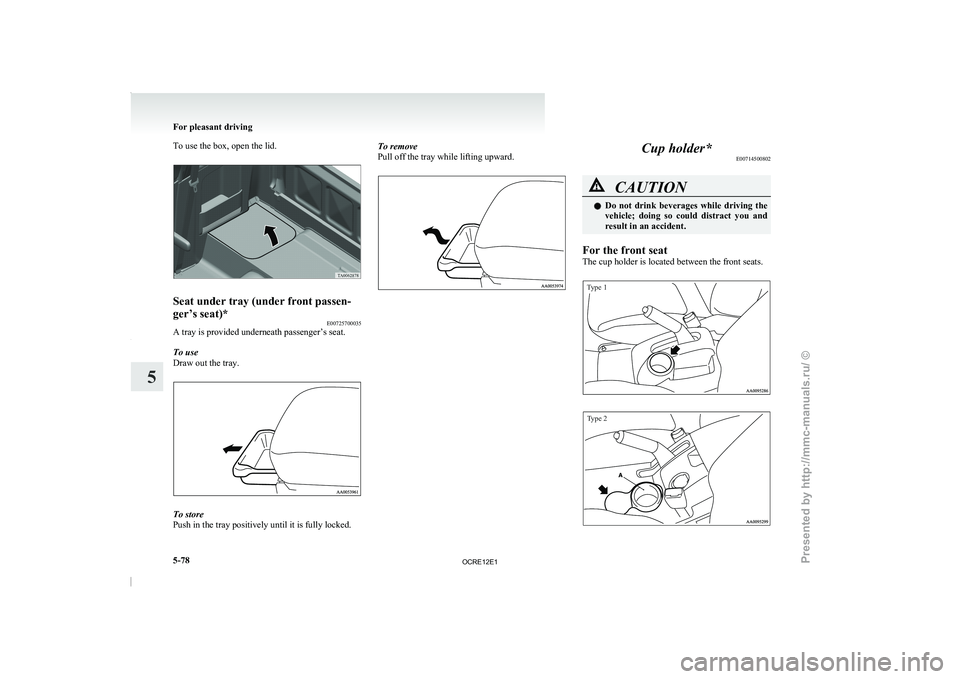
To use the box, open the lid.
Seat under tray (under front passen-
ger’s seat)*
E00725700035
A tray is provided underneath passenger’s seat.
To use
Draw out the tray. To store
Push in the tray positively until it is fully locked. To remove
Pull off the tray while lifting upward. Cup holder*
E00714500802 CAUTION
l
Do not drink beverages
while driving the
vehicle; doing so could distract you and
result in an accident.
For the front seat
The cup holder is located between the front seats.
Type 1
Type 2 For pleasant driving
5-78
5
OCRE12E1
Presented by http://mmc-manuals.ru/ \251
Page 284 of 369
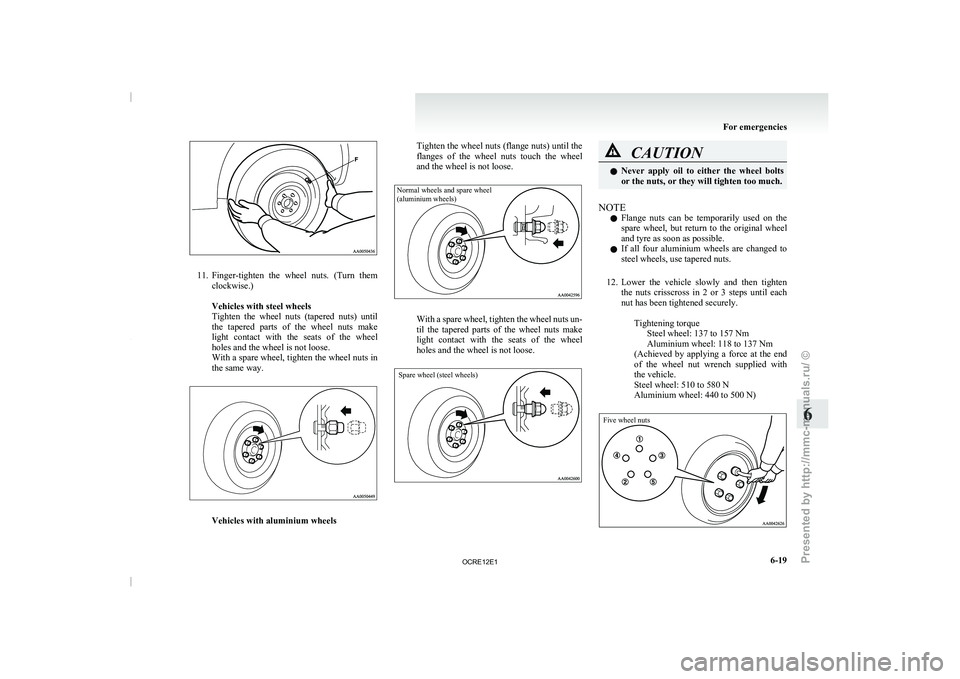
11. Finger-tighten the wheel nuts.
(Turn them
clockwise.)
Vehicles with steel wheels
Tighten the wheel nuts (tapered nuts) until
the tapered parts of the wheel nuts make
light contact with the seats of the wheel
holes and the wheel is not loose.
With a spare wheel, tighten the wheel nuts in
the same way. Vehicles with aluminium wheels Tighten the wheel nuts (flange nuts) until the
flanges of the wheel nuts
touch the wheel
and the wheel is not loose.
Normal wheels and spare wheel
(aluminium wheels) With a spare wheel, tighten the wheel nuts un-
til the tapered parts
of
the wheel nuts make
light contact with the seats of the wheel
holes and the wheel is not loose.
Spare wheel (steel wheels) CAUTION
l
Never apply oil to either
the wheel bolts
or the nuts, or they will tighten too much.
NOTE l Flange
nuts can be temporarily
used on the
spare wheel, but return to the original wheel
and tyre as soon as possible.
l If all four aluminium wheels are changed to
steel wheels, use tapered nuts.
12. Lower the vehicle slowly and then tighten the nuts crisscross in 2 or 3 steps until each
nut has been tightened securely.
Tightening torqueSteel wheel: 137 to 157 Nm
Aluminium wheel: 118 to 137 Nm
(Achieved by applying a force at the end
of the wheel nut wrench supplied with
the vehicle.
Steel wheel: 510 to 580 N
Aluminium wheel: 440 to 500 N)
Five wheel nuts For emergencies
6-19 6
OCRE12E1
Presented by http://mmc-manuals.ru/ \251
Page 293 of 369
Vehicle care precautions
E00900100870
In order to maintain the
value of your vehicle, it is
necessary to perform regular maintenance using the
proper procedures. Always maintain your vehicle
in compliance with environmental pollution control
regulations. Carefully select the materials used for
washing, etc., to be sure that they do not contain cor-
rosives. If in doubt, we recommend you to consult
a specialist for selection of these materials. CAUTION
l
Cleaning products can be
dangerous.
Some
are poisonous. Others can burst in-
to flame if you strike a match or drop
them on a hot part of the vehicle. Some
are dangerous if you breathe their fumes
in a closed space. When you use anything
in a container to clean your vehicle, al-
ways follow the instructions and always
open your vehicle doors or windows when
you’re cleaning the inside. Never use the
following to clean your vehicle: • Petrol
• Paint Thinner
• Benzine
• Kerosene
• Turpentine
• Naphtha
• Lacquer Thinner
• Carbon Tetrachloride
• Nail Polish Remover
• Acetone
l These are all dangerous, and can damage
your vehicle. Cleaning the interior of your
vehicle E00900200288
After cleaning the interior of
your vehicle with wa-
ter, cleaner or similar, wipe and dry in a shady, well-
ventilated area. CAUTION
l
Do not use organic
substances
(solvents,
benzine, kerosene, alcohol, petrol, etc.) or
alkaline or acidic solutions.
These chemicals can cause discolouring,
staining or cracking of the surface.
If you use cleaners or polishing agents,
make sure their ingredients do not in-
clude the substances mentioned above.
NOTE l Always
read the instructions on
the cleaner la-
bel.
Plastic, vinyl leather, fabric and
flocked parts E00900300377
1. Gently wipe off with gauze or other soft
cloth soaked with a
3 % aqueous solution of
neutral detergent.
2. Dip cloth in fresh water and wring out well. Using this cloth, wipe off the detergent thor-
oughly. NOTE
l Do
not use cleaners, conditioners,
and protec-
tants containing silicons or wax.
Such products, when applied to the instru-
ment panels or other parts, may cause reflec-
tions on the windscreen and obscure vision.
Also, if such products get on the switches of
the electrical accessories, it may lead to fail-
ure of these accessories.
Upholstery E00900500018
1. To maintain the value of your new vehicle,
handle the upholstery carefully
and keep the
interior clean.
Use a vacuum cleaner and brush to clean the
seats. If stained, vinyl and synthetic leather
should be cleaned with an appropriate clean-
er, and cloth fabrics can be cleaned with ei-
ther upholstery cleaner or a 3 % solution of
neutral detergent in lukewarm water.
2. Clean the carpeting with a vacuum cleaner and remove any stains with carpet cleaner.
Oil and grease can be removed by lightly dab-
bing with a clean colourfast cloth and stain re-
mover.
Genuine leather* E00900600817
1. Gently wipe off with gauze or other soft
cloth soaked with a
5 % aqueous solution of
neutral detergent.
2. Dip cloth in fresh water and wring it out well. Using this cloth, wipe off the detergent
thoroughly.
3. Apply leather protecting agent to the genuine leather surface. Vehicle care
7-02
7
OCRE12E1
Presented by http://mmc-manuals.ru/ \251
Page 357 of 369
E
Easy select 4WD 4-26
Economical driving 4-02
Electric window control 1-08 Switch 1-08
Electrical system 9-17 Electronic immobilizer (Anti-theft starting sys-
tem) 1-03
Emergency starting 6-02
Engine specifications
9-15
Engine Coolant 8-06,9-22
Number 9-02
Oil 8-04,9-22
Overheating 6-04
Specifications 9-15
Used engine oils safety instructions and disposal
information 05
Water temperature gauge 3-05
Error codes 5-42
Exterior and interior lamp operation 8-18
FFirst-aid kit and warning triangle band for secur-
ing 5-80
Floor console box 5-76
Fluid
Automatic transmission fluid 8-07,9-22Brake fluid 8-08,9-22
Clutch fluid 8-09,9-22
Engine coolant 8-06,9-22
Power steering fluid 8-09,9-22
Washer fluid 8-08,9-22
For cold and snowy weather 8-19
Front console box 5-76
Front fog lamps Bulb capacity 8-24
Indication lamp
3-07
Replacement
8-28
Switch 3-34
Front room lamp Bulb capacity 8-25
Replacement 8-32
Front seat 2-03
Front turn-signal lamps Bulb capacity
8-24
Replacement 8-27
Fuel consumption 9-20
Fuel Filling the fuel tank 02
Fuel filter indication lamp 3-07
Fuel gauge 3-04
Fuel selection 02
Low fuel warning lamp 3-04
Modification/alterations to the electrical or fuel
systems 04
Tank capacity 02
Fuses 8-20
Fusible links 8-19
G Gauges 3-02
General maintenance 8-18
General vehicle data 9-03
Genuine parts 05
Glove box 5-76
Glove box lamp
Bulb capacity 8-24
Replacement 8-34
H Handling of compact discs 5-48
Hazard warning flasher switch 3-34Hazard warning indication lamps 3-07
Head restraints 2-08
Headlamp levelling switch 3-32
Headlamps
Bulb capacity 8-24
Headlamp flasher 3-31
Replacement 8-25
Switch 3-30
Washer switch 3-39
Heated mirror 4-11
Heated seats 2-06
Heater 5-03
High-mounted stop lamp Bulb capacity 8-24
Replacement
8-31
Hinges and latches lubrication 8-19
Hooks Coat hook 5-80
Convenient hook 5-80
Horn switch 3-40
I If the vehicle breaks down 6-02
Ignition switch 4-11
Indication and warning lamps 3-06
Indication lamps 3-07
Inside rear-view mirror 4-09
Inspection and maintenance following rough road
operation 4-41
Installation of accessories 04
Instruments 3-02
Interior lamps 5-73
J Jack handle 6-12
Storage 6-07
Jacking up the vehicle 6-13 Alphabetical index
2
OCRE12E1
Presented by http://mmc-manuals.ru/ \251