airbag MITSUBISHI TRITON 2011 Owner's Manual
[x] Cancel search | Manufacturer: MITSUBISHI, Model Year: 2011, Model line: TRITON, Model: MITSUBISHI TRITON 2011Pages: 369, PDF Size: 26.15 MB
Page 74 of 369
WARNING
l A FORWARD FACING CHILD RE-
STRAINT should not be used in the front
passenger seat whenever possible; if used
in the front passenger seat, adjust the
seat to the most rearward position. Fail-
ure to do so could kill or cause serious in-
juries to the child. WARNING
l Older children should be
seated,
properly
wearing the seat belt, with an appropri-
ate booster seat if needed. Caution for installing the child re-
straint on vehicles with a front passen-
ger airbag
E00408800272
The label shown here is
attached on vehicles with a
front passenger airbag. WARNING
l Extreme Hazard!
Do not use a
rearward
facing child re-
straint on a seat protected by an airbag in
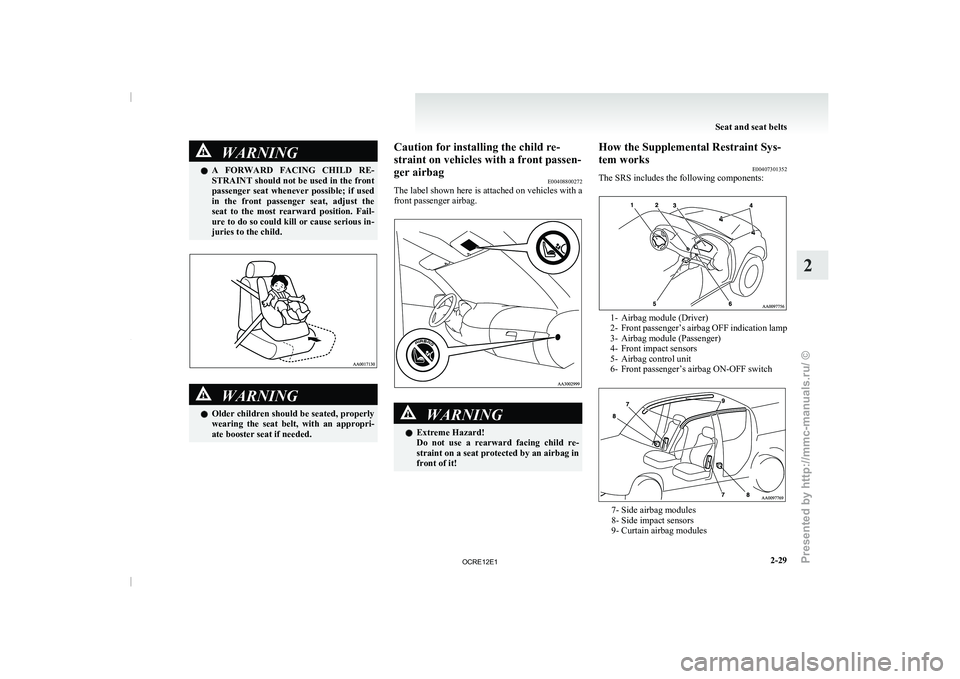
front of it! How the Supplemental Restraint Sys-
tem works
E00407301352
The SRS includes the following components: 1- Airbag module (Driver)
2- Front passenger’s airbag OFF
indication
lamp
3- Airbag module (Passenger)
4- Front impact sensors
5- Airbag control unit
6- Front passenger’s airbag ON-OFF switch 7- Side airbag modules
8- Side impact sensors
9- Curtain airbag modules Seat and seat belts
2-29 2
OCRE12E1
Presented by http://mmc-manuals.ru/ \251
Page 75 of 369
The airbags will operate only when the ignition
switch is in the “ON” or “START” position.
When the airbag control unit
detect an impact of suf-
ficient frontal or side force, it sends an ignition sig-
nal to the airbag modules to ignite materials in the
inflator and generate gas and inflate the airbags.
The airbags deployment produces a sudden, loud
noise, and releases some smoke and powder, but
these conditions are not injurious, and do not indi-
cate a fire in the vehicle. People with respiratory
problems may feel some temporary irritation from
chemicals used to produce the deployment; open
the windows after airbag deployment, if safe to do
so.
The airbags deflate very rapidly after deployment,
so there is little danger of obscured vision.
The time required from the sensors detecting an im-
pact to deflation of the airbags after deployment is
shorter than a blink of an eye. CAUTION
l
Airbags inflate at an
extremely
rapid
speed. In certain situations, contact with
inflating airbags can result in abrasions,
light cuts, bruises, and the like.
Front passenger’s airbag ON-OFF
switch E00410100184
The front passenger’s airbag ON-OFF switch can
be used to
disable the
front passenger’s airbag. If
you have a rearward facing child restraint system
that cannot be fitted to any seat other than the front
passenger seat, be sure to turn OFF the front passen-
ger’s airbag ON-OFF switch before using it. (Refer
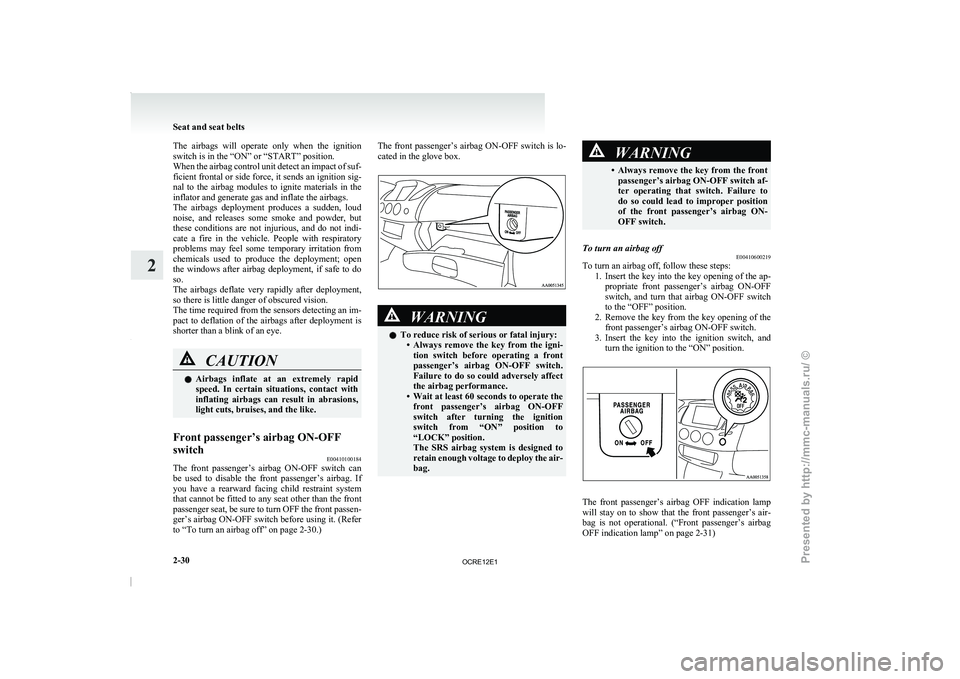
to “To turn an airbag off” on page 2-30.) The front passenger’s airbag ON-OFF switch is lo-
cated in the glove box.
WARNING
l To reduce risk of serious or fatal injury:
• Always remove the key from
the igni-
tion switch before operating a front
passenger’s airbag ON-OFF switch.
Failure to do so could adversely affect
the airbag performance.
• Wait at least 60 seconds to operate the front passenger’s airbag ON-OFF
switch after turning the ignition
switch from “ON” position to
“LOCK” position.
The SRS airbag system is designed to
retain enough voltage to deploy the air-
bag. WARNING
• Always remove the key from the front passenger’s airbag ON-OFF switch af-
ter operating that switch.
Failure to
do so could lead to improper position
of the front passenger’s airbag ON-
OFF switch.
To turn an airbag off E00410600219
To turn an airbag off, follow these steps:
1. Insert the key into the
key opening of the ap-
propriate front passenger’s airbag ON-OFF
switch, and turn that airbag ON-OFF switch
to the “OFF” position.
2. Remove the key from the key opening of the front passenger’s airbag ON-OFF switch.
3. Insert the key into the ignition switch, and turn the ignition to the “ON” position. The front passenger’s airbag OFF indication lamp
will stay on to
show
that the front passenger’s air-
bag is not operational. (“Front passenger’s airbag
OFF indication lamp” on page 2-31) Seat and seat belts
2-30
2
OCRE12E1
Presented by http://mmc-manuals.ru/ \251
Page 76 of 369
That airbag will remain OFF, and will NOT de-
ploy, until it is turned ON again.
WARNING
l To reduce risk of serious or fatal injury:
• If the indication lamp does
not come
on when the front passenger’s airbag
ON-OFF switch is turned OFF, do not
fit a rearward facing child restraint
system to the front passenger seat.
• Do not turn OFF the front passen- ger’s airbag ON-OFF switch except
when a rearward facing child re-
straint system is fitted to the front pas-
senger seat.
To turn an airbag on E00410700106
To turn an airbag on, follow these steps:
1. Insert the key
into the
key opening of the ap-
propriate front passenger’s airbag ON-OFF
switch, and turn that airbag ON-OFF switch
to “ON” position.
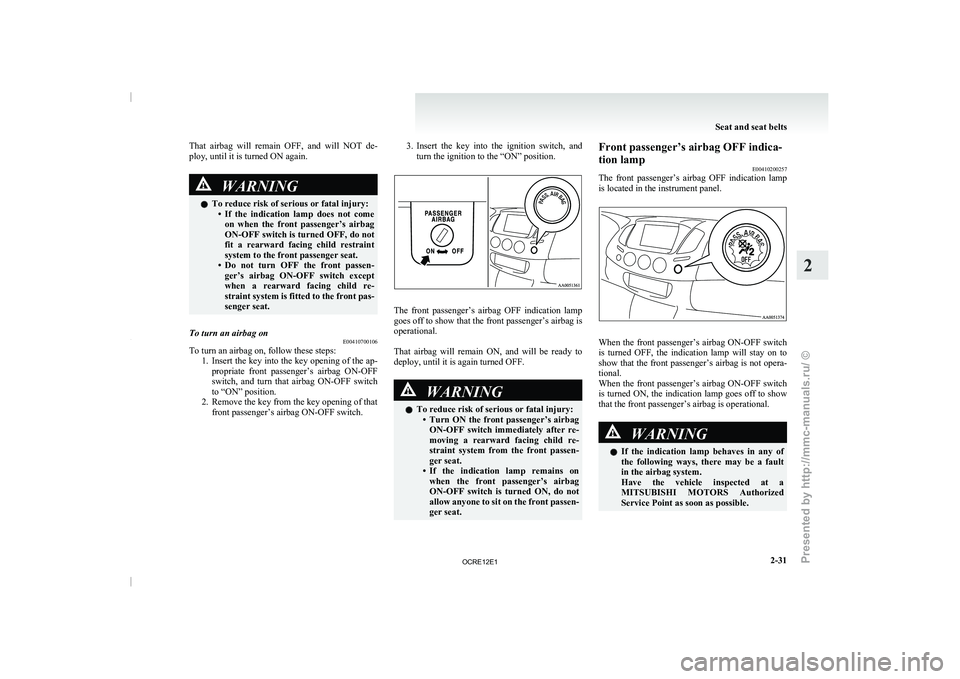
2. Remove the key from the key opening of that front passenger’s airbag ON-OFF switch. 3. Insert the key into the ignition switch, and
turn the ignition to the “ON” position. The front passenger’s airbag OFF indication lamp
goes off to show
that
the front passenger’s airbag is
operational.
That airbag will remain ON, and will be ready to
deploy, until it is again turned OFF. WARNING
l To reduce risk of serious or fatal injury:
• Turn ON
the front
passenger’s
airbag
ON-OFF switch immediately after re-
moving a rearward facing child re-
straint system from the front passen-
ger seat.
• If the indication lamp remains on when the front passenger’s airbag
ON-OFF switch is turned ON, do not
allow anyone to sit on the front passen-
ger seat. Front passenger’s airbag OFF indica-
tion lamp
E00410200257
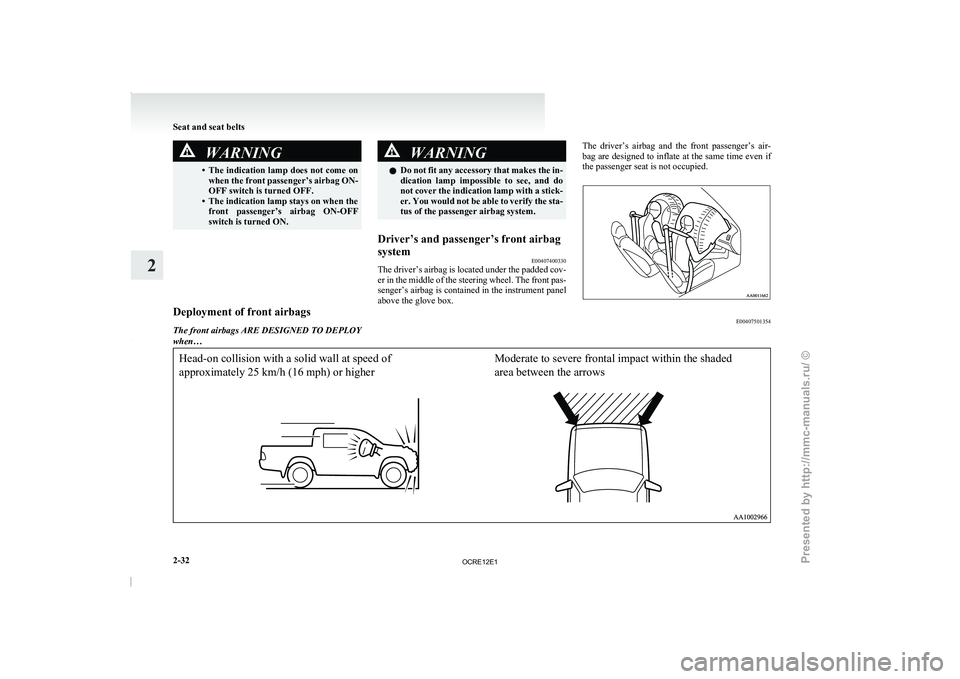
The front passenger’s airbag OFF
indication lamp
is located in the instrument panel. When the front passenger’s airbag ON-OFF switch
is turned OFF, the
indication
lamp will stay on to
show that the front passenger’s airbag is not opera-
tional.
When the front passenger’s airbag ON-OFF switch
is turned ON, the indication lamp goes off to show
that the front passenger’s airbag is operational. WARNING
l If
the
indication lamp
behaves
in any of
the following ways, there may be a fault
in the airbag system.
Have the vehicle inspected at a
MITSUBISHI MOTORS Authorized
Service Point as soon as possible. Seat and seat belts
2-31 2
OCRE12E1
Presented by http://mmc-manuals.ru/ \251
Page 77 of 369
WARNING
• The indication lamp does not come on when the front passenger’s
airbag ON-
OFF switch is turned OFF.
• The indication lamp stays on when the front passenger’s airbag ON-OFF
switch is turned ON. WARNING
l Do not fit any accessory that makes the in-
dication lamp impossible to see, and do
not cover the indication lamp with a stick-
er. You would not be able to verify the sta-
tus of the passenger airbag system.
Driver’s and passenger’s front airbag
system E00407400330
The driver’s airbag is located under the padded cov-
er in the
middle of
the steering wheel. The front pas-
senger’s airbag is contained in the instrument panel
above the glove box. The driver’s airbag and the front passenger’s air-
bag
are
designed to
inflate
at the same time even if
the passenger seat is not occupied. Deployment of front airbags
E00407501354
The front airbags ARE DESIGNED TO DEPLOY
when…
Head-on collision with a solid wall at speed of
approximately 25 km/h (16 mph) or higher Moderate to severe frontal impact within the shaded
area between the arrowsSeat and seat belts
2-32
2
OCRE12E1
Presented by http://mmc-manuals.ru/ \251
Page 78 of 369
The front airbags are designed to deploy when the
vehicle suffers a moderate to
severe frontal impact.
A typical condition is shown in the illustration.
The front airbags will deploy if the severity of im-
pact is above the designed threshold level, compa-
rable to an approximately 25 km/h (16 mph) colli-
sion when impacting straight into a solid wall that
does not move or deform. If the severity of the im-
pact is below the above threshold level, the front air-
bags may not deploy. However, this threshold
speed will be considerably higher if the vehicle
strikes an object that absorbs the impact by either
deforming or moving (for example, another station-
ary vehicle, pole or a guard rail).
Because frontal collisions can easily move you out
of position, it is important to always properly wear
your seat belts. Your seat belts will help keep you
in a safe distance from the steering wheel and in-
strument panel during the initial stages of airbag de-
ployment. The initial stage of airbag inflation is the
most forceful, and can possibly cause serious or fa-
tal injuries. Moreover, the seat belts in your vehicle
are your primary means of protection in a collision.
The SRS airbags are designed to provide additional
protection. Therefore, for your safety and the safe-
ty of all occupants, be sure to always properly wear
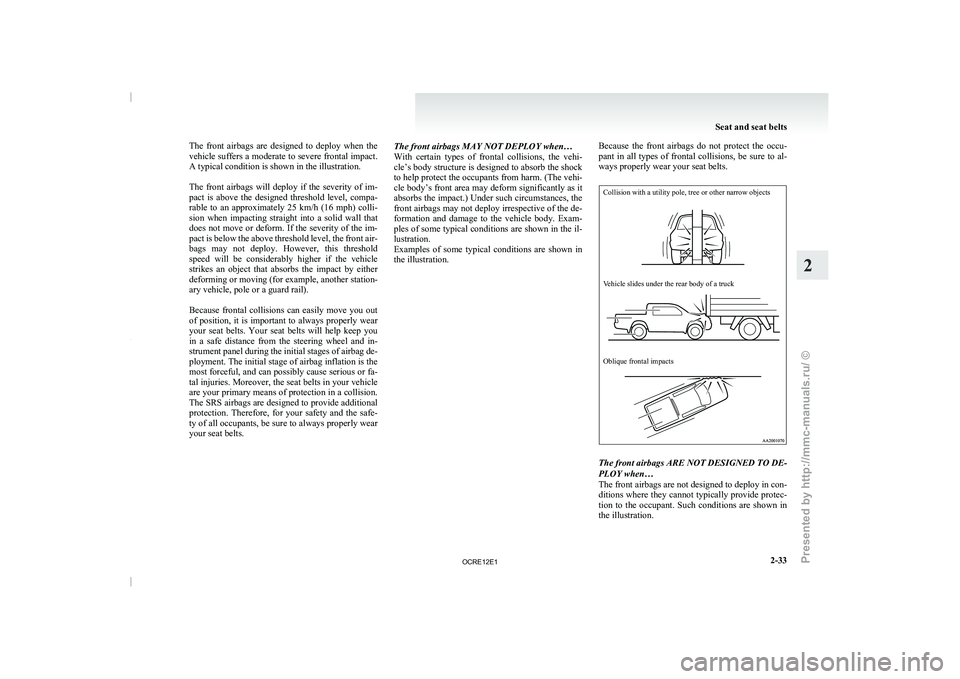
your seat belts. The front airbags MAY NOT DEPLOY when…
With certain types of frontal
collisions, the vehi-
cle’s body structure is designed to absorb the shock
to help protect the occupants from harm. (The vehi-
cle body’s front area may deform significantly as it
absorbs the impact.) Under such circumstances, the
front airbags may not deploy irrespective of the de-
formation and damage to the vehicle body. Exam-
ples of some typical conditions are shown in the il-
lustration.
Examples of some typical conditions are shown in
the illustration.
Because the front airbags do not protect the occu-
pant in all types of
frontal collisions, be sure to al-
ways properly wear your seat belts.
Collision with a utility pole, tree or other narrow objects
Vehicle slides under the rear body of a truck
Oblique frontal impacts The front airbags ARE NOT DESIGNED TO DE-
PLOY when…
The
front
airbags are
not
designed to deploy in con-
ditions where they cannot typically provide protec-
tion to the occupant. Such conditions are shown in
the illustration.
Seat and seat belts
2-33 2
OCRE12E1
Presented by http://mmc-manuals.ru/ \251
Page 79 of 369
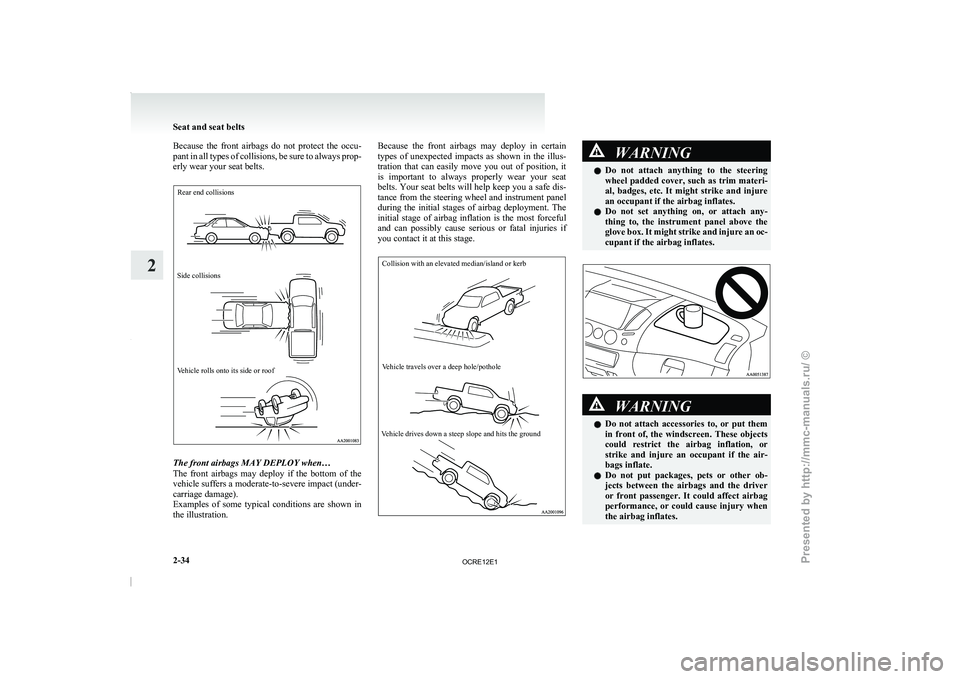
Because the front airbags do not protect the occu-
pant in all types of
collisions, be sure to always prop-
erly wear your seat belts.
Rear end collisions
Side collisions
Vehicle rolls onto its side or roof The front airbags MAY DEPLOY when…
The
front
airbags may
deploy
if the bottom of the
vehicle suffers a moderate-to-severe impact (under-
carriage damage).
Examples of some typical conditions are shown in
the illustration.
Because the front airbags may deploy in certain
types
of
unexpected impacts
as
shown in the illus-
tration that can easily move you out of position, it
is important to always properly wear your seat
belts. Your seat belts will help keep you a safe dis-
tance from the steering wheel and instrument panel
during the initial stages of airbag deployment. The
initial stage of airbag inflation is the most forceful
and can possibly cause serious or fatal injuries if
you contact it at this stage.
Collision with an elevated median/island or kerb
Vehicle travels over a deep hole/pothole
Vehicle drives down a steep slope and hits the ground WARNING
l Do not attach anything to
the steering
wheel padded cover, such as trim materi-
al, badges, etc. It might strike and injure
an occupant if the airbag inflates.
l Do not set anything on, or attach any-
thing to, the instrument panel above the
glove box. It might strike and injure an oc-
cupant if the airbag inflates. WARNING
l Do not attach accessories
to,
or put them
in front of, the windscreen. These objects
could restrict the airbag inflation, or
strike and injure an occupant if the air-
bags inflate.
l Do not put packages, pets or other ob-
jects between the airbags and the driver
or front passenger. It could affect airbag
performance, or could cause injury when
the airbag inflates. Seat and seat belts
2-34
2
OCRE12E1
Presented by http://mmc-manuals.ru/ \251
Page 80 of 369
WARNING
l Right after the airbag inflation, several
airbag system components will be hot. Do
not touch them; you could be burned.
l The airbag system is designed to work on-
ly once. Once the airbags have deployed,
they will not work again. They must
promptly be replaced, and we recom-
mend you to have the entire airbag sys-
tem inspected by a MITSUBISHI
MOTORS Authorized Service Point.
Side airbag system E00407600374
The side airbags (A) are contained in the driver and
front passenger seatbacks.
The side airbag
is designed
to inflate only on the
side of the vehicle that is impacted, even with no
passenger in the front seat. The label shown here is attached to the seatbacks
with a side airbag.
Curtain airbag system
E00409100474
The curtain airbags are contained in the front pil-
lars and roof side rail.
The curtain airbag is de-
signed to inflate only on the side of the vehicle that
is impacted, even with no passenger in the front
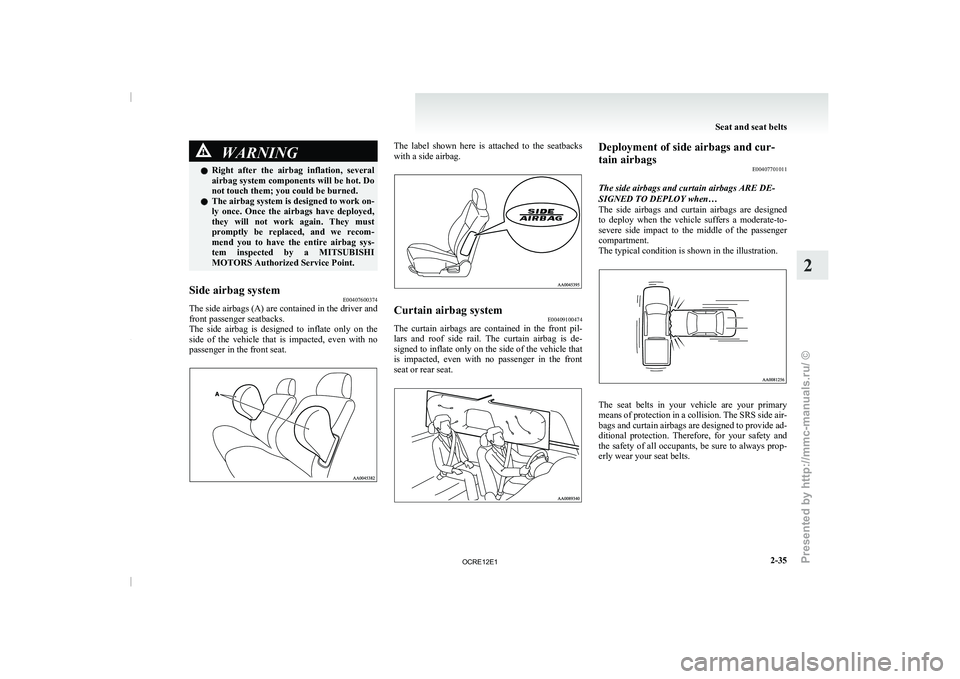
seat or rear seat. Deployment of side airbags and cur-
tain airbags
E00407701011
The side airbags and curtain airbags ARE DE-
SIGNED TO DEPLOY when…
The side airbags and curtain
airbags are designed
to deploy when the vehicle suffers a moderate-to-
severe side impact to the middle of the passenger
compartment.
The typical condition is shown in the illustration. The seat belts in your vehicle are your primary
means of protection in
a
collision. The SRS side air-
bags and curtain airbags are designed to provide ad-
ditional protection. Therefore, for your safety and
the safety of all occupants, be sure to always prop-
erly wear your seat belts. Seat and seat belts
2-35 2
OCRE12E1
Presented by http://mmc-manuals.ru/ \251
Page 81 of 369
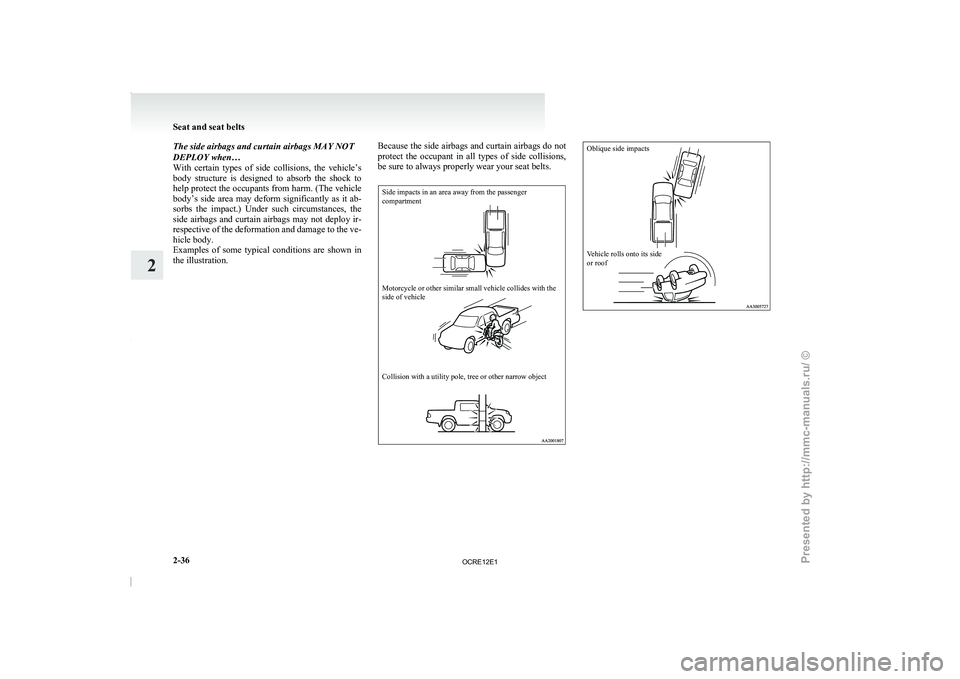
The side airbags and curtain airbags MAY NOT
DEPLOY when…
With certain types of side
collisions, the vehicle’s
body structure is designed to absorb the shock to
help protect the occupants from harm. (The vehicle
body’s side area may deform significantly as it ab-
sorbs the impact.) Under such circumstances, the
side airbags and curtain airbags may not deploy ir-
respective of the deformation and damage to the ve-
hicle body.
Examples of some typical conditions are shown in
the illustration.
Because the side airbags and curtain airbags do not
protect the occupant in all
types of side collisions,
be sure to always properly wear your seat belts.
Side impacts in an area away from the passenger
compartment
Motorcycle or other similar small vehicle collides with the
side of vehicle
Collision with a utility pole, tree or other narrow object
Oblique side impacts
Vehicle rolls onto its side
or roof Seat and seat belts
2-36
2
OCRE12E1
Presented by http://mmc-manuals.ru/ \251
Page 82 of 369
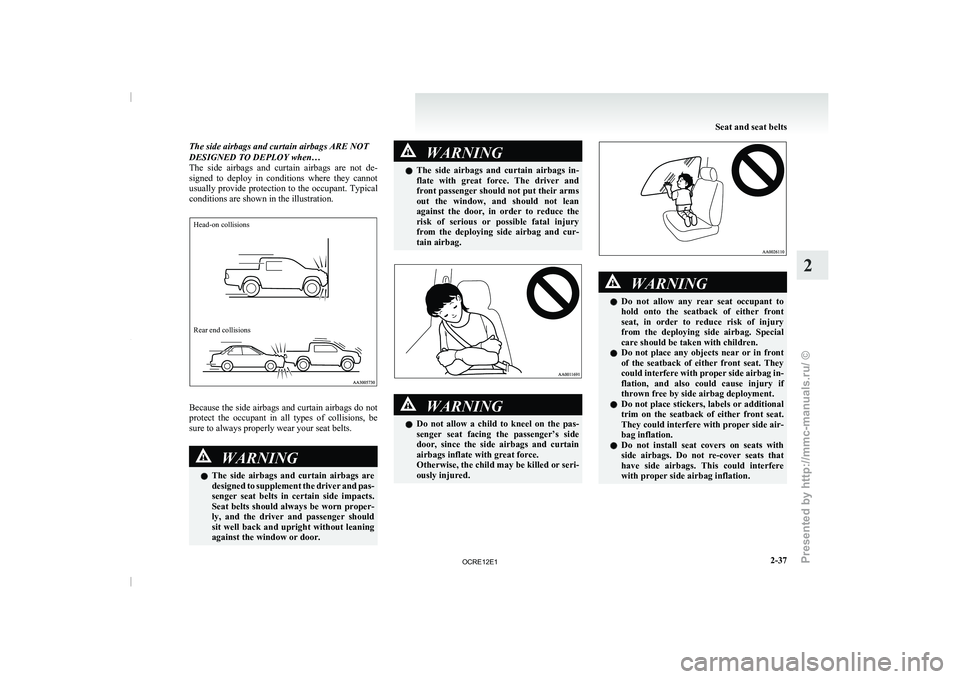
The side airbags and curtain airbags ARE NOT
DESIGNED TO DEPLOY when…
The side airbags and curtain
airbags are not de-
signed to deploy in conditions where they cannot
usually provide protection to the occupant. Typical
conditions are shown in the illustration.
Head-on collisions
Rear end collisions Because the side airbags and curtain airbags do not
protect the occupant in
all
types of collisions, be
sure to always properly wear your seat belts. WARNING
l The side airbags and
curtain
airbags are
designed to supplement the driver and pas-
senger seat belts in certain side impacts.
Seat belts should always be worn proper-
ly, and the driver and passenger should
sit well back and upright without leaning
against the window or door. WARNING
l The side airbags and curtain
airbags in-
flate with great force. The driver and
front passenger should not put their arms
out the window, and should not lean
against the door, in order to reduce the
risk of serious or possible fatal injury
from the deploying side airbag and cur-
tain airbag. WARNING
l Do not allow a
child
to kneel on the pas-
senger seat facing the passenger’s side
door, since the side airbags and curtain
airbags inflate with great force.
Otherwise, the child may be killed or seri-
ously injured. WARNING
l Do not allow any
rear
seat occupant to
hold onto the seatback of either front
seat, in order to reduce risk of injury
from the deploying side airbag. Special
care should be taken with children.
l Do not place any objects near or in front
of the seatback of either front seat. They
could interfere with proper side airbag in-
flation, and also could cause injury if
thrown free by side airbag deployment.
l Do not place stickers, labels or additional
trim on the seatback of either front seat.
They could interfere with proper side air-
bag inflation.
l Do not install seat covers on seats with
side airbags. Do not re-cover seats that
have side airbags. This could interfere
with proper side airbag inflation. Seat and seat belts
2-37 2
OCRE12E1
Presented by http://mmc-manuals.ru/ \251
Page 83 of 369
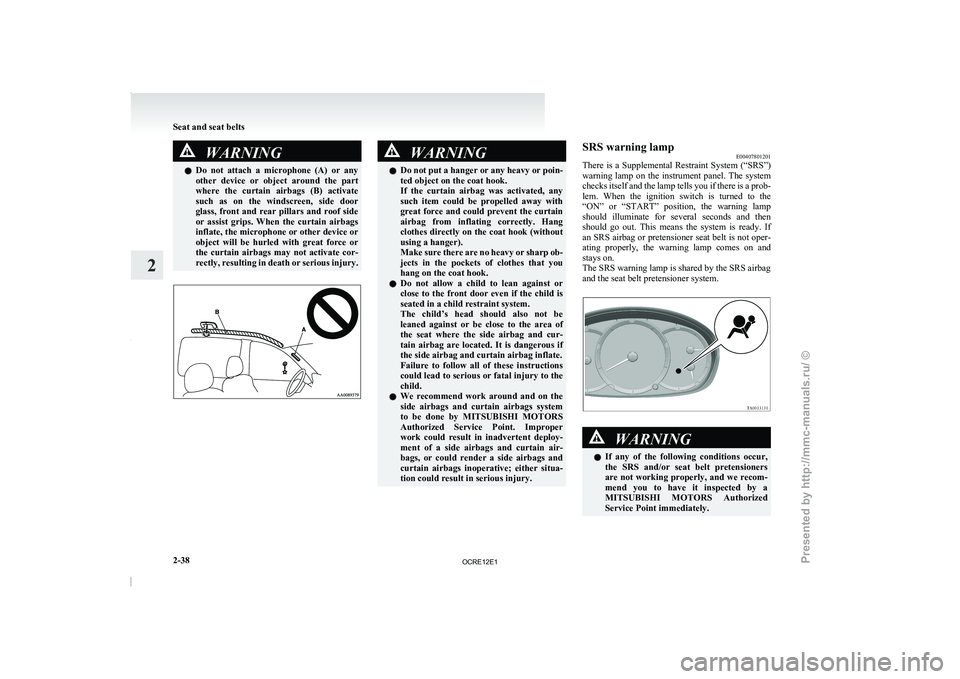
WARNING
l Do not attach a microphone (A) or any
other device or object around the part
where the curtain airbags (B) activate
such as on the windscreen, side door
glass, front and rear pillars and roof side
or assist grips. When the curtain airbags
inflate, the microphone or other device or
object will be hurled with great force or
the curtain airbags may not activate cor-
rectly, resulting in death or serious injury. WARNING
l Do not put a hanger or any heavy or poin-
ted object on the coat hook.
If the curtain airbag was activated, any
such item could be propelled away with
great force and could prevent the curtain
airbag from inflating correctly. Hang
clothes directly on the coat hook (without
using a hanger).
Make sure there are no heavy or sharp ob-
jects in the pockets of clothes that you
hang on the coat hook.
l Do not allow a child to lean against or
close to the front door even if the child is
seated in a child restraint system.
The child’s head should also not be
leaned against or be close to the area of
the seat where the side airbag and cur-
tain airbag are located. It is dangerous if
the side airbag and curtain airbag inflate.
Failure to follow all of these instructions
could lead to serious or fatal injury to the
child.
l We recommend work around and on the
side airbags and curtain airbags system
to be done by MITSUBISHI MOTORS
Authorized Service Point. Improper
work could result in inadvertent deploy-
ment of a side airbags and curtain air-
bags, or could render a side airbags and
curtain airbags inoperative; either situa-
tion could result in serious injury. SRS warning lamp
E00407801201
There is a Supplemental Restraint
System (“SRS”)
warning lamp on the instrument panel. The system
checks itself and the lamp tells you if there is a prob-
lem. When the ignition switch is turned to the
“ON” or “START” position, the warning lamp
should illuminate for several seconds and then
should go out. This means the system is ready. If
an SRS airbag or pretensioner seat belt is not oper-
ating properly, the warning lamp comes on and
stays on.
The SRS warning lamp is shared by the SRS airbag
and the seat belt pretensioner system. WARNING
l If any of the
following
conditions occur,
the SRS and/or seat belt pretensioners
are not working properly, and we recom-
mend you to have it inspected by a
MITSUBISHI MOTORS Authorized
Service Point immediately. Seat and seat belts
2-38
2
OCRE12E1
Presented by http://mmc-manuals.ru/ \251