trailer NISSAN 350Z 2003 Z33 Owners Manual
[x] Cancel search | Manufacturer: NISSAN, Model Year: 2003, Model line: 350Z, Model: NISSAN 350Z 2003 Z33Pages: 227, PDF Size: 2.39 MB
Page 92 of 227
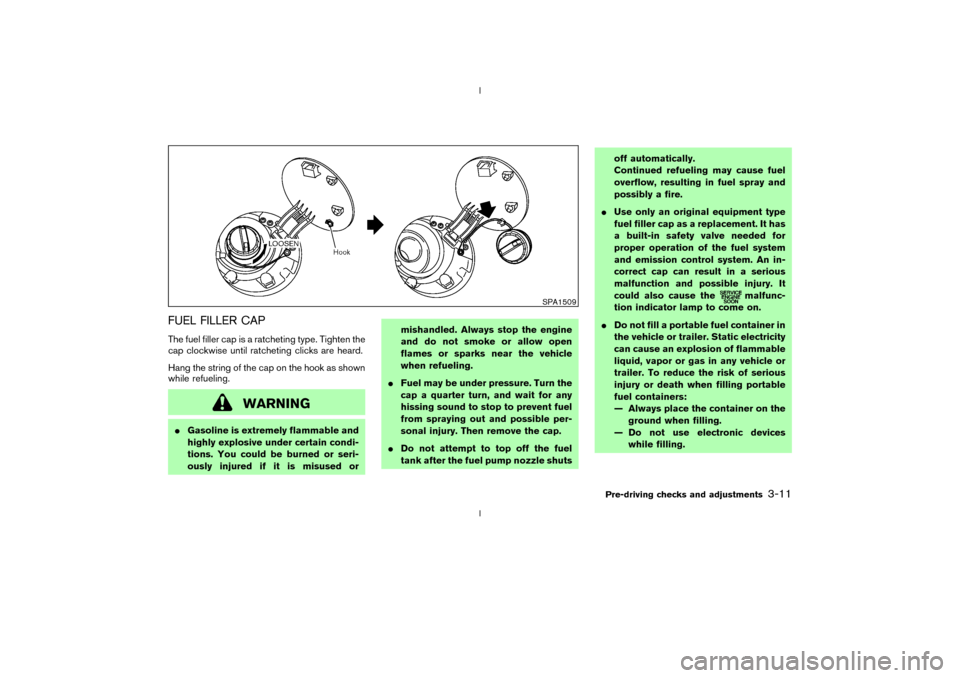
FUEL FILLER CAPThe fuel filler cap is a ratcheting type. Tighten the
cap clockwise until ratcheting clicks are heard.
Hang the string of the cap on the hook as shown
while refueling.
WARNING
IGasoline is extremely flammable and
highly explosive under certain condi-
tions. You could be burned or seri-
ously injured if it is misused ormishandled. Always stop the engine
and do not smoke or allow open
flames or sparks near the vehicle
when refueling.
IFuel may be under pressure. Turn the
cap a quarter turn, and wait for any
hissing sound to stop to prevent fuel
from spraying out and possible per-
sonal injury. Then remove the cap.
IDo not attempt to top off the fuel
tank after the fuel pump nozzle shutsoff automatically.
Continued refueling may cause fuel
overflow, resulting in fuel spray and
possibly a fire.
IUse only an original equipment type
fuel filler cap as a replacement. It has
a built-in safety valve needed for
proper operation of the fuel system
and emission control system. An in-
correct cap can result in a serious
malfunction and possible injury. It
could also cause the
malfunc-
tion indicator lamp to come on.
IDo not fill a portable fuel container in
the vehicle or trailer. Static electricity
can cause an explosion of flammable
liquid, vapor or gas in any vehicle or
trailer. To reduce the risk of serious
injury or death when filling portable
fuel containers:
Ð Always place the container on the
ground when filling.
Ð Do not use electronic devices
while filling.
SPA1509
Pre-driving checks and adjustments
3-11
Z
02.9.13/Z33-D/V5.0
X
Page 119 of 227
WARNING
IDo not leave children, impaired
adults, or pets alone in your vehicle.
They could accidentally injure them-
selves or others through inadvertent
operation of the vehicle. Also, on hot,
sunny days, temperatures in a closed
vehicle could quickly become high
enough to cause severe or possibly
fatal injuries to people or animals.
IProperly secure all cargo to help pre-
vent it from sliding or shifting. Do not
place cargo higher than the seat-
backs. In a sudden stop or collision,
unsecured cargo could cause per-
sonal injury.EXHAUST GAS (Carbon monoxide)
WARNING
Do not breathe exhaust gases; they con-
tain colorless and odorless carbonmonoxide. Carbon monoxide is dan-
gerous. It can cause unconscious-
ness or death.
IIf you suspect that exhaust fumes are
entering the vehicle, drive with all
windows fully open, and have the
vehicle inspected immediately.
IDo not run the engine in closed
spaces such as a garage.
IDo not park the vehicle with the en-
gine running for any extended length
of time.
IKeep the rear hatch closed while
driving, otherwise exhaust gases
could be drawn into the passenger
compartment. If you must drive with
the rear hatch open, follow these
precautions:
1. Open all the windows.
2. Set the air recirculation mode OFF
and the fan control at the maxi-
mum position to circulate the air.
IIf electrical wiring or other cable con-nections must pass to a trailer
through the seal on the rear hatch or
the body, follow the manufacturer's
recommendation to prevent carbon
monoxide entry into the vehicle.
IIf a special body or other equipment
is added for recreational or other
usage, follow the manufacturer's rec-
ommendation to prevent carbon
monoxide entry into the vehicle.
(Some recreational vehicle appli-
ances such as stoves, refrigerator,
heaters, etc. may also generate car-
bon monoxide.)
IThe exhaust system and body should
be inspected by a qualified mechanic
whenever:
a. The vehicle is raised for service.
b. You suspect that exhaust fumes
are entering into the passenger
compartment.
c. You notice a change in the sound
of the exhaust system.PRECAUTIONS WHEN STARTING
AND DRIVING5-2
Starting and driving
Z
02.9.13/Z33-D/V5.0
X
Page 134 of 227

SET switch. Each time you do this, the set
speed will decrease by about 1 MPH (1.6
km/h).
To resume the preset speed,push and re-
lease the RES/ACCEL set switch. The vehicle
will resume the last set cruising speed when the
vehicle speed is over 25 MPH (40 km/h).During the first 1,200 miles (2,000 km), follow
these recommendations to obtain maximum en-
gine performance and ensure the future reliability
and economy of your new vehicle. Failure to
follow these recommendations may result in
shortened engine life and reduced engine per-
formance.
IAvoid driving for long periods at constant
speed, either fast or slow. Do not run the
engine over 4,000 rpm.
IDo not accelerate at full throttle in any gear.
IAvoid quick starts.
IAvoid hard braking as much as possible.
IDo not tow a trailer for the first 500 miles
(800 km).IAccelerate slowly and smoothly. Maintain
cruising speeds with a constant accelerator
position.
IDrive at moderate speeds on the highway.
Driving at high speed will lower fuel economy.
IAvoid unnecessary stopping and braking.
Maintain a safe distance behind other ve-
hicles.
IUse a proper gear range which suits road
conditions. On level roads, shift into high gear
as soon as possible.
IAvoid unnecessary engine idling.
IKeep your engine tuned up.
SD1001M
BREAK-IN SCHEDULE INCREASING FUEL ECONOMY
Starting and driving
5-17
Z
02.9.13/Z33-D/V5.0
X
Page 195 of 227
spare tire. Tire chains will not fit
properly on the T-type spare tire and
may cause damage to the vehicle.
ITire tread of the T-type spare tire will
wear at a faster rate than the original
tire. Replace the T-type spare tire as
soon as the tread wear indicators
appear.
IBecause the T-type spare tire is
smaller than the original tire, ground
clearance is reduced. To avoid dam-
age to the vehicle do not drive over
obstacles. Also do not drive the ve-
hicle through an automatic car wash
since it may get stuck.
IDo not use the T-type spare tire on
other vehicles.
IDo not use more than one T-type
spare tire at the same time.
IDo not tow a trailer while the T-type
spare tire is installed.
8-34
Maintenance and do-it-yourself
Z
02.9.13/Z33-D/V5.0
X
Page 196 of 227

9 Technical and consumer informationCapacities and recommended fuel/lubricants ................ 9-2
Fuel recommendation...................................................... 9-3
Engine oil and oil filter recommendation.................... 9-5
Recommended SAE viscosity number ....................... 9-6
Air conditioning system refrigerant and lubricant
recommendations ............................................................. 9-6
Specifications.......................................................................... 9-8
Engine ................................................................................. 9-8
Wheels and tires .............................................................. 9-9
Dimensions and weights ................................................ 9-9
When traveling or registering your vehicle in another
country.................................................................................... 9-10
Vehicle identification ........................................................... 9-10
Vehicle identification number (VIN) plate ................ 9-10
Vehicle identification number (Chassis number) ... 9-10
Engine serial number .................................................... 9-11
F.M.V.S.S. certification label ....................................... 9-11
Emission control information label ............................ 9-11Tire placard ..................................................................... 9-12
Air conditioner specification label ............................. 9-12
Installing front license plate .............................................. 9-13
Vehicle loading information ............................................... 9-14
Terms ................................................................................ 9-14
Determining vehicle load capacity ............................ 9-14
Loading tips .................................................................... 9-15
Towing a trailer .................................................................... 9-15
Maximum load limits ...................................................... 9-16
Towing safety.................................................................. 9-17
Uniform tire quality grading............................................... 9-19
Emission control system warranty ................................... 9-20
Reporting safety defects (US only) ................................ 9-20
Readiness for inspection/maintenance (I/M) test
(US only)................................................................................ 9-21
Owner's manual/service manual order information ... 9-22
In the event of a collision ............................................ 9-22
Z
02.9.13/Z33-D/V5.0
X
Page 201 of 227
Change intervalsThe oil and oil filter change intervals for your
engine are based on the use of the specified
quality oils and filters. Oil and filter other than the
specified quality, or oil and filter change intervals
longer than recommended could reduce engine
life. Damage to engines caused by improper
maintenance or use of incorrect oil and filter
quality and/or viscosity is not covered by the
new NISSAN vehicle warranties.
Your engine was filled with a high quality engine
oil when it was built. You do not have to change
the oil before the first recommended change
interval. Oil and filter change intervals depend
upon how you use your vehicle. Operation under
the following conditions may require more fre-
quent oil and filter changes.
Irepeated short distance driving at cold out-
side temperatures,
Idriving in dusty conditions,
Iextensive idling,
Itowing a trailer,
Istop and go ªrush hourº traffic.
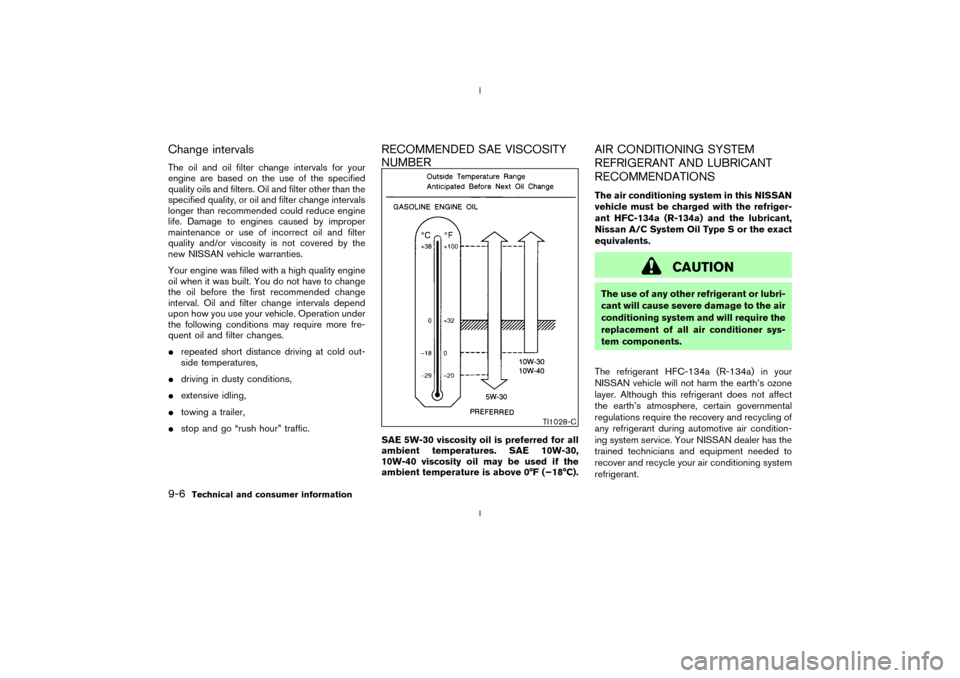
RECOMMENDED SAE VISCOSITY
NUMBERSAE 5W-30 viscosity oil is preferred for all
ambient temperatures. SAE 10W-30,
10W-40 viscosity oil may be used if the
ambient temperature is above 0ÉF (þ18ÉC).
AIR CONDITIONING SYSTEM
REFRIGERANT AND LUBRICANT
RECOMMENDATIONSThe air conditioning system in this NISSAN
vehicle must be charged with the refriger-
ant HFC-134a (R-134a) and the lubricant,
Nissan A/C System Oil Type S or the exact
equivalents.
CAUTION
The use of any other refrigerant or lubri-
cant will cause severe damage to the air
conditioning system and will require the
replacement of all air conditioner sys-
tem components.
The refrigerant HFC-134a (R-134a) in your
NISSAN vehicle will not harm the earth's ozone
layer. Although this refrigerant does not affect
the earth's atmosphere, certain governmental
regulations require the recovery and recycling of
any refrigerant during automotive air condition-
ing system service. Your NISSAN dealer has the
trained technicians and equipment needed to
recover and recycle your air conditioning system
refrigerant.
TI1028-C
9-6
Technical and consumer information
Z
02.9.13/Z33-D/V5.0
X
Page 210 of 227
ceeded. If GVWR is exceeded, remove cargo
as necessary. If either the front or rear GAWR
is exceeded, shift the load or remove cargo
as necessary.
LOADING TIPSIThe GVW must not exceed GVWR or
GAWR as specified on the F.M.V.S.S. certi-
fication label.
IDo not load the front and rear axle to the
GAWR. Doing so will exceed the GVWR.
WARNING
IProperly secure all cargo to help pre-
vent it from sliding or shifting. Do not
place cargo higher than the seat-
backs. In a sudden stop or collision,
unsecured cargo could cause per-
sonal injury.
IDo not load your vehicle any heavier
than the GVWR or the maximum front
and rear GAWRs. If you do, parts on
your vehicle can break, or it can
change the way your vehicle handles.
This could result in loss of controland cause personal injury.
IOverloading can shorten the life of
your vehicle. Failures caused by over-
loading are not covered by your war-
ranty.
Your new vehicle was designed to be used
primarily to carry passengers and cargo. Re-
member that towing a trailer will place additional
loads on your vehicle's engine, drive train, steer-
ing, braking and other systems.
Information on trailer towing ability and the spe-
cial equipment required should be obtained from
your NISSAN dealer. He can obtain aNISSAN
Trailer Towing Guide(US only) for you.
TI1011M
TOWING A TRAILERTechnical and consumer information
9-15
Z
02.9.13/Z33-D/V5.0
X
Page 211 of 227
MAXIMUM LOAD LIMITS
Maximum trailer loadsNever allow the total trailer load to exceed 1,000
lb (454 kg). The total trailer load equals trailer
weight plus its cargo weight. Towing loads
greater than 1,000 lb (454 kg) or using improper
towing equipment could adversely affect vehicle
handling, braking and performance.
The ability of your vehicle to tow a trailer is not
only related to the maximum trailer loads, but
also the places you plan to tow. Tow weights
appropriate for level highway driving may have to
be reduced on very steep grades or in low
traction situations (for example, on slippery boat
ramps).
WARNING
Vehicle damage and/or personal injury
resulting from improper towing proce-
dures are not covered by NISSAN war-
ranties. A NISSAN Trailer Towing Guide
(U.S. only) containing information on
trailer towing ability and the special
equipment required may be obtained
from a NISSAN dealer.
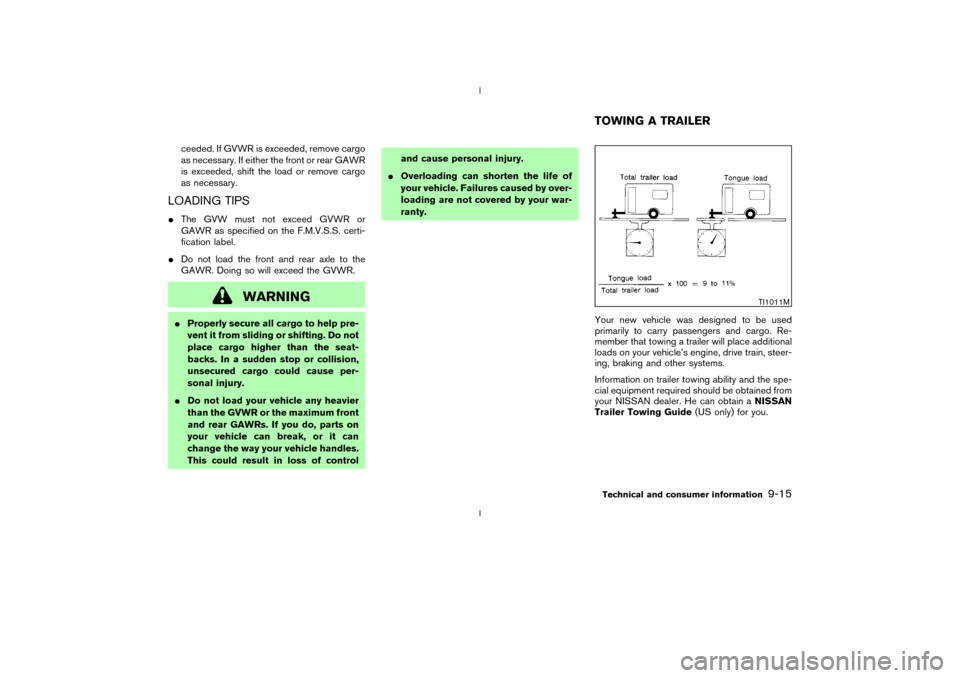
Tongue loadKeep the tongue load between 9 and 11% of the
total trailer load. If the tongue load becomes
excessive, rearrange cargo to allow for proper
tongue load.
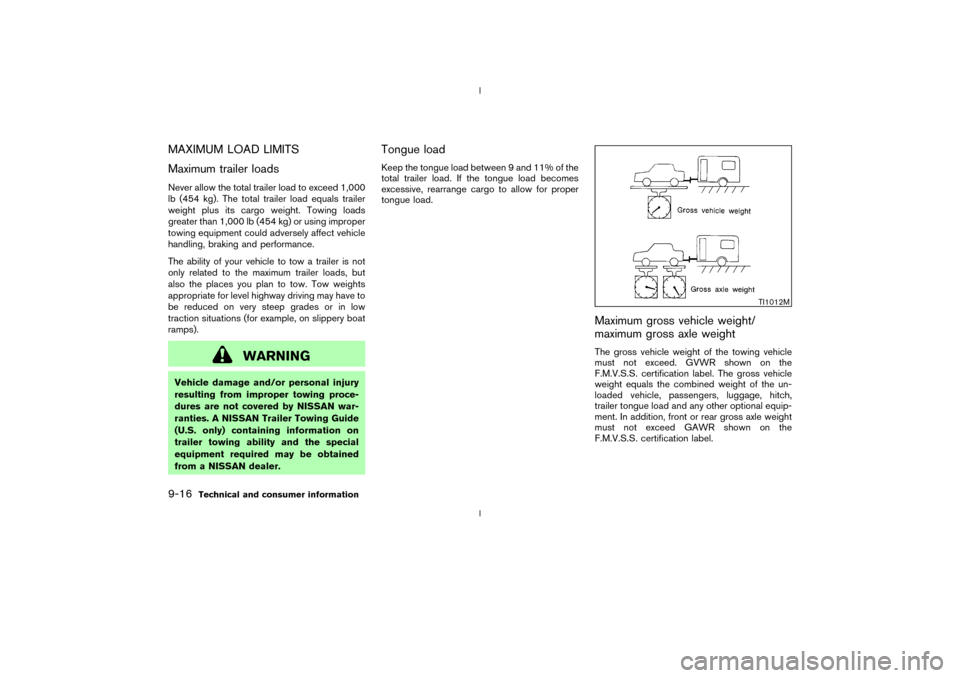
Maximum gross vehicle weight/
maximum gross axle weightThe gross vehicle weight of the towing vehicle
must not exceed. GVWR shown on the
F.M.V.S.S. certification label. The gross vehicle
weight equals the combined weight of the un-
loaded vehicle, passengers, luggage, hitch,
trailer tongue load and any other optional equip-
ment. In addition, front or rear gross axle weight
must not exceed GAWR shown on the
F.M.V.S.S. certification label.
TI1012M
9-16
Technical and consumer information
Z
02.9.13/Z33-D/V5.0
X
Page 212 of 227
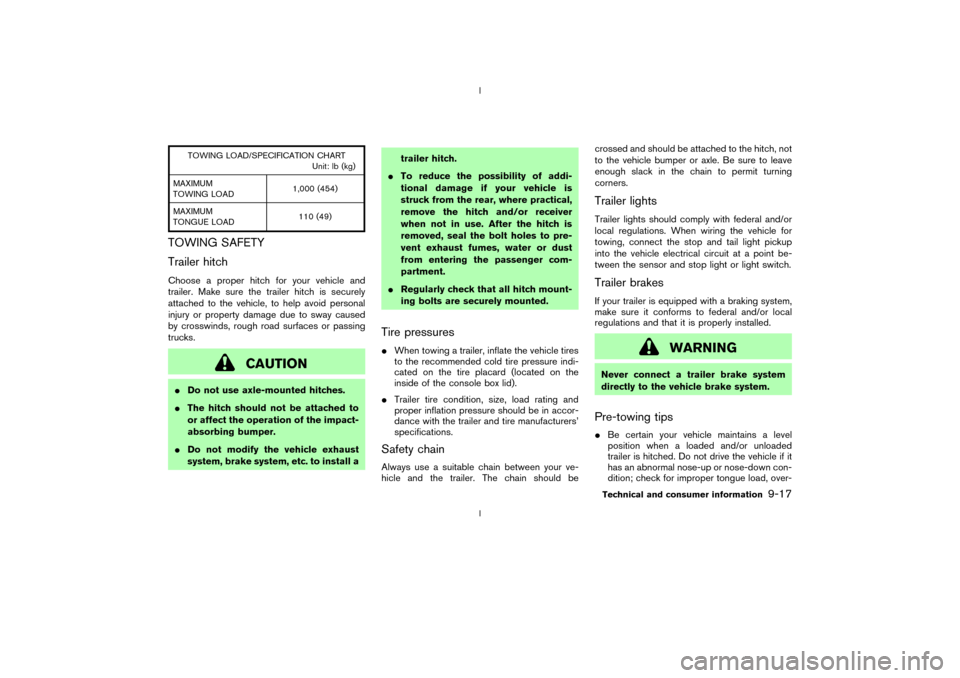
TOWING LOAD/SPECIFICATION CHART
Unit: lb (kg)
MAXIMUM
TOWING LOAD1,000 (454)
MAXIMUM
TONGUE LOAD110 (49)
TOWING SAFETY
Trailer hitchChoose a proper hitch for your vehicle and
trailer. Make sure the trailer hitch is securely
attached to the vehicle, to help avoid personal
injury or property damage due to sway caused
by crosswinds, rough road surfaces or passing
trucks.
CAUTION
IDo not use axle-mounted hitches.
IThe hitch should not be attached to
or affect the operation of the impact-
absorbing bumper.
IDo not modify the vehicle exhaust
system, brake system, etc. to install atrailer hitch.
ITo reduce the possibility of addi-
tional damage if your vehicle is
struck from the rear, where practical,
remove the hitch and/or receiver
when not in use. After the hitch is
removed, seal the bolt holes to pre-
vent exhaust fumes, water or dust
from entering the passenger com-
partment.
IRegularly check that all hitch mount-
ing bolts are securely mounted.
Tire pressuresIWhen towing a trailer, inflate the vehicle tires
to the recommended cold tire pressure indi-
cated on the tire placard (located on the
inside of the console box lid).
ITrailer tire condition, size, load rating and
proper inflation pressure should be in accor-
dance with the trailer and tire manufacturers'
specifications.Safety chainAlways use a suitable chain between your ve-
hicle and the trailer. The chain should becrossed and should be attached to the hitch, not
to the vehicle bumper or axle. Be sure to leave
enough slack in the chain to permit turning
corners.
Trailer lightsTrailer lights should comply with federal and/or
local regulations. When wiring the vehicle for
towing, connect the stop and tail light pickup
into the vehicle electrical circuit at a point be-
tween the sensor and stop light or light switch.Trailer brakesIf your trailer is equipped with a braking system,
make sure it conforms to federal and/or local
regulations and that it is properly installed.
WARNING
Never connect a trailer brake system
directly to the vehicle brake system.Pre-towing tipsIBe certain your vehicle maintains a level
position when a loaded and/or unloaded
trailer is hitched. Do not drive the vehicle if it
has an abnormal nose-up or nose-down con-
dition; check for improper tongue load, over-Technical and consumer information
9-17
Z
02.9.13/Z33-D/V5.0
X
Page 213 of 227

load, worn suspension or other possible
causes of either condition.
IAlways secure items in the trailer to prevent
load shifts while driving.
IBe certain your rear view mirrors conform to
all federal, state or local regulations. If not,
install any mirrors required for towing before
driving the vehicle.
Trailer towing tipsIn order to gain skill and an understanding of the
vehicle's behavior, you should practice turning,
stopping and backing up in an area which is free
from traffic. Steering stability, and braking per-
formance will be somewhat different than under
normal driving conditions.
IAlways secure items in the trailer to prevent
load shift while driving.
IAvoid abrupt starts, acceleration or stops.
IAvoid sharp turns or lane changes.
IAlways drive your vehicle at a moderate
speed.
IAlways block the wheels on both vehicle and
trailer when parking. Parking on a slope is not
recommended; however, if you must do so,
and if your vehicle is equipped with automatic
transmission, first apply the parking brakeand block the wheels, and then move the
transmission selector lever into the P (Park)
position. If you move the selector lever to the
P (Park) position before blocking the wheels
and applying the parking brake, the transmis-
sion may get damaged.
IWhen going down a hill, shift into a lower
gear and use the engine braking effect.
When ascending on a long grade, downshift
the transmission to a lower gear and reduce
speed to reduce chances of engine overload-
ing and/or overheating.
IIf the engine coolant rises to an extremely
high temperature when the air conditioning
system is on, turn off the air conditioner.
Coolant heat can be additionally vented by
opening the windows, switching the fan con-
trol to high and setting the temperature con-
trol to the HOT position.
ITrailer towing consumes more fuel than nor-
mal circumstances.
IAvoid towing a trailer for the first 500 miles
(800 km).
IHave your vehicle serviced more often than at
intervals specified in the recommended main-
tenance schedule.
IWhen making a turn, your trailer wheels will
be closer to the inside of the turn than yourvehicle wheels. To compensate for this, make
a larger than normal turning radius during the
turn.
ICrosswinds and rough roads will adversely
affect vehicle/trailer handling, possibly caus-
ing vehicle sway. When being passed by
larger vehicles, be prepared for possible
changes in crosswinds that could affect ve-
hicle handling. If swaying does occur, firmly
grip the steering wheel, steer straight ahead,
and immediately (but gradually) reduce ve-
hicle speed. This combination will help stabi-
lize the vehicle. Never increase speed.
IBe careful when passing other vehicles.
Passing while towing a trailer requires con-
siderably more distance than normal passing.
Remember the length of the trailer must also
pass the other vehicle before you can safely
change lanes.
ITo maintain engine braking efficiency and
electrical charging performance, do not use
6th gear (manual transmission) or 5th posi-
tion (automatic transmission).
IAvoid holding the brake pedal down too long
or too frequently. This could cause the brakes
to overheat, resulting in reduced braking ef-
ficiency.
When towing a trailer, change transmis-9-18
Technical and consumer information
Z
02.9.13/Z33-D/V5.0
X