lock NISSAN 370Z 2018 Owner´s Manual
[x] Cancel search | Manufacturer: NISSAN, Model Year: 2018, Model line: 370Z, Model: NISSAN 370Z 2018Pages: 453, PDF Size: 2.19 MB
Page 38 of 453
1-14Safety — Seats, seat belts and supplemental restraint system
impacts.
The Automatic Locking Retractor (ALR)
mode (child restraint mode) locks the
seat belt for child restraint installation.
Pull the seat belt out until it is fully
extended to activate the ALR mode.
Detach the seat belt tongue from the
buckle and retract the seat belt comple-
tely to cancel the ALR mode and revert
back to the ELR mode.
When the ALR mode is activated the seat
belt cannot be extended again until the
seat belt tongue is detached from the
buckle and fully retracted. For additional
information, see “Child restraints” (P.1-19).
The ALR mode should be used only for
child restraint installation. During nor-
mal seat belt use by an occupant, the
ALR mode should not be activated. If it
is activated it may cause uncomfortable
seat belt tension.
WARNING
When fastening the seat belts, be
certain that seatbacks are comple-
tely secured in the latched position.
If they are not completely secured,
passengers may be injured in an
accident or sudden stop.
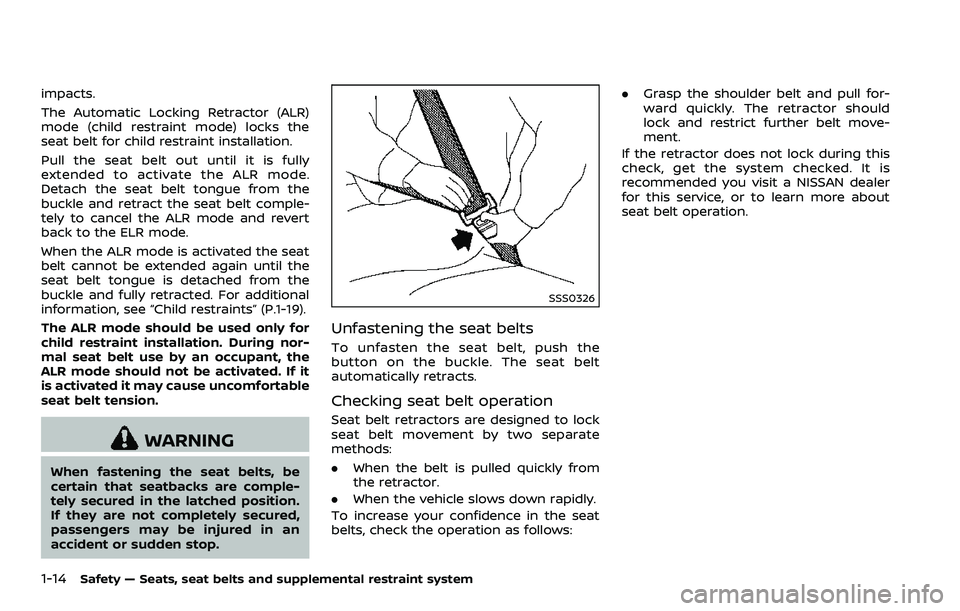
SSS0326
Unfastening the seat belts
To unfasten the seat belt, push the
button on the buckle. The seat belt
automatically retracts.
Checking seat belt operation
Seat belt retractors are designed to lock
seat belt movement by two separate
methods:
.When the belt is pulled quickly from
the retractor.
. When the vehicle slows down rapidly.
To increase your confidence in the seat
belts, check the operation as follows: .
Grasp the shoulder belt and pull for-
ward quickly. The retractor should
lock and restrict further belt move-
ment.
If the retractor does not lock during this
check, get the system checked. It is
recommended you visit a NISSAN dealer
for this service, or to learn more about
seat belt operation.
Page 40 of 453
1-16Safety — Seats, seat belts and supplemental restraint system
WARNING
Do not allow children to play with the
seat belts. Most seating positions are
equipped with Automatic Locking
Retractor (ALR) mode seat belts. If
the seat belt becomes wrapped
around a child’s neck with the ALR
mode activated, the child can be
seriously injured or killed if the seat
belt retracts and becomes tight. This
can occur even if the vehicle is
parked. Unbuckle the seat belt to
release the child. If the seat belt can
not be unbuckled or is already un-
buckled, release the child by cutting
the seat belt with a suitable tool
(such as a knife or scissors) to
release the seat belt.
Children need adults to help protect
them. They need to be properly re-
strained.
In addition to the general information in
this manual, child safety information is
available from many other sources, in-
cluding doctors, teachers, government
traffic safety offices, and community or-
ganizations. Every child is different, so be
sure to learn the best way to transport
your child. There are three basic types of child
restraint systems:
.
Rear-facing child restraint
. Front-facing child restraint
. Booster seat
The proper restraint depends on the
child’s size. Generally, infants (up to about
1 year and less than 20 lb (9 kg)) should be
placed in rear-facing child restraints.
Front-facing child restraints are available
for children who outgrow rear-facing
child restraints and are at least 1 year
old. Booster seats are used to help
position a vehicle lap/shoulder belt on a
child who can no longer use a front-
facing child restraint.
WARNING
Infants and children need special
protection. The vehicle’s seat belts
may not fit them properly. The
shoulder belt may come too close
to the face or neck. The lap belt may
not fit over their small hip bones. In
an accident, an improperly fitting
seat belt could cause serious or fatal
injury. Always use appropriate child
restraints.
All U.S. states and Canadian provinces or territories require the use of approved
child restraints for infants and small
children. (See “Child restraints” (P.1-19).)
Also, there are other types of child
restraints available for larger children for
additional protection.
INFANTS
Infants up to at least 1 year old should be
placed in a rear-facing child restraint.
NISSAN recommends that infants be
placed in child restraints that comply with
Federal Motor Vehicle Safety Standards
or Canadian Motor Vehicle Safety Stan-
dards. You should choose a child restraint
that fits your vehicle and always follow
the manufacturer’s instructions for instal-
lation and use.
SMALL CHILDREN (for Coupe mod-
els)
Children that are over 1 year old and
weigh at least 20 lb (9 kg) should remain
in a rear-facing child restraint as long as
possible up to the height or weight limit
of the child restraint. Children who out-
grow the height or weight limit of the
rear-facing child restraint and are at least
1 year old should be secured in a forward-
facing child restraint with a harness. Refer
to the manufacturer’s instructions for
minimum and maximum weight and
height recommendations. NISSAN recom-
CHILD SAFETY
Page 46 of 453
1-22Safety — Seats, seat belts and supplemental restraint system
Top tether anchor point location
The anchor point is located on the floor of
the cargo area.
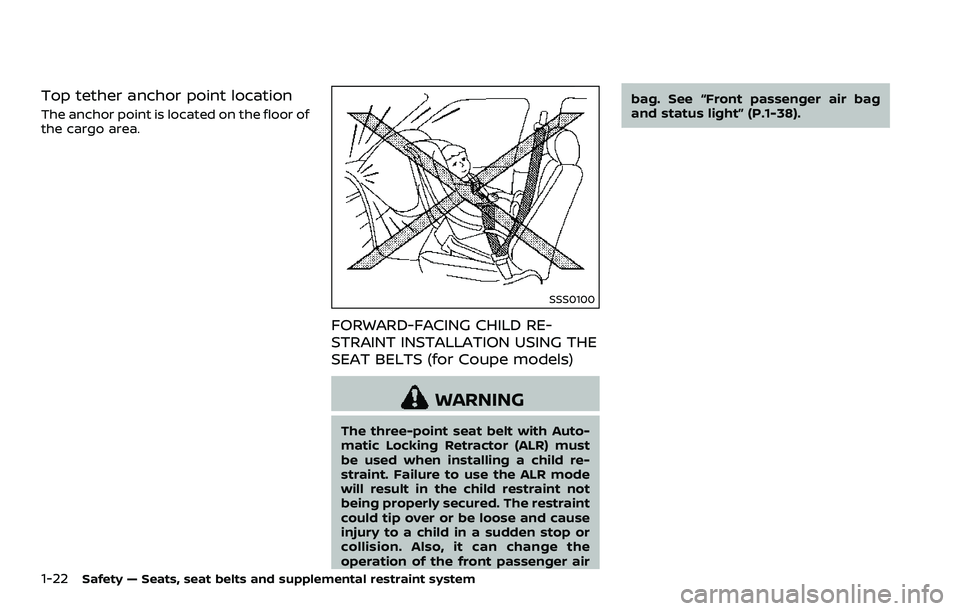
SSS0100
FORWARD-FACING CHILD RE-
STRAINT INSTALLATION USING THE
SEAT BELTS (for Coupe models)
WARNING
The three-point seat belt with Auto-
matic Locking Retractor (ALR) must
be used when installing a child re-
straint. Failure to use the ALR mode
will result in the child restraint not
being properly secured. The restraint
could tip over or be loose and cause
injury to a child in a sudden stop or
collision. Also, it can change the
operation of the front passenger airbag. See “Front passenger air bag
and status light” (P.1-38).
Page 48 of 453
1-24Safety — Seats, seat belts and supplemental restraint system
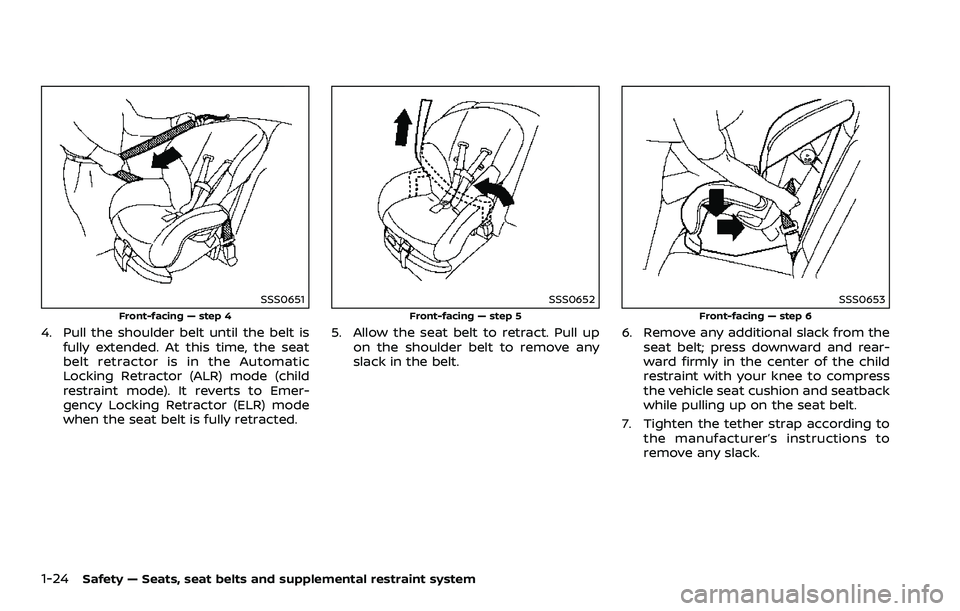
SSS0651
Front-facing — step 4
4. Pull the shoulder belt until the belt isfully extended. At this time, the seat
belt retractor is in the Automatic
Locking Retractor (ALR) mode (child
restraint mode). It reverts to Emer-
gency Locking Retractor (ELR) mode
when the seat belt is fully retracted.
SSS0652
Front-facing — step 5
5. Allow the seat belt to retract. Pull upon the shoulder belt to remove any
slack in the belt.
SSS0653
Front-facing — step 6
6. Remove any additional slack from theseat belt; press downward and rear-
ward firmly in the center of the child
restraint with your knee to compress
the vehicle seat cushion and seatback
while pulling up on the seat belt.
7. Tighten the tether strap according to the manufacturer’s instructions to
remove any slack.
Page 49 of 453
SSS0641
Front-facing — step 8
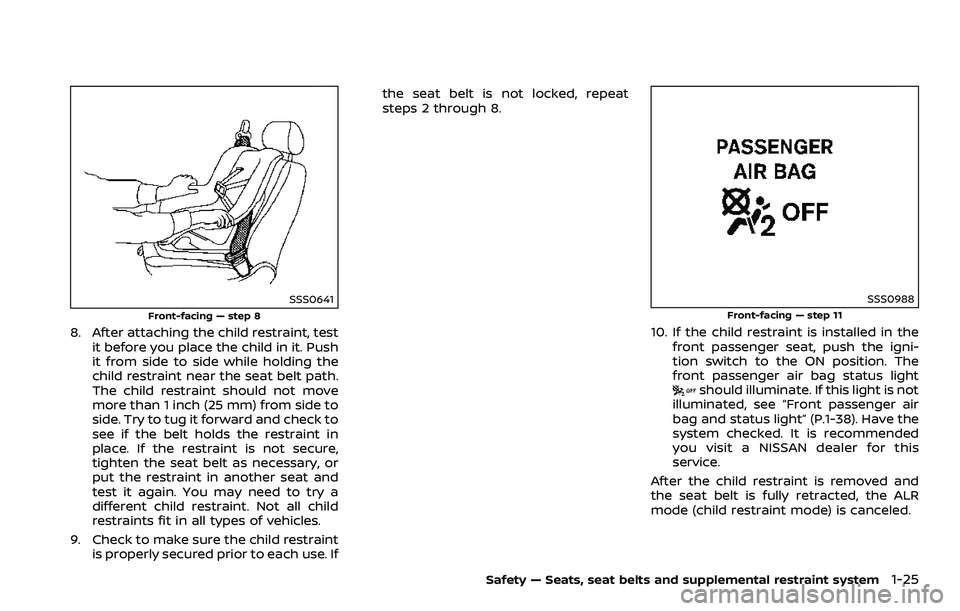
8. After attaching the child restraint, testit before you place the child in it. Push
it from side to side while holding the
child restraint near the seat belt path.
The child restraint should not move
more than 1 inch (25 mm) from side to
side. Try to tug it forward and check to
see if the belt holds the restraint in
place. If the restraint is not secure,
tighten the seat belt as necessary, or
put the restraint in another seat and
test it again. You may need to try a
different child restraint. Not all child
restraints fit in all types of vehicles.
9. Check to make sure the child restraint is properly secured prior to each use. If the seat belt is not locked, repeat
steps 2 through 8.
SSS0988Front-facing — step 11
10. If the child restraint is installed in the
front passenger seat, push the igni-
tion switch to the ON position. The
front passenger air bag status light
should illuminate. If this light is not
illuminated, see “Front passenger air
bag and status light” (P.1-38). Have the
system checked. It is recommended
you visit a NISSAN dealer for this
service.
After the child restraint is removed and
the seat belt is fully retracted, the ALR
mode (child restraint mode) is canceled.
Safety — Seats, seat belts and supplemental restraint system1-25
Page 52 of 453
1-28Safety — Seats, seat belts and supplemental restraint system
Booster seat installation
CAUTION
Do not use the lap/shoulder belt
Automatic Locking Retractor (ALR)
mode when using a booster seat
with the seat belts.
Refer to all Warnings and Cautions in the
“Child safety”, “Child restraints” and “Boos-
ter seats” sections earlier in this section
before installing a child restraint.
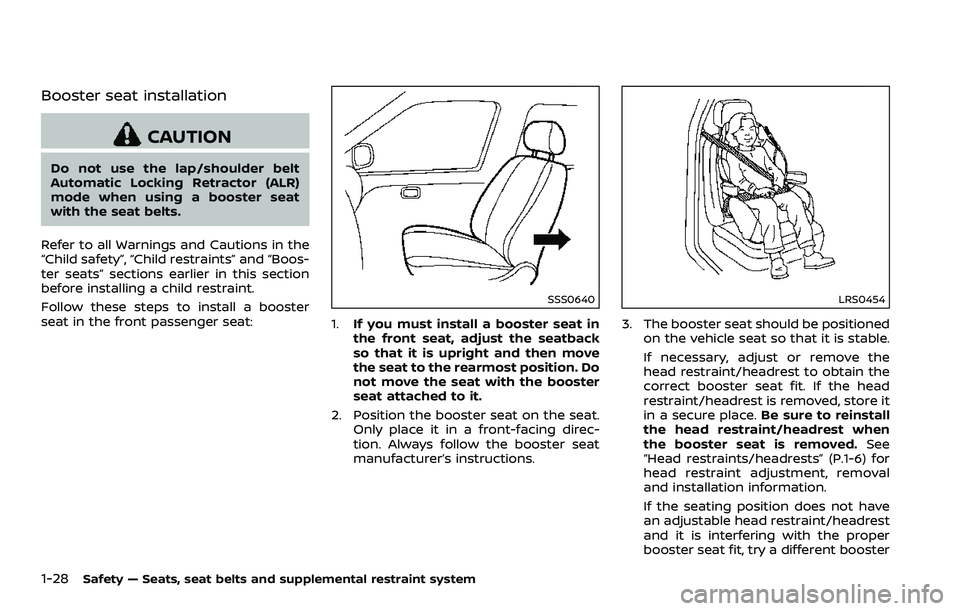
Follow these steps to install a booster
seat in the front passenger seat:
SSS0640
1. If you must install a booster seat in
the front seat, adjust the seatback
so that it is upright and then move
the seat to the rearmost position. Do
not move the seat with the booster
seat attached to it.
2. Position the booster seat on the seat. Only place it in a front-facing direc-
tion. Always follow the booster seat
manufacturer’s instructions.
LRS0454
3. The booster seat should be positioned
on the vehicle seat so that it is stable.
If necessary, adjust or remove the
head restraint/headrest to obtain the
correct booster seat fit. If the head
restraint/headrest is removed, store it
in a secure place. Be sure to reinstall
the head restraint/headrest when
the booster seat is removed. See
“Head restraints/headrests” (P.1-6) for
head restraint adjustment, removal
and installation information.
If the seating position does not have
an adjustable head restraint/headrest
and it is interfering with the proper
booster seat fit, try a different booster
Page 69 of 453
.The supplemental air bag warning
light remains on after approximately
7 seconds.
. The supplemental air bag warning
light flashes intermittently.
. The supplemental air bag warning
light does not come on at all.
Under these conditions, the air bag and/
or pretensioner systems may not operate
properly. They must be checked and
repaired. It is recommended you visit a
NISSAN dealer for this service.
WARNING
If the supplemental air bag warning
light is on, it could mean that the
front air bag, side air bag, curtain air
bag and/or pretensioner systems
will not operate in an accident. To
help avoid injury to yourself or
others, have your vehicle checked
as soon as possible. It is recom-
mended you visit a NISSAN dealer
for this service.
REPAIR AND REPLACEMENT PRO-
CEDURE
The front air bags, side air bags, curtain
air bags and pretensioners are designed
to activate on a one-time-only basis. As a
reminder, unless it is damaged, the sup-
plemental air bag warning light will re-
main illuminated after inflation has
occurred. These systems should be re-
paired and/or replaced as soon as possi-
ble. It is recommended you visit a NISSAN
dealer for this service.
When maintenance work is required on
the vehicle, the front air bags, side air
bags, curtain air bags, pretensioners and
related parts should be pointed out to the
person conducting the maintenance. The
ignition switch should always be in the
LOCK position when working under the
hood or inside the vehicle.
WARNING
. Once a front air bag, side air bag,
or curtain air bag has inflated, the
air bag module will not function
again and must be replaced. Ad-
ditionally, the activated preten-
sioner must also be replaced. The
air bag module and pretensioner
system should be replaced. It is recommended you visit a NISSAN
dealer for this service. The air bag
module and pretensioner system
cannot be repaired.
. The front air bag, side air bag and
curtain air bag systems and the
pretensioner system should be
inspected if there is any damage
to the front end or side portion of
the vehicle. It is recommended
you visit a NISSAN dealer for this
service.
. If you need to dispose of the
supplemental air bag or preten-
sioner systems or scrap the vehi-
cle, it is recommended you visit a
NISSAN dealer. Correct supple-
mental air bag and seat belt
pretensioner system disposal
procedures are set forth in the
appropriate NISSAN Service Man-
ual. Incorrect disposal procedures
could cause personal injury.
Safety — Seats, seat belts and supplemental restraint system1-45
Page 75 of 453
SSI0509
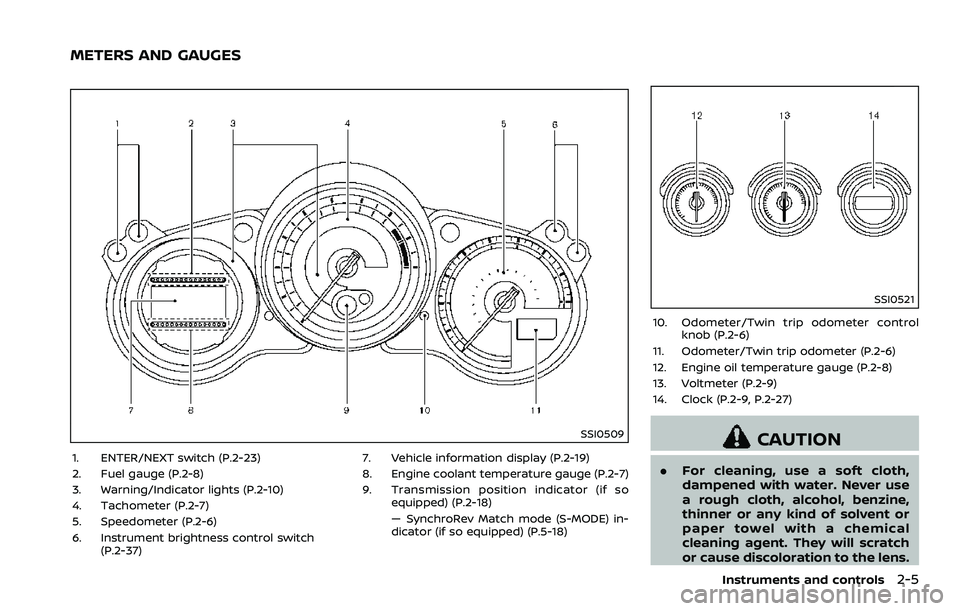
1. ENTER/NEXT switch (P.2-23)
2. Fuel gauge (P.2-8)
3. Warning/Indicator lights (P.2-10)
4. Tachometer (P.2-7)
5. Speedometer (P.2-6)
6. Instrument brightness control switch(P.2-37) 7. Vehicle information display (P.2-19)
8. Engine coolant temperature gauge (P.2-7)
9. Transmission position indicator (if so
equipped) (P.2-18)
— SynchroRev Match mode (S-MODE) in-
dicator (if so equipped) (P.5-18)
SSI0521
10. Odometer/Twin trip odometer controlknob (P.2-6)
11. Odometer/Twin trip odometer (P.2-6)
12. Engine oil temperature gauge (P.2-8)
13. Voltmeter (P.2-9)
14. Clock (P.2-9, P.2-27)
CAUTION
. For cleaning, use a soft cloth,
dampened with water. Never use
a rough cloth, alcohol, benzine,
thinner or any kind of solvent or
paper towel with a chemical
cleaning agent. They will scratch
or cause discoloration to the lens.
Instruments and controls2-5
METERS AND GAUGES
Page 78 of 453
2-8Instruments and controls
SIC3976
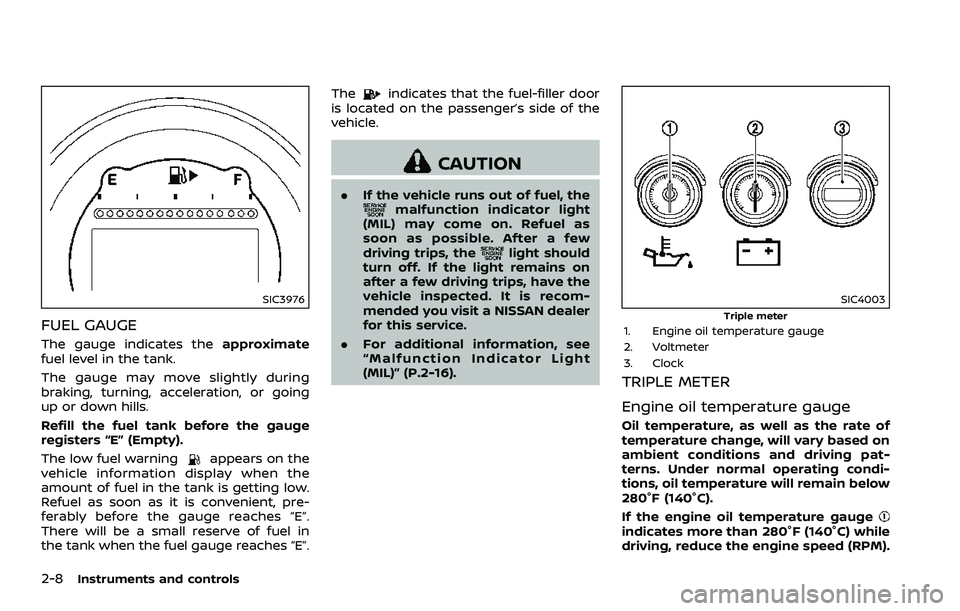
FUEL GAUGE
The gauge indicates theapproximate
fuel level in the tank.
The gauge may move slightly during
braking, turning, acceleration, or going
up or down hills.
Refill the fuel tank before the gauge
registers “E” (Empty).
The low fuel warning
appears on the
vehicle information display when the
amount of fuel in the tank is getting low.
Refuel as soon as it is convenient, pre-
ferably before the gauge reaches “E”.
There will be a small reserve of fuel in
the tank when the fuel gauge reaches “E”. The
indicates that the fuel-filler door
is located on the passenger’s side of the
vehicle.
CAUTION
. If the vehicle runs out of fuel, themalfunction indicator light
(MIL) may come on. Refuel as
soon as possible. After a few
driving trips, the
light should
turn off. If the light remains on
after a few driving trips, have the
vehicle inspected. It is recom-
mended you visit a NISSAN dealer
for this service.
. For additional information, see
“Malfunction Indicator Light
(MIL)” (P.2-16).
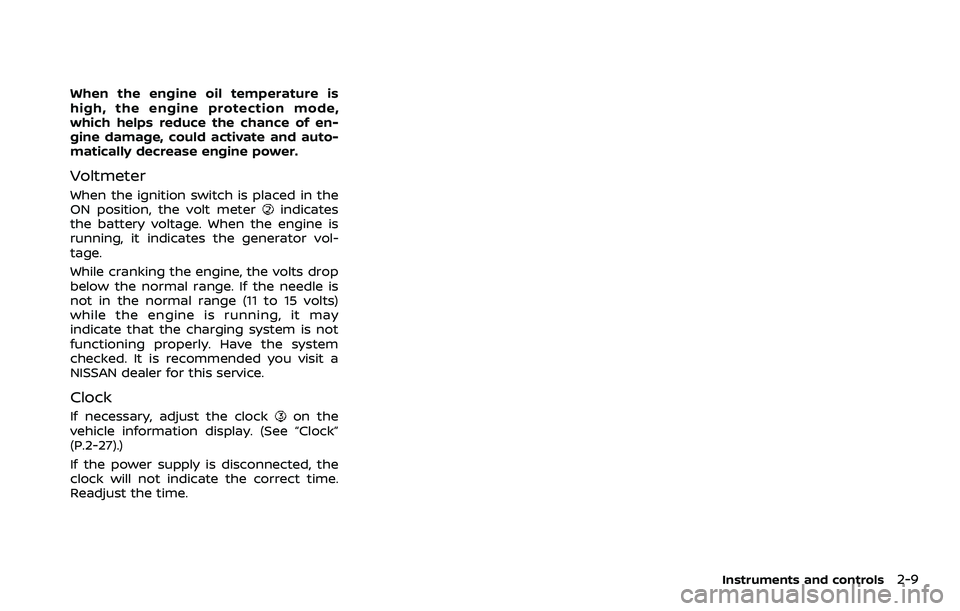
SIC4003
Triple meter1. Engine oil temperature gauge
2. Voltmeter
3. Clock
TRIPLE METER
Engine oil temperature gauge
Oil temperature, as well as the rate of
temperature change, will vary based on
ambient conditions and driving pat-
terns. Under normal operating condi-
tions, oil temperature will remain below
280°F (140°C).
If the engine oil temperature gauge
indicates more than 280°F (140°C) while
driving, reduce the engine speed (RPM).
Page 79 of 453
When the engine oil temperature is
high, the engine protection mode,
which helps reduce the chance of en-
gine damage, could activate and auto-
matically decrease engine power.
Voltmeter
When the ignition switch is placed in the
ON position, the volt meterindicates
the battery voltage. When the engine is
running, it indicates the generator vol-
tage.
While cranking the engine, the volts drop
below the normal range. If the needle is
not in the normal range (11 to 15 volts)
while the engine is running, it may
indicate that the charging system is not
functioning properly. Have the system
checked. It is recommended you visit a
NISSAN dealer for this service.
Clock
If necessary, adjust the clockon the
vehicle information display. (See “Clock”
(P.2-27).)
If the power supply is disconnected, the
clock will not indicate the correct time.
Readjust the time.
Instruments and controls2-9