service indicator NISSAN 370Z 2018 Owner´s Manual
[x] Cancel search | Manufacturer: NISSAN, Model Year: 2018, Model line: 370Z, Model: NISSAN 370Z 2018Pages: 453, PDF Size: 2.19 MB
Page 162 of 453
3-36Pre-driving checks and adjustments
To lock, close the fuel-filler door securely
and lock all doors by operating the door
handle request switch, the LOCK button
on the Intelligent Key, the mechanical key
or the power door lock switch.
FUEL-FILLER CAP
WARNING
.Gasoline is extremely flammable
and highly explosive under cer-
tain conditions. You could be
burned or seriously injured if it is
misused or mishandled. Always
stop engine and do not smoke or
allow open flames or sparks near
the vehicle when refueling.
. Do not attempt to top off the fuel
tank after the fuel pump nozzle
shuts off automatically. Contin-
ued refueling may cause fuel
overflow, resulting in fuel spray
and possibly a fire.
. Use only an original equipment
type fuel-filler cap as a replace-
ment. It has a built-in safety valve
needed for proper operation of
the fuel system and emission
control system. An incorrect cap
can result in a serious malfunc-
tion and possible injury. It could also cause the malfunction indi-
cator light to come on.
. Never pour fuel into the throttle
body to attempt to start your
vehicle.
. Do not fill a portable fuel contain-
er in the vehicle or trailer. Static
electricity can cause an explosion
of flammable liquid, vapor or gas
in any vehicle or trailer. To reduce
the risk of serious injury or death
when filling portable fuel contain-
ers:
— Always place the container on
the ground when filling.
— Do not use electronic devices when filling.
— Keep the pump nozzle in con- tact with the container while
you are filling it.
— Use only approved portable fuel containers for flammable
liquid.
CAUTION
. If fuel is spilled on the vehicle
body, flush it away with water to avoid paint damage.
. Insert the cap straight into the
fuel-filler tube, then tighten until
the fuel-filler cap clicks. Failure to
tighten the fuel-filler cap properly
may cause the
malfunction
indicator light (MIL) to illuminate.
If the
light illuminates be-
cause the fuel-filler cap is loose
or missing, tighten or install the
cap and continue to drive the
vehicle. The
light should turn
off after a few driving trips. If the
light does not turn off after a
few driving trips, have the vehicle
inspected. It is recommended you
visit a NISSAN dealer for this
service.
. The LOOSE FUEL CAP warning will
appear if the fuel-filler cap is not
properly tightened. It may take a
few driving trips for the message
to be displayed. Failure to tighten
the fuel-filler cap properly after
the LOOSE FUEL CAP warning
appears may cause the
Mal-
function Indicator Light (MIL) to
illuminate.
Page 295 of 453
THREE-WAY CATALYST
The three-way catalyst is an emission
control device installed in the exhaust
system. Exhaust gases in the three-way
catalyst are burned at high temperatures
to help reduce pollutants.
WARNING
.The exhaust gas and the exhaust
system are very hot. Keep people,
animals or flammable materials
away from the exhaust system
components.
. Do not stop or park the vehicle
over flammable materials such as
dry grass, waste paper or rags.
They may ignite and cause a fire.
CAUTION
.Do not use leaded gasoline. De-
posits from leaded gasoline ser-
iously reduce the three-way
catalyst’s ability to help reduce
exhaust pollutants.
. Keep your engine tuned up. Mal-
functions in the ignition, fuel in-
jection, or electrical systems can cause overrich fuel flow into the
three-way catalyst, causing it to
overheat. Do not keep driving if
the engine misfires, or if notice-
able loss of performance or other
unusual operating conditions are
detected. Have the vehicle in-
spected. It is recommended you
visit a NISSAN dealer for this
service.
. Avoid driving with an extremely
low fuel level. Running out of fuel
could cause the engine to misfire,
damaging the three-way catalyst.
. Do not race the engine while
warming it up.
. Do not push or tow your vehicle
to start the engine.
TIRE PRESSURE MONITORING SYS-
TEM (TPMS)
Each tire, including the spare (if provided),
should be checked monthly when cold
and inflated to the inflation pressure
recommended by the vehicle manufac-
turer on the vehicle placard or tire infla-
tion pressure label. (If your vehicle has
tires of a different size than the size
indicated on the vehicle placard or tire
inflation pressure label, you should deter-
mine the proper tire inflation pressure for those tires.)
As an added safety feature, your vehicle
has been equipped with a Tire Pressure
Monitoring System (TPMS) that illumi-
nates a low tire pressure telltale when
one or more of your tires is significantly
under-inflated. Accordingly, when the low
tire pressure telltale illuminates, you
should stop and check your tires as soon
as possible, and inflate them to the
proper pressure. Driving on a significantly
under-inflated tire causes the tire to
overheat and can lead to tire failure.
Under-inflation also reduces fuel effi-
ciency and tire tread life, and may affect
the vehicle’s handling and stopping abil-
ity.
Please note that the TPMS is not a
substitute for proper tire maintenance,
and it is the driver’s responsibility to
maintain correct tire pressure, even if
under-inflation has not reached the level
to trigger illumination of the TPMS low
tire pressure telltale.
Your vehicle has also been equipped with
a TPMS malfunction indicator to indicate
when the system is not operating prop-
erly. The TPMS malfunction indicator is
combined with the low tire pressure tell-
tale. When the system detects a malfunc-
tion, the telltale will flash for
approximately one minute and then re-
Starting and driving5-3
Page 308 of 453
5-16Starting and driving
SSD0832
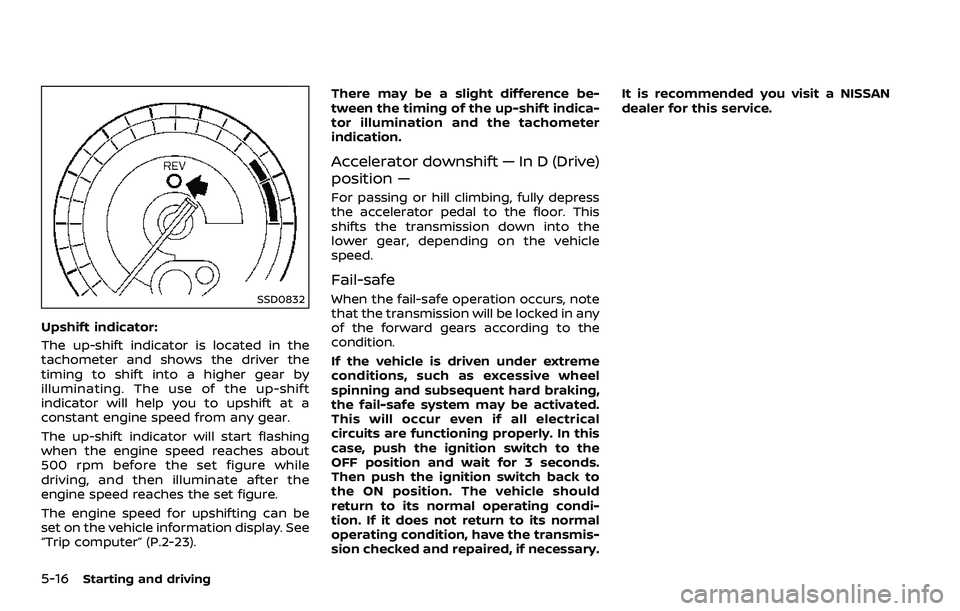
Upshift indicator:
The up-shift indicator is located in the
tachometer and shows the driver the
timing to shift into a higher gear by
illuminating. The use of the up-shift
indicator will help you to upshift at a
constant engine speed from any gear.
The up-shift indicator will start flashing
when the engine speed reaches about
500 rpm before the set figure while
driving, and then illuminate after the
engine speed reaches the set figure.
The engine speed for upshifting can be
set on the vehicle information display. See
“Trip computer” (P.2-23).There may be a slight difference be-
tween the timing of the up-shift indica-
tor illumination and the tachometer
indication.
Accelerator downshift — In D (Drive)
position —
For passing or hill climbing, fully depress
the accelerator pedal to the floor. This
shifts the transmission down into the
lower gear, depending on the vehicle
speed.
Fail-safe
When the fail-safe operation occurs, note
that the transmission will be locked in any
of the forward gears according to the
condition.
If the vehicle is driven under extreme
conditions, such as excessive wheel
spinning and subsequent hard braking,
the fail-safe system may be activated.
This will occur even if all electrical
circuits are functioning properly. In this
case, push the ignition switch to the
OFF position and wait for 3 seconds.
Then push the ignition switch back to
the ON position. The vehicle should
return to its normal operating condi-
tion. If it does not return to its normal
operating condition, have the transmis-
sion checked and repaired, if necessary.It is recommended you visit a NISSAN
dealer for this service.
Page 311 of 453
SSD0830
SynchroRev Match mode (S-MODE)
warning:
The SynchroRev Match mode (S-MODE)
warning will appear on the vehicle infor-
mation display and the S-MODE indicator
will turn off if a system malfunction
occurs.
If the warning appears, the S-MODE func-
tion will not operate, but manual trans-
mission will operate normally and driving
can be continued. Have the system
checked. It is recommended you visit a
NISSAN dealer for this service.
SSD0831
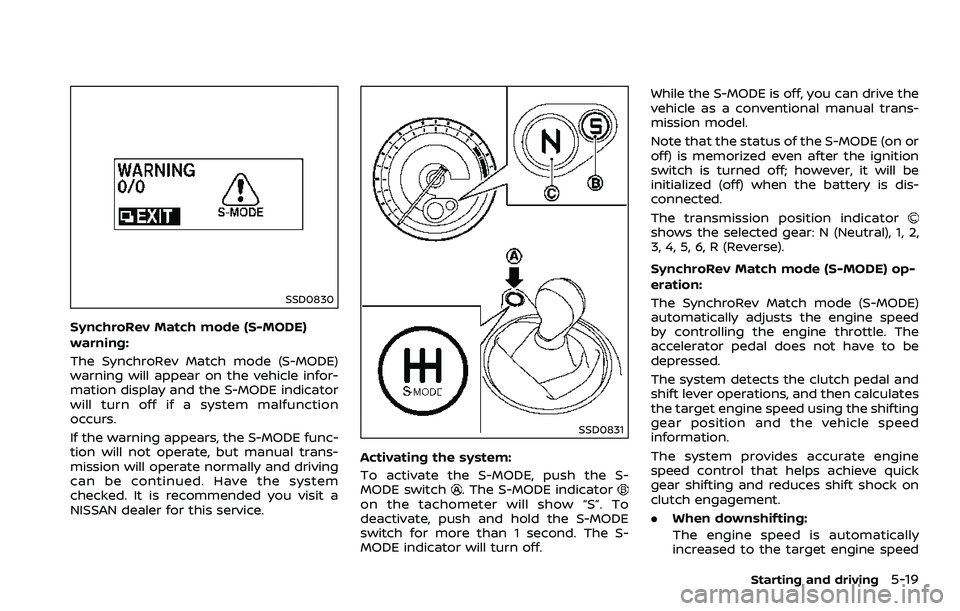
Activating the system:
To activate the S-MODE, push the S-
MODE switch
. The S-MODE indicatoron the tachometer will show “S”. To
deactivate, push and hold the S-MODE
switch for more than 1 second. The S-
MODE indicator will turn off.While the S-MODE is off, you can drive the
vehicle as a conventional manual trans-
mission model.
Note that the status of the S-MODE (on or
off) is memorized even after the ignition
switch is turned off; however, it will be
initialized (off) when the battery is dis-
connected.
The transmission position indicator
shows the selected gear: N (Neutral), 1, 2,
3, 4, 5, 6, R (Reverse).
SynchroRev Match mode (S-MODE) op-
eration:
The SynchroRev Match mode (S-MODE)
automatically adjusts the engine speed
by controlling the engine throttle. The
accelerator pedal does not have to be
depressed.
The system detects the clutch pedal and
shift lever operations, and then calculates
the target engine speed using the shifting
gear position and the vehicle speed
information.
The system provides accurate engine
speed control that helps achieve quick
gear shifting and reduces shift shock on
clutch engagement.
.
When downshifting:
The engine speed is automatically
increased to the target engine speed
Starting and driving5-19
Page 314 of 453
5-22Starting and driving
SPA2110
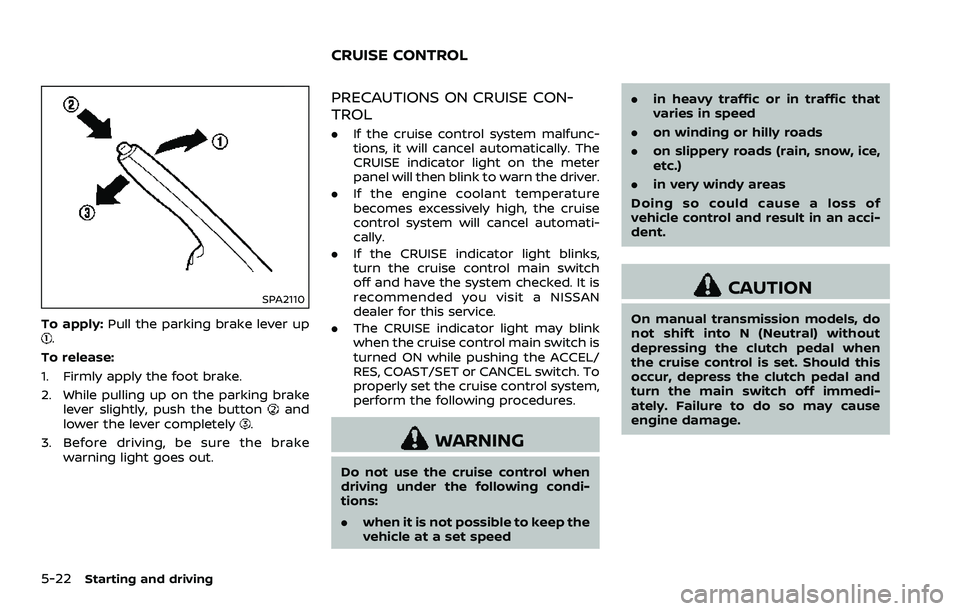
To apply:Pull the parking brake lever up.
To release:
1. Firmly apply the foot brake.
2. While pulling up on the parking brake lever slightly, push the button
and
lower the lever completely.
3. Before driving, be sure the brake warning light goes out.
PRECAUTIONS ON CRUISE CON-
TROL
.If the cruise control system malfunc-
tions, it will cancel automatically. The
CRUISE indicator light on the meter
panel will then blink to warn the driver.
. If the engine coolant temperature
becomes excessively high, the cruise
control system will cancel automati-
cally.
. If the CRUISE indicator light blinks,
turn the cruise control main switch
off and have the system checked. It is
recommended you visit a NISSAN
dealer for this service.
. The CRUISE indicator light may blink
when the cruise control main switch is
turned ON while pushing the ACCEL/
RES, COAST/SET or CANCEL switch. To
properly set the cruise control system,
perform the following procedures.
WARNING
Do not use the cruise control when
driving under the following condi-
tions:
. when it is not possible to keep the
vehicle at a set speed .
in heavy traffic or in traffic that
varies in speed
. on winding or hilly roads
. on slippery roads (rain, snow, ice,
etc.)
. in very windy areas
Doing so could cause a loss of
vehicle control and result in an acci-
dent.
CAUTION
On manual transmission models, do
not shift into N (Neutral) without
depressing the clutch pedal when
the cruise control is set. Should this
occur, depress the clutch pedal and
turn the main switch off immedi-
ately. Failure to do so may cause
engine damage.
CRUISE CONTROL
Page 396 of 453
8-34Do-it-yourself
tion” (US) or “Tire Safety In-
formation” (Canada) in the
Warranty Information Book-
let.
SDI1663
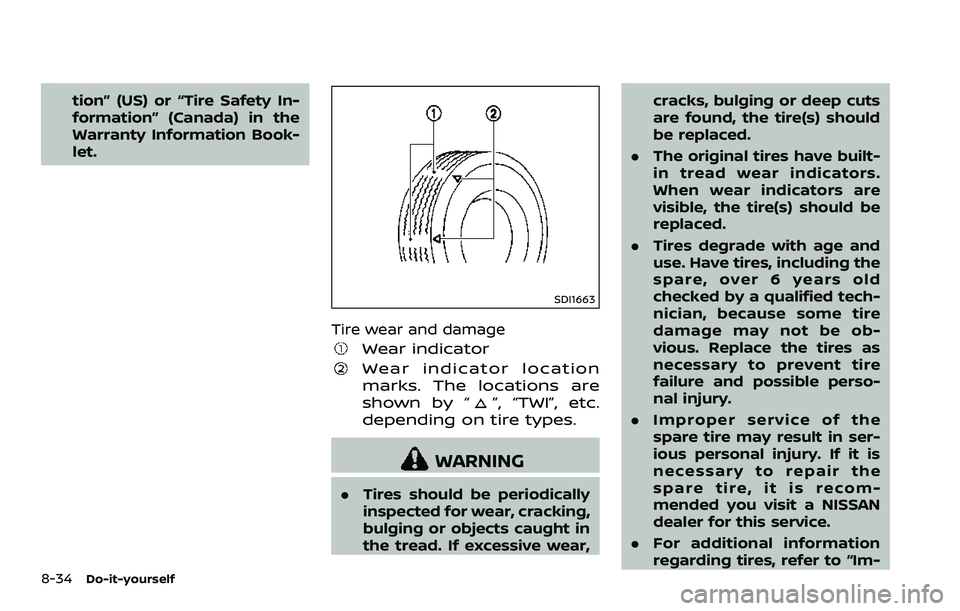
Tire wear and damage
Wear indicator
Wear indicator location
marks. The locations are
shown by “
”, “TWI”, etc.
depending on tire types.
WARNING
. Tires should be periodically
inspected for wear, cracking,
bulging or objects caught in
the tread. If excessive wear, cracks, bulging or deep cuts
are found, the tire(s) should
be replaced.
. The original tires have built-
in tread wear indicators.
When wear indicators are
visible, the tire(s) should be
replaced.
. Tires degrade with age and
use. Have tires, including the
spare, over 6 years old
checked by a qualified tech-
nician, because some tire
damage may not be ob-
vious. Replace the tires as
necessary to prevent tire
failure and possible perso-
nal injury.
. Improper service of the
spare tire may result in ser-
ious personal injury. If it is
necessary to repair the
spare tire, it is recom-
mended you visit a NISSAN
dealer for this service.
. For additional information
regarding tires, refer to “Im-
Page 398 of 453
8-36Do-it-yourself
without warning.
. The use of retread tire is not
recommended.
. For additional information re-
garding tires, refer to “Important
Tire Safety Information” (US) or
“Tire Safety Information” (Cana-
da) in the Warranty Information
Booklet.
Wheel balance
Unbalanced wheels may affect vehicle
handling and tire life. Even with regular
use, wheels can get out of balance.
Therefore, they should be balanced as
required.
Wheel balance service should be per-
formed with the wheels off the vehicle.
Spin balancing the wheels on the vehi-
cle could lead to mechanical damage.
For additional information regarding tires,
refer to “Important Tire Safety Informa-
tion” (US) or “Tire Safety Information”
(Canada) in the NISSAN Warranty Infor-
mation Booklet.
Care of wheels
See “Cleaning exterior” (P.7-2) for details
about care of the wheels.
Spare tire (TEMPORARY USE ONLY
(T-type) spare tire) (if so equipped)
Observe the following precautions if the
T-type spare tire must be used, otherwise
your vehicle could be damaged or in-
volved in an accident.
WARNING
.The T-type spare tire should be
used for emergency use. It should
be replaced with the standard tire
at the first opportunity to avoid
possible tire or differential da-
mage.
. Drive carefully while the TEMPOR-
ARY USE ONLY spare tire is in-
stalled. Avoid sharp turns and
abrupt braking while driving.
. Periodically check spare tire in-
flation pressure. Always keep the
pressure of the TEMPORARY USE
ONLY spare tire at 60 psi (420
kPa, 4.2 bar). Always keep the
pressure of the full size spare tire
(if so equipped) at the recom-
mended pressure for standard tires, as indicated on the Tire
and Loading Information label.
For Tire and Loading Information
label location, see “Tire and Load-
ing Information label” in the index
of this manual.
. With the TEMPORARY USE ONLY
spare tire installed do not drive
your vehicle at speeds faster than
50 MPH (80 km/h).
. When driving on roads covered
with snow or ice, the TEMPORARY
USE ONLY spare tire should be
used on the front wheels and
original tire used on the rear
wheels (drive wheels). Use tire
chains only on the two rear origi-
nal tires.
. Tire tread of the TEMPORARY USE
ONLY spare tire will wear at a
faster rate than the standard tire.
Replace the spare tire as soon as
the tread wear indicators appear.
. Do not use the spare tire on other
vehicles.
. Do not use more than one spare
tire at the same time.
Page 448 of 453
11-4
Headlights bulb replacement ...................... 8-23
Indicator lights.......................................................... 2-15
Interior light control switch .......................... 2-50
Interior lights............................................................. 2-50
Map lights .................................................................... 2-50
Replacement ............................................................. 8-22
Trunk light................................................................... 2-52
Vanity mirror lights ............................................... 2-51
Warning lights, indicator lights and
audible reminders ................................................... 2-11
Xenon headlights................................................... 2-34
Lights check/instrument panel............................ 2-11
Lights, Exterior and interior
light replacement .......................................................... 8-24
Loading information (See vehicle
loading information) ................................................. 10-19
Lock Automatic door locks............................................ 3-6
Door locks....................................................................... 3-5
Power door lock ........................................................ 3-5
Rear hatch lock........................................................ 3-18
Trunk lid ........................................................................\
3-20
Locking with mechanical key ................................. 3-5
Low tire pressure warning light ......................... 2-13
Low tire pressure warning system (See Tire
Pressure Monitoring System (TPMS)) ............... 5-3
M
Maintenance Battery........................................................................\
...... 8-11
General maintenance............................................ 9-2
Inside the vehicle...................................................... 9-3
Maintenance indicators.................................... 2-23
Maintenance log...................................................... 9-14
Maintenance precautions.................................. 8-2
Maintenance requirement................................. 9-2 Maintenance schedules....................................... 9-6
Maintenance under severe
driving conditions .................................................. 9-13
Outside the vehicle ................................................. 9-2
Seat belt maintenance........................................ 1-15
Standard maintenance ........................................ 9-7
Maintenance schedules............................................... 9-6
Malfunction indicator light (MIL)......................... 2-16
Manual front seat adjustment ................................ 1-4
Map lights ........................................................................\
... 2-50
Master warning light.................................................... 2-14
Mechanical key (Intelligent Key system) ........ 3-4
Meter Trip computer .......................................................... 2-23
Meters and gauges ......................................................... 2-5 Instrument brightness control ................... 2-37
Mirror
Inside mirror .............................................................. 3-39
Outside mirrors ....................................................... 3-40
Vanity mirror .............................................................. 3-41
Multi-function controller............................................ 4-4
N
New vehicle break-in .................................................. 5-24
NISSAN Vehicle Immobilizer System ............. 2-30
NISSAN voice recognition system ................... 4-99
No key warning.............................................................. 2-20
O
Odometer........................................................................\
........ 2-6
Off-road recovery ............................................................. 5-6
Oil Capacities and
recommended fluids/lubricants................. 10-2
Changing engine oil and filter ....................... 8-6 Checking engine oil level.................................... 8-6
Engine oil.....................................................................\
.... 8-6
Engine oil viscosity ................................................ 10-7
Oil filter replacement indicator .................. 2-23
Opening the soft top.................................................. 3-23
Operation, Operational indicators .................... 2-19
Outside mirrors .............................................................. 3-40
Overheat, If your vehicle overheats................. 6-17
Owner’s Manual/Service Manual
order information....................................................... 10-26
P
Panic alarm........................................................................\
.. 3-15
Parking Brake break-in ......................................................... 5-28
Parking brake operation................................... 5-21
Parking on hills........................................................ 5-26
Performance dampers .............................................. 5-32
Phone Bluetooth® hands-free phone system
(models with navigation system) ............. 4-76
Bluetooth® hands-free phone system
(models without navigation system) ..... 4-86
Car phone or CB radio ...................................... 4-75
Power Front seat adjustment .......................................... 1-3
Power door lock ........................................................ 3-5
Power outlet.............................................................. 2-42
Power steering ........................................................ 5-27
Power steering fluid ............................................... 8-8
Power windows ...................................................... 2-46
Precautions ........................................................................\
5-22 Audio operation...................................................... 4-30
Braking precautions............................................ 5-27
Child restraints .......................................................... 1-19
Cruise control operations................................ 5-18