flat tire NISSAN 370Z 2018 Owner´s Manual
[x] Cancel search | Manufacturer: NISSAN, Model Year: 2018, Model line: 370Z, Model: NISSAN 370Z 2018Pages: 453, PDF Size: 2.19 MB
Page 339 of 453
These parts are dealer options. Contact
a NISSAN dealer about obtaining these
parts. See “Changing a flat tire (for
models with spare tire)” (P.6-4) for
usage of jacking tools and tire replace-
ment.
Before using emergency tire punc-
ture repair kit
.If any foreign object (for example, a
screw or nail) is embedded in the tire,
do not remove it.
. Check the expiration date of the
sealant (shown on the label attached
to the bottle). Never use a sealant
whose expiration date has passed.
Repairing tire
WARNING
Observe the following precautions
when using the tire repair com-
pound.
.Swallowing the compound is
dangerous. Immediately drink as
much water as possible and seek
prompt medical assistance.
. Rinse well with lots of water if the
compound comes into contact
with skin or eyes. If irritation
persists, seek prompt medical attention.
. Keep the repair compound out of
the reach of children.
. The emergency repair compound
may cause a malfunction of the
tire pressure sensors and cause
the low tire pressure warning
light to illuminate. Have the tire
pressure sensor replaced as soon
as possible.
NOTE:
Do not remove any nails or screws that
have penetrated the tire when perform-
ing repairs.
JVE0014X
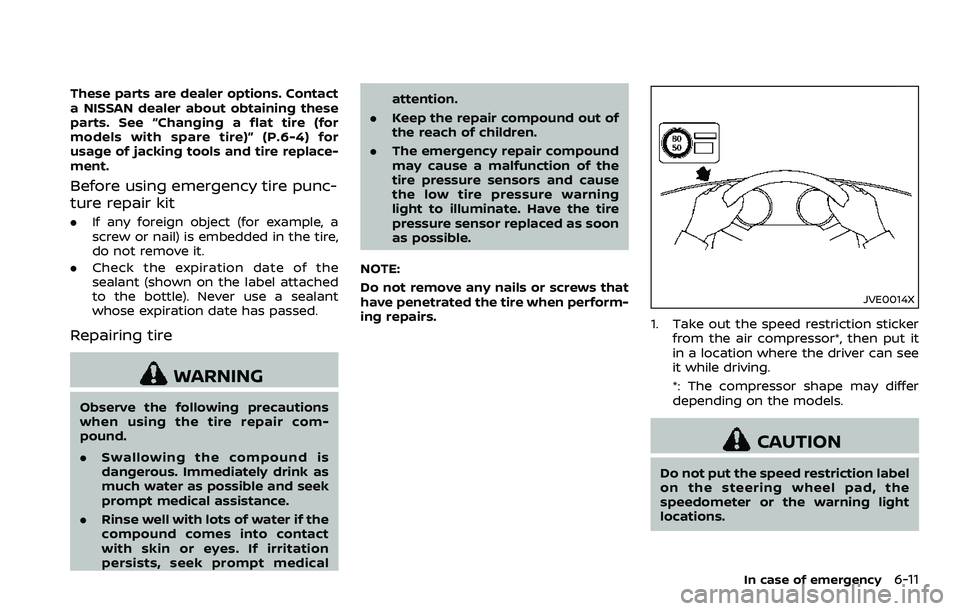
1. Take out the speed restriction sticker from the air compressor*, then put it
in a location where the driver can see
it while driving.
*: The compressor shape may differ
depending on the models.
CAUTION
Do not put the speed restriction label
on the steering wheel pad, the
speedometer or the warning light
locations.
In case of emergency6-11
Page 340 of 453
6-12In case of emergency
SCE0868
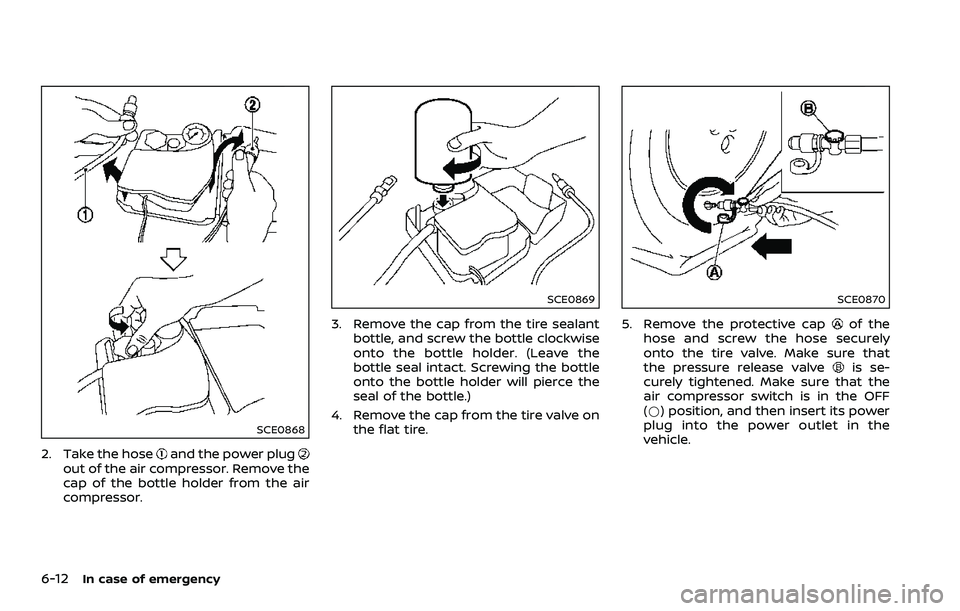
2. Take the hoseand the power plugout of the air compressor. Remove the
cap of the bottle holder from the air
compressor.
SCE0869
3. Remove the cap from the tire sealantbottle, and screw the bottle clockwise
onto the bottle holder. (Leave the
bottle seal intact. Screwing the bottle
onto the bottle holder will pierce the
seal of the bottle.)
4. Remove the cap from the tire valve on the flat tire.
SCE0870
5. Remove the protective capof the
hose and screw the hose securely
onto the tire valve. Make sure that
the pressure release valve
is se-
curely tightened. Make sure that the
air compressor switch is in the OFF
(*) position, and then insert its power
plug into the power outlet in the
vehicle.
Page 341 of 453
SCE0871
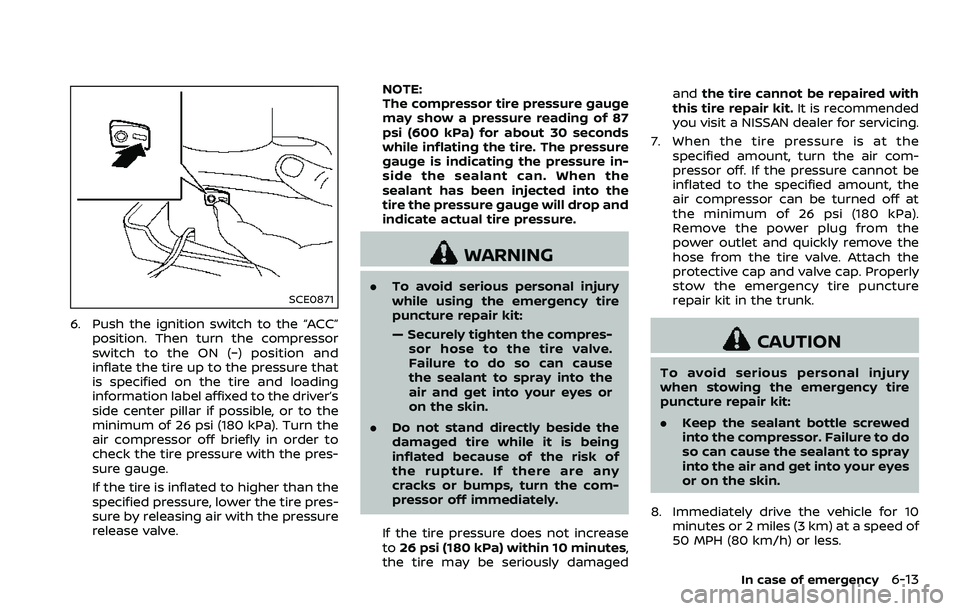
6. Push the ignition switch to the “ACC”position. Then turn the compressor
switch to the ON (−) position and
inflate the tire up to the pressure that
is specified on the tire and loading
information label affixed to the driver’s
side center pillar if possible, or to the
minimum of 26 psi (180 kPa). Turn the
air compressor off briefly in order to
check the tire pressure with the pres-
sure gauge.
If the tire is inflated to higher than the
specified pressure, lower the tire pres-
sure by releasing air with the pressure
release valve. NOTE:
The compressor tire pressure gauge
may show a pressure reading of 87
psi (600 kPa) for about 30 seconds
while inflating the tire. The pressure
gauge is indicating the pressure in-
side the sealant can. When the
sealant has been injected into the
tire the pressure gauge will drop and
indicate actual tire pressure.
WARNING
.
To avoid serious personal injury
while using the emergency tire
puncture repair kit:
— Securely tighten the compres-
sor hose to the tire valve.
Failure to do so can cause
the sealant to spray into the
air and get into your eyes or
on the skin.
. Do not stand directly beside the
damaged tire while it is being
inflated because of the risk of
the rupture. If there are any
cracks or bumps, turn the com-
pressor off immediately.
If the tire pressure does not increase
to 26 psi (180 kPa) within 10 minutes,
the tire may be seriously damaged and
the tire cannot be repaired with
this tire repair kit. It is recommended
you visit a NISSAN dealer for servicing.
7. When the tire pressure is at the specified amount, turn the air com-
pressor off. If the pressure cannot be
inflated to the specified amount, the
air compressor can be turned off at
the minimum of 26 psi (180 kPa).
Remove the power plug from the
power outlet and quickly remove the
hose from the tire valve. Attach the
protective cap and valve cap. Properly
stow the emergency tire puncture
repair kit in the trunk.
CAUTION
To avoid serious personal injury
when stowing the emergency tire
puncture repair kit:
.Keep the sealant bottle screwed
into the compressor. Failure to do
so can cause the sealant to spray
into the air and get into your eyes
or on the skin.
8. Immediately drive the vehicle for 10 minutes or 2 miles (3 km) at a speed of
50 MPH (80 km/h) or less.
In case of emergency6-13
Page 350 of 453
6-22In case of emergency
SCE0836
TOWING RECOMMENDED BY
NISSAN (NISMO models)
CAUTION
Do not tow NISMO models with any
wheel on the ground, or with the
front or rear wheels raised, because
this may cause damage to the front
bumper with an aerodynamic split-
ter, rear bumper with an aerody-
namic diffuser or exhaust pipes.
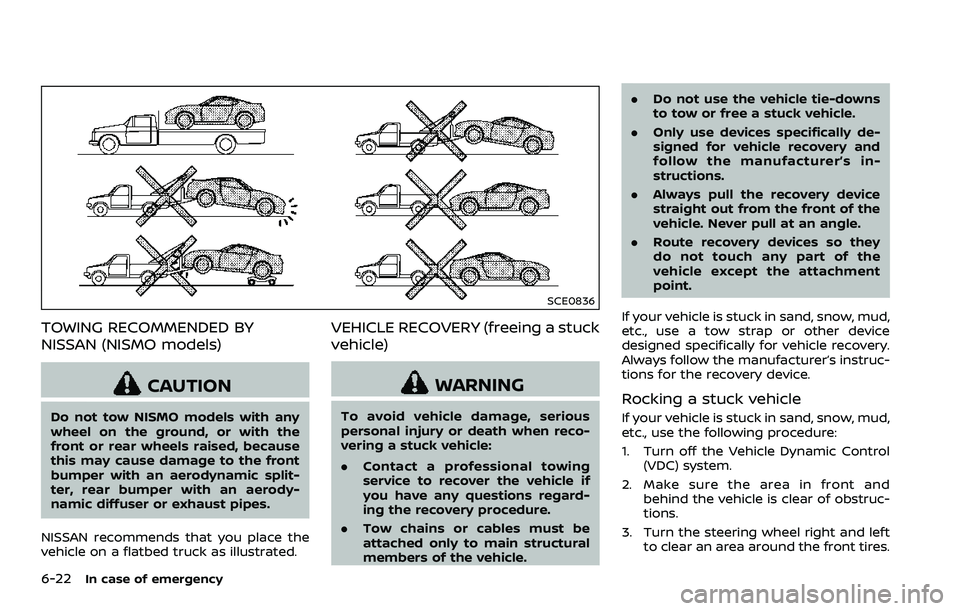
NISSAN recommends that you place the
vehicle on a flatbed truck as illustrated.
VEHICLE RECOVERY (freeing a stuck
vehicle)
WARNING
To avoid vehicle damage, serious
personal injury or death when reco-
vering a stuck vehicle:
. Contact a professional towing
service to recover the vehicle if
you have any questions regard-
ing the recovery procedure.
. Tow chains or cables must be
attached only to main structural
members of the vehicle. .
Do not use the vehicle tie-downs
to tow or free a stuck vehicle.
. Only use devices specifically de-
signed for vehicle recovery and
follow the manufacturer’s in-
structions.
. Always pull the recovery device
straight out from the front of the
vehicle. Never pull at an angle.
. Route recovery devices so they
do not touch any part of the
vehicle except the attachment
point.
If your vehicle is stuck in sand, snow, mud,
etc., use a tow strap or other device
designed specifically for vehicle recovery.
Always follow the manufacturer’s instruc-
tions for the recovery device.
Rocking a stuck vehicle
If your vehicle is stuck in sand, snow, mud,
etc., use the following procedure:
1. Turn off the Vehicle Dynamic Control (VDC) system.
2. Make sure the area in front and behind the vehicle is clear of obstruc-
tions.
3. Turn the steering wheel right and left to clear an area around the front tires.
Page 388 of 453
8-26Do-it-yourself
If you have a flat tire, see “Flat tire” (P.6-
3).
TIRE PRESSURE
Tire Pressure Monitoring System
(TPMS)
This vehicle is equipped with the Tire
Pressure Monitoring System (TPMS). It
monitors tire pressure of all tires except
the spare. When the low tire pressure
warning light is lit and the CHECK TIRE
PRESSURE warning appears on the vehi-
cle information display, one or more of
your tires is significantly under-inflated.
The TPMS will activate only when the
vehicle is driven at speeds above 16 MPH
(25 km/h). Also, this system may not
detect a sudden drop in tire pressure
(for example a flat tire while driving).
For more details, see “Low tire pressure
warning light” (P.2-13), “Tire Pressure Mon-
itoring System (TPMS)” (P.5-3) and “Tire
Pressure Monitoring System (TPMS)” (P.6-
3).
Tire inflation pressure
Check the pressure of the tires
(including the spare) often and al-
ways prior to long distance trips.
The recommended tire pressure
specifications are shown on the
Tire and Loading Information label
under the “Cold Tire Pressure”
heading. The Tire and Loading In-
formation label is affixed to the
driver side center pillar. Tire pres-
sures should be checked regularly
because:
.Most tires naturally lose air over
time.
. Tires can lose air suddenly when
driven over potholes or other
objects or if the vehicle strikes
a curb while parking.
The tire pressures should be
checked when the tires are cold.
The tires are considered COLD after
the vehicle has been parked for 3 or
more hours, or driven less than 1
mile (1.6 km) at moderate speeds.
Incorrect tire pressure, including
under inflation, may adversely affect tire life and vehicle hand-
ling.
WARNING
.
Improperly inflated tires can
fail suddenly and cause an
accident.
. The Gross Vehicle Weight
rating (GVWR) is located on
the F.M.V.S.S./C.M.V.S.S. la-
bel. The vehicle weight ca-
pacity is indicated on the
Tire and Loading Informa-
tion label. Do not load your
vehicle beyond this capacity.
Overloading your vehicle
may result in reduced tire
life, unsafe operating condi-
tions due to premature tire
failure, or unfavorable hand-
ling characteristics and
could also lead to a serious
accident. Loading beyond
the specified capacity may
also result in failure of other
vehicle components.
WHEELS AND TIRES
Page 390 of 453
8-28Do-it-yourself
Cold tire pressure: Inflate
the tires to this pressure
when the tires are cold.
Tires are considered COLD
after the vehicle has been
parked for 3 or more hours,
or driven less than 1 mile
(1.6 km) at moderate
speeds. The recommended
cold tire inflation is set by
the manufacturer to pro-
vide the best balance of
tire wear, vehicle handling,
driveability, tire noise, etc.,
up to the vehicle’s GVWR.
Tire size — see “Tire label-
ing” (P.8-30).
Spare tire size or compact
spare tire size (if so
equipped)
SDI1949
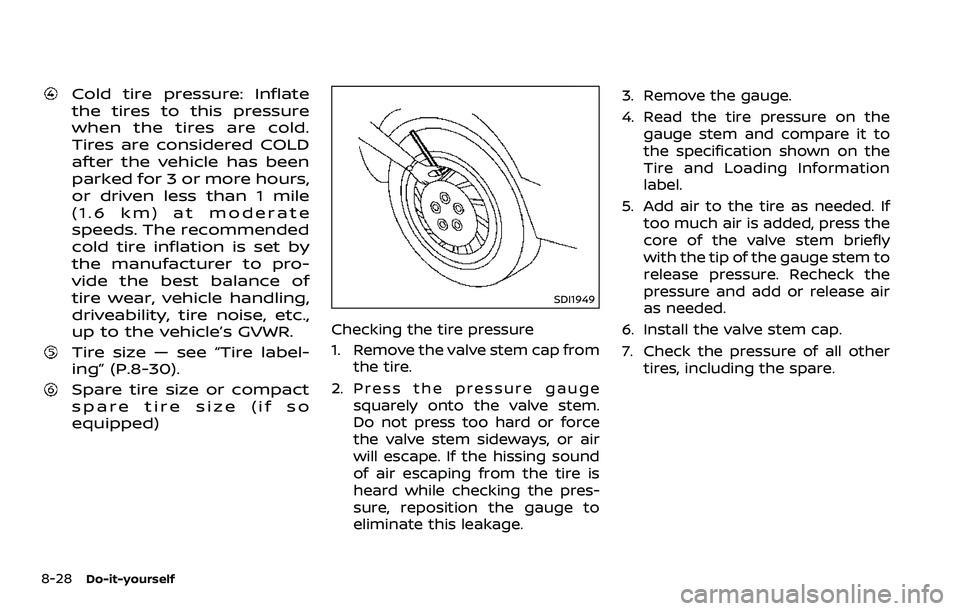
Checking the tire pressure
1. Remove the valve stem cap fromthe tire.
2. Press the pressure gauge squarely onto the valve stem.
Do not press too hard or force
the valve stem sideways, or air
will escape. If the hissing sound
of air escaping from the tire is
heard while checking the pres-
sure, reposition the gauge to
eliminate this leakage. 3. Remove the gauge.
4. Read the tire pressure on the
gauge stem and compare it to
the specification shown on the
Tire and Loading Information
label.
5. Add air to the tire as needed. If too much air is added, press the
core of the valve stem briefly
with the tip of the gauge stem to
release pressure. Recheck the
pressure and add or release air
as needed.
6. Install the valve stem cap.
7. Check the pressure of all other tires, including the spare.
Page 393 of 453
JVM0694X
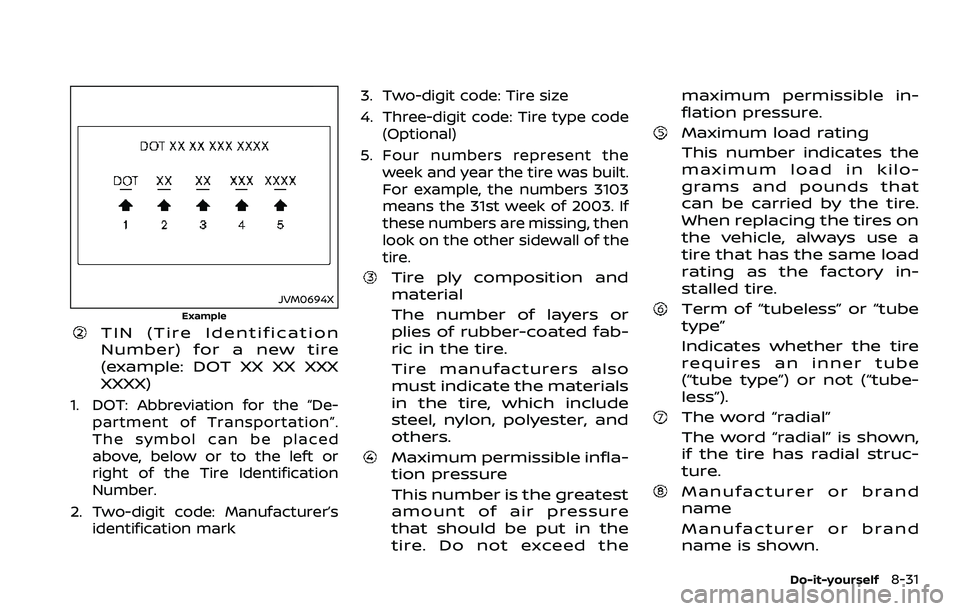
Example
TIN (Tire Identification
Number) for a new tire
(example: DOT XX XX XXX
XXXX)
1. DOT: Abbreviation for the “De-partment of Transportation”.
The symbol can be placed
above, below or to the left or
right of the Tire Identification
Number.
2. Two-digit code: Manufacturer’s identification mark 3. Two-digit code: Tire size
4. Three-digit code: Tire type code
(Optional)
5. Four numbers represent the week and year the tire was built.
For example, the numbers 3103
means the 31st week of 2003. If
these numbers are missing, then
look on the other sidewall of the
tire.
Tire ply composition and
material
The number of layers or
plies of rubber-coated fab-
ric in the tire.
Tire manufacturers also
must indicate the materials
in the tire, which include
steel, nylon, polyester, and
others.
Maximum permissible infla-
tion pressure
This number is the greatest
amount of air pressure
that should be put in the
tire. Do not exceed the maximum permissible in-
flation pressure.
Maximum load rating
This number indicates the
maximum load in kilo-
grams and pounds that
can be carried by the tire.
When replacing the tires on
the vehicle, always use a
tire that has the same load
rating as the factory in-
stalled tire.
Term of “tubeless” or “tube
type”
Indicates whether the tire
requires an inner tube
(“tube type”) or not (“tube-
less”).
The word “radial”
The word “radial” is shown,
if the tire has radial struc-
ture.
Manufacturer or brand
name
Manufacturer or brand
name is shown.
Do-it-yourself8-31
Page 395 of 453
provincial laws before installing studded
tires. Skid and traction capabilities of
studded snow tires, on wet or dry sur-
faces, may be poorer than that of non-
studded snow tires.
TIRE CHAINS
CAUTION
Tire chains/cables should not be
installed on 19-inch size tires. Doing
so will cause damage to the vehicle.
If you plan to use tire chains/cables,
you should install 18-inch size tires
on your vehicle.
Use of tire chains may be prohibited
according to location. Check the local
laws before installing tire chains. When
installing tire chains, make sure they are
the proper size for the tires on your
vehicle and are installed according to
the chain manufacturer’s suggestions.
Use only SAE Class S chains. Class “S”
chains are used on vehicles with re-
stricted tire to vehicle clearance. Vehicles
that can use Class “S” chains are designed
to meet the SAE standard minimum
clearances between the tire and the
closest vehicle suspension or body com-
ponent required to accommodate the use of a winter traction device (tire chains
or cables). The minimum clearances are
determined using the factory equipped
tire size. Other types may damage your
vehicle. Use chain tensioners when re-
commended by the tire chain manufac-
turer to ensure a tight fit. Loose end links
of the tire chain must be secured or
removed to prevent the possibility of
whipping action damage to the fenders
or underbody. If possible, avoid fully load-
ing your vehicle when using tire chains. In
addition, drive at a reduced speed. Other-
wise, your vehicle may be damaged and/
or vehicle handling and performance may
be adversely affected.
Tire chains must be installed only on
the rear wheels and not on the front
wheels.
Never install tire chains on a TEMPORARY
USE ONLY spare tire.
Do not use tire chains on dry roads.
Driving with tire chains in such conditions
can cause damage to the various me-
chanisms of the vehicle due to some
overstress.
CHANGING WHEELS AND TIRES
Tire rotation
Tires cannot be rotated on this
vehicle because the front tires are
a different size than the rear tires.
A pin is on the front brake rotor to
prevent the rear wheels from being
installed in place of the front
wheels. The spare tire can be
installed in place of the front and
rear wheels. When installing the
spare tire in the front wheel, the
hole in the spare tire wheel must be
aligned with the pin on the brake
rotor.
WARNING
.
Retighten the wheel nuts
when the vehicle has been
driven for 600 miles (1,000
km) (also in cases of a flat
tire, etc.).
. For additional information
regarding tires, refer to “Im-
portant Tire Safety Informa-
Do-it-yourself8-33
Page 398 of 453
8-36Do-it-yourself
without warning.
. The use of retread tire is not
recommended.
. For additional information re-
garding tires, refer to “Important
Tire Safety Information” (US) or
“Tire Safety Information” (Cana-
da) in the Warranty Information
Booklet.
Wheel balance
Unbalanced wheels may affect vehicle
handling and tire life. Even with regular
use, wheels can get out of balance.
Therefore, they should be balanced as
required.
Wheel balance service should be per-
formed with the wheels off the vehicle.
Spin balancing the wheels on the vehi-
cle could lead to mechanical damage.
For additional information regarding tires,
refer to “Important Tire Safety Informa-
tion” (US) or “Tire Safety Information”
(Canada) in the NISSAN Warranty Infor-
mation Booklet.
Care of wheels
See “Cleaning exterior” (P.7-2) for details
about care of the wheels.
Spare tire (TEMPORARY USE ONLY
(T-type) spare tire) (if so equipped)
Observe the following precautions if the
T-type spare tire must be used, otherwise
your vehicle could be damaged or in-
volved in an accident.
WARNING
.The T-type spare tire should be
used for emergency use. It should
be replaced with the standard tire
at the first opportunity to avoid
possible tire or differential da-
mage.
. Drive carefully while the TEMPOR-
ARY USE ONLY spare tire is in-
stalled. Avoid sharp turns and
abrupt braking while driving.
. Periodically check spare tire in-
flation pressure. Always keep the
pressure of the TEMPORARY USE
ONLY spare tire at 60 psi (420
kPa, 4.2 bar). Always keep the
pressure of the full size spare tire
(if so equipped) at the recom-
mended pressure for standard tires, as indicated on the Tire
and Loading Information label.
For Tire and Loading Information
label location, see “Tire and Load-
ing Information label” in the index
of this manual.
. With the TEMPORARY USE ONLY
spare tire installed do not drive
your vehicle at speeds faster than
50 MPH (80 km/h).
. When driving on roads covered
with snow or ice, the TEMPORARY
USE ONLY spare tire should be
used on the front wheels and
original tire used on the rear
wheels (drive wheels). Use tire
chains only on the two rear origi-
nal tires.
. Tire tread of the TEMPORARY USE
ONLY spare tire will wear at a
faster rate than the standard tire.
Replace the spare tire as soon as
the tread wear indicators appear.
. Do not use the spare tire on other
vehicles.
. Do not use more than one spare
tire at the same time.
Page 399 of 453
CAUTION
.Do not use tire chains on a
TEMPORARY USE ONLY spare tire.
Tire chains will not fit properly
and may cause damage to the
vehicle.
. Because the TEMPORARY USE
ONLY spare tire is smaller than
the original tire, ground clearance
is reduced. To avoid damage to
the vehicle, do not drive over
obstacles. Also do not drive the
vehicle through an automatic car
wash since it may get caught.
EMERGENCY TIRE PUNCTURE RE-
PAIR KIT (if so equipped)
The emergency tire puncture repair kit
(Emergency Tire Sealant) is supplied with
the vehicle instead of a spare tire. It can
be used to temporarily repair minor tire
punctures.
If possible, have the vehicle towed to a
facility that can repair or replace the flat
tire. Using the emergency tire puncture
repair kit may cause a malfunction of the
tire pressure sensor and cause the low
tire pressure warning light to illuminate.
See “Flat tire” (P.6-3) for more details.
Do-it-yourself8-37