tires NISSAN 370Z 2018 Owner´s Manual
[x] Cancel search | Manufacturer: NISSAN, Model Year: 2018, Model line: 370Z, Model: NISSAN 370Z 2018Pages: 453, PDF Size: 2.19 MB
Page 350 of 453
6-22In case of emergency
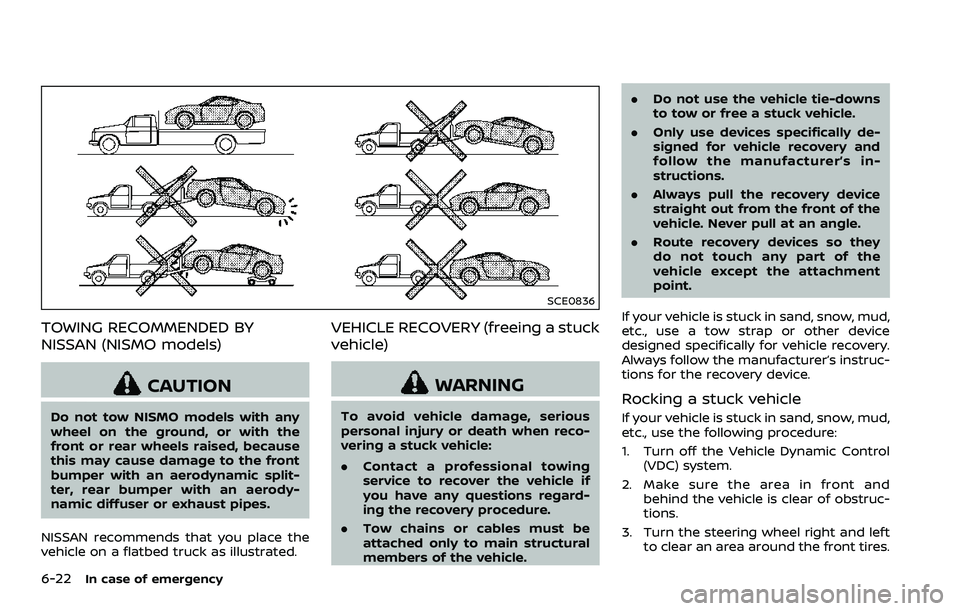
SCE0836
TOWING RECOMMENDED BY
NISSAN (NISMO models)
CAUTION
Do not tow NISMO models with any
wheel on the ground, or with the
front or rear wheels raised, because
this may cause damage to the front
bumper with an aerodynamic split-
ter, rear bumper with an aerody-
namic diffuser or exhaust pipes.
NISSAN recommends that you place the
vehicle on a flatbed truck as illustrated.
VEHICLE RECOVERY (freeing a stuck
vehicle)
WARNING
To avoid vehicle damage, serious
personal injury or death when reco-
vering a stuck vehicle:
. Contact a professional towing
service to recover the vehicle if
you have any questions regard-
ing the recovery procedure.
. Tow chains or cables must be
attached only to main structural
members of the vehicle. .
Do not use the vehicle tie-downs
to tow or free a stuck vehicle.
. Only use devices specifically de-
signed for vehicle recovery and
follow the manufacturer’s in-
structions.
. Always pull the recovery device
straight out from the front of the
vehicle. Never pull at an angle.
. Route recovery devices so they
do not touch any part of the
vehicle except the attachment
point.
If your vehicle is stuck in sand, snow, mud,
etc., use a tow strap or other device
designed specifically for vehicle recovery.
Always follow the manufacturer’s instruc-
tions for the recovery device.
Rocking a stuck vehicle
If your vehicle is stuck in sand, snow, mud,
etc., use the following procedure:
1. Turn off the Vehicle Dynamic Control (VDC) system.
2. Make sure the area in front and behind the vehicle is clear of obstruc-
tions.
3. Turn the steering wheel right and left to clear an area around the front tires.
Page 351 of 453
4. Slowly rock the vehicle forward andbackward.
.Shift back and forth between R(Reverse) and D (Drive) (automatic
transmission models) or 1st and R
(Reverse) (manual transmission
models).
.Apply the accelerator as little as
possible to maintain the rocking
motion.
.Release the accelerator pedal be-fore shifting between R (Reverse)
and D (Drive) (automatic transmis-
sion models) or 1st and R (Reverse)
(manual transmission models).
.Do not spin the tires above 35 MPH(55 km/h).
5. If the vehicle cannot be freed after a few tries, contact a professional tow-
ing service to remove the vehicle.
WARNING
.Stand clear of a stuck vehicle.
. Do not spin your tires at high
speed. This could cause them to
explode and result in serious in-
jury. Parts of your vehicle could
also overheat and be damaged.
In case of emergency6-23
Page 357 of 453
CAUTION
Do not use abrasive cleaners when
washing the wheels.
Aluminum alloy wheels
Wash regularly with a sponge dampened
in a mild soap solution, especially during
winter months in areas where road salt is
used. Salt could discolor the wheels if not
removed.
CAUTION
Follow the directions below to avoid
staining or discoloring the wheels:
.Do not use a cleaner that uses
strong acid or alkali contents to
clean the wheels.
. Do not apply wheel cleaners to
the wheels when they are hot.
The wheel temperature should be
the same as ambient tempera-
ture.
. Rinse the wheel to completely
remove the cleaner within 15
minutes after the cleaner is ap-
plied.
CHROME PARTS
Clean chrome parts regularly with a non-
abrasive chrome polish to maintain the
finish.
TIRE DRESSING
NISSAN does not recommend the use of
tire dressings. Tire manufacturers apply a
coating to the tires to help reduce dis-
coloration of the rubber. If a tire dressing
is applied to the tires, it may react with
the coating and form a compound. This
compound may come off the tire while
driving and stain the vehicle paint.
If you choose to use a tire dressing, take
the following precautions:
.Use a water-based tire dressing. The
coating on the tire dissolves more
easily with an oil-based tire dressing.
. Apply a light coat of tire dressing to
help prevent it from entering the tire
tread/grooves (where it would be
difficult to remove).
. Wipe off excess tire dressing using a
dry towel. Make sure the tire dressing
is completely removed from the tire
tread/grooves.
. Allow the tire dressing to dry as
recommended by tire dressing manu-
facturer. Occasionally remove loose dust from the
interior trim, plastic parts and seats using
a vacuum cleaner or soft bristled brush.
Wipe the vinyl and leather surfaces with a
clean, soft cloth dampened in mild soap
solution, then wipe clean with a dry soft
cloth.
Regular care and cleaning is required in
order to maintain the appearance of the
leather.
Before using any fabric protector, read
the manufacturer’s recommendations.
Some fabric protectors contain chemicals
that may stain or bleach the seat materi-
al.
Use a cloth dampened only with water, to
clean the meter and gauge lens.
WARNING
Do not use water or acidic cleaners
(hot steam cleaners) on the seat. This
can damage the seat or occupant
classification sensor. This can also
affect the operation of the air bag
system and result in serious perso-
nal injury.
Appearance and care7-5
CLEANING INTERIOR
Page 363 of 453
8 Do-it-yourself
Maintenance precautions ....................................................... 8-2
Engine compartment check locations ......................... 8-3VQ37VHR engine model .................................................... 8-3
Engine cooling system .............................................................. 8-4 Checking engine coolant level ..................................... 8-5
Changing engine coolant ................................................. 8-5
Engine oil ........................................................................\
...................... 8-6 Checking engine oil level .................................................. 8-6
Changing engine oil and filter ...................................... 8-6
Automatic Transmission Fluid (ATF) .............................. 8-8
Power steering fluid .................................................................... 8-8
Brake and clutch fluid ................................................................ 8-9 Brake fluid ........................................................................\
............. 8-9
Clutch fluid (Manual transmission models) ..... 8-10
Window washer fluid ............................................................... 8-10
Battery ........................................................................\
........................... 8-11
Jump starting ........................................................................\
... 8-13
Variable voltage control system ..................................... 8-13
Drive belts ........................................................................\
.................. 8-14
Spark plugs ........................................................................\
............... 8-14
Replacing spark plugs ....................................................... 8-15
Air cleaner ........................................................................\
................. 8-15 Windshield wiper blades ....................................................... 8-16
Cleaning ........................................................................\
............. 8-16
Replacing ........................................................................\
.......... 8-16
Brakes ........................................................................\
.......................... 8-17 Self-adjusting brakes ....................................................... 8-17
Brake pad wear warning .............................................. 8-17
Fuses ........................................................................\
............................. 8-18 Engine compartment ...................................................... 8-18
Passenger compartment ............................................. 8-19
Intelligent Key battery replacement ........................... 8-20
Lights ........................................................................\
........................... 8-22 Coupe ........................................................................\
................. 8-22
Roadster ........................................................................\
........... 8-23
Headlights ........................................................................\
....... 8-23
Exterior and interior lights ......................................... 8-24
Wheels and tires ........................................................................\
. 8-26
Tire pressure ........................................................................\
. 8-26
Tire labeling ........................................................................\
.. 8-30
Types of tires ........................................................................\
8-32
Tire chains ........................................................................\
....... 8-33
Changing wheels and tires ....................................... 8-33
Emergency tire puncture repair kit (if
so equipped) ........................................................................\
.. 8-37
Page 388 of 453
8-26Do-it-yourself
If you have a flat tire, see “Flat tire” (P.6-
3).
TIRE PRESSURE
Tire Pressure Monitoring System
(TPMS)
This vehicle is equipped with the Tire
Pressure Monitoring System (TPMS). It
monitors tire pressure of all tires except
the spare. When the low tire pressure
warning light is lit and the CHECK TIRE
PRESSURE warning appears on the vehi-
cle information display, one or more of
your tires is significantly under-inflated.
The TPMS will activate only when the
vehicle is driven at speeds above 16 MPH
(25 km/h). Also, this system may not
detect a sudden drop in tire pressure
(for example a flat tire while driving).
For more details, see “Low tire pressure
warning light” (P.2-13), “Tire Pressure Mon-
itoring System (TPMS)” (P.5-3) and “Tire
Pressure Monitoring System (TPMS)” (P.6-
3).
Tire inflation pressure
Check the pressure of the tires
(including the spare) often and al-
ways prior to long distance trips.
The recommended tire pressure
specifications are shown on the
Tire and Loading Information label
under the “Cold Tire Pressure”
heading. The Tire and Loading In-
formation label is affixed to the
driver side center pillar. Tire pres-
sures should be checked regularly
because:
.Most tires naturally lose air over
time.
. Tires can lose air suddenly when
driven over potholes or other
objects or if the vehicle strikes
a curb while parking.
The tire pressures should be
checked when the tires are cold.
The tires are considered COLD after
the vehicle has been parked for 3 or
more hours, or driven less than 1
mile (1.6 km) at moderate speeds.
Incorrect tire pressure, including
under inflation, may adversely affect tire life and vehicle hand-
ling.
WARNING
.
Improperly inflated tires can
fail suddenly and cause an
accident.
. The Gross Vehicle Weight
rating (GVWR) is located on
the F.M.V.S.S./C.M.V.S.S. la-
bel. The vehicle weight ca-
pacity is indicated on the
Tire and Loading Informa-
tion label. Do not load your
vehicle beyond this capacity.
Overloading your vehicle
may result in reduced tire
life, unsafe operating condi-
tions due to premature tire
failure, or unfavorable hand-
ling characteristics and
could also lead to a serious
accident. Loading beyond
the specified capacity may
also result in failure of other
vehicle components.
WHEELS AND TIRES
Page 389 of 453
.Before taking a long trip, or
whenever you heavily load
your vehicle, use a tire pres-
sure gauge to ensure that
the tire pressures are at the
specified level.
. For additional information
regarding tires, refer to “Im-
portant Tire Safety Informa-
tion” (US) or “Tire Safety
Information” (Canada) in the
Warranty Information Book-
let.
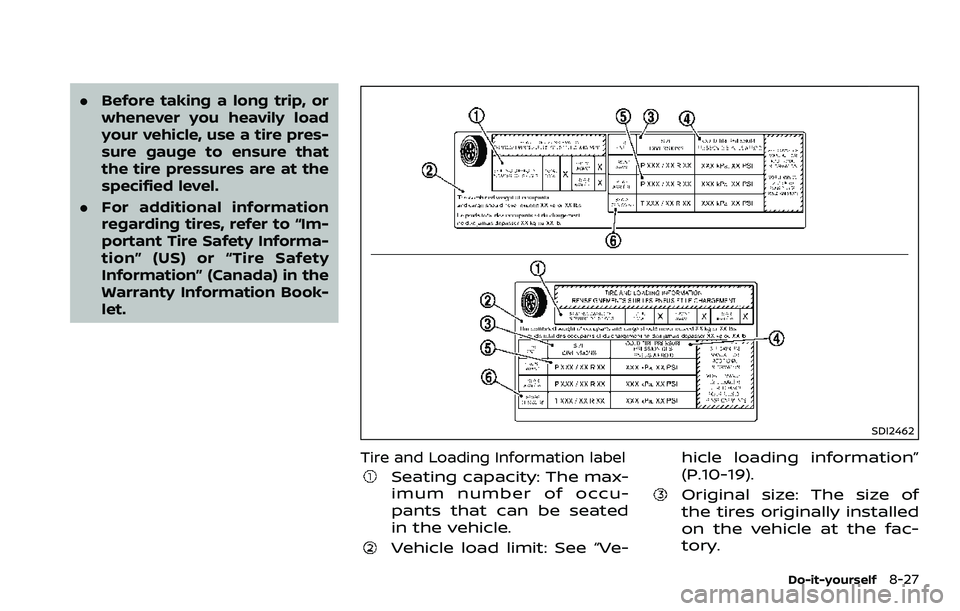
SDI2462
Tire and Loading Information label
Seating capacity: The max-
imum number of occu-
pants that can be seated
in the vehicle.
Vehicle load limit: See “Ve- hicle loading information”
(P.10-19).
Original size: The size of
the tires originally installed
on the vehicle at the fac-
tory.
Do-it-yourself8-27
Page 390 of 453
8-28Do-it-yourself
Cold tire pressure: Inflate
the tires to this pressure
when the tires are cold.
Tires are considered COLD
after the vehicle has been
parked for 3 or more hours,
or driven less than 1 mile
(1.6 km) at moderate
speeds. The recommended
cold tire inflation is set by
the manufacturer to pro-
vide the best balance of
tire wear, vehicle handling,
driveability, tire noise, etc.,
up to the vehicle’s GVWR.
Tire size — see “Tire label-
ing” (P.8-30).
Spare tire size or compact
spare tire size (if so
equipped)
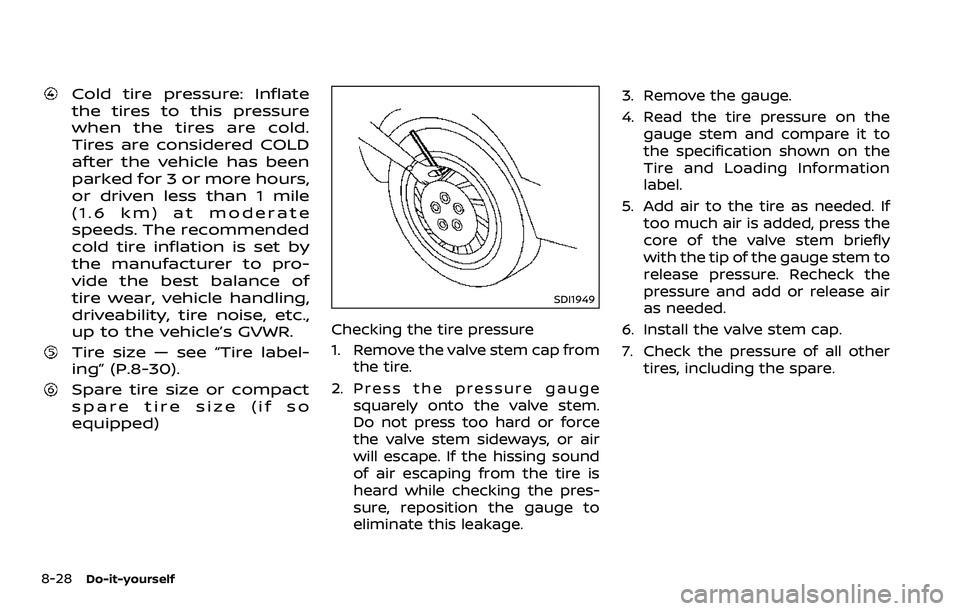
SDI1949
Checking the tire pressure
1. Remove the valve stem cap fromthe tire.
2. Press the pressure gauge squarely onto the valve stem.
Do not press too hard or force
the valve stem sideways, or air
will escape. If the hissing sound
of air escaping from the tire is
heard while checking the pres-
sure, reposition the gauge to
eliminate this leakage. 3. Remove the gauge.
4. Read the tire pressure on the
gauge stem and compare it to
the specification shown on the
Tire and Loading Information
label.
5. Add air to the tire as needed. If too much air is added, press the
core of the valve stem briefly
with the tip of the gauge stem to
release pressure. Recheck the
pressure and add or release air
as needed.
6. Install the valve stem cap.
7. Check the pressure of all other tires, including the spare.
Page 392 of 453
8-30Do-it-yourself
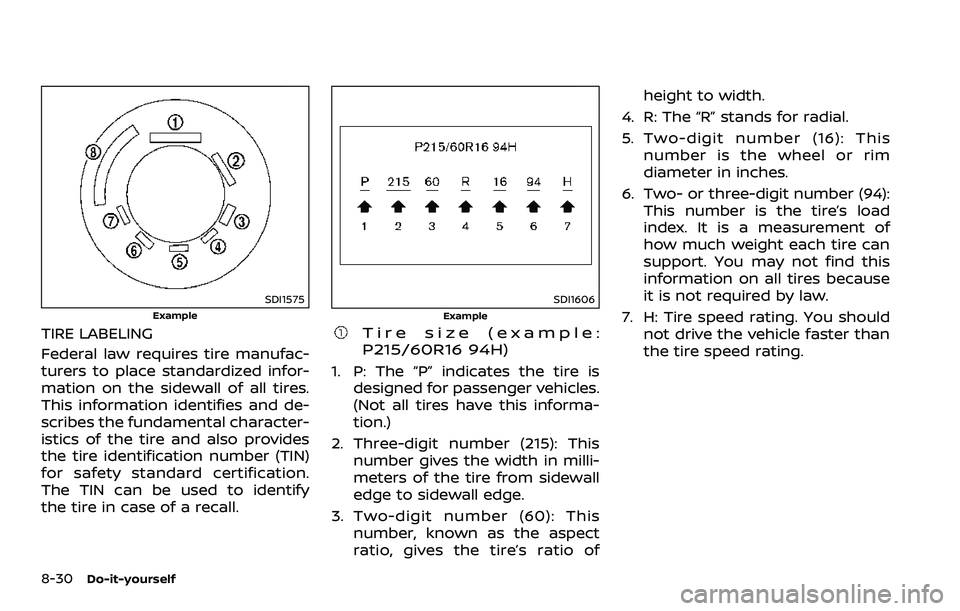
SDI1575
Example
TIRE LABELING
Federal law requires tire manufac-
turers to place standardized infor-
mation on the sidewall of all tires.
This information identifies and de-
scribes the fundamental character-
istics of the tire and also provides
the tire identification number (TIN)
for safety standard certification.
The TIN can be used to identify
the tire in case of a recall.
SDI1606
Example
Tire size (example:
P215/60R16 94H)
1. P: The “P” indicates the tire isdesigned for passenger vehicles.
(Not all tires have this informa-
tion.)
2. Three-digit number (215): This number gives the width in milli-
meters of the tire from sidewall
edge to sidewall edge.
3. Two-digit number (60): This number, known as the aspect
ratio, gives the tire’s ratio of height to width.
4. R: The “R” stands for radial.
5. Two-digit number (16): This number is the wheel or rim
diameter in inches.
6. Two- or three-digit number (94): This number is the tire’s load
index. It is a measurement of
how much weight each tire can
support. You may not find this
information on all tires because
it is not required by law.
7. H: Tire speed rating. You should not drive the vehicle faster than
the tire speed rating.
Page 393 of 453
JVM0694X
Example
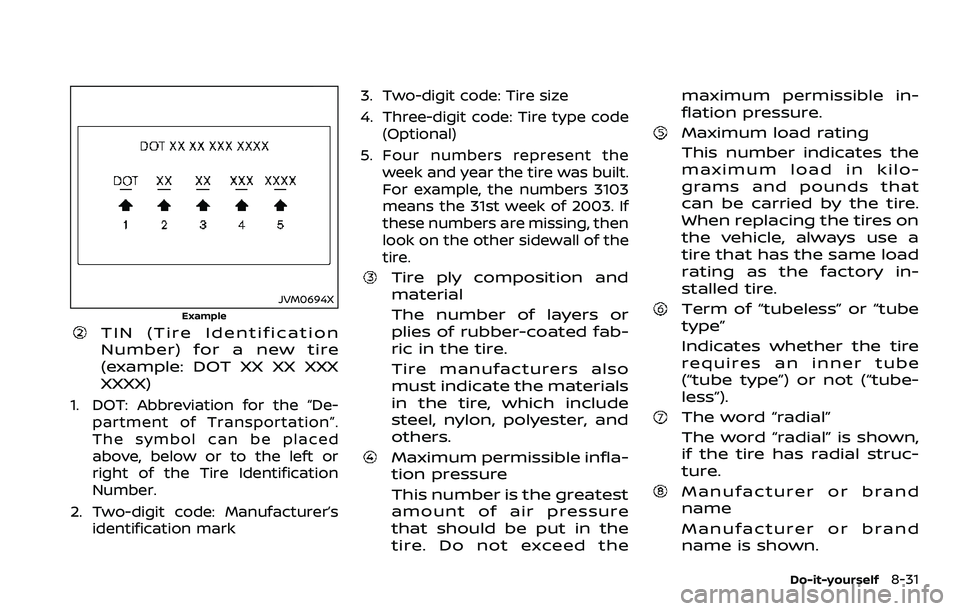
TIN (Tire Identification
Number) for a new tire
(example: DOT XX XX XXX
XXXX)
1. DOT: Abbreviation for the “De-partment of Transportation”.
The symbol can be placed
above, below or to the left or
right of the Tire Identification
Number.
2. Two-digit code: Manufacturer’s identification mark 3. Two-digit code: Tire size
4. Three-digit code: Tire type code
(Optional)
5. Four numbers represent the week and year the tire was built.
For example, the numbers 3103
means the 31st week of 2003. If
these numbers are missing, then
look on the other sidewall of the
tire.
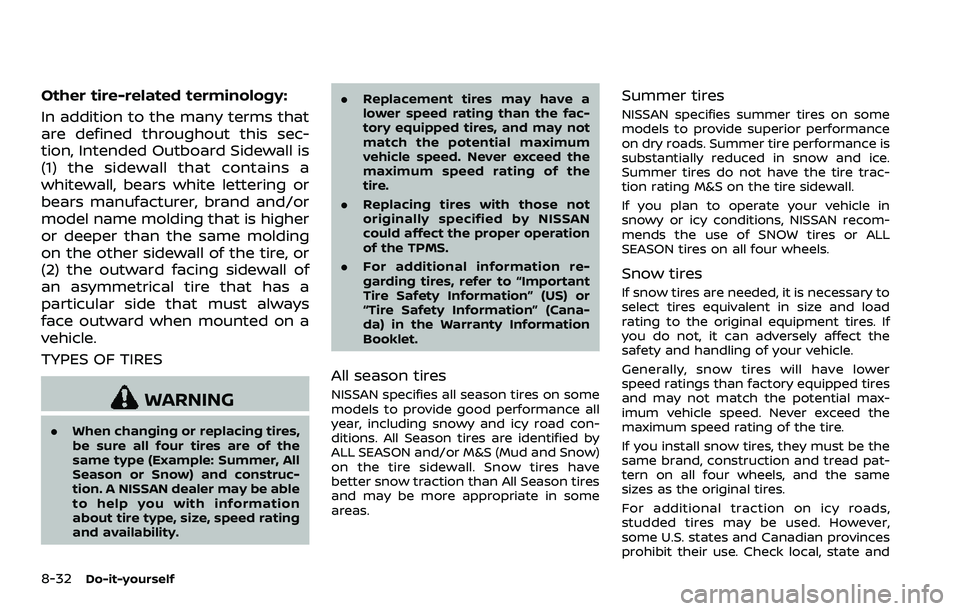
Tire ply composition and
material
The number of layers or
plies of rubber-coated fab-
ric in the tire.
Tire manufacturers also
must indicate the materials
in the tire, which include
steel, nylon, polyester, and
others.
Maximum permissible infla-
tion pressure
This number is the greatest
amount of air pressure
that should be put in the
tire. Do not exceed the maximum permissible in-
flation pressure.
Maximum load rating
This number indicates the
maximum load in kilo-
grams and pounds that
can be carried by the tire.
When replacing the tires on
the vehicle, always use a
tire that has the same load
rating as the factory in-
stalled tire.
Term of “tubeless” or “tube
type”
Indicates whether the tire
requires an inner tube
(“tube type”) or not (“tube-
less”).
The word “radial”
The word “radial” is shown,
if the tire has radial struc-
ture.
Manufacturer or brand
name
Manufacturer or brand
name is shown.
Do-it-yourself8-31
Page 394 of 453
8-32Do-it-yourself
Other tire-related terminology:
In addition to the many terms that
are defined throughout this sec-
tion, Intended Outboard Sidewall is
(1) the sidewall that contains a
whitewall, bears white lettering or
bears manufacturer, brand and/or
model name molding that is higher
or deeper than the same molding
on the other sidewall of the tire, or
(2) the outward facing sidewall of
an asymmetrical tire that has a
particular side that must always
face outward when mounted on a
vehicle.
TYPES OF TIRES
WARNING
.When changing or replacing tires,
be sure all four tires are of the
same type (Example: Summer, All
Season or Snow) and construc-
tion. A NISSAN dealer may be able
to help you with information
about tire type, size, speed rating
and availability. .
Replacement tires may have a
lower speed rating than the fac-
tory equipped tires, and may not
match the potential maximum
vehicle speed. Never exceed the
maximum speed rating of the
tire.
. Replacing tires with those not
originally specified by NISSAN
could affect the proper operation
of the TPMS.
. For additional information re-
garding tires, refer to “Important
Tire Safety Information” (US) or
“Tire Safety Information” (Cana-
da) in the Warranty Information
Booklet.
All season tires
NISSAN specifies all season tires on some
models to provide good performance all
year, including snowy and icy road con-
ditions. All Season tires are identified by
ALL SEASON and/or M&S (Mud and Snow)
on the tire sidewall. Snow tires have
better snow traction than All Season tires
and may be more appropriate in some
areas.
Summer tires
NISSAN specifies summer tires on some
models to provide superior performance
on dry roads. Summer tire performance is
substantially reduced in snow and ice.
Summer tires do not have the tire trac-
tion rating M&S on the tire sidewall.
If you plan to operate your vehicle in
snowy or icy conditions, NISSAN recom-
mends the use of SNOW tires or ALL
SEASON tires on all four wheels.
Snow tires
If snow tires are needed, it is necessary to
select tires equivalent in size and load
rating to the original equipment tires. If
you do not, it can adversely affect the
safety and handling of your vehicle.
Generally, snow tires will have lower
speed ratings than factory equipped tires
and may not match the potential max-
imum vehicle speed. Never exceed the
maximum speed rating of the tire.
If you install snow tires, they must be the
same brand, construction and tread pat-
tern on all four wheels, and the same
sizes as the original tires.
For additional traction on icy roads,
studded tires may be used. However,
some U.S. states and Canadian provinces
prohibit their use. Check local, state and