wheel NISSAN 370Z 2018 Owner´s Manual
[x] Cancel search | Manufacturer: NISSAN, Model Year: 2018, Model line: 370Z, Model: NISSAN 370Z 2018Pages: 453, PDF Size: 2.19 MB
Page 335 of 453
SCE0504
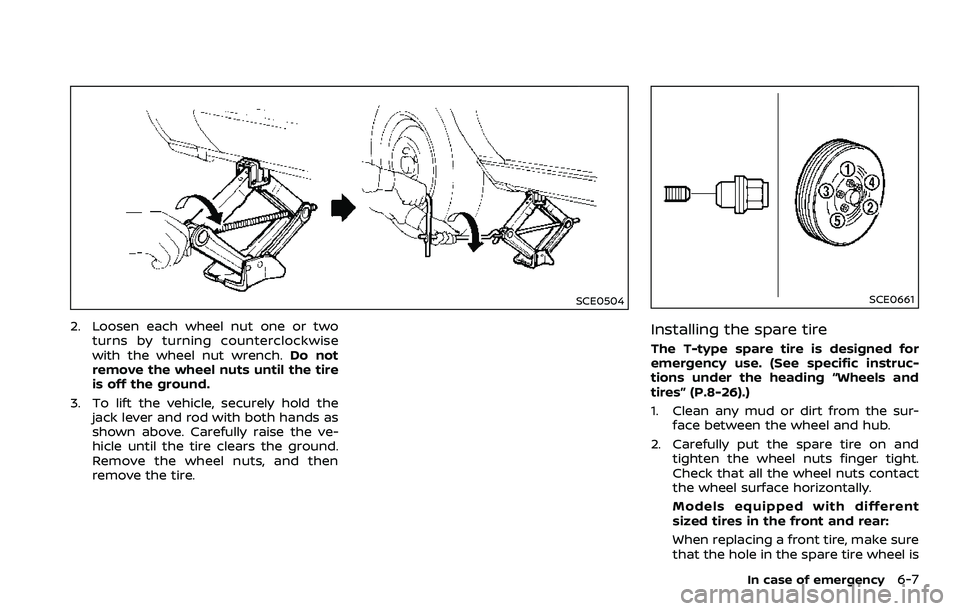
2. Loosen each wheel nut one or twoturns by turning counterclockwise
with the wheel nut wrench. Do not
remove the wheel nuts until the tire
is off the ground.
3. To lift the vehicle, securely hold the jack lever and rod with both hands as
shown above. Carefully raise the ve-
hicle until the tire clears the ground.
Remove the wheel nuts, and then
remove the tire.
SCE0661
Installing the spare tire
The T-type spare tire is designed for
emergency use. (See specific instruc-
tions under the heading “Wheels and
tires” (P.8-26).)
1. Clean any mud or dirt from the sur-face between the wheel and hub.
2. Carefully put the spare tire on and tighten the wheel nuts finger tight.
Check that all the wheel nuts contact
the wheel surface horizontally.
Models equipped with different
sized tires in the front and rear:
When replacing a front tire, make sure
that the hole in the spare tire wheel is
In case of emergency6-7
Page 336 of 453
6-8In case of emergency
aligned with the pin on the brake
rotor.
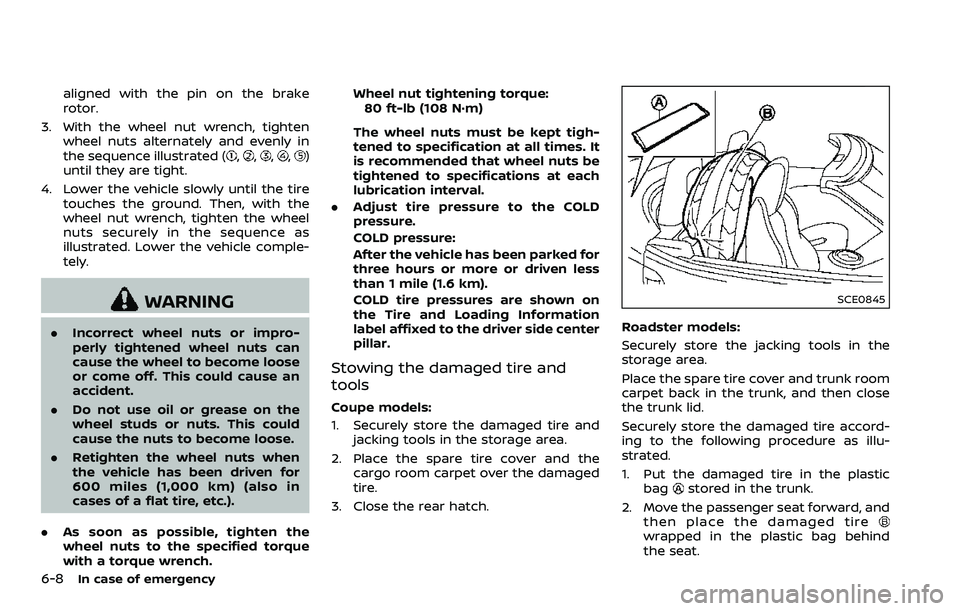
3. With the wheel nut wrench, tighten wheel nuts alternately and evenly in
the sequence illustrated (
,,,,)
until they are tight.
4. Lower the vehicle slowly until the tire touches the ground. Then, with the
wheel nut wrench, tighten the wheel
nuts securely in the sequence as
illustrated. Lower the vehicle comple-
tely.
WARNING
.Incorrect wheel nuts or impro-
perly tightened wheel nuts can
cause the wheel to become loose
or come off. This could cause an
accident.
. Do not use oil or grease on the
wheel studs or nuts. This could
cause the nuts to become loose.
. Retighten the wheel nuts when
the vehicle has been driven for
600 miles (1,000 km) (also in
cases of a flat tire, etc.).
. As soon as possible, tighten the
wheel nuts to the specified torque
with a torque wrench. Wheel nut tightening torque:
80 ft-lb (108 N·m)
The wheel nuts must be kept tigh-
tened to specification at all times. It
is recommended that wheel nuts be
tightened to specifications at each
lubrication interval.
. Adjust tire pressure to the COLD
pressure.
COLD pressure:
After the vehicle has been parked for
three hours or more or driven less
than 1 mile (1.6 km).
COLD tire pressures are shown on
the Tire and Loading Information
label affixed to the driver side center
pillar.
Stowing the damaged tire and
tools
Coupe models:
1. Securely store the damaged tire and
jacking tools in the storage area.
2. Place the spare tire cover and the cargo room carpet over the damaged
tire.
3. Close the rear hatch.
SCE0845
Roadster models:
Securely store the jacking tools in the
storage area.
Place the spare tire cover and trunk room
carpet back in the trunk, and then close
the trunk lid.
Securely store the damaged tire accord-
ing to the following procedure as illu-
strated.
1. Put the damaged tire in the plastic bag
stored in the trunk.
2. Move the passenger seat forward, and then place the damaged tire
wrapped in the plastic bag behind
the seat.
Page 337 of 453
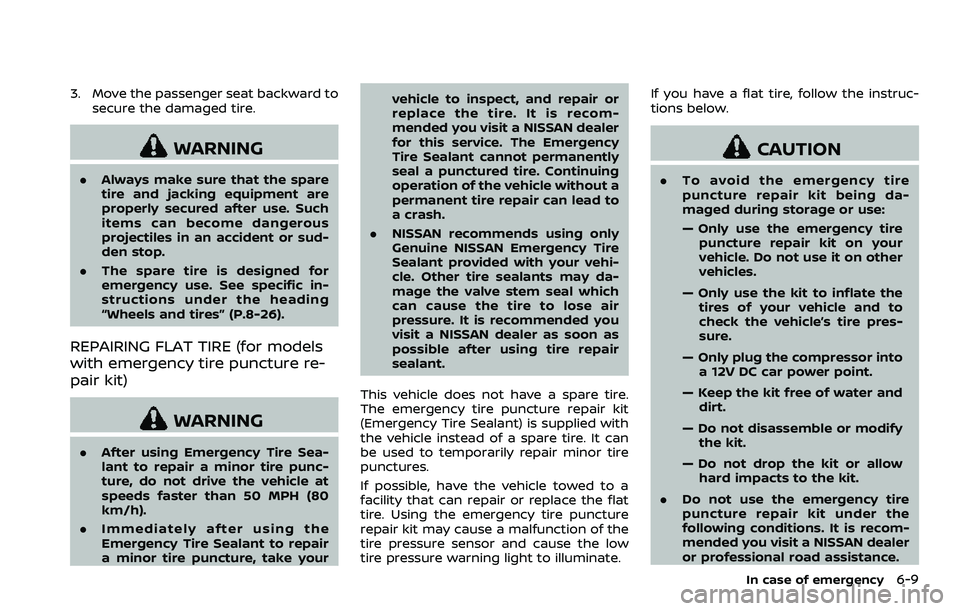
3. Move the passenger seat backward tosecure the damaged tire.
WARNING
.Always make sure that the spare
tire and jacking equipment are
properly secured after use. Such
items can become dangerous
projectiles in an accident or sud-
den stop.
. The spare tire is designed for
emergency use. See specific in-
structions under the heading
“Wheels and tires” (P.8-26).
REPAIRING FLAT TIRE (for models
with emergency tire puncture re-
pair kit)
WARNING
.After using Emergency Tire Sea-
lant to repair a minor tire punc-
ture, do not drive the vehicle at
speeds faster than 50 MPH (80
km/h).
. Immediately after using the
Emergency Tire Sealant to repair
a minor tire puncture, take your vehicle to inspect, and repair or
replace the tire. It is recom-
mended you visit a NISSAN dealer
for this service. The Emergency
Tire Sealant cannot permanently
seal a punctured tire. Continuing
operation of the vehicle without a
permanent tire repair can lead to
a crash.
. NISSAN recommends using only
Genuine NISSAN Emergency Tire
Sealant provided with your vehi-
cle. Other tire sealants may da-
mage the valve stem seal which
can cause the tire to lose air
pressure. It is recommended you
visit a NISSAN dealer as soon as
possible after using tire repair
sealant.
This vehicle does not have a spare tire.
The emergency tire puncture repair kit
(Emergency Tire Sealant) is supplied with
the vehicle instead of a spare tire. It can
be used to temporarily repair minor tire
punctures.
If possible, have the vehicle towed to a
facility that can repair or replace the flat
tire. Using the emergency tire puncture
repair kit may cause a malfunction of the
tire pressure sensor and cause the low
tire pressure warning light to illuminate. If you have a flat tire, follow the instruc-
tions below.
CAUTION
.
To avoid the emergency tire
puncture repair kit being da-
maged during storage or use:
— Only use the emergency tire
puncture repair kit on your
vehicle. Do not use it on other
vehicles.
— Only use the kit to inflate the tires of your vehicle and to
check the vehicle’s tire pres-
sure.
— Only plug the compressor into a 12V DC car power point.
— Keep the kit free of water and dirt.
— Do not disassemble or modify the kit.
— Do not drop the kit or allow hard impacts to the kit.
. Do not use the emergency tire
puncture repair kit under the
following conditions. It is recom-
mended you visit a NISSAN dealer
or professional road assistance.
In case of emergency6-9
Page 338 of 453
6-10In case of emergency
— when the sealant has passedits expiration date (shown on
the label attached to the bot-
tle)
— when the cut or the puncture is approximately 0.25 in (6
mm) or longer
— when the tire sidewall is da- maged
— when the vehicle has been driven with extremely low tire
pressure
— when the tire has come off the inside or the outside of the
wheel.
— when the tire wheel is da- maged
— when two or more tires are flat
Stopping the vehicle
1. Safely move the vehicle off the road and away from traffic.
2. Turn on the hazard warning flashers.
3. Park on a level surface and apply the parking brake.
4. Automatic Transmission models:
Move the shift lever to the P (Park) position.
Manual Transmission models:
Move the shift lever to the R (Reverse)
position.
5. Turn off the engine.
6. Raise the hood to warn other traffic and to signal professional road assis-
tance personnel that you need assis-
tance.
7. Have all passengers get out of the vehicle and stand in a safe place, away
from traffic and clear of the vehicle.
WARNING
Make sure the parking brake is se-
curely applied and the manual trans-
mission is shifted into R (Reverse) or
the automatic transmission into P
(Park).
.Never repair tires when the vehi-
cle is on a slope, ice or slippery
areas. This is hazardous.
. Never repair tires if oncoming
traffic is close to your vehicle.
Wait for professional road assis-
tance.
JVE0122X
Getting emergency tire puncture
repair kit
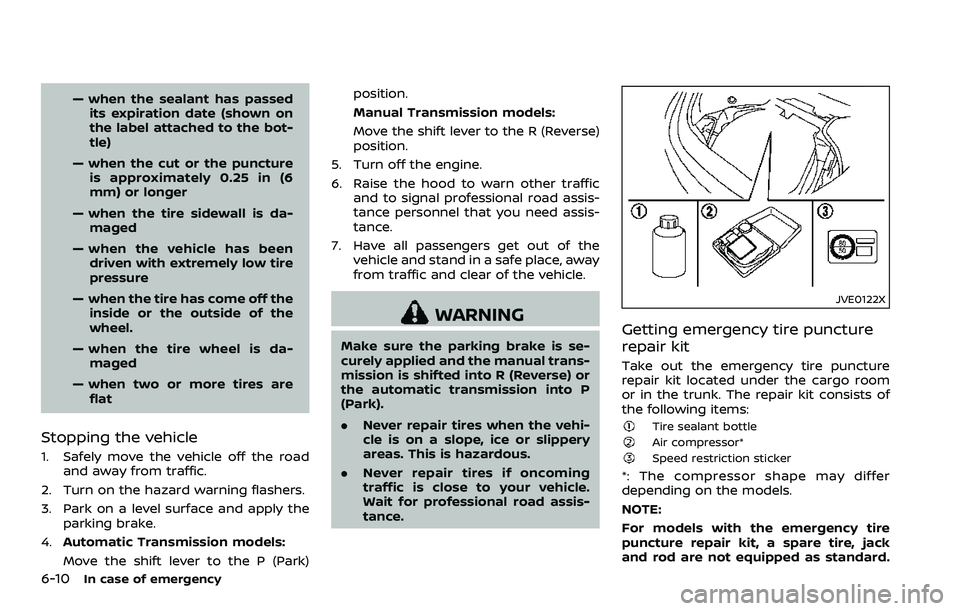
Take out the emergency tire puncture
repair kit located under the cargo room
or in the trunk. The repair kit consists of
the following items:
Tire sealant bottleAir compressor*Speed restriction sticker
*: The compressor shape may differ
depending on the models.
NOTE:
For models with the emergency tire
puncture repair kit, a spare tire, jack
and rod are not equipped as standard.
Page 339 of 453
These parts are dealer options. Contact
a NISSAN dealer about obtaining these
parts. See “Changing a flat tire (for
models with spare tire)” (P.6-4) for
usage of jacking tools and tire replace-
ment.
Before using emergency tire punc-
ture repair kit
.If any foreign object (for example, a
screw or nail) is embedded in the tire,
do not remove it.
. Check the expiration date of the
sealant (shown on the label attached
to the bottle). Never use a sealant
whose expiration date has passed.
Repairing tire
WARNING
Observe the following precautions
when using the tire repair com-
pound.
.Swallowing the compound is
dangerous. Immediately drink as
much water as possible and seek
prompt medical assistance.
. Rinse well with lots of water if the
compound comes into contact
with skin or eyes. If irritation
persists, seek prompt medical attention.
. Keep the repair compound out of
the reach of children.
. The emergency repair compound
may cause a malfunction of the
tire pressure sensors and cause
the low tire pressure warning
light to illuminate. Have the tire
pressure sensor replaced as soon
as possible.
NOTE:
Do not remove any nails or screws that
have penetrated the tire when perform-
ing repairs.
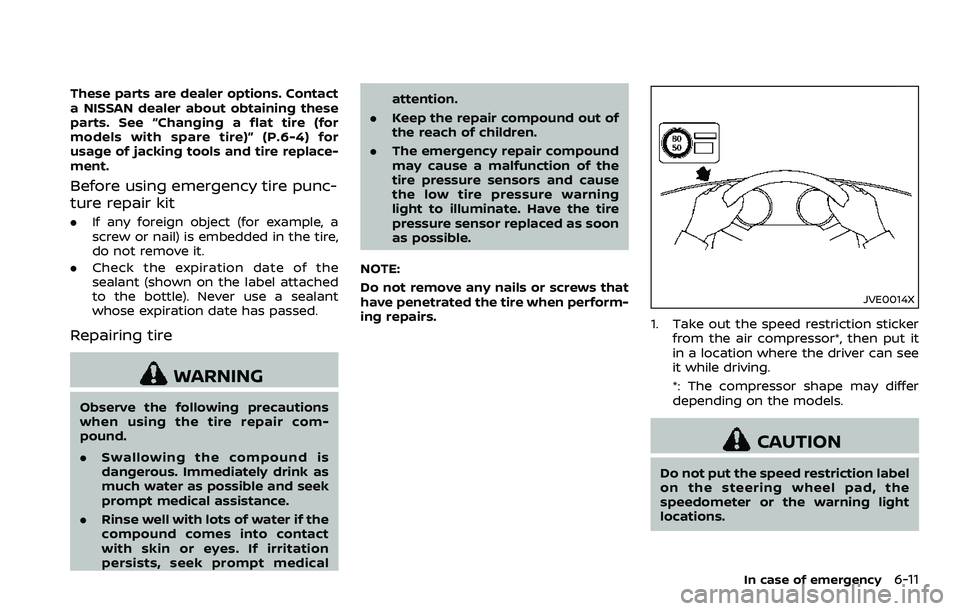
JVE0014X
1. Take out the speed restriction sticker from the air compressor*, then put it
in a location where the driver can see
it while driving.
*: The compressor shape may differ
depending on the models.
CAUTION
Do not put the speed restriction label
on the steering wheel pad, the
speedometer or the warning light
locations.
In case of emergency6-11
Page 348 of 453
6-20In case of emergency
SCE0792
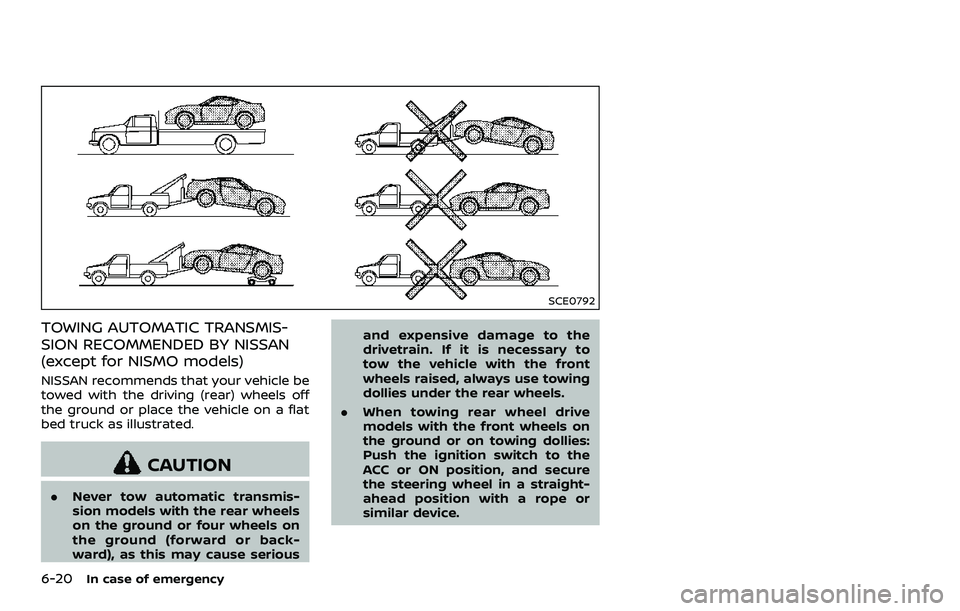
TOWING AUTOMATIC TRANSMIS-
SION RECOMMENDED BY NISSAN
(except for NISMO models)
NISSAN recommends that your vehicle be
towed with the driving (rear) wheels off
the ground or place the vehicle on a flat
bed truck as illustrated.
CAUTION
.Never tow automatic transmis-
sion models with the rear wheels
on the ground or four wheels on
the ground (forward or back-
ward), as this may cause serious and expensive damage to the
drivetrain. If it is necessary to
tow the vehicle with the front
wheels raised, always use towing
dollies under the rear wheels.
. When towing rear wheel drive
models with the front wheels on
the ground or on towing dollies:
Push the ignition switch to the
ACC or ON position, and secure
the steering wheel in a straight-
ahead position with a rope or
similar device.
Page 349 of 453
JVE0415X
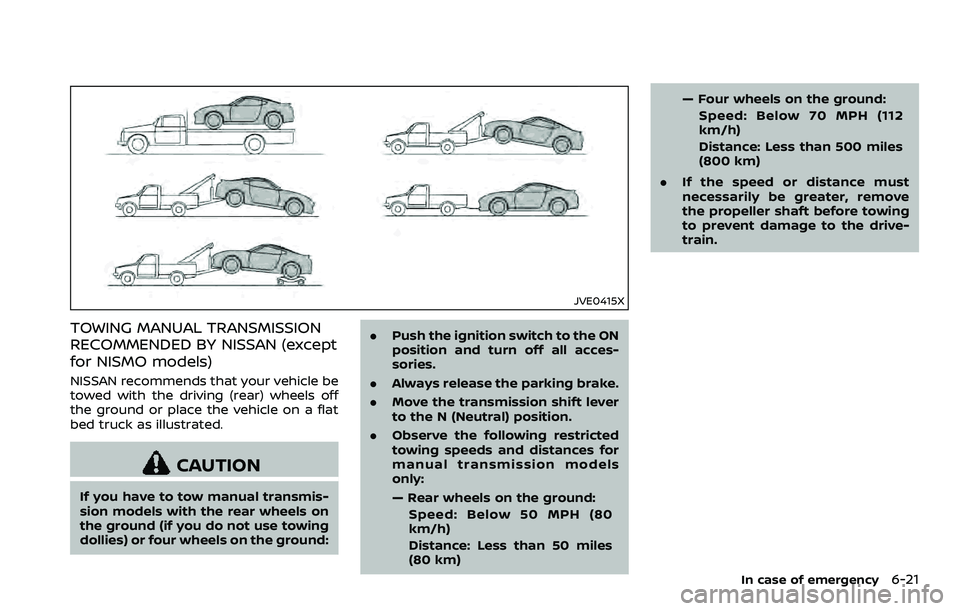
TOWING MANUAL TRANSMISSION
RECOMMENDED BY NISSAN (except
for NISMO models)
NISSAN recommends that your vehicle be
towed with the driving (rear) wheels off
the ground or place the vehicle on a flat
bed truck as illustrated.
CAUTION
If you have to tow manual transmis-
sion models with the rear wheels on
the ground (if you do not use towing
dollies) or four wheels on the ground:.
Push the ignition switch to the ON
position and turn off all acces-
sories.
. Always release the parking brake.
. Move the transmission shift lever
to the N (Neutral) position.
. Observe the following restricted
towing speeds and distances for
manual transmission models
only:
— Rear wheels on the ground:
Speed: Below 50 MPH (80
km/h)
Distance: Less than 50 miles
(80 km) — Four wheels on the ground:
Speed: Below 70 MPH (112
km/h)
Distance: Less than 500 miles
(800 km)
. If the speed or distance must
necessarily be greater, remove
the propeller shaft before towing
to prevent damage to the drive-
train.
In case of emergency6-21
Page 350 of 453
6-22In case of emergency
SCE0836
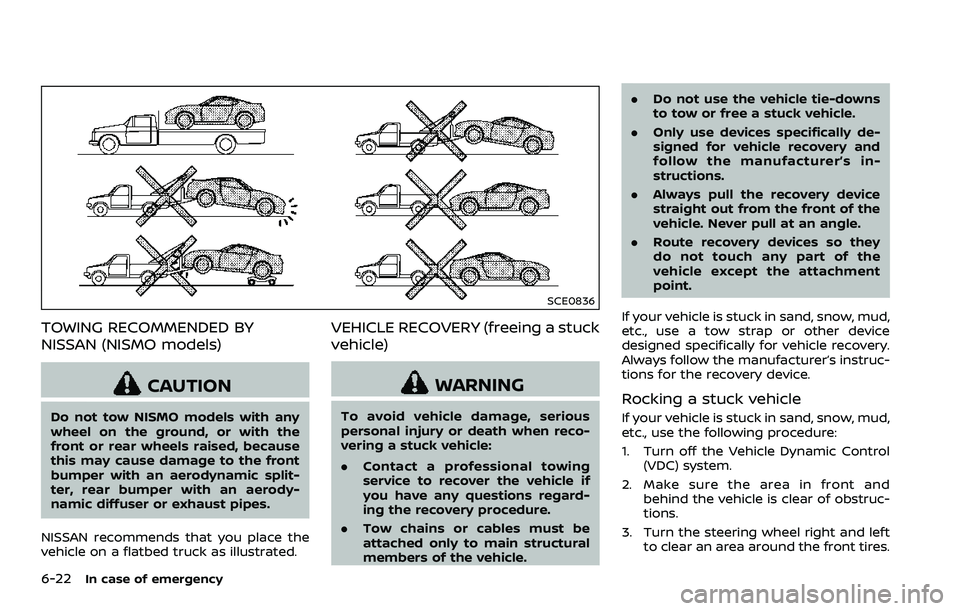
TOWING RECOMMENDED BY
NISSAN (NISMO models)
CAUTION
Do not tow NISMO models with any
wheel on the ground, or with the
front or rear wheels raised, because
this may cause damage to the front
bumper with an aerodynamic split-
ter, rear bumper with an aerody-
namic diffuser or exhaust pipes.
NISSAN recommends that you place the
vehicle on a flatbed truck as illustrated.
VEHICLE RECOVERY (freeing a stuck
vehicle)
WARNING
To avoid vehicle damage, serious
personal injury or death when reco-
vering a stuck vehicle:
. Contact a professional towing
service to recover the vehicle if
you have any questions regard-
ing the recovery procedure.
. Tow chains or cables must be
attached only to main structural
members of the vehicle. .
Do not use the vehicle tie-downs
to tow or free a stuck vehicle.
. Only use devices specifically de-
signed for vehicle recovery and
follow the manufacturer’s in-
structions.
. Always pull the recovery device
straight out from the front of the
vehicle. Never pull at an angle.
. Route recovery devices so they
do not touch any part of the
vehicle except the attachment
point.
If your vehicle is stuck in sand, snow, mud,
etc., use a tow strap or other device
designed specifically for vehicle recovery.
Always follow the manufacturer’s instruc-
tions for the recovery device.
Rocking a stuck vehicle
If your vehicle is stuck in sand, snow, mud,
etc., use the following procedure:
1. Turn off the Vehicle Dynamic Control (VDC) system.
2. Make sure the area in front and behind the vehicle is clear of obstruc-
tions.
3. Turn the steering wheel right and left to clear an area around the front tires.
Page 353 of 453

7 Appearance and care
Cleaning exterior ........................................................................\
.... 7-2Washing ........................................................................\
.................. 7-2
Soft top care and cleaning
(Roadster models) .................................................................. 7-3
Waxing ........................................................................\
..................... 7-4
Removing spots ....................................................................... 7-4
Underbody ........................................................................\
............ 7-4
Glass ........................................................................\
.......................... 7-4
Wheels ........................................................................\
...................... 7-4
Chrome parts ........................................................................\
..... 7-5
Tire dressing ........................................................................\
....... 7-5 Cleaning interior ........................................................................\
.... 7-5
Air fresheners ........................................................................\
.. 7-6
Floor mats ........................................................................\
.......... 7-6
Seat belts ........................................................................\
............. 7-7
Corrosion protection ................................................................. 7-8 Most common factors contributing to
vehicle corrosion ................................................................... 7-8
Environmental factors influence the rate
of corrosion ........................................................................\
....... 7-8
To protect your vehicle from corrosion ............. 7-8
Page 355 of 453
Rinse the vehicle thoroughly with plenty
of clean water.
Inside flanges, seams and folds on the
doors, hatches and hood are particularly
vulnerable to the effects of road salt.
Therefore, these areas must be regularly
cleaned. Make sure that the drain holes in
the lower edge of the door are open.
Spray water under the body and in the
wheel wells to loosen the dirt and wash
away road salt.
Avoid leaving water spots on the paint
surface by using a damp chamois to dry
the vehicle.
JVA0019X
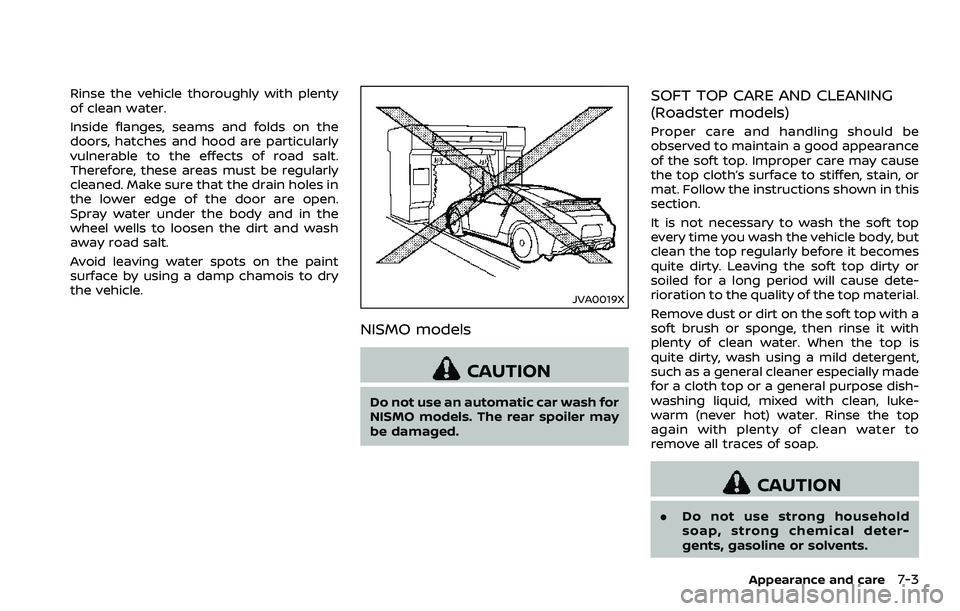
NISMO models
CAUTION
Do not use an automatic car wash for
NISMO models. The rear spoiler may
be damaged.
SOFT TOP CARE AND CLEANING
(Roadster models)
Proper care and handling should be
observed to maintain a good appearance
of the soft top. Improper care may cause
the top cloth’s surface to stiffen, stain, or
mat. Follow the instructions shown in this
section.
It is not necessary to wash the soft top
every time you wash the vehicle body, but
clean the top regularly before it becomes
quite dirty. Leaving the soft top dirty or
soiled for a long period will cause dete-
rioration to the quality of the top material.
Remove dust or dirt on the soft top with a
soft brush or sponge, then rinse it with
plenty of clean water. When the top is
quite dirty, wash using a mild detergent,
such as a general cleaner especially made
for a cloth top or a general purpose dish-
washing liquid, mixed with clean, luke-
warm (never hot) water. Rinse the top
again with plenty of clean water to
remove all traces of soap.
CAUTION
.Do not use strong household
soap, strong chemical deter-
gents, gasoline or solvents.
Appearance and care7-3