service NISSAN 370Z 2020 Owner´s Manual
[x] Cancel search | Manufacturer: NISSAN, Model Year: 2020, Model line: 370Z, Model: NISSAN 370Z 2020Pages: 455, PDF Size: 2.22 MB
Page 352 of 455
6-18In case of emergency
2. Turn off the air conditioner. Open allthe windows, move the heater or air
conditioner temperature control to
maximum hot and fan control to high
speed.
3. If engine overheating is caused by climbing a long hill on a hot day, run
the engine at a fast idle (approxi-
mately 1,500 rpm) until the tempera-
ture gauge indication returns to
normal.
4. Get out of the vehicle. Look and listen for steam or coolant escaping from
the radiator before opening the hood.
(If steam or coolant is escaping, turn
off the engine.) Do not open the hood
further until no steam or coolant can
be seen.
5. Open the engine hood.
WARNING
If steam or water is coming from the
engine, stand clear to prevent get-
ting burned.
6. Visually check if the cooling fan is running. The radiator hoses and ra-
diator should not leak water. If coolant
is leaking or the cooling fan does not
run, stop the engine.
WARNING
Be careful not to allow your hands,
hair, jewelry or clothing to come into
contact with, or get caught in, engine
belts or the engine cooling fan. The
engine cooling fan can start at any
time.
7. After the engine cools down, check the coolant level in the reservoir with
the engine running. Add coolant to
the reservoir if necessary. Have your
vehicle repaired. It is recommended
you visit a NISSAN dealer for this
service.
Page 353 of 455
When towing your vehicle, all State (Pro-
vincial in Canada) and local regulations
for towing must be followed. Incorrect
towing equipment could damage your
vehicle. Towing instructions are available
from a NISSAN dealer. Local service op-
erators are familiar with the applicable
laws and procedures for towing. To
assure proper towing and to prevent
accidental damage to your vehicle,
NISSAN recommends that you have a
service operator tow your vehicle. It is
advisable to have the service operator
carefully read the following precautions.
WARNING
.Never ride in a vehicle that is
being towed.
. Never get under your vehicle after
it has been lifted by a tow truck.
CAUTION
.When towing, make sure that the
transmission, axles, steering sys-
tem and drivetrain are in working
condition. If any unit is damaged,
dollies must be used. .
Always attach safety chains be-
fore towing.
For information about towing your vehi-
cle behind a recreational vehicle (RV), see
“Flat towing” (P.10-22) of this manual.
In case of emergency6-19
TOWING YOUR VEHICLE
Page 356 of 455
6-22In case of emergency
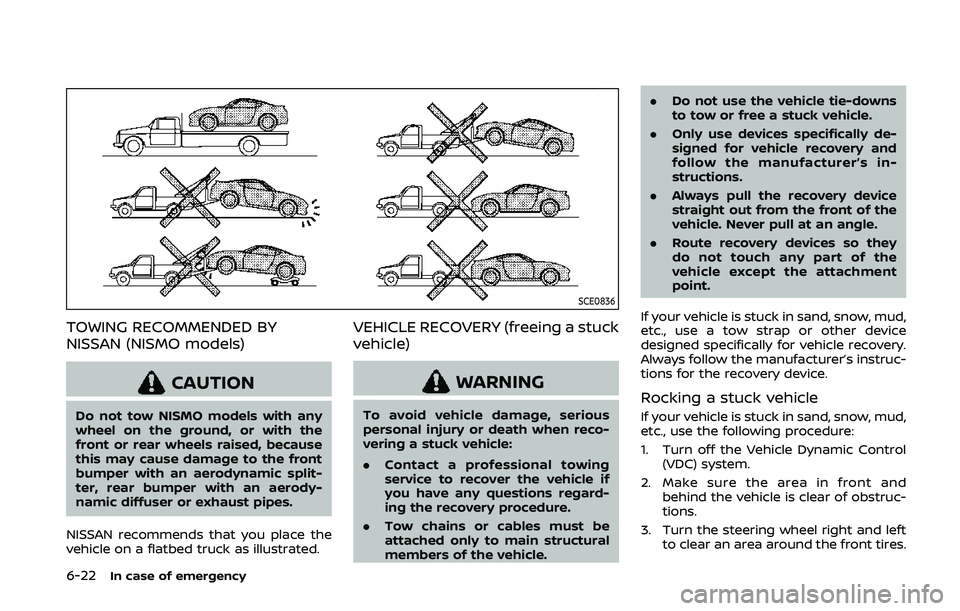
SCE0836
TOWING RECOMMENDED BY
NISSAN (NISMO models)
CAUTION
Do not tow NISMO models with any
wheel on the ground, or with the
front or rear wheels raised, because
this may cause damage to the front
bumper with an aerodynamic split-
ter, rear bumper with an aerody-
namic diffuser or exhaust pipes.
NISSAN recommends that you place the
vehicle on a flatbed truck as illustrated.
VEHICLE RECOVERY (freeing a stuck
vehicle)
WARNING
To avoid vehicle damage, serious
personal injury or death when reco-
vering a stuck vehicle:
. Contact a professional towing
service to recover the vehicle if
you have any questions regard-
ing the recovery procedure.
. Tow chains or cables must be
attached only to main structural
members of the vehicle. .
Do not use the vehicle tie-downs
to tow or free a stuck vehicle.
. Only use devices specifically de-
signed for vehicle recovery and
follow the manufacturer’s in-
structions.
. Always pull the recovery device
straight out from the front of the
vehicle. Never pull at an angle.
. Route recovery devices so they
do not touch any part of the
vehicle except the attachment
point.
If your vehicle is stuck in sand, snow, mud,
etc., use a tow strap or other device
designed specifically for vehicle recovery.
Always follow the manufacturer’s instruc-
tions for the recovery device.
Rocking a stuck vehicle
If your vehicle is stuck in sand, snow, mud,
etc., use the following procedure:
1. Turn off the Vehicle Dynamic Control (VDC) system.
2. Make sure the area in front and behind the vehicle is clear of obstruc-
tions.
3. Turn the steering wheel right and left to clear an area around the front tires.
Page 357 of 455
4. Slowly rock the vehicle forward andbackward.
.Shift back and forth between R(Reverse) and D (Drive) (automatic
transmission models) or 1st and R
(Reverse) (manual transmission
models).
.Apply the accelerator as little as
possible to maintain the rocking
motion.
.Release the accelerator pedal be-fore shifting between R (Reverse)
and D (Drive) (automatic transmis-
sion models) or 1st and R (Reverse)
(manual transmission models).
.Do not spin the tires above 35 MPH(55 km/h).
5. If the vehicle cannot be freed after a few tries, contact a professional tow-
ing service to remove the vehicle.
WARNING
.Stand clear of a stuck vehicle.
. Do not spin your tires at high
speed. This could cause them to
explode and result in serious in-
jury. Parts of your vehicle could
also overheat and be damaged.
In case of emergency6-23
Page 370 of 455
8-2Do-it-yourself
When performing any inspection or main-
tenance work on your vehicle, always
take care to prevent serious accidental
injury to yourself or damage to the
vehicle. The following are general precau-
tions which should be closely observed.
WARNING
.Park the vehicle on a level sur-
face, apply the parking brake
securely and block the wheels to
prevent the vehicle from moving.
For manual transmission models,
move the shift lever to N (Neutral).
For automatic transmission mod-
els, move the shift lever to P
(Park).
. Be sure the ignition switch is in
the OFF or LOCK position when
performing any parts replace-
ment or repairs.
. Never connect or disconnect the
battery or any transistorized
component while the ignition
switch is in the ON position.
. Never leave the engine or auto-
matic transmission related com-
ponent harnesses disconnected
while the ignition switch is in the
ON position. .
If you must work with the engine
running, keep your hands, cloth-
ing, hair and tools away from
moving fans, belts and any other
moving parts.
. It is advisable to secure or re-
move any loose clothing and
remove any jewelry, such as
rings, watches, etc. before work-
ing on your vehicle.
. Always wear eye protection
whenever you work on your ve-
hicle.
. If you must run the engine in an
enclosed space such as a garage,
be sure there is proper ventilation
for exhaust gases to escape.
. Never get under the vehicle while
it is supported only by a jack. If it
is necessary to work under the
vehicle, support it with safety
stands.
. Keep smoking materials, flame
and sparks away from fuel tank
and the battery.
. Your vehicle is equipped with an
automatic engine cooling fan. It
may come on at any time without
warning, even if the ignition key is
in the OFF position and the en-
gine is not running. To avoid injury, always disconnect the ne-
gative battery cable before work-
ing near the fan.
. Because the fuel lines are under
high pressure even when the
engine is off, it is recommended
you visit a NISSAN dealer for
service of the fuel filter or fuel
lines.
CAUTION
.Do not work under the hood while
the engine is hot. Turn the engine
off and wait until it cools down.
. Avoid direct contact with used
engine oil and coolant. Impro-
perly disposed engine oil, coolant,
and/or other vehicle fluids can
damage the environment. Always
conform to local regulations for
disposal of vehicle fluid.
This “8. Do-it-yourself” section gives in-
structions regarding only those items
which are relatively easy for an owner to
perform.
A genuine NISSAN Service Manual is also
available. (See “Owner’s Manual/Service
Manual order information” (P.10-26).)
MAINTENANCE PRECAUTIONS
Page 373 of 455
JVM0087X
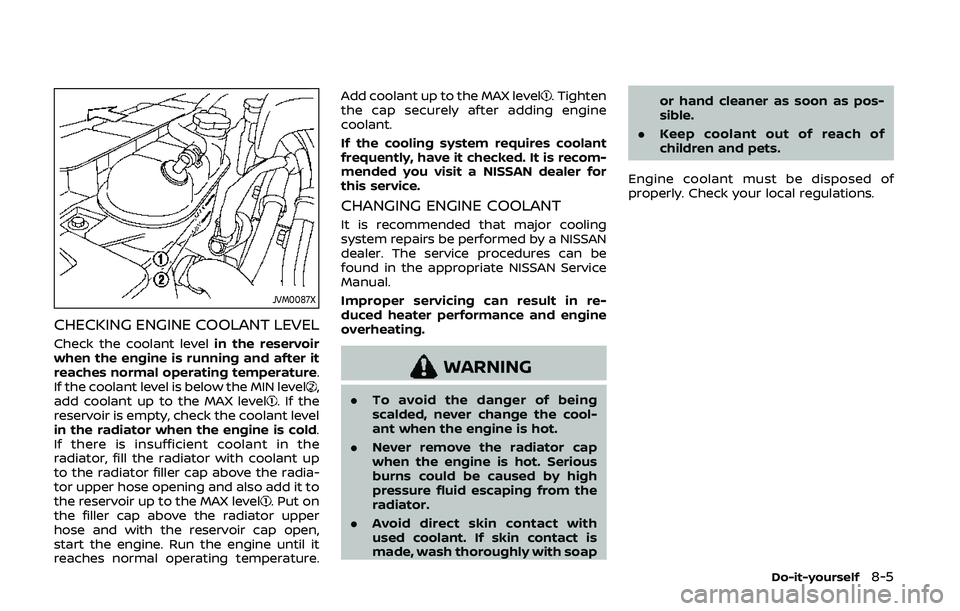
CHECKING ENGINE COOLANT LEVEL
Check the coolant levelin the reservoir
when the engine is running and after it
reaches normal operating temperature.
If the coolant level is below the MIN level
,
add coolant up to the MAX level. If the
reservoir is empty, check the coolant level
in the radiator when the engine is cold.
If there is insufficient coolant in the
radiator, fill the radiator with coolant up
to the radiator filler cap above the radia-
tor upper hose opening and also add it to
the reservoir up to the MAX level
. Put on
the filler cap above the radiator upper
hose and with the reservoir cap open,
start the engine. Run the engine until it
reaches normal operating temperature. Add coolant up to the MAX level
. Tighten
the cap securely after adding engine
coolant.
If the cooling system requires coolant
frequently, have it checked. It is recom-
mended you visit a NISSAN dealer for
this service.
CHANGING ENGINE COOLANT
It is recommended that major cooling
system repairs be performed by a NISSAN
dealer. The service procedures can be
found in the appropriate NISSAN Service
Manual.
Improper servicing can result in re-
duced heater performance and engine
overheating.
WARNING
. To avoid the danger of being
scalded, never change the cool-
ant when the engine is hot.
. Never remove the radiator cap
when the engine is hot. Serious
burns could be caused by high
pressure fluid escaping from the
radiator.
. Avoid direct skin contact with
used coolant. If skin contact is
made, wash thoroughly with soap or hand cleaner as soon as pos-
sible.
. Keep coolant out of reach of
children and pets.
Engine coolant must be disposed of
properly. Check your local regulations.
Do-it-yourself8-5
Page 377 of 455
CAUTION
.Do not overfill.
. Use Genuine NISSAN PSF or
equivalent. For further brake and clutch fluid infor-
mation, see “Capacities and recom-
mended fluids/lubricants” (P.10-2) of this
manual.
WARNING
.
Use only new fluid from a sealed
container. Old, inferior or con-
taminated fluid may damage the
brake and clutch systems. The
use of improper fluids can da-
mage the brake and clutch sys-
tems, and affect the vehicle’s
stopping ability.
. Clean the filler cap before remov-
ing.
. Brake fluid and clutch fluid are
poisonous and should be stored
carefully in marked containers
out of the reach of children.
CAUTION
Do not spill the fluid on painted
surfaces. This will damage the paint.
If fluid is spilled, wash the surface
with water.
SDI2025A
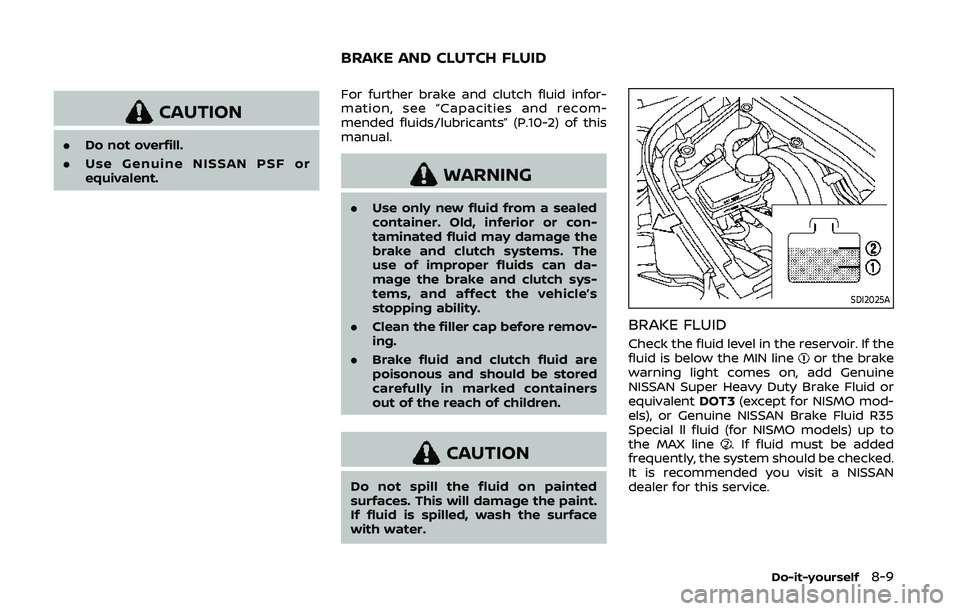
BRAKE FLUID
Check the fluid level in the reservoir. If the
fluid is below the MIN lineor the brake
warning light comes on, add Genuine
NISSAN Super Heavy Duty Brake Fluid or
equivalent DOT3(except for NISMO mod-
els), or Genuine NISSAN Brake Fluid R35
Special ll fluid (for NISMO models) up to
the MAX line
. If fluid must be added
frequently, the system should be checked.
It is recommended you visit a NISSAN
dealer for this service.
Do-it-yourself8-9
BRAKE AND CLUTCH FLUID
Page 378 of 455
8-10Do-it-yourself
WARNING
For NISMO models: Genuine NISSAN
Brake Fluid R35 Special II is the
factory fill brake fluid. The Vehicle
Dynamic Control (VDC) unit and other
related parts were specially de-
signed for this brake fluid. Using
any other non-equivalent brake fluid
may result in improper operation of
the brake system which result in
serious injury or death.
SDI1906A
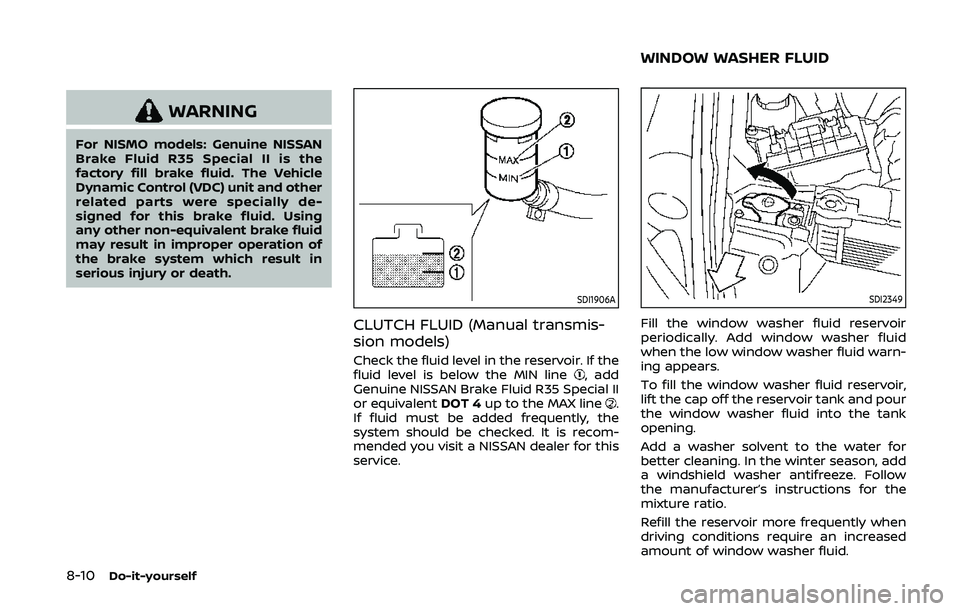
CLUTCH FLUID (Manual transmis-
sion models)
Check the fluid level in the reservoir. If the
fluid level is below the MIN line, add
Genuine NISSAN Brake Fluid R35 Special II
or equivalent DOT 4up to the MAX line
.
If fluid must be added frequently, the
system should be checked. It is recom-
mended you visit a NISSAN dealer for this
service.
SDI2349
Fill the window washer fluid reservoir
periodically. Add window washer fluid
when the low window washer fluid warn-
ing appears.
To fill the window washer fluid reservoir,
lift the cap off the reservoir tank and pour
the window washer fluid into the tank
opening.
Add a washer solvent to the water for
better cleaning. In the winter season, add
a windshield washer antifreeze. Follow
the manufacturer’s instructions for the
mixture ratio.
Refill the reservoir more frequently when
driving conditions require an increased
amount of window washer fluid.
WINDOW WASHER FLUID
Page 381 of 455
SDI1480E
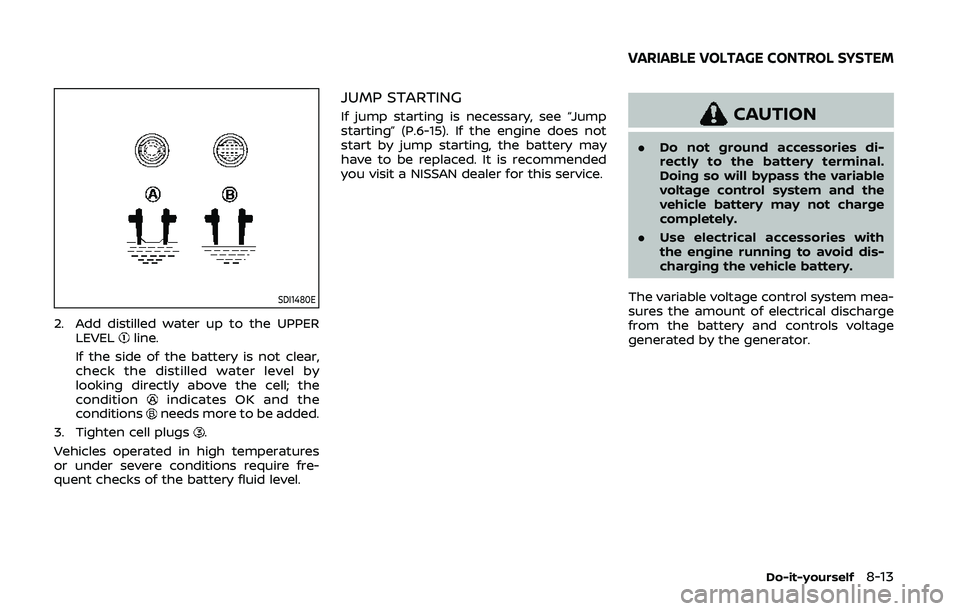
2. Add distilled water up to the UPPERLEVELline.
If the side of the battery is not clear,
check the distilled water level by
looking directly above the cell; the
condition
indicates OK and the
conditionsneeds more to be added.
3. Tighten cell plugs
.
Vehicles operated in high temperatures
or under severe conditions require fre-
quent checks of the battery fluid level.
JUMP STARTING
If jump starting is necessary, see “Jump
starting” (P.6-15). If the engine does not
start by jump starting, the battery may
have to be replaced. It is recommended
you visit a NISSAN dealer for this service.CAUTION
. Do not ground accessories di-
rectly to the battery terminal.
Doing so will bypass the variable
voltage control system and the
vehicle battery may not charge
completely.
. Use electrical accessories with
the engine running to avoid dis-
charging the vehicle battery.
The variable voltage control system mea-
sures the amount of electrical discharge
from the battery and controls voltage
generated by the generator.
Do-it-yourself8-13
VARIABLE VOLTAGE CONTROL SYSTEM
Page 382 of 455
8-14Do-it-yourself
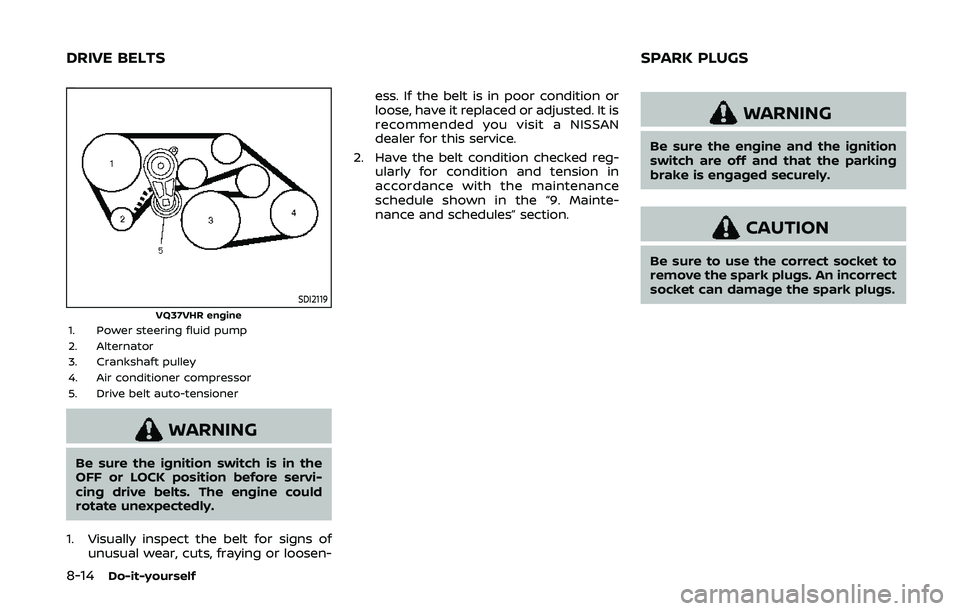
SDI2119VQ37VHR engine1. Power steering fluid pump
2. Alternator
3. Crankshaft pulley
4. Air conditioner compressor
5. Drive belt auto-tensioner
WARNING
Be sure the ignition switch is in the
OFF or LOCK position before servi-
cing drive belts. The engine could
rotate unexpectedly.
1. Visually inspect the belt for signs of unusual wear, cuts, fraying or loosen- ess. If the belt is in poor condition or
loose, have it replaced or adjusted. It is
recommended you visit a NISSAN
dealer for this service.
2. Have the belt condition checked reg- ularly for condition and tension in
accordance with the maintenance
schedule shown in the “9. Mainte-
nance and schedules” section.
WARNING
Be sure the engine and the ignition
switch are off and that the parking
brake is engaged securely.
CAUTION
Be sure to use the correct socket to
remove the spark plugs. An incorrect
socket can damage the spark plugs.
DRIVE BELTS SPARK PLUGS