check engine light NISSAN 370Z COUPE 2010 Owner's Manual
[x] Cancel search | Manufacturer: NISSAN, Model Year: 2010, Model line: 370Z COUPE, Model: NISSAN 370Z COUPE 2010Pages: 409, PDF Size: 3.56 MB
Page 294 of 409
Black plate (294,1)
Model "Z34-D" EDITED: 2009/ 9/ 10
WARNING
.Be sure the parking brake is fully
released before driving. Failure to
do so can cause brake failure and
lead to an accident.
. Do not release the parking brake
from outside the vehicle.
. Do not use the gear shift in place of
the parking brake. When parking, be
sure the parking brake is fully
engaged.
. Do not leave children unattended in
a vehicle. They could release the
parking brake and cause an acci-
dent.
SPA2110
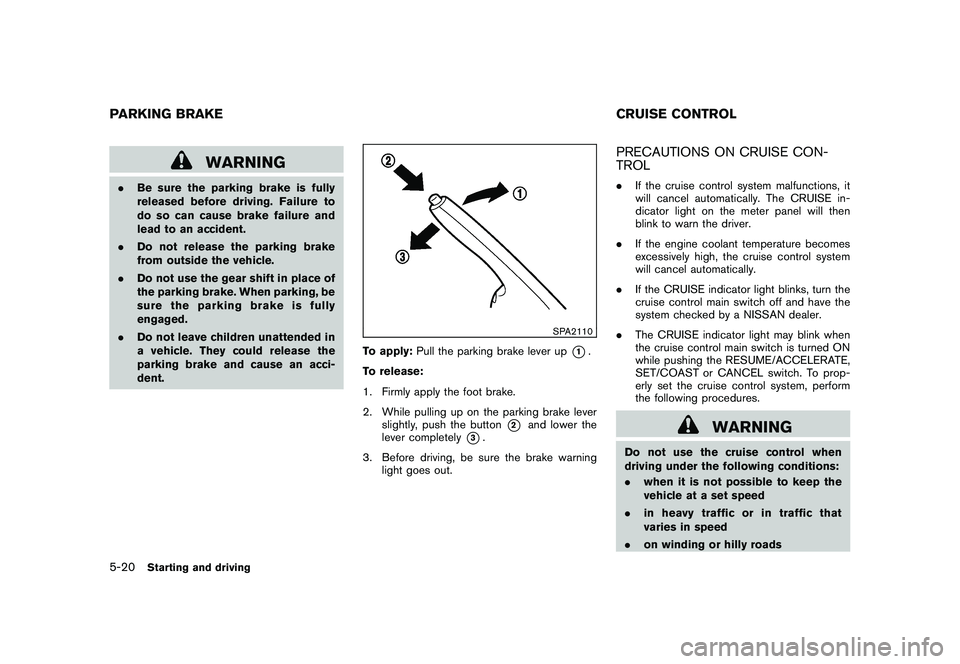
To apply: Pull the parking brake lever up
*1.
To release:
1. Firmly apply the foot brake.
2. While pulling up on the parking brake lever slightly, push the button
*2
and lower the
lever completely
*3.
3. Before driving, be sure the brake warning light goes out.
PRECAUTIONS ON CRUISE CON-
TROL.If the cruise control system malfunctions, it
will cancel automatically. The CRUISE in-
dicator light on the meter panel will then
blink to warn the driver.
. If the engine coolant temperature becomes
excessively high, the cruise control system
will cancel automatically.
. If the CRUISE indicator light blinks, turn the
cruise control main switch off and have the
system checked by a NISSAN dealer.
. The CRUISE indicator light may blink when
the cruise control main switch is turned ON
while pushing the RESUME/ACCELERATE,
SET/COAST or CANCEL switch. To prop-
erly set the cruise control system, perform
the following procedures.
WARNING
Do not use the cruise control when
driving under the following conditions:
.when it is not possible to keep the
vehicle at a set speed
. in heavy traffic or in traffic that
varies in speed
. on winding or hilly roads
PARKING BRAKE CRUISE CONTROL5-20
Starting and driving
Page 301 of 409
Black plate (301,1)
Model "Z34-D" EDITED: 2009/ 9/ 10
instrument panel. The brake system then oper-
ates normally, but without anti-lock assistance.
If the ABS warning light illuminates during the
self-test or while driving, have the vehicle
checked by a NISSAN dealer.Normal operationThe ABS operates at speeds above 3 to 6 MPH
(5 to 10 km/h) .
When the ABS senses that one or more wheels
are close to locking up, the actuator rapidly
applies and releases hydraulic pressure. This
action is similar to pumping the brakes very
quickly. You may feel a pulsation in the brake
pedal and hear a noise from under the hood or
feel a vibration from the actuator when it is
operating. This is normal and indicates that the
ABS is operating properly. However, the pulsa-
tion may indicate that road conditions are
hazardous and extra care is required while
driving.The Vehicle Dynamic Control (VDC) system
uses various sensors to monitor driver inputs
and vehicle motion. Under certain driving con-
ditions, the VDC system helps to perform the
following functions.
.
Controls brake pressure to reduce wheel
slip on one slipping drive wheel so power is
transferred to a non slipping drive wheel on
the same axle.
. Controls brake pressure and engine output
to reduce drive wheel slip based on vehicle
speed (traction control function) .
. Controls brake pressure at individual wheels
and engine output to help the driver maintain
control of the vehicle in the following
conditions:
— understeer (vehicle tends to not follow the steered path despite increased steering
input)
— oversteer (vehicle tends to spin due to certain road or driving conditions) .
The VDC system can help the driver to maintain
control of the vehicle, but it cannot prevent loss
of vehicle control in all driving situations.
When the VDC system operates, the
indicator in the instrument panel flashes so note
the following:
. The road may be slippery or the system may determine some action is required to help
keep the vehicle on the steered path.
. You may feel a pulsation in the brake pedal
and hear a noise or vibration from under the
hood. This is normal and indicates that the
VDC system is working properly.
. Adjust your speed and driving to the road
conditions.
See “Slip indicator light” in the “2. Instruments
and controls” section and “Vehicle Dynamic
Control (VDC) off indicator light” in the “2.
Instruments and controls” section.
If a malfunction occurs in the system, the
and
indicatorlightscomeoninthe
instrument panel. The VDC system automatically
turns off when these indicator lights are on.
The VDC OFF switch is used to turn off the VDC
system. The VDC off indicator illuminates to
indicate the VDC system is off. When the VDC
switch is used to turn off the system, the VDC
system still operates to prevent one drive wheel
from slipping by transferring power to a non
slipping drive wheel. The
indicator flashes
if this occurs. All other VDC functions are off and
the
indicator will not flash. The VDC
System is automatically reset to on when the
ignition switch is placed in the off position then
back to the on position.
The computer has a built-in diagnostic feature
VEHICLE DYNAMIC CONTROL (VDC)
SYSTEM
Starting and driving
5-27
Page 339 of 409
Black plate (25,1)
8 Maintenance and do-it-yourself
Model "Z34-D" EDITED: 2009/ 9/ 10
Maintenance requirement..................................... 8-2
Scheduled maintenance ................................... 8-2
General maintenance ...................................... 8-2
Where to go for service ................................... 8-2
General maintenance .......................................... 8-2
Explanation of maintenance items ....................... 8-2
Maintenance precautions ..................................... 8-5
Engine compartment check locations ...................... 8-7
VQ37VHR engine model. ................................. 8-7
Engine cooling system ......................................... 8-8
Checking engine coolant level ........................... 8-8
Changing engine coolant ................................. 8-9
Engine oil ......................................................... 8-9
Checking engine oil level ................................. 8-9
Changing engine oil and filter ............................ 8-9
Automatic transmission fluid ................................ 8-11
Power steering fluid .......................................... 8-12
Brake and clutch fluid ....................................... 8-12
Brake fluid .................................................. 8-13
Clutch fluid ................................................. 8-13
Window washer fluid ........................................ 8-13
Battery .......................................................... 8-14
Jump starting .............................................. 8-16
Variable voltage control system ............................ 8-16
Drive belts ...................................................... 8-16 Spark plugs
.................................................... 8-17
Replacing spark plugs ................................... 8-17
Air cleaner ...................................................... 8-18
Windshield wiper blades .................................... 8-18
Cleaning .................................................... 8-18
Replacing ................................................... 8-19
Brakes ........................................................... 8-20
Self-adjusting brakes .................................... 8-20
Brake pad wear warning ................................ 8-20
Fuses ............................................................ 8-20
Engine compartment ..................................... 8-20
Passenger compartment ................................ 8-22
Intelligent Key battery replacement ....................... 8-22
Lights ............................................................ 8-24
Coupe ....................................................... 8-24
Roadster .................................................... 8-25
Headlights .................................................. 8-26
Exterior and interior lights ............................... 8-26
Wheels and tires .............................................. 8-28
Tire pressure ............................................... 8-28
Tire labeling ................................................ 8-31
Types of tires .............................................. 8-33
Tire chains .................................................. 8-34
Changing wheels and tires ............................. 8-35
Emergency tire puncture repair kit
(if so equipped) ........................................... 8-37
Page 342 of 409
Black plate (344,1)
Model "Z34-D" EDITED: 2009/ 9/ 10
Warning lights and chimes:Make sure that
all warning lights and chimes are operating
properly.
Windshield defroster: Check that the air
comes out of the defroster outlets properly and
in sufficient quantity when operating the heater
or air conditioner.
Windshield wiper and washer*: Check that
the wipers and washer operate properly and that
the wipers do not streak.Under the hood and vehicleThe maintenance items listed here should be
checked periodically (for example, each time you
check the engine oil or refuel) .
Battery*: Check the fluid level in each cell. It
should be between the MAX and MIN lines.
Vehicles operated in high temperatures or under
severe condition require frequent checks of the
battery fluid level.
Brake and clutch fluid levels*: Make sure
that the brake and clutch fluid levels are
between the MAX and MIN lines on the
reservoirs.
Engine coolant level*: Check the coolant level
when the engine is cold.
Engine drive belts*: Make sure that no belt is
frayed, worn, cracked or oily. Engine oil level*:
Check the level after parking
the vehicle on a level spot and turning off the
engine. Wait more than 15 minutes for the oil to
drain back into the oil pan.
Exhaust system: Make sure there are no loose
supports, cracks or holes. If the sound of the
exhaust seems unusual or there is a smell of
exhaust fumes, immediately have the exhaust
system inspected by a NISSAN dealer. (See
“PRECAUTIONS WHEN STARTING AND
DRIVING” in the “5. St arting and driving”
section for exhaust gas (carbon monoxide) .)
Fluid leaks: Check under the vehicle for fuel,
oil, water or other fluid leaks after the vehicle has
been parked for a while. Water dripping from the
air conditioner after use is normal. If you should
notice any leaks or if gasoline fumes are evident,
check for the cause and have it corrected
immediately.
Power steering fluid level* and lines: Check
the level with the engine off. Check the lines for
proper attachment, leaks, cracks, etc.
Radiator and hoses: Check the front of the
radiator and clean off any dirt, insects, leaves,
etc., that may have accumulated. Make sure the
hoses have no cracks, deformation, rot or loose
connections. Underbody:
The underbody is frequently ex-
posed to corrosive substances such as those
used on icy roads or to control dust. It is very
important to remove these substances, other-
wise rust will form on the floor pan, frame, fuel
lines and around the exhaust system. At the end
of winter, the underbody should be thoroughly
flushed with plain water, being careful to clean
those areas where mud and dirt may accumu-
late. For additional information, see “CLEANING
EXTERIOR” in the “7. Appearance and care”
section.
Windshield washer fluid*: Check that there is
adequate fluid in the reservoir.8-4
Maintenance and do-it-yourself
Page 348 of 409
Black plate (350,1)
Model "Z34-D" EDITED: 2009/ 9/ 10
vehicle jack-up points.
. A suitable adapter should be attached to
the jack stand saddle.
5. Remove the plastic engine undercover. a. Remove the small plastic clips at thecenter of the undercover.
b. Then remove the bolts that hold the undercover in place.
CAUTION
Make sure the correct lifting and sup-
port points are used to avoid vehicle
damage.
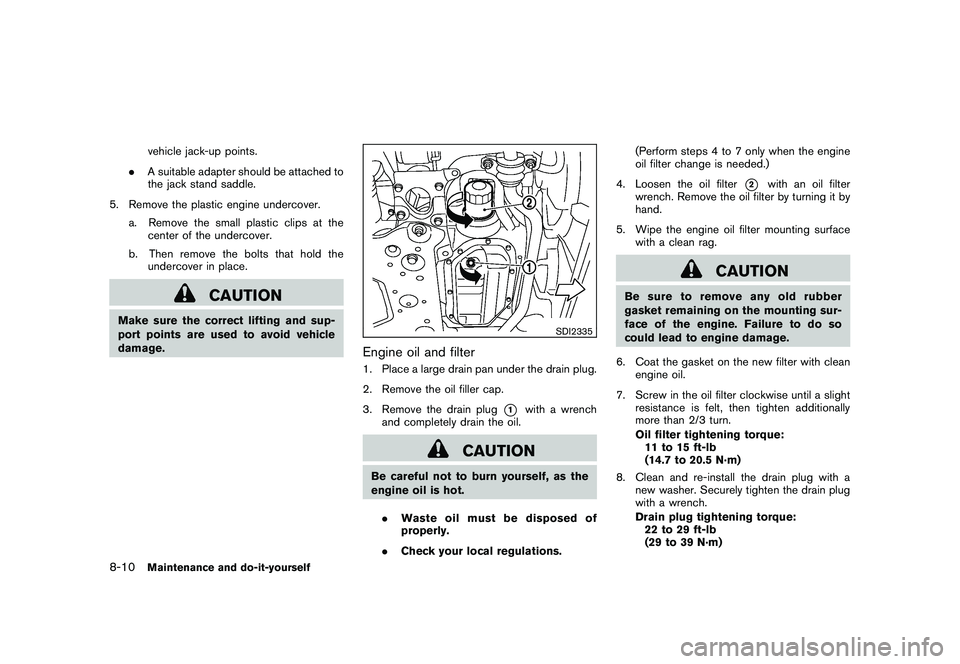
SDI2335
Engine oil and filter1. Place a large drain pan under the drain plug.
2. Remove the oil filler cap.
3. Remove the drain plug
*1
with a wrench
and completely drain the oil.
CAUTION
Be careful not to burn yourself, as the
engine oil is hot.
. Waste oil must be disposed of
properly.
. Check your local regulations. (Perform steps 4 to 7 only when the engine
oil filter change is needed.)
4. Loosen the oil filter
*2
with an oil filter
wrench. Remove the oil filter by turning it by
hand.
5. Wipe the engine oil filter mounting surface with a clean rag.
CAUTION
Be sure to remove any old rubber
gasket remaining on the mounting sur-
face of the engine. Failure to do so
could lead to engine damage.
6. Coat the gasket on the new filter with clean engine oil.
7. Screw in the oil filter clockwise until a slight resistance is felt, then tighten additionally
more than 2/3 turn.
Oil filter tightening torque:11 to 15 ft-lb
(14.7 to 20.5 N·m)
8. Clean and re-install the drain plug with a new washer. Securely tighten the drain plug
with a wrench.
Drain plug tightening torque:22 to 29 ft-lb
(29 to 39 N·m)
8-10
Maintenance and do-it-yourself
Page 358 of 409
Black plate (360,1)
Model "Z34-D" EDITED: 2009/ 9/ 10
If the brakes do not operate properly, have the
brakes checked by a NISSAN dealer.SELF-ADJUSTING BRAKESYour vehicle is equipped with self-adjusting
brakes.
The disc-type brakes self-adjust every time the
brake pedal is applied.
WARNING
See a NISSAN dealer for a brake
system check if the brake pedal height
does not return to normal.BRAKE PAD WEAR WARNINGThe disc brake pads have audible wear warn-
ings. When a brake pad requires replacement, it
will make a high pitched scraping sound when
the vehicle is in motion. This scraping sound will
first occur only when the brake pedal is
depressed. After more wear of the brake pad
the sound will always be heard even if the brake
pedal is not depressed. Have the brakes
checked as soon as possible if the wear warning
sound is heard.
Under some driving or climate conditions,
occasional brake squeak, squeal or other noise
may be heard. Occasional brake noise during
light to moderate stops is normal and does not affect the function or performance of the brake
system.
Proper brake inspection intervals should
be followed.
For additional information, see the
maintenance log section of your “NISSAN
Service and Maintenance Guide”.
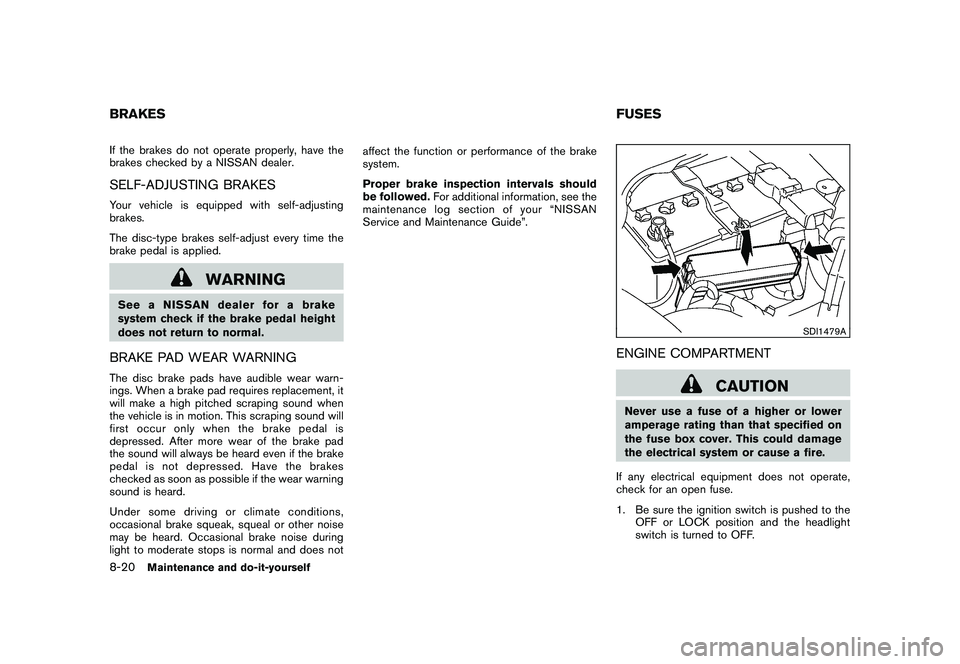
SDI1479A
ENGINE COMPARTMENT
CAUTION
Never use a fuse of a higher or lower
amperage rating than that specified on
the fuse box cover. This could damage
the electrical system or cause a fire.
If any electrical equipment does not operate,
check for an open fuse.
1. Be sure the ignition switch is pushed to the OFF or LOCK position and the headlight
switch is turned to OFF.
BRAKES FUSES8-20
Maintenance and do-it-yourself
Page 380 of 409
Black plate (382,1)
Model "Z34-D" EDITED: 2009/ 9/ 10
vehicles.
If any undesirable driveability problems such as
engine stalling or hard hot starting are experi-
enced after using oxygenate-blend fuels, im-
mediately change to a non-oxygenate fuel or a
fuel with a low blend of MTBE.
Take care not to spill gasoline during
refueling. Gasoline containing oxygenates
can cause paint damage.
E-85 fuelE-85 fuel is a mixture of approximately 85% fuel
ethanol and 15% unleaded gasoline. E-85 can
only be used in a Flexible Fuel Vehicle (FFV) . Do
not use E-85 fuel in your vehicle. U.S. govern-
ment regulations require fuel ethanol dispensing
pumps to be identified by a small, square,
orange and black label with the common
abbreviation or the appropriate percentage for
that region.Aftermarket fuel additivesNISSAN does not recommend the use of any
aftermarket fuel additives (Example: fuel injector
cleaner, octane booster, intake valve deposit
removers, etc.) which are sold commercially.
Many of these additives intended for gum,
varnish or deposit removal may contain active
solvent or similar ingredients that can be harmful
to the fuel system and engine.
Octane rating tipsUsing unleaded gasoline with an octane
rating lower than recommended above can
cause persistent, heavy spark knock.
(Spark knock is a metallic rapping noise.)
If severe, this can lead to engine damage.
If you detect a persistent heavy spark
knock even when using gasoline of the
stated octane rating, or if you hear steady
spark knock while holding a steady speed
on level roads, have a NISSAN dealer
correct the condition. Failure to correct
the condition is misuse of the vehicle, for
which NISSAN is not responsible.
Incorrect ignition timing will result in knocking,
after-run or overheating. This in turn may cause
excessive fuel consumption or damage to the
engine. If any of the above symptoms are
encountered, have your vehicle checked at a
NISSAN dealer or other competent service
facility.
However, now and then you may notice
light spark knock for a short time while
accelerating or driving up hills. This is no
cause for concern, because you get the
greatest fuel benefit when there is light
spark knock for a short time under heavy
engine load.
9-4
Technical and consumer information
Page 398 of 409
Black plate (400,1)
Model "Z34-D" EDITED: 2009/ 9/ 10
If you believe that your vehicle has a defect
which could cause a crash or could cause
injury or death, you should immediately
inform the National Highway Traffic Safety
Administration (NHTSA) in addition to
notifying NISSAN.
If NHTSA receives similar complaints, it
may open an investigation, and if it finds
that a safety defect exists in a group of
vehicles, it may order a recall and remedy
campaign. However, NHTSA cannot be-
come involved in individual problems be-
tween you, your dealer, or NISSAN.
To contact NHTSA, you may call the
Vehicle Safety Hotline toll-free at 1-888-
327-4236 (TTY: 1-800-424-9153); go to
http://www.safercar.gov; or write to: Ad-
ministrator, NHTSA, 400 Seventh Street,
SW., Washington DC 20590. You can also
obtain other information about motor vehi-
cle safety from http://www.safercar.gov.
You may notify NISSAN by contacting our
Consumer Affairs Department, toll-free, at
1-800-662-6200.
Due to legal requirements in some states/ areas,
your vehicle may be required to be in what is
called the “ready condition” for an Inspection/
Maintenance (I/M) test of the emission control
system.
The vehicle is set to the “ready condition” when
it is driven through certain driving patterns.
Usually, the “ready condition” can be obtained
by ordinary usage of the vehicle.
If a powertrain system component is repaired or
the battery is disconnected, the vehicle may be
reset to a “not ready condition”. Before taking
the I/M test, check the vehicle’s inspection/
maintenance test readiness condition. Push the
ignition switch to the ON position without
starting the engine. If the Malfunction Indicator
Light (MIL) comes on steady for 20 seconds and
then blinks for 10 seconds, the I/M test
condition is “not ready”. If the MIL does not
blink after 20 seconds, the I/M test condition is
“ready”.
If your vehicle does not pass an I/M test, the MIL
may not come on. Contact a NISSAN dealer to
prepare the vehicle for retesting.
If the MIL indicates the vehicle is in a “not ready”
condition, drive the vehicle through the following
pattern to set the vehicle to the “ready condi-
tion”. If you cannot or do not want to perform the
driving pattern, a NISSAN dealer can conduct it
for you.
WARNING
Always drive the vehicle in a safe and
prudent manner according to traffic
conditions and obey all traffic laws.
1. Start the engine. Allow the engine to idle until the engine coolant temperature gauge
needle points between the C and H (normal
operating temperature) .
2. Accelerate the vehicle to 55 MPH (88 km/h) , then quickly release the accelerator
pedal completely and keep it released for at
least 10 seconds.
3. Quickly depress the accelerator pedal for a moment, then drive the vehicle at a speed of
53 to 60 MPH (86 to 96 km/h) for at least 9
minutes.
4. Stop the vehicle. Leave the engine running.
5. Accelerate the vehicle to 55 MPH (88 km/h) and maintain the speed for 2 minutes.
6. Repeat steps 4 and 5 at least 10 times.
7. Quickly release the accelerator pedal com- pletely and keep it released for at least for 1
minute. Maintain the speed for at least 5
minutes.
REPORTING SAFETY DEFECTS (US
only) READINESS FOR INSPECTION/
MAINTENANCE (I/M) TEST (US only)9-22
Technical and consumer information
Page 401 of 409

Black plate (1,1)
10 Index
A
ABS (Anti-lock Braking System) .................. 5-26
Advanced air bag system ......................... 1-32
Air bag system Advanced air bag system ..................... 1-32
Front passenger air bag and status light .... 1-33
Front-seat mounted side-impact
supplemental air bag system .................. 1-36
Roof-mounted curtain side-impact
supplemental air bag system .................. 1-36
Air bag warning labels ............................. 1-39
Air bag warning light ....................... 1-39, 2-12
Air cleaner housing filter .......................... 8-18
Air conditioner Air conditioner operation ...................... 4-17
Air conditioner service ......................... 4-24
Air conditioner specification label ............ 9-12
Air conditioning system refrigerant and
lubricant recommendations .............. 4-24, 9-6
In-cabin microfilter ............................. 4-23
Air deflectors ....................................... 9-16
Alarm, How to stop alarm
(see vehicle security system) ..................... 2-26
Alcohol, drugs and driving .......................... 5-7
Antenna ............................................. 4-73
Anti-lock Braking System (ABS) .................. 5-26
Anti-lock braking system (ABS) warning light ..... 2-9
Appearance care Exterior appearance care ........................ 7-2
Interior appearance care ........................ 7-5
Audible reminders ................................. 2-15
Audio operation precautions ...................... 4-24 Audio system
....................................... 4-24
Steering wheel audio controls ................ 4-71
Autochanger Compact Disc (CD) ........................... 4-42
Autolight system ................................... 2-30
Automatic Air conditioner (Type A) ....................... 4-18
Automatic adjusting function
(front windows) ................................ 2-43
Automatic transmission fluid (ATF) ........... 8-11
Door locks ........................................ 3-5
Driving with automatic transmission .......... 5-12
Auxiliary input jacks ................................ 4-69
Avoiding collision and rollover ...................... 5-5
B
Battery .............................................. 8-14
Battery saver system .......................... 2-31
Intelligent Key .................................. 8-22
Variable voltage control system ............... 8-16
Before starting the engine ........................ 5-10
Belts (See drive belts) ............................. 8-16
Bluetooth
®hands-free phone system
(models with navigation system) .................. 4-74
Bluetooth®hands-free phone system
(models without navigation system) .............. 4-85
Booster seats ...................................... 1-23
Brake Anti-lock Braking System (ABS) .............. 5-26
Brake and clutch fluid ......................... 8-12
Brake fluid ...................................... 8-13
Brake system ................................... 5-25 Parking brake operation
....................... 5-20
Warning light ..................................... 2-9
Break-in schedule .................................. 5-22
Brightness control Display ON/OFF button ......................... 4-6
Instrument panel ............................... 2-32
Bulb check/instrument panel ........................ 2-8
Bulb replacement .................................. 8-24
C
Cabin air filter ...................................... 4-23
Capacities and recommended fuel/lubricants ..... 9-2
Car phone or CB radio ............................ 4-74
Cargo cover ........................................ 2-41
Catalytic converter, Three way catalyst ............ 5-2
Center multi-function control panel
(models with navigation system) .................... 4-2
Child restraint, Installation using the seat
belts ................................................. 1-19
Child restraints ..................................... 1-17
Booster seats .................................. 1-23
Precautions on child restraints ................ 1-17
Top tether strap ................................ 1-19
Child safety ......................................... 1-11
Chimes Audible reminders ............................. 2-15
Seat belt warning light and chime ............ 2-11
Circuit breaker, Fusible link ....................... 8-21
Cleaning exterior and interior ................. 7-2, 7-5
Clock .......................................... 2-7, 2-23
Clutch fluid ......................................... 8-12
Cockpit ............................................... 2-2
Model "Z34-D" EDITED: 2009/ 9/ 10
Page 402 of 409
Black plate (2,1)
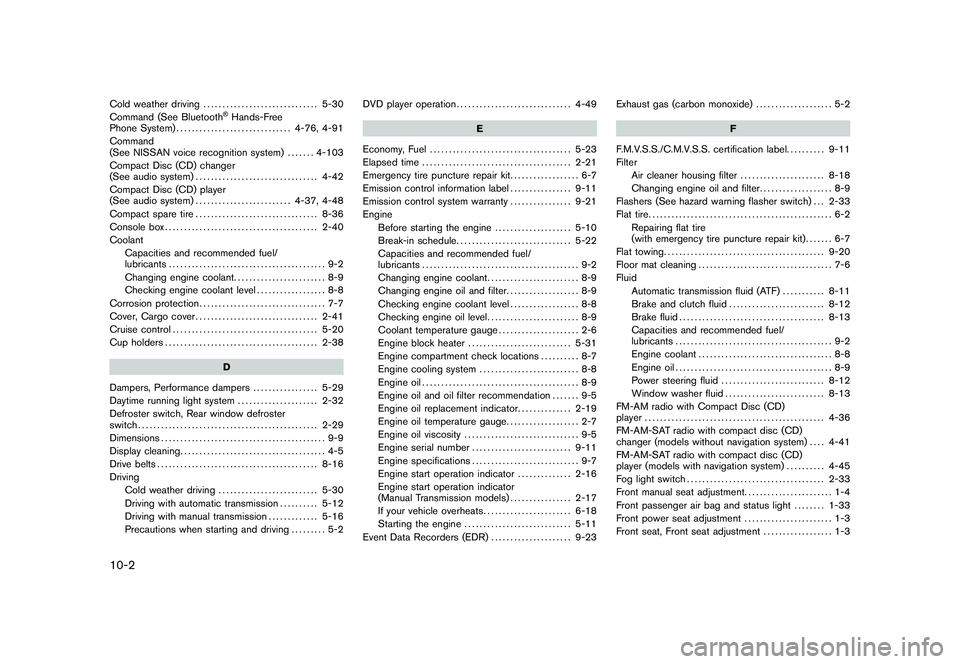
10-2Cold weather driving.............................. 5-30
Command (See Bluetooth
®Hands-Free
Phone System) .............................. 4-76, 4-91
Command
(See NISSAN voice recognition system) ....... 4-103
Compact Disc (CD) changer
(See audio system) ................................ 4-42
Compact Disc (CD) player
(See audio system) ......................... 4-37, 4-48
Compact spare tire ................................ 8-36
Console box ........................................ 2-40
Coolant Capacities and recommended fuel/
lubricants ......................................... 9-2
Changing engine coolant ........................ 8-9
Checking engine coolant level .................. 8-8
Corrosion protection ................................. 7-7
Cover, Cargo cover ................................ 2-41
Cruise control ...................................... 5-20
Cup holders ........................................ 2-38
D
Dampers, Performance dampers ................. 5-29
Daytime running light system ..................... 2-32
Defroster switch, Rear window defroster
switch ............................................... 2-29
Dimensions ........................................... 9-9
Display cleaning ...................................... 4-5
Drive belts .......................................... 8-16
Driving Cold weather driving .......................... 5-30
Driving with automatic transmission .......... 5-12
Driving with manual transmission ............. 5-16
Precautions when starting and driving ......... 5-2DVD player operation
.............................. 4-49
E
Economy, Fuel ..................................... 5-23
Elapsed time ....................................... 2-21
Emergency tire puncture repair kit .................. 6-7
Emission control information label ................ 9-11
Emission control system warranty ................ 9-21
Engine Before starting the engine .................... 5-10
Break-in schedule .............................. 5-22
Capacities and recommended fuel/
lubricants ......................................... 9-2
Changing engine coolant ........................ 8-9
Changing engine oil and filter ................... 8-9
Checking engine coolant level .................. 8-8
Checking engine oil level ........................ 8-9
Coolant temperature gauge ..................... 2-6
Engine block heater ........................... 5-31
Engine compartment check locations .......... 8-7
Engine cooling system .......................... 8-8
Engine oil ......................................... 8-9
Engine oil and oil filter recommendation ....... 9-5
Engine oil replacement indicator .............. 2-19
Engine oil temperature gauge ................... 2-7
Engine oil viscosity .............................. 9-5
Engine serial number .......................... 9-11
Engine specifications ............................ 9-7
Engine start operation indicator .............. 2-16
Engine start operation indicator
(Manual Transmission models) ................ 2-17
If your vehicle overheats ....................... 6-18
Starting the engine ............................ 5-11
Event Data Recorders (EDR) ..................... 9-23Exhaust gas (carbon monoxide)
.................... 5-2
F
F.M.V.S.S./C.M.V.S.S. certification label. ......... 9-11
Filter Air cleaner housing filter ...................... 8-18
Changing engine oil and filter ................... 8-9
Flashers (See hazard warning flasher switch) . . . 2-33
Flat tire ................................................ 6-2
Repairing flat tire
(with emergency tire puncture repair kit) ....... 6-7
Flat towing .......................................... 9-20
Floor mat cleaning ................................... 7-6
Fluid Automatic transmission fluid (ATF) ........... 8-11
Brake and clutch fluid ......................... 8-12
Brake fluid ...................................... 8-13
Capacities and recommended fuel/
lubricants ......................................... 9-2
Engine coolant ................................... 8-8
Engine oil ......................................... 8-9
Power steering fluid ........................... 8-12
Window washer fluid .......................... 8-13
FM-AM radio with Compact Disc (CD)
player ............................................... 4-36
FM-AM-SAT radio with compact disc (CD)
changer (models without navigation system) .... 4-41
FM-AM-SAT radio with compact disc (CD)
player (models with navigation system) .......... 4-45
Fog light switch .................................... 2-33
Front manual seat adjustment. ...................... 1-4
Front passenger air bag and status light ........ 1-33
Front power seat adjustment ....................... 1-3
Front seat, Front seat adjustment .................. 1-3
Model "Z34-D" EDITED: 2009/ 9/ 10