computer NISSAN 370Z COUPE 2016 Z34 User Guide
[x] Cancel search | Manufacturer: NISSAN, Model Year: 2016, Model line: 370Z COUPE, Model: NISSAN 370Z COUPE 2016 Z34Pages: 428, PDF Size: 3.01 MB
Page 313 of 428
5-28Starting and driving
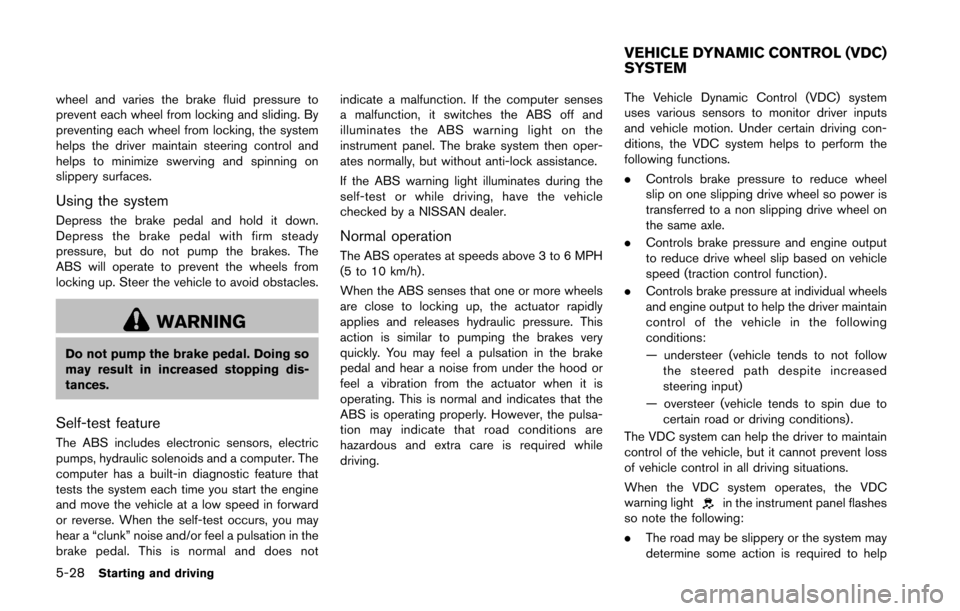
wheel and varies the brake fluid pressure to
prevent each wheel from locking and sliding. By
preventing each wheel from locking, the system
helps the driver maintain steering control and
helps to minimize swerving and spinning on
slippery surfaces.
Using the system
Depress the brake pedal and hold it down.
Depress the brake pedal with firm steady
pressure, but do not pump the brakes. The
ABS will operate to prevent the wheels from
locking up. Steer the vehicle to avoid obstacles.
WARNING
Do not pump the brake pedal. Doing so
may result in increased stopping dis-
tances.
Self-test feature
The ABS includes electronic sensors, electric
pumps, hydraulic solenoids and a computer. The
computer has a built-in diagnostic feature that
tests the system each time you start the engine
and move the vehicle at a low speed in forward
or reverse. When the self-test occurs, you may
hear a “clunk” noise and/or feel a pulsation in the
brake pedal. This is normal and does notindicate a malfunction. If the computer senses
a malfunction, it switches the ABS off and
illuminates the ABS warning light on the
instrument panel. The brake system then oper-
ates normally, but without anti-lock assistance.
If the ABS warning light illuminates during the
self-test or while driving, have the vehicle
checked by a NISSAN dealer.
Normal operation
The ABS operates at speeds above 3 to 6 MPH
(5 to 10 km/h) .
When the ABS senses that one or more wheels
are close to locking up, the actuator rapidly
applies and releases hydraulic pressure. This
action is similar to pumping the brakes very
quickly. You may feel a pulsation in the brake
pedal and hear a noise from under the hood or
feel a vibration from the actuator when it is
operating. This is normal and indicates that the
ABS is operating properly. However, the pulsa-
tion may indicate that road conditions are
hazardous and extra care is required while
driving.
The Vehicle Dynamic Control (VDC) system
uses various sensors to monitor driver inputs
and vehicle motion. Under certain driving con-
ditions, the VDC system helps to perform the
following functions.
.
Controls brake pressure to reduce wheel
slip on one slipping drive wheel so power is
transferred to a non slipping drive wheel on
the same axle.
. Controls brake pressure and engine output
to reduce drive wheel slip based on vehicle
speed (traction control function) .
. Controls brake pressure at individual wheels
and engine output to help the driver maintain
control of the vehicle in the following
conditions:
— understeer (vehicle tends to not follow
the steered path despite increased
steering input)
— oversteer (vehicle tends to spin due to certain road or driving conditions) .
The VDC system can help the driver to maintain
control of the vehicle, but it cannot prevent loss
of vehicle control in all driving situations.
When the VDC system operates, the VDC
warning light
in the instrument panel flashes
so note the following:
. The road may be slippery or the system may
determine some action is required to help
VEHICLE DYNAMIC CONTROL (VDC)
SYSTEM
Page 314 of 428
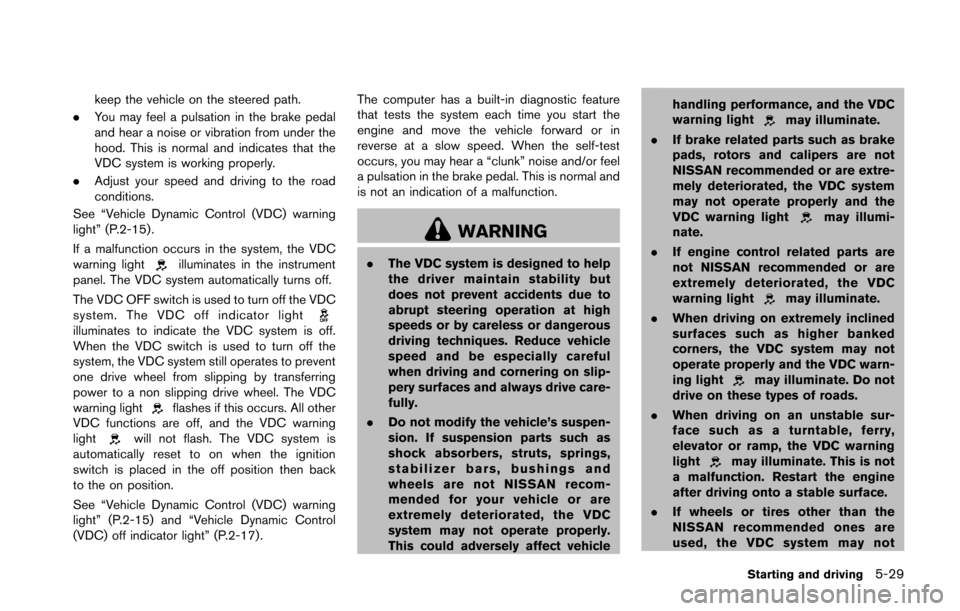
keep the vehicle on the steered path.
. You may feel a pulsation in the brake pedal
and hear a noise or vibration from under the
hood. This is normal and indicates that the
VDC system is working properly.
. Adjust your speed and driving to the road
conditions.
See “Vehicle Dynamic Control (VDC) warning
light” (P.2-15).
If a malfunction occurs in the system, the VDC
warning light
illuminates in the instrument
panel. The VDC system automatically turns off.
The VDC OFF switch is used to turn off the VDC
system. The VDC off indicator light
illuminates to indicate the VDC system is off.
When the VDC switch is used to turn off the
system, the VDC system still operates to prevent
one drive wheel from slipping by transferring
power to a non slipping drive wheel. The VDC
warning light
flashes if this occurs. All other
VDC functions are off, and the VDC warning
light
will not flash. The VDC system is
automatically reset to on when the ignition
switch is placed in the off position then back
to the on position.
See “Vehicle Dynamic Control (VDC) warning
light” (P.2-15) and “Vehicle Dynamic Control
(VDC) off indicator light” (P.2-17). The computer has a built-in diagnostic feature
that tests the system each time you start the
engine and move the vehicle forward or in
reverse at a slow speed. When the self-test
occurs, you may hear a “clunk” noise and/or feel
a pulsation in the brake pedal. This is normal and
is not an indication of a malfunction.
WARNING
.
The VDC system is designed to help
the driver maintain stability but
does not prevent accidents due to
abrupt steering operation at high
speeds or by careless or dangerous
driving techniques. Reduce vehicle
speed and be especially careful
when driving and cornering on slip-
pery surfaces and always drive care-
fully.
. Do not modify the vehicle’s suspen-
sion. If suspension parts such as
shock absorbers, struts, springs,
stabilizer bars, bushings and
wheels are not NISSAN recom-
mended for your vehicle or are
extremely deteriorated, the VDC
system may not operate properly.
This could adversely affect vehicle handling performance, and the VDC
warning light
may illuminate.
. If brake related parts such as brake
pads, rotors and calipers are not
NISSAN recommended or are extre-
mely deteriorated, the VDC system
may not operate properly and the
VDC warning light
may illumi-
nate.
. If engine control related parts are
not NISSAN recommended or are
extremely deteriorated, the VDC
warning light
may illuminate.
. When driving on extremely inclined
surfaces such as higher banked
corners, the VDC system may not
operate properly and the VDC warn-
ing light
may illuminate. Do not
drive on these types of roads.
. When driving on an unstable sur-
face such as a turntable, ferry,
elevator or ramp, the VDC warning
light
may illuminate. This is not
a malfunction. Restart the engine
after driving onto a stable surface.
. If wheels or tires other than the
NISSAN recommended ones are
used, the VDC system may not
Starting and driving5-29
Page 422 of 428
Fusible links ................................................................. 8-22
G
Garage door opener, HomeLinkŠ
Universal Transceiver ................................................. 2-50
Gas cap ........................................................................ 3-34
Gauge .............................................................................. 2-5Engine coolant temperature gauge ................... 2-7
Fuel gauge ............................................................... 2-8
Odometer ................................................................. 2-6
Speedometer ........................................................... 2-6
Tachometer ............................................................... 2-7
Trip computer ....................................................... 2-23
General maintenance .................................................. 8-3
Glove box ..................................................................... 2-43
H
Hands-free phone system, BluetoothŠ
(models with navigation system) ............................ 4-75
Hands-free phone system, BluetoothŠ
(models without navigation system) ...................... 4-86
Hatch, Rear hatch ...................................................... 3-17
Hazard warning flasher switch .................................. 6-2
Head restraints/headrests .......................................... 1-6
Headlights Bulb replacement ................................................ 8-27
Headlight switch .................................................. 2-33
Xenon headlights ................................................. 2-33
Heated seats ............................................................... 2-37
Heater Engine block heater ............................................ 5-33
Heater and air conditioner operation ............. 4-24
HomeLink
ŠUniversal Transceiver .......................... 2-50
Hood release ............................................................... 3-16
Horn ............................................................................... 2-37
I
Ignition switch (Push-button) .......................................................... 5-7
Manual transmission models ............................ 5-16
Immobilizer system ..................................................... 2-29
In-cabin microfilter ...................................................... 4-29
Indicator lights ............................................................. 2-15
INFO button ................................................................... 4-7
Inside mirror ................................................................. 3-37
Inspection/maintenance (I/M) test .......................... 9-24
Instrument brightness control .................................. 2-36
Instrument panel ........................................................... 2-4
Instrument pocket ....................................................... 2-41
Intelligent Key ................................................................ 3-2
Intelligent Key battery discharge indicator ........... 2-20
Intelligent Key removal indicator ............................. 2-19
Intelligent Key system .................................................. 3-6 Battery replacement ............................................ 8-24
Intelligent Key system warning light ............... 2-12
Key operating range .............................................. 3-8
Key operation ........................................................... 3-9
Warning signals ................................................... 3-11
Interior light control switch ...................................... 2-48
Interior light replacement .......................................... 8-28
Interior lights ................................................................ 2-48
Interior trunk lid release ............................................ 3-20
iPod
Šplayer operation .............................................. 4-67
J
Jump starting ............................................................... 6-14
K
Keyless entry (See remote keyless
entry system) ............................................................... 3-13
Keys ................................................................................. 3-2 For Intelligent Key system .................................... 3-6
L
LabelsAir bag warning labels ....................................... 1-42
Air conditioner specification label ................... 9-13
Emission control information label .................. 9-12
Engine serial number .......................................... 9-12
F.M.V.S.S./C.M.V.S.S. certification label ........ 9-12
Tire and Loading information label ....... 8-31, 9-13
Vehicle identification number (VIN) ................ 9-11
License plate, Installing front license plate .......... 9-14
Light Air bag warning light .......................................... 1-42
Bulb replacement ................................................ 8-26
Cargo area courtesy light .................................. 2-49
Cargo light ............................................................ 2-50
Fog light switch ................................................... 2-37
Headlight switch .................................................. 2-33
Headlights bulb replacement ........................... 8-27
Indicator lights ...................................................... 2-15
Interior light control switch ............................... 2-48
Interior lights ......................................................... 2-48
Map lights .............................................................. 2-48
Replacement ......................................................... 8-26
Trunk light .............................................................. 2-50
Vanity mirror lights ............................................... 2-49
Warning lights, indicator lights and
audible reminders ................................................ 2-11
Xenon headlights ................................................. 2-33
Lights, Exterior and interior light replacement .... 8-28
10-3
Page 423 of 428
10-4
Loading information (See vehicle
loading information) ................................................... 9-18
LockAutomatic door locks ............................................ 3-5
Door locks ................................................................ 3-4
Power door lock ..................................................... 3-4
Rear hatch lock .................................................... 3-17
Trunk lid .................................................................. 3-19
Locking with mechanical key ..................................... 3-4
Low tire pressure warning light .............................. 2-13
Low tire pressure warning system (See tire
pressure monitoring system (TPMS)) ..................... 5-3
M
Maintenance Battery .................................................................... 8-15
General maintenance ............................................ 8-3
Inside the vehicle .................................................... 8-4
Maintenance indicators ...................................... 2-22
Maintenance precautions ..................................... 8-6
Maintenance requirements ................................... 8-3
Outside the vehicle ................................................ 8-3
Seat belt maintenance ....................................... 1-15
Malfunction indicator light (MIL) ............................. 2-15
Manual front seat adjustment .................................... 1-4
Map lights ..................................................................... 2-48
Master warning light .................................................. 2-14
Mechanical key (Intelligent Key system) ................. 3-3
Meter Trip computer ....................................................... 2-23
Meters and gauges ...................................................... 2-5 Instrument brightness control ........................... 2-36
Mirror Inside mirror .......................................................... 3-37
Outside mirrors .................................................... 3-38
Vanity mirror .......................................................... 3-39 Multi-function controller .............................................. 4-4
N
New vehicle break-in ................................................. 5-23
NISSAN Vehicle Immobilizer System .................... 2-29
NISSAN voice recognition system ......................... 4-99
No key warning ........................................................... 2-19
O
Odometer ....................................................................... 2-6
Off-road recovery ......................................................... 5-6
Oil
Capacities and
recommended fluids/lubricants ........................... 9-2
Changing engine oil and filter .......................... 8-10
Checking engine oil level .................................. 8-10
Engine oil ............................................................... 8-10
Engine oil viscosity ................................................. 9-6
Oil filter replacement indicator ......................... 2-22
Opening the soft top ................................................. 3-21
Operation, Operational indicators .......................... 2-19
Outside mirrors ........................................................... 3-38
Overheat, If your vehicle overheats ....................... 6-16
Owner’s Manual/Service Manual
order information ......................................................... 9-25
P
Panic alarm .................................................................. 3-14
Parking Brake break-in ...................................................... 5-26
Parking brake operation ..................................... 5-20
Parking on hills ..................................................... 5-25
Performance dampers ............................................... 5-31 Phone
Bluetooth
Šhands-free phone system
(models with navigation system) ..................... 4-75
Bluetooth
Šhands-free phone system
(models without navigation system) ............... 4-86
Car phone or CB radio ...................................... 4-74
Power Front seat adjustment ............................................ 1-3
Power door lock ..................................................... 3-4
Power outlet .......................................................... 2-40
Power steering ..................................................... 5-26
Power steering fluid ............................................ 8-12
Power windows .................................................... 2-45
Precautions .................................................................. 5-21 Audio operation .................................................... 4-30
Braking precautions ............................................ 5-26
Child restraints ..................................................... 1-19
Cruise control operations .................................. 5-17
Maintenance ............................................................. 8-6
Seat belt usage .................................................... 1-10
Supplemental restraint system ......................... 1-29
When starting and driving .................................... 5-2
Predictive course line settings ................................ 4-22
Push starting ................................................................ 6-16
Push warning (Automatic
Transmission models) ................................................ 2-20
Push-button ignition switch .............................. 5-7, 5-8
R
Radio ............................................................................. 4-30 Car phone or CB radio ...................................... 4-74
Rapid air pressure loss ............................................... 5-6
Readiness for inspection/maintenance
(I/M) test ....................................................................... 9-24
Rear hatch .................................................................... 3-17
Rear hatch opener ..................................................... 3-17
Page 425 of 428
10-6
TiresEmergency tire puncture repair kit ..................... 6-8
Flat tire ...................................................................... 6-3
Low tire pressure warning system ..................... 5-3
Spare tire ............................................................... 8-39
Tire and Loading information label ....... 8-31, 9-13
Tire chains ............................................................. 8-36
Tire dressing ............................................................ 7-5
Tire pressure ......................................................... 8-30
Tire pressure monitoring
system (TPMS) .............................................. 5-3, 6-3
Tire rotation ........................................................... 8-37
Types of tires ........................................................ 8-35
Uniform tire quality grading ............................... 9-21
Wheel/tire size ........................................................ 9-9
Wheels and tires ................................................. 8-30
Tonneau cover (see cargo cover) .......................... 2-44
Top, Soft top ................................................................ 3-21
Touch screen ................................................................. 4-4
Towing
Flat towing ............................................................. 9-21
Tow truck towing ................................................. 6-18
Towing a trailer ..................................................... 9-20
TPMS, Tire pressure monitoring system ................ 5-3
TPMS, Tire pressure warning system ..................... 6-3
Trailer towing ............................................................... 9-20
Transceiver, HomeLink
ŠUniversal Transceiver .... 2-50
Transmission Automatic Transmission Fluid (ATF) ............... 8-12
Driving with automatic transmission ............... 5-12
Driving with manual transmission .................... 5-16
Transmission shift lever lock release .............. 5-16
Transmitter (See remote keyless
entry system) ............................................................... 3-13
Traveling or registering your vehicle in
another country ........................................................... 9-11
Trip computer .............................................................. 2-23 Trip odometer .............................................................. 2-25
Triple meter .................................................................... 2-8
Trunk
Interior trunk lid release ..................................... 3-20
Light ........................................................................ 2-50
Secondary trunk lid release .............................. 3-20
Trunk lid .................................................................. 3-19
Trunk release power cancel switch ................ 3-19
Turn signal switch ....................................................... 2-36
U
Underbody cleaning ..................................................... 7-4
Uniform tire quality grading ...................................... 9-21
USB (Universal Serial Bus)
connection port ............................................... 4-47, 4-58
V
Vanity mirror ................................................................. 3-39
Vanity mirror lights ...................................................... 2-49
Variable voltage control system .............................. 8-17
Vehicle Dimensions ............................................................ 9-10
Identification number (VIN) ............................... 9-11
Information and settings (models with
navigation system) ................................................. 4-7
Information display............................................... 2-18
Loading information ............................................ 9-18
Recovery (freeing a stuck vehicle) .................. 6-21
Security system .................................................... 2-28
Vehicle dynamic control (VDC) off switch .... 2-40
Vehicle dynamic control (VDC) system ......... 5-28
Ventilators ..................................................................... 4-23
Voice command (Bluetooth
ŠHands-Free
Phone System) ........................................................... 4-91 Voice command (NISSAN voice
recognition system) ................................................ 4-104
Voltmeter ......................................................................... 2-9
W
Warning
Hazard warning flasher switch ............................ 6-2
Lights ...................................................................... 2-11
Tire pressure monitoring
system (TPMS) .............................................. 5-3, 6-3
Warning lights, indicator lights and
audible reminders ................................................ 2-10
Warning labels, Air bag warning labels ................ 1-42
Warning light Air bag warning light ............................... 1-42, 2-14
Anti-lock braking system (ABS)
warning light ......................................................... 2-11
Brake warning light ............................................. 2-11
Intelligent Key system warning light ............... 2-12
Low tire pressure warning light ....................... 2-13
Seat belt warning light and chime .................. 2-14
Warnings and alerts (vehicle
information display) .................................................... 2-21
Warranty, Emission control system warranty ....... 9-22
Washer switch, Wiper and washer switch .......... 2-31
Washing .......................................................................... 7-2
Waxing ............................................................................ 7-3
Wheel/tire size .............................................................. 9-9
Wheels and tires ........................................................ 8-30 Care of wheels ........................................................ 7-4
Cleaning aluminum alloy wheels ......................... 7-4
Window washer fluid ................................................. 8-14
Window(s) Automatic adjusting function ............................ 2-47
Cleaning .................................................................... 7-4
Power windows .................................................... 2-45